This is just getting absurd: Hugo 2023 fallout

Where do I even start?

A brief chronology:

  • On January 21 Ada Palmer published a blog post on the topic of self-censorship. This became relevant to subsequent discourse.
  • On February 7, File 770 and Jason Sandford’s blog co-published a report derived from Diane Lacey’s now-public comments regarding her role in censoring the Hugo Awards. The report surfaced two important details that had previously been left to speculation: first that the English speaking members of the concom, apparently without any feedback from the Chinese members of the concom had assembled dossiers on people who they suspected might be upsetting to the Chinese government. Some of these people (notably Paul Weimer, Xiran Jay Zhao and R. F. Kuang) were subsequently determined to be ineligible, again by the Western contingent of the concom on the basis of these dossiers. In many cases the texts declared ineligible were not read by the people assembling the dossiers. Second that this act of censorship was in concert with a decision, apparently made by Dave McCarty in specific, to exclude several works of Chinese fiction from consideration on the basis that he believed them to have been slated. Many of these works would have likely been finalists in their respective categories, making it highly questionable that the English language works that eventually won those categories would have even made the ballot if not for this intercession.
  • On February 19, Meg Frank stated that Dave McCarty had been “emotionally abusive, generally manipulative, and has sexually harassed myself and numerous others,” and that they’d previously made code of conduct complaints against him that had failed to gain traction due to his history of community service and concomitant popularity in the Worldcon set.
  • Also on February 19, Cheryl Morgan announced her resignation from the Hugo Award Marketing Committee and expressed fears that she, and others who had volunteered for the Hugo Awards may have become open to threat of lawsuit in the United States due to the handling of the trademark by the Chengdu concom.
  • Still on February 19, Xiran Jay Zhao stated they’d been contacted by a representative of the House Select Committee on Strategic Competition Between the United States and the Chinese Communist Party. This led to speculation among various Worldcon adjacent people that the United States might be considering punitive action against Worldcon on the basis that China Telecom, a sanctioned company in the United States, made financial contributions to Worldcon which subsequently may have donated money to the Mark Protection Committee or Worldcon Intellectual Property. According to these speculations, this might be interpreted as laundering money into a US organization from a sanctioned company – which is not an entirely dissimilar state of affairs to what led to the Meng Wanzhou diplomatic incident.

Needless to say, it has been an eventful month.

So let’s begin with self-censorship. Starting with largely around the time the February 7 report came out the discourse from within fandom was to say, “OK so maybe McCarty was principally involved in the exclusions but it was self-censorship because China is so censorious he felt he had to. This is largely in keeping with Palmer’s argument that a line cannot be drawn “between state censorship and private or civilian censorship.”

However this approach ignores an important question: if we assume that a censorious regime is imposing power such that the English speaking members of the concom self-censor, which censorious regime is it? The obvious answer is that they did it based on their beliefs of what might be problematic to the Chinese state. However this raises a second, very important question, where did the concom’s ideas of what would or would not upset the Chinese state come from?

This points back to my question surrounding the exclusion of Kuang’s book from my last Hugo piece. R.F. Kuang has a book deal in China. The book that was censored says nothing bad about China and instead principally addresses questions about English colonialism. Contending that the Chinese state is censorious the next question is why somebody would think, knowing what the Chinese state tends to censor, that this book would be likely to face censure. First we must consider who was doing the censoring. Based on the leaked emails reported on by Barkley and Sanford the vetting subcommittee was hand-picked by Dave McCarty and excluded all Chinese concom members. In a leaked email from June 6, regarding Babel, Kat Jones said Babel, “has a lot about China. I haven’t read it, and am not up on Chinese politics, so cannot say whether it would be viewed as ‘negatives of China.’”

Note that she had not read the book. It was excluded because Jones understood, somehow, that the book spoke at length about China. This must be contextualized together with Dave McCarty’s decision (seemingly alone) to invalidate votes for Chinese language work that appeared on recommended reading lists produced by the publisher Qidian and by the world’s largest science fiction magazine, Science Fiction World.

The ultimate result of this censorship was the systematic exclusion of Chinese and Chinese diaspora authors from the Hugo ballot, ultimately favoring many of the same fandom-proximate figures who have become Hugo perennials. It ended up with a remarkably white set of Hugo awards. Can we really suggest that a person with first-hand knowledge of Chinese censorship practices would respond by removing all the Chinese people from the ballot? So if this constitutes self-censorship (which depends on a narrow read of self-censorship as any form of censorship undertaken by a private party at the assumed behest of a state) what was the state who was being appeased? Because it seems like this censorship does more to reify the general American misconceptions of China than anything from within China. If we call this self-censorship then it’s as valid to say the censorious regime was the US State Department as it is to say it was the CCP. After all, many of these fantasies about China come, ultimately from there.

This is categorically not something that China would want. In fact a quick perusal of Chinese media reveals that about all that was of concern within China regarding Worldcon was the presence of Chinese authors. The wrap-up article in the China Daily contained a single line regarding the (English language) winner of Best Novel before devoting a paragraph to Hai Ya and then shorter writeups for every other Chinese national who won their category. Zhao Enzhe gets a significant quotation, saying, “I always recommend the style of Chinese ancient paintings, graceful and full of vitality,” and “ancient Chinese culture provides the best style for sci-fi and with my efforts, I hope I can bring more sci-fi artworks with Chinese philosophical thinking to foreign audiences.” South China Morning Post also published a glowing feature on Hai Ya. This should tell western audiences the direction of Chinese propaganda surrounding this event. Excluding Chinese nationals from the ballot was something explicitly contrary to these aims. Notably there is nothing published in Chinese state affiliated media subsequent to the revelation of the irregularities. But considering how the profiles of Hai Ya and Zhao Enzhe contained superlative statements regarding the significance and prestige of the Hugo awards I’d suspect that nobody in the Chinese propaganda apparatus is too happy with the western members of the concom right now.

All this is to say that if self-censorship is to be brought forward as affecting the concom’s aims and if we should tie this directly to the power of the state, per Palmer’s argument, we must interrogate which state’s power was being projected by ensuring the international audience that, even at an award ceremony held in China, American literature remained dominant.

We should also consider the possibility that this is not the first Hugo award to have faced irregularities. Mary Robinette Kowal has said that Dave McCarty created proprietary software for Hugo vote tabulation this software gives him scrutiny over which people voted for which finalists but he will not show anybody the code underlying it. Considering the preponderance of sources suggesting that McCarty was the leader of the censorship effort at Chengdu it raises the question of how many other votes may have had his finger on the scales. From what I can see McCarty’s was modelling voting data as early as 2016; this could potentially call into question every Hugo finalist since the start of the EPH process. And considering the known irregularities that led to the adoption of EPH this could, in turn, suggest there hasn’t been a single Hugo Award since 2013 that is above suspicion of tampering either by the antics of the reactionary Sad Puppies or by the so-called SMOFs of the World Science Fiction Society (WSFS) putting their fingers on the scale.

Now this is where it’s relevant to bring up the accusations of harassment against Dave McCarty. These have been going around fandom for some time. As Meg Frank said, McCarty is not a missing stair. Rather he’s a man who was protected from the consequences of his actions. Complaints of groping and other abusive behaviour surfaced at 2011 SMOFCON and were largely brushed off. Meg Frank has reported that this is a pattern of behaviour demonstrated by McCarty and his enablers.

What is concerning is that treating these irregularities as solely the Dave McCarty screw-up is letting too many others off the hook. This one man didn’t amass such influence and immunity without a score of friends and helpers. If we can look at Chengdu and call it Dave McCarty’s fiefdom it’s only because of the many people who called him friend and helped him establish it. This man should have been asked to leave in 2011. Here we are, 13 years later, reaping the consequence of his enablement. And this is where we should pivot to a discussion of the byzantine finances of WSFS and its affiliated bodies.

If we look at Cheryl Morgan’s public statement following her resignation from the Hugo Award Marketing Committee we can note a rather anomalous point where she says, “Having seen legal advice on the subject, I am confident that the contracts I issued from Wizard’s Tower Press are structured in such a way that no one suing me, either individually or as an officer of WSFS, will be able to obtain the rights to any of the works published by Wizard’s Tower.” And at the time I thought this quite odd as I couldn’t think of any good reason why anyone would sue Morgan over her rather tangential involvement.

So I asked her. And she provided me with some answers which I took to a few other people. And from what I can put together Morgan had said on social media some time previous that it would be pointless to sue WSFS because WSFS barely exists as an organization and has no money. Whereupon a legal academic informed her that a litigant could always sue the membership in such a case as US law has stipulations for suits against non-incorporated entities like WSFS. And this apparently alarmed Morgan sufficient to make her want to distance herself from any element of WSFS quite vociferously to avoid ending up party to a lawsuit for something she had absolutely nothing to do with aside from managing a webpage.

Now neither Morgan nor myself are Americans and while I cannot speak for her I would never pretend to be a legal expert even within the bounds of Canadian law. I cannot adjudicate the level of actual risk Morgan faced.

It’s at this point we must turn to address Worldcon finances. During the debacle surrounding Discon III I actually tried to dig into Worldcon finances and what I found was a disorganized mess that took me down a few blind alleys and ultimately led nowhere. Frankly, from publicly available sources, it was impossible for me to figure out where Discon III money had gone. At the time I set it aside as largely irrelevant to my point surrounding the ethics of allowing an arms manufacturer as a sponsor of a literary event. Although this was not originally a particular focus of this piece it ultimately sent me down a remarkable rabbit hole due to the non-standardized and difficult to balance nature of Worldcon financial reporting year over year.

See WSFS is non-incorporated and consists of the voting membership of WSFS in any given year. That’s true. But there is a non-profit organization called Worldcon Intellectual Property (WIP) which exists to, according to Kevin Standlee, “pursue registration of marks outside the United States.” According to information compiled by Jay Blanc, the Worldcon Marks Protection Committee (MPC) seems to have unilaterally determined that the MPC would take ownership of Worldcon related trademarks within the USA as they came up for renewal. It is worth noting that the initial board of the MPC in 2015, when these decisions were made included Dave McCarty, Kevin Standlee and Ben Yalow, among others. Blanc’s investigation points out both that this appears to have been structured specifically to keep both the MPC and WIP not legally responsible for WSFS but in such a manner that it would normally require that 33% of its annual income be taken from individual small donors. Blanc asserts that WIP’s income is taken in the form of a single grant from the yearly Worldcon. According to the most recently published financial statement for WIP, WIP earned $3,100 before September 11, 2023. $3,000 from Chicon 8 and $100 listed as “Deposit, Misc.” According to minutes published in December 3, 2023 for a special meeting of the Mark Protection Committee, “There are no dues outstanding since we just received nearly $3,000 from Chengdu” A footnote indicates, “The money from Chengdu is not part of the $18,800 noted as our bank balance, since it had just been received.” It is unclear whether this means the money had yet to be deposited into WIP accounts or whether it means the money had yet to be accounted for. There is no mention of a near-$3,000 expense item in the agenda of the Worldcon Business Meeting from Chengdu dated October 19-22. Which likely indicates the payment happened after October 22 and before December 3 however there’s no audit trail I can find for it at that time.

And I want to note that this is not a Chengdu-specific problem. However it’s worth noting that it’s not uncommon for there to be a remarkably low level of granularity in financial reports from Worldcons. For instance: the Discon III financial report from September 9 2023 includes an expense item of “Art Sales Reimbursements | $30,698.78” with no immediate context as to why these reimbursements occurred. There is no references to art sales reimbursements in the minutes of either the business meeting minutes for Discon III or Chicon 8. I would expect that a reimbursement of that size would at least warrant some discussion at a business meeting or at least some explication on the financial documentation.

However such vagaries are somewhat par for the course among Worldcons. Also a challenge is that most conventions (with the exception of Chengdu) report their finances in local currency and little detail goes into describing money conversion among pass-along funds. This makes an independent third-party balancing of Worldcon finances difficult year over year.

The difficulty of transferring money in and out of China only compounded this problem. The solution that was arrived at by the conrunners was to create a separate business entity – a 501c3 incorporated in Wyoming and headquartered at the residence of one of its board members – called the Development Center for Chengdu Worldcon (DCCW) whose responsibility it was to handle US finances for Worldcon. However, it should be noted, the articles of incorporation don’t mention that as the mission of the DCCW – instead saying that its mission is to “Facilitate the education and study of literary works internationally and in the United States.”

This caused several issues. First: the delays in allowing for registration in Chengdu Worldcon proved vexatious for some attendees. Allen Tipper went so far as to call for censure of the concom, though they were prohibited by meeting rules at Chicon8 from elaborating on the minuted records, telling me, “their skirting of the rules with regards to allowing memberships to be purchased was making me lose confidence in their ability to run a Worldcon. I would have specifically noted that I could buy a membership for Glasgow before I could buy one for Chengdu.”

Based on my research of the timeline surrounding the creation of DCCW, this was likely the root cause of this issue.

The administrators of DCCW seem to have been hard-pressed to keep up with the requirements of running the charitable organization. Wyoming state records indicate that the 501c3 became delinquent in its filings on August 2, 2023 and were administratively dissolved on October 9, 2023. This state of affairs was not rectified until February 2, 2024, when their annual report to the state was filed and their status was restored.

It seems somewhat alarming that this entity was in a legally tenuous position throughout the period of the convention itself, especially considering how finances were handled between the DCCW and the Chengdu Worldcon organization (which appears to have been the legal structure of the convention within China).

Now I will admit that what follows here is something of a guess. But the financial report for the Chengdu Worldcon contains a column for China funds and overseas funds before providing a total across both categories. The China funds are reported both in CNY and in USD while overseas funds are reported only in USD. It should note that this is actually somewhat better detail than most conventions financial reports provide.

As of August 31, the date on the financial report given at the October Worldcon, income in China funds totals to $279,704.43 while overseas income comes to $236,359.60. Expenses in China funds: $94,799.14 and in the overseas funds column it is $46,844.07. This leads to a reported net income of $184,905.29 in China funds and $189,515.53 in overseas funds. What’s interesting is when we look at the reported bank balances we see that the 2032 Chengdu Worldcon bank account is listed at $184,905.29 and the bank balance reported for the DCCW is listed at $189,515.53. This would seem to indicate, although I cannot be entirely sure, that the China funds column refers to income and expenses incurred by Chengdu Worldcon while the overseas fund column refers to income and expenses incurred by DCCW.

Now it is somewhat alarming that, at the time the report was produced the DCCW was delinquent in its filings with Wyoming and by the time the report was delivered to the membership of WSSF the DCCW had been dissolved. There is no mention of this dissolution within the agenda and I have been unable to find the minutes for the business meeting although they have apparently been published. However there are other challenges that arise from my interpretation of this report in this way.

For instance pass-along payments from CoNZealand and Discon3 are split between the two organizations. The split for CoNZealand was 75% / 25% – $37,500 went to Chengdu Worldcon while $12,500 went to DCCW. On the other hand the split for Discon 3 was 70% / 30% – of $28,528 passed along $19,928 went to Chengdu Worldcon and $8,600 went to DCCW. It’s unclear why these were handled differently.

Also unclear is the $57,428 Chicon 8 Pass-along waiver expense against Chengdu Worldcon that does not touch DCCW finances at all. I tried to find references to the pass-along waiver in the minutes of Chicon 8 and was unsuccessful. The pass-along waiver does appear as income on the Chicon 8 budget as of August 31, 2023. Again it’s unclear why this decision was made.

Another oddity is how small the amount of money was spent by either organization on international travel. DCCW paid $34,173.05 on international travel. Of that $26,522.45 was for an all-staff meeting in June. The remaining $7,650.60 was paid to convention guests. This is odd considering the number of accounts that have come out of convention panelists being comped flights and or accommodation. Tied to this oddity is the presence of only two corporate sponsors on the Chengdu financial document: Chengdu Technology Innovation New City Investment and Development Co., Ltd. – which appears to be a property development concern – and Chengdu Media Group – a media production company which also seems involved in the redevelopment efforts of the former company to some extent.

However reviewing the programming book for the Chengdu Worldcon reveals several other sponsors. Notably China Telecom, a company currently under US sanctions, was listed as a “2023 Chengdu Worldcon Starseeker” tier sponsor. Huawei, another telecommunications company under US sanctions, meanwhile does not appear as a sponsor but is an exhibitor, hosted an event attended by Worldcon panelists, and gave awards to participants (entirely distinct from the Hugos). This discrepancy is explained by statements made by Ben Yalow at Smofcon 40, previously reported by File 770, “None of that appears on our financial report because we didn’t get any money out of the deal. The convention never saw that money. What the convention saw was Hugo finalists who would show up and their plane ticket was taken care of and their hotel room was taken care of. It means that our financial report is completely accurate and totally misleading.” If I am parsing Yalow’s statement correctly this means that many of the line items that appeared remarkably low on the Chengdu budget were so because sponsors provided contributions in kind. While I will not profess to have any particular knowledge of US law regarding 501c3 reporting requirements I will say, as someone with prior experience in the not-for-profit sector, that it is not best-practice to exclude contributions in kind from financial records. You end up with “totally misleading” financial statements that way.

What makes this somewhat disconcerting is that there does not appear to be any sort of impermeability between DCCW and Chengdu Worldcon finances. Payments were divided between the two and it is unclear from the records I have access to why these payment decisions were handled in this way. If it were simply a matter of handling payments from the United States, why were pass-along payments split? If there is a good reason for this then why was the ratio of these splits different for each line item?

When we include an event that included participation of companies on US sanctions lists it would have been wise to maintain books that clearly indicated that no China Telecom or Huawei contributions entered the accounting of DCCW. As they were left entirely off the books this is opaque to me.

What I really want to highlight here is that this is a culmination of a series of decisions that significantly predate the Chengdu Worldcon. The absence of a unified financial reporting model is present for the same reason as the absence of any overarching formal guiding body for the WSFS. An old libertarian drive to resist incorporation has blocked any sort of year-to-year consistency surrounding standards and practices since ~1953. Hilariously a key fear appears to have been that incorporation would provide a method for incompetent volunteers to remain in positions of authority of for various cliques to exercise out-sized influence. Of course, now, this simply happens informally as many perennial volunteers, of various levels of competence, reoccur year over year and, in fact, decade over decade.

In fact, the Chengdu financial reports are more detailed than many other Worldcons. The financial report of Worldcon 76 has no entry for legal expenses despite a $4,000 settlement to Jon Del Arroz. Worldcon 79 has no line item for charitable donation expenses despite their board having publicly said they would do so.

NASFiC 15 provided a four-line financial statement claiming both a deficit of $24,468 and a cash balance of $5,964.27. Their notes include that they expect additional income and expenses but aside from statements regarding an application for a tourism grant they provide no real detail on how they will close this deficit gap. Nor is it clear, with how WSFS is structured, who would be responsible for paying the deficit if they cannot balance their accounts. Probably Cansmof.

Finally there is the involvement of the office of Representative Mike Gallagher. Xiran Jay Zhao says that a representative of his office contacted them saying that Gallagher was interested in this situation. This isn’t entirely surprising. Gallagher is described as a “China watchdog” and probably apprehended the existence of this issue from early reporting that suggested the big story here was CCP censorship of an international literary award. Gallagher is the chair of the United States House Select Committee on Strategic Competition between the United States and the Chinese Communist Party – a republican-led committee which lacks any Chinese diaspora members and that tends to issue inflammatory rhetoric and little else. Gallagher also has prior history of being interested in nerd shit having issued a strongly worded letter to Activision Blizzard over their rather shameful behaviour during the Hong Kong protests of 2019.

However Gallagher is in a tight position over his recent refusal to vote to impeach the Homeland Security Secretary Alejandro Mayorkas. The end result is that Gallagher will not be seeking re-election. This is to say that this is an ineffective politician from an ineffective subcommittee. I would suggest the likelihood of a congressional star-chamber for members of the concom is vanishingly small. The fact that he contacted Zhao is telling. Xiran Jay Zhao is a celebrity. They’re well-known, have a large online platform via Tik Tok and have been vociferous with their criticism of the CCP. If we treat Gallagher as a propagandist, which we honestly should, then they’re pretty much perfect for his purposes. But I doubt he has the influence in Congress, as it is currently composed, to do much beyond write another strongly worded letter. Frankly Zhao is, at best, a peripheral person to this whole mess. The people who would be best situated to answer questions about what the heck the concom were thinking are a collection of volunteer conrunners scattered across the United States, not a Canadian Tik Tok star.

I will note that there is a small silver lining here as two of the Hugo winners, Samantha Mills and Adrian Tchaikovsky, have renounced their Hugo wins from 2023 on the basis of the blanket exclusion of Chinese authors. I didn’t personally like Rabbit Test much on aesthetic and structural grounds but I do want to say that Mills, who was the first Hugo winner to make this move, deserves recognition for her strong ethics. I hope more of the Hugo winning authors will follow the example set by Mills and Tchaikovsky.

The hilarious truth is that of all the broad assortment of people and organizations involved in this bizarre story one of the most blameless is the CCP. Dave McCarty actually seems to have foiled the main CCP objective of the Chengdu Worldcon by excising Chinese authors so thoroughly from the ballot. Instead we see the American SMOF contingent at the heart of year-over-year conrunning struggling to adapt the calcified traditions of an 85 year-old institution that has aggressively resisted means and standards to an international context that desperately requires means and standards.

Please don’t take this to mean I am bringing forth the shadow of WSFS Inc. once more. Because the truth is that I don’t believe there’s anything of value left to Worldcon. As a vehicle of international connection it’s a failure: the immediate response of the Worldcon core audience to irregularities was to blame foreigners when the call was coming from inside the house. As a vehicle for a prestigious award it’s a failure: there is no good reason to believe that there has been a clean Hugo award in the last decade. I have alluded to this previously but the only period, in the history of the Hugo Awards, in which non-white authors won for Best Novel was between 2015 and 2018; it seems like the interest in honoring diverse authors dropped off sharply once the Sad Puppies were safely vanquished back to the margins. I’m sure many of the voters who gave N.K. Jemisin three Hugos in a row and then never awarded another Black author would have also voted for Obama a third time if they could.

Worldcon is a millstone around the neck of the genre community. Genre authors should not seek its awards. The WSFS should wrap itself up and any bank balances remaining on its various threadbare books should be donated to charities that can persist more than a year without falling into delinquency. Should some other international Science Fiction gathering present itself, perhaps one not so intrinsically tied to a late-1930s schism between libertarians from New Jersey and New York communists, then there could potentially be a successor to Worldcon in the future. But not as Worldcon. It’s a year-over-year embarrassment. Let it die.

Chengdu 2023 – the least important front of the new Cold War

Stop the presses! There have been voter irregularities involving second and third placing Hugo award finalists at Chengdu! The stakes have never been higher!

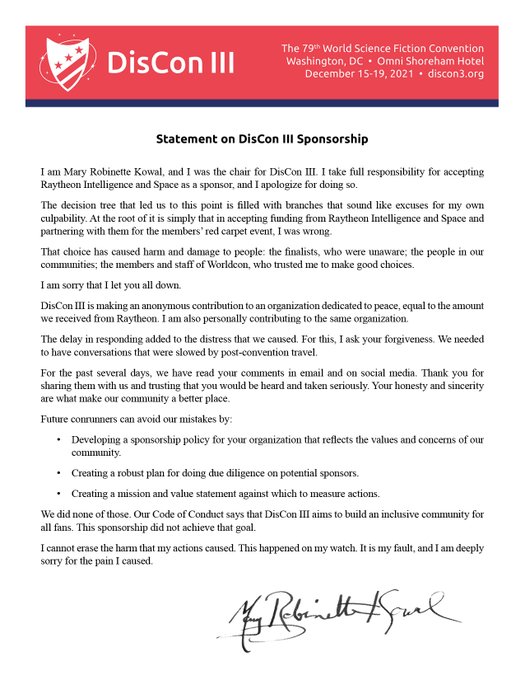
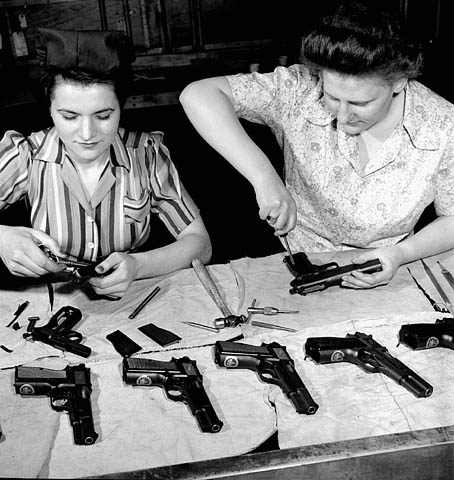
I don’t have any great respect for the Hugo Awards. What little respect I had for them was fully torpedoed after the incident where a Washington DC Worldcon, at which a lot of people got COVID, was sponsored by Raytheon. For anybody in my readership who isn’t familiar, the Hugo Awards are a fan-administered award for science fiction and fantasy genre material voted for by the voting membership of Worldcon – an annually cycling science fiction convention that is put together by the unincorporated literary society the World Science Fiction Society (WSFS). Anybody who can put together $50 and has sufficient interest can buy a voting membership, which allows them both the option to vote on site bids for future Worldcons and also to nominate and vote for Hugo Award winners.

While, historically, the Hugo Awards have been awarded to some excellent works of SF such as Neuromancer, Dune and The Dispossessed, the truth is that they generally go to whichever works of science fiction (and while fantasy is awarded these awards do skew toward science fiction) happens to be popular at that time which leads to embarrassing incidents such as the year that a Harry Potter book or Robert Sawyer’s forgettable Hominids novel won the award.

Due to the lack of any sort of jury and the low barrier to entry it’s not uncommon for people to attempt to game the Hugo system. An early example of this was in 1987 when the founder of the Scientology new-religious movement, L. Ron Hubbard, was placed posthumously onto the best novel shortlist via the concerted efforts of his religious adherents. Another would be the extended Sad Puppy fiasco. Part of the reason the Hugos should not be taken seriously is because they have no consistent aesthetic or political aim and generally just award whatever the most people feel passionate enough about to waste $50 over.

However, for the people who regularly vote in the Hugos, both those for whom Worldcon is a regular vacation destination and those who just pay their annual $50 dues, the Hugo Awards are assigned a grandiose purpose, referred to as being part of the triple-crown of Science Fiction awards along with the Nebula awards, voted upon by the members of the American professional association Science Fiction Writers of America, and the Philip K. Dick award, a juried award managed by the Philip K. Dick Trust and the Philadelphia Science Fiction Society. An astute reader might notice that these awards skew toward the specific taste of American Science Fiction readers. 60 of the 84 Worldcons were also hosted in the United States, with an additional five of the remainder next-door to the US in Canada. Worldcon has been hosted in Asia twice, once in Yokohama in 2007 and most recently in Chengdu in 2023. This has proven deeply controversial to the principal American audience. Worldcon has never been held in Africa, the Caribbean or in Latin America.

A seed of the grandiosity that affects the Hugo voters can be seen in a picture of the world that is mostly the United States with occasional visits to its closest (white) neighbor, to Europe and Australia and a vague nod toward the existence of Asia as a place where people live. While one person recently pointed out that, should a site selection be approved, Worldcon could be hosted on Alpha Centauri, this disregards that the majority of the usual voters of Worldcon come from the United States, the majority of the very small number of people who care about Worldcon (with winning bids requiring a few thousand votes at most) are in the United States. Worldcon is, effectively, an American event held mostly by and always for Americans.

Until 2023.

Science fiction is very popular in China. Chinese people read a lot of science fiction. There is a very large domestic market for domestically produced science fiction. A lot of Chinese TV plays with science fiction tropes and the Chinese movie market includes a lot of science fiction films. It’s a big deal. So it wasn’t unsurprising that, eventually, some people in China decided to bid on Worldcon. In this case the bid came from Chengdu, the provincial capital of Sichuan in Western China, a well-known tourist destination, well-known for its progressivism, welcoming of LGBT people and with excellent cuisine, Chengdu made perfect sense as a Chinese Worldcon site. Now, please keep in mind, that when we talk about tourism in China the Chinese market is a principal market. China will take in tourists from other countries but tourism, in China, is, perhaps even to a greater extent than in the United States, built around getting people from one part of the country to visit another part of the country.

So, in a way, it’s easy enough to understand why many Americans felt like Worldcon was being “stolen” – after all, this American event, generally set up to serve American tourists, was being transported to a city where English was not even the second-most frequently spoken language, in a country they see as a rival power, and which had a tourist market that was unconcerned with catering to American interests or tastes as foreign tourism is a secondary draw to domestic tourism.

There were efforts to prevent this from happening with the rival Winnipeg organizing committee trying to get online ballots from China thrown out due to absent address lines which they claimed were evidence of ballot box stuffing. This belies the first of several misunderstandings of China as many people live in narrow alleys that may not have a street address as precise as North Americans are accustomed to. The honest truth is that the address-line question is neither evidence for, nor against, ballot stuffing. But as Worldcon has been set up so that anybody with $50 to spend can buy a vote in these matters the people who were upset over this vagary had nobody to blame but themselves.

After Chengdu’s site selection was confirmed there were, of course, inevitable calls for boycotts. The Xinjiang conflict was cited. People made claims about lack of safety for LGBTQ+ attendees which disregard the reality that Chengdu is far friendlier to queer people than Miami. People claimed that their freedom of speech would be curtailed and that there’d be secret police combing the hotel to rendition dissident voices. It was, frankly, unhinged.

But, despite all the Sturm und Drang, the Chengdu Worldcon proceeded apace. Frankly there was no real mechanism to strip Chengdu of the winning bid due to the amateur design of the Worldcon constitution and the ephemeral character of the WSFS as a body. Calls for a boycott could be easily ignored if one considers that the foreign tourism market was a secondary concern. Chengdu would be happy to host a Worldcon to a principally Chinese audience.

Of course considering how well American SFF did on the final ballot I think a lot of Americans didn’t boycott anyway and dutifully doled out their $50. Best novel went to the American author T. Kingfisher, Best Novella to Seanan McGuire, a perennial Hugo favorite, best short story went to Rabbit Test by Samantha Mills, a didactic piece of Americana, very particular to the current American political moment, and precisely the sort of short story well liked by Hugo voters and few others. Best Semiprozine went to Uncanny. Again. And the Astounding Award went to Travis Baldree in his first year of eligibility, hot on the heels of his successful pivot of Legends & Lattes from self-pub to Tor. I find it safe to conclude that the majority of people voting for the Hugo Awards were Americans and, despite the ambiguity to follow, their will was reasonably reflected. These are precisely the people one would expect to see winning Hugo Awards in Winnipeg or Washington DC.

However the voting statistics for the Hugo Awards were delayed until the last minute they should be published per the Worldcon constitution and when they came out there were notable irregularities. Some of these appeared to be misunderstandings of handling the Hugo’s rather byzantine transferrable ballot process. But more alarming were a few exclusions of mid-ballot finalists. Xiran Jay Zhao was disqualified for the Astounding Award; Paul Weimer was disqualified from the fanwriter category; an episode of the Netflix TV show Sandman was disqualified from dramatic presentation, short form, and most glaringly, Babel by R. F. Kuang was disqualified from the best novel category.

For most of these reasonable explanations could conceivably exist, however the person from the concom to communicate out on these, Dave McCarty, has been loath to explain the reasoning for disqualifying them, instead, quite vaguely, and with some hostility, saying he followed the rules in these decisions. We could easily speculate that Zhao’s exclusion was due to misinterpretations of Astounding Award second-year eligibility criteria. As of writing they have two books published, a third on the way and one translated into Spanish. They should have been eligible for a second year as a “new author” but it’s reasonable to suggest that their exclusion was due to mistake rather than malice. The Sandman show had been disqualified from Dramatic Presentation, Long Form, on the basis that it was appropriately in the Short Form category and then disqualified from short form for unknown reasons. I’ve seen half of Sandman, including the disqualified episode, (I lost interest shortly thereafter as it is a very dull TV series) and there’s nothing in there that I expect would bother Chinese TV censors at all. With this in mind I think it’s likely this was a plain and simple fuck-up and that McCarty is loath to say to Neil Gaiman that he screwed the pooch on the eligibility criteria for the episode. It’s unlikely we’ll ever find out why.

In the case of Paul Weimer a few possibilities exist. He is a participant on the podcast Skiffy and Fanty which was nominated separately from him and qualified but didn’t make the cut for the final ballot. So they may have thought that excluded him from the Fanwriter category. It’s possible that the concom simply didn’t see the relevance. Most of his SF blogging is on Patreon and, if the concom didn’t look there they might have just seen his photography website.

Alternatively the concom might have seen Weimer’s writing about the Chengdu worldcon, where he once said, “it may already be ‘too late’ if there are, and its dollars to donuts that there are, fans of SF within the CCP. The CCP may not be content with just the already horrible prospect of monitoring the 2023 Worldcon closely. What if they decide to, say, sponsor the Hugo Awards a la Raytheon and Google? Or some other aspect of the con? Chengdu is not going to be able to say no. It is literally an offer they can’t refuse. I feel bad for my fellow fans in Chengu. I do not envy their position in trying to put on a Worldcon in such a country, such an environment, with such a looming shadow.”

Frankly, if somebody said that about an event I was hosting in my home town you can damn well bet he wouldn’t be getting any special honours at that event. This patronizing and, in my opinion, unhinged fantasy is, sadly the shallow end of the yellow-peril handwringing that went on surrounding Chengdu.

The strangest, most inexplicable, and most suspicious exclusion was that of Babel by R. F. Kuang. Kuang’s previous work touched on contemporary Chinese history quite a lot, using a fantasy setting to relate the events of the Second Sino-Japanese War but, far from being a censored topic, this historical event is a favourite of mainland fiction writers and TV producers. Kuang’s books centered the fantasy stand-in of mainland Chinese protagonists as heroes and allies of other colonized people. Babel continues with her theme of exploration of empire and colonization with a specific look at the role of the British academia in colonization. Far from being topics that would be excluded from a Chinese discourse on science fiction, Kuang’s books are almost precisely the sort of fiction I would expect mainland China to celebrate. The exclusion of Kuang from consideration did not get a Chinese author onto the ballot for best novel, which ultimately contained four Americans, one New Zealander and a Canadian.

Kuang’s book was placed third in the nominations, behind Legends & Lattes and eventual winner Nettle & Bone but not so distantly (810 nominations compared to 831 and 815 respectively for the other two) that we could discount it might have won the Hugo, unlike most of the others on this list. There’s no explicable why either the Chinese state or even the concom as an organization would want to put their fingers so obviously on the scale here. Furthermore the end result, possibly clearing the path for T. Kingfisher to win or slipping Silvia Moreno Garcia onto the ballot also simply don’t make sense as motives. Babel was obviously an eligible work – first year of publication, definitely a novel, definitely SFF. It makes no sense.

Some people have dreamed up conspiracist scenarios that Kuang was being blackballed by China because her grandfather served under Chiang Kai-Shek but this disregards the modern condition of the KMT.

There are now two Kuomintang parties. The first, the Revolutionary Committee of the Chinese Kuomintang holds 65 of the CPPCC seats and is the largest of the “minor parties” in Chinese national politics. The second is presently the opposition party of Taiwan and is marked by its position that Taiwan should reunify with Mainland China in a manner that retains its unique cultural and democratic character. Both of these parties are political allies of the CCP. Kuang’s family history here is simply not something that would matter in the slightest to the Chinese government.

But this whole issue also belies how badly westerners understand the political structure of nominatively socialist countries. Now first off we could have a whole digression regarding conceptions of mass democracy via Cuban localist political action or through the Maoist conception of the mass line. However that would be something of a rhetorical cul-de-sac as neither Cuban localism nor mass line politics are really practiced by the Chinese government today. However there is a general principle to Socialist organizing that is very much in play in China which is that power tends to devolve to be closer to the people.

In practical terms this means that municipal governments often have quite a lot more influence than their counterparts in North America. Provincial governments then direct municipalities regarding national planning with the national government being largely hands-off unless something goes terribly wrong. The real hard truth is that, contrary to the view of a totalizing and ever-present party with its fingers in the lives of every citizen, the CCP and the government of China, was, probably not even aware of Worldcon. The government of Sichuan may have rubber-stamped approvals for Chengdu but it’s hardly likely they had any interest in the itinerary of the event. Sichuan is a province with a population of 83 million people. A book convention in Chongqing attended by a few thousand people barely rises to the level of administrative notice. Proportionally it’d be like asking Justin Trudeau for his opinion on Toronto FanExpo except that Sichuan has a population nearly twice that of Canada. And Chinese cities have far more autonomy than Toronto does.

At the municipal level we know that Wang Fengchao was quite aware of the event. He arranged busses to assist the tourists there in doing additional sight-seeing. He showed up for a grip-and-grin. So I suppose one could ask the question of why the mayor of Chengdu might have decided to exclude one innocuous fantasy author whose past works portrayed China in a favorable light and whose current work was critical of England, a country with which China has a particularly fraught history from an award ceremony hosted at a Chengdu hotel. But I suspect it’s unlikely he had anything to do with it. My personal opinion, based on my knowledge of Kuang’s public persona, of the nature of Worldcon and the nature of Chinese politics is that whatever led to Kuang’s exclusion on the ballot was a decision made entirely by one or more members of the concom.

Now Dave McCarthy quite flatly said, regarding the exclusion of the excluded works in general (not of Kuang’s work in specific), “Nobody has ordered me to do anything. Nobody is changing decisions I have made… There was no communication between the Hugo administration and the Chinese government in any manner… I’ve done this job four times now and assisted a few more times. The rules I followed this time are the same as the rules I followed the others….and the same as every Hugo administrator ever has followed.”

Regarding the Sandman episode McCarthy was even more specific that he was a decision-making authority saying “it was a judgment call on my part whether to list both the same way or note that per the WSFS constitution, only one could be considered. I thought it more appropriate to do it the way it appears.”

Plenty of people are speculating that McCarthy was bribed, blackmailed, that he’s protecting somebody else on the Worldcon team who may be vulnerable or all kinds of other reasons for his standoffish, oblique and stubborn responses. I don’t see that. My personal opinion is that he looks like a petty asshole protecting his fiefdom. He tells us he’s done it a lot. He tells us that he is an expert. He tells us explicitly he made decisions regarding Sandman. The Hugo Awards weren’t built for consistency or accountability. Who knows? Maybe McCarthy is as ignorant of Chinese politics as he is of social graces. Maybe McCarthy believed that Kuang’s work would upset Chinese censors and he decided on his own to remove it. It’s more likely than a shadowy government conspiracy predicated on no discernable political or aesthetic aim. Let us recall Occam’s Razor: Entities are not to be multiplied without necessity.

We have an entity who says, “I did this along with the concom because I thought it was the correct choice.” We don’t need to drag Wang Fengchao, Huang Qiang (the governor of Sichuan) or Xi Jinping into this mess. We don’t need to imagine CCP agents lurking in shadowy corners since the issue of Kuang’s exclusion from the ballot is fully explicable by a guy named Dave, who believes himself an expert in Hugo awards, deciding she was ineligible with the full knowledge that literally nobody can do anything about it. It might be nice to know why but it’s not necessary to know a motive to put forward this as the most likely root cause of this problem.

Now, with all this said, and looking beyond the yellow-peril racism of American fans bitter at becoming the marginal audience to their own party for one year, there is the kernel of an interesting thing happening here. And because the stakes are so remarkably low it’s almost a useful case study for assessing how people think about these things. Because the Hugo Awards have become a discursive territory for discussing the nature of democracy.

Cheryl Morgan addresses these points pretty clearly in her blog post titled “How did we get here?“, in which she says, “Democracy only works if we are constantly vigilant and prevent it being subverted.

But then there are people who say that it can never work because the wrong people will always get elected. That’s much more of a Libertarian viewpoint: all government is bad, because anyone who gets to be in government is bad.”

Now, again, I want to stress that we’re talking about an award for science fiction books with an electorate counted in a handful of thousands of people at the most. In some categories, such as fanwriter, a person can reach the final ballot with fewer than one hundred nominations. This is hardly mass-democracy.

And I might note that it’s somewhat pernicious to call anything democracy when it requires you to spend $50 to vote. Poll taxes are rather un-democratic on their face. However I think there’s also a mistake in associating democracy so directly with governmentality. Because, of course, there is another viewpoint that is critical of government beyond the right-libertarian one. And that’s the Anarchist perspective that says the problem is not that people make decisions together but that they should need to be governed to do so. In this manner Anarchists and Marxists share some common ground, power should rest closest to the masses. People should have as close as possible to direct control of their own lives. The truth is that this is a key political perspective of both Anarchists and of Marxist states. The question then becomes in defining what “as close as possible” means. Anarchists would argue that people should have a direct grasp of the power that affects their lives while the Marxist state believes it’s necessary there be some form of authority and the question becomes how to use that authority to give voice to the authentic will of the masses. The disconnect between liberal representative democracy and the Marxist state is that the Marxist states operate from the perspective that liberal democracies serve only very specific classes of people (the bourgeoisie) and fail to ever become truly democratic in the first place. But, of course, the anarchist response is that this is true also of the Marxist states even if the people they purport to serve may not be precisely the same class as the liberal democracies.

Now here is where I make my pitch for what is called destituent communism. This form of socialist organizing, conceived by Marcello Tari, drawing from Marxism and Anarchism in near equal measures, argues that the problem with power isn’t its movement or concentration into any given set of hands but rather its tendency to form into institutions. Power as potential is concentrated in order to achieve an aim, this is all well and good. The problem is that, after that aim has been achieved, the concentrated power perpetuates itself and holds onto power. As such the most critical mass power in order to empower revolutionary change is the power to take down extant structures regardless of their replacements.

For Tari, the perfect exemplar of destituent power was Subcommante Marcos of the Zapatistas. This anonymous spokesperson of the movement and, in fact the movement for which he spoke, have constantly shifted and changed so that the people they represent can be served, not governed. When Marcos was not needed Marcos, as an authority, was voided and the commander disappeared into anonymity. The Zapatistas are well represented by the statement, “Here the people command and the government obeys.”

So what would this look for in the context of the Hugos?

Well first, despite the silly Libertarian history underlying the resistance of the WSFS to incorporation it’s probably for the best they never did. Because the best thing to do would probably be just to get rid of the Hugos.

The Hugo awards, as an institution of authority regarding the zeitgeist of science fiction, have long outlived their usefulness. Worldcon, as a body, has only ever represented an American distortion of the world, one where most of the world is America, Asia is a distant other and the global south is best ignored altogether. The little personal fiefdoms of guys named Dave and the various hangers on of the Worldcon scene have no power or significance in the world.

In fact this is the principal source of my skepticism that the CCP had their thumb on the Hugo scales. The Hugo awards simply don’t matter. They’re irrelevant. There is nearly no power invested in the Hugo awards but it’s clear that power has only been wielded to perpetuate itself for a very long time now so best to do away with it. Allow other people with other methods to hold the third gem of the “triple crown.” I’ve heard good things about the Ignyte Awards. Is it good what happened in Chengdu? No. It sucks. But it sucks for the same petty, grandiose, self-important, self-satisfied reasons that the Hugo awards have sucked for a very long time now.

A lot of people have been saying that now the Hugo awards have lost their credibility. But the Hugo awards lost credibility when their red carpet was sponsored by a bomb maker. They lost credibility when a bitter conservative author brigaded the nominations using a slate because he thought it was his turn for the participation trophy. They lost credibility when they said Harry Potter and the Goblet of Fire was the best SFF novel of 2001 rather than A Storm of Swords or Midnight Robber. They lost credibility when they included the second volume of L Ron Hubbard’s manifesto in the form of a 10-volume posthumous SF series on the short-list. As of the time of writing the Hugo Award for best novel has been awarded to only two non-white authors: N. K. Jemisin and Liu Cixin (as translated by Ken Liu) in a brief run from 2015-2018 – this is not the actions of a credible award. The Hugo awards have never been credible.

Let’s just end them here.

Regarding adults and children’s media

I didn’t want to talk any more about this.

My principal reason for writing In Praise of Discomfort was because The Mary Sue deceptively used links to my words in the service of a bizarre and gender-essentialist read of the horror genre. This is something that I, as a horror critic and reader, wasn’t about to sit back and allow.

And now…

It’s happening again.

Specifically a book reviewer and writer of no particular talent but rather great popularity on the fan circuit, Cora Buhlert, has scrawled her latest volley in an ongoing dispute between two loosely defined cliques of genre writers, readers and critics.

In the process she brings me and my friend Raquel S. Benedict up at length in order to attempt to pillory us for the crime of disagreeing that the people pushing the marketing category of “cozy horror” will be good for horror in general. And even Buhlert cannot deny that “cozy horror” is effectively just marketing buzzwords, saying, “In fact, I should maybe try to rebrand the Hallowind Cove series (which started out as an attempt to write horror and became a sort of horror parody set in a quirky small town) as cozy horror, since nothing else has worked to help those stories find their market. “

With apologies to Buhlert I’ve read a small amount of one of her Hallowind Cove books and being mis-marketed is not, in fact, why she fails to sell:

He’d once asked Ian, Landlord of The Croaking Foghorn and the closest thing Paul had to a friend here in Hallowind Cove, about the raven.

“Oh that’s just Hugo,” Ian had said, “Never mind him. He likes to pretend he’s a harbinger of doom, but he’s really quite harmless.”

“Wa-atch out,” Hugo croaked again, “Wa-atch out”

Cora Buhlert – The Revenant of Wrecker’s Cove – Hallowind Cove Book 1

With sub-Gaimanesque prose stylings like this and a cover containing clipart so obvious that you can still see the edge of the .jpg overlay in one place, her work lacks both the quality and the commitment to professional standards necessary to be worthy of much attention. I doubt marketing this piffle as “cozy horror” is likely to improve her sales much.

However it’s not Buhlert at her most honest here that warrants a response. I’d have been happy to keep quiet on my opinions of her stories much like I am on the work of countless other amateur story-writers had she not also said the following:

“As for why Benedict, McNeil and Sullivan object to the existence of cozy horror, there are several arguments, most of them familiar from previous debates. McNeil’s main point is that he believes that horror should make people uncomfortable and that cozy horror is therefore an oxymoron. He also dismisses several of the examples given in The Mary Sue article, particularly the 2014 animated series Over the Garden Wall, as “children’s media”. Now Over the Garden Wall may well be aimed at children – I haven’t seen it. Besides, as I’ve pointed out above, horror is a genre that appeals to the young. However, there is a certain sneering undertone in the way McNeil dismisses “children’s media” that you often find with a certain type critic, who tend to conflate “I don’t like this” or “I’m not the target audience for this” with “This is YA”, whereby YA is inevitably viewed as a bad thing.”

And again we’re seeing the same, sad, attempt to smear critics playing out in Buhlert’s blog that we did in the original Mary Sue article. And Buhlert fundamentally misunderstands my concern about adult consumption of children’s media.

See I actually think children’s media is quite important. Even moreso I expect it to be good. This was actually a focus on a significant sub-series of my blog, “kids stuff” and I would dearly appreciate if the next person to accuse me of “sneering” at children’s media would start by reading these articles and noting some of the things I have to say about children’s media.

For instance, I concluded my review of The Mitchells vs the Machines, by saying, “It’s to be expected that a movie financed by Sony and Netflix and created by a team that brought you a hyper-stylized comic book and a 101 minute toy commercial would fail to create something critical of capitalism, that they’d be unable to recognize that the subject of critique in PAL’s nihilism and Mark’s disregard for relationship was somehow connected to a psychology that triangulates social relations against a patriarch or that both were tied inextricably to capital. It’s a challenge because I do want to see media going the direction The Mitchells vs the Machines goes. It’s just that it doesn’t go anywhere near as far as art must.” This echoes my conclusion regarding the Netflix limited series Wednesday, ” Jenna Ortega is a talented new actress and I’m glad to see her getting a larger role after playing a second-fiddle in recent outings like Scream (2022) and X. But it really drives home that you can’t expect a coherent critique of normativity from Tim Burton. And we can all, perhaps, admit at last that it was good he passed on the 1991 film and cleared the path for Barry Sonnenfeld to direct in his stead. Because, building largely on the aesthetic legacy of Sonnenfeld’s movie and on the hastily redacted fan-series of Melissa Hunter, Burton managed to make… a mess.”

Talking about the classic children’s novel, A Wizard of Earthsea, I said “Ged is the wellspring of power that rises out of the primordial origin of all things. He is the doer, the agent of action in the story. The gebbeth is the un-doer, the reactive, the end of things. Ged, to come into an understanding of himself, must see his end as clearly as his beginning. He must be as aware of the ways in which he un-does as the ways he does. Unexamined, Ged’s shadow-self seeks revenge against Jasper and it is let loose, it rampages. It kills. It hounds Ged from crisis to crisis. But when faced, when Ged points to his own darkness and calls it with his name, it comes; it becomes; it comes into being. But by coming into being it is done away with because it becomes nothing but the awareness Ged has of his own potential toward death. There is no other here. There isn’t a wanderer and his shadow – there is a river, all of it, from its spring to its sinking in the sea.”

In short what I expect of children’s media is, for the most part, what I expect of adult media: that it can stand up to critical scrutiny, that it is well-crafted and that it communicate a clear and consistent theme. But it’s also true that I’m rather critical of adults fans of children’s programming.

This is because there’s one other element of children’s media that absolutely must be true: children’s media must be legible to children.

Now I know from experience that creating legibility for a child requires a process of a certain simplification. I joked about that in the Earthsea essay, qualifying its inclusion in children’s literature by saying, “However, despite these hallmarks of children’s fictions, this is a book with a density of theme and topic that could prove challenging for an undergraduate university student to fully disentangle. While I have positive things to say about some of the very inventive structural and pedagogical things done in modern children’s lit, for instance, Elizabetta Dami‘s use of modified type to emphasize key words is a very interesting artistic choice, and one with an obvious pedagogical benefit, I don’t think there’s a single voice in children’s literature in the 21st century who would tackle the very abstract topics like the ones that are at the center of Le Guin’s book.”

And this absence of abstraction is a key problem. Adults should be accustomed to paying attention to abstract and dense topics. That’s part of being an adult. As Paul’s first epistle to the Corinthians says, “When I was a child, I spoke as a child, I understood as a child, I thought as a child: but when I became a man, I put away childish things.” As a person grows and develops out of childhood they need to be able to observe phenomena through a lens that simply isn’t available to children because it is dependent on the experience of growing into adulthood. For one’s taste to remained mired in children’s media isn’t a problem because children’s media is bad but rather because children’s media is good for children. I would expect adults to find it limiting in precisely the same way they would find the shoes they wore when they were six limiting: because they have outgrown it.

So, no, YA is not, “inevitably a bad thing.” It’s a perfectly good thing for twelve to fourteen year-olds. But if you are a fourty year-old and you’re still shopping for books principally in the YA aisle you have some growing up to get on with.

I am happy to see that Buhlert reacts with discomfort to the use of gentrification in this discussion as a metaphor. “Though personally I find the metaphor hugely problematic, because gentrification does untold harm in the real world by displacing and destroying whole neighbourhoods,” she says. And, yes, it’s very true that gentrification really is that bad. But perhaps she should note that I’m the same person who simultaneously said leftists should be uncomfortable with folk horror because of the way the subgenre deploys reactionary volkishness on one hand and then recommended leftists should watch folk horror so as to interrogate their discomfort on the other. I recommended In the Earth as a good one. Basically I don’t write to make people comfortable and if Buhlert is made uncomfortable by the idea that the genre fiction scene shares characteristics with real-world gentrification then she has a wonderful opportunity to interrogate that discomfort.

Moreau Vazh has laid out with clarity and precision exactly what I mean when I talk about gentrification within this metaphorical context, saying of the SFF publishing mainstream, “When the sub-reddit has been quiet for months and the last specialist bookfluencer has stopped coming up with themed dances to celebrate book releases, they bust out the joint and light a match. The old shit is dead and oppressive… It is tiring having to talk about it… It sucks all the air out of the room when we should be talking about the new shit.”

Effectively, when Buhlert says she thinks it’s “problematic” to use the gentrification metaphor to describe what SFF does as it, to paraphrase Vazh, hops from sinking ship to sinking ship, what she’s really saying is that she doesn’t like what I’m implying about her and her friends – that they are gentrifiers.

But this is the old liberal / leftist mismatch on language at play. Liberals, poisoned by the individual and atomized subject-concept of their decrepit ideology, see any reference to a systemic problem, such as gentrification, and assume it must be made up of a category of individuals who are essentially gentrifiers. Whereas a leftist such as myself denies that a subject is individual at all to begin with.

I don’t think Buhlert is a gentrifier. The truth is that, when she hasn’t deigned to impose herself upon me, I don’t think about Buhlert at all. But I don’t assign any personal blame to Buhlert. It’s not morally wrong to be an untalented short story writer. But it is, at the very best, gauche and a little pathetic to make veiled accusations regarding the politics of one’s critics because they happen not to be on board with the marketing category you’ve decided will be a silver bullet for the fortunes of your amateur story-writing efforts.

I sincerely hope this will be the last thing I ever have to say about “cozy” Horror.

In Praise of Discomfort

Earlier today my attention was drawn to an article put up by Julia Glassman for The Mary Sue telling everybody to shut up about “cozy horror”. In it they quoted a tweet I put at the end of a thread regarding the sub-genre four days ago. I suppose this particular fandom publication deciding to jump in on a discourse three days late and a dollar short shouldn’t be much surprise but I’m rather put out that they chose to quote a minor point I made at the end of that thread rather than engaging with my core argument so that they could complain, “people are compelled to take something fun and wholesome and turn it into a heated debate.” Even that would be insufficient to warrant a reply if the author hadn’t later said, in the same article, “It’s also undeniable that this problem is gendered. Endurance is associated with masculinity, and coziness is associated with femininity. Maybe that supposed femininity is what makes cozy horror feel so threatening to people who consider themselves hardcore horror fans.”

Now frankly this is not only nonsense but it’s offensive nonsense. Neither myself, nor the other people I know who were linked by this article as critics of cozy horror put forward such a gender-essentialist read of the phenomenon. In fact, when later asked for an example of cozy horror the one I gave was a short story written by a man.

It’s not entirely uncommon for The Mary Sue to pull this maneuver: They will start by adopting a position in favour of big-tent, commercially viable, smoothed down forms of media and then they will code this media as feminine so as to claim that anyone who dislikes said media must, thus, be a sexist. This works poorly, though, when your target has an open and expressed tendency to work specifically with queer fiction. So let’s avoid these bad-faith swipes going forward and instead examine what I actually said about horror.

In my thread, what I said was, “Regarding Cozy Horror and my resistance to it, I generally start my inquiries into a medium with the question of what it does. In the case if Cozy Horror it seeks to remove discomfort from Horror. I mean that’s on the box. I find discomfort a necessary sensation to maintain the horrific. As such attempts to render Horror comfortable collapse Horror. There’s plenty of comfortable spooky media which is not Horror. Generally it’s situation comedy (like the Addams Family) or it’s fantasy / adventure with a Halloween vibe (Nightmare Before Christmas). These are fine. But they aren’t horrific. They are also mostly children’s media. As such I find “Cozy Horror” to generally be either an attempt to market children’s media to adults or it’s just not very good at furnishing the experience it promises. And I worry that it will try to gentrify Horror. People who seek comfort from art often react… negatively… to the presence of art intended to provoke discomfort. Nobody likes a severed head replacing their marshmallows in their hot cocoa.”

As you can see the commentary on the gentrification of horror, mostly a veiled swipe at a certain subset of SF/F authors who have been actively introducing “cozy” vibes into their early forays into the horrific, was nowhere near the main point of my argument. Instead I was focusing on the function of discomfort to the horrific.

Now discomfort need not be extreme. While I am fond of chasing the limit experience that the works of Barker and Bataille are about, not every moment of discomfort needs to be an ecstatic experience that brings a subject to the limit of experience. Discomfort can be as simple as the itch of wool against bare skin.

We can find these degrees of discomfort throughout horror – be that in the long and awkward stares of the secondary characters in Get Out, in the creeping dread and uncertainty of The Lighthouse and Pulse or in the frank body horror of Gretchen Felker Martin’s superb Manhunt (or the discomforting normalcy of her villains internal lives for that matter). Discomfort can live in eros such as in the far-too-appealing monsters of Nightbreed. We look at the monster and want that for ourselves thus feeling discomfort in our own desire. Certainly there is discomfort in extremity. Nobody can comfortably read the n-Body Problem which is nearly as extreme as horror fiction gets. But that is also a book that ends with the protagonist observing a rainbow. As the recent Hellraiser reboot remarked discomfort is something to modulate. We can see this in extreme music: Pushing into more and more extreme walls of haptic noise is less effective at causing discomfort than the rise and fall of chaos in the work of Litvrgy. And much as with extreme music, discomfort isn’t always about what happens to a character either. Sometimes the discomfort is literally a physical discomfort caused in the audience such as the strain caused by trying to make sense of the garbled organic noise of Merhige’s Begotten.

Discomfort is a multivariate sensation but Glassman makes an elementary error by assigning discomfort against a kind of “endurance contest” as if we want to reduce the experience of horror to a guest spot on Hot Ones. I am not certain how often I have to talk about the significance of surrender to art before this becomes clear but there’s no contestation here. The point isn’t to overcome the horrific but to be overcome by it. And this is what comfort fiction denies its audience.

Now I want to focus, for a moment, on a work I am currently reading. I was lucky enough to be given an ARC of The Water Outlaws by S. L. Huang. This is not a horror work at all but, then, neither is Over the Garden Wall and that didn’t stop Glassman for putting this children’s cartoon front and center in her attack on the critics of cozy horror. Now I want to preface this comment by noting that, at time of publication, I have not finished reading Huang’s book and a full review will be forthcoming but one thing I observed is that it is largely a very cinematic novel. Huang has an exceptional grasp of what characters see but generally gives short shrift to other sensations.

With one exception: pain.

When one of the perspective characters feels pain the text comes alive. We get not just another sense beyond what is seen but also an enhanced view into the internality of the protagonist in her moment of discomfort. The discomfort of the character, the physical and psychic discomfort of the character, brings the text to life in a way that a dozen pages of beautifully rendered description of scene fails to do. We don’t just read her discomfort; we feel it. There’s an expression that the excellent horror critic Ashley Darrow often uses: horror wants to do things to your body. And this is what makes discomfort so central to the experience. Comfort is an opiate; as such it numbs nerves that should be made hot.

Now when I briefly examined cozy horror before I pointed out that much of what is put forward as cozy horror is children’s media. I don’t have a problem with children’s media. In fact I did a whole series of articles specifically about critical evaluation of children’s media. But Glassman can hardly say that comfort fiction is not infantilizing on one hand while on the other throwing forward examples from children’s cartoons. Frankly as amusing as a show like Dead End: Paranormal Park may be, it isn’t horrific. There’s no discomfort present. Because it’s not aiming for discomfort but rather to provide children with a fun supernatural adventure.

“Cozy horror may sound safer than other horror genres, but it’s a mistake to think that it’s any less complex or sophisticated.” Glassman says, but this a non-sequitur. Nobody said cozy horror lacked complexity. We said it lacked horror.

And this brings me, at last, to gentrification. I said before that “people don’t like to find a severed head in their hot cocoa” and this is what worries me about cozy horror advocates. Because, as is often the case with defenders of comfort fiction, cozy horror fans seem to have very thin skins. And this sensitivity leads them to tell people who criticize their preferred media to shut up in articles on major fandom websites. “What’s odd about the whole debate is that the time people spend denouncing a genre is time they could spend reading or watching stuff they actually like?” Glassman asks and the answer is we were. Quite happily. Until you went and got irritated over the fact that anyone anywhere said anything negative about this subgenre. I wrote four tweets four days ago and as a result you put me and a bunch of other people who likewise spent a tiny bit of time on one afternoon talking about how cozy horror had some problems on blast – called us sexists and such. Criticism happens. How many times have French New Extremity films been called “torture porn?” How many uneducated think-pieces do we need to see about final girls written by people who don’t appear to have the first clue who Carol Clover is? Do you think a literature that is built upon equal measures of Mary Shelly’s radicalism and Bram Stoker’s conservativism has no critical evaluations of how it treats race, class or gender? Perhaps if The Mary Sue were to hire somebody who wasn’t a neophyte with horror to write their think pieces on the topic they’d realize that autocriticism is a common recreation of people who watch and read horror fiction. As one might expect from people enamored with the fiction of discomfort, many of us enjoy turning that discomfort inward and interrogating what it means to read and appreciate uncomfortable material. But apparently Glassman does not like that discomfort any more than she would like the discomfort of the bodily destruction present in In The Earth, one of the best recent folk-horror films.

Glassman is welcome to enjoy situation comedies like What We Do in the Shadows and children’s shows like Over the Garden Wall. But perhaps she should save the culture criticism for people like Carol Clover, Gretchen Felker Martin and Annie Rose Malamet – who know how to interrogate their discomfort without recoiling in favour of the softness of a cotton blanket.

Fantasy and history

Recently Amazon released the first few episodes of the new tv show about the second age – The Lord of the Rings: The Rings of Power.

This ensemble cast fantasy show is set in the second age of Tolkien’s world (the events of the Lord of the Rings happen some 3-5,000 odd years later at the end of the third age). It explores the creation of the rings of power by the elven craftsmen under Celebrimbor‘s leadership and the tutelage of Sauron in his guise as Annatar, “the Lord of Gifts.”

However this Lord of the Rings show has become a center of controversy, along with the Game of Thrones prequel House of the Dragon and the Disney live action remake of the Little Mermaid for casting choices that gave major roles to non-white actors.

The argument from certain (bigoted) corners of the internet is that the inclusion especially of black characters in this setting is damaging to the historical accuracy of these stories. But of course this is patently nonsense.

Now the easiest way to demonstrate this is nonsense is to point out that Rome had significant African holdings and that, as early as 19 BC Roman explorers had crossed the Sahara and made contact with Sub-Saharan cultures. Furthermore from the 8th until the 15th century much of what is now Spain was occupied by an African aristocracy after the invasion of Tariq ibn Ziyad. This is all information that would have been readily available to Tolkien as a philologist and literary scholar. But, of course, for that to be relevant you would have to contend that fantasy exists to reproduce history. And that’s just not the case.

While fantasy books may have a deep interest in history fantasy, by its very nature, is uninterested in producing an accurate simulation of history. This would be more properly historical study – or, if we’re being generous, historical fiction. Fantasy, as speculative literature, is unlikely to have much to say about a careful reproduction of history.

Where fantasy lives instead is in the area of meta-questions regarding history: what is the relationship between history and the present? How does history inform a person’s position in the world? Can history be escaped? What is the weight of history?

And these sorts of questions depend not on reproducing history but on disrupting it. The flooding of Beleriand and later of Numenor is thus informed, not just by Atlantis, but also by the flooding of Doggerland – which flooded across two periods: one in which an island was left and a second in which the island remnants were washed away, likely by a tsunami. The events in Doggerland are prehistorical ones discovered via archaeological labour and happy accident. The people of Doggerland were a mesolithic culture which we can say very little of. Certainly it would be difficult in the extreme to trace the occupants of that flooded land to any modern nation.

Throughout the Lord of the Rings the heroes are forever passing through the ancient ruins of abandoned kingdoms. Orthanc and Osgiliath, Amon Sûl and Khazad-dûm, Minas Morgul and Amon Hen are all remnants of three thousand years of history. The weapons of the Barrow Downs are likewise ancient, coming from kingdoms extinguished 1,500 years previous.

History, in Tolkien, is the ruin within which the present moment walks. How can we possibly speak of accuracy in its depiction when there has been so much clarity provided by the text that it believes history to be an incomplete and fragmentary account? This is reinforced metatextually via Tolkien’s appendices which provide fragments of historical record: selected charts of lineage, some linguistics, notes on things forgotten.

Frankly I do have some complaints with how Lord of the Rings: The Rings of Power handles history because the show seems intent on compressing 3,000 years of the second age into a period the length of a human lifespan. Events that should be separated by centuries and people who lived many lifetimes apart are walking shoulder to shoulder so that the show can maintain a consistent cast. I worry that this takes away some of the most interesting things Tolkien’s work has to say about history and that it, more than anything else the show has done, grounds his elves and transforms them from the semi-angelic beings they are into just guys with pointy ears and ninja powers.

However, if we are going to do away with the argument that Lord of the Rings, or fantasy more generally, is trying to accurately reproduce history then the obvious presence of people of African descent throughout the last 2,000 years of European history is also not available as an apologia. However textual accuracy becomes important. And frequently it’s an examination of textual references that displays the poor reading comprehension of many bigots. After all, fantasy and science fiction is filled with non-white characters whose depictions have either been white-washed without any furor (Ged in the execrable Earthsea mini-series) or whose accurate depictions led to outcry from racists who were too poor at reading comprehension to recognize what they were reading.

Now the truth is that I don’t believe any apologia is necessary to diversely cast fantasy stories. They’re fantasies. We can do what we like with them. But if we absolutely must cling to questions of reproductive accuracy the question should at least be, “were there people of colour in the text this show is based on?” And the answer to that is yes. Fortunately Tolkien straight up tells us that some hobbits, in particular, are not white. Let’s examine some quotes:

“In his lap lay Frodo’s head, drowned deep in sleep; upon his white forehead lay one of Sam’s brown hands, and the other lay softly upon his master’s breast.”

Here it’s important to remember that this couldn’t possibly be referring to Sam being tanned from working outside for so long. This scene happens just outside of Mordor after both Frodo and Sam had been travelling for six months.

Now I know a lot of the people complaining about race depictions in fantasy never leave their parents basements but take it from this weirdo farmer that it takes significantly less than six months for a tan to come in and yet Sam is described as brown and Frodo as white. They’ve been together six months, living outdoors for much of it, they’ve had the same opportunity to tan. If Sam’s skin colour, in this scene, is depicted as different from Frodo’s it’s because he had different coloured skin. This is not the only time that we see reference to Sam’s skin colour either. Sometime later, during the fight with Shelob, the story says, “As if to do honour to his hardihood, and to grace with splendour his faithful brown hobbit-hand that had done such deeds, the phial blazed forth suddenly, so that all the shadowy court was lit with a dazzling radiance like lightning; but it remained steady and did not pass.”

Sam is also described as having curly hair and brown eyes. Frankly casting Sean Astin in the role was whitewashing a character who was clearly written as not white. What’s more Tolkien says this is a characteristic of the largest of the hobbit clans, from whom Sam descends. “The Harfoots were browner of skin, smaller, and shorter, and they were beardless and bootless; their hands and feet were neat and nimble; and they preferred highlands and hillsides.”

The hobbit clan depicted in Lord of the Rings: The Rings of Power are the Harfoots and while efforts have been made for diverse casting throughout the show it is among the Harfoots we see the greatest concentration of non-white actors. So frankly, while no apologetics are necessary to justify diverse casting, we have multiple clear references to Harfoots, such as Sam Gamgee, being brown-skinned, brown-eyed and curly-haired. How much clearer does this have to be spelled out?

But let’s give authorial intent the final word because Tolkien addressed race and segregation, contextualized within his youth in colonial South Africa, very clearly. And here’s what he said: “I have the hatred of apartheid in my bones; and most of all I detest the segregation or separation of Language and Literature. I do not care which of them you think White.”

Taxonomies

Recent discussions in genre have had one central question at their heart: how coherent is a category? There is a camp of critics who feel that it is the duty of their compatriots to provide clarity with regard to categorizations. To do otherwise is to invite sloppy thinking and the risk of error. On her essay, “How To Define a New Subgenre/Trend: The Speculative Epic and an Addendum to the “Squeecore” Debate” Cora Buhlert, a veteran SFF blogger and critic, sets out very specific criteria for how to go about identifying an artistic phenomenon citing the example of Lincoln Michel as an exemplar.

Buhlert defines very carefully what she sees as the correct method to approach this topic, saying, “I have identified a trend and here are some examples of people who have noticed it, too, as well as some examples of works that fit into that trend. I propose this name for it (a name that’s not derogatory) and it has this characteristics. It’s also part of a larger trend towards genre-bending fiction.”

She also provides a guide to what is absent from Michel’s work and which she thinks other critics should avoid saying, “What this article notably does not include is snarky asides against authors and books that Lincoln Michel does not like, buzzwords like “neoliberal” and issues that are worth addressing but have nothing to do with the subgenre in question. Also, Michel offers solid criteria for defining speculative epics and not criteria that are so vague that they apply hundreds of things up to and including Shakespeare.”

Buhlert tips her hand saying that she is very interested in, “literary trends, subgenre formation and genre taxonomy.” Now quite a lot could be said about Buhlert’s declaration of “neoliberalism” to be a buzzword as “buzzword” tends to imply a fuzziness in definition that allows a word or phrase to be used in a broad and inexact manner. The general sense I get from Buhlert is that she isn’t particularly fond of the broad and the inexact. But beyond that it’s worth noting that the word that gets Buhlert’s goat, in particular, is reference to a pervasive political ideology. It’s certainly the case that many people use “neoliberalism” inexactly. But considering that the impact of neoliberalism, with a very careful delineation of what is meant by such, is a principal concern of this blog I’d suggest that what concerns Buhlert is the idea of the political invading the dispassionate work of the taxonomer. Taxonomy is ultimately an attempt to objectively categorize a thing and define its relationship with all other things. If you care about a fixed taxonomy then the politicization of it certainly is a problem. Categorizing works in the past based on their political use in the present screws taxonomy all up.

I don’t mean to pick on Buhlert especially. I cite her as an example because she is an experienced critic with a long-standing and prolific output on genre literature however her position is indicative of a broad general sentiment within genre fiction readership that a taxonomy of fiction is something of value. And it’s critical to note, for this discussion, two things: first that science fiction includes among its readership many people with a particularly close relationship to taxonomies of fiction relative other readerships and second that this is not at all a phenomenon that arose in response to the Squeecore debate which serves as the inciting motivation behind Buhlert’s call for renewed taxonomic precision.

The Classics of Science Fiction blog attempted a taxonomy of genre fiction even going so far as to cite Linnaeus in 2019. The author of this blog, James Wallace Harris, is another long-established science fiction critic who shares some of Buhlert’s concerns regarding the politicizing of genre categorization. “To be told what my favorites should be is incredibly insulting. To me, that’s far more offensive than the Sad Puppies pushing their political agenda at the Hugos.” Harris, in particular, has a very long-standing relationship to the construction of taxa for fiction.

Jacob Ross and Jeoffrey Thane at Latter-Day Saint Philosopher also spend some effort on a taxonomy of science fiction but provide effectively no argument as to why they would do so (unlike the superior work of Buhlert and Harris) so I will only note it as being yet another example and move on from here.

I will provide a final example somewhat more useful than the LDS Phlosopher article from Clare McBride. Notwithstanding some unusual choices in categorization what makes her article about literary taxonomy interesting is in her recognition of the inadequacies of taxonomy, saying, “once we get to speculative fiction, everything gets a lot soupier.” She admits that these taxonomic exercises are somewhat subjective, saying, “But there are some foggy bits between them, of course–quite technically, I should classify Harry Potter and The Mists of Avalon as supernatural fiction, but I don’t. In Harry Potter’s case, it’s the fullness of the magical world, which probably could function quite separately from the Muggle world, and, in The Mists of Avalon, it’s simply because medieval Europe is the generic fantasy setting to the extent I can’t see past it. If it was set in medieval China, would I still file it under fantasy? Perhaps–I don’t know.”

It is interesting to note that McBride prefaces her 2010 essay by discussing the then-current discourse between Ursula Le Guin and Margaret Atwood over what constituted science fiction. Atwood was, at the time, quite reticent to treat her many science fictional works as being within the genre as they didn’t include ray guns and rocket ships. Le Guin rather disagreed with her taxonomic criteria.

What I find most interesting is that McBride was the only one of these critics who seemed interested in what a taxonomy might be for at all. Buhlert and Harris provide taxonomies because they enjoy it. Both of these critics seems invested in the idea that precise categorization is a result of precise thought and that precise thought is good.

This should be unsurprising as both Buhlert and Harris are first and foremost science fiction critics and what is science but a treatment of precise thought as a good? It should not surprise that critics of the fiction of science should aspire to a scientific objectivity and clarity in their critique.

But this raises the question of what art criticism is, philosophy, science or art?

In What is Philosophy? Deleuze and Guattari attempt to define the boundaries between philosophy, science and art, saying of science that, “The object of science is not concepts but rather functions that are presented as propositions in discursive systems. The elements of functions are called functives. A scientific notion is defined not by concepts but by functions or propositions,” while philosophy is taken with the creation of concepts – something which they previously define at length. Art meanwhile operates to preserve, “a bloc of sensations, that is to say, a compound of percepts and affects.” Now of course in proper Deleuzo-Guattarian fashion we can immediately disrupt these neat categorizations by pointing out how art criticism acts as both an art – preserving percepts and affects in the form of the responsive essay and as philosophy – creating concepts with regard to art, developing novel ways to think about art, and that these novel concepts might even include the possibility of a scientific or pseudo-scientific taxonomy of the arts. The lesson that Deleuze and Guattari teach us best is that the best, and most amusing, thing to do with a category is to destabilize it, to pick at the corners and kick at the edges until the whole damn thing falls apart. Their own categories are, of course, not immune to this loving destruction.

So what use then is a scientific notion of art? We can’t just immediately discard it by suggesting that art is intrinsically different from science when a critic might be very interested in presenting functions of literature in a discursive system. But a discursive system implies a test. So if a taxonomy is testing something then what is being tested and why?

Buhlert is very explicit that what is being tested is simply this, “is artwork A part of group X?” Buhlert is very clear that group X needs to be defined such that an intelligible distinction between within group X and without group X can be made – if a category is so broad that anything can be within group X then it’s useless for saying anything about the text.

What all of the critics cited above except for McBride elide is what can actually be said about a work of art by distinguishing it as part of a category. For McBride the question becomes one of establishing parameters for art discourse. We need to know what is within speculative fiction because we cannot otherwise have a productive discussion of the qualities of speculative fiction. However this becomes something of a circular argument: we cannot discuss the qualities of speculative fiction without defining the qualities of speculative fiction but why do we want to discuss the the qualities of speculative fiction? Because they are necessary to identify what is within speculative fiction.

However the particularity of works of art operates against this. Ultimately each artwork is a unique thing. This is why mechanical reproduction is corrosive to artistic quality – each work of art preserves within itself a unique set of percepts and affects. Take, for example, Junji Ito’s adaptation of Frankenstein. It is simultaneously a horror comic, a science fiction story, a gothic, a work in translation, a literary classic and also something quite modern. Placing this adaptation even in a taxonomy of Frankenstein adaptations might be difficult enough. Was Ito more affected by James Wale, Terrence Fisher or Kenneth Branagh? Can we ignore the multitudinous cinematic adaptations he might have seen between when Shelly wrote her book and when he penned his adaptation?

And so our first obstacle to taxonomizing art is that the uniqueness of any given artwork pushes against clearly delineated categorization at all. The second is that taxonomy forces a specific shape upon the history of artwork. Taxonomies are made out of lines and breaks. You trace a line to a point and say, “here the line divides.” Working in reverse you should be able to trace a taxonomy back to the first thing within the set. In the beginning there were single celled life-forms. Then they began to differentiate. We can cut here where fish emerge, here birds, here mammals.

But there is no one first work of art. At best there is the first work of art still preserved but there is ample evidence that art emerges wherever there are people. Art isn’t arborescent. There isn’t any singular source of all art that we could trace back with to find, eventually, a complete category of all things that are art. It’s certainly true that art is in discourse with the past of art but it’s in discourse with the entire past of art. Art doesn’t operate as a tree but as a geology. Some art may occupy a valley, carved out from erosion, and its artists can see the strata of past artworks displayed on its boundaries but this doesn’t make for a full categorization of all art, just for a categorization of historic breaks within this valley. Across the hill may be something completely different. Like a geology the past, present and future of art are jammed together. The past of art might explode like a volcano and leave a new future that occludes what came before. Likewise the new might wash away parts of what came before and expose hidden truths about fiction. The history of art is not like a tree: it is far too dynamic. And categorizing objects within dynamic systems is a messy and inexact business.

When we look at cyberpunk how do we define what is in and out of it? We can set up taxonomies but if every urban science fiction where an information network and massively powerful corporations are major elements of story action is a cyberpunk novel then the Mass Effect trilogy is a cyberpunk video game rather than space opera. After all the whole Noveria plot of Mass Effect 1 is corporate intrigue, the action of Mass Effect is centered around urban hubs like the Citadel and Omega and the extranet is a pervasive story element, as are VR visualizations of data, particularly during the Geth story lines of Mass Effect 2 and 3.

Of course this is an absurd categorization. And yet.

Perhaps the problem is the urge to categorization. But of course this raises a central problem of identification. There has to be some difference qua difference for objects to exist at all. It’s an easy short circuit to make the difference a negation: it is science fiction if it is not any of the things that are not science fiction. However this gloss of science is a straight-jacket for a critic. Why would I want to talk about Jin Yong while eliding Dumas? And if we’re talking about Dumas how can we but talk about Scott and Hugo both?

But how much of The Hunchback of Notre Dame could we possibly find in The Book and the Sword? Genres and subgenres are territories on a map but they’re not mutually exclusive territories. And, of course, a territory isn’t the same thing as its boundaries – in fact a territory comprises everything that is not the boundary of it. This is to say that it is fully possible to identify that a territory exists without understanding, let alone articulating, its outline. We can see the stuff that is the territory quite clearly even if we don’t think like a state and demand a clear line be drawn around it.

Furthermore, since art criticism is an artistic response to art and since art is the preservation of affects and perceptions we cannot have an objective criticism that ignores the affective character of art. As such any identification of a territory within art will include within it affective judgments. This art fits here in part because it made me feel this way; even SF critics understood this when they valorized sense of wonder which is a fully affective reaction to a genre. And this means that, yes, some categorizations of art will be derisive in character. They are those artworks that made the critic feel derision. But this means an objective measure of art is missing the entire point. Art is that which we cannot possibly be objective about.

In the end I don’t think taxonomy is a productive use of a critics time. Our first order of business should be the creation of art – the preservation of percepts and affects, the direct artistic response to another work of art. Our second order of business should be the creation of artistic concepts – creating new ways to think about art.

This careful sorting of art into delineated categories is neither.

It is definitely good for a critic to refer to specific work. After all a percept or an affect is best preserved by being present. Zizek’s review of the Matrix Resurrections, which he did not see, is a perfect example of how this can be simultaneously reified and also destabilized. It does preserve his affect toward the film even in the process of declining to watch it, a truly artistic response to a work of art but one dependent upon reference to the artwork nonetheless. But when creating concepts it’s unnecessary to do so with exhaustive scientific precision. This philosophical mode of criticism is not science nor should critics aspire to be scientists. It’s enough for a critic to say I saw it here and here and here. There is no impetus within the form of criticism to say, “it cannot possibly arise here. It is bounded by this line.”

Hopepunk: A genealogical sketch

Barack Obama "Hope" poster - Wikipedia

Hope is not an optimistic emotion.

When we discuss optimism we can start by returning to that very early definition of optimism as an emotional position: the glass is half full. Optimism is grounded in an assessment of material conditions. The glass is an object. Its condition – being half-full of water – is a part of its facticity. The water, too, is an object. The optimist begins from the material conditions that exist and extrapolates how the good arises from them. While an optimist has one eye on the future state of the object their gaze is fixed first upon the conditions as they exist.

Hope is far slipperier. In some ways it is an expression of despair. To hope is to observe the abjection of the material and to reject that as the basis for analysis, instead looking toward some outside agency to swoop in and make things better. The optimist, looking at the half-full glass might extrapolate that there is water to be had. The hopeful imagines somebody will bring them more instead.

This feature of optimism – the tendency toward agency – was remarked upon by Antonio Gramsci in his prison letters when he said, “My own state of mind synthesises these two feelings and transcends them: my mind is pessimistic, but my will is optimistic. Whatever the situation, I imagine the worst that could happen in order to summon up all my reserves and will power to overcome every obstacle.” Gramsci’s assessment starts from a material basis and, as one might expect of a Marxist in an Italian prison during the reign of the fascists, he finds his material condition unfortunate. However Gramsci maintains an “optimism of the will” – a revolutionary optimism that demands that the revolution never ended, the workers have not been defeated, so long as one fighter draws breath and continues to fight. Gramsci suffered imprisonment and maltreatment for much of his too-brief life. But his optimism left behind him a legacy of academic work that forwarded revolution for decades to come. What of hope? Hope never lifted him from his prison nor overthrew the Fascist regime in Italy. But the Salò Republic fell and Communist partisans slaughtered Mussolini like the pig he was. This agency is not the object of hope but of such a revolutionary optimism.

However this optimism of the will – this sense that a person can start from their material basis and enact meaningful change – that the words of a neglected prisoner can be one of the sparks that leads to the death of a fascist demagogue – depends on being enmeshed in history. By history here I don’t mean an account of the past but rather a continuous process of movement of the future into the present and the present into the past. Optimism depends on the presence of ambiguity within the facticity of our situation. To be optimistic is to recognize that there is a seed of good here and now from which a person can, with sufficient will, build the future.

In Capitalist Realism Fisher proposes that this is the very thing neoliberalism sought to snuff out. We can see this desire, to bring about an end to history, in both the theoretical works of people like Fukuyama, who proposed history as an evolutionary process and the present moment as its final form (eliding both that human social development has never been evolutionary in character but rather more like an ecological process in a state of metastatic equilibrium and that evolution itself has no end) and in the practical efforts of Margaret Thatcher’s “no alternative” rhetoric, the neoliberal order is sustained in its own perilous equilibrium largely by the lie it foments that this is all we can strive for: a present that is always at the end of the arc of history curving inevitably toward freedom. A past that is always a time of darkness and superstition. A future that is more present but just with a faster phone with more pixels in the screen.

In such a future there is no place for the agency of revolutionary optimism. The neoliberal order hardly even likes to admit the agency of people is a good. Populism is made a dirty word and equated exclusively with fascists. Government becomes technocratic – governance a task best left to experts like some perverse materialization of Plato’s philosopher kings. But in a world where agency must always accompany professional expertise there is a place for hope. Perhaps, in the future, The Experts will make things better. A person who is an agent of hope thus ends up fighting a rear-guard action for the status quo. Any upset too far, any reactivation of history, carries with it the risk that the outside agents who hold aloft the light of hope cannot come and save us.

The neoliberal circumscription of the imagination has certainly had a negative impact on science fiction. In the precursor novel to cyberpunk, “The Sheep Look Up” the future was bleak. The novel traces the dissolution of the American empire after all and it does so with an unflinching eye to the circumstances of empire. However even there we get a sense that alternatives exist. The problem isn’t a purely Malthusian one but rather one that is specific to a mode of production in a specific place and time, “We can just about restore the balance of the ecology, the biosphere, and so on – in other words we can live within our means instead of an unrepayable overdraft, as we’ve been doing for the past half century – if we exterminate the two hundred million most extravagant and wasteful of our species,” in other words the alternative will arise out of the funeral pyre of empire. At the other end of the cyberpunk genre, William Gibson built the story of Virtual Light entirely out of the grounding of the future in a material present – a vast real-estate deal might reshape a city if only a person has the right eyes to see it.

Of course there’s a cynicism in cyberpunk. It is very much a genre of pessimism of the intellect, optimism of the spirit. The little people who populate cyberpunk novels – the thugs and grifters, the couriers and the hackers are not movers or shakers. And yet, despite being vastly, overwhelmingly, outpowered by the forces arrayed against them, they do their little hustles, carve out space for a future, for a history. This is because cyberpunk, charting that thread of science fiction between Brunner and Dick at one end and Gibson, Sterling and Stevenson at the other, was in many ways a punk genre.

Punk rock arose contiguously with cyberpunk. In retrospect 1968 had repercussions much farther afield than the French academy and this sense that the alternative future offered by the Soviet Union was perhaps as failed as the future offered by the United States informed many of these cynical quests to find an optimism of the will within pessimistic times. Within music this arose largely as a matter of distrust in the studio system and an unwillingness to participate in those syndical games compromising artistic vision. And so we have the Fugs announcing that they “dreamed of a bum, seven foot tall, who crushed the Bourgeoisie with a cross,” and we have Iggy Pop singing about his own desire for subjugation, “now I wanna be your dog.” The music, carving our an optimism of the will via a rejection of a formal system in favour of embracing the limits of do-it-yourself aesthetics contained within it the realization of a potential new future for music – a continuation of history by turning away from money and from polish in order to access something primordial: a broken and jagged scream that had no place in the institutions of the time.

Of course punk was recaptured by capital and the Stooges gave way to Blink 182. The bringing of punk to heel was a death by a thousand cuts. It may have begun with the style-before-substance empty anarchy of the Sex Pistols but there was no one moment before which punk was good and after which it was bad. Green Day were part of the punk-pop movement and yet they still carried with them that yearning for things to be different that characterized more radical precedents like the Dead Kennedys. Even now punk produces acts like Red Bait as well as acts like Paramore.

The capture of Punk was a suffocation under new axioms. Punk might be music for hoodlums and thugs but if it bends this direction or that, if it can become a vessel of a form of commodity fetishism, then places can be carved out for it. Crust punks might still gather in the living rooms of squats to reintroduce the primal scream of punk but they can be disregarded as long as carefully manicured ballads to teen angst played over three chords could also be allowed. Punk was expanded, not stylistically, there was always already a vast panoply of sounds to punk whether it’s the folk-sludge of the Fugs and the amateurish jangle of the Stooges or the surf-rock riffs of the Dead Kennedys and the Celtic lilt of The Real McKenzies – but rather it was expanded ideologically so that its initial rejection of the systems it was formed as an escape from became unnecessary – not incompatible, just unrequired. It’s important in this to keep in mind that what we see is a division of punk into these two components. The first is a punk aesthetic – a carrier of the artistic form associated with punk. The second is a system of material relationships with art. It describes a set of social and economic relations to art along with an underlying ethic regarding the purpose of art. This we could generalize as a punk ethos. This ethos does not need to map perfectly onto a specific aesthetic, which is why we could call acts that aren’t precisely within the punk genre of music (notably Gaylord and Feminazgul) as strong examples of the continuation of this ethos along with the aforementioned Red Bait.

A similar expansion was occurring in the waning days of cyberpunk. In 1990, William Gibson and Bruce Sterling, two of the luminaries of the subgenre, wrote The Difference Engine. This novel proposed an alternate history where Charles Babbage successfully created an analytical engine and where the British labour movement was subsequently crushed much sooner. This novel sought to trace a technological inevitability to neoliberalism and its anti-labour positions, as if the computer was responsible for crushing miner’s strikes. While I’m quite critical of The Difference Engine and its positioning of technology as the engine of history more than humans it was still effectively a cyberpunk work – its position in 1855 was to put forward the argument that the present age would inevitably arise when the technological conditions existed. The Difference Engine proposes the cyberpunk dystopia as the end of history.

However this novel also acted to pry open the definition of literary punk via the anointing of a successor in the form of Steampunk. Steampunk was a failed read of The Difference Engine that latched onto the aesthetic indicators of the second half of the nineteenth century as imagined by a deranged clock maker. Certainly Babbage’s computing engines were machines of gears and precision, but this is largely where the analysis of the Steampunks ended.

While Gibson and Sterling acted to critique the relationship between the industrial revolution and novel technologies by introducing a novel technology from the information revolution into the mix the Steampunk fandom were mostly just interested in the aesthetics this critique was clad in – the aesthetics of the Victorian world.

Steampunk provided an easy way to market all kinds of alternative histories diverging at some key technological nexus: Dieselpunk, Atompunk, Biopunk, and all the other -punk subgenres arose not directly from Cyberpunk but rather from the fannish under-interpretation of this one late-cyberpunk text and from the many imitators that tried to ride on the coattails of its success. If Steampunks had one last connection to anything punk it was via a DIY sensibility surrounding costuming that wasn’t honestly particularly unique within cosplay as an artistic movement. All cosplayers lionized the self-made costume over store-bought. Only Steampunks tried to say this made them punk.

By the time Hopepunk was codified as an aesthetic positionality, punk had become nothing but a floating signifier – its boundaries had been so expanded that virtually any work of art could be called a punk text. This was the final defanging of punk as a genre. Red Bait and their radical ilk only manage to hold on by disregarding the punk label entirely and instead presenting a punk ethos. Hopepunk arose out of the bromine claim that “hope is punk” but it should be obvious by now that such a claim is farcical. Punks do for themselves, they make and they perform, they live in the margins and the recesses. Punks may have a pessimism of the intellect – a cynicism of the world as a broken place. But Punk, any remnant of the Punk ethos that remains in the wake of its defanging, insists on the agency of its participants. Punk doesn’t hope that the world will be better and instead gets on acting with autonomy in the world that is. Punk is materialist.

So, no, hope is not punk. It’s not punk at all. But this isn’t sufficient to render Hopepunk entirely occluded within its antimonies because, arising as it did from the fandom thread tracing back to Steampunk there’s no need for a punk ethos within Hopepunk for it to claim the -punk suffix. It’s just an intrinsically meaningless sound used to denote the aesthetic center of the subgenre. A -punk suffix does nothing but direct the reader that the prefix carries the essence of the subgenre. Dieselpunk is about trains. Atompunk is retrofuturistic nostalgia for the 1950s. Steampunk is the second half of the nineteenth century imagined as if their technology exceeded our own while retaining the aesthetic character of the industrial revolution. Hopepunk is likewise uninterested in being punk in the sense that The Stooges or The Sheep Look Up is punk but is instead interested in centralizing the experience of hope as its central aesthetic concern.

Thus far we cannot say much about Hopepunk. It certainly isn’t punk but we can hardly fault it for that. It is simply using common understandings to communicate that the emotion of hope is the essence of the genre. But, as I said, hope is something of a slippery emotion – it is an essentializing of optimism that divorces it from a material basis via an absolute rejection of facticity. But all this says is that Hopepunk is an idealist literature. However Hopepunk does not lack for manifestos.

Perhaps the most important of these would be an untitled essay of Alexandra Rowland’s from 2017 where she expands upon the statement that Hopepunk is best understood as the opposite to Grimdark saying that the older subgenre’s essence, “is that everyone’s inherently sort of a bad person and does bad things, and that’s awful and disheartening and cynical. It’s looking at human nature and going, “The glass is half empty.”

No examples are provided of what Rowland considers to constitute a Grimdark literature. We could surmise she might be referring to the work of fantasists such as Joe Abercrombie who take a more discursive tone to the fantastical, interrogating the essentialism of good and evil presented in classics such as the Lord of the Rings. Rowland includes this text as a Hopepunk text, along with The Handmaid’s Tale, “Jesus and Gandhi and Martin Luther King and Robin Hood and John Lennon,” to put forward something of a Hopepunk canon.

Now there are a few things we can take from this essay of Rowland’s regarding her characterization of Hopepunk. We can see it as existing in a broadly liberal space. There’s a certain lack of criticality to including John Lennon alongside the mythical founder of one of the world’s largest religions. Rowland gestures toward people who are, however, enmeshed in a specific kind of liberal sense of the Good. John Lennon earns his spot next to Jesus not because of any sort of shared facticity but rather by the shared beauty of their imaginations. She’s treating these disparate figures as their texts, comparing The Sermon on the Mount to King’s Dream speech to Lennon’s Imagine. Alongside this treatment of these people as text she’s using the object of their deaths to create her essence, interrelating the martyrdom of Jesus King, Ghandhi and Lennon too. Tolkien is Hopepunk too – after all there has rarely been a greater master of the idealist fantasy than he – but this is with a slight caveat that situates the example as a specific interpretation of the text by Sean Astin in a specific scene of The Two Towers film.

What can be drawn from Rowland’s examples is that she is pursuing an idealist Good as an objective of fiction. She gestures that people may not succeed all the time – most people aren’t John Lennon after all – and much of her political language is very much of its time and place as an American Democrat in the early days of the Trump presidency. However we can certainly situate Hopepunk as a liberal literature that is quite welcoming of conservativism as long as it is the friendly idealist version put forward by old JRR.

Rowland wrote a second manifesto in 2019 which I think serves as a clarification of the 2017 definition. In this she posits that the crux of her argument is that, “being kind is a political act. An act of rebellion.” I think she does something interesting here in situating a positionality for the ethic of Hopepunk in a specific class when she says, “But once in a while, the people toward the middle of the heap manage to look down and see the mass of wretched bodies below, the base of the pyramid that’s supporting them, and for a moment, they see the instability of their own position, that their pyramid isn’t built on solid ground but on human flesh and human pain.” Of course, the, “middle class,” is no class at all. As Deleuze and Guattari put it, under late capitalism, “there is only one class, the Bourgeoisie.” Absent this striation you get nothing but this undifferentiated pyramid of suffering. “The middle of the heap,” is a dangerously reductive statement compared to the clarity of a working class. And I do want to make sure that it is entirely clear from the context of this essay that “the middle of the heap,” can be taken to mean, “us.”

Rowland seems to have pivoted from a clear liberal idealism in 2017 to a position more akin to a humanist existentialism in 2019. This humanism is largely being brought in by way of the great humanist satirist Terry Pratchett. However much of her attempt at devising an aesthetic seems to largely be a frame for her personal response to the declining political situation of the United States across those last pre-COVID years. Rowland says, at one point, “The world has always and only been a never-ending, Darwinian struggle for survival, an ’empire of unsheathed knives and hungers,’ clawing at each other and climbing over each other in a mad riot, pushing our boots down into someone else’s face to heave ourselves up a little higher or risk being trampled ourselves.” This, together with the bleak picture of the middle of the heap complexify her humanism in uncomfortable ways. It’s hard to see both the kind of Beauvoirian ethic she attempts to approach in this article when you are also seeing all of human culture as a demonic crab bucket.

When Rowland returns to Hopepunk after this rather bleak precis she starts by claiming, “First, you must understand that everything is stories: money, manners, civilization. It’s all just little tales we tell each other, little collective hallucinations. A set of rules so that we can all play pretend together.” This fixation on culture as text is very nearly Derridean in its focus but misses the mark a bit when it reduces the concept of narrative, of text, to “little collective hallucinations.” This becomes a return to a kind of idealism, a sense that there is no world beyond the mind and that noumen are inaccessible to us. Rowland’s critique of the decline of the American empire under Trump stumbles over this refusal of materialism. She lacks anything like an optimism of the spirit in this moment of this text. And as I said before, hope is a dialectical unity with despair.

Rowland tries to bridge this despair with a valorization of stubbornness. Again the problem remains this focus on an idealist worldview wherein the social field is just a network of hallucinations or, as she quotes Pratchett, little lies. But then she does an odd pivot in an attempt to create a companion subgenre to Hopepunk in “Noblebright” (another attempt at an opposite to the still-undefined Grimdark).

“Noblebright is about goodness and truth and vanquishing evil forever, about a core of goodness in humanity. It’s most of the Arthurian legends, the Star Wars original trilogy, Narnia . . . in Tolkien terms, it’s Aragorn, rather than Frodo and Sam (who are hopepunk as hell). In noblebright, when we overthrow the dark lord, the world is saved and our work is done. Equilibrium and serenity return to the land. Our king is kind and good and pure of heart; that’s why he’s the king.

It’s all very nice,” she says. And Rowland, during the more desperate period of her essay in which she reflected upon the politics of the moment has been quite critical of niceness. Rowland tries to create a discourse between this proposed subgenre and Hopepunk, using them to tease out the aforementioned Beauvoirian ethic except that her idealist approach serves her poorly there. “It’s about being kind merely for the sake of kindness, and because you have the means to be, and giving a fuck because the world is (somehow, mysteriously, against all evidence) worth it and we don’t have anywhere else to go anyway.” Somehow, mysteriously, against all evidence. This, then is the return to hope contra optimism I mentioned before. Rowland doesn’t want to look for the Good in her facticity but rather to find it against all evidence.

In the end Rowland turned from a pure sort of Liberal idealism in 2017 to a kind of existentialism in 2019 – but in doing so she occluded an actual definition of Hopepunk even further. What is Hopepunk? It’s an idealist literature of a non-existent class that attempts to respond to power with aphorisms about the value of kindness but an avowed willingness to lean into ambiguity. This makes it even harder to square some of the many disparate examples. Aside from one song how does any of this apply to the man who sang Taxman – a protest song against progressive taxation under a Labour government? How could this attempt at a radical idealist kindness lionize a political leader who was all too happy to call Hitler his “dear friend,” a man who was all too happy to deploy racist arguments about Black South Africans if it meant improving the position of Indians within the colony? In Rowland’s two manifestos much changes. Her entire ideological frame seems to shift and she attempts to pivot Hopepunk with it. It isn’t enough to have constructed a strawman in “grimdark” against which to measure this vague subgenre but now a second one, “noblebright,” must be deployed as a foil. And of course the examples for “noblebright” fiction are safely anachronistic. Star Wars may, in fact, be the most recent work of art mentioned and I would propose that Rowland may have misapplied her rubric. If she believed truly that, especially that first film dealt in absolutes then she might want to consider revisiting the text of Star Wars from the perspective that the Jedi aren’t entirely reliable expositors. Ultimately an attempt to sketch what Hopepunk actually is will need to leave Rowland behind. She’s critical to its formulation but her manifestos are impacted to their detriment by her obvious attempts to process the failure of American liberalism without letting go of American liberalism entirely. We must expand our field of view.

The Jesuit priest Jim McDermott contributed an interesting thread to the definition of Hopepunk by claiming it for Catholicism largely through the invocations of Tolkien and Lewis in its formation. Writing in 2019 he elaborated on Rowland’s essay first by attempting to define “grimdark,” describing its central texts as, ““The Walking Dead,” “Breaking Bad” or the Zack Snyder-helmed DC Comic book movies.” On the other hand, McDermott sees a reflection of his faith in Hopepunk, saying, ” hopepunk insists there are streams of life-giving water all around us—stories, people and experiences to which we can still turn for inspiration and renewal. Our very faith is built upon such a story, one in fact so ridiculously unafraid of the worst that reality can throw at us that it chose to make the moment of its most horrendous loss the icon of its hope.”

For him, the thread of the valorization of the martyr found in Rowland’s first essay is key and he repeats her invocation not just of Jesus but of Martin Luther King Jr. This inclusion is interesting since his thesis is so specifically to claim Hopepunk for Catholicism and King was a Baptist. But he is writing for an American catholic publication and King is not just a Christian martyr but also a principal martyr of the American civic cult so I suppose this fits the specific syncretism of the American Liberal Priest just fine. McDermott is a poetic essayist, it’s sure and his conclusion is beautifully worded, “That is the point and opportunity of hopepunk: the Spirit does not follow the rules we set down. Grace rebels and God thrives not in some impossible sanctity but in the actual mess of our humanity.” But this merely reinforces the idealist thread of Rowland’s work. His reading of Rowland is one of a transcendental soul upon which a moral field acts. The other commonality between McDermott and Rowland’s definitions of Hopepunk is that both assume a clear ethical dimension to art – for both authors art exists to communicate Good whether that’s Rowland’s vaguely secular humanistic Good or his more explicitly Catholic ethic.

Aja Romano also situates Hopepunk as beginning from Rowland’s pronouncement in opposition to “grimdark” however she treats it more as a literary movement than an aesthetic or an ethos. Romano implores her audience to “picture that swath of comfy ideas” and I think this is a very important dictum as the Hopepunk ethic is very much rooted in the literary concept of the cozy. It’s a fiction that tries to keep the mean stuff off the page as much as possible. We know orcs are bad and Sauron worse but we don’t see the torture chambers of Mordor – we just hear about them. Cozy novels want to encourage an integrated audience who can ride along with the characters of the story in maximum comfort. This is largely a utilitarian motivation as in the mystery genre, where the cozy is particularly prevalent, this comfort with our characters allows the audience to solve the crime along with the detective. The Cozy arises in other context too though, with On The Beach being a key early example of the cozy apocalypse. Out there everything has fallen apart but over here things still go on in a way as we all await the end quietly, contemplatively, inevitably.

Romano shares the same examples of “grimdark” as McDermott albeit with a bit more shade for Nolan and a bit less for Snyder and here is where we begin to see part of the problem with Hopepunk’s search for a moral essence in fiction because they fail to differentiate Breaking Bad as a text from the worst audience responses to the same. Breaking Bad is flatly satirical – a vicious attack on the American healthcare system, the American education system and a case study in how one vicious little man can befoul the lives of the people around him all while pursuing a perverted idea of the American Dream. Though weakened by the dramatic positioning of the “One who knocks” speech and Bryan Cranston’s career-defining performance there was nothing in Breaking Bad that suggested that Walter White should be anything other than a moral warning. There is an ethic underlying Breaking Bad and it is one that is fundamentally critical of our Heisenberg. The finale of Season 2, in particular, should dispel any notion that Walt is anything other than a moral hazard for everyone around him. The way it builds so much death and pain off of chance encounters doesn’t lionize his bad behaviour – it condemns it. But this seems missed by a literature that desires a moral lesson in a cozy package.

Romano also draws out in text some of the subtext in Rowland’s first manifesto, describing Rowland’s strange Jesus and John Lennon list as, “heroes who chose to perform radical resistance in unjust political climates, and to imagine better worlds.” I believe I’ve dwelled enough on the heroism of Ghandi and John Lennon’s heroism for one essay but suffice it to say I am uncomfortable with calling either of them, especially, heroic.

Romano is honest about the frustrating vagueness of definition in Rowland’s manifesto saying, “The broad strokes of Rowland’s definition mean that a lot of things can feel hopepunk, just as long as they contain a character who’s resisting something,” but she attempts to supersede Rowland’s insufficient definitions, providing a bulleted list of aesthetic parameters including, “A weaponized aesthetic of softness, wholesomeness, or cuteness — and perhaps, more generally, a mood of consciously chosen gentleness,” and, “An emphasis on community-building through cooperation rather than conflict.” I think this essay is the first time we get a clear sense of the problem presented by Hopepunk as a narrative construction: Romano refers to it as being of a cloth with, “an extreme, even aggressive form of self-care and wellness” and this, combined with its idealist connection to an ethic and its discomfort with critical depictions of cruelty leave Hopepunk a relatively empty form made principally out of blind spots.

We’ve seen what aggressive self-care often looks like and that is an expulsion of discomfort. An oyster who encounters a piece of grit responds by forming a pearl around it but this aggressive advocacy for cozy fiction mostly ends up being much more like a Sea Cucumber expelling its own innards to escape a threat. Romano describes Hopepunk as possessing the aesthetics of Bag End – being fixed upon comfort and she attempts to equate this comfort-seeking with some sort of radical rejection of work. This seems otherwise unsupported by the available texts. Certainly it’s at odds with Rowland’s vision of Hopepunk as a proactive tool of protest.

Romano also expounds on the link between Harry Potter and the September 11 attacks of 2001 (not to be confused with the far-more tragic September 11 of 1973) suggesting that the, “films provided essential tales of optimism in response to widespread narratives of war and anti-globalization.” Anti-globalization is an interesting insertion into this discourse considering how activities such as the Alter-Globalization movement were recharacterized, following September 11, as anti-globalist, and the demands that neoliberal exploitation of multilateral trade be restricted were reframed as some sort of impossible demand to return to a protectionist past. Of course plenty of ink has been spilled about the neoliberalism of Harry Potter. After dwelling on various strands of Potter-branded activism Romano turns to the claiming of additional fictions that are built around emotional empathy as Hopepunk, fixing her attention on Sense8 in a move that I think grossly misses the point of that show.

“Even more, in the literary sense, hopepunk has the power to embed the conscious kindness that Sam encourages within the worldview and worldbuilding of a story itself.” Romano says and this reinforces the sense that Hopepunk, as a literary movement, has specific expectations not only of the message of a text but also its form. It’s not enough that evil be repudiated by the authorial voice, comfort must be baked into the very worldbuilding of the story. It’s unsurprising that the luminary texts of Hopepunk are principally mass-market fantasies.

Romano is also one of the first voices within this literary movement to articulate an actual target within “grimdark” literature, via Game of Thrones though even here it’s cloaked through reference to a filmic adaptation as she interprets Jon Snow as “a chosen one,” figure, seemingly oblivious to the fact that Martin’s Work in a Song of Ice and Fire was explicitly problematizing the idea of the “chosen one trope” and was critical of it.

This is where the idealism of Hopepunk makes it ultimately unsuited to a revolutionary task. Hopepunk is incapable of recognizing a critical movement within literature. So fixed on surfaces, on televisual and filmic representations of kindness and empathy, that it fails to see that Walter White is the bad guy of Breaking Bad or that Jon Snow remains, to this day, dead in the snow and betrayed by his brothers in the books. Hopepunk, when deployed as a critical standpoint, has terrible aim. Its central formulators want to claim it as a weapon against oppression and the far-right but will only countenance this rebellion if it is comfortable. Absent this demand of comfort Hopepunk becomes so nebulous that about all you can say of it is that it is a vaguely Bourgeois fiction that traffics in idealistic understandings of the Good, which is to say it’s just fantasy fiction. Standard fantasy fiction.

Hopepunk loves a martyr and McDermott is quite right to call it a Christian fiction, even if he reaches too far in claiming it for Catholicism in particular. The true believers of the movement see it, quoting a friend of Romano, as “some seriously important and sacred shit!” But Hopepunk struggles as a fiction of the sacred because it also wants so badly to be a humanist fiction. It’s frustrating to see people approaching Pratchett in the same breath as Tolkien considering how much the former’s career served as a critique of the latter. But again this points back to the fixation of Hopepunk with comfortable surfaces. It’s easy to look at Death in Hogfather talking about little lies and to stop there. But to avoid that you’d need to be blind to the historical materialism of the Hogfather’s growth from a seasonal sacrificial rite to a commercial holiday. Pratchett is deeply and critically involved with the enmeshment of the social field in the material. The point, the real point, of Hogfather is that they aren’t lies at all. That place where the rising ape meets the falling angel is materiality, it’s a human condition that exists within history, within matter. This is why the Auditors cannot win. They don’t understand the materiality of culture – they mistakenly assume the material is just rocks moving in arcs.

I think Rowland’s 2019 essay is perhaps the best possible version of a Hopepunk we could expect until it divorces itself from the liberal legacy of the fantasy mainstream. Her attempt at an existentialist ethic misses key qualities of Beauvoir’s materialism in The Ethics of Ambiguity but she does grasp well the idea of the pursuit of the good as a task without an end, a task that exists in a state of ambiguity. However I think the version of Hopepunk that actually exists is the far more frustrating version put forward by Romano. This is the version that is obsessed with an aesthetic of comfort, that refuses to engage with anything critical because it might seem unkind. Romano’s framing of Hopepunk will never produce pearls although it has a legacy of driving two years of twitter feuds.

I do think a revolutionary literature is valuable but for a literature to be revolutionary it must have three qualities Hopepunk lacks: a critical response to extant material conditions, a willingness to explore discomfort and a complete rejection of the status quo. A revolutionary literature doesn’t require hope – but it does require pessimism of the intellect and optimism of the will. Frankly, a revolutionary literature has to, in the end, be truly punk.

Quick Raytheon / Hugo Update

I am throwing this up really quick just as a situation update to my recent post on the ethics of participating in a fan convention with an arms manufacturer sponsor. The chair of the DisCon III concom, Mary Robinette Kowal, released an official statement yesterday and it’s actually… pretty good all things considered.

A picture of con chair Mary Robinette Kowal's statement and apology, along with her signature, regarding the sponsorship DisCon III received from Raytheon Intelligence and Space.

Now a few notes, mostly positive. This letter did several things that were required. First, Kowal has taken responsibility for this action personally. One of the things I was worried about previously was how the loose and rather byzantine organization of Worldcon created a risk of a diffusion of responsibility that passed the moral burden to the aggregate membership rather than a single person. I’ve said elsewhere that, based on my past professional experience in non-profit advancement teams, major sponsorship agreements don’t get approval without going up to senior leadership within the non-profit so it was always going to come back to her. I’m encouraged she recognized this and took that responsibility.

Second, while a full accounting of the process might have been interesting from a root-cause-failure approach I appreciate that Kowal elided on specifics because she didn’t want to be seen as making excuses. This is actually probably the right course of action all things considered.

Likewise the fact that Kowal declines to mention the charity she and DisCon III have selected by name is actually a good choice. It is good for two reasons: the first because it takes out any opportunity for praise over the donation. This is an act of restitution and the removal of the ego-effect of being probably a significant donor is a good choice. The second is because the ideological landscape with regard to NGOs is pretty fraught and even a slam-dunk donation (like to War Child, for instance) probably would have upset somebody so from the perspective of resolving the current social conflict an anonymous donation was a reasonable choice.

Finally it is good that specific recommendations for future con organizers were made. We all wanted transparency and this is part of that.

The main two pieces of missing information that would have been good to include here are a timeline of when the sponsorship deal was signed and when it was publicized and the amount of the donation. However the former is very minor and the latter is important but will likely come out eventually.

There is one other item I want to address here and that is the question over why Raytheon attracted such ire when the other banner sponsor – Google – is also bad. Again this ties back to my discussion of ethical ambiguity and ethical bounds. Google is not good. They’re an evil company that does bad things. But, as we discussed before, the same could be leveled of any organization able to throw around “major sponsor” money.

There is a powerful left-critique of the NGO that treats the non-profit as a form of social control whereby the wealty are able to invest in the direction of the power their wealth represents. In this frame of treating charitable giving as being a form of directed power relation we cannot remove the non-profit and the volunteer-run organization from the superstructure of capitalism as its base economic conditions are inextricably bound to that superstructure. The non-profit, under capitalism, is an organization within capitalism. This is where “no ethical consumption under capitalism” kind of actually lives. However, as I said, there are some ethical distinctions that don’t partake in the ambiguity of operating within the interior of capital as all non-profits do. And, with a product of imperial death, Raytheon is beyond all possible ethical ambiguity in a way that even pretty wholly awful companies like Google are not. Simply put, arms merchants are a special kind of evil that goes beyond even the mundane evil of Google and its ilk. As a communist I would bring the whole edifice down and Google is as much a target as Raytheon. But I am a communist living within the bounds of Capitalism and as such I need to be able to draw ethical distinctions within that territory. To put it in theoretical terms, the Socius is a field of inscription. It exists in being marked. The territory within Capitalism is delineated in a way that the outside of Capitalism simply is not by dint of its non-being. As such moral distinctions within Capitalism are inevitable. And so, yes, the donation from Google is also bad but, no, it was not hypocritical to be especially upset by the donation from Raytheon.

Last word on this subject from me: I don’t particularly like Kowal and I think her leadership of this concom was pretty disastrous between this and the increasing likelihood that Worldcon was a COVID superspreader event (17 possible exposures identified and counting). But, as I’ve said before, no ethical failure precludes the possibility of future right-decisions and I think this letter is a very positive first step. I think we should, on the left, be willing to acknowledge that this was a good first step and continue to kindly encourage accountability and restitution from the concom as a whole and Kowal in particular. I also think we should probably all lay off of the finalists who were caught flat-footed and may have responded defensively to being thrust into an uncomfortable position.

Drawing the line: Capitalism and Wrong Livelihood

(Image c/o Wikipedia)

The Worldcon that never should have happened has had a wild ride after an all-too-easy to call COVID outbreak, some shady business at the business meeting that seemed likely an attempt to influence the site selection process away from the (ultimately winning) Chengdu bid for next year and then, the piece de resistance, the revelation that a major sponsor for the convention, with a branded red-carpet photo wall at the Hugo Awards was the Raytheon corporation.

This raises an interesting question regarding the duty of participants in Worldcon to respond to the interface of their science fiction convention with a “defense contractor” that was supplying materiel to Saudi Arabia at least as recently as 2017 and that is a key supplier of the US military. Should a concom be held responsible for how sponsorships are used to launder the reputation of corporations? What about the ethics of working for such an organization? After all, it’s something of a received wisdom in progressive spaces that corporations are de-facto evil; if we cannot work but to work for an evil organization is there a gradient of evil to mark against? How far is, ultimately, too far beyond the pale?

Buddhism provides a very concrete starting point for what constitutes a boundary with the Aṅguttara Nikāya, in particular containing discourses accredited to the Buddha and his disciples on the topic of right livelihood – one of the eight subjects of the Noble Eightfold Path. According to these early Buddhist texts, a right livelihood is one that does not involve traffic in, “weapons, living beings, meat, alcoholic drink or poison.”

As such it’s clear that, at least from an orthodox Buddhist perspective, there is a very specific line and it is one that Raytheon is entirely beyond. Of course the same could be said of the butcher and the liquor store down the road along with any pet store proprietors and certain garden shops that sell plants that could potentially be used for the production of poison so we could, perhaps, argue that such specificity is somewhat unhelpful to a modern context.

The Buddhist proscription is bound, inextricably, to a Buddhist ethical universe that seeks to avoid the causation of harm. As such proscribed livelihoods are proscribed because of their specific interaction with the Buddhist perspective on what constitutes the Good. However what the Buddhist example is best for showing is that a boundary can be set. We can, in fact, say that even if all things are not intrinsically ethical some things, in particular, are unethical enough that they should be avoided as moral hazards.

No ethical consumption under Capitalism

There is something of a mimetic phrase within progressive circles that there is no ethical consumption under capitalism. This phrase appears not to have a clearly fixed origin although it does seem to arise out of online spaces. Now this argument – that ethical consumption is impossible within Capitalism points in two disparate directions. First, it is deployed as a form of absolution. “Yes I know this product was made by an appartheid state in an occupied territory but there’s no ethical consumption under Capitalism,” at the extreme sure but also, “I’m aware that fast food restaurants deploy environmentally destructive agricultural practices to keep prices down but there’s no ethical consumption under capitalism, I live in a food dessert and have few choices and ultimately I have to eat something,” would be closer to an ideal example of this absolutory use. The second is as a critique. A celebrity backs a T-shirt slogan – or some other commodified piece of political rhetoric – and critics point out that it was manufactured with exploited labour. Does a feminist really look like a white woman getting rich off of sloganeering at the expense of vulnerable workers in Bangladesh? There is no ethical consumption under Capitalism.

And so, effectively this statement means either, “I am aware of the contradiction in my position and cannot avoid it,” or “you should be aware of the contradiction in your position,” depending upon whose consumption is the subject of ethical assessment.

Now a fan convention is most certainly an example of consumption. In fact, fewer things are more purely consumptive than a fan convention – an event that seeks to lionize and institutionalize a category of consumption, to bring consumers into the proximity of producers so that they can consume more effectively. And with a fan convention being a form of institutionalized consumption, sponsors of a convention are certainly to be counted both as consumers of the product the convention offers (largely the attention of other consumers) and simultaneously as producers of the event. Raytheon is both a consumer of Discon III and also a product that Discon III attendees are being invited to consume. And anybody who took a photo at the Raytheon branded red carpet photo station, anybody who went to the Raytheon booth, they were consuming Raytheon. So when people respond to this consumption of Raytheon by attendees that there is no ethical consumption under Capitalism our question then becomes whether this is the consumer being asked to be aware of the contradiction in their position or if it is the consumer aware of the contradiction claiming they have no choice.

It honestly seems mostly to be the latter.

Certainly, unless that consumer was on the concom they had no choice about whether to invite Raytheon to be a sponsor so we may be able to absolve most attendees of that specific blame. Although members of the concom should certainly be called to account for their funding decisions. However, while the attending membership had no choice whether Raytheon was to be a sponsor, this doesn’t mean they had no agency in this situation at all. And this is where things become even more difficult.

Ambiguity

In her seminal work, “the Ethics of Ambiguity,” Simone de Beauvoir grappled with the fundamental problem of making ethical judgments in recognition of the inability of a person to have an objective understanding of all consequences. In this book Beauvoir remains consequentialist in her outlook, maintaining that the ethical value of an act had to do with its movement toward liberation but problematized consequentialist ethics by pointing out that it would be nearly impossible to judge, in a moment of action, whether any given well-intentioned action, in fact, moved in the direction of liberation. Antagonistic to the virtue-ethic of the Buddhists that would declare it is wrong livelihood, a consequentialist might ask to whom weapons were being sold and to what purpose. Beauvoir then points out that, no matter how great the purpose the consequentialist cannot possibly know what the ultimate consequences of selling those guns must be.

In the end, Beauvoir’s ethic proposes something of a Sisyphean life – one of constantly striving toward a greater freedom fully aware that it can never be obtained. The struggle for liberation is an endless and ever-changing task. All a person can do is their best. As Beauvoir puts it, “Ethics does not furnish recipes any more than do science and art. One can merely propose methods. Thus, in science the fundamental problem is to make the idea adequate to its content and the law adequate to the facts; the logician finds that in the case where the pressure of the given fact bursts the concept which serves to comprehend it, one is obliged to invent another concept; but he can not define a priori the moment of invention, still less foresee it.”

Beauvoir argues that meaning is constantly changing and that the movement of life with purpose, of a good life, is thus also constantly a moving target. But that doesn’t mean she provides no lodestone. Instead Beauvoir takes a nearly Epicurean approach, saying, “However, it must not be forgotten that there is a concrete bond between freedom and existence; to will man free is to will there to be being, it is to will the disclosure of being in the joy of existence; in order for the idea of liberation to have a concrete meaning, the joy of existence must be asserted in each one, at every instant; the movement toward freedom assumes its real, flesh and blood figure in the world by thickening into pleasure, into happiness. If the satisfaction of an old man drinking a glass of wine counts for nothing, then production and wealth are only hollow myths; they have meaning only if they are capable of being retrieved in individual and living joy. The saving of time and the conquest of leisure have no meaning if we are not moved by the laugh of a child at play. If we do not love life on our own account and through others, it is futile to seek to justify it in any way.”

And, of course, this idea of a good life as being one that pursues some sort of genuine happiness both on our own account and through others is something of a shared quest between Beauvoir, the Epicureans and the Buddhists.

What then is the ethical weight of a red-carpet photo against the death of a child in Yemen? It should be such a simple formula – arms dealers bad – and yet it brings with it so much other baggage. Did the actions of the red-carpet walkers contribute to Raytheon’s ability to sell the weapons that kill? Were factors such as the ability of convention members to pursue a career in the arts (which received wisdom says necessitates participation in fan conventions) ones that moved their own actions, in that moment toward a concrete mode of liberation? Should an artist who discovers their participation might give a company like Raytheon access to an audience disengage immediately? How much burden to know what, in fact, Raytheon is and does should be ascribed to the hosts of a Science Fiction podcast or the creators of a popular semi-pro zine? I don’t think I need the certainty of the Noble Eightfold Path to say that Raytheon is ethically compromised. It sells weapons to many of the most aggressive and warlike militaries in the world. No country has as many extraterritorial military bases as the United State. Few states wage war as readily and egregiously as Saudi Arabia. That Raytheon partners with these militaries makes it obvious that there’s very little ambiguity at play with working in their employ or with deliberately selling them advertising space at your convention. A good Raytheon employee is an employee who quits.

But I think the “no ethical consumption” line creates more problems than it solves. Certainly it’s true in as far as capitalism is a system that pushes back against Beauvoir’s idea of a life of love on our own account and lived through others. It’s a system that depends, instead, on a zero-sum gamification of existence where every moment of joy we squeeze out of life must, at its core, be a moment of joy denied to another. But the moment of radical freedom we call revolution depends on a level of mass action that doesn’t reside with some atomized individual. Turning around and walking out of the Hugo awards upon sighting the Raytheon banner would have been a decent action. It would be what Buddhists call “right intention” but it would be ineffectual. It would not overthrow the rule of Capital; it would not unmake the missiles and the bombs. In order for it to be a truly revolutionary moment it would require a total desertion of Discon III – for every single person there to spontaneously refuse to cross that threshold. And absent that sort of spontaneous and revolutionary moment ambiguity rules here. Hugo awards make careers and it’s just a banner.

Ultimately the concom of Discon III has earned scorn. It was the height of irresponsibility to hold a convention in Washington DC in 2021. We all knew perfectly well the pandemic would not be over and I think it’s not too much of a stretch to assume most people knew the pandemic would not be over in the United States specifically considering the disorganized way it responded to the crisis. Frankly there should have been no opportunity to pose in front of a Raytheon banner at all. And even if we set aside the irresponsibility of holding an in-person fan convention during a plague year the concom should not have sold its sponsorship opportunities to a “defense contractor.” Awarding a sponsorship to Raytheon was an egregious lapse in ethics by the standard of the Buddhists, the Epicureans, the standards of Beauvoir and frankly even those of Kant who would have fixed upon the concom the duty of acting in a manner that advanced respect and dignity of all people. Death from above at the hands of missiles manufactured half a world away is, at its core disrespectful. It is a death lacking in dignity to be snuffed out like an unwanted candle.

Capitalism operates through a diffusion of responsibility. People who have worked within the IT divisions of defense contractors talk about jobs that center around entirely abstract snippets of code – work toward abstract benchmarks where they haven’t the first clue what their code is even intended to do. This sort of diffusion permeates capitalist organization such that, ultimately, no one person is ever to be blamed for the cruelties of the system. And the concom could argue, in their defense, that then never dropped a bomb nor asked one to be dropped.

Ultimately the question becomes: where do you draw the line? As Jello Biafra said, “I’m not telling you, I’m asking you.”

For me, the line is drawn not at being an audience for Raytheon but it is certainly drawn before collaborating with Raytheon to give them an audience. But each person must construct that line for themselves. This is the ultimate paradox of collective spontaneity. We must each, alone, decide to act together in the moment. If a spontaneous moment is lost to ambiguity we should, rather than ripping at those people who, enmeshed in ambiguity, may have made a wrong choice, aim toward building better preconditions to make the right choice in the future.

As such my final word is this: No more arms manufacturers at fan conventions. And if anyone violates this clear line by inviting arms manufacturers to participate, let’s deem them outside what we see as the genre community. In that moment of collaboration they have put themselves beyond the pale. But let’s stop there and work to build solidarity around this line.

The misapprehension of mythology

Odysseus' return from Trojan War dated
Odysseus slaying the suitors.

There’s something of a truism that has arisen over the last decade within anglosphere cultural conversations. This goes that superhero stories are, “modern mythology.” I call this a truism because the discourses surrounding the position of the superhero vis-a-vis the myth is not to ask whether a superhero constitutes a mythic figure but rather to treat the consequences of superheroes as mythic figures. This has been an unfortunate development for criticism for a few reasons. It is, of course, flatly wrong. It also elides the reality of the mythology that underpins the modern world. This is ultimately a harmful obfuscation because it obscures how mythologies inform both literature and ideology. But to pick apart the nature of this error it’s necessary to step back and look at how the anglosphere has, throughout the 20th and 21st century, completely failed to understand myth.

The Golden Bough

During the Victorian period, James Frazer published a substantial study of mythography called The Golden Bough. In the Golden Bough, Frazer attempted to show commonalities between ritual and myth across cultures. He argued for an evolutionary progress of human culture from magic to religion and then science. This rigid progression of knowledge allowed for the assumption that the industrial imperial nations of Europe were, actually, helping their subjects by accelerating their progress past superstition toward technology. Furthermore, by categorizing “primitive” religions as magical thinking less advanced than monotheistic religion, efforts to convert colonial subjects to Christianity could be justified as a necessary progression to move them from superstition and toward reason.

It’s difficult to overstate the significance of The Golden Bough. The idea of cross-cultural mythological commonality became central to Campbell’s monomyth. Frazer’s work also informed Freud’s development of the Oedipus Complex – the idea that laws against incest could only arise because incest was desired traced directly from Frazer’s treatment of sacred kings and the origin of law. But, of course, there’s a problem here. Frazer’s work was an explicitly colonial treatise. The assumption of an inevitable progress to the development of culture was a fiction formed by colonial powers as a post-hoc justification for their abuses of power.

This error was expounded upon in a particularly cogent fashion by Pierre Clastres when he said, “the assertion of an obvious evolution cannot justify a doctrine which, arbitrarily tying the state of civilization to the civilization of the State, designates the latter as the necessary end result assigned to all societies.” Clastres demonstrated, rather than a necessary evolution of societies toward the (capitalist) state, that societies would find social equilibria in which they operated quite stably until some disruption occurred. This is a social version of an ecological concept called metastable equilibrium. The interesting about systems in states of metastable equilibrium is that, when they are disrupted by external conditions, these systems tend to find new modes of equilibrium. These changes in equilibrium then require far more energy input to restore to the previous state of equilibrium than was required to disrupt the state to begin with. There is no inevitable progression; there is equilibrium, disruption and some new equilibrium. The commonality that underpins the work of Frazer and later theorists like Campbell then becomes largely a fragment of cherry picking and of projection. The colonial theorist plasticizes the culture of the imperial subject and shapes it in his own understanding to fit his idea of how these subjects should behave.

Monomyth and Archetype

It should be clear by now that I hold Campbell’s monomyth in no particular regard. I last visited it when I was discussing A Wizard of Earthsea and the ways in which Le Guin disrupted monomythic expectations by deviating from Campbell’s heroic journey.

However the next fall-back of mythic universalists is a slightly harder nut to crack than Campbell’s hand-picked selection of mythography, and that’s also often the point of approach which advocates of the superhero-as-modern-myth prefer. That is the Jungian concept of the archetype. Now of course the through-line here with Jung is largely the same as it is with Campbell. Jung, as a student of Freud, was influenced by Freud’s reading of myth which was, in turn, influenced by Frazer’s colonialist universalism. However it would be a little bit shoddy to just declare Jung and Freud fruit of a poison tree and discard both out of turn. In one regard, Jung is much more assailable than Freud in that his concepts of collective unconscious and of synchronicity become increasingly nothing but idealistic mysticism. Jung puts forward these ideal forms of unconsciousness and suggests that they create universal patterns, a shared phenomenological shape to experience. These packets of meaning are communicated at a subliminal level be it by processes of biological heritability or by a more mystical connection between minds at some quantum level. Any specific hero then carries The Hero within it. Le Guin realizes one of these archetypical constructions in A Wizard of Earthsea in the Gebbeth – a material manifestation of Ged’s own Shadow. But Jung’s archetypes have the typical idealistic failure of assuming a reality that is perpetually out of reach. We can’t apprehend this ideal Shadow directly but only manifestations of it – facets of a jewel that is never entirely within our experiential frame. And as these archetypes cannot be apprehended directly but instead can only be apprehended via their manifestations they become just as plastic as Frazer’s colonial universalism of myth.

This plasticity and denial of the particularity of myth makes it a simple process to declare any sufficiently broad piece of art mythic. Superheroic stories are about these “archetypical” characters who engage in “epic” adventures. This makes them “mythic” and thus makes them into myth.

Except archetypical here mostly just means broad. Superheroes are the products of many hands, their tangled literary continuities are full of internal contradictions because of the divided character of their authorship. But divided authorship isn’t the hallmark of a myth. Homer’s Illiad may or may not have been contributed to by multiple people but it has a singular author. Likewise Beowulf’s author, the Green Knight poet, Hesiod or Snorri Sturlson. The diffusion of authority that led to superheroes becoming broad, “archetypical,” characters misses the reasons that the Illiad, the Theogony, the Grail Cycle, Beowulf, or Gylfaginning achieve the status of myth. Myth exists in the investment of a people into these stories to the point where they believe this particular story says something about their particular experience as a people.

The value of myth doesn’t lie in its archetypical similarities but in the particulars. It’s irrelevant that there is a commonality in that Pangu‘s bones are the mountains and that Ymir‘s blood is the oceans. What makes these stories into myths are the ways in which people tied their own being to these stories. The mythic doesn’t lie in the general or the generalizable. It lies in the particular. Archetype points away from what makes the mythic significant.

Guan Yu

Guan Yu was a retainer of Liu Bei during the three kingdoms period of China. There is little known about his life with the historical record depending principally upon the Sanguozhi – an historical document written by the official historian of the Jin dynasty, Chen Shou, which provided a valuable justification for the succession from the Han dynasty through the three kingdoms period and to the rise of the Jin – effectively a chronicle of the time of disruption between two moments of social equilibrium. As such the Sanguozhi has to be treated as a fundamentally political document and the things it reports about Guan Yu – his loyalty to Liu Bei, the high regard Cao Cao held for him, his eventual execution by Sun Quan and his posthumous honoring by Cao Cao should be treated as specifically propagandistic works. However something odd happened with Guan Yu that did not occur with the other historical figures of the Sanguo Zhi – he was deified. Now the deification of Guan Yu was a messy process and one that also contained some rather explicitly political dimensions. Buddhists adopted him at some point after the start of the Tang dynasty as a bodhisattva and between the Song and Ming dynasties, Guan Yu became increasingly treated as a god figure within Taoism and Chinese Folk Religion. By the time the Sanguo Yanyi was written, Guan Yu was well within the popular consciousness as a god figure and the book drew from various popular depictions to create something of a canonical story of his apotheosis that combined the guardian deity elements of Chinese folk religion with the war god and slayer of demons of Taoism and the bodhisattva of Buddhism into something of a coherent character. It’s from the Sanguo Yanyi that the picture of Guan Yu with eyes like a phoenix and skin as red as a ripe date arises, and this is the image that all modern altars to Guan Yu use as the basis for his depiction.

The myth of Guan Yu doesn’t come from a singular author but it was seeded by one in Chen Shou and codified by another with Luo Guanzhong. He is a man who was elevated to a war god, a protector and a god of good fortune, a killer of demons and a protector of the faith. But comparing him to Gilgamesh or to Romulus misses everything that makes Guan Yu significant as a myth. The threads of Taoism, Buddhism and Chinese Folk Religion, the operas and the histories, the particularity of the political situation that gave rise to his fundamental texts, these are where the myth of Guan Yu lives. Guan Yu has a terroir, he is inseparable from the people who deified him across history and into the present. Guan Yu is a modern myth in that he is a figure out of myth who still holds mythic resonance today. The shrine to Guan Yu is an incredibly common Chinese cultural indicator but reducing him to nothing but an archetypical character means erasing the messy particularity that creates him as a subject of myth making.

Constructing a myth is something that people do together. They are the product of centuries of that call-and-response feedback that is the artistic cycle as a culture tells itself about itself and replies again and again and again. The figures within it might carry surface similarities to figures from other myths. But they are inseparable from their origins, from their particularity.

Myth and Literature

Superman isn’t this. Frankly all these superheroes are far too young to have become mythic. The accretion of myth is a geologic process. Guan Yu contains strata: the Sanguozhi and its commentaries, the folk operas, the escalation of posthumous titles, the elevation to bodhisattva, the positioning of him as a war god, as a door god, as a protector and bringer of fortune, the codification of these narratives in the Sanguo Yanyi and the operas, movies and TV shows that arose from that. These strata conceal what came before but incompletely. The past of the Sanguo Zhi erupts into the Sanguo Yanyi a thousand years later. The nation building task of the Jin and the nation building task of the Ming create resonances between these strata that sing to each other like tectonic plates grinding. We have a tendency to look back at myth and say, “it started there,” but if we peel back the layers that origin retreats from us. It took 2000 years to create the modern myth of Guan Yu. These broad, plastic, heroes are empty of particularity. Sure you can say of Superman that he stands for, “truth, justice and the American way,” but even after a century of growth there’s far too little there to say what Superman stands for. He hasn’t had nearly the time necessary for Americans to fill him up and make him mythic.

George Washington, on the other hand, has. Washington, as a figure, exists in a superposition of deification and historicism not dissimilar to Guan Yu and his position as the founding leader of the American empire invests him with an immediate significance to Americans as a people. But of course the historical Washington is only one stratum of the myth of Washington along with the accretion of apocrypha such as the cherry tree story and the lionization of him as one of the “founding fathers.” Washington begins with a singularity of authorship in Mason Weems, but explodes into something of a possession of all Americans. He stands in for the particular experience of being American and as the nature of Americanness as changed, so too have strata accreted onto the myth of Washington to accommodate that transformed understanding.

Superman is literature. He’s a story told by authors to an audience. What’s more, the careful ownership that DC maintains over Superman, the fact that he remains just one owner’s piece of art constrains him from ever achieving a truly mythic resonance. Nobody owns the mythic resonance of American “Founding Fathers.” The civic cult is far more diffuse than that. A subject escapes literature and becomes myth when there is sufficient weight behind them that they stop being property of a person and become, instead, a reflection of a people. The mythic contains within it all the particularity of the people who elevated that myth and being modern myth depends on a depth of history that is contiguous with the development of the people holding that myth. There’s an arrogance present in these creators of broad archetypical stories that are all so hollow and plastic in thinking they can conjure myth out of declaring it so. But the mythic, the truly mythic, will repel these idealistic declarations.