
Where do I even start?
A brief chronology:
- On January 21 Ada Palmer published a blog post on the topic of self-censorship. This became relevant to subsequent discourse.
- On February 7, File 770 and Jason Sandford’s blog co-published a report derived from Diane Lacey’s now-public comments regarding her role in censoring the Hugo Awards. The report surfaced two important details that had previously been left to speculation: first that the English speaking members of the concom, apparently without any feedback from the Chinese members of the concom had assembled dossiers on people who they suspected might be upsetting to the Chinese government. Some of these people (notably Paul Weimer, Xiran Jay Zhao and R. F. Kuang) were subsequently determined to be ineligible, again by the Western contingent of the concom on the basis of these dossiers. In many cases the texts declared ineligible were not read by the people assembling the dossiers. Second that this act of censorship was in concert with a decision, apparently made by Dave McCarty in specific, to exclude several works of Chinese fiction from consideration on the basis that he believed them to have been slated. Many of these works would have likely been finalists in their respective categories, making it highly questionable that the English language works that eventually won those categories would have even made the ballot if not for this intercession.
- On February 19, Meg Frank stated that Dave McCarty had been “emotionally abusive, generally manipulative, and has sexually harassed myself and numerous others,” and that they’d previously made code of conduct complaints against him that had failed to gain traction due to his history of community service and concomitant popularity in the Worldcon set.
- Also on February 19, Cheryl Morgan announced her resignation from the Hugo Award Marketing Committee and expressed fears that she, and others who had volunteered for the Hugo Awards may have become open to threat of lawsuit in the United States due to the handling of the trademark by the Chengdu concom.
- Still on February 19, Xiran Jay Zhao stated they’d been contacted by a representative of the House Select Committee on Strategic Competition Between the United States and the Chinese Communist Party. This led to speculation among various Worldcon adjacent people that the United States might be considering punitive action against Worldcon on the basis that China Telecom, a sanctioned company in the United States, made financial contributions to Worldcon which subsequently may have donated money to the Mark Protection Committee or Worldcon Intellectual Property. According to these speculations, this might be interpreted as laundering money into a US organization from a sanctioned company – which is not an entirely dissimilar state of affairs to what led to the Meng Wanzhou diplomatic incident.
Needless to say, it has been an eventful month.
So let’s begin with self-censorship. Starting with largely around the time the February 7 report came out the discourse from within fandom was to say, “OK so maybe McCarty was principally involved in the exclusions but it was self-censorship because China is so censorious he felt he had to. This is largely in keeping with Palmer’s argument that a line cannot be drawn “between state censorship and private or civilian censorship.”
However this approach ignores an important question: if we assume that a censorious regime is imposing power such that the English speaking members of the concom self-censor, which censorious regime is it? The obvious answer is that they did it based on their beliefs of what might be problematic to the Chinese state. However this raises a second, very important question, where did the concom’s ideas of what would or would not upset the Chinese state come from?
This points back to my question surrounding the exclusion of Kuang’s book from my last Hugo piece. R.F. Kuang has a book deal in China. The book that was censored says nothing bad about China and instead principally addresses questions about English colonialism. Contending that the Chinese state is censorious the next question is why somebody would think, knowing what the Chinese state tends to censor, that this book would be likely to face censure. First we must consider who was doing the censoring. Based on the leaked emails reported on by Barkley and Sanford the vetting subcommittee was hand-picked by Dave McCarty and excluded all Chinese concom members. In a leaked email from June 6, regarding Babel, Kat Jones said Babel, “has a lot about China. I haven’t read it, and am not up on Chinese politics, so cannot say whether it would be viewed as ‘negatives of China.’”
Note that she had not read the book. It was excluded because Jones understood, somehow, that the book spoke at length about China. This must be contextualized together with Dave McCarty’s decision (seemingly alone) to invalidate votes for Chinese language work that appeared on recommended reading lists produced by the publisher Qidian and by the world’s largest science fiction magazine, Science Fiction World.
The ultimate result of this censorship was the systematic exclusion of Chinese and Chinese diaspora authors from the Hugo ballot, ultimately favoring many of the same fandom-proximate figures who have become Hugo perennials. It ended up with a remarkably white set of Hugo awards. Can we really suggest that a person with first-hand knowledge of Chinese censorship practices would respond by removing all the Chinese people from the ballot? So if this constitutes self-censorship (which depends on a narrow read of self-censorship as any form of censorship undertaken by a private party at the assumed behest of a state) what was the state who was being appeased? Because it seems like this censorship does more to reify the general American misconceptions of China than anything from within China. If we call this self-censorship then it’s as valid to say the censorious regime was the US State Department as it is to say it was the CCP. After all, many of these fantasies about China come, ultimately from there.
This is categorically not something that China would want. In fact a quick perusal of Chinese media reveals that about all that was of concern within China regarding Worldcon was the presence of Chinese authors. The wrap-up article in the China Daily contained a single line regarding the (English language) winner of Best Novel before devoting a paragraph to Hai Ya and then shorter writeups for every other Chinese national who won their category. Zhao Enzhe gets a significant quotation, saying, “I always recommend the style of Chinese ancient paintings, graceful and full of vitality,” and “ancient Chinese culture provides the best style for sci-fi and with my efforts, I hope I can bring more sci-fi artworks with Chinese philosophical thinking to foreign audiences.” South China Morning Post also published a glowing feature on Hai Ya. This should tell western audiences the direction of Chinese propaganda surrounding this event. Excluding Chinese nationals from the ballot was something explicitly contrary to these aims. Notably there is nothing published in Chinese state affiliated media subsequent to the revelation of the irregularities. But considering how the profiles of Hai Ya and Zhao Enzhe contained superlative statements regarding the significance and prestige of the Hugo awards I’d suspect that nobody in the Chinese propaganda apparatus is too happy with the western members of the concom right now.
All this is to say that if self-censorship is to be brought forward as affecting the concom’s aims and if we should tie this directly to the power of the state, per Palmer’s argument, we must interrogate which state’s power was being projected by ensuring the international audience that, even at an award ceremony held in China, American literature remained dominant.
We should also consider the possibility that this is not the first Hugo award to have faced irregularities. Mary Robinette Kowal has said that Dave McCarty created proprietary software for Hugo vote tabulation this software gives him scrutiny over which people voted for which finalists but he will not show anybody the code underlying it. Considering the preponderance of sources suggesting that McCarty was the leader of the censorship effort at Chengdu it raises the question of how many other votes may have had his finger on the scales. From what I can see McCarty’s was modelling voting data as early as 2016; this could potentially call into question every Hugo finalist since the start of the EPH process. And considering the known irregularities that led to the adoption of EPH this could, in turn, suggest there hasn’t been a single Hugo Award since 2013 that is above suspicion of tampering either by the antics of the reactionary Sad Puppies or by the so-called SMOFs of the World Science Fiction Society (WSFS) putting their fingers on the scale.
Now this is where it’s relevant to bring up the accusations of harassment against Dave McCarty. These have been going around fandom for some time. As Meg Frank said, McCarty is not a missing stair. Rather he’s a man who was protected from the consequences of his actions. Complaints of groping and other abusive behaviour surfaced at 2011 SMOFCON and were largely brushed off. Meg Frank has reported that this is a pattern of behaviour demonstrated by McCarty and his enablers.
What is concerning is that treating these irregularities as solely the Dave McCarty screw-up is letting too many others off the hook. This one man didn’t amass such influence and immunity without a score of friends and helpers. If we can look at Chengdu and call it Dave McCarty’s fiefdom it’s only because of the many people who called him friend and helped him establish it. This man should have been asked to leave in 2011. Here we are, 13 years later, reaping the consequence of his enablement. And this is where we should pivot to a discussion of the byzantine finances of WSFS and its affiliated bodies.
If we look at Cheryl Morgan’s public statement following her resignation from the Hugo Award Marketing Committee we can note a rather anomalous point where she says, “Having seen legal advice on the subject, I am confident that the contracts I issued from Wizard’s Tower Press are structured in such a way that no one suing me, either individually or as an officer of WSFS, will be able to obtain the rights to any of the works published by Wizard’s Tower.” And at the time I thought this quite odd as I couldn’t think of any good reason why anyone would sue Morgan over her rather tangential involvement.
So I asked her. And she provided me with some answers which I took to a few other people. And from what I can put together Morgan had said on social media some time previous that it would be pointless to sue WSFS because WSFS barely exists as an organization and has no money. Whereupon a legal academic informed her that a litigant could always sue the membership in such a case as US law has stipulations for suits against non-incorporated entities like WSFS. And this apparently alarmed Morgan sufficient to make her want to distance herself from any element of WSFS quite vociferously to avoid ending up party to a lawsuit for something she had absolutely nothing to do with aside from managing a webpage.
Now neither Morgan nor myself are Americans and while I cannot speak for her I would never pretend to be a legal expert even within the bounds of Canadian law. I cannot adjudicate the level of actual risk Morgan faced.
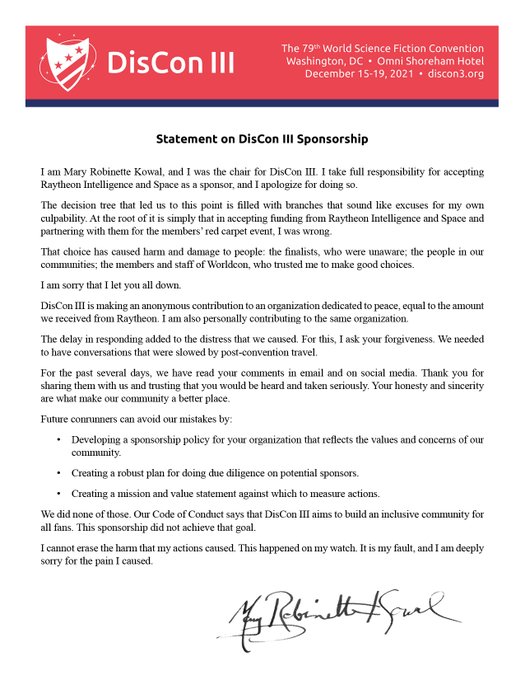
It’s at this point we must turn to address Worldcon finances. During the debacle surrounding Discon III I actually tried to dig into Worldcon finances and what I found was a disorganized mess that took me down a few blind alleys and ultimately led nowhere. Frankly, from publicly available sources, it was impossible for me to figure out where Discon III money had gone. At the time I set it aside as largely irrelevant to my point surrounding the ethics of allowing an arms manufacturer as a sponsor of a literary event. Although this was not originally a particular focus of this piece it ultimately sent me down a remarkable rabbit hole due to the non-standardized and difficult to balance nature of Worldcon financial reporting year over year.
See WSFS is non-incorporated and consists of the voting membership of WSFS in any given year. That’s true. But there is a non-profit organization called Worldcon Intellectual Property (WIP) which exists to, according to Kevin Standlee, “pursue registration of marks outside the United States.” According to information compiled by Jay Blanc, the Worldcon Marks Protection Committee (MPC) seems to have unilaterally determined that the MPC would take ownership of Worldcon related trademarks within the USA as they came up for renewal. It is worth noting that the initial board of the MPC in 2015, when these decisions were made included Dave McCarty, Kevin Standlee and Ben Yalow, among others. Blanc’s investigation points out both that this appears to have been structured specifically to keep both the MPC and WIP not legally responsible for WSFS but in such a manner that it would normally require that 33% of its annual income be taken from individual small donors. Blanc asserts that WIP’s income is taken in the form of a single grant from the yearly Worldcon. According to the most recently published financial statement for WIP, WIP earned $3,100 before September 11, 2023. $3,000 from Chicon 8 and $100 listed as “Deposit, Misc.” According to minutes published in December 3, 2023 for a special meeting of the Mark Protection Committee, “There are no dues outstanding since we just received nearly $3,000 from Chengdu” A footnote indicates, “The money from Chengdu is not part of the $18,800 noted as our bank balance, since it had just been received.” It is unclear whether this means the money had yet to be deposited into WIP accounts or whether it means the money had yet to be accounted for. There is no mention of a near-$3,000 expense item in the agenda of the Worldcon Business Meeting from Chengdu dated October 19-22. Which likely indicates the payment happened after October 22 and before December 3 however there’s no audit trail I can find for it at that time.
And I want to note that this is not a Chengdu-specific problem. However it’s worth noting that it’s not uncommon for there to be a remarkably low level of granularity in financial reports from Worldcons. For instance: the Discon III financial report from September 9 2023 includes an expense item of “Art Sales Reimbursements | $30,698.78” with no immediate context as to why these reimbursements occurred. There is no references to art sales reimbursements in the minutes of either the business meeting minutes for Discon III or Chicon 8. I would expect that a reimbursement of that size would at least warrant some discussion at a business meeting or at least some explication on the financial documentation.
However such vagaries are somewhat par for the course among Worldcons. Also a challenge is that most conventions (with the exception of Chengdu) report their finances in local currency and little detail goes into describing money conversion among pass-along funds. This makes an independent third-party balancing of Worldcon finances difficult year over year.
The difficulty of transferring money in and out of China only compounded this problem. The solution that was arrived at by the conrunners was to create a separate business entity – a 501c3 incorporated in Wyoming and headquartered at the residence of one of its board members – called the Development Center for Chengdu Worldcon (DCCW) whose responsibility it was to handle US finances for Worldcon. However, it should be noted, the articles of incorporation don’t mention that as the mission of the DCCW – instead saying that its mission is to “Facilitate the education and study of literary works internationally and in the United States.”
This caused several issues. First: the delays in allowing for registration in Chengdu Worldcon proved vexatious for some attendees. Allen Tipper went so far as to call for censure of the concom, though they were prohibited by meeting rules at Chicon8 from elaborating on the minuted records, telling me, “their skirting of the rules with regards to allowing memberships to be purchased was making me lose confidence in their ability to run a Worldcon. I would have specifically noted that I could buy a membership for Glasgow before I could buy one for Chengdu.”
Based on my research of the timeline surrounding the creation of DCCW, this was likely the root cause of this issue.
The administrators of DCCW seem to have been hard-pressed to keep up with the requirements of running the charitable organization. Wyoming state records indicate that the 501c3 became delinquent in its filings on August 2, 2023 and were administratively dissolved on October 9, 2023. This state of affairs was not rectified until February 2, 2024, when their annual report to the state was filed and their status was restored.
It seems somewhat alarming that this entity was in a legally tenuous position throughout the period of the convention itself, especially considering how finances were handled between the DCCW and the Chengdu Worldcon organization (which appears to have been the legal structure of the convention within China).
Now I will admit that what follows here is something of a guess. But the financial report for the Chengdu Worldcon contains a column for China funds and overseas funds before providing a total across both categories. The China funds are reported both in CNY and in USD while overseas funds are reported only in USD. It should note that this is actually somewhat better detail than most conventions financial reports provide.
As of August 31, the date on the financial report given at the October Worldcon, income in China funds totals to $279,704.43 while overseas income comes to $236,359.60. Expenses in China funds: $94,799.14 and in the overseas funds column it is $46,844.07. This leads to a reported net income of $184,905.29 in China funds and $189,515.53 in overseas funds. What’s interesting is when we look at the reported bank balances we see that the 2032 Chengdu Worldcon bank account is listed at $184,905.29 and the bank balance reported for the DCCW is listed at $189,515.53. This would seem to indicate, although I cannot be entirely sure, that the China funds column refers to income and expenses incurred by Chengdu Worldcon while the overseas fund column refers to income and expenses incurred by DCCW.
Now it is somewhat alarming that, at the time the report was produced the DCCW was delinquent in its filings with Wyoming and by the time the report was delivered to the membership of WSSF the DCCW had been dissolved. There is no mention of this dissolution within the agenda and I have been unable to find the minutes for the business meeting although they have apparently been published. However there are other challenges that arise from my interpretation of this report in this way.
For instance pass-along payments from CoNZealand and Discon3 are split between the two organizations. The split for CoNZealand was 75% / 25% – $37,500 went to Chengdu Worldcon while $12,500 went to DCCW. On the other hand the split for Discon 3 was 70% / 30% – of $28,528 passed along $19,928 went to Chengdu Worldcon and $8,600 went to DCCW. It’s unclear why these were handled differently.
Also unclear is the $57,428 Chicon 8 Pass-along waiver expense against Chengdu Worldcon that does not touch DCCW finances at all. I tried to find references to the pass-along waiver in the minutes of Chicon 8 and was unsuccessful. The pass-along waiver does appear as income on the Chicon 8 budget as of August 31, 2023. Again it’s unclear why this decision was made.
Another oddity is how small the amount of money was spent by either organization on international travel. DCCW paid $34,173.05 on international travel. Of that $26,522.45 was for an all-staff meeting in June. The remaining $7,650.60 was paid to convention guests. This is odd considering the number of accounts that have come out of convention panelists being comped flights and or accommodation. Tied to this oddity is the presence of only two corporate sponsors on the Chengdu financial document: Chengdu Technology Innovation New City Investment and Development Co., Ltd. – which appears to be a property development concern – and Chengdu Media Group – a media production company which also seems involved in the redevelopment efforts of the former company to some extent.
However reviewing the programming book for the Chengdu Worldcon reveals several other sponsors. Notably China Telecom, a company currently under US sanctions, was listed as a “2023 Chengdu Worldcon Starseeker” tier sponsor. Huawei, another telecommunications company under US sanctions, meanwhile does not appear as a sponsor but is an exhibitor, hosted an event attended by Worldcon panelists, and gave awards to participants (entirely distinct from the Hugos). This discrepancy is explained by statements made by Ben Yalow at Smofcon 40, previously reported by File 770, “None of that appears on our financial report because we didn’t get any money out of the deal. The convention never saw that money. What the convention saw was Hugo finalists who would show up and their plane ticket was taken care of and their hotel room was taken care of. It means that our financial report is completely accurate and totally misleading.” If I am parsing Yalow’s statement correctly this means that many of the line items that appeared remarkably low on the Chengdu budget were so because sponsors provided contributions in kind. While I will not profess to have any particular knowledge of US law regarding 501c3 reporting requirements I will say, as someone with prior experience in the not-for-profit sector, that it is not best-practice to exclude contributions in kind from financial records. You end up with “totally misleading” financial statements that way.
What makes this somewhat disconcerting is that there does not appear to be any sort of impermeability between DCCW and Chengdu Worldcon finances. Payments were divided between the two and it is unclear from the records I have access to why these payment decisions were handled in this way. If it were simply a matter of handling payments from the United States, why were pass-along payments split? If there is a good reason for this then why was the ratio of these splits different for each line item?
When we include an event that included participation of companies on US sanctions lists it would have been wise to maintain books that clearly indicated that no China Telecom or Huawei contributions entered the accounting of DCCW. As they were left entirely off the books this is opaque to me.
What I really want to highlight here is that this is a culmination of a series of decisions that significantly predate the Chengdu Worldcon. The absence of a unified financial reporting model is present for the same reason as the absence of any overarching formal guiding body for the WSFS. An old libertarian drive to resist incorporation has blocked any sort of year-to-year consistency surrounding standards and practices since ~1953. Hilariously a key fear appears to have been that incorporation would provide a method for incompetent volunteers to remain in positions of authority of for various cliques to exercise out-sized influence. Of course, now, this simply happens informally as many perennial volunteers, of various levels of competence, reoccur year over year and, in fact, decade over decade.
In fact, the Chengdu financial reports are more detailed than many other Worldcons. The financial report of Worldcon 76 has no entry for legal expenses despite a $4,000 settlement to Jon Del Arroz. Worldcon 79 has no line item for charitable donation expenses despite their board having publicly said they would do so.
NASFiC 15 provided a four-line financial statement claiming both a deficit of $24,468 and a cash balance of $5,964.27. Their notes include that they expect additional income and expenses but aside from statements regarding an application for a tourism grant they provide no real detail on how they will close this deficit gap. Nor is it clear, with how WSFS is structured, who would be responsible for paying the deficit if they cannot balance their accounts. Probably Cansmof.
Finally there is the involvement of the office of Representative Mike Gallagher. Xiran Jay Zhao says that a representative of his office contacted them saying that Gallagher was interested in this situation. This isn’t entirely surprising. Gallagher is described as a “China watchdog” and probably apprehended the existence of this issue from early reporting that suggested the big story here was CCP censorship of an international literary award. Gallagher is the chair of the United States House Select Committee on Strategic Competition between the United States and the Chinese Communist Party – a republican-led committee which lacks any Chinese diaspora members and that tends to issue inflammatory rhetoric and little else. Gallagher also has prior history of being interested in nerd shit having issued a strongly worded letter to Activision Blizzard over their rather shameful behaviour during the Hong Kong protests of 2019.
However Gallagher is in a tight position over his recent refusal to vote to impeach the Homeland Security Secretary Alejandro Mayorkas. The end result is that Gallagher will not be seeking re-election. This is to say that this is an ineffective politician from an ineffective subcommittee. I would suggest the likelihood of a congressional star-chamber for members of the concom is vanishingly small. The fact that he contacted Zhao is telling. Xiran Jay Zhao is a celebrity. They’re well-known, have a large online platform via Tik Tok and have been vociferous with their criticism of the CCP. If we treat Gallagher as a propagandist, which we honestly should, then they’re pretty much perfect for his purposes. But I doubt he has the influence in Congress, as it is currently composed, to do much beyond write another strongly worded letter. Frankly Zhao is, at best, a peripheral person to this whole mess. The people who would be best situated to answer questions about what the heck the concom were thinking are a collection of volunteer conrunners scattered across the United States, not a Canadian Tik Tok star.
I will note that there is a small silver lining here as two of the Hugo winners, Samantha Mills and Adrian Tchaikovsky, have renounced their Hugo wins from 2023 on the basis of the blanket exclusion of Chinese authors. I didn’t personally like Rabbit Test much on aesthetic and structural grounds but I do want to say that Mills, who was the first Hugo winner to make this move, deserves recognition for her strong ethics. I hope more of the Hugo winning authors will follow the example set by Mills and Tchaikovsky.
The hilarious truth is that of all the broad assortment of people and organizations involved in this bizarre story one of the most blameless is the CCP. Dave McCarty actually seems to have foiled the main CCP objective of the Chengdu Worldcon by excising Chinese authors so thoroughly from the ballot. Instead we see the American SMOF contingent at the heart of year-over-year conrunning struggling to adapt the calcified traditions of an 85 year-old institution that has aggressively resisted means and standards to an international context that desperately requires means and standards.
Please don’t take this to mean I am bringing forth the shadow of WSFS Inc. once more. Because the truth is that I don’t believe there’s anything of value left to Worldcon. As a vehicle of international connection it’s a failure: the immediate response of the Worldcon core audience to irregularities was to blame foreigners when the call was coming from inside the house. As a vehicle for a prestigious award it’s a failure: there is no good reason to believe that there has been a clean Hugo award in the last decade. I have alluded to this previously but the only period, in the history of the Hugo Awards, in which non-white authors won for Best Novel was between 2015 and 2018; it seems like the interest in honoring diverse authors dropped off sharply once the Sad Puppies were safely vanquished back to the margins. I’m sure many of the voters who gave N.K. Jemisin three Hugos in a row and then never awarded another Black author would have also voted for Obama a third time if they could.
Worldcon is a millstone around the neck of the genre community. Genre authors should not seek its awards. The WSFS should wrap itself up and any bank balances remaining on its various threadbare books should be donated to charities that can persist more than a year without falling into delinquency. Should some other international Science Fiction gathering present itself, perhaps one not so intrinsically tied to a late-1930s schism between libertarians from New Jersey and New York communists, then there could potentially be a successor to Worldcon in the future. But not as Worldcon. It’s a year-over-year embarrassment. Let it die.
 Simon McNeil