The Scold

This comes as an additional reflection arising from, not so much the Neiman book from yesterday’s review, as the media campaign that originally brought it to my attention. See Neiman was interviewed by CBC and the interview, which led me to expect the typical centrist hand-wringing over “Wokeness” was largely focused not around Neiman’s impassioned defense of Kant nor her burning hatred of Foucault but rather of a theme that only really arises briefly in her introduction and conclusion: the idea that there exists a “radical” or “woke” left who can be meaningfully juxtaposed against more reasonable leftist elements.

This is a statement I’ve always rather vehemently denied but the reasons why I deny that this is a meaningful phenomenon of “the left” are neither a no-true-Scotsman approach where I’m excluding these types from “the left” nor do I treat the subject of the scold, who will be the principal target of this discussion as being a good thing or as being a delusion of the right.

But while Neiman’s book is, honestly, almost entirely mute on the figure of the scold some of my private conversations yesterday with friends and colleagues have circled back to this subject. And so I felt it would be prudent to lay out a piece addressing a few questions:

  1. What do I mean when I talk about the left?
  2. Why do I say that the scold is not a left-wing phenomenon?
  3. What, if anything, must the left do about the scold?

So let’s start by defining our terms. I have a very clear and specific definition of the left. The left is composed of non-liberal political actors who are against capitalism and for global liberation. As such the principle contingent of the left is built from various forms of socialist, anarchist and communist. Now note that I see these phrases as being broadly overlapping. I regularly call myself a Marxist and a search through this website to references to Marx will bring up many hits. I also often call myself an Anarchist as I am anti-statist and see the “socialism in one state” model as being against the goal of liberation. I don’t call myself a Leninist but, while I have little patience for Stalinists and none for red-browns, I am quite generally open to the positions of Maoists, Leninists and Trotskyists and have read political writing by all three.

I often joke that the only reasonable political center is that between Anarchism and Marxism-Leninism and, being honest, I’m not really joking. This, then, is the constellation of ideologies and tendencies I see as the left. It’s a fractious group which contains very different views on the tactical approach to overthrowing capitalism and forwarding the objective of liberation so I don’t see the left as a unified ideological clique. Rather it is a collection of several disparate and sometimes conflicting political ideologies and tendencies that happen to share two key strategic aims. Notably this definition excludes certain tendencies like Anarcho-Capitalism, which doesn’t seek to overthrow capitalism, Dengism (for the same reason), and progressive liberalism.

So now that we’ve established what I mean by “the left” the next question is to treat the figure of the scold with similar rigor. The scold is principally (although not entirely) an online phenomenon. This figure is someone who has spent enough time in online discourses to learn some academic terminology but, through inexperience, disinterest or malice, does not understand how to use that language well. Frequently this leads to scolds going so far as to invert the intrinsic meaning behind academic terminology. I will provide a few examples:

In 1989 Dr. Peggy McIntosh, a very senior humanities professor who has worked in English, Women’s Studies and Pedagogy condensed a prior work on the topic of “privilege” down to a briefer work called White Privilege: Unpacking the Invisible Knapsack. It’s very important to historicize this work in the context of her founding position at the National SEED Project on Inclusive Curriculum IE: privilege, in her work, is explicitly a pedagogical tool designed to close epistemological and ontological gaps.

McIntosh saw this as being a positive pedagogical problem. Privilege wasn’t merely a matter of blind spots but of having been taught in specific ways: “I think whites are carefully taught not to recognize white privilege, as males are taught not to recognize male privilege.” She says that there is an intentionality surrounding the invisibility of privilege but this intentionality is not a deliberate blindness on the part of the privileged subject – it’s a matter of having been instructed. Social reproduction creates the invisibility of privilege and, as a matter of pedagogy, it is a situation that can be corrected.

“I was taught to see myself as an individual whose moral state depended on her individual moral will,” McIntosh writes, establishing that this view is incorrect. This is something which I personally agree on although my (Deleuzean) tendency to shatter the “individual” and show how easily the subject can be divided may not be what she was aiming for. I suspect McIntosh was more pointing toward collective modes of subjectivation. This is, of course, a non-liberal viewpoint that reaches toward the goal of global liberation. This situates McIntosh as being one “destroy Capitalism” away from achieving my definition of leftist. McIntosh then enumerates a list of conditions she can expect, on account of her whiteness, that she has recognized are unavailable to black people.

In her essay McIntosh seems to stumble across the idea that was previously elucidated by Antonio Gramsci of hegemony – that there is a dominant cultural force operating superstructurally upon subjects which shapes their subjectivities. But it’s interesting to note that McIntosh sees privilege of consisting of two categories: privileges that should rightly be enjoyed by all and privileges that should be enjoyed by nobody. She is also quite clear that this systemic process of domination is corrosive to all the subjects within it saying, “In any case, we need to do more work in identifying how they {privileges} actually affect our daily lives. Many, perhaps most, of our white students in the U.S. think that racism doesn’t affect them because they are not people of color; they do not see “whiteness” as a racial identity.”

Now McIntosh made a small error here in that there certainly is a category of Americans who see “whiteness” as a racial identity – white supremacists – but the awareness of white supremacists that they can openly dominate is less her aim here than those people who have been instructed by white supremacist systems to ignore the system they live within. “In my class and place, I did not see myself as a racist because I was taught to recognize racism only in individual acts of meanness by members of my group, never in invisible systems conferring unsought racial dominance on my group from birth.”

Ultimately what McIntosh wanted to do was to make subjects that were taboo matters for open conversation. She wanted to close the epistemic gap between subjugated and dominating subjects within a hegemonic social milieu and to use privilege as a method of creating a clearer compassion and empathy for dominated people among the privileged classes. She ends her paper by saying that, while she was uncertain this would work, she wanted those people who had been conferred power via privilege to use said power to break it down.

However in the hands of the scold this is inverted. Privilege becomes a matter of epistemic closure. ‘You cannot understand this experience because you have privilege,’ the scold says. ‘You should not speak because you have privilege,’ the scold says. Privilege is taken from a recognition of systemic collective hegemony and turned into a personal failing. To have privilege is, in the hands of the scold, to be personally evil. I’ve joked that people should not use “privilege” in online discourse if they don’t know who McIntosh is and this is because McIntosh is a white woman, highly educated and slightly too old to count as a member of the baby boom. McIntosh is, by her assessment in 1989 and by the standards of privilege as a received discursive tool, a privileged subject and that the origin of privilege comes from privilege is context its author makes clear as significant. She wants to change how privileged subjects are educated such that they can recognize hegemony and work to dismantle it.

Effectively the scold, in the context of left-discourses, is a person, generally but not always a progressive liberal, who hasn’t done the readings. As such they’ve missed key contexts (treatment of privilege as a pedagogical tool to bridge epistemic gaps, privilege as a systemic issue rather than an individual one, the necessity for collective action to level privilege by both extending privilege to subjugated people and by withdrawing perverse privileges from all, privilege as a method for furthering understanding and compassion) and instead use the term inexactly and in manners that forward the objective of excluding people who annoy them online.

Now it’s important to note that annoying a scold does not make a person good any more than coming from a privileged class makes a person bad. Frankly the other hallmark of the scold, beyond their tendency to mis-apply academic language they clearly don’t understand, is how easily they are annoyed. It is harmful to tell a scold they should read if they wish to be a good writer. This is flattened to being of the same class of problem as making bigoted statements. Either might cause the scold to lash out. It’s quite clear that these expressions contain a moral difference. But the moral certainty and the moral flattening of the scold also undermines their ability to argue their case well. Because the scold replaces a clear grasp of the concepts they use with moral fury and righteousness a single scold becomes very easy to discount and scolds in aggregate become just… annoying.

But, while the tendency to treat privilege as an individual failing rather than a hegemonic construction of the social superstructure tends to situate that particular class of scold among progressive liberals there can certainly be scolds among other ideologies including leftists. The problem isn’t one of ideological viewpoint – it’s one of a combination of incomplete education and extreme discursive sensitivity. As such we also see scolds very frequently among the right.

In fact the principal difference between liberal and leftist scolds on one hand and conservative scolds on the other is that liberal and leftist scolds are mostly nobodies. They might amass clout on social media platforms but this isn’t really any more of an accomplishment than being particularly good at a video game.

Right wing scolds get money and political power.

Look, for example, at Jordan Peterson. This man is treated as a clinical psychologist (although perhaps not for much longer) and his notoriety comes from his purported expertise as a Jungian scholar and analyst. And yet his self-help work demonstrates a remarkably poor grasp of key Jungian terms such as archetypes.

First off Peterson tends to inflate the importance of the conscious ego over the unconscious. This isn’t surprising since it’s hard to sell self-help books that treat the self as an ocean of concepts and affects over which the ego is a little boat floating around the top of. But also Peterson tends to flatten the Jungian unconscious of archetypes down to only those which are useful. He writes a lot about the shadow but never about the animus and anima.

After all an area of repression where the parts of the self the ego is afraid to look at is useful to his reactionary political project while the idea that there exists a feminine image in the psyche of every man and a masculine image within the psyche of every woman upsets the gender binary he cares so deeply for.

Peterson is, thus, poorly educated and regularly uses academic language he clearly doesn’t understand. It is an indictment of the Canadian educational system that this man was ever allowed to teach students but it appears his years of failing to understand the requirements of his own profession are catching up to him. It’s unfortunate that this will do little to tamp down his notoriety or his influence since neither are, at this point, tied to his membership in a professional organization.

Peterson is also incredibly sensitive to discursive offense and flattens all responses down to a uniform kind of harm. “Up yours woke moralists!” may be his most famous utterance but it’s equally evident in his participation in lawsuits over curricular restrictions placed upon TAs.

And so when I say that scolds aren’t a problem for the left it’s because scolds are a problem more generally of online culture. Part of the issue is that academics are some of the most terminally online people and academic language, both social justice language, therapy language and other specialized language regularly filters outward from academics to those for whom ‘doing the reading’ largely meant seeing a word on Tumblr, Twitter or Facebook. I still persist in arguing that scolds are, in fact, less common on the actual far-left than in other spaces with their pervasiveness and influence growing the more conservative the audience although, again, I qualify this to say there are plenty of leftist scolds. In fact the left has something of a different problem with scolds from the right in that much of the language of social justice – one of the favourite categories of misappropriated language among non-conservative scolds – is widely used correctly by leftists. Separating out people talking about privilege as a method of articulating hegemony in pedagogical spaces from those using it as a cudgel for shouting down annoying people on Twitter is thus somewhat more fraught than in other discursive spaces.

And this acts to get at my third question: what should we do about scolds.

Frankly we should encourage them to do the readings. Here Gramsci is useful again. Gramsci argued for a proletarian education by and for proletarians. He saw these as taking the forms of reading groups and discussion circles. One of the best way to inure us against scolds without falling down the rabbit hole of “the left has gone mad” reactionary types is to help people discover how to make appropriate use of this specialized language.

This blog was largely intended for a similar purpose – I wanted to introduce a body of philosophical and critical work into the discourses surrounding genre criticism – and it has been a very successful project among leftists in genre spaces. (It has also made me deeply unpopular with liberals in genre.) Pedagogy is important and, for those of us who want to take on such a role, it can be good to read pedagogical and epistemological work so that we can develop effective strategies for disseminating a clear understanding of not just the words behind social justice but the appropriate use of those words.

This also requires us to rein in our worst impulses. A Gramscian perspective on education by and for the proletariat requires us to enter discursive spaces prepared to both speak and to listen. In McIntosh’s reflection her objective was to correct deficiencies in the education of fellow white people but this required of her a fair bit of autocriticism. And there is an important lesson there in that McIntosh didn’t see her white privilege concept as being a tool to educate marginalized subjects (notwithstanding her recognition of intersectional marginalization) but to make visible the invisible to normative subjects so that the would seek to change that state of affairs.

We should not start by engaging with scolds. This way lies the sort of almost ressentimental frustration that leads to the penning of very bad books. But also we should all probably be less online in general. One of the big problems with the scold as a figure is how they flatten out discourses into simple binaries – generally ethical binaries where there is a clear good side and a clear bad side. However the structure of social media websites also flattens discourse. A look at how Twitter has allowed conspiracy theories about the forest fires in Hawaii to proliferate is a perfect example of this discursive flattening in action. A post from a literal fascist promoting fascism and a post from an annoying person being a nuisance both look effectively the same: a small rectangle of text perhaps with a link and an image. Even by the standards of textual communication the post is incredibly homogenous and this structural homogeneity makes it far too easy to treat the message of a post as homogenous.

I am very critical of McLuhan’s “medium is the message idea” in that I find the contents of a container more relevant than the form of the container but this doesn’t mean the form of the container is irrelevant and the flat homogeneity of the post as a container is something that tends to flatten an audience reception of a post. When a sensitive person sees, in aggregate, a dozen posts from scolds and two dozen that correctly identify an issue with their rhetoric they will likely just see three dozen scolds.

So what should the left do to combat scolds? We should use tactics such as those proposed by McIntosh and Gramsci to make more leftists. And we should all get the fuck off Twitter.

Gothic anti-realism: art for the unsatisfied

Angelus Novus by Paul Klee

His face is turned toward the past. Where we perceive a chain of events, he sees one single catastrophe which keeps piling wreckage and hurls it in front of his feet. The angel would like to stay, awaken the dead, and make whole what has been smashed. But a storm is blowing in from Paradise; it has got caught in his wings with such a violence that the angel can no longer close them. The storm irresistibly propels him into the future to which his back is turned, while the pile of debris before him grows skyward. This storm is what we call progress.

— Walter Benjamin

We are being crushed under realism.

We are all living in a world after the age of no alternative. We are all cursed to see ourselves as survivors of a failed apocalypse: the so-called end of history. But in the absence of the end of history communicating anything truly revelatory we all seem trapped, waiting for the other shoe to drop. This is, in brief, the ontological condition of capitalist realism. Believing that nothing can possibly create a real transformative change in the world order we are confined to what Fisher called “reflexive impotence.” We, “know things are bad, but more than that, {we} know {we} can’t do anything about it.” After all, history is over. All we can do now is accept that this is the final form of the world, the final and eternal order. Of course Fisher described this not as “a passive knowledge of an already existing state of affairs. It is a self fulfilling prophesy.”

Looking then at how this paradoxical apocalypse without an eschaton has affected the arts we can understand quite clearly how this realism leads to a few different strands:

  1. A prioritization of comfort as a response to absurdity
  2. A reification of normalcy onto those things that do not fit
  3. A fear and suspicion toward transformative change

These three threads run through quite a few liberal-progressive arguments with regard to art. For instance comfortcore, hopepunk and other proposed subgenres of fiction have attempted to carve out a moral imperative to tell people that it’s OK. The world already ended and you’re still here so you might as well get used to it and find your joy where you can.

We see a huge focus on the valor behind “found family” as the entirety of social life is re-enscribed into the domestic, familial, and (as such) patriarchal sphere. In fact we are told this is good, it’s progress that now, too, people who might have been excluded by their old patriarch can create a family of their own. There are, after all, as the prophet of the end of history, Margaret Thatcher said, “only individuals and their families. There is no alternative.”

And we see, in general, a lot of media that is focused on making the status quo nicer. We want everyone to have a seat at the table to the end of the world, every person should find a family with whom they can enjoy the endless grey suffocation of all this forevermore.

Because the vicissitudes of power have made it so that almost no art has a chance except for the broad, the corporate, the four-quadrant, the comfortable, we see a host of artists, fans and critics justifying that this is actually a good state of affairs. It’s right to engage mostly with children’s media. It’s suspicious to want art that is cynical, cruel or angry, Only reactionaries show wrath in public and you wouldn’t want to be one of them.

We want heroes who have fun adventures, find a family, and who demonstrate that even if they are something a little strange, like a sentient gemstone or a gay person, they’re actually Just Like You: a normal citizen of the end of the world.

But if all there is are individuals and their families then we can, as Deleuze says, “no longer form a unified subject able to act.” We aren’t a people. We aren’t a community. We’re individuals and their (found families) living in the ruins of ended time in suspension. So what is to be done? We can’t cozy our way out of the endless grey suffocation of capitalist realism. But likewise I doubt anyone would find that the equally stultifying (socialist) realism of the Stalinists and their descendants is any more comforting to the spirit.

In the end realism is, itself, the enemy. This idea that art must be applicable to this historical moment is itself an enemy. We don’t need a children’s cartoon to tell us how queer love is just the same as the heterosexual family. Instead we need a subtle knife that can cut time itself and kill even God. The art that this moment demands must reveal the rot of the end of history.

Shirley Jackson famously wrote, “No live organism can continue for long to exist sanely under conditions of absolute reality; even larks and katydids are supposed, by some, to dream. Hill House, not sane, stood by itself against its hills, holding darkness within; it had stood for eighty years and might stand for eighty more. Within, walls continued upright, bricks met neatly, floors were firm, and doors were sensibly shut; silence lay steadily against the wood and stone of Hill House, and whatever walked there, walked alone,” and I think this is a strong way to begin approaching the demands of art to break realism. And just as no live organism can continue for long to exist sanely under conditions of absolute reality. No live organism can continue for long to exist sanely under conditions of absolute realism. This stultifying sense of being at the end, at the final form, in the best possible fallen world, is maddening. Is it any wonder so many people want to retreat into nostalgia and childhood?

The gothic has always been an enemy of realism because the gothic recognizes first and foremost the impermanence of all things. The House of Usher exists to fall. Heathcliff cannot ultimately survive the death of Catherine. The damned immortality of Dorian Grey and of Count Dracula exists to be torn down.

The gothic is, as such, an historicizing form of fiction, it is one that places its subjects into a flow of history in which they are temporary and contingent. Not without consequence, of course, you cannot be a part of history while being entirely insubstantial. But the gothic does not exist in a world suffocated under a grey blanket of the real. The gothic treats the current moment as a dying and diseased thing that will be replaced in its turn by something else, something new.

It is important to note that new does not mean better. We cannot know, when we shatter the real of today, what the world of tomorrow will truly be like. It might be a horror show. But the time of monsters is birthed, per Gramsci because the old world is dying but the new one cannot be born. The refuse and ruin of the old world clogs the path. The grey blanket of “no alternative” forestalls the birth of the new.

It must be burned away.

And so I want art that is a torch touched to dry kindling.

I want art that is a knife that cuts that is a gun fired into a crowd.

I want art that leaves the audience uncomfortable and disturbed, that shows the crumbling foundations of the real and takes a sledgehammer to them. I don’t want a found family; I want to see other, novel, social formations that we might assume and I want artists to have the courage to say that, for instance, a sensate cluster isn’t a family at all. I want art to be the sharp knife that cuts the fetters on time and frees the angel of history from its shackles. I want art that maddens and confuses.

Not children’s cartoons but the avant garde. Not the MCU but Sion Sono. In order to cut away the fetters on history we must unmoor ourselves from nostalgia and the reflexive recreation of the past into the present and the future. Art like this does exist, of course. The directorial work of Julia Ducournau and Sion Sono, particularly their recent films, Titane and Prisoners of the Ghostland respectively, are key figures for such an art. In literature we can see this anti-realism and reactivation of history in the work of Tamsyn Muir (particularly her second book, Harrow the Ninth) and Jeff Vandermeer such as in the Southern Reach trilogy. In visual art, the work of Jessi Sheron, particularly her “Other Happy Place” project reflects many of these aesthetic values.

Many of these artists are grim. And the gothic will never be anything but dark. However you will never free the angel of history with hugs.

Hopepunk: A genealogical sketch

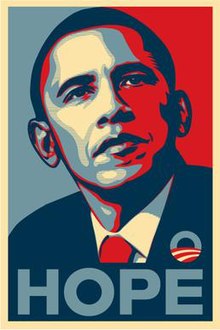
Barack Obama "Hope" poster - Wikipedia

Hope is not an optimistic emotion.

When we discuss optimism we can start by returning to that very early definition of optimism as an emotional position: the glass is half full. Optimism is grounded in an assessment of material conditions. The glass is an object. Its condition – being half-full of water – is a part of its facticity. The water, too, is an object. The optimist begins from the material conditions that exist and extrapolates how the good arises from them. While an optimist has one eye on the future state of the object their gaze is fixed first upon the conditions as they exist.

Hope is far slipperier. In some ways it is an expression of despair. To hope is to observe the abjection of the material and to reject that as the basis for analysis, instead looking toward some outside agency to swoop in and make things better. The optimist, looking at the half-full glass might extrapolate that there is water to be had. The hopeful imagines somebody will bring them more instead.

This feature of optimism – the tendency toward agency – was remarked upon by Antonio Gramsci in his prison letters when he said, “My own state of mind synthesises these two feelings and transcends them: my mind is pessimistic, but my will is optimistic. Whatever the situation, I imagine the worst that could happen in order to summon up all my reserves and will power to overcome every obstacle.” Gramsci’s assessment starts from a material basis and, as one might expect of a Marxist in an Italian prison during the reign of the fascists, he finds his material condition unfortunate. However Gramsci maintains an “optimism of the will” – a revolutionary optimism that demands that the revolution never ended, the workers have not been defeated, so long as one fighter draws breath and continues to fight. Gramsci suffered imprisonment and maltreatment for much of his too-brief life. But his optimism left behind him a legacy of academic work that forwarded revolution for decades to come. What of hope? Hope never lifted him from his prison nor overthrew the Fascist regime in Italy. But the Salò Republic fell and Communist partisans slaughtered Mussolini like the pig he was. This agency is not the object of hope but of such a revolutionary optimism.

However this optimism of the will – this sense that a person can start from their material basis and enact meaningful change – that the words of a neglected prisoner can be one of the sparks that leads to the death of a fascist demagogue – depends on being enmeshed in history. By history here I don’t mean an account of the past but rather a continuous process of movement of the future into the present and the present into the past. Optimism depends on the presence of ambiguity within the facticity of our situation. To be optimistic is to recognize that there is a seed of good here and now from which a person can, with sufficient will, build the future.

In Capitalist Realism Fisher proposes that this is the very thing neoliberalism sought to snuff out. We can see this desire, to bring about an end to history, in both the theoretical works of people like Fukuyama, who proposed history as an evolutionary process and the present moment as its final form (eliding both that human social development has never been evolutionary in character but rather more like an ecological process in a state of metastatic equilibrium and that evolution itself has no end) and in the practical efforts of Margaret Thatcher’s “no alternative” rhetoric, the neoliberal order is sustained in its own perilous equilibrium largely by the lie it foments that this is all we can strive for: a present that is always at the end of the arc of history curving inevitably toward freedom. A past that is always a time of darkness and superstition. A future that is more present but just with a faster phone with more pixels in the screen.

In such a future there is no place for the agency of revolutionary optimism. The neoliberal order hardly even likes to admit the agency of people is a good. Populism is made a dirty word and equated exclusively with fascists. Government becomes technocratic – governance a task best left to experts like some perverse materialization of Plato’s philosopher kings. But in a world where agency must always accompany professional expertise there is a place for hope. Perhaps, in the future, The Experts will make things better. A person who is an agent of hope thus ends up fighting a rear-guard action for the status quo. Any upset too far, any reactivation of history, carries with it the risk that the outside agents who hold aloft the light of hope cannot come and save us.

The neoliberal circumscription of the imagination has certainly had a negative impact on science fiction. In the precursor novel to cyberpunk, “The Sheep Look Up” the future was bleak. The novel traces the dissolution of the American empire after all and it does so with an unflinching eye to the circumstances of empire. However even there we get a sense that alternatives exist. The problem isn’t a purely Malthusian one but rather one that is specific to a mode of production in a specific place and time, “We can just about restore the balance of the ecology, the biosphere, and so on – in other words we can live within our means instead of an unrepayable overdraft, as we’ve been doing for the past half century – if we exterminate the two hundred million most extravagant and wasteful of our species,” in other words the alternative will arise out of the funeral pyre of empire. At the other end of the cyberpunk genre, William Gibson built the story of Virtual Light entirely out of the grounding of the future in a material present – a vast real-estate deal might reshape a city if only a person has the right eyes to see it.

Of course there’s a cynicism in cyberpunk. It is very much a genre of pessimism of the intellect, optimism of the spirit. The little people who populate cyberpunk novels – the thugs and grifters, the couriers and the hackers are not movers or shakers. And yet, despite being vastly, overwhelmingly, outpowered by the forces arrayed against them, they do their little hustles, carve out space for a future, for a history. This is because cyberpunk, charting that thread of science fiction between Brunner and Dick at one end and Gibson, Sterling and Stevenson at the other, was in many ways a punk genre.

Punk rock arose contiguously with cyberpunk. In retrospect 1968 had repercussions much farther afield than the French academy and this sense that the alternative future offered by the Soviet Union was perhaps as failed as the future offered by the United States informed many of these cynical quests to find an optimism of the will within pessimistic times. Within music this arose largely as a matter of distrust in the studio system and an unwillingness to participate in those syndical games compromising artistic vision. And so we have the Fugs announcing that they “dreamed of a bum, seven foot tall, who crushed the Bourgeoisie with a cross,” and we have Iggy Pop singing about his own desire for subjugation, “now I wanna be your dog.” The music, carving our an optimism of the will via a rejection of a formal system in favour of embracing the limits of do-it-yourself aesthetics contained within it the realization of a potential new future for music – a continuation of history by turning away from money and from polish in order to access something primordial: a broken and jagged scream that had no place in the institutions of the time.

Of course punk was recaptured by capital and the Stooges gave way to Blink 182. The bringing of punk to heel was a death by a thousand cuts. It may have begun with the style-before-substance empty anarchy of the Sex Pistols but there was no one moment before which punk was good and after which it was bad. Green Day were part of the punk-pop movement and yet they still carried with them that yearning for things to be different that characterized more radical precedents like the Dead Kennedys. Even now punk produces acts like Red Bait as well as acts like Paramore.

The capture of Punk was a suffocation under new axioms. Punk might be music for hoodlums and thugs but if it bends this direction or that, if it can become a vessel of a form of commodity fetishism, then places can be carved out for it. Crust punks might still gather in the living rooms of squats to reintroduce the primal scream of punk but they can be disregarded as long as carefully manicured ballads to teen angst played over three chords could also be allowed. Punk was expanded, not stylistically, there was always already a vast panoply of sounds to punk whether it’s the folk-sludge of the Fugs and the amateurish jangle of the Stooges or the surf-rock riffs of the Dead Kennedys and the Celtic lilt of The Real McKenzies – but rather it was expanded ideologically so that its initial rejection of the systems it was formed as an escape from became unnecessary – not incompatible, just unrequired. It’s important in this to keep in mind that what we see is a division of punk into these two components. The first is a punk aesthetic – a carrier of the artistic form associated with punk. The second is a system of material relationships with art. It describes a set of social and economic relations to art along with an underlying ethic regarding the purpose of art. This we could generalize as a punk ethos. This ethos does not need to map perfectly onto a specific aesthetic, which is why we could call acts that aren’t precisely within the punk genre of music (notably Gaylord and Feminazgul) as strong examples of the continuation of this ethos along with the aforementioned Red Bait.

A similar expansion was occurring in the waning days of cyberpunk. In 1990, William Gibson and Bruce Sterling, two of the luminaries of the subgenre, wrote The Difference Engine. This novel proposed an alternate history where Charles Babbage successfully created an analytical engine and where the British labour movement was subsequently crushed much sooner. This novel sought to trace a technological inevitability to neoliberalism and its anti-labour positions, as if the computer was responsible for crushing miner’s strikes. While I’m quite critical of The Difference Engine and its positioning of technology as the engine of history more than humans it was still effectively a cyberpunk work – its position in 1855 was to put forward the argument that the present age would inevitably arise when the technological conditions existed. The Difference Engine proposes the cyberpunk dystopia as the end of history.

However this novel also acted to pry open the definition of literary punk via the anointing of a successor in the form of Steampunk. Steampunk was a failed read of The Difference Engine that latched onto the aesthetic indicators of the second half of the nineteenth century as imagined by a deranged clock maker. Certainly Babbage’s computing engines were machines of gears and precision, but this is largely where the analysis of the Steampunks ended.

While Gibson and Sterling acted to critique the relationship between the industrial revolution and novel technologies by introducing a novel technology from the information revolution into the mix the Steampunk fandom were mostly just interested in the aesthetics this critique was clad in – the aesthetics of the Victorian world.

Steampunk provided an easy way to market all kinds of alternative histories diverging at some key technological nexus: Dieselpunk, Atompunk, Biopunk, and all the other -punk subgenres arose not directly from Cyberpunk but rather from the fannish under-interpretation of this one late-cyberpunk text and from the many imitators that tried to ride on the coattails of its success. If Steampunks had one last connection to anything punk it was via a DIY sensibility surrounding costuming that wasn’t honestly particularly unique within cosplay as an artistic movement. All cosplayers lionized the self-made costume over store-bought. Only Steampunks tried to say this made them punk.

By the time Hopepunk was codified as an aesthetic positionality, punk had become nothing but a floating signifier – its boundaries had been so expanded that virtually any work of art could be called a punk text. This was the final defanging of punk as a genre. Red Bait and their radical ilk only manage to hold on by disregarding the punk label entirely and instead presenting a punk ethos. Hopepunk arose out of the bromine claim that “hope is punk” but it should be obvious by now that such a claim is farcical. Punks do for themselves, they make and they perform, they live in the margins and the recesses. Punks may have a pessimism of the intellect – a cynicism of the world as a broken place. But Punk, any remnant of the Punk ethos that remains in the wake of its defanging, insists on the agency of its participants. Punk doesn’t hope that the world will be better and instead gets on acting with autonomy in the world that is. Punk is materialist.

So, no, hope is not punk. It’s not punk at all. But this isn’t sufficient to render Hopepunk entirely occluded within its antimonies because, arising as it did from the fandom thread tracing back to Steampunk there’s no need for a punk ethos within Hopepunk for it to claim the -punk suffix. It’s just an intrinsically meaningless sound used to denote the aesthetic center of the subgenre. A -punk suffix does nothing but direct the reader that the prefix carries the essence of the subgenre. Dieselpunk is about trains. Atompunk is retrofuturistic nostalgia for the 1950s. Steampunk is the second half of the nineteenth century imagined as if their technology exceeded our own while retaining the aesthetic character of the industrial revolution. Hopepunk is likewise uninterested in being punk in the sense that The Stooges or The Sheep Look Up is punk but is instead interested in centralizing the experience of hope as its central aesthetic concern.

Thus far we cannot say much about Hopepunk. It certainly isn’t punk but we can hardly fault it for that. It is simply using common understandings to communicate that the emotion of hope is the essence of the genre. But, as I said, hope is something of a slippery emotion – it is an essentializing of optimism that divorces it from a material basis via an absolute rejection of facticity. But all this says is that Hopepunk is an idealist literature. However Hopepunk does not lack for manifestos.

Perhaps the most important of these would be an untitled essay of Alexandra Rowland’s from 2017 where she expands upon the statement that Hopepunk is best understood as the opposite to Grimdark saying that the older subgenre’s essence, “is that everyone’s inherently sort of a bad person and does bad things, and that’s awful and disheartening and cynical. It’s looking at human nature and going, “The glass is half empty.”

No examples are provided of what Rowland considers to constitute a Grimdark literature. We could surmise she might be referring to the work of fantasists such as Joe Abercrombie who take a more discursive tone to the fantastical, interrogating the essentialism of good and evil presented in classics such as the Lord of the Rings. Rowland includes this text as a Hopepunk text, along with The Handmaid’s Tale, “Jesus and Gandhi and Martin Luther King and Robin Hood and John Lennon,” to put forward something of a Hopepunk canon.

Now there are a few things we can take from this essay of Rowland’s regarding her characterization of Hopepunk. We can see it as existing in a broadly liberal space. There’s a certain lack of criticality to including John Lennon alongside the mythical founder of one of the world’s largest religions. Rowland gestures toward people who are, however, enmeshed in a specific kind of liberal sense of the Good. John Lennon earns his spot next to Jesus not because of any sort of shared facticity but rather by the shared beauty of their imaginations. She’s treating these disparate figures as their texts, comparing The Sermon on the Mount to King’s Dream speech to Lennon’s Imagine. Alongside this treatment of these people as text she’s using the object of their deaths to create her essence, interrelating the martyrdom of Jesus King, Ghandhi and Lennon too. Tolkien is Hopepunk too – after all there has rarely been a greater master of the idealist fantasy than he – but this is with a slight caveat that situates the example as a specific interpretation of the text by Sean Astin in a specific scene of The Two Towers film.

What can be drawn from Rowland’s examples is that she is pursuing an idealist Good as an objective of fiction. She gestures that people may not succeed all the time – most people aren’t John Lennon after all – and much of her political language is very much of its time and place as an American Democrat in the early days of the Trump presidency. However we can certainly situate Hopepunk as a liberal literature that is quite welcoming of conservativism as long as it is the friendly idealist version put forward by old JRR.

Rowland wrote a second manifesto in 2019 which I think serves as a clarification of the 2017 definition. In this she posits that the crux of her argument is that, “being kind is a political act. An act of rebellion.” I think she does something interesting here in situating a positionality for the ethic of Hopepunk in a specific class when she says, “But once in a while, the people toward the middle of the heap manage to look down and see the mass of wretched bodies below, the base of the pyramid that’s supporting them, and for a moment, they see the instability of their own position, that their pyramid isn’t built on solid ground but on human flesh and human pain.” Of course, the, “middle class,” is no class at all. As Deleuze and Guattari put it, under late capitalism, “there is only one class, the Bourgeoisie.” Absent this striation you get nothing but this undifferentiated pyramid of suffering. “The middle of the heap,” is a dangerously reductive statement compared to the clarity of a working class. And I do want to make sure that it is entirely clear from the context of this essay that “the middle of the heap,” can be taken to mean, “us.”

Rowland seems to have pivoted from a clear liberal idealism in 2017 to a position more akin to a humanist existentialism in 2019. This humanism is largely being brought in by way of the great humanist satirist Terry Pratchett. However much of her attempt at devising an aesthetic seems to largely be a frame for her personal response to the declining political situation of the United States across those last pre-COVID years. Rowland says, at one point, “The world has always and only been a never-ending, Darwinian struggle for survival, an ’empire of unsheathed knives and hungers,’ clawing at each other and climbing over each other in a mad riot, pushing our boots down into someone else’s face to heave ourselves up a little higher or risk being trampled ourselves.” This, together with the bleak picture of the middle of the heap complexify her humanism in uncomfortable ways. It’s hard to see both the kind of Beauvoirian ethic she attempts to approach in this article when you are also seeing all of human culture as a demonic crab bucket.

When Rowland returns to Hopepunk after this rather bleak precis she starts by claiming, “First, you must understand that everything is stories: money, manners, civilization. It’s all just little tales we tell each other, little collective hallucinations. A set of rules so that we can all play pretend together.” This fixation on culture as text is very nearly Derridean in its focus but misses the mark a bit when it reduces the concept of narrative, of text, to “little collective hallucinations.” This becomes a return to a kind of idealism, a sense that there is no world beyond the mind and that noumen are inaccessible to us. Rowland’s critique of the decline of the American empire under Trump stumbles over this refusal of materialism. She lacks anything like an optimism of the spirit in this moment of this text. And as I said before, hope is a dialectical unity with despair.

Rowland tries to bridge this despair with a valorization of stubbornness. Again the problem remains this focus on an idealist worldview wherein the social field is just a network of hallucinations or, as she quotes Pratchett, little lies. But then she does an odd pivot in an attempt to create a companion subgenre to Hopepunk in “Noblebright” (another attempt at an opposite to the still-undefined Grimdark).

“Noblebright is about goodness and truth and vanquishing evil forever, about a core of goodness in humanity. It’s most of the Arthurian legends, the Star Wars original trilogy, Narnia . . . in Tolkien terms, it’s Aragorn, rather than Frodo and Sam (who are hopepunk as hell). In noblebright, when we overthrow the dark lord, the world is saved and our work is done. Equilibrium and serenity return to the land. Our king is kind and good and pure of heart; that’s why he’s the king.

It’s all very nice,” she says. And Rowland, during the more desperate period of her essay in which she reflected upon the politics of the moment has been quite critical of niceness. Rowland tries to create a discourse between this proposed subgenre and Hopepunk, using them to tease out the aforementioned Beauvoirian ethic except that her idealist approach serves her poorly there. “It’s about being kind merely for the sake of kindness, and because you have the means to be, and giving a fuck because the world is (somehow, mysteriously, against all evidence) worth it and we don’t have anywhere else to go anyway.” Somehow, mysteriously, against all evidence. This, then is the return to hope contra optimism I mentioned before. Rowland doesn’t want to look for the Good in her facticity but rather to find it against all evidence.

In the end Rowland turned from a pure sort of Liberal idealism in 2017 to a kind of existentialism in 2019 – but in doing so she occluded an actual definition of Hopepunk even further. What is Hopepunk? It’s an idealist literature of a non-existent class that attempts to respond to power with aphorisms about the value of kindness but an avowed willingness to lean into ambiguity. This makes it even harder to square some of the many disparate examples. Aside from one song how does any of this apply to the man who sang Taxman – a protest song against progressive taxation under a Labour government? How could this attempt at a radical idealist kindness lionize a political leader who was all too happy to call Hitler his “dear friend,” a man who was all too happy to deploy racist arguments about Black South Africans if it meant improving the position of Indians within the colony? In Rowland’s two manifestos much changes. Her entire ideological frame seems to shift and she attempts to pivot Hopepunk with it. It isn’t enough to have constructed a strawman in “grimdark” against which to measure this vague subgenre but now a second one, “noblebright,” must be deployed as a foil. And of course the examples for “noblebright” fiction are safely anachronistic. Star Wars may, in fact, be the most recent work of art mentioned and I would propose that Rowland may have misapplied her rubric. If she believed truly that, especially that first film dealt in absolutes then she might want to consider revisiting the text of Star Wars from the perspective that the Jedi aren’t entirely reliable expositors. Ultimately an attempt to sketch what Hopepunk actually is will need to leave Rowland behind. She’s critical to its formulation but her manifestos are impacted to their detriment by her obvious attempts to process the failure of American liberalism without letting go of American liberalism entirely. We must expand our field of view.

The Jesuit priest Jim McDermott contributed an interesting thread to the definition of Hopepunk by claiming it for Catholicism largely through the invocations of Tolkien and Lewis in its formation. Writing in 2019 he elaborated on Rowland’s essay first by attempting to define “grimdark,” describing its central texts as, ““The Walking Dead,” “Breaking Bad” or the Zack Snyder-helmed DC Comic book movies.” On the other hand, McDermott sees a reflection of his faith in Hopepunk, saying, ” hopepunk insists there are streams of life-giving water all around us—stories, people and experiences to which we can still turn for inspiration and renewal. Our very faith is built upon such a story, one in fact so ridiculously unafraid of the worst that reality can throw at us that it chose to make the moment of its most horrendous loss the icon of its hope.”

For him, the thread of the valorization of the martyr found in Rowland’s first essay is key and he repeats her invocation not just of Jesus but of Martin Luther King Jr. This inclusion is interesting since his thesis is so specifically to claim Hopepunk for Catholicism and King was a Baptist. But he is writing for an American catholic publication and King is not just a Christian martyr but also a principal martyr of the American civic cult so I suppose this fits the specific syncretism of the American Liberal Priest just fine. McDermott is a poetic essayist, it’s sure and his conclusion is beautifully worded, “That is the point and opportunity of hopepunk: the Spirit does not follow the rules we set down. Grace rebels and God thrives not in some impossible sanctity but in the actual mess of our humanity.” But this merely reinforces the idealist thread of Rowland’s work. His reading of Rowland is one of a transcendental soul upon which a moral field acts. The other commonality between McDermott and Rowland’s definitions of Hopepunk is that both assume a clear ethical dimension to art – for both authors art exists to communicate Good whether that’s Rowland’s vaguely secular humanistic Good or his more explicitly Catholic ethic.

Aja Romano also situates Hopepunk as beginning from Rowland’s pronouncement in opposition to “grimdark” however she treats it more as a literary movement than an aesthetic or an ethos. Romano implores her audience to “picture that swath of comfy ideas” and I think this is a very important dictum as the Hopepunk ethic is very much rooted in the literary concept of the cozy. It’s a fiction that tries to keep the mean stuff off the page as much as possible. We know orcs are bad and Sauron worse but we don’t see the torture chambers of Mordor – we just hear about them. Cozy novels want to encourage an integrated audience who can ride along with the characters of the story in maximum comfort. This is largely a utilitarian motivation as in the mystery genre, where the cozy is particularly prevalent, this comfort with our characters allows the audience to solve the crime along with the detective. The Cozy arises in other context too though, with On The Beach being a key early example of the cozy apocalypse. Out there everything has fallen apart but over here things still go on in a way as we all await the end quietly, contemplatively, inevitably.

Romano shares the same examples of “grimdark” as McDermott albeit with a bit more shade for Nolan and a bit less for Snyder and here is where we begin to see part of the problem with Hopepunk’s search for a moral essence in fiction because they fail to differentiate Breaking Bad as a text from the worst audience responses to the same. Breaking Bad is flatly satirical – a vicious attack on the American healthcare system, the American education system and a case study in how one vicious little man can befoul the lives of the people around him all while pursuing a perverted idea of the American Dream. Though weakened by the dramatic positioning of the “One who knocks” speech and Bryan Cranston’s career-defining performance there was nothing in Breaking Bad that suggested that Walter White should be anything other than a moral warning. There is an ethic underlying Breaking Bad and it is one that is fundamentally critical of our Heisenberg. The finale of Season 2, in particular, should dispel any notion that Walt is anything other than a moral hazard for everyone around him. The way it builds so much death and pain off of chance encounters doesn’t lionize his bad behaviour – it condemns it. But this seems missed by a literature that desires a moral lesson in a cozy package.

Romano also draws out in text some of the subtext in Rowland’s first manifesto, describing Rowland’s strange Jesus and John Lennon list as, “heroes who chose to perform radical resistance in unjust political climates, and to imagine better worlds.” I believe I’ve dwelled enough on the heroism of Ghandi and John Lennon’s heroism for one essay but suffice it to say I am uncomfortable with calling either of them, especially, heroic.

Romano is honest about the frustrating vagueness of definition in Rowland’s manifesto saying, “The broad strokes of Rowland’s definition mean that a lot of things can feel hopepunk, just as long as they contain a character who’s resisting something,” but she attempts to supersede Rowland’s insufficient definitions, providing a bulleted list of aesthetic parameters including, “A weaponized aesthetic of softness, wholesomeness, or cuteness — and perhaps, more generally, a mood of consciously chosen gentleness,” and, “An emphasis on community-building through cooperation rather than conflict.” I think this essay is the first time we get a clear sense of the problem presented by Hopepunk as a narrative construction: Romano refers to it as being of a cloth with, “an extreme, even aggressive form of self-care and wellness” and this, combined with its idealist connection to an ethic and its discomfort with critical depictions of cruelty leave Hopepunk a relatively empty form made principally out of blind spots.

We’ve seen what aggressive self-care often looks like and that is an expulsion of discomfort. An oyster who encounters a piece of grit responds by forming a pearl around it but this aggressive advocacy for cozy fiction mostly ends up being much more like a Sea Cucumber expelling its own innards to escape a threat. Romano describes Hopepunk as possessing the aesthetics of Bag End – being fixed upon comfort and she attempts to equate this comfort-seeking with some sort of radical rejection of work. This seems otherwise unsupported by the available texts. Certainly it’s at odds with Rowland’s vision of Hopepunk as a proactive tool of protest.

Romano also expounds on the link between Harry Potter and the September 11 attacks of 2001 (not to be confused with the far-more tragic September 11 of 1973) suggesting that the, “films provided essential tales of optimism in response to widespread narratives of war and anti-globalization.” Anti-globalization is an interesting insertion into this discourse considering how activities such as the Alter-Globalization movement were recharacterized, following September 11, as anti-globalist, and the demands that neoliberal exploitation of multilateral trade be restricted were reframed as some sort of impossible demand to return to a protectionist past. Of course plenty of ink has been spilled about the neoliberalism of Harry Potter. After dwelling on various strands of Potter-branded activism Romano turns to the claiming of additional fictions that are built around emotional empathy as Hopepunk, fixing her attention on Sense8 in a move that I think grossly misses the point of that show.

“Even more, in the literary sense, hopepunk has the power to embed the conscious kindness that Sam encourages within the worldview and worldbuilding of a story itself.” Romano says and this reinforces the sense that Hopepunk, as a literary movement, has specific expectations not only of the message of a text but also its form. It’s not enough that evil be repudiated by the authorial voice, comfort must be baked into the very worldbuilding of the story. It’s unsurprising that the luminary texts of Hopepunk are principally mass-market fantasies.

Romano is also one of the first voices within this literary movement to articulate an actual target within “grimdark” literature, via Game of Thrones though even here it’s cloaked through reference to a filmic adaptation as she interprets Jon Snow as “a chosen one,” figure, seemingly oblivious to the fact that Martin’s Work in a Song of Ice and Fire was explicitly problematizing the idea of the “chosen one trope” and was critical of it.

This is where the idealism of Hopepunk makes it ultimately unsuited to a revolutionary task. Hopepunk is incapable of recognizing a critical movement within literature. So fixed on surfaces, on televisual and filmic representations of kindness and empathy, that it fails to see that Walter White is the bad guy of Breaking Bad or that Jon Snow remains, to this day, dead in the snow and betrayed by his brothers in the books. Hopepunk, when deployed as a critical standpoint, has terrible aim. Its central formulators want to claim it as a weapon against oppression and the far-right but will only countenance this rebellion if it is comfortable. Absent this demand of comfort Hopepunk becomes so nebulous that about all you can say of it is that it is a vaguely Bourgeois fiction that traffics in idealistic understandings of the Good, which is to say it’s just fantasy fiction. Standard fantasy fiction.

Hopepunk loves a martyr and McDermott is quite right to call it a Christian fiction, even if he reaches too far in claiming it for Catholicism in particular. The true believers of the movement see it, quoting a friend of Romano, as “some seriously important and sacred shit!” But Hopepunk struggles as a fiction of the sacred because it also wants so badly to be a humanist fiction. It’s frustrating to see people approaching Pratchett in the same breath as Tolkien considering how much the former’s career served as a critique of the latter. But again this points back to the fixation of Hopepunk with comfortable surfaces. It’s easy to look at Death in Hogfather talking about little lies and to stop there. But to avoid that you’d need to be blind to the historical materialism of the Hogfather’s growth from a seasonal sacrificial rite to a commercial holiday. Pratchett is deeply and critically involved with the enmeshment of the social field in the material. The point, the real point, of Hogfather is that they aren’t lies at all. That place where the rising ape meets the falling angel is materiality, it’s a human condition that exists within history, within matter. This is why the Auditors cannot win. They don’t understand the materiality of culture – they mistakenly assume the material is just rocks moving in arcs.

I think Rowland’s 2019 essay is perhaps the best possible version of a Hopepunk we could expect until it divorces itself from the liberal legacy of the fantasy mainstream. Her attempt at an existentialist ethic misses key qualities of Beauvoir’s materialism in The Ethics of Ambiguity but she does grasp well the idea of the pursuit of the good as a task without an end, a task that exists in a state of ambiguity. However I think the version of Hopepunk that actually exists is the far more frustrating version put forward by Romano. This is the version that is obsessed with an aesthetic of comfort, that refuses to engage with anything critical because it might seem unkind. Romano’s framing of Hopepunk will never produce pearls although it has a legacy of driving two years of twitter feuds.

I do think a revolutionary literature is valuable but for a literature to be revolutionary it must have three qualities Hopepunk lacks: a critical response to extant material conditions, a willingness to explore discomfort and a complete rejection of the status quo. A revolutionary literature doesn’t require hope – but it does require pessimism of the intellect and optimism of the will. Frankly, a revolutionary literature has to, in the end, be truly punk.

Art, qualification and risk

When I talk about art, I think it’s important to understand first that I think art is a fundamentally proletarian thing to do. By this, I mean that art is something that all people have the capacity to do, that all people can intrinsically participate in. There is no barrier to entry to be an artist, there are no qualifications required.

Qualification and scholarship

Like any activity that can be undertaken, art has associated skills that can be trained. Art schools, writer’s workshops and such are important for developing those skills, but we should always remain alert to Gramsci‘s warning that the formalization of intellectual life into schools and narrow disciplines serves only hegemony. As artists are schooled and formalized they become intellectuals who, “are the dominant group’s ‘deputies’ exercising the subaltern functions of social hegemony and political government.”

Of particular interest to Gramsci is the way in which formal education into hegemonic systems allows for the arising of a false sort of, “spontaneous consent given by the great masses of the population to the general direction imposed on social life by the dominant fundamental group.”

Or, as Assata Shakur said much more plainly, “No one is going to give you the education you need to overthrow them.”

As such, while formal schooling in art can lead to the improvement of technical skill and intellectual study which can, in turn, allow an artist to create better art, this is neither a guaranteed path nor one without its dangers. After all, channeling artistic impulses down specific canals cuts off other possible avenues of exploration.

Gramsci and Shakur both believed it was necessary, in a revolutionary context, for the oppressed classes to bring about, within themselves, a specifically proletarian intellectualism that spoke with the voice of the oppressed. This would arise through auto-didacticism, study groups and other forms of mutual and shared communities of study and critique. Within art, this speaks to the necessity of oppressed people to speak in their voice about their struggles. Authors like Barker are critical within queer spaces because their art arises from the dark places of oppression that are the shared understanding of the non-straight to what we now call cisheteronormatvity – the hegemony of desire within the anglosphere that predominated in the late-20th century, when he began writing.

The arising of such queer voices is a necessary and critical thing. And it has been instrumental for weakening the hegemonic power of dominant institutions. However it does not follow that an artist must only speak with their own voice to create good art. Kipo and the Age of Wonderbeasts is a good work of art. It is thoughtful, thorough and has interesting things to say. Its characters are voiced in a sincere manner that treats them first as realized people rather than tropes. It achieves the principal artistic objective of communicating something novel about the world.

But its credited creators are a pair of white men, despite the subjects of the story being people of colour and mostly girls. There’s no talk of license here. There’s no talk of qualification. It’s not that Barker and his ilk have an exclusive qualification to speak to the queer experience, it’s that those voices that come from within oppressed groups are necessary and deserving of critical and audience attention.

The failure to put own-voice authors forward does not come from artists creating art outside of their lane. It comes from editors, publishers, and critics failing to give them the attention they are due, and it must be viewed as a systemic problem rather than one of an individual, personal, failure. As such, it’s very frustrating to see advice given to artists that they should see themselves as unqualified to create this work or that on the basis of an intrinsic lack. This misses the point of organic scholarship, it, in fact, inverts the relationship and seeks to exclude people from creating art rather than seeking to break down the hegemonic systems that create that exclusion.

The exclusion is, in fact, the problem. Just as factory workers and their experience was excluded from the intellectual games of the bourgeois, so too are the experiences of queer people, women, people of colour, disabled people and people who suffer under systemic oppression excluded from the hegemonic understanding of art on the basis of the superstructure of art. As such, a library administrator who caves to public pressure and cancels drag queen story events and an algorithm trained on a dataset that assumes queer media is intrinsically more adult than heterosexual media are far more pressing problems than a straight artist writing about the gays.

The liberal response is to try and make a bigger tent – to identify those ways in which the existing superstructure can be modified in order to allow the inclusion of previously excluded subjects. This is toward the good as far as it goes. However, these modular adjustments to the superstructure ultimately fail to address the presence of a base condition which will reproduce hegemonic exclusion in new and novel forms. Or which will only allow the inclusion of oppressed voices by taming them and slotting them into a worldview that will not disrupt hegemony.

The Marxist suggestion is to, instead, create a rival superstructure. Gramsci was a university drop-out. He was also deeply and fundamentally committed to working class people making contributions to explicitly working class bodies of knowledge. Gramsci believed we could create an epistemological rupture by operating within these processes of organic scholarship which required, as part of their basis, systems of dissemination, communication, critique and response that had to operate explicitly within the interests of the class of people it served.

To return it to the art world, it was essential not just that there be queer authors but also queer agents, editors, publishers, distributors, booksellers, and in fact queer understandings of the nature of literature and its communication.

Art and quality

Of course although we champion difference within art we cannot reject quality. For this, I want to turn to Kierkegaard. And, especially as this essay is principally situating itself within discussion of queer representation, I do want to start by mentioning that I use Kierkegaard for value here particularly because he represents one of the key antecedents to what we understand as queer theory.

There’s a small body of historicism suggesting that Kierkegaard was, himself, not straight. But he’d caution us away from making any declarative statements about his identity. And this is part of the thing. Kierkegaard saw identity as a matter of deep personal anxiety. Authenticity was a goal but even a person living an authentic life could not be certain they were, in fact, being authentic. Nor could they communicate a state of authenticity to any outside party. Instead, a person had to live with the anxiety and doubt intrinsic to being and to leap over the leveling scythe of (dialectical) reason toward authenticity.

Kierkegaard was worried that dialectics destroyed value. So let’s back up once again to describe what dialectics, and particularly the Hegelian dialectics that informs the Marxists I discussed above, is. The common-repeated mantra of thesis-antithesis-synthesis does not derive from Hegel. Instead it was the work of a contemporary German idealist, Fichte. This error, attributing Fichte’s dialectic to Hegel and via him to Marx and the Marxists has given rise to the hilariously misinformed “problem-reaction-solution” interpretation of dialectics put forward mostly by David Icke. I bring up these mistakes in dialectics because in understanding why Kierkegaard criticized dialectics specifically on the quality of value it is first necessary to understand what the predominant Hegelian dialectic was.

The simplest way to describe the Hegelian dialectic is to imagine a magnet. It has a left pole and a right pole. But it is one magnet. If you cut the magnet in half you get two magnets each with a left and a right pole and not two magnetic monopoles. Hegelian dialectics was in fact a manner of observing how phenomena contain their own negation or opposite such that everything can sort of fold-upward to oneness: a singular universal phenomenon which contains everything and thus is everything.

But if everything is just one then nothing has value. Art, to be valuable within a dialectical model, must also be worthless. This worried Kierkegaard greatly. And it should worry artists too because once we reject that formal artistic training is the source of value in art, as we must if we are to adopt a position that favours organic scholarship, we have to reject that the value of art comes from the labour of formal education. We could decide to assign art a value based on market forces. But I have detailed elsewhere how dependence on a market to define artistic value is corrosive. The challenge before us is to devise an artistic value that allows for difference and that allows for the many.

In the introduction to Difference and Repetition, Deleuze proposes a solution in Kierkegaard that might suffice us here:

Furthermore, if repetition concerns the most interior element of the will, this is because everything changes around the will,
 in accordance with the law of nature. According to the law of nature, repetition is impossible. For this reason, Kierkegaard condemns as aesthetic repetition every attempt to obtain repetition from the laws of nature by identifying with the legislative principle, whether in the Epicurean or the Stoic manner.

Deleuze has a great deal more to say on the topics of difference, and I’ve already alluded to that somewhat through my references to Bataille and Deleuze in previous essays. However for the purpose of establishing a sense that art can have value discrete from market value it is enough to propose a rough draft for a method of assessing good art:

  1. Does it overcome its antinomies sufficiently to communicate a message?
  2. Is the communicated message aesthetically pleasing?
  3. Is the communication novel?
  4. Is the communication authentic?

Grounding art in difference requires us to concede that all art contains within it antinomies that must be reconciled in some way. In Cabal, Lori is the subject who desires. As the book centers around the idea of being monstrous, this situates Lori in the fundamentally queer position of desiring monstrosity, of (if we do away with the metaphor) wanting to be queer. However, in the film adaptation, the scene where Lori tours Midian, which in the book is central for showing us her desire for monstrosity, sits more external and Lori is presented as an intruding outsider, a metaphor for the gentrifying gaze of the hets in love with this strange community, wanting to save it, and damning it in the process. The intertextual relationship between the film and the book are such that this becomes like a magic-eye picture. Once seen her intrusion is there in the book too. Once seen her desire to be a monster is there in the film too.

These different reads of Lori must coexist within the text. And they are at odds with each other but they are not each other’s negation. In both cases, Lori’s desire is central. The difference arises in whether her desire represents a homecoming or an intrusion. And these two are not opposites that negate into unity. If we affirm difference is we must accept that any text will contain such dialectically incomplete contradictions. As such, the irreconcilable and irreducible differences of a text will act as a form of semiotic interference. If the interference is so great that nothing is communicated by the art, it is not good art.

Aesthetic pleasure is a more challenging question as it is bound so closely to subjectivity. I previously touched on the difficulty of assigning beauty in my moral case for spoilers, and I think that using a position of moral judgment may be useful for ascertaining what an aesthetically pleasing communication might resemble. If we deny that there is a clear and delineated boundary between the good and the beautiful we eventually concede that at least some moral arguments are sufficiently aesthetic for them to hold some weight in assigning value to art. However morality, like aesthetics, remains a subjective concern. I might find it morally repugnant to euthanize stray cats. Someone else might find it morally repugnant to keep them alive when they predate local bird populations. We might situate De Beauvoir’s demand that we serve a movement toward an open future as an ethical absolute, especially since it also serves our rejection of the One in favour of difference well; but beyond these highly abstract ethical requirements the ambiguity of the situation interferes and leaves this an area up to the interpretation of the critic to respond and call this or that work good through their ability to articulate their aesthetic response to it.

Squaring the circle of novelty and repetition remains one of my central aesthetic concerns. The truth is that the repetitive and parodic character of art is inescapable. Bataille went so far as to say, “the world is purely parodic, in other words, that each thing seen is the parody of another,” and if the whole world is a sequence of parodies then art can hardly escape. So where do we find novelty but in those things that transform within the process of iteration. This is why it is so essential to grasp the loving destruction of the artistic mode of engaging with art. Each artwork is a parody of other art it is, as Bataille said, “the same thing in a deceptive form.” Each artwork however introduces differences, and in the pattern of these differences arises novelty. An artwork must be a transformation and not just a repetition back of precisely the same thing it was before. There is no artistry in disassembling a chair, laying all the pieces out and then reassembling again the precise same chair. Nothing was transformed, it merely underwent a change and then was restored. And so we begin to see a definition of good art accrete out of these definitions: good art creates an aesthetically pleasing pattern of difference from that which came before, and this pattern encodes a message powerful enough to overcome the contradictions that are intrinsic to any system that rejects the One.

But then there is the final question of authenticity – and as you may recall from when I touched on this before – Kierkegaard believes authenticity to be incommunicable and ultimately a vector of self-doubt that can only be overcome through irrational faith. A personal example: as one reading these essays can likely tell I care a great deal about queer representation in art. I am myself openly bisexual and find great significance in exploring those aspects of who I am. However I was closeted for a long time, and being closeted is easy. I married a woman. This isn’t at all uncommon for bisexual men. Many of us are monogamous or at least indifferent enough to the question of monogamy and polyamory to find comfort in a monogamous relationship. And based on simple demography the likelihood that a monogamously-inclined bisexual is to end up in a long-term relationship with a heterosexual partner or with a partner with whom the relationship maintains the veneer of het-passing (IE: with partners who are trans or non-binary but present enough like cis members of the opposite sex to pass and bisexual partners of the opposite sex) is approximately eight times greater than for such a person to end up in a non-het-passing long term relationship assuming the subject has no preferences regarding partner sex or gender whatsoever. Frankly, there’s simply a lot more heterosexuals than there are us queers. While closeted there were occasions when I wanted to submit art to queer calls for work and did not because I didn’t feel my bisexuality was authentic-enough. The truth is that I could have been a member of a sense8 cluster and still probably have reason to doubt if I was queer enough to be in queer spaces because bisexuality is a liminal condition that thrives and sustains itself on the same ambiguity that leaves space for doubt to undermine authenticity.

Nobody but the artist can know whether an artistic expression is authentic and even the artist will have cause to doubt. “Perhaps I only painted it that way because I was watching a video about Matisse, that day. Maybe it’s not really what I meant to make.” And yet, authenticity is necessary for good art.

A critic, called upon to judge a work may very well instead attempt to apply an heuristic. One is to substitute this last question for a reiteration of the second: but did this communication please me? Did I, the audience, have an authentic reaction to it? This is probably the correct approach. The second is to deny that an artist might possibly be authentic. This dismissive attitude says, well it’s just a parody of something better after all. Or it says, this artist couldn’t possibly have made this art. This sort of a priori assumption about authenticity should be avoided by a good critic as the critical moment only arises after exposure to the text.

Risk and the hostile critic

So far this might seem like a defense of problematic art. And it is insofar as my personal aesthetic sentiment is such that art which problematizes nothing is generally boring. Remember to problematize something is to force additional questions, to dig deeper to get to the roots, the mycelia and rhizomatic stems, that undergird the phenomena of the world. However this must not be taken as a defense of bad art nor of systems that allow for the creation of bad art. Frankly most colloquial uses of, “problematic,” could easily be replaced with, “bad,” and would be better arguments for their clarity.

Rather it is a matter of addressing the apportionment of blame. A bad artist is not to blame for failing to realize his art communicates ugly ideas, or communicates in such a muddled way that it communicates nothing, or is just an inferior copy of a better work. A bad artist is even not to be blamed for failing to realize that his work is hollow because, well, we all might be hollow. But presentation of art includes an implicit contract: the artist must be willing to expose their work to the critic and, more horrifying still, to other artists. An artist, who has put out a work of art, has nobody to blame but themselves if critics engage with the art and say cruel things about it. They have nobody to blame but themselves if other artists make cruel transformations. Critics owe art their attention. They owe artists nothing. Art is built upon the violence of transformation and the art community is rarely nice. Although these cruelties and schisms are often decried as being a wrong thing, they are in fact part of what art is. In Desert Islands and Other Texts, Deleuze said, “Good destruction requires love,” and that’s true. Love is as indivisible from art as cruelty, but there is cruelty in these destructive acts, and it, too is indivisible from art.

And now we should return to the idea of a rival superstructure because what we are doing here is effectively an artistic project. The creation of a queer artistic superstructure includes within it the loving destruction of the straight one. And that loving destruction will look like appropriating their queer coded villains, it will look like excluding straights from anthologies and it will look like the sort of critical action that led to Laura Mixon’s wrong-headed and mean-spirited Hugo award winning complaint. It will look like a disregard for copyright law and it will look like a refusal on the part of oppressed artists, critics and fans to accept the demand we behave in accordance with the decorum necessary to be allowed to remain in the big tent.

This, therefore is the artistic gamble:

To move art toward the open future we must deny no artist the right to create art. There is no qualification to be set. There is no barrier to entry. But when hegemony silences oppressed artists, it is right for them to create structures hostile to the hegemonic. As a critic we have a duty to grapple with art before we review and not to pre-judge it. But we likewise have a duty to be cruel when we must. As artists we must love art. And we must destroy it. There is no artistic unity. All that there is, is difference. But herein lies the path to us creating a value for art aside from the market or the demands of formality. By recognizing that some differences please us and others do not, we affirm that art has significance, has meaning, has value that goes beyond numbers in a ledger.