This is just getting absurd: Hugo 2023 fallout

Where do I even start?

A brief chronology:

  • On January 21 Ada Palmer published a blog post on the topic of self-censorship. This became relevant to subsequent discourse.
  • On February 7, File 770 and Jason Sandford’s blog co-published a report derived from Diane Lacey’s now-public comments regarding her role in censoring the Hugo Awards. The report surfaced two important details that had previously been left to speculation: first that the English speaking members of the concom, apparently without any feedback from the Chinese members of the concom had assembled dossiers on people who they suspected might be upsetting to the Chinese government. Some of these people (notably Paul Weimer, Xiran Jay Zhao and R. F. Kuang) were subsequently determined to be ineligible, again by the Western contingent of the concom on the basis of these dossiers. In many cases the texts declared ineligible were not read by the people assembling the dossiers. Second that this act of censorship was in concert with a decision, apparently made by Dave McCarty in specific, to exclude several works of Chinese fiction from consideration on the basis that he believed them to have been slated. Many of these works would have likely been finalists in their respective categories, making it highly questionable that the English language works that eventually won those categories would have even made the ballot if not for this intercession.
  • On February 19, Meg Frank stated that Dave McCarty had been “emotionally abusive, generally manipulative, and has sexually harassed myself and numerous others,” and that they’d previously made code of conduct complaints against him that had failed to gain traction due to his history of community service and concomitant popularity in the Worldcon set.
  • Also on February 19, Cheryl Morgan announced her resignation from the Hugo Award Marketing Committee and expressed fears that she, and others who had volunteered for the Hugo Awards may have become open to threat of lawsuit in the United States due to the handling of the trademark by the Chengdu concom.
  • Still on February 19, Xiran Jay Zhao stated they’d been contacted by a representative of the House Select Committee on Strategic Competition Between the United States and the Chinese Communist Party. This led to speculation among various Worldcon adjacent people that the United States might be considering punitive action against Worldcon on the basis that China Telecom, a sanctioned company in the United States, made financial contributions to Worldcon which subsequently may have donated money to the Mark Protection Committee or Worldcon Intellectual Property. According to these speculations, this might be interpreted as laundering money into a US organization from a sanctioned company – which is not an entirely dissimilar state of affairs to what led to the Meng Wanzhou diplomatic incident.

Needless to say, it has been an eventful month.

So let’s begin with self-censorship. Starting with largely around the time the February 7 report came out the discourse from within fandom was to say, “OK so maybe McCarty was principally involved in the exclusions but it was self-censorship because China is so censorious he felt he had to. This is largely in keeping with Palmer’s argument that a line cannot be drawn “between state censorship and private or civilian censorship.”

However this approach ignores an important question: if we assume that a censorious regime is imposing power such that the English speaking members of the concom self-censor, which censorious regime is it? The obvious answer is that they did it based on their beliefs of what might be problematic to the Chinese state. However this raises a second, very important question, where did the concom’s ideas of what would or would not upset the Chinese state come from?

This points back to my question surrounding the exclusion of Kuang’s book from my last Hugo piece. R.F. Kuang has a book deal in China. The book that was censored says nothing bad about China and instead principally addresses questions about English colonialism. Contending that the Chinese state is censorious the next question is why somebody would think, knowing what the Chinese state tends to censor, that this book would be likely to face censure. First we must consider who was doing the censoring. Based on the leaked emails reported on by Barkley and Sanford the vetting subcommittee was hand-picked by Dave McCarty and excluded all Chinese concom members. In a leaked email from June 6, regarding Babel, Kat Jones said Babel, “has a lot about China. I haven’t read it, and am not up on Chinese politics, so cannot say whether it would be viewed as ‘negatives of China.’”

Note that she had not read the book. It was excluded because Jones understood, somehow, that the book spoke at length about China. This must be contextualized together with Dave McCarty’s decision (seemingly alone) to invalidate votes for Chinese language work that appeared on recommended reading lists produced by the publisher Qidian and by the world’s largest science fiction magazine, Science Fiction World.

The ultimate result of this censorship was the systematic exclusion of Chinese and Chinese diaspora authors from the Hugo ballot, ultimately favoring many of the same fandom-proximate figures who have become Hugo perennials. It ended up with a remarkably white set of Hugo awards. Can we really suggest that a person with first-hand knowledge of Chinese censorship practices would respond by removing all the Chinese people from the ballot? So if this constitutes self-censorship (which depends on a narrow read of self-censorship as any form of censorship undertaken by a private party at the assumed behest of a state) what was the state who was being appeased? Because it seems like this censorship does more to reify the general American misconceptions of China than anything from within China. If we call this self-censorship then it’s as valid to say the censorious regime was the US State Department as it is to say it was the CCP. After all, many of these fantasies about China come, ultimately from there.

This is categorically not something that China would want. In fact a quick perusal of Chinese media reveals that about all that was of concern within China regarding Worldcon was the presence of Chinese authors. The wrap-up article in the China Daily contained a single line regarding the (English language) winner of Best Novel before devoting a paragraph to Hai Ya and then shorter writeups for every other Chinese national who won their category. Zhao Enzhe gets a significant quotation, saying, “I always recommend the style of Chinese ancient paintings, graceful and full of vitality,” and “ancient Chinese culture provides the best style for sci-fi and with my efforts, I hope I can bring more sci-fi artworks with Chinese philosophical thinking to foreign audiences.” South China Morning Post also published a glowing feature on Hai Ya. This should tell western audiences the direction of Chinese propaganda surrounding this event. Excluding Chinese nationals from the ballot was something explicitly contrary to these aims. Notably there is nothing published in Chinese state affiliated media subsequent to the revelation of the irregularities. But considering how the profiles of Hai Ya and Zhao Enzhe contained superlative statements regarding the significance and prestige of the Hugo awards I’d suspect that nobody in the Chinese propaganda apparatus is too happy with the western members of the concom right now.

All this is to say that if self-censorship is to be brought forward as affecting the concom’s aims and if we should tie this directly to the power of the state, per Palmer’s argument, we must interrogate which state’s power was being projected by ensuring the international audience that, even at an award ceremony held in China, American literature remained dominant.

We should also consider the possibility that this is not the first Hugo award to have faced irregularities. Mary Robinette Kowal has said that Dave McCarty created proprietary software for Hugo vote tabulation this software gives him scrutiny over which people voted for which finalists but he will not show anybody the code underlying it. Considering the preponderance of sources suggesting that McCarty was the leader of the censorship effort at Chengdu it raises the question of how many other votes may have had his finger on the scales. From what I can see McCarty’s was modelling voting data as early as 2016; this could potentially call into question every Hugo finalist since the start of the EPH process. And considering the known irregularities that led to the adoption of EPH this could, in turn, suggest there hasn’t been a single Hugo Award since 2013 that is above suspicion of tampering either by the antics of the reactionary Sad Puppies or by the so-called SMOFs of the World Science Fiction Society (WSFS) putting their fingers on the scale.

Now this is where it’s relevant to bring up the accusations of harassment against Dave McCarty. These have been going around fandom for some time. As Meg Frank said, McCarty is not a missing stair. Rather he’s a man who was protected from the consequences of his actions. Complaints of groping and other abusive behaviour surfaced at 2011 SMOFCON and were largely brushed off. Meg Frank has reported that this is a pattern of behaviour demonstrated by McCarty and his enablers.

What is concerning is that treating these irregularities as solely the Dave McCarty screw-up is letting too many others off the hook. This one man didn’t amass such influence and immunity without a score of friends and helpers. If we can look at Chengdu and call it Dave McCarty’s fiefdom it’s only because of the many people who called him friend and helped him establish it. This man should have been asked to leave in 2011. Here we are, 13 years later, reaping the consequence of his enablement. And this is where we should pivot to a discussion of the byzantine finances of WSFS and its affiliated bodies.

If we look at Cheryl Morgan’s public statement following her resignation from the Hugo Award Marketing Committee we can note a rather anomalous point where she says, “Having seen legal advice on the subject, I am confident that the contracts I issued from Wizard’s Tower Press are structured in such a way that no one suing me, either individually or as an officer of WSFS, will be able to obtain the rights to any of the works published by Wizard’s Tower.” And at the time I thought this quite odd as I couldn’t think of any good reason why anyone would sue Morgan over her rather tangential involvement.

So I asked her. And she provided me with some answers which I took to a few other people. And from what I can put together Morgan had said on social media some time previous that it would be pointless to sue WSFS because WSFS barely exists as an organization and has no money. Whereupon a legal academic informed her that a litigant could always sue the membership in such a case as US law has stipulations for suits against non-incorporated entities like WSFS. And this apparently alarmed Morgan sufficient to make her want to distance herself from any element of WSFS quite vociferously to avoid ending up party to a lawsuit for something she had absolutely nothing to do with aside from managing a webpage.

Now neither Morgan nor myself are Americans and while I cannot speak for her I would never pretend to be a legal expert even within the bounds of Canadian law. I cannot adjudicate the level of actual risk Morgan faced.

It’s at this point we must turn to address Worldcon finances. During the debacle surrounding Discon III I actually tried to dig into Worldcon finances and what I found was a disorganized mess that took me down a few blind alleys and ultimately led nowhere. Frankly, from publicly available sources, it was impossible for me to figure out where Discon III money had gone. At the time I set it aside as largely irrelevant to my point surrounding the ethics of allowing an arms manufacturer as a sponsor of a literary event. Although this was not originally a particular focus of this piece it ultimately sent me down a remarkable rabbit hole due to the non-standardized and difficult to balance nature of Worldcon financial reporting year over year.

See WSFS is non-incorporated and consists of the voting membership of WSFS in any given year. That’s true. But there is a non-profit organization called Worldcon Intellectual Property (WIP) which exists to, according to Kevin Standlee, “pursue registration of marks outside the United States.” According to information compiled by Jay Blanc, the Worldcon Marks Protection Committee (MPC) seems to have unilaterally determined that the MPC would take ownership of Worldcon related trademarks within the USA as they came up for renewal. It is worth noting that the initial board of the MPC in 2015, when these decisions were made included Dave McCarty, Kevin Standlee and Ben Yalow, among others. Blanc’s investigation points out both that this appears to have been structured specifically to keep both the MPC and WIP not legally responsible for WSFS but in such a manner that it would normally require that 33% of its annual income be taken from individual small donors. Blanc asserts that WIP’s income is taken in the form of a single grant from the yearly Worldcon. According to the most recently published financial statement for WIP, WIP earned $3,100 before September 11, 2023. $3,000 from Chicon 8 and $100 listed as “Deposit, Misc.” According to minutes published in December 3, 2023 for a special meeting of the Mark Protection Committee, “There are no dues outstanding since we just received nearly $3,000 from Chengdu” A footnote indicates, “The money from Chengdu is not part of the $18,800 noted as our bank balance, since it had just been received.” It is unclear whether this means the money had yet to be deposited into WIP accounts or whether it means the money had yet to be accounted for. There is no mention of a near-$3,000 expense item in the agenda of the Worldcon Business Meeting from Chengdu dated October 19-22. Which likely indicates the payment happened after October 22 and before December 3 however there’s no audit trail I can find for it at that time.

And I want to note that this is not a Chengdu-specific problem. However it’s worth noting that it’s not uncommon for there to be a remarkably low level of granularity in financial reports from Worldcons. For instance: the Discon III financial report from September 9 2023 includes an expense item of “Art Sales Reimbursements | $30,698.78” with no immediate context as to why these reimbursements occurred. There is no references to art sales reimbursements in the minutes of either the business meeting minutes for Discon III or Chicon 8. I would expect that a reimbursement of that size would at least warrant some discussion at a business meeting or at least some explication on the financial documentation.

However such vagaries are somewhat par for the course among Worldcons. Also a challenge is that most conventions (with the exception of Chengdu) report their finances in local currency and little detail goes into describing money conversion among pass-along funds. This makes an independent third-party balancing of Worldcon finances difficult year over year.

The difficulty of transferring money in and out of China only compounded this problem. The solution that was arrived at by the conrunners was to create a separate business entity – a 501c3 incorporated in Wyoming and headquartered at the residence of one of its board members – called the Development Center for Chengdu Worldcon (DCCW) whose responsibility it was to handle US finances for Worldcon. However, it should be noted, the articles of incorporation don’t mention that as the mission of the DCCW – instead saying that its mission is to “Facilitate the education and study of literary works internationally and in the United States.”

This caused several issues. First: the delays in allowing for registration in Chengdu Worldcon proved vexatious for some attendees. Allen Tipper went so far as to call for censure of the concom, though they were prohibited by meeting rules at Chicon8 from elaborating on the minuted records, telling me, “their skirting of the rules with regards to allowing memberships to be purchased was making me lose confidence in their ability to run a Worldcon. I would have specifically noted that I could buy a membership for Glasgow before I could buy one for Chengdu.”

Based on my research of the timeline surrounding the creation of DCCW, this was likely the root cause of this issue.

The administrators of DCCW seem to have been hard-pressed to keep up with the requirements of running the charitable organization. Wyoming state records indicate that the 501c3 became delinquent in its filings on August 2, 2023 and were administratively dissolved on October 9, 2023. This state of affairs was not rectified until February 2, 2024, when their annual report to the state was filed and their status was restored.

It seems somewhat alarming that this entity was in a legally tenuous position throughout the period of the convention itself, especially considering how finances were handled between the DCCW and the Chengdu Worldcon organization (which appears to have been the legal structure of the convention within China).

Now I will admit that what follows here is something of a guess. But the financial report for the Chengdu Worldcon contains a column for China funds and overseas funds before providing a total across both categories. The China funds are reported both in CNY and in USD while overseas funds are reported only in USD. It should note that this is actually somewhat better detail than most conventions financial reports provide.

As of August 31, the date on the financial report given at the October Worldcon, income in China funds totals to $279,704.43 while overseas income comes to $236,359.60. Expenses in China funds: $94,799.14 and in the overseas funds column it is $46,844.07. This leads to a reported net income of $184,905.29 in China funds and $189,515.53 in overseas funds. What’s interesting is when we look at the reported bank balances we see that the 2032 Chengdu Worldcon bank account is listed at $184,905.29 and the bank balance reported for the DCCW is listed at $189,515.53. This would seem to indicate, although I cannot be entirely sure, that the China funds column refers to income and expenses incurred by Chengdu Worldcon while the overseas fund column refers to income and expenses incurred by DCCW.

Now it is somewhat alarming that, at the time the report was produced the DCCW was delinquent in its filings with Wyoming and by the time the report was delivered to the membership of WSSF the DCCW had been dissolved. There is no mention of this dissolution within the agenda and I have been unable to find the minutes for the business meeting although they have apparently been published. However there are other challenges that arise from my interpretation of this report in this way.

For instance pass-along payments from CoNZealand and Discon3 are split between the two organizations. The split for CoNZealand was 75% / 25% – $37,500 went to Chengdu Worldcon while $12,500 went to DCCW. On the other hand the split for Discon 3 was 70% / 30% – of $28,528 passed along $19,928 went to Chengdu Worldcon and $8,600 went to DCCW. It’s unclear why these were handled differently.

Also unclear is the $57,428 Chicon 8 Pass-along waiver expense against Chengdu Worldcon that does not touch DCCW finances at all. I tried to find references to the pass-along waiver in the minutes of Chicon 8 and was unsuccessful. The pass-along waiver does appear as income on the Chicon 8 budget as of August 31, 2023. Again it’s unclear why this decision was made.

Another oddity is how small the amount of money was spent by either organization on international travel. DCCW paid $34,173.05 on international travel. Of that $26,522.45 was for an all-staff meeting in June. The remaining $7,650.60 was paid to convention guests. This is odd considering the number of accounts that have come out of convention panelists being comped flights and or accommodation. Tied to this oddity is the presence of only two corporate sponsors on the Chengdu financial document: Chengdu Technology Innovation New City Investment and Development Co., Ltd. – which appears to be a property development concern – and Chengdu Media Group – a media production company which also seems involved in the redevelopment efforts of the former company to some extent.

However reviewing the programming book for the Chengdu Worldcon reveals several other sponsors. Notably China Telecom, a company currently under US sanctions, was listed as a “2023 Chengdu Worldcon Starseeker” tier sponsor. Huawei, another telecommunications company under US sanctions, meanwhile does not appear as a sponsor but is an exhibitor, hosted an event attended by Worldcon panelists, and gave awards to participants (entirely distinct from the Hugos). This discrepancy is explained by statements made by Ben Yalow at Smofcon 40, previously reported by File 770, “None of that appears on our financial report because we didn’t get any money out of the deal. The convention never saw that money. What the convention saw was Hugo finalists who would show up and their plane ticket was taken care of and their hotel room was taken care of. It means that our financial report is completely accurate and totally misleading.” If I am parsing Yalow’s statement correctly this means that many of the line items that appeared remarkably low on the Chengdu budget were so because sponsors provided contributions in kind. While I will not profess to have any particular knowledge of US law regarding 501c3 reporting requirements I will say, as someone with prior experience in the not-for-profit sector, that it is not best-practice to exclude contributions in kind from financial records. You end up with “totally misleading” financial statements that way.

What makes this somewhat disconcerting is that there does not appear to be any sort of impermeability between DCCW and Chengdu Worldcon finances. Payments were divided between the two and it is unclear from the records I have access to why these payment decisions were handled in this way. If it were simply a matter of handling payments from the United States, why were pass-along payments split? If there is a good reason for this then why was the ratio of these splits different for each line item?

When we include an event that included participation of companies on US sanctions lists it would have been wise to maintain books that clearly indicated that no China Telecom or Huawei contributions entered the accounting of DCCW. As they were left entirely off the books this is opaque to me.

What I really want to highlight here is that this is a culmination of a series of decisions that significantly predate the Chengdu Worldcon. The absence of a unified financial reporting model is present for the same reason as the absence of any overarching formal guiding body for the WSFS. An old libertarian drive to resist incorporation has blocked any sort of year-to-year consistency surrounding standards and practices since ~1953. Hilariously a key fear appears to have been that incorporation would provide a method for incompetent volunteers to remain in positions of authority of for various cliques to exercise out-sized influence. Of course, now, this simply happens informally as many perennial volunteers, of various levels of competence, reoccur year over year and, in fact, decade over decade.

In fact, the Chengdu financial reports are more detailed than many other Worldcons. The financial report of Worldcon 76 has no entry for legal expenses despite a $4,000 settlement to Jon Del Arroz. Worldcon 79 has no line item for charitable donation expenses despite their board having publicly said they would do so.

NASFiC 15 provided a four-line financial statement claiming both a deficit of $24,468 and a cash balance of $5,964.27. Their notes include that they expect additional income and expenses but aside from statements regarding an application for a tourism grant they provide no real detail on how they will close this deficit gap. Nor is it clear, with how WSFS is structured, who would be responsible for paying the deficit if they cannot balance their accounts. Probably Cansmof.

Finally there is the involvement of the office of Representative Mike Gallagher. Xiran Jay Zhao says that a representative of his office contacted them saying that Gallagher was interested in this situation. This isn’t entirely surprising. Gallagher is described as a “China watchdog” and probably apprehended the existence of this issue from early reporting that suggested the big story here was CCP censorship of an international literary award. Gallagher is the chair of the United States House Select Committee on Strategic Competition between the United States and the Chinese Communist Party – a republican-led committee which lacks any Chinese diaspora members and that tends to issue inflammatory rhetoric and little else. Gallagher also has prior history of being interested in nerd shit having issued a strongly worded letter to Activision Blizzard over their rather shameful behaviour during the Hong Kong protests of 2019.

However Gallagher is in a tight position over his recent refusal to vote to impeach the Homeland Security Secretary Alejandro Mayorkas. The end result is that Gallagher will not be seeking re-election. This is to say that this is an ineffective politician from an ineffective subcommittee. I would suggest the likelihood of a congressional star-chamber for members of the concom is vanishingly small. The fact that he contacted Zhao is telling. Xiran Jay Zhao is a celebrity. They’re well-known, have a large online platform via Tik Tok and have been vociferous with their criticism of the CCP. If we treat Gallagher as a propagandist, which we honestly should, then they’re pretty much perfect for his purposes. But I doubt he has the influence in Congress, as it is currently composed, to do much beyond write another strongly worded letter. Frankly Zhao is, at best, a peripheral person to this whole mess. The people who would be best situated to answer questions about what the heck the concom were thinking are a collection of volunteer conrunners scattered across the United States, not a Canadian Tik Tok star.

I will note that there is a small silver lining here as two of the Hugo winners, Samantha Mills and Adrian Tchaikovsky, have renounced their Hugo wins from 2023 on the basis of the blanket exclusion of Chinese authors. I didn’t personally like Rabbit Test much on aesthetic and structural grounds but I do want to say that Mills, who was the first Hugo winner to make this move, deserves recognition for her strong ethics. I hope more of the Hugo winning authors will follow the example set by Mills and Tchaikovsky.

The hilarious truth is that of all the broad assortment of people and organizations involved in this bizarre story one of the most blameless is the CCP. Dave McCarty actually seems to have foiled the main CCP objective of the Chengdu Worldcon by excising Chinese authors so thoroughly from the ballot. Instead we see the American SMOF contingent at the heart of year-over-year conrunning struggling to adapt the calcified traditions of an 85 year-old institution that has aggressively resisted means and standards to an international context that desperately requires means and standards.

Please don’t take this to mean I am bringing forth the shadow of WSFS Inc. once more. Because the truth is that I don’t believe there’s anything of value left to Worldcon. As a vehicle of international connection it’s a failure: the immediate response of the Worldcon core audience to irregularities was to blame foreigners when the call was coming from inside the house. As a vehicle for a prestigious award it’s a failure: there is no good reason to believe that there has been a clean Hugo award in the last decade. I have alluded to this previously but the only period, in the history of the Hugo Awards, in which non-white authors won for Best Novel was between 2015 and 2018; it seems like the interest in honoring diverse authors dropped off sharply once the Sad Puppies were safely vanquished back to the margins. I’m sure many of the voters who gave N.K. Jemisin three Hugos in a row and then never awarded another Black author would have also voted for Obama a third time if they could.

Worldcon is a millstone around the neck of the genre community. Genre authors should not seek its awards. The WSFS should wrap itself up and any bank balances remaining on its various threadbare books should be donated to charities that can persist more than a year without falling into delinquency. Should some other international Science Fiction gathering present itself, perhaps one not so intrinsically tied to a late-1930s schism between libertarians from New Jersey and New York communists, then there could potentially be a successor to Worldcon in the future. But not as Worldcon. It’s a year-over-year embarrassment. Let it die.

Chengdu 2023 – the least important front of the new Cold War

Stop the presses! There have been voter irregularities involving second and third placing Hugo award finalists at Chengdu! The stakes have never been higher!

I don’t have any great respect for the Hugo Awards. What little respect I had for them was fully torpedoed after the incident where a Washington DC Worldcon, at which a lot of people got COVID, was sponsored by Raytheon. For anybody in my readership who isn’t familiar, the Hugo Awards are a fan-administered award for science fiction and fantasy genre material voted for by the voting membership of Worldcon – an annually cycling science fiction convention that is put together by the unincorporated literary society the World Science Fiction Society (WSFS). Anybody who can put together $50 and has sufficient interest can buy a voting membership, which allows them both the option to vote on site bids for future Worldcons and also to nominate and vote for Hugo Award winners.

While, historically, the Hugo Awards have been awarded to some excellent works of SF such as Neuromancer, Dune and The Dispossessed, the truth is that they generally go to whichever works of science fiction (and while fantasy is awarded these awards do skew toward science fiction) happens to be popular at that time which leads to embarrassing incidents such as the year that a Harry Potter book or Robert Sawyer’s forgettable Hominids novel won the award.

Due to the lack of any sort of jury and the low barrier to entry it’s not uncommon for people to attempt to game the Hugo system. An early example of this was in 1987 when the founder of the Scientology new-religious movement, L. Ron Hubbard, was placed posthumously onto the best novel shortlist via the concerted efforts of his religious adherents. Another would be the extended Sad Puppy fiasco. Part of the reason the Hugos should not be taken seriously is because they have no consistent aesthetic or political aim and generally just award whatever the most people feel passionate enough about to waste $50 over.

However, for the people who regularly vote in the Hugos, both those for whom Worldcon is a regular vacation destination and those who just pay their annual $50 dues, the Hugo Awards are assigned a grandiose purpose, referred to as being part of the triple-crown of Science Fiction awards along with the Nebula awards, voted upon by the members of the American professional association Science Fiction Writers of America, and the Philip K. Dick award, a juried award managed by the Philip K. Dick Trust and the Philadelphia Science Fiction Society. An astute reader might notice that these awards skew toward the specific taste of American Science Fiction readers. 60 of the 84 Worldcons were also hosted in the United States, with an additional five of the remainder next-door to the US in Canada. Worldcon has been hosted in Asia twice, once in Yokohama in 2007 and most recently in Chengdu in 2023. This has proven deeply controversial to the principal American audience. Worldcon has never been held in Africa, the Caribbean or in Latin America.

A seed of the grandiosity that affects the Hugo voters can be seen in a picture of the world that is mostly the United States with occasional visits to its closest (white) neighbor, to Europe and Australia and a vague nod toward the existence of Asia as a place where people live. While one person recently pointed out that, should a site selection be approved, Worldcon could be hosted on Alpha Centauri, this disregards that the majority of the usual voters of Worldcon come from the United States, the majority of the very small number of people who care about Worldcon (with winning bids requiring a few thousand votes at most) are in the United States. Worldcon is, effectively, an American event held mostly by and always for Americans.

Until 2023.

Science fiction is very popular in China. Chinese people read a lot of science fiction. There is a very large domestic market for domestically produced science fiction. A lot of Chinese TV plays with science fiction tropes and the Chinese movie market includes a lot of science fiction films. It’s a big deal. So it wasn’t unsurprising that, eventually, some people in China decided to bid on Worldcon. In this case the bid came from Chengdu, the provincial capital of Sichuan in Western China, a well-known tourist destination, well-known for its progressivism, welcoming of LGBT people and with excellent cuisine, Chengdu made perfect sense as a Chinese Worldcon site. Now, please keep in mind, that when we talk about tourism in China the Chinese market is a principal market. China will take in tourists from other countries but tourism, in China, is, perhaps even to a greater extent than in the United States, built around getting people from one part of the country to visit another part of the country.

So, in a way, it’s easy enough to understand why many Americans felt like Worldcon was being “stolen” – after all, this American event, generally set up to serve American tourists, was being transported to a city where English was not even the second-most frequently spoken language, in a country they see as a rival power, and which had a tourist market that was unconcerned with catering to American interests or tastes as foreign tourism is a secondary draw to domestic tourism.

There were efforts to prevent this from happening with the rival Winnipeg organizing committee trying to get online ballots from China thrown out due to absent address lines which they claimed were evidence of ballot box stuffing. This belies the first of several misunderstandings of China as many people live in narrow alleys that may not have a street address as precise as North Americans are accustomed to. The honest truth is that the address-line question is neither evidence for, nor against, ballot stuffing. But as Worldcon has been set up so that anybody with $50 to spend can buy a vote in these matters the people who were upset over this vagary had nobody to blame but themselves.

After Chengdu’s site selection was confirmed there were, of course, inevitable calls for boycotts. The Xinjiang conflict was cited. People made claims about lack of safety for LGBTQ+ attendees which disregard the reality that Chengdu is far friendlier to queer people than Miami. People claimed that their freedom of speech would be curtailed and that there’d be secret police combing the hotel to rendition dissident voices. It was, frankly, unhinged.

But, despite all the Sturm und Drang, the Chengdu Worldcon proceeded apace. Frankly there was no real mechanism to strip Chengdu of the winning bid due to the amateur design of the Worldcon constitution and the ephemeral character of the WSFS as a body. Calls for a boycott could be easily ignored if one considers that the foreign tourism market was a secondary concern. Chengdu would be happy to host a Worldcon to a principally Chinese audience.

Of course considering how well American SFF did on the final ballot I think a lot of Americans didn’t boycott anyway and dutifully doled out their $50. Best novel went to the American author T. Kingfisher, Best Novella to Seanan McGuire, a perennial Hugo favorite, best short story went to Rabbit Test by Samantha Mills, a didactic piece of Americana, very particular to the current American political moment, and precisely the sort of short story well liked by Hugo voters and few others. Best Semiprozine went to Uncanny. Again. And the Astounding Award went to Travis Baldree in his first year of eligibility, hot on the heels of his successful pivot of Legends & Lattes from self-pub to Tor. I find it safe to conclude that the majority of people voting for the Hugo Awards were Americans and, despite the ambiguity to follow, their will was reasonably reflected. These are precisely the people one would expect to see winning Hugo Awards in Winnipeg or Washington DC.

However the voting statistics for the Hugo Awards were delayed until the last minute they should be published per the Worldcon constitution and when they came out there were notable irregularities. Some of these appeared to be misunderstandings of handling the Hugo’s rather byzantine transferrable ballot process. But more alarming were a few exclusions of mid-ballot finalists. Xiran Jay Zhao was disqualified for the Astounding Award; Paul Weimer was disqualified from the fanwriter category; an episode of the Netflix TV show Sandman was disqualified from dramatic presentation, short form, and most glaringly, Babel by R. F. Kuang was disqualified from the best novel category.

For most of these reasonable explanations could conceivably exist, however the person from the concom to communicate out on these, Dave McCarty, has been loath to explain the reasoning for disqualifying them, instead, quite vaguely, and with some hostility, saying he followed the rules in these decisions. We could easily speculate that Zhao’s exclusion was due to misinterpretations of Astounding Award second-year eligibility criteria. As of writing they have two books published, a third on the way and one translated into Spanish. They should have been eligible for a second year as a “new author” but it’s reasonable to suggest that their exclusion was due to mistake rather than malice. The Sandman show had been disqualified from Dramatic Presentation, Long Form, on the basis that it was appropriately in the Short Form category and then disqualified from short form for unknown reasons. I’ve seen half of Sandman, including the disqualified episode, (I lost interest shortly thereafter as it is a very dull TV series) and there’s nothing in there that I expect would bother Chinese TV censors at all. With this in mind I think it’s likely this was a plain and simple fuck-up and that McCarty is loath to say to Neil Gaiman that he screwed the pooch on the eligibility criteria for the episode. It’s unlikely we’ll ever find out why.

In the case of Paul Weimer a few possibilities exist. He is a participant on the podcast Skiffy and Fanty which was nominated separately from him and qualified but didn’t make the cut for the final ballot. So they may have thought that excluded him from the Fanwriter category. It’s possible that the concom simply didn’t see the relevance. Most of his SF blogging is on Patreon and, if the concom didn’t look there they might have just seen his photography website.

Alternatively the concom might have seen Weimer’s writing about the Chengdu worldcon, where he once said, “it may already be ‘too late’ if there are, and its dollars to donuts that there are, fans of SF within the CCP. The CCP may not be content with just the already horrible prospect of monitoring the 2023 Worldcon closely. What if they decide to, say, sponsor the Hugo Awards a la Raytheon and Google? Or some other aspect of the con? Chengdu is not going to be able to say no. It is literally an offer they can’t refuse. I feel bad for my fellow fans in Chengu. I do not envy their position in trying to put on a Worldcon in such a country, such an environment, with such a looming shadow.”

Frankly, if somebody said that about an event I was hosting in my home town you can damn well bet he wouldn’t be getting any special honours at that event. This patronizing and, in my opinion, unhinged fantasy is, sadly the shallow end of the yellow-peril handwringing that went on surrounding Chengdu.

The strangest, most inexplicable, and most suspicious exclusion was that of Babel by R. F. Kuang. Kuang’s previous work touched on contemporary Chinese history quite a lot, using a fantasy setting to relate the events of the Second Sino-Japanese War but, far from being a censored topic, this historical event is a favourite of mainland fiction writers and TV producers. Kuang’s books centered the fantasy stand-in of mainland Chinese protagonists as heroes and allies of other colonized people. Babel continues with her theme of exploration of empire and colonization with a specific look at the role of the British academia in colonization. Far from being topics that would be excluded from a Chinese discourse on science fiction, Kuang’s books are almost precisely the sort of fiction I would expect mainland China to celebrate. The exclusion of Kuang from consideration did not get a Chinese author onto the ballot for best novel, which ultimately contained four Americans, one New Zealander and a Canadian.

Kuang’s book was placed third in the nominations, behind Legends & Lattes and eventual winner Nettle & Bone but not so distantly (810 nominations compared to 831 and 815 respectively for the other two) that we could discount it might have won the Hugo, unlike most of the others on this list. There’s no explicable why either the Chinese state or even the concom as an organization would want to put their fingers so obviously on the scale here. Furthermore the end result, possibly clearing the path for T. Kingfisher to win or slipping Silvia Moreno Garcia onto the ballot also simply don’t make sense as motives. Babel was obviously an eligible work – first year of publication, definitely a novel, definitely SFF. It makes no sense.

Some people have dreamed up conspiracist scenarios that Kuang was being blackballed by China because her grandfather served under Chiang Kai-Shek but this disregards the modern condition of the KMT.

There are now two Kuomintang parties. The first, the Revolutionary Committee of the Chinese Kuomintang holds 65 of the CPPCC seats and is the largest of the “minor parties” in Chinese national politics. The second is presently the opposition party of Taiwan and is marked by its position that Taiwan should reunify with Mainland China in a manner that retains its unique cultural and democratic character. Both of these parties are political allies of the CCP. Kuang’s family history here is simply not something that would matter in the slightest to the Chinese government.

But this whole issue also belies how badly westerners understand the political structure of nominatively socialist countries. Now first off we could have a whole digression regarding conceptions of mass democracy via Cuban localist political action or through the Maoist conception of the mass line. However that would be something of a rhetorical cul-de-sac as neither Cuban localism nor mass line politics are really practiced by the Chinese government today. However there is a general principle to Socialist organizing that is very much in play in China which is that power tends to devolve to be closer to the people.

In practical terms this means that municipal governments often have quite a lot more influence than their counterparts in North America. Provincial governments then direct municipalities regarding national planning with the national government being largely hands-off unless something goes terribly wrong. The real hard truth is that, contrary to the view of a totalizing and ever-present party with its fingers in the lives of every citizen, the CCP and the government of China, was, probably not even aware of Worldcon. The government of Sichuan may have rubber-stamped approvals for Chengdu but it’s hardly likely they had any interest in the itinerary of the event. Sichuan is a province with a population of 83 million people. A book convention in Chongqing attended by a few thousand people barely rises to the level of administrative notice. Proportionally it’d be like asking Justin Trudeau for his opinion on Toronto FanExpo except that Sichuan has a population nearly twice that of Canada. And Chinese cities have far more autonomy than Toronto does.

At the municipal level we know that Wang Fengchao was quite aware of the event. He arranged busses to assist the tourists there in doing additional sight-seeing. He showed up for a grip-and-grin. So I suppose one could ask the question of why the mayor of Chengdu might have decided to exclude one innocuous fantasy author whose past works portrayed China in a favorable light and whose current work was critical of England, a country with which China has a particularly fraught history from an award ceremony hosted at a Chengdu hotel. But I suspect it’s unlikely he had anything to do with it. My personal opinion, based on my knowledge of Kuang’s public persona, of the nature of Worldcon and the nature of Chinese politics is that whatever led to Kuang’s exclusion on the ballot was a decision made entirely by one or more members of the concom.

Now Dave McCarthy quite flatly said, regarding the exclusion of the excluded works in general (not of Kuang’s work in specific), “Nobody has ordered me to do anything. Nobody is changing decisions I have made… There was no communication between the Hugo administration and the Chinese government in any manner… I’ve done this job four times now and assisted a few more times. The rules I followed this time are the same as the rules I followed the others….and the same as every Hugo administrator ever has followed.”

Regarding the Sandman episode McCarthy was even more specific that he was a decision-making authority saying “it was a judgment call on my part whether to list both the same way or note that per the WSFS constitution, only one could be considered. I thought it more appropriate to do it the way it appears.”

Plenty of people are speculating that McCarthy was bribed, blackmailed, that he’s protecting somebody else on the Worldcon team who may be vulnerable or all kinds of other reasons for his standoffish, oblique and stubborn responses. I don’t see that. My personal opinion is that he looks like a petty asshole protecting his fiefdom. He tells us he’s done it a lot. He tells us that he is an expert. He tells us explicitly he made decisions regarding Sandman. The Hugo Awards weren’t built for consistency or accountability. Who knows? Maybe McCarthy is as ignorant of Chinese politics as he is of social graces. Maybe McCarthy believed that Kuang’s work would upset Chinese censors and he decided on his own to remove it. It’s more likely than a shadowy government conspiracy predicated on no discernable political or aesthetic aim. Let us recall Occam’s Razor: Entities are not to be multiplied without necessity.

We have an entity who says, “I did this along with the concom because I thought it was the correct choice.” We don’t need to drag Wang Fengchao, Huang Qiang (the governor of Sichuan) or Xi Jinping into this mess. We don’t need to imagine CCP agents lurking in shadowy corners since the issue of Kuang’s exclusion from the ballot is fully explicable by a guy named Dave, who believes himself an expert in Hugo awards, deciding she was ineligible with the full knowledge that literally nobody can do anything about it. It might be nice to know why but it’s not necessary to know a motive to put forward this as the most likely root cause of this problem.

Now, with all this said, and looking beyond the yellow-peril racism of American fans bitter at becoming the marginal audience to their own party for one year, there is the kernel of an interesting thing happening here. And because the stakes are so remarkably low it’s almost a useful case study for assessing how people think about these things. Because the Hugo Awards have become a discursive territory for discussing the nature of democracy.

Cheryl Morgan addresses these points pretty clearly in her blog post titled “How did we get here?“, in which she says, “Democracy only works if we are constantly vigilant and prevent it being subverted.

But then there are people who say that it can never work because the wrong people will always get elected. That’s much more of a Libertarian viewpoint: all government is bad, because anyone who gets to be in government is bad.”

Now, again, I want to stress that we’re talking about an award for science fiction books with an electorate counted in a handful of thousands of people at the most. In some categories, such as fanwriter, a person can reach the final ballot with fewer than one hundred nominations. This is hardly mass-democracy.

And I might note that it’s somewhat pernicious to call anything democracy when it requires you to spend $50 to vote. Poll taxes are rather un-democratic on their face. However I think there’s also a mistake in associating democracy so directly with governmentality. Because, of course, there is another viewpoint that is critical of government beyond the right-libertarian one. And that’s the Anarchist perspective that says the problem is not that people make decisions together but that they should need to be governed to do so. In this manner Anarchists and Marxists share some common ground, power should rest closest to the masses. People should have as close as possible to direct control of their own lives. The truth is that this is a key political perspective of both Anarchists and of Marxist states. The question then becomes in defining what “as close as possible” means. Anarchists would argue that people should have a direct grasp of the power that affects their lives while the Marxist state believes it’s necessary there be some form of authority and the question becomes how to use that authority to give voice to the authentic will of the masses. The disconnect between liberal representative democracy and the Marxist state is that the Marxist states operate from the perspective that liberal democracies serve only very specific classes of people (the bourgeoisie) and fail to ever become truly democratic in the first place. But, of course, the anarchist response is that this is true also of the Marxist states even if the people they purport to serve may not be precisely the same class as the liberal democracies.

Now here is where I make my pitch for what is called destituent communism. This form of socialist organizing, conceived by Marcello Tari, drawing from Marxism and Anarchism in near equal measures, argues that the problem with power isn’t its movement or concentration into any given set of hands but rather its tendency to form into institutions. Power as potential is concentrated in order to achieve an aim, this is all well and good. The problem is that, after that aim has been achieved, the concentrated power perpetuates itself and holds onto power. As such the most critical mass power in order to empower revolutionary change is the power to take down extant structures regardless of their replacements.

For Tari, the perfect exemplar of destituent power was Subcommante Marcos of the Zapatistas. This anonymous spokesperson of the movement and, in fact the movement for which he spoke, have constantly shifted and changed so that the people they represent can be served, not governed. When Marcos was not needed Marcos, as an authority, was voided and the commander disappeared into anonymity. The Zapatistas are well represented by the statement, “Here the people command and the government obeys.”

So what would this look for in the context of the Hugos?

Well first, despite the silly Libertarian history underlying the resistance of the WSFS to incorporation it’s probably for the best they never did. Because the best thing to do would probably be just to get rid of the Hugos.

The Hugo awards, as an institution of authority regarding the zeitgeist of science fiction, have long outlived their usefulness. Worldcon, as a body, has only ever represented an American distortion of the world, one where most of the world is America, Asia is a distant other and the global south is best ignored altogether. The little personal fiefdoms of guys named Dave and the various hangers on of the Worldcon scene have no power or significance in the world.

In fact this is the principal source of my skepticism that the CCP had their thumb on the Hugo scales. The Hugo awards simply don’t matter. They’re irrelevant. There is nearly no power invested in the Hugo awards but it’s clear that power has only been wielded to perpetuate itself for a very long time now so best to do away with it. Allow other people with other methods to hold the third gem of the “triple crown.” I’ve heard good things about the Ignyte Awards. Is it good what happened in Chengdu? No. It sucks. But it sucks for the same petty, grandiose, self-important, self-satisfied reasons that the Hugo awards have sucked for a very long time now.

A lot of people have been saying that now the Hugo awards have lost their credibility. But the Hugo awards lost credibility when their red carpet was sponsored by a bomb maker. They lost credibility when a bitter conservative author brigaded the nominations using a slate because he thought it was his turn for the participation trophy. They lost credibility when they said Harry Potter and the Goblet of Fire was the best SFF novel of 2001 rather than A Storm of Swords or Midnight Robber. They lost credibility when they included the second volume of L Ron Hubbard’s manifesto in the form of a 10-volume posthumous SF series on the short-list. As of the time of writing the Hugo Award for best novel has been awarded to only two non-white authors: N. K. Jemisin and Liu Cixin (as translated by Ken Liu) in a brief run from 2015-2018 – this is not the actions of a credible award. The Hugo awards have never been credible.

Let’s just end them here.

The Scold

This comes as an additional reflection arising from, not so much the Neiman book from yesterday’s review, as the media campaign that originally brought it to my attention. See Neiman was interviewed by CBC and the interview, which led me to expect the typical centrist hand-wringing over “Wokeness” was largely focused not around Neiman’s impassioned defense of Kant nor her burning hatred of Foucault but rather of a theme that only really arises briefly in her introduction and conclusion: the idea that there exists a “radical” or “woke” left who can be meaningfully juxtaposed against more reasonable leftist elements.

This is a statement I’ve always rather vehemently denied but the reasons why I deny that this is a meaningful phenomenon of “the left” are neither a no-true-Scotsman approach where I’m excluding these types from “the left” nor do I treat the subject of the scold, who will be the principal target of this discussion as being a good thing or as being a delusion of the right.

But while Neiman’s book is, honestly, almost entirely mute on the figure of the scold some of my private conversations yesterday with friends and colleagues have circled back to this subject. And so I felt it would be prudent to lay out a piece addressing a few questions:

  1. What do I mean when I talk about the left?
  2. Why do I say that the scold is not a left-wing phenomenon?
  3. What, if anything, must the left do about the scold?

So let’s start by defining our terms. I have a very clear and specific definition of the left. The left is composed of non-liberal political actors who are against capitalism and for global liberation. As such the principle contingent of the left is built from various forms of socialist, anarchist and communist. Now note that I see these phrases as being broadly overlapping. I regularly call myself a Marxist and a search through this website to references to Marx will bring up many hits. I also often call myself an Anarchist as I am anti-statist and see the “socialism in one state” model as being against the goal of liberation. I don’t call myself a Leninist but, while I have little patience for Stalinists and none for red-browns, I am quite generally open to the positions of Maoists, Leninists and Trotskyists and have read political writing by all three.

I often joke that the only reasonable political center is that between Anarchism and Marxism-Leninism and, being honest, I’m not really joking. This, then, is the constellation of ideologies and tendencies I see as the left. It’s a fractious group which contains very different views on the tactical approach to overthrowing capitalism and forwarding the objective of liberation so I don’t see the left as a unified ideological clique. Rather it is a collection of several disparate and sometimes conflicting political ideologies and tendencies that happen to share two key strategic aims. Notably this definition excludes certain tendencies like Anarcho-Capitalism, which doesn’t seek to overthrow capitalism, Dengism (for the same reason), and progressive liberalism.

So now that we’ve established what I mean by “the left” the next question is to treat the figure of the scold with similar rigor. The scold is principally (although not entirely) an online phenomenon. This figure is someone who has spent enough time in online discourses to learn some academic terminology but, through inexperience, disinterest or malice, does not understand how to use that language well. Frequently this leads to scolds going so far as to invert the intrinsic meaning behind academic terminology. I will provide a few examples:

In 1989 Dr. Peggy McIntosh, a very senior humanities professor who has worked in English, Women’s Studies and Pedagogy condensed a prior work on the topic of “privilege” down to a briefer work called White Privilege: Unpacking the Invisible Knapsack. It’s very important to historicize this work in the context of her founding position at the National SEED Project on Inclusive Curriculum IE: privilege, in her work, is explicitly a pedagogical tool designed to close epistemological and ontological gaps.

McIntosh saw this as being a positive pedagogical problem. Privilege wasn’t merely a matter of blind spots but of having been taught in specific ways: “I think whites are carefully taught not to recognize white privilege, as males are taught not to recognize male privilege.” She says that there is an intentionality surrounding the invisibility of privilege but this intentionality is not a deliberate blindness on the part of the privileged subject – it’s a matter of having been instructed. Social reproduction creates the invisibility of privilege and, as a matter of pedagogy, it is a situation that can be corrected.

“I was taught to see myself as an individual whose moral state depended on her individual moral will,” McIntosh writes, establishing that this view is incorrect. This is something which I personally agree on although my (Deleuzean) tendency to shatter the “individual” and show how easily the subject can be divided may not be what she was aiming for. I suspect McIntosh was more pointing toward collective modes of subjectivation. This is, of course, a non-liberal viewpoint that reaches toward the goal of global liberation. This situates McIntosh as being one “destroy Capitalism” away from achieving my definition of leftist. McIntosh then enumerates a list of conditions she can expect, on account of her whiteness, that she has recognized are unavailable to black people.

In her essay McIntosh seems to stumble across the idea that was previously elucidated by Antonio Gramsci of hegemony – that there is a dominant cultural force operating superstructurally upon subjects which shapes their subjectivities. But it’s interesting to note that McIntosh sees privilege of consisting of two categories: privileges that should rightly be enjoyed by all and privileges that should be enjoyed by nobody. She is also quite clear that this systemic process of domination is corrosive to all the subjects within it saying, “In any case, we need to do more work in identifying how they {privileges} actually affect our daily lives. Many, perhaps most, of our white students in the U.S. think that racism doesn’t affect them because they are not people of color; they do not see “whiteness” as a racial identity.”

Now McIntosh made a small error here in that there certainly is a category of Americans who see “whiteness” as a racial identity – white supremacists – but the awareness of white supremacists that they can openly dominate is less her aim here than those people who have been instructed by white supremacist systems to ignore the system they live within. “In my class and place, I did not see myself as a racist because I was taught to recognize racism only in individual acts of meanness by members of my group, never in invisible systems conferring unsought racial dominance on my group from birth.”

Ultimately what McIntosh wanted to do was to make subjects that were taboo matters for open conversation. She wanted to close the epistemic gap between subjugated and dominating subjects within a hegemonic social milieu and to use privilege as a method of creating a clearer compassion and empathy for dominated people among the privileged classes. She ends her paper by saying that, while she was uncertain this would work, she wanted those people who had been conferred power via privilege to use said power to break it down.

However in the hands of the scold this is inverted. Privilege becomes a matter of epistemic closure. ‘You cannot understand this experience because you have privilege,’ the scold says. ‘You should not speak because you have privilege,’ the scold says. Privilege is taken from a recognition of systemic collective hegemony and turned into a personal failing. To have privilege is, in the hands of the scold, to be personally evil. I’ve joked that people should not use “privilege” in online discourse if they don’t know who McIntosh is and this is because McIntosh is a white woman, highly educated and slightly too old to count as a member of the baby boom. McIntosh is, by her assessment in 1989 and by the standards of privilege as a received discursive tool, a privileged subject and that the origin of privilege comes from privilege is context its author makes clear as significant. She wants to change how privileged subjects are educated such that they can recognize hegemony and work to dismantle it.

Effectively the scold, in the context of left-discourses, is a person, generally but not always a progressive liberal, who hasn’t done the readings. As such they’ve missed key contexts (treatment of privilege as a pedagogical tool to bridge epistemic gaps, privilege as a systemic issue rather than an individual one, the necessity for collective action to level privilege by both extending privilege to subjugated people and by withdrawing perverse privileges from all, privilege as a method for furthering understanding and compassion) and instead use the term inexactly and in manners that forward the objective of excluding people who annoy them online.

Now it’s important to note that annoying a scold does not make a person good any more than coming from a privileged class makes a person bad. Frankly the other hallmark of the scold, beyond their tendency to mis-apply academic language they clearly don’t understand, is how easily they are annoyed. It is harmful to tell a scold they should read if they wish to be a good writer. This is flattened to being of the same class of problem as making bigoted statements. Either might cause the scold to lash out. It’s quite clear that these expressions contain a moral difference. But the moral certainty and the moral flattening of the scold also undermines their ability to argue their case well. Because the scold replaces a clear grasp of the concepts they use with moral fury and righteousness a single scold becomes very easy to discount and scolds in aggregate become just… annoying.

But, while the tendency to treat privilege as an individual failing rather than a hegemonic construction of the social superstructure tends to situate that particular class of scold among progressive liberals there can certainly be scolds among other ideologies including leftists. The problem isn’t one of ideological viewpoint – it’s one of a combination of incomplete education and extreme discursive sensitivity. As such we also see scolds very frequently among the right.

In fact the principal difference between liberal and leftist scolds on one hand and conservative scolds on the other is that liberal and leftist scolds are mostly nobodies. They might amass clout on social media platforms but this isn’t really any more of an accomplishment than being particularly good at a video game.

Right wing scolds get money and political power.

Look, for example, at Jordan Peterson. This man is treated as a clinical psychologist (although perhaps not for much longer) and his notoriety comes from his purported expertise as a Jungian scholar and analyst. And yet his self-help work demonstrates a remarkably poor grasp of key Jungian terms such as archetypes.

First off Peterson tends to inflate the importance of the conscious ego over the unconscious. This isn’t surprising since it’s hard to sell self-help books that treat the self as an ocean of concepts and affects over which the ego is a little boat floating around the top of. But also Peterson tends to flatten the Jungian unconscious of archetypes down to only those which are useful. He writes a lot about the shadow but never about the animus and anima.

After all an area of repression where the parts of the self the ego is afraid to look at is useful to his reactionary political project while the idea that there exists a feminine image in the psyche of every man and a masculine image within the psyche of every woman upsets the gender binary he cares so deeply for.

Peterson is, thus, poorly educated and regularly uses academic language he clearly doesn’t understand. It is an indictment of the Canadian educational system that this man was ever allowed to teach students but it appears his years of failing to understand the requirements of his own profession are catching up to him. It’s unfortunate that this will do little to tamp down his notoriety or his influence since neither are, at this point, tied to his membership in a professional organization.

Peterson is also incredibly sensitive to discursive offense and flattens all responses down to a uniform kind of harm. “Up yours woke moralists!” may be his most famous utterance but it’s equally evident in his participation in lawsuits over curricular restrictions placed upon TAs.

And so when I say that scolds aren’t a problem for the left it’s because scolds are a problem more generally of online culture. Part of the issue is that academics are some of the most terminally online people and academic language, both social justice language, therapy language and other specialized language regularly filters outward from academics to those for whom ‘doing the reading’ largely meant seeing a word on Tumblr, Twitter or Facebook. I still persist in arguing that scolds are, in fact, less common on the actual far-left than in other spaces with their pervasiveness and influence growing the more conservative the audience although, again, I qualify this to say there are plenty of leftist scolds. In fact the left has something of a different problem with scolds from the right in that much of the language of social justice – one of the favourite categories of misappropriated language among non-conservative scolds – is widely used correctly by leftists. Separating out people talking about privilege as a method of articulating hegemony in pedagogical spaces from those using it as a cudgel for shouting down annoying people on Twitter is thus somewhat more fraught than in other discursive spaces.

And this acts to get at my third question: what should we do about scolds.

Frankly we should encourage them to do the readings. Here Gramsci is useful again. Gramsci argued for a proletarian education by and for proletarians. He saw these as taking the forms of reading groups and discussion circles. One of the best way to inure us against scolds without falling down the rabbit hole of “the left has gone mad” reactionary types is to help people discover how to make appropriate use of this specialized language.

This blog was largely intended for a similar purpose – I wanted to introduce a body of philosophical and critical work into the discourses surrounding genre criticism – and it has been a very successful project among leftists in genre spaces. (It has also made me deeply unpopular with liberals in genre.) Pedagogy is important and, for those of us who want to take on such a role, it can be good to read pedagogical and epistemological work so that we can develop effective strategies for disseminating a clear understanding of not just the words behind social justice but the appropriate use of those words.

This also requires us to rein in our worst impulses. A Gramscian perspective on education by and for the proletariat requires us to enter discursive spaces prepared to both speak and to listen. In McIntosh’s reflection her objective was to correct deficiencies in the education of fellow white people but this required of her a fair bit of autocriticism. And there is an important lesson there in that McIntosh didn’t see her white privilege concept as being a tool to educate marginalized subjects (notwithstanding her recognition of intersectional marginalization) but to make visible the invisible to normative subjects so that the would seek to change that state of affairs.

We should not start by engaging with scolds. This way lies the sort of almost ressentimental frustration that leads to the penning of very bad books. But also we should all probably be less online in general. One of the big problems with the scold as a figure is how they flatten out discourses into simple binaries – generally ethical binaries where there is a clear good side and a clear bad side. However the structure of social media websites also flattens discourse. A look at how Twitter has allowed conspiracy theories about the forest fires in Hawaii to proliferate is a perfect example of this discursive flattening in action. A post from a literal fascist promoting fascism and a post from an annoying person being a nuisance both look effectively the same: a small rectangle of text perhaps with a link and an image. Even by the standards of textual communication the post is incredibly homogenous and this structural homogeneity makes it far too easy to treat the message of a post as homogenous.

I am very critical of McLuhan’s “medium is the message idea” in that I find the contents of a container more relevant than the form of the container but this doesn’t mean the form of the container is irrelevant and the flat homogeneity of the post as a container is something that tends to flatten an audience reception of a post. When a sensitive person sees, in aggregate, a dozen posts from scolds and two dozen that correctly identify an issue with their rhetoric they will likely just see three dozen scolds.

So what should the left do to combat scolds? We should use tactics such as those proposed by McIntosh and Gramsci to make more leftists. And we should all get the fuck off Twitter.

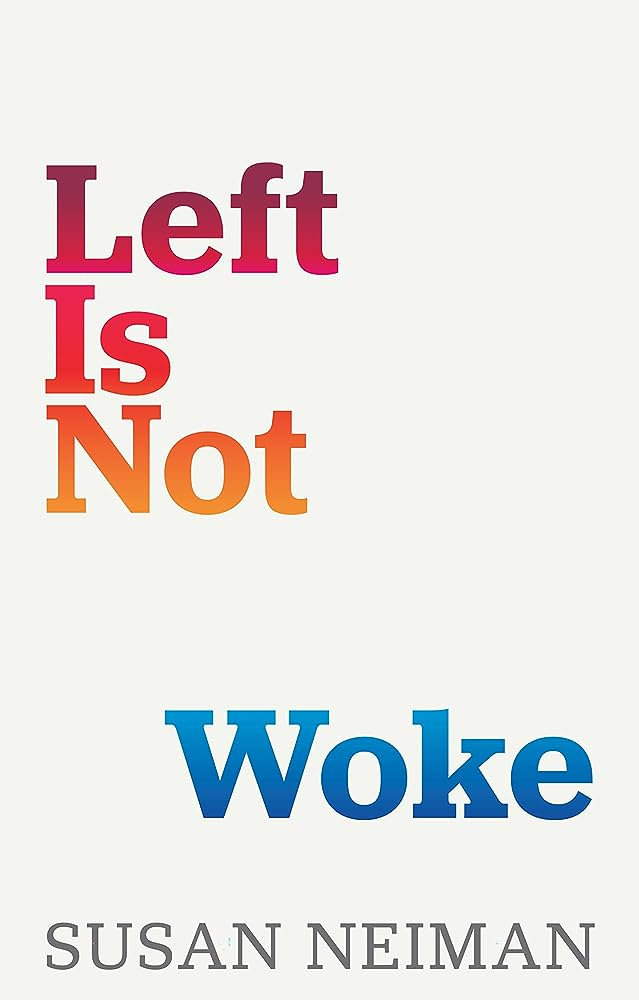
Mirror-Universe Foucault in a land without Marx: The bizarre phantasmagoria of Left is Not Woke by Susan Neiman

This book is not what I expected.

When I initially opened the cover and was confronted by the statement that, “Except as occasional targets, they {‘leftist’ ideas of universalism, justice and belief in the possibility of progress} are hard to find in contemporary discourse. This has led a number of my friends in several countries to conclude, morosely, that they no longer belong to the left. Despite lifetimes of commitment to social justice, they’re estranged by developments on what’s called the woke left, or the far left, or the radical left.” I assumed this was the tired Sam Harris style grift whereby a centrist liberal declares themselves the real left and, glancing at progressive liberals, declares them the far left, ignoring entirely the existence of communists, socialists and anarchists.

That’s not this book though. Instead the book is far stranger than that. This isn’t to say that the book is good. It is perhaps the second-worst work of pop-philosophy I’ve ever read (the worst being the absolutely execrable How To Be Perfect by TV producer Michael Schur). Where it differs, and how it ultimately exceeds the worst-of-the worst is in the clear breadth of Neiman’s reading. However this makes some of the remarkable exclusions in the text even more baffling. Things I could pass off as ignorance on the part of Schur are burdened with significance in Neiman’s book.

Now, since I’ve said the book is not a typical right-reframing of the Overton window a-la Sam Harris or his sad ilk the question should be raised as to what exactly the book is. And this book actually has a laser-sharp focus which is elided by its unfortunate, and overly-broad, title. This book is an attempt by Neiman to accuse Michel Foucault of smuggling Naziism into leftist philosophy. There is a secondary objective of this book – and that is to reestablish the primacy of Immanuel Kant as the champion of progress and to defend him from accusations of racism.

This comes together in her essay when Neiman makes the absurd proposition that Enlightenment philosophers can be distinguished from “practitioners of theory” in that these later “practitioners of theory” write in impenetrable jargon while the enlightenment philosophers “wrote clearly, without jargon, in the interest of reaching the widest number of readers. (Even Kant, the most difficult of Enlightenment philosophers , wrote fifteen perfectly intelligible essays for a general audience.)”

As somebody who has read both Discipline and Punish and the Critique of Pure Reason about the only thing I can say about such a claim is ‘LOL; LMAO.’

However this is ultimately a bit of a misleading passage for what follows as it becomes clear that Neiman has read both Foucault and a sufficient number of his critics to recognize that he wrote essays that were quite clear and accessible to a general audience. Rather she’s concerned that Foucault’s work depends on a method whereby it “hypnotizes” the audience rather than depending on rational argumentation.

For the first half of the book Neiman cannot mention Foucault (and she mentions Foucault quite a lot) without also bringing up the Nazi jurist Carl Schmitt and although she’s never quite bold enough to say so openly it really does seem like what Neiman wants her audience to believe about Foucault is that he was some sort of secret Nazi. She certainly doesn’t hesitate to call the concept of Power-knowledge reactionary.

But I do believe a lot of the disconnect in Neiman’s very unsympathetic reading of Foucault boils down to the old idealist / materialist split. For Neiman there are three fundamental elements to the left wing project, three precepts, that she believes Foucault’s work violates:

  1. Universalism
  2. Justice
  3. Progress

Now with progress, Neiman has a very careful and specific definition which she applies. Unfortunately she reserves defining this term to the conclusion of the book which is a poor structural choice as her failure to properly define progress at the outset significantly weakens her argument.

“It’s a matter of changing direction: Rather than thinking of progress as directed to a particular goal it can be useful to think of progress from a problematic situation to one that is less constrained.” Now this is very close to Beauvoir’s idea from The Ethics of Ambiguity regarding the movement toward an open future as the objective of a Left-wing ethic. It’s a real shame that Neiman never thinks to cite Beauvoir. Although Kantians ignoring Beauvoir’s ethic is something of a perennial complaint of mine it’s remarkable how this specific Kantian manages to arrive at some of Beauvoir’s conclusions without giving her predecessor even the most cursory recognition. However what Neiman fails to do at all is demonstrate how Foucault violates this revised precept of progress.

Certainly Foucault is critical of readings of history as progressive. His project examines how power changes form in relationship to changing epistemologies and how politics acts as a form of open warfare between parties. But Neiman takes from Foucault’s historicism that his writing makes it “hard to avoid concluding that any attempt to improve things will only make them worse.” This is a wild reading of Foucault to say the least.

At one of her most charitable episodes Neiman compares Foucault’s critique to that of Rousseau but argues that after Rousseau constructed his critique he spent the rest of his life trying to fix the world.

However this appears to be Neiman treating both of these writers as their texts alone. Certainly Foucault’s academic work remained diagnostic rather than prescriptive but it could be argued just as easily that Rousseau’s diagnosis was incomplete when he abandoned it in favour of spinning off a bunch of proposals that history demonstrated failed to lead to mass liberation. Meanwhile Foucault worked hard toward prison abolition.

Neiman briefly addresses Foucault’s abolitionism but only to suggest that Foucault’s motivations for doing so were amoral and that this means these activist activities somehow didn’t count. She loves going on about the supposed moral void of Foucault’s work, citing Chomsky calling him evil, citing Améry calling him problematic. But she fails to contend with the idea that Foucault limited his academic work pretty specifically to epistemology and never pretended to be writing an ethic; not everything has to be an ethic to be useful.

Despite Neiman’s relatively nuanced perspective on progress she still falls into the broad progressivist trap of seeing an arc of history bending inexorably toward justice, saying of the Kennedy administration’s record on civil rights in the United States that, “A world where all citizens have equal rights to eat, ride and study where they want to is better than a world where they do not, and no amount of dialectical sophistication would lead a black Southerner who lived through segregation to deny it.” There are, of course, two issues with such valorizations of incremental progress. The first is that Neiman is choosing to look at a specific change in a specific historical moment and to weigh it ethically as being “more good than what immediately preceded it” but in doing so fails to contend with the possibility of reversals throughout the history prior. This is unsurprising. Neiman believes that focusing “too much” on history blocks the path to progress.

The other problem is that Neiman seems unable to believe that anyone would write a philosophical text that explicitly avoids ethical statements and keeps trying to read an ethic back into Foucault where there is none. When she succeeds she calls this ethic perverse. When she fails she decries him as amoral. Using these two positions she characterizes the extra-academic actions Foucault took which have an ethical dimension as being perverse and amoral even when he was actively fighting for liberation.

On progress Neiman frequently raises and explores the question of the State of Nature. Much of this is to defend enlightenment thinkers from accusations of racism or colonialism. Neiman is careful to cite African philosophers regularly and I will say makes a convincing argument that she is on the right side of history when it comes to black liberation. This makes her blind spots concerning Indigenous North Americans all the more bizarre. Neiman insists on talking about “tribalism” and “tribes” throughout the book, saying that she prefers the word because it conjures the idea of barbarism. She openly admits that somebody (possibly a sensitivity reader) told her she shouldn’t say that but she did it anyway. And yet, for all of this, there are only two citations to anthropologists: David Graeber, who she is dismissive of, and Claude Lévi-Strauss, who she treats as having tried to test Rousseau’s state of nature hypotheses.

She certainly fails to address the writings of anyone of the ilk of Pierre Clastres – whose work helped to scientifically repudiate the racist idea of a progression from savagery to civilization. In fact between her vehement defense of Kant against charges of racism and her insistence of tribalism, I described the first half of this book, excluding the critique of Foucault thus: someone called Kant racist and she called them a tribalist and then that same someone said that’s racist and she got so mad she wrote a whole book about it. Of course Neiman cites no Indigenous sources.

Before departing from the topic of the state of nature I will say that some of the best material in this book is a thorough, vicious and insightful critique of Richard Dawkins and of Evolutionary Psychology. She easily recognizes the misogyny at the heart of evo-psych and she pulls no punches. More strangely she claims that evo-psych is broadly accepted as settled science by left and right alike (this is news to me) and she makes a weak attempt to tie this abortion of pseudoscience back to Foucault. Foucault was, of course, quite hostile to the idea of human nature as such. This makes attempts to blame him for some of the worst of the “just human nature” crowd rather absurd. To her marginal credit it seems even Neiman recognizes she’s stretching here and so we end up with a third of a chapter mostly about how Foucault is a secret Nazi that diverges into a good critique of a contemporary reactionary movement without much connection to the rest of her thesis.

On justice she believes Foucault to be of an accord with Schmitt that there is none. She’s aghast at Foucault’s account of juridicalism and is deeply discomforted by the contents of Discipline and Punish. But there’s an odd dance Neiman often does in her critique of that book whereby she will complain about some position Foucault took there, then will generalize it to the entirety of his being, constructing an essential Foucault, then justify that essential Foucault with quotations from Nietzsche, Genealogy, History.

However it’s worth also noting that Neiman has a view of justice that is both vulgarly-progressive (she believes society has become more just over time) and that is very much in the Kantian idealist mode whereby justice is a noumen of which any given application of justice is a phenomenon reaching (necessarily) imperfectly toward it. As such she excuses contemporary injustice as a work in progress while insisting both that the prison is preferable to the gallows and also that Foucault thought the opposite. She is poorly equipped to handle a materialist view of justice as a historically-bound system of power relations.

And here is where we must address the glaring omission in the heart of Neiman’s book because she has penned an entire book about “the left” that mentions “Marxists” twice (neither complimentary), Engels once and Marx never at all. She cites Fanon a lot but of him she says, “Fanon was a universalist who sought justice and believe in the possibility of progress.” This is made even more baffling by her vague assertion that ‘the Left’ has abandoned Diderot along with the rest of the enlightenment. Diderot is brought up in her text in close proximity to Fanon.

Now it’s notable that Karl Marx, who Fanon studied with care, was very fond of Diderot. As such there is actually a philosophical lineage that can be drawn directly between Fanon and Diderot. It’s just that, for this to be intelligible, you have to admit that Karl Marx existed.

On universalism Neiman is on the weakest ground. She realizes that the colonial project of civilizing the savage was a product of universalist thought and repeatedly argues, passionately and at length, that colonial powers misappropriated enlightenment thought that was critical of their project. Again there is an idealism here that wants to separate out what a thought is in itself from how it is used. Kant criticized colonialism so the use of his work by colonial powers is irrelevant. He’s not to blame for how his work was used.

It seems like Neiman cannot imagine a molecular justice or progress. She insists the left, to have a meaningful project, must pursue the same outcome (justice and progress) for all people everywhere. What makes this absurd is that she might be much more capable of making this argument if she abandoned Kant even briefly and spoke in Marxist terms. While many contemporary Marxists (such as myself) have read enough Deleuze to recognize the value of the micropolitical and the local on praxis there is a wealth of thoroughly universalist Marxist writing she could have drawn from. I mean Trotsky is right there. As a result Neiman’s deep loyalty to Kant ultimately severely hamstrings her ability to claim that universalism is a good. She’s far too concerned with defending the reputations of Kant (especially Kant), Voltaire, Rousseau, Montesquieu and Diderot to succeed in creating a persuasive argument for the necessity of universalism on the left.

I think I understand Neiman’s hesitance around Marx though and it’s because I don’t actually believe Foucault was the real target of her critique. Frankly Neiman’s Foucault is a straw man among straw men. Anyone with even a basic grounding in Foucault can either dismantle or brush away most of her criticisms without difficulty. Foucault was amoral? So what? Does that make his epistemology incorrect? But what’s going on here is that Neiman has a deep distrust of historical materialism.

Historical materialism is a demystifying way of looking at the world as a set of contingent material conditions where progress is not assured, where justice is described in non-moral terms and where universality is ultimately impossible. If you accept a view of history as a series of conflicts between classes then the progress toward justice rapidly becomes the playing out of conflicting powers rather than reason fumbling toward a nouminous good. “We have no compassion and we ask no compassion from you. When our turn comes, we shall not make excuses for the terror,” Marx said and this was a recognition that the proletarian struggle was not one of seeking progress toward an ideal. It was a threat, “we are coming for you.”

But as much as Neiman is obviously uncomfortable with the lack of idealism in Marx she cannot bring herself to attack him. It becomes clear in her conclusion that, despite some boomerish language, her preferred political project is far too close to socialism to openly attack Marx. As I mentioned before her idea of progress is incredibly close to Beauvoir’s (Marxist) idea of freedom. To openly disavow Marx would be to destroy the basis for her own project.

And I do think Neiman constitutes a leftist, even if one with some troubling unexamined baggage around Indigenous North Americans. So I don’t think she wants to undermine that basis. Instead she has produced this remarkably bad book. She sets up a caricature of Foucault for demolition and, in his place she raises up Kant as the father of the Left. Neiman acts as if Marx never existed and as if his students and friends hardly did either (excepting Fanon whose tie to Marx she elides) and, having erased him from history she rebuilds social democracy from a basis of the categorical imperative.

Neiman’s book is thorough and, on those rare occasions she isn’t talking about Foucault, it’s logical. But the problem is that it seems to have been written from a mirror universe with significant differences from ours. Now I’ve seen enough American radlibs who know the words to liberation but who don’t understand the beat, the sort of people who will say that it’s actually doing fascist work to de-platform a fascist if, in the process of that de-platforming, a marginalized person might come to harm. But it’s absurd to call these failures of education the far-left. That is still composed principally of Marxists and Anarchists who are usually more sensible. And it’s even more absurd to suggest such frivolous appropriations of the language of social justice are the fault of Michel Foucault. Hopefully this book will be forgotten by the history whose interrogation its author fears.

Regarding adults and children’s media

I didn’t want to talk any more about this.

My principal reason for writing In Praise of Discomfort was because The Mary Sue deceptively used links to my words in the service of a bizarre and gender-essentialist read of the horror genre. This is something that I, as a horror critic and reader, wasn’t about to sit back and allow.

And now…

It’s happening again.

Specifically a book reviewer and writer of no particular talent but rather great popularity on the fan circuit, Cora Buhlert, has scrawled her latest volley in an ongoing dispute between two loosely defined cliques of genre writers, readers and critics.

In the process she brings me and my friend Raquel S. Benedict up at length in order to attempt to pillory us for the crime of disagreeing that the people pushing the marketing category of “cozy horror” will be good for horror in general. And even Buhlert cannot deny that “cozy horror” is effectively just marketing buzzwords, saying, “In fact, I should maybe try to rebrand the Hallowind Cove series (which started out as an attempt to write horror and became a sort of horror parody set in a quirky small town) as cozy horror, since nothing else has worked to help those stories find their market. “

With apologies to Buhlert I’ve read a small amount of one of her Hallowind Cove books and being mis-marketed is not, in fact, why she fails to sell:

He’d once asked Ian, Landlord of The Croaking Foghorn and the closest thing Paul had to a friend here in Hallowind Cove, about the raven.

“Oh that’s just Hugo,” Ian had said, “Never mind him. He likes to pretend he’s a harbinger of doom, but he’s really quite harmless.”

“Wa-atch out,” Hugo croaked again, “Wa-atch out”

Cora Buhlert – The Revenant of Wrecker’s Cove – Hallowind Cove Book 1

With sub-Gaimanesque prose stylings like this and a cover containing clipart so obvious that you can still see the edge of the .jpg overlay in one place, her work lacks both the quality and the commitment to professional standards necessary to be worthy of much attention. I doubt marketing this piffle as “cozy horror” is likely to improve her sales much.

However it’s not Buhlert at her most honest here that warrants a response. I’d have been happy to keep quiet on my opinions of her stories much like I am on the work of countless other amateur story-writers had she not also said the following:

“As for why Benedict, McNeil and Sullivan object to the existence of cozy horror, there are several arguments, most of them familiar from previous debates. McNeil’s main point is that he believes that horror should make people uncomfortable and that cozy horror is therefore an oxymoron. He also dismisses several of the examples given in The Mary Sue article, particularly the 2014 animated series Over the Garden Wall, as “children’s media”. Now Over the Garden Wall may well be aimed at children – I haven’t seen it. Besides, as I’ve pointed out above, horror is a genre that appeals to the young. However, there is a certain sneering undertone in the way McNeil dismisses “children’s media” that you often find with a certain type critic, who tend to conflate “I don’t like this” or “I’m not the target audience for this” with “This is YA”, whereby YA is inevitably viewed as a bad thing.”

And again we’re seeing the same, sad, attempt to smear critics playing out in Buhlert’s blog that we did in the original Mary Sue article. And Buhlert fundamentally misunderstands my concern about adult consumption of children’s media.

See I actually think children’s media is quite important. Even moreso I expect it to be good. This was actually a focus on a significant sub-series of my blog, “kids stuff” and I would dearly appreciate if the next person to accuse me of “sneering” at children’s media would start by reading these articles and noting some of the things I have to say about children’s media.

For instance, I concluded my review of The Mitchells vs the Machines, by saying, “It’s to be expected that a movie financed by Sony and Netflix and created by a team that brought you a hyper-stylized comic book and a 101 minute toy commercial would fail to create something critical of capitalism, that they’d be unable to recognize that the subject of critique in PAL’s nihilism and Mark’s disregard for relationship was somehow connected to a psychology that triangulates social relations against a patriarch or that both were tied inextricably to capital. It’s a challenge because I do want to see media going the direction The Mitchells vs the Machines goes. It’s just that it doesn’t go anywhere near as far as art must.” This echoes my conclusion regarding the Netflix limited series Wednesday, ” Jenna Ortega is a talented new actress and I’m glad to see her getting a larger role after playing a second-fiddle in recent outings like Scream (2022) and X. But it really drives home that you can’t expect a coherent critique of normativity from Tim Burton. And we can all, perhaps, admit at last that it was good he passed on the 1991 film and cleared the path for Barry Sonnenfeld to direct in his stead. Because, building largely on the aesthetic legacy of Sonnenfeld’s movie and on the hastily redacted fan-series of Melissa Hunter, Burton managed to make… a mess.”

Talking about the classic children’s novel, A Wizard of Earthsea, I said “Ged is the wellspring of power that rises out of the primordial origin of all things. He is the doer, the agent of action in the story. The gebbeth is the un-doer, the reactive, the end of things. Ged, to come into an understanding of himself, must see his end as clearly as his beginning. He must be as aware of the ways in which he un-does as the ways he does. Unexamined, Ged’s shadow-self seeks revenge against Jasper and it is let loose, it rampages. It kills. It hounds Ged from crisis to crisis. But when faced, when Ged points to his own darkness and calls it with his name, it comes; it becomes; it comes into being. But by coming into being it is done away with because it becomes nothing but the awareness Ged has of his own potential toward death. There is no other here. There isn’t a wanderer and his shadow – there is a river, all of it, from its spring to its sinking in the sea.”

In short what I expect of children’s media is, for the most part, what I expect of adult media: that it can stand up to critical scrutiny, that it is well-crafted and that it communicate a clear and consistent theme. But it’s also true that I’m rather critical of adults fans of children’s programming.

This is because there’s one other element of children’s media that absolutely must be true: children’s media must be legible to children.

Now I know from experience that creating legibility for a child requires a process of a certain simplification. I joked about that in the Earthsea essay, qualifying its inclusion in children’s literature by saying, “However, despite these hallmarks of children’s fictions, this is a book with a density of theme and topic that could prove challenging for an undergraduate university student to fully disentangle. While I have positive things to say about some of the very inventive structural and pedagogical things done in modern children’s lit, for instance, Elizabetta Dami‘s use of modified type to emphasize key words is a very interesting artistic choice, and one with an obvious pedagogical benefit, I don’t think there’s a single voice in children’s literature in the 21st century who would tackle the very abstract topics like the ones that are at the center of Le Guin’s book.”

And this absence of abstraction is a key problem. Adults should be accustomed to paying attention to abstract and dense topics. That’s part of being an adult. As Paul’s first epistle to the Corinthians says, “When I was a child, I spoke as a child, I understood as a child, I thought as a child: but when I became a man, I put away childish things.” As a person grows and develops out of childhood they need to be able to observe phenomena through a lens that simply isn’t available to children because it is dependent on the experience of growing into adulthood. For one’s taste to remained mired in children’s media isn’t a problem because children’s media is bad but rather because children’s media is good for children. I would expect adults to find it limiting in precisely the same way they would find the shoes they wore when they were six limiting: because they have outgrown it.

So, no, YA is not, “inevitably a bad thing.” It’s a perfectly good thing for twelve to fourteen year-olds. But if you are a fourty year-old and you’re still shopping for books principally in the YA aisle you have some growing up to get on with.

I am happy to see that Buhlert reacts with discomfort to the use of gentrification in this discussion as a metaphor. “Though personally I find the metaphor hugely problematic, because gentrification does untold harm in the real world by displacing and destroying whole neighbourhoods,” she says. And, yes, it’s very true that gentrification really is that bad. But perhaps she should note that I’m the same person who simultaneously said leftists should be uncomfortable with folk horror because of the way the subgenre deploys reactionary volkishness on one hand and then recommended leftists should watch folk horror so as to interrogate their discomfort on the other. I recommended In the Earth as a good one. Basically I don’t write to make people comfortable and if Buhlert is made uncomfortable by the idea that the genre fiction scene shares characteristics with real-world gentrification then she has a wonderful opportunity to interrogate that discomfort.

Moreau Vazh has laid out with clarity and precision exactly what I mean when I talk about gentrification within this metaphorical context, saying of the SFF publishing mainstream, “When the sub-reddit has been quiet for months and the last specialist bookfluencer has stopped coming up with themed dances to celebrate book releases, they bust out the joint and light a match. The old shit is dead and oppressive… It is tiring having to talk about it… It sucks all the air out of the room when we should be talking about the new shit.”

Effectively, when Buhlert says she thinks it’s “problematic” to use the gentrification metaphor to describe what SFF does as it, to paraphrase Vazh, hops from sinking ship to sinking ship, what she’s really saying is that she doesn’t like what I’m implying about her and her friends – that they are gentrifiers.

But this is the old liberal / leftist mismatch on language at play. Liberals, poisoned by the individual and atomized subject-concept of their decrepit ideology, see any reference to a systemic problem, such as gentrification, and assume it must be made up of a category of individuals who are essentially gentrifiers. Whereas a leftist such as myself denies that a subject is individual at all to begin with.

I don’t think Buhlert is a gentrifier. The truth is that, when she hasn’t deigned to impose herself upon me, I don’t think about Buhlert at all. But I don’t assign any personal blame to Buhlert. It’s not morally wrong to be an untalented short story writer. But it is, at the very best, gauche and a little pathetic to make veiled accusations regarding the politics of one’s critics because they happen not to be on board with the marketing category you’ve decided will be a silver bullet for the fortunes of your amateur story-writing efforts.

I sincerely hope this will be the last thing I ever have to say about “cozy” Horror.

The incoherence of “fuck Trudeau”

I have an ambivalent relationship to the statement “fuck Trudeau.”

On one hand, yes, fuck that guy. The government of Justin Trudeau has overseen the collapse of Canada’s healthcare system across multiple provinces – in part due to the complete failure of Canada to set safe COVID-19 policy or to effectively communicate those policies that were set. The abdication of COVID policy to provinces was one of many failures of inaction. Another cogent example has been the failure of the Trudeau government to meaningfully address contaminated water in First Nations communities or to respond meaningfully to the multiple discoveries of mass graves on residential school properties. Further failures of the Trudeau government include out-of-control inflation leading to a Bank of Canada response that deepened the ongoing national housing crisis and a blind eye to monopolistic practices by Canada’s two largest grocery conglomerates and a general abdication of foreign policy to the United States and a failure of Canada as a reasonable diplomatic intercessor – as the Trudeau regime has largely fallen in line with American neo-cold-war policy.

With that being said I haven’t a single good thing to say about any person who sticks a “F(maple leaf)ck Trudeau” sticker on the back window of their car – this political expression maps almost as closely to crypto-fascist politics as the thin blue line flag icon. This is ultimately because the ultra-conservatives who advertise their desire to enter into carnal relations with Justin Trudeau fundamentally misunderstand the problem with Canadian politics.

The issue isn’t that Justin Trudeau is an incompetent, blundering, indecisive toady to the United States nor is it, as some conservatives might imply, that he’s a secret communist trying to sell Canada to the Communist Party of China. Rather it’s that Canada is an undemocratic systemic failure. These conservatives misapprehend that the problem with Canada is Justin Trudeau and if they could just get their guy in (be it Pierre Poilievre or Maxime Bernier) then things would be peachy.

Of course the best case scenario from a government headed by Poilievre or Bernier would be more of the exact same failures demonstrated throughout Trudeau’s tenure as prime minister. the worst-case scenario would be an acceleration to the same sort of open fascism that now characterizes the politics of the United States. This is not the sort of decision matrix that any decent Canadian should wish to see.

Canada, in 2023, is a neoliberal experiment in government by and for a vanishingly small number of resource extraction enterprises. Canada isn’t a society; it is ten mining companies, three telcos and two groceries in a trench-coat and all the policy positions of both the Trudeau government and their predecessors – the Harper-led Conservatives – make sense in that context. The remarkable continuity of these governments, divesting themselves of foreign policy decisions in favour of key trade partners, safeguarding mining and extraction at home and abroad, allowing unchecked monopoly power over food and communications all while sitting on their thumbs while all matters that can reasonably be described as provincial jurisdiction get perpetually more broken across the country isn’t a matter of Liberal / Trudeau policy nor of Conservative / Harper policy. There is a broad bipartisan consensus on these issues. The function of the two parties is to provide each with an easy scapegoat for the continuation of their shared policies. The collapse of healthcare? Don’t blame the Liberals! Blame those conservative governments at the provincial level with their unreasonable demands. And as for all the economic fallout of the bungled COVID-19 response? Well, “fuck Trudeau.” Parties in Canada are top-down affairs. The government is commanded by party leaders and the parties exist merely to amplify the will of these leaders. All the while these petty dictators in democratic guise bellow, “more of the same!” Their followers are contented merely to hate each other.

There is an imaginary in which there might be some cultural difference between Conservatives and Liberals which might serve as justification for personal grievance. The Conservatives are bigots, anti-vaxers and racists, right? But as the conservatives love hypocritically pointing out, the Prime Minister, a former drama teacher, just seems to love getting done up in cultural costume or even straight-up blackface. Ultimately the overt bigotry of the conservatives and the polite bigotry of the Liberals serves the same function: to divide the working classes against each other. This is why we must oppose bigotry in all its forms – only by overcoming homophobia, transphobia and racism can we form the sort of mass movement necessary to destroy the real enemy: Canada.

Because this is the real truth that the patriots on both sides fail to see. The problem isn’t Justin Trudeau nor is it Pierre Poilievre. The problem is Canada. Canada is a neoliberal playground for the rich and the various political figures are just distinct heads of a single hydra. A real democratic nation would depend on the elimination of Canada. It must be built, first and foremost, on a recognition of the treaties signed between the colonial powers who created Canada and the First Nations they sought to supplant and reparations for violations thereof but beyond that we must create a society which is not a neoliberal state but a post-state democratic culture in which the voices of all Canadians govern themselves rather than taking marching orders from party heads. This will not happen within Canada as it exists today because states are all perpetually terrified of their own mortality. Canada will cling to its neoliberal undeath until we drive a stake through its heart.

This is to say, while Trudeau can get fucked what we really should be saying is fuck Canada.

Harry Potter and the Death of Roland Barthes

We are in hell.

This is a specifically neoliberal hell wherein, “no ethical consumption under capitalism” has, as one online commentator put it, become, an ethical imperative to consume. People see anyone interfering with their unimpeded enjoyment of those things they seek to consume as being, at best, morally questionable. How dare somebody else tell me, an individual, how to go about enjoying the things I want to enjoy?

This sense that it’s somehow wrong to interfere with the flow of libidinal intensity does, however, require a fair bit of apologetics and this is where the corpse of Roland Barthes gets hauled out of the grave and paraded around. “I separate the artist from the artwork,” people say, as if to suggest that because we can void the authority of the author to grant a text meaning this means that the author is no longer materially connected to the text.

Of course this is absolute nonsense. First off we would have to accept, fully, that Barthes’ premise was correct and that an author has no special authority over a text. Certainly Rowling, in particular, problematizes this premise as she has been particularly activist in the assignment of specific meanings to her text after delivery of it. Retcons such as the declaration that Dumbledore was a gay man, that various other schools of magic existed that were outside of the bounds of the delivered text (such as the nearly offensively named Mahoutokoro and Castelobruxo), or basically everything that happened in and around Harry Potter and the Cursed Child show that Rowling, as an author, has never been satisfied to allow an audience to construct meaning in her texts absent her influence; Rowling is a nearly uniquely activist author with regard to what her books mean. Furthermore, Rowling’s activism aside, the assumption that authorial intention is diffused by contradictions within a text is built around the asumption that authors are unified in their intention. If we start from assuming a certain polymorphic quality to authorial desire then we would end up with a situation in which any meaning that can be reasonably read into a text can be seen as an intended meaning. An author is not individual in that their authority, as an author, can be divided across all the things that they put into the text. All this is to say that it’s rather absurd to divide Rowling’s interpretation of her “wizarding world” from its implementation in texts such as a recently released half-rate Destiny clone.

However there’s something more insidious about attempts to divide Rowling from derivative licensed work such as Hogwarts Legacy – this is that Rowling gets paid for these things. While it’s true that the depiction of goblins in Rowling’s text is alarming at best, and while it’s also true that the “queer rep” of a transphobic straight woman will be problematic at best all this is somewhat irrelevant to the game itself – which Rowling didn’t write. She is, in fact, not the direct author here aside from her tendency to insert herself as an authority. The problem is that Rowling gets paid for this work and, with that pay, can continue amplifying her transphobia. There is a material relationship between the video game and the author of the books it is derived from that cannot be elided by any sort of pseudo-structuralist literary analysis. This is the problem with buying Hogwarts Legacy. It is not a question of the meaning of the text. By most accounts Hogwarts Legacy is a game that tries to mean very little of note. You run around blasting fire balls and other such violent magic at goblins only to discover it was all a frame job at the last minute. I’m sure this will be a cold comfort to all the goblins the players vaporized in the process of discovering the frame. So, no, Hogwarts Legacy looks like yet another committee-made, focus-group approved, skinner box that seeks to say as little as possible in order to maximize the likelihood that the audience will get hooked on the core gameplay loop and stay engaged. But it’s a skinner box where every person who buys it contributes a few pennies to the cause of bigotry via its material economic link to someone who regularly expresses bigoted views.

A a result people such as Jessica Conditt have, via their engagement with this game, helped to enable this bigoted agenda in the real world where you can’t just obliviate away all memories that Rowling is a TERF. It does not matter in the slightest that the reviewer has, “a big ol’ Harry Potter tattoo next to an anti-TERF tattoo,” because the issue is not the meaning she personally assigns to Harry Potter. The issue is money. Conditt, writing editorials for endgadget promoting that it’s morally Ok to buy this game, has, whether she intends to or not, financially aligned herself with TERFS. I couldn’t care less about the marks on her skin next to how she acts in the world. And how she acts in the world is as a promoter for this awful little game. The tendency of defenders is to fall back to individual subjectivity. This is, yet again, a reification of the moral imperative to consume. “As someone who searched desperately for an example of my own identity in the pages of Harry Potter novels, I deeply appreciate the evolution and inclusion in Hogwarts Legacy. This level of representation didn’t exist in AAA games 15 years ago, and it’s the result of all the progress made, through protest and education, since the books were published. Long before the in-fighting over a choice to play a video game.” Conditt says and I have no doubt she sincerely feels that way. She just fails to see that her feelings don’t justify how Rowling spends the money this game will earn her and the derivative money that she will gain through the continued cultural relevance of these awful wizard books. Conditt says, ” It’s us against the transphobic people in the world, not us against each other,” but this isn’t true. There’s no “us” here. She’s on the side of the transphobe because she’s promoting the transphobe’s product that will make her money. It’s really that simple.

Also Conditt’s plea, “boycott the game – just don’t boycott the players,” demonstrates an atomized and neutered view of the boycott. The boycott is, in fact, an act of moral shaming. It’s not just a person witholding their money. It’s a person publicly announcing it’s immoral to give money to this or that product. It’s “no ethical consumption under capital” arising as apologia yet again. And just as it’s clearly immoral to advertise for arms manufacturers it is also, clearly and obviously, immoral to give money to bigots. If you do it you are doing a bad thing and you should be ashamed. Stop trotting around Barthes’ picked-clean skeleton and actually take some accountability for the moral weight of your choices. Consider how your actions actually materially impact people. Think about the money for once.

Truck Nuts

Truck nuts are just that — nuts

Throughout the month of February, Canada has been gripped in a slow-moving crisis involving a group that calls itself the Freedom Convoy occupying Ottawa with a loud and often threatening assortment of tactics, blocking international crossings such as the Ambassador Bridge and generally being a nuisance on the roads.

The claim of this group is that their principal motivation is that they are protesting against a vaccine mandate for truckers who cross the border between Canada and the United States. Presently such mandates for COVID-19 vaccination are required by both Canada and the United States. Also presently compliance among truckers is over 90% within Canada. Furthermore this convoy is not supported by the labour movement that represents Canadian truckers with Teamsters Canada, calling the convoy a “despicable display of hate lead by the political Right and shamefully encouraged by elected conservative politicians.”

This convoy is principally composed not of long-haul truckers but rather of private citizens most of whom drive pickup trucks or SUVs. This is categorically not a protest of truckers nor for truckers. However, thanks to a leak of donation data from Give Send Go we can see certain things about the composition of the active supporters therein.

The largest single named donor to this convoy was an American billionaire. The largest Canadian donor is a New Brunswick small business owner. Within the PEI data, which I have reviewed with some level of detail, approximately half of those donors who could be identified at any level of support were entrepreneurs or small business owners. The largest PEI donation (listed at $700) was paid directly by an eavestrough business. This convoy is not in support of truck drivers but rather of small and medium business owners with the explicit financial backing of American billionaires and crypto investors. The majority of donations (roughly 56% of recorded donations) came from donors in the United States. (Before anyone brings it up, 12 of the nearly 93,000 donations came from Russia.) So this is who this convoy serves: Canadian and American Petit-Bourgeois entrepreneurs. Mostly Americans.

The stated goals of the convoy are to ease restrictions related to COVID-19 however most of these restrictions are time-limited and set to expire in coming months. This was already known in late January when these protests began. So if the convoy could achieve their goals in a reasonable timeframe doing nothing why did they bother to come out and protest?

Well it’s because their goals aren’t really to have COVID restrictions eased.

Frankly the convoy is not a protest. It is a show of force. And so far it has been stunningly successful.

Here’s what it has accomplished:

  • The ouster of the vaguely moderate federal Conservative leader Erin O’Toole
  • The revelation that the police cannot be trusted to protect Canadians against the threat of far-right violence and that organized labour is too weak in this country to confront them directly
  • Free harassment of the citizens of the national capital
  • Airtime from news media outlets
  • A lot of money funneled to far-right figures in Canada from far-right figures in the United States; much of this money is being transmitted not via operational fundraisers like Give Send Go but rather via distribution of cryptocurrencies.

About the only thing this convoy has been unsuccessful in doing is ousting the Trudeau government – but the have struck a blow to his governance which has been weak, indecisive and overly-cautious throughout the crisis.

So what we have is a show of political force being put forward with the explicit backing of the petit bourgeois in defense of capitalist interests and in the face of crisis. As early as 1931 Leon Trotsky had that clocked as the material basis of a fascist movement. Despite his criticisms of Marx’s definition of the proletariat this is a point that Reich agreed with in The Mass Psychology of Fascism when he said, “As is done in every reactionary movement, Hitler relied upon the various strata of the lower middle class for his support. National Socialism exposes all the contradictions that characterize the mass psychology of the petty bourgeois”

We know this dance.

Communists, anarchists and other anti-fascists have spent the last two years trying to warn anyone who would listen about how the far-right, all these modern by-blows of fascism, have integrated into the anti-vax movement and how they’ve used this alliance to position themselves with increasing power. We explained anti-masking when the mainstream were bewildered by it. We explained how naturopathic concepts of cleanliness and purity fed into fascist fear of the other and everybody thought we were being hyperbolic.

Well now they’re here in force. Journalists are peeling the decals off their vans because they’re afraid of being identified. Tow truck operators are standing aside because they’re afraid of retaliatory violence. And the police don’t have the will to stop these neo-fascists from doing whatever the fuck they want. Don’t dare try and say we didn’t warn you.

But this presents us with a problem. Because, quoting Beauvoir, “When a young sixteen-year old Nazi died crying, “Heil Hitler!” he was not guilty, and it was not he whom we hated but his masters. The desirable thing would be to re-educate this misled youth; it would be necessary to expose the mystification and to put the men who are its victims in the presence of their freedom. But the urgency of the struggle forbids this slow labor. We are obliged to destroy not only the oppressor but also those who serve him, whether they do so out of ignorance or out of constraint.” You don’t surrender public squares to fascism. A response is required and the desire for the government to do something is fully justified. But part of the problem here is the complete abdication of responsibility by an intransigent police force that seems very supportive of these far-right figures. Our supposed political leaders seem unable to command police to deal with fascists as they would with First Nations activists. As such, new laws prohibiting vehicular blockades and occupations or categorizing these economic actions as terrorism are undesirable. There’s plenty of existing law that could be used against these fascists. The police are demurring from doing so. New laws just give the police-allies of fascism new tools to oppress enemies of fascism.

One of the principal preoccupations of Marcello Tari’s very challenging eschatological work, There is no unhappy revolution. is the position of the strike in modern revolutionary praxis:

“{In the new form of strike} there is no classic demand of future closure – something that became even more explicit during the revolt against the French labor laws – but expresses itself instead through the blockages of normal social functioning on the one hand, and the immediate material transformation of life and how we think about life on the other. The more intense the form of the strike, the more intense becomes the ungovernable nature of the form of life that expresses it.”

Simply put, in 2017, Marcello Tari was telling communists that they should be occupying cities and disrupting metropolitan economies. The problem is not that disruption has occurred but rather the who and the why of the matter. A fascist revolution will not create those new and ungovernable forms of life that represent the eschatological beyond of the revolution on the threshold Tari wants to prophecy. The real desire of these movements is to put things back to how they were in 2019. Just with a little bit more death. So we cannot use these movements. We must remove them. But we must do so in a manner that will not foreclose upon the left or our allies making use of similar tactics in the future.

An ideal solution would be for organized labour to remove these occupiers. The streets they honk their horns down do not belong to them and there is justice in removing them. If police will not do so citizens should. But if labour is unable to accomplish this task we still must remove these people from our streets and we must do so without the police as the police have made it entirely clear they intend to do nothing at all. This means that a critical thing we can do is to give support to Ottawa area resistance to these demonstrators.

I know some socialists have declared the convoy “a distraction” from the real work of dismantling capitalism but I have to take issue here. Fascism is the old enemy in its most visible form. It is the mobilization of capitalist violence without pretense. This is why the police sit back and do nothing. The leaders of the police will say the rank and file are afraid to act. The rank and file will say the brass is restraining them but the truth is far simpler: the convoy are adjuncts of the police establishment. They want an end to mask wearing for precisely the same reason the police do. They feel entitled to see your face and confirm you are allowed. They want an end to biopolitical regulations such as social distancing, reduced capacity at restaurants and other venues, vaccine passes and the like because these measures interfere with the free flow of capital and this is the freedom this “freedom convoy” really cares about. Just like police.

I know this rhetoric, calling for direct action on the part of labour from outside the strictures of law, explicitly criticizing policing as a solution to fascist social disorder, will probably leave NDP-type social democrats feeling very uncomfortable. And that’s good. I’m not comfortable with anything going on in this country right now, are you? Should you be?

Ultimately what we need is a renunciation. There’s no prelapsarian past to return to. COVID has arrived and the epoch has turned. That’s it. We must renounce the very idea that there’s a normal to return to or that we would even want it. I mean were you satisfied with life in this country in 2019?

One more reflection on Tari. I have to admit I am still reading There is no unhappy revolution. It’s not an easy book, dipping heavily from Walter Benjamin‘s Marxist and rabbinical thought, Catholic eschatology and the poststructuralist formations of Deleuze, Guattari and Agamben. But I’ve got far enough into it to put forward an hypothesis about what the book is saying.

In his formation of the Eternal Return, Nietzsche effectively asks us the question, “would you say yes if you had to say yes to absolutely everything?” There is no unhappy revolution. is an inversion of this, asking, “would you say no if you had to say no to absolutely everything?” There are fascists occupying Ottawa and at time of publication the police have done nothing to oppose them. How much are we willing to refuse to remove them?

Drawing the line: Capitalism and Wrong Livelihood

(Image c/o Wikipedia)

The Worldcon that never should have happened has had a wild ride after an all-too-easy to call COVID outbreak, some shady business at the business meeting that seemed likely an attempt to influence the site selection process away from the (ultimately winning) Chengdu bid for next year and then, the piece de resistance, the revelation that a major sponsor for the convention, with a branded red-carpet photo wall at the Hugo Awards was the Raytheon corporation.

This raises an interesting question regarding the duty of participants in Worldcon to respond to the interface of their science fiction convention with a “defense contractor” that was supplying materiel to Saudi Arabia at least as recently as 2017 and that is a key supplier of the US military. Should a concom be held responsible for how sponsorships are used to launder the reputation of corporations? What about the ethics of working for such an organization? After all, it’s something of a received wisdom in progressive spaces that corporations are de-facto evil; if we cannot work but to work for an evil organization is there a gradient of evil to mark against? How far is, ultimately, too far beyond the pale?

Buddhism provides a very concrete starting point for what constitutes a boundary with the Aṅguttara Nikāya, in particular containing discourses accredited to the Buddha and his disciples on the topic of right livelihood – one of the eight subjects of the Noble Eightfold Path. According to these early Buddhist texts, a right livelihood is one that does not involve traffic in, “weapons, living beings, meat, alcoholic drink or poison.”

As such it’s clear that, at least from an orthodox Buddhist perspective, there is a very specific line and it is one that Raytheon is entirely beyond. Of course the same could be said of the butcher and the liquor store down the road along with any pet store proprietors and certain garden shops that sell plants that could potentially be used for the production of poison so we could, perhaps, argue that such specificity is somewhat unhelpful to a modern context.

The Buddhist proscription is bound, inextricably, to a Buddhist ethical universe that seeks to avoid the causation of harm. As such proscribed livelihoods are proscribed because of their specific interaction with the Buddhist perspective on what constitutes the Good. However what the Buddhist example is best for showing is that a boundary can be set. We can, in fact, say that even if all things are not intrinsically ethical some things, in particular, are unethical enough that they should be avoided as moral hazards.

No ethical consumption under Capitalism

There is something of a mimetic phrase within progressive circles that there is no ethical consumption under capitalism. This phrase appears not to have a clearly fixed origin although it does seem to arise out of online spaces. Now this argument – that ethical consumption is impossible within Capitalism points in two disparate directions. First, it is deployed as a form of absolution. “Yes I know this product was made by an appartheid state in an occupied territory but there’s no ethical consumption under Capitalism,” at the extreme sure but also, “I’m aware that fast food restaurants deploy environmentally destructive agricultural practices to keep prices down but there’s no ethical consumption under capitalism, I live in a food dessert and have few choices and ultimately I have to eat something,” would be closer to an ideal example of this absolutory use. The second is as a critique. A celebrity backs a T-shirt slogan – or some other commodified piece of political rhetoric – and critics point out that it was manufactured with exploited labour. Does a feminist really look like a white woman getting rich off of sloganeering at the expense of vulnerable workers in Bangladesh? There is no ethical consumption under Capitalism.

And so, effectively this statement means either, “I am aware of the contradiction in my position and cannot avoid it,” or “you should be aware of the contradiction in your position,” depending upon whose consumption is the subject of ethical assessment.

Now a fan convention is most certainly an example of consumption. In fact, fewer things are more purely consumptive than a fan convention – an event that seeks to lionize and institutionalize a category of consumption, to bring consumers into the proximity of producers so that they can consume more effectively. And with a fan convention being a form of institutionalized consumption, sponsors of a convention are certainly to be counted both as consumers of the product the convention offers (largely the attention of other consumers) and simultaneously as producers of the event. Raytheon is both a consumer of Discon III and also a product that Discon III attendees are being invited to consume. And anybody who took a photo at the Raytheon branded red carpet photo station, anybody who went to the Raytheon booth, they were consuming Raytheon. So when people respond to this consumption of Raytheon by attendees that there is no ethical consumption under Capitalism our question then becomes whether this is the consumer being asked to be aware of the contradiction in their position or if it is the consumer aware of the contradiction claiming they have no choice.

It honestly seems mostly to be the latter.

Certainly, unless that consumer was on the concom they had no choice about whether to invite Raytheon to be a sponsor so we may be able to absolve most attendees of that specific blame. Although members of the concom should certainly be called to account for their funding decisions. However, while the attending membership had no choice whether Raytheon was to be a sponsor, this doesn’t mean they had no agency in this situation at all. And this is where things become even more difficult.

Ambiguity

In her seminal work, “the Ethics of Ambiguity,” Simone de Beauvoir grappled with the fundamental problem of making ethical judgments in recognition of the inability of a person to have an objective understanding of all consequences. In this book Beauvoir remains consequentialist in her outlook, maintaining that the ethical value of an act had to do with its movement toward liberation but problematized consequentialist ethics by pointing out that it would be nearly impossible to judge, in a moment of action, whether any given well-intentioned action, in fact, moved in the direction of liberation. Antagonistic to the virtue-ethic of the Buddhists that would declare it is wrong livelihood, a consequentialist might ask to whom weapons were being sold and to what purpose. Beauvoir then points out that, no matter how great the purpose the consequentialist cannot possibly know what the ultimate consequences of selling those guns must be.

In the end, Beauvoir’s ethic proposes something of a Sisyphean life – one of constantly striving toward a greater freedom fully aware that it can never be obtained. The struggle for liberation is an endless and ever-changing task. All a person can do is their best. As Beauvoir puts it, “Ethics does not furnish recipes any more than do science and art. One can merely propose methods. Thus, in science the fundamental problem is to make the idea adequate to its content and the law adequate to the facts; the logician finds that in the case where the pressure of the given fact bursts the concept which serves to comprehend it, one is obliged to invent another concept; but he can not define a priori the moment of invention, still less foresee it.”

Beauvoir argues that meaning is constantly changing and that the movement of life with purpose, of a good life, is thus also constantly a moving target. But that doesn’t mean she provides no lodestone. Instead Beauvoir takes a nearly Epicurean approach, saying, “However, it must not be forgotten that there is a concrete bond between freedom and existence; to will man free is to will there to be being, it is to will the disclosure of being in the joy of existence; in order for the idea of liberation to have a concrete meaning, the joy of existence must be asserted in each one, at every instant; the movement toward freedom assumes its real, flesh and blood figure in the world by thickening into pleasure, into happiness. If the satisfaction of an old man drinking a glass of wine counts for nothing, then production and wealth are only hollow myths; they have meaning only if they are capable of being retrieved in individual and living joy. The saving of time and the conquest of leisure have no meaning if we are not moved by the laugh of a child at play. If we do not love life on our own account and through others, it is futile to seek to justify it in any way.”

And, of course, this idea of a good life as being one that pursues some sort of genuine happiness both on our own account and through others is something of a shared quest between Beauvoir, the Epicureans and the Buddhists.

What then is the ethical weight of a red-carpet photo against the death of a child in Yemen? It should be such a simple formula – arms dealers bad – and yet it brings with it so much other baggage. Did the actions of the red-carpet walkers contribute to Raytheon’s ability to sell the weapons that kill? Were factors such as the ability of convention members to pursue a career in the arts (which received wisdom says necessitates participation in fan conventions) ones that moved their own actions, in that moment toward a concrete mode of liberation? Should an artist who discovers their participation might give a company like Raytheon access to an audience disengage immediately? How much burden to know what, in fact, Raytheon is and does should be ascribed to the hosts of a Science Fiction podcast or the creators of a popular semi-pro zine? I don’t think I need the certainty of the Noble Eightfold Path to say that Raytheon is ethically compromised. It sells weapons to many of the most aggressive and warlike militaries in the world. No country has as many extraterritorial military bases as the United State. Few states wage war as readily and egregiously as Saudi Arabia. That Raytheon partners with these militaries makes it obvious that there’s very little ambiguity at play with working in their employ or with deliberately selling them advertising space at your convention. A good Raytheon employee is an employee who quits.

But I think the “no ethical consumption” line creates more problems than it solves. Certainly it’s true in as far as capitalism is a system that pushes back against Beauvoir’s idea of a life of love on our own account and lived through others. It’s a system that depends, instead, on a zero-sum gamification of existence where every moment of joy we squeeze out of life must, at its core, be a moment of joy denied to another. But the moment of radical freedom we call revolution depends on a level of mass action that doesn’t reside with some atomized individual. Turning around and walking out of the Hugo awards upon sighting the Raytheon banner would have been a decent action. It would be what Buddhists call “right intention” but it would be ineffectual. It would not overthrow the rule of Capital; it would not unmake the missiles and the bombs. In order for it to be a truly revolutionary moment it would require a total desertion of Discon III – for every single person there to spontaneously refuse to cross that threshold. And absent that sort of spontaneous and revolutionary moment ambiguity rules here. Hugo awards make careers and it’s just a banner.

Ultimately the concom of Discon III has earned scorn. It was the height of irresponsibility to hold a convention in Washington DC in 2021. We all knew perfectly well the pandemic would not be over and I think it’s not too much of a stretch to assume most people knew the pandemic would not be over in the United States specifically considering the disorganized way it responded to the crisis. Frankly there should have been no opportunity to pose in front of a Raytheon banner at all. And even if we set aside the irresponsibility of holding an in-person fan convention during a plague year the concom should not have sold its sponsorship opportunities to a “defense contractor.” Awarding a sponsorship to Raytheon was an egregious lapse in ethics by the standard of the Buddhists, the Epicureans, the standards of Beauvoir and frankly even those of Kant who would have fixed upon the concom the duty of acting in a manner that advanced respect and dignity of all people. Death from above at the hands of missiles manufactured half a world away is, at its core disrespectful. It is a death lacking in dignity to be snuffed out like an unwanted candle.

Capitalism operates through a diffusion of responsibility. People who have worked within the IT divisions of defense contractors talk about jobs that center around entirely abstract snippets of code – work toward abstract benchmarks where they haven’t the first clue what their code is even intended to do. This sort of diffusion permeates capitalist organization such that, ultimately, no one person is ever to be blamed for the cruelties of the system. And the concom could argue, in their defense, that then never dropped a bomb nor asked one to be dropped.

Ultimately the question becomes: where do you draw the line? As Jello Biafra said, “I’m not telling you, I’m asking you.”

For me, the line is drawn not at being an audience for Raytheon but it is certainly drawn before collaborating with Raytheon to give them an audience. But each person must construct that line for themselves. This is the ultimate paradox of collective spontaneity. We must each, alone, decide to act together in the moment. If a spontaneous moment is lost to ambiguity we should, rather than ripping at those people who, enmeshed in ambiguity, may have made a wrong choice, aim toward building better preconditions to make the right choice in the future.

As such my final word is this: No more arms manufacturers at fan conventions. And if anyone violates this clear line by inviting arms manufacturers to participate, let’s deem them outside what we see as the genre community. In that moment of collaboration they have put themselves beyond the pale. But let’s stop there and work to build solidarity around this line.

How to poison a franchise

3-6-banthaThis isn’t about squicking anybody’s squee. Well, it is, but not in the way you might expect. With that being said, fuck Star Wars Legends.

I hate, HATE Legends. I have read a grand total of 0.5 Legends books, and that some decades ago. Usually I don’t hold passionate opinions about sprawling franchises that I’ve no investment in. So why the hate for Legends?

Because of the fans who won’t let that shit go.

These are the fans who are so convinced that their manic pixie dream villain Thrawn would be better than Hux, Snoke and Kyllo Ren for Reasons.

These are the fans who heap insults upon Chuck Wendig books that haven’t been released yet, up to and including one who said he hoped Wendig had an accident that permanently ended his writing career.

These are the fans who whined that there were two Star Wars movies, (In A Row!) with a woman as the main protagonist.

I am generalizing a group a bit here. I don’t think every one of the misogynistic SW fans is also a Legends EU fan, but the venn diagram kind of looks like this:

venn

Mostly overlap.

And here’s the thing: When, every time I hear, “but it should have been THRAAAAAAAAAAAAWN!” it’s accompanied by, “eeew, girls and gays all over my Star Wars!” I am less likely to want to read about Thrawn ever again.

I bounced off the EU books because they were crap.

Sorry fans.

They started off as bland corporate tie-in fiction, and they turned into a dog’s breakfast of bad plot decisions and shocking twists that failed to shock or twist much.

So, no, the Heir to Empire books should NOT be movies 7, 8 and 9. But what’s more, I’ve been re-examining a lot of Star Wars media because of how wildly successful the film was. I might have considered revisiting the Legends books. Except that fans who aren’t happy because the story they like isn’t the annointed official narrative for some reason that I’ve never been fully clear on have poisoned that well.

So congratulations Sad Banthas. You’re so worried about Disney taking Star Wars Legends off life support that you’ve killed the franchise yourself.

Meanwhile I still don’t understand why the fuck canon status matters.

Oh wait, it doesn’t.