Had a great time at Michael’s short fiction market workshop today at The Book Store.
Full post tomorrow when I’ve had a chance to go over my notes.
Had a great time at Michael’s short fiction market workshop today at The Book Store.
Full post tomorrow when I’ve had a chance to go over my notes.
It looks like Amazon is getting into a bit of a price war with Overstock. And it looks like this could be very bad for authors and publishers, both in the short-term an as part of a larger trend.
A little while ago I weighed in on the Apple / Amazon model over agency pricing and the ruling that this was a price-fixing deal. At that time I said that I wasn’t sure which side I came down upon with the whole thing.
But if we’re going to be seeing more of this without agency pricing perhaps I do know which side I’m on. I am still unconvinced that agency pricing is that good for small presses or anybody other than Apple and the Big Five. But with that being said, with things like this happening this soon after the court ruling in Amazon’s favour I am beginning to think that, perhaps, Apple and the consortium with the Big Five is the lesser of two evils.
Still very interested to hear other opinions on this. I’m less divided now, but not undivided.
Thanks to Raw Dog Screaming Press for providing the link to the original article.
Yesterday the Atlantic ran an article called “The Hole in Our Collective Memory” about the impact of copyright on middle-aged books. In short it’s not good. Publishers are hesitant to put up books for sale a few years after they come out and the sales drop off rapidly until you get to public domain, at which point they spike again big-time.
But, of course, changes to copyright law have been steadily expanding the period of time before a creative work enters the public domain.
Extended copyrights do not benefit artists. They benefit the occasional estate holder and they benefit large corporations who depend on franchise IP for continued profit.
We need to reopen the copyright debate – but not with a concentration on tightening restrictions on fair use, nor on smacking down those evil pirates.
No, we need to reopen debates like when work should enter the public domain. I tend toward the “no more than 20 years” camp. And I don’t mean 20 years from the death of the artist, I mean 20 years from date of publication / initial distribution.
20 years is plenty of time to make money from one work of art. After all, do we all aspire to have exactly one book in us? What do you think about copyright? Let me know in the comments.
*EDIT NOTE*
I have re-examined my position since this article was posted and now lean more toward life+20 years than 20 years full stop. Sometimes we need to admit when we’re wrong and I think I was when I wrote this.
 Boing Boing recently posted an article about Penguin’s policy which restricts access to digital galley copies.
At the heart of the issue there are two items – the first is that the work of layout artists has value, and that layout and book design are value adds which publisher contribute above and beyond an author’s work.
As Doctrow did I can kind of buy that. But like Doctrow I agree that it’s a bit of a cop-out. That value add is one of the top reasons to have a publisher. Without publishers contributing that value we’d all probably be self-pub by now.
But, of course, the big elephant in the room is the risk of piracy.
If a galley gets out beforehand, especially one with little or no DRM the book could end up leaked. And once a book gets leaked there’s no putting the genie back in the bottle.
Here’s the thing though. There’s basically three types of people who pirate stuff:
So either pirates are non-customers or prospects. Why are we punishing prospective customers out of spite about non-customers?
So, yeah, I’m not worried about pirates. And the truth is that Penguin probably shouldn’t be either.
P.S. Belated props to Tor/Forge books for going DRM free.
 I unabashedly write kung fu stories. It has to do with the fact that one of my biggest influences is Jin Yong. I’m a huge fan of Wuxia and, in fact, have written articles on the topic of the genre previously.
In short Wuxia is a genre of historical fantasy from China. It draws its roots from Chinese folk tales and opera, historical classics like the Romance of the Three Kingdoms and the Water Margin, and from 19th century romances, especially those of Alexandre Dumas père.
Jin Yong generally built his stories along the lines of a bildungsroman, as the development of the protagonist is traced from late childhood to adulthood. Other authors used the template of detective stories.
But what gets remembered most about Wuxia stories is that they are kung fu stories. The depiction of superhuman martial skill is the short-hand by which a diverse and complex genre is differentiated from other branches of romance.
And let me tell you, writing fights is hard. A key difficulty is keeping the action moving properly in your head. To write a fight you have to choreograph every player in the combat. You have to be able to keep track of where each person is standing, what they’re doing.
And then you have to be able to lay it out in an orderly fashion. You have to do it in a way that makes it clear what’s going on. You have to do so while respecting the pace of the story, and the pace of the fight. After all, fights happen FAST and if you linger too long describing perfectly what happened you’ll pull your reader out of the story.
At the end of the day there’s no one right way to write fights. There’s a million wrong ways.
I’m interested in your opinion. Please let me know a story you thought had excellent fight sequences, or horribly written fights in the comments.
 I came across EdX on the Colbert Report, of all places and I got immediately excited.
Colbert had the president of EdX, Anant Agarwal on to talk about the program – a free online university offering courses from some of the best universities on the planet.
And when I say some of the best universities I am not engaging in hyperbole. Participating schools include MIT, Harvard, Australian National University, the University of Toronto, McGill, Cornell, the University of Hong Kong and Peking University.
The model is simple. You browse a list of available courses, read descriptions and register for the ones you want to take. You can choose to audit a course or to take it graded. If you choose to take the course graded and you pass you are issued a certificate of mastery indicating the university that offered the course.
Writers are life-long learners. Sometimes we stop going to school but we never stop reading, researching, adding to our understanding of the world.
EdX provides easy access to up-to-date learning on deeply academic subjects, freely, without needing to travel. It is, simply put, one of the best research tools writers have ever had.
The internet changed the research game forever. Edx has the potential, if it becomes a successful and long-term educational institution, to be nearly as seismic a shift in the way we perceive research and continuing education.
I’ve included links at the top. Seriously, check this thing out.
 One of my favourite authors and “PC Monster” Saladin Ahmed shared this chart recently and I was a little bit disgusted.
The chart shows a breakdown of people reviewed by the New York Times by skin colour and ethnicity. The big blue part are the white people. Everybody else are represented by all those little wedges there.
Yeah, that really stinks. Out of 742 books reviewed only nine were written by Hispanic authors – that’s 1.2% of the books reviewed. According to 2010 statistics, 16.4% of the population of the US is Hispanic.
Similar disparities exist with other groups – 4.2% of reviewed authors were African Americans – the same statistics listed the African American population at 12.6%. When there is under-representation at a rate of three to one (or worse, 10 to one) this strikes me as problematic bias.
We, in the literary community, can do better than this. We should be seeking out diverse voices, not ignoring them. It can be hard to find work written by diverse voices sometimes and this is part of it. If the books aren’t reviewed they don’t get distributed. If they don’t get wide distribution people don’t read them.
And that’s not even considering straight-up censorship of minority writers, which still totally happens.
 Yesterday I discussed the necessity of bounding a fantasy world with rules of some description. I said that the rules should reflect the theme of the story in some way and should build internal consistency.
I also hinted that, while it was necessary for the author to understand the rules governing a fantasy world it was not necessary for the audience or the characters to. That’s what I’d like to elaborate on today.
Characters come in all stripes. There could be characters who are deeply enmeshed in the cosmology and metaphysics of their respective universes. These characters might understand the minutiae of how their worlds are governed. Gandalf is one of the most active and aware members of the Wise of Middle Earth. There are few characters who understand the rules underlying Middle Earth better than he does – maybe Galadriel – maybe…
Other characters might start clueless, but learn over the course of the story. Lyra may arrive at a deep understanding of the universe with Will by the end of the series, but when we first meet her at the start of His Dark Materials she doesn’t have the first clue even how daemons work – let alone any of the deeper secrets beyond that.
Some characters might even bumble through their universe entirely ignorant to how it works, never becoming the least bit enlightened.
But whether it is the high fantasy of Lord of the Rings, the cosmological metaphor of His Dark Materials or the absurdist sci-fi setting of Hitchhiker’s Guide to the Galaxy, all of these books have settings bound by rules – even if those rules are that in an infinite universe the most improbable thing can, and probably will, eventually happen.
Just because you’ve calculated the universal constants of your fantasy world into a complex set of equations does not mean your audience needs to see it. Exposition is one of the greatest stumbling blocks of genre fiction.
Part of the problem, of course, is that the great masters of early science fiction were just notorious for unnecessary exposition. (Don’t get me wrong, I love the Foundation series, but it was rife with clumsy exposition including frequent occasions where Hari Seldon or his ghost would pop up and explain the story in detail.)
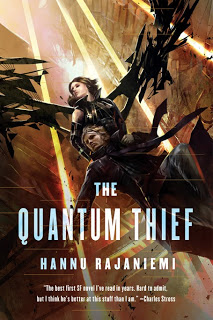 Fortunately, genre authors have gotten much better about this sort of thing.
I can’t rave enough about the Quantum Thief and its sequel, the Fractal Prince. Post-human heist capers with a culture and technology both fully realized and almost entirely alien, these books have sometimes faced some flak for their lack of exposition. I know a few science fiction readers who were frustrated by the book for that reason.
I read it through the lens of a fantasy reader, and thought it one of the best works of science fiction of the last decade. This is because Rajaniemi didn’t bother telling me what gas the spaceship ran on (well actually, he kind of did, but he did it in an off-hand and organic way). What he did do was tell why these things mattered.
A lot of fantasy writers aren’t fully comfortable with rules. In fact arguments against the rule of rules are pretty common on a lot of writing sites, especially those populated by new writers.
And I understand. Fantasy is the genre that embraces magic. And a lot of people magic as being the infinity of possibility made manifest. Magic can do anything – that’s the whole point.
So if we are writing in worlds defined by their lack of limitation anything should be possible… right? Right??
Well, not exactly. Because there’s this little thing necessary for suspension of disbelief – it’s called internal consistency. And that is a harsh and unforgiving taskmaster.
We can contrast a (narratively) successful fantasy story from one that is less so largely by looking at which stories keep better track of their own worlds.
In our successful example the rules of the world are clearly well-understood by the author. This doesn’t mean that she isn’t able to startle or delight with the flights of fancy she conjures with her magical take on England and Europe in the time of Napoleon. It’s just that it all seems to fit. Everything from the mytho-history surrounding magic to the culture of magic users ties together seamlessly into a perfectly realized world.
In our less successful example the world is constructed hodge-podge. Elements are (to be gentle) borrowed from diverse sources without any specific concern for how they actually fit into the overall continuity of the world. Most of the time things get shuffled in for reasons no more thought out than that the author thought it seemed neat. Furthermore the actual capabilities of any given component of the story (such as the protagonist’s “Talent”) expand or contract in scope depending on the needs of the narrative. The Nightside books are readable – but there’s no denying that they are a veritable lace of plot holes and nonsense.
As a result it’s much more easy to feel like Clarke’s world is a real world.
Rules define this internal consistency. They can be high order things like “nothing is ever free” or specific like “you must use blood sacrifice to power dark magic which is defined as X” – they should point toward the themes of your story either way.
But just because a fantasy story should be constrained by rules doesn’t mean that your audience, or even your characters need to know about them. I’ll get into rules and exposition tomorrow.
I’m not the first person to write an article talking about the recent fiscal 2013 year-end earnings report from Barnes and Noble. But people who decry B&N’s loss as another nail in the coffin of bookstores everywhere are missing the lead.
Don’t get me wrong, Showcasing is kind of awful and it doesn’t help bookstores at all. But it’s not showcasing or Amazon killing B&N. It’s the Nook.
Don’t believe me? Look at the numbers:
Sales
Retail $ 947,677 1,052,533 $ 4,568,243 4,852,913
College 252,295 227,891 1,763,248 1,743,662
NOOK 107,950 163,617 776,237 933,471
Elimination (30,901 ) (64,331 ) (268,723 ) (400,847 )
Total $ 1,277,021 1,379,710 $ 6,839,005 7,129,199Gross Profit
Retail $ 259,304 329,353 $ 1,397,859 1,452,804
College 76,131 69,781 405,076 395,311
NOOK (107,000 ) 999 (122,293 ) 68,065
Total $ 228,435 400,133 $ 1,680,642 1,916,180Selling and Administrative Expenses
Retail $ 208,244 262,244 $ 1,023,633 1,130,311
College 72,341 69,600 293,618 279,364
NOOK 69,895 77,988 353,125 329,777
Total $ 350,480 409,832 $ 1,670,376 1,739,452EBITDA
Retail $ 51,060 67,109 $ 374,226 322,493
College 3,790 181 111,458 115,947
NOOK (176,895 ) (76,989 ) (475,418 ) (261,712 )
Total $ (122,045 ) (9,699 ) $ 10,266 176,728Net Loss
EBITDA $ (122,045 ) (9,699 ) $ 10,266 176,728
Depreciation and Amortization (55,725 ) (58,968 ) (227,134 ) (232,667 )
Interest Expense, net (9,510 ) (8,629 ) (35,345 ) (35,304 )
Income Taxes 68,639 20,381 97,407 25,600
Total $ (118,641 ) (56,915 ) $ (154,806 ) (65,643 )
As you can see from the above, Retail and College are actually doing alright. The problem is that B&N is taking such a bath on NOOK that it’s dragging down the rest of its business.
In short it’s because Barnes and Noble is trying to be a better Amazon than Amazon is and they’re not going to succeed at that. Amazon is just too far ahead in that space.
Nook was not ever going to be sufficient to let B&N compete in Amazon’s space with Amazon. As a result the retail and college segments have to carry the losses posted by the (expense heavy) hardware and the not-particularly profitable ecosystem of the Nook.
Barnes and Noble is doing one thing right by cutting back on the Nook tablet business, contracting out development of co-branded tablets to a third party. I’d go a step further and also do the same with the black and white e-readers but they’re a dying technology to begin with.
What B&N should be doing is concentrating on ways to increase foot traffic into stores and ways to get those walk-ins to buy.
And I’m going to suggest something crazy – B&N should be looking to the model of smaller, local shops for a way forward.
Establishing smaller stores in high traffic urban areas, populating those stores with educated and engaged sales staff (and putting some of that staff on the floor) and then giving local stores control over at least 50% of inventory so that the stores have diverse content could help with this.
If people are going to showcase anyway give them the opportunity to do so more easily – but then put a friendly and well-read salesperson right there to try and convert that cover search into a book buy on the spot.
You know, add value.
 Simon McNeil