The Matrix Resurrections proves a better blockbuster is still possible

undefined

I cannot assume that a review for a major movie that came out literally yesterday is going to be read only by my regular audience so before I get into the meat of the review I should mention that I regularly discuss incidents from the plot of my subjects of critique, including climactic events, in the course of review. I have strong and somewhat idiosyncratic views on the concept of the “spoiler” and its place within criticism and film discourse but I also know there will be a lot of people who want to experience the surprises and reversals of this movie fresh. I loved this film. It’s funny and heartfelt, achingly sincere in that so-very-Wachowski manner, and, as one less favorable critic said, it’s full of “philosophical mumbo jumbo” (would we want it any other way?) and has a “woke agenda” (in that it recognizes patriarchy and misogyny as foundational poles of social control). So this is your warning. If you don’t know how the events of the film transpire and would prefer not to learn about them in a review you should stop here and wait until you can watch the movie. The legal choices currently are either to go to a cinema or watch it on a streaming service that is technically only available in the United States, which is unfortunate but this is, alas, the world we live in here in the closing days of 2021. I don’t personally council going to theaters right now, there was a public exposure site at one of the showings of that other blockbuster movie here on my remote island. But if that’s the choice you make please take precautions, wear a well-fitted three-layer mask, sit away from others, avoid eating in the theater and make sure your vaccinations are up to date.

So let’s dig in.

The first act of The Matrix Resurrections starts with an apology for the making of The Matrix Resurrections. In this part of the film Neo is once again living as Thomas Anderson: a successful video game designer whose game, The Matrix, won substantial critical acclaim. But Thomas is a mess. His studio is owned by Warner Brothers and they’ve insisted that the studio begin work on a sequel to the long-completed trilogy of original games. Thomas’ partner in the company confides in him that WB will be making the sequel with or without him and that if he refuses to participate he can be easily removed as an obstacle to its creation. The choice before him is a non-choice. He can make another game, guide how it’s shaped to an extent and take his share of the profits from its eventual success or he can step aside and get nothing while somebody else does whatever they want with his career-defining creation.

I am very fond of the tendency of Wachowski movies to be entirely unsubtle but this remarkably on the nose.

There are two possible ways to read this early sub-plot. Either it’s a sincere apology that a sequel was made for such a definitively finished work, possibly even a recounting of the conversations Lana Wachowski had to have surrounding the production, or it’s a sly joke winking at the possibility of the same. From any other creative team I’d assume the latter but considering how Wachowski sister movies traffic in sincerity here I lean in the direction of the former.

During the discussion, Thomas, showing obvious signs of extreme anxiety begins to see his partner’s mouth seal shut in precisely the way Smith had once done to him in the first film. Later Thomas talks to his analyst who reassures him about the indications of progress evident that he could even articulate this hallucination freely. His analyst calls the discussion an ambush and suggests his hallucination was a transference; Thomas felt his voice was taken away by the decision to make a sequel over his wishes so he imagined his partner’s voice taken instead. The analyst offers Neo a refill on a prescription he’s been using. Bright blue pills the same shade as the analyst’s smart jacket and fashion-forward glasses frames.

This setup comfortably introduces a lot of the key themes that run through the movie simultaneous to its work as a piece of critical apologia for the sequel-driven state of Hollywood blockbusters in general and for the decision to make this movie at this time in particular. The Matrix is a film very concerned with identity – specifically with the divide between the self-gaze and the gaze of the other. Thomas sees himself as we, the audience, see him: Keanu Reeves with long hair and a beard. But we catch glimpses of another man in a reflection. An older man, balding, with a face that looks ground down by a life described later by the Analyst as a combination of yearning for what you don’t have and fear of losing what you do. Other such circumstances apply to the other characters introduced in the first act. Thomas’ partner displays many of the mannerisms of Agent Smith but looks nothing like him and he seems friendly even if the Analyst is wary of his intentions. In another early sequence, somewhat disconnected from Thomas’ story, a new character, Bugs, enters a part of the Matrix that looks like the opening sequence of the first film. But it’s different. Trinity has a different face. It’s similar, hauntingly familiar, but it’s not her. And in this node of the Matrix Agent Smith is there but he’s also Morpheus this blending of identities carries with it a new face in the form of Yahya Abdul-Mateen – who brings an off-kilter humour to his performance that lands many of the best jokes in a surprisingly funny film.

In this retelling of the opening scenes of the first film, Trinity doesn’t escape; she is surrounded by agents and they’re beating her down. Bugs interferes and is pursued by Morpheus / Smith. She escapes into Thomas Anderson’s apartment from the first film and there encounters Morpheus / Smith who is an agent and a program but who is also certain that he is, in fact, Morpheus. Both Bugs and Morpheus are sure Neo is still alive. She saw him. He awoke her. Morpheus shares the same story.

A Neo who is Thomas Anderson again. A Smith who isn’t Smith. A Morpheus who is Smith. A Trinity named Tiffany and another Trinity who isn’t. The first act of this film introduces us to all these fragments of identity that carry with them the signification of others. These are characters who are split between how they see themselves and how others see them. When Thomas looks at his partner and, for a moment, sees Smith we are invited to ask whether it is, in fact Smith, or whether it’s a remnant of the significance Smith had on his life.

There’s a principal question regarding self the film attacks early on rooted in the question of memory and narrativization. Thomas has created a fiction of his memories of the Matrix. He has written it into a video game. In the process of doing so he’s creating a narrative frame out of his past. But the film asks whether this frame is a fiction or whether it is an authentic reflection of the becoming of this man at this time.

The Matrix plays out Thomas’ struggle with what constitutes his reality for far longer than the first film. There’s an extended montage of him mainlining blue pills and sleepwalking through his painfully unfulfilling life, work, gym, pining after Tiffany (Trinity) in the delightfully named Simulatte coffee shop as she nips in and out with her children but saying nothing.

Tiffany is a mother to a whole gaggle of kids. She’s got a doting husband (Chad) and doesn’t understand either why her life feels a little bit empty. She tries to exorcize the ennui by building motorcycles as a hobby and fantasizes about kicking Chad, “not too hard, just maybe hard enough to break his ribs.” A work colleague of Thomas forces an introduction because he’s tired of seeing his buddy mooning after Tiffany from afar and they form a slightly remote friendship. Tiffany can’t help but notice how much Trinity in the Matrix video game looks like her. But she is anxious about the affection she feels for Thomas, the familiarity she has to him because she is a loving mother and wife.

Morpheus forces a confrontation. He reveals that the node of the matrix Bugs found him in was, in fact, a construct created by Thomas with the express purpose of gestating an AI. He is a fusion of Smith and Morpheus because these two people were the most formative on Neo’s life and Neo needed them both to forge his escape from this new prison he found himself trapped within. He offers Thomas a red pill but Thomas refuses. Police invade and chaos ensues. Thomas’ partner stumbles into the bloodshed as Morpheus battles the police and picks up a pistol. In that moment he becomes Smith again, bellowing, “Mr. Anderson” at Thomas rather than Tom and immediately trying to kill him. There’s a discontinuity, a cat named Deja Vu, and then Thomas is back with his therapist who is very concerned for his wellbeing.

Bugs and Morpheus must make another attempt before they can free Neo from the prison of the identity of Thomas Anderson that has been forced upon him. Of course, despite spending an hour with our anxious and emotionally fragile depressive Thomas trying to navigate a disintegrating reality, the Matrix Resurrections must eventually pivot back to being a Matrix movie – it cannot prevaricate endlessly over what is the Matrix and what is the Real. I know many fans had hoped for some revelation that the Real was itself another Matrix, that reality was a nested set of simulations but this is not the case. In fact, in a film that exists specifically to upset binary divisions in so many ways, the division between the Matrix and the Real is the one it leaves unbroken. There are different nodes, different places, within the Matrix. Bits of old code get slotted in. There are constructs and there are sandboxes. But ultimately these are all part of the Matrix which is just as much a prison as it ever was.

There is a hint of an abolitionist critique here. The Tiqqun phrase I’m so fond of is apropos. “But evasion is only a simple escape: it leaves the prison intact. We must have desertion, a flight that at the same time obliterates the whole prison. Properly speaking, there is no individual desertion. Each deserter takes with him a little of the group’s fighting spirit. By simply existing he is an active challenge to the social order: and all the relationships he enters are contaminated by the radicality of his situation.” Neo’s compromise with the Machines left the Matrix intact but unstable. There was a civil war among the Machines. The losing side of that civil war joined with the survivors of Zion to create Io – a new city ruled over by an ancient and cynical Niobe. The victors created a far worse Matrix. By failing to break the prison of the Matrix entirely, Neo left his job only half-done. The change he brought created a difference. The society of Io is different in so many ways from Zion – some better, some worse. But the revolution never ended. The world remained at war, even if the sides of the conflict changed, and Niobe has grown bitter and fearful because of it. Niobe fears that the return of Neo will spark a new front in the war. But this film isn’t a war movie at all. It’s a rescue mission.

The Neoliberal Matrix

Stepping back for a moment it’s significant to situate this as an auteurial movie. And, happily, it’s learned one lesson that separates effective auteurial projects from failures. An auteurial film requires a singularity of creative vision, not of creative control. Tells such as the presence of many, many Sense8 actors in the cast along with David Mitchel and Aleksandar Hemon who have both previously collaborated with Wachowski on the script, cinematographer John Toll who has been the Wachowski cinematographer since Cloud Atlas, Joseph Jett Sally as editor (previously an assistant editor on Speed Racer) and Lindsay Pugh in costuming – another Sense8 alum – indicate that a cohesive creative team has built up around Lana Wachowski. This construction of the team is so fundamentally important to the creation of that unified vision that makes auteurial cinema stand out from more studio fare. And this is critical because of how this film answers the apology in act 1. In The Matrix Resurrections irony, sarcasm and emotional distance code directly onto villains. Our protagonists are achingly sincere, painfully vulnerable. This is a long-standing theme in Wachowski films. It’s notably present in the original Matrix sequels and in Sense8 – a show almost entirely about the power of sincerity and emotional vulnerability. This puts this film directly at odds with the quippy ironic distance of blockbuster fare like Red Notice, Deadpool or anything directed by Joss Whedon and also at the cold and clinical distance of blockbuster directors like Nolan and Snyder. We get multiple close-ups of Thomas rubbing the fabric of his jeans to ground himself, touch has power. After Thomas and Tiffany shake hands for the first time the sense memory of her hand conjures powerful memories of his life as Neo in him. In the Matrix, as in much of the Wachowski ouevre, love is a force of real power. The bonds people form, the way that they live through the other via love is central to their ability to overcome the challenges before them. This film problematizes this by redesigning the Matrix. This isn’t the old Matrix where the main mode was an enforced somnescence and where love merely had to be a powerful enough clarion call to awaken the sleeper. The Architect, who scorned human emotion as being something irrelevant to the grand algorithmic balance of his construction is gone and in his place is the Analyst – who has built his prison explicitly out of love.

Specifically the Analyst, finally revealed not as Thomas’ therapist but rather as Neo and Trinity’s jailer has built his new matrix out of the frustrated potential of Neo and Trinity’s love unrealized. When the Matrix was destabilized following the end of the war with Zion, the Analyst instituted a project to restore Neo and Trinity from death. And once he’d done this, he bound them together as the processing core of the new Matrix and as a psychological template for its systems of control. Neo and Trinity are bound into their prison by what he describes as their yearning for what they don’t have coupled with their fear to lose what they do. He keeps them close enough they can almost touch while constantly frustrating their efforts. He creates for Trinity a husband, children. For Thomas a high paying job in the creative industry. The choice exists for them both. They can see each other. And the Analyst cannot fully erase the meaning they hold for each other because the whole Matrix is literally powered by their frustration. And so they must be separated by emotional and psychological obstacles: her family, his mental health problems. In the process of imprisoning Neo and Trinity thus he has also bound Smith who was forced into the role of Neo’s partner and artificially kept from being who he truly is. The Architect makes Neo and Trinity choose their own subjugation. When Neo is freed he threatens Trinity and promises to kill her if Neo will not return of his own volition.

This film has inherited the complicated discourse the first three movies wove around the issue of choice. The question of choice is omni-present. Sati reminds everyone during the rescue of Trinity that she must choose to be freed or the mission will fail. But simultaneously many characters including Morpheus, Bugs and Smith comment on the illusory nature of choice. Smith-the-partner presents Thomas with the sequel fait accompli. He could choose to refuse to participate but that would basically just mean cutting his own input out of an unhaltable process. When Bugs offers Morpheus the red pill choice they both admit there’s no choice there and he already knows which pill he will take. This ties into the idea of the Eternal Return which was central to the original sequels. And, sure enough, this film plays with the ideas of difference and repetition a lot. It’s present in the gestating simulation Thomas uses to create Morpheus. It’s there when, during the second act, Neo and Smith fight and the entire fight is an echo of their past encounters.

There is intercut footage from the original film series throughout this movie. When Smith speaks the image will momentarily cut to a time from the first movie when Hugo Weaving’s Smith said the thing. When Morpheus confronts Neo during his rescue he does so in a cinema playing footage from Thomas’ game – of the scene in which Fishburne’s Morpheus originally gave Neo the red-pill choice. When Thomas struggles with his memories of being Neo we see them as fragmented images from across the original trilogy. This, combined with some excellent sound editing makes for an often unnerving experience, especially as Wachowski has maintained the original, highly aestheticized look of the original footage but has used entirely different and far broader-spectrum colour grading for the new Matrix.

The Analyst, and most of the rest of the cast other than Bugs and Morpheus, see the Matrix as an inevitability. There is no alternative. They tried to shut it down and doing so just fragmented the Machines, created new factions but no peace and no end to the Matrix. The Analyst believes that most of the “coppertops” prefer their subjugation. They’re too afraid to lose what little they have to step out of line. The unequal power structures that define the contemporary moment exist because the victims choose them.Hang on tight and spit on me,” is the mode of the Analyst’s Matrix.

Niobe is an old revolutionary lost to pessimism. She’s seen too much death and pain and she’s sick of it. She sees no alternative to the Matrix because they tried once and it didn’t work. She’s deeply bitter toward Morpheus (the original Morpheus) who never stopped believing that the revolution could never be defeated. The Analyst sees no alternative because he doesn’t want an alternative. He doesn’t even want a rollback to an earlier version of the Matrix, one that isn’t dependent on keeping two resurrected heroes in a state of immortal purgatory. And Smith isn’t beholden to this Matrix or that – he just doesn’t want to be put back in prison.

And to a certain extent there’s some honesty to the Analyst’s defense of the new Matrix. A rollback would not, on its own, be anything even resembling enough. Mark Fisher puts forward a left-accelerationist read of Lyotard in Postcapitalist Desire that, “that there’s no possible retreat from capitalism – there’s no space of primitive outside to which we can return, we have to go all the way through capitalism.” Likewise there’s no return to Zion and the war with The Machines. In fact nobody would want that. The dissident Machines are a loved and valued part of the society of Io. Morpheus (the program), Cybebe and Lumin8 are valued and beloved allies of the Resistance, nobody wants to go back to the absolute binary of Neo’s era. The only way out is through.

But the other thing nobody really wants is another front in the war. And this is the final really significant formal structural detail I want to draw out here – the plot of the Matrix Resurrections isn’t a bildungsroman like the first nor is it a war movie like the original sequels. This is a rescue movie. The new Matrix, the one powered by the double-bind of yearning and fear, only functions by keeping the object of desire always just out of reach of the subject. They can see it, the thing they want, right there but they can’t quite reach. But if they stay in the system, if they don’t make waves, maybe they can get just a tiny bit closer – a perverse Xeno’s paradox at play that the film depicts clearly during Neo’s first true confrontation with the Analyst in which the program fires a gun at Trinity and holds Neo back just long enough that he thinks he might still power through and rescue her while knowing he almost certainly will have to watch her die again.

The Analyst wants Neo to return to his cage willingly and so he holds Trinity up as a hostage. Neo is faced with another choice-that-is-not-a-choice: he can escape at the cost of Trinity’s life or he can return to a prison where he will, forever, look but never touch. But Sati proposes a rescue – with the only catch being that Trinity must choose to be rescued and during his attempts to win Trinity over she reveals to Neo that she has been having prophetic dreams much like his from The Matrix Reloaded; they end badly. By the moment of the confrontation the story has laid the groundwork that “Tiffany” is as unsatisfied in this half-life as Neo was when he was compelled into the persona of Thomas. But even so it’s terrifying to let go of what she had: a husband, children. The Analyst engineers a crisis at home to drag Trinity away from Neo at the last moment, to skew her to staying in his simulation in hopes a failure of the rescue mission will also compel Neo back under his domination. But Trinity turns back on her way out the door, sees Neo getting pressed to the ground under a horde of cops and something snaps and she breaks free. She decides the simulated family isn’t worth sacrificing the truth. She becomes tired of Chad grabbing her by the arm and leading her where the Analyst wants her. She is tired of building bikes rather than riding them. She leaps.

The Leap

Love, in the Matrix, is always a matter of faith. It’s power is ineffable and irrational. This is why the Architect failed – he disregarded love as nonsense and the love Neo and Trinity had for each other was enough to overturn his plans. The Analyst, instead, wants to pervert love into a weapon to use against the lovers. He knows that love is a desire and that he can use the productive force of desire as a real source of energy if he can only keep the lovers just the right distance apart. The Analyst doesn’t underestimate love qua love. He doesn’t underestimate love as an emotion. But he does understand love as an expression of faith.

There had always been hints of this idea in the Matrix. As early as the first film Morpheus showed Neo how far he could jump if he only freed his mind. In this film the Leap and its expression of the concept of faith takes center stage. Bugs tells Neo that she awakened when she saw him jump off a building and he never fell. The analyst, meanwhile, refers to “Thomas” as a suicide survivor and attempts to make Neo’s faith, his belief that he could be free, into a matter of shame and anxiety. “The doubt that saves doubts only itself,” Kierkegaard says. He means this as a challenge against the idea of dialectical skepticism in the context of theology. Hegelian theology was popular at the time of Kierkegaard’s career and he pushed back against the ability to approach religion from the direction of doubt. He would rather doubt the doubt itself.

There is some power in this position. I’ve often remarked that the biggest failing of Rational Skepticism is the unwillingness to turn the tools of skepticism inward, to doubt the bases upon which they build their skeptical responses to the external phenomena they doubt. There is a danger in self-assuredness that creates blind spots the anxious may see. Kierkegaard put forward this paradoxical position of anxious self-doubt as the basis for authentic belief throughout much of his body of work and his solution was to leap over the leveling scythe of reason and into faith. Kierkegaard counseled an irrational response to matters of faith as being the only true avenue for the expression of real faith. What faith is there in biblical proof?

In the film, Neo has lost the ability to fly. In fact, he spends much of the movie rusty – an old soldier who thought his days of fighting were over – and whose hesitance to re-enter the fray manifests in a reduction of his powers. He’s still strong enough to toss enemies around and to stop bullets with his will. He’s still fast enough to dodge bullets and to observe their path through the air and he’s still robust enough to survive being thrown through a concrete pillar but he is not the man he once was.

Neo is plagued with self-doubt. He begins the film with crippling self-doubt. He doubts even his own life story, a doubt that the Analyst is all to eager to help along with a delightful display of Wormtoungery. Neo wants to make a leap but his doubts plague him. And he can’t just start flying from the ground because his faith is insufficient. It isn’t a leap of faith to jump up when there’s no risk. You have to put everything you are into a moment of irrational devotion. Only there does an authentic leap of faith lie.

On the other side of the leap is the Knight of Faith and Kierkegaard cautions us that this is an incommunicable state of being. It’s impossible to know for sure if a leap is genuine harder still to communicate the essence of such a genuine moment.

After they escape from the Analyst, Neo and Trinity flee through the streets of the Matrix pursued by a horde of zombies. (The Analyst feels this “horde mode” is a more effective solution than the agents of the previous iteration.)

This whole sequence is interesting in that it puts the threat of stochastic terrorism and mass violence front-and-center where once it was just cops. Furthermore it shows how cops and stochastic terrorists operate together for the maintenance of the status quo. And so the zombies chase Neo and Trinity onto a roof where helicopters wait to gun them down. But they agree that they will not return to their prison and they jump. It should come as no surprise to anyone watching this film that it is Trinity who has a moment of authentic faith and discovers the ability to fly although I’m certain it will upset all of the worst members of the audience to no end.

Patriarchy and Societies of Control

In Michel Foucault’s Discipline and Punish he describes an epistemological regime called the “disciplinary society.” This is a system of subjectification wherein a subject enters into a space where their body is trained before exiting that space and, as Deleuze put it, starting from 0 again in that new space. Disciplinary societies are best reflected in disciplinary institutions such as the school, the hospital, the factory and the prison. Now it’s important to note that these epistemic systems are not complete and impermeable. The principal work of Discipline and Punish was to show a genealogy of how previous epistemic systems led to the production of the disciplinary society as a mode of subjectification. A feature of the disciplinary society was a focus of power on the individual subject, specifically a focus on shaping the individual subject into an ideal citizen – a perfection of the soul through the rigors of training and a sort of inherited monasticism. He remarks upon how the design of the prison cell and the work-house cell of the early factories was modeled rather explicitly on the monastic cell. But while these epistemes leave marks they do not remain the dominant systems of subjectification forever and in the Postscript to Societies of Control, Deleuze proposed that, by the 1990s the disciplinary society was already being supplanted by a new episteme – the society of control.

The principal difference between the disciplinary society and the society of control was a spatial one – the disciplinary society is made up of a series of distinct spaces you move within. You go to school, advance through grades, complete school. Then you move to the new enclosed space of the factory. If you get sick you go to the hospital and go through triage, observation, treatment. If you fall afoul of police you go through arrest, trial, sentence. In all these cases there’s a focus on specific delineated corrective spaces.

The society of control is modular. Access to this module is granted or removed. Guattari, who Deleuze cites in the essay, proposed this as being like a city divided into zones in which the gates were operated by a key card. At any time a subject could be admitted to some zones and excluded from others. Deleuze took this observation even farther and suggested that the singular subjectivity of the disciplinary society – that focus on a perfectible singular being upon whom discipline could operate – had been replaced by a modular subject. Distinct schools were replaced with training modules. Professional memberships and licensing organizations could assign or withdraw various rights. A perfect genealogical precursor to this power relation is the driver’s license: you have permission to operate a motor vehicle contingent on not being found to do so in an unsafe manner. This is not the disciplinary power relation although it was not, alone, sufficient to manifest as a new episteme. The original Matrix was released nine years after Deleuze’s postscript, seven years after its first translation into English. While Deleuze believed that the society of control had already become the predominant episteme at that time, per both Deleuze and Foucault, no episteme erases the marks of the one before and the transition from one to another can only ever be discovered genealogically. We recognize we are in a new episteme when we can recognize the completion of the old order. This period of transition is visible in the first Matrix movie. Knowledge is modular. Put in a disc and know kung fu. But the authority of the agents is still disciplinary. Smith takes Thomas Anderson out of the space of the workplace and into the interrogation room. There he engages in an attempt to correct Mr. Anderson, to return him to a life of productive service to the extant power structure. This is fundamentally a disciplinary power mechanism.

In contrast the Analyst implements measures of control. Identity is treated as modular. Neo is allowed to be “Thomas Anderson” he’s even allowed to have a personal history with the Matrix and an awareness of his past but he is denied access to his own face. Trinity features similar dividuality of her being, buried under the disguise of Tiffany. Access to spaces is also modular. An alarm rings in Thomas’ workplace and lets everybody know access is now forbidden. The enforcement of authority that comes after is not an attempt to correct a defective soul but rather a purge of all subjects who have failed to depart from the denied zone.

The granting and denial of the object of desire in various forms is central to the Analyst’s Matrix, very much in contrast to the Architect’s disciplinary one. And this also shows in the difference between agents and the horde mode. The agents are aware singular subjects who can appear and remove a subject for correction. They take people like Neo and Morpheus and put them in rooms to reshape them to suit a purpose. The horde mode is a modular area denial tool. They can be activated in this zone or that to force subjects to move into this space but not that one.

Control, much like the related but distinct Foucauldian concept of the biopolitical order is not concerned with individual subjects so much as it is with modules, aggregates, clusters and categories. And this traces into how the Analyst deploys misogyny. Because, oh boy, but the Analyst is the most misogynistic robot I have ever encountered. In the denouement, when Trinity has proven Smith correct in his statement that “anyone could be Neo” by achieving an equivalent level off awakening, and Neo and Trinity both confront the Analyst to warn him that they will be remaking his world, Trinity takes the lead while Neo hangs back. She repeatedly kills the Analyst and restores him and all the while the Analyst begs Neo to control his woman. This same pattern of misogynistic subjugation is clear in the differential treatment of Neo and Trinity by the Analyst in their imprisonment. Neo is defined by his career. Trinity is defined by her family.

And we are invited to see her discomfort with this when she says to Neo that she isn’t certain whether she had children because she wanted them or because it was expected that she would. Trinity is given a history, as Tiffany, that includes these children who she loves, because in the modular self the Analyst has created for her includes these children. She is, in this film, entirely correct to question whether her having children, feeling like she wanted them, is a compulsion put upon her by an outside force. And the love for a child is the emotional cudgel the Analyst uses to try and dissuade Trinity from choosing her own freedom.

Because this film is ultimately too existentialist to treat this dividuality of the self as fully real. The Matrix posits that there is, in fact, an authentic subjective core to being. There is a Neo underneath who is the authentic Neo. There is a Trinity who is the authentic Trinity. This authenticity is reflected through the love these two have for each other.

Importantly that same access to authenticity is also applied to Smith who insists Neo freed him and whose whole motivation is doing whatever he deems necessary to avoid being imprisoned away from his own authentic self again, to avoid being treated as a modular being. Considering how the old Smith desired to make everything the same, like him, this pursuit of an authentic self is an interesting direction to take Smith but not an inappropriate one. His core of authenticity is also relational. His bond with Neo plays very much into the Spinozist sense of the proximity of love and hatred.

The tension of this film is the idea that power will shape people not by taking them, one at a time, into a room and making them conform but by creating a social field in which they will move themselves into controllable relations. Trinity will be a home maker. Neo will be a careerist. Smith will be a defanged antagonist rather than the trickster he desires to be. They will not be these things because they were trained to be but because the social field was manipulated to move them into these spaces. This deployment of misogyny specifically in the case of Trinity is particularly telling and points toward how reactionaries deploy nostalgia for the nuclear family to exercise control over men and women alike. Patriarchy is at much in play in making Neo an alienated worker as it is in making Trinity a dissatisfied homemaker but special cruelty is applied to Trinity. She is allowed less of her authentic self by dint of being a woman and being compelled into situations of inauthentic love.

This movie is a rescue mission. It’s not the triumphant return of the hero. Neo barely spends any time in Io and he’s seen there more as an inconvenience than as a hero. But Trinity being rescued from the Matrix is the one thing, the lynch pin. That is the only thing the Analyst cannot countenance, that will break his Matrix entirely.

This is a delightfully kind reminder that revolution must not only be a matter of giving a different set of men the power and control over society but should instead recognize and destitute all axes of control that prevent people from realizing their authentic relationships. This is where they break from Kierkegaad because he thought that everybody must make the leap into faith alone but the Matrix Resurrections knows that the leap can only ever be made together. Authenticity exists, we can discover a core to our being, but it isn’t some hard kernel alone from all others. It’s a shining web of loves and hatreds, of lives touched and of differences made. We must all leap together into an uncertain future if we want to paint the sky with rainbows.
Quick Raytheon / Hugo Update

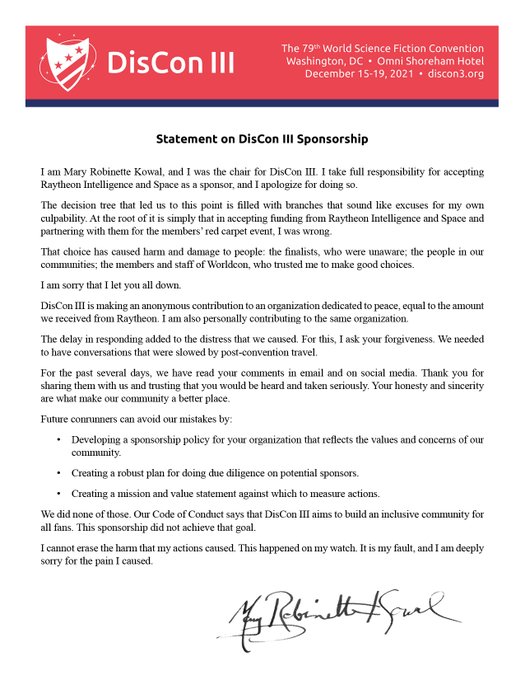
I am throwing this up really quick just as a situation update to my recent post on the ethics of participating in a fan convention with an arms manufacturer sponsor. The chair of the DisCon III concom, Mary Robinette Kowal, released an official statement yesterday and it’s actually… pretty good all things considered.

A picture of con chair Mary Robinette Kowal's statement and apology, along with her signature, regarding the sponsorship DisCon III received from Raytheon Intelligence and Space.

Now a few notes, mostly positive. This letter did several things that were required. First, Kowal has taken responsibility for this action personally. One of the things I was worried about previously was how the loose and rather byzantine organization of Worldcon created a risk of a diffusion of responsibility that passed the moral burden to the aggregate membership rather than a single person. I’ve said elsewhere that, based on my past professional experience in non-profit advancement teams, major sponsorship agreements don’t get approval without going up to senior leadership within the non-profit so it was always going to come back to her. I’m encouraged she recognized this and took that responsibility.

Second, while a full accounting of the process might have been interesting from a root-cause-failure approach I appreciate that Kowal elided on specifics because she didn’t want to be seen as making excuses. This is actually probably the right course of action all things considered.

Likewise the fact that Kowal declines to mention the charity she and DisCon III have selected by name is actually a good choice. It is good for two reasons: the first because it takes out any opportunity for praise over the donation. This is an act of restitution and the removal of the ego-effect of being probably a significant donor is a good choice. The second is because the ideological landscape with regard to NGOs is pretty fraught and even a slam-dunk donation (like to War Child, for instance) probably would have upset somebody so from the perspective of resolving the current social conflict an anonymous donation was a reasonable choice.

Finally it is good that specific recommendations for future con organizers were made. We all wanted transparency and this is part of that.

The main two pieces of missing information that would have been good to include here are a timeline of when the sponsorship deal was signed and when it was publicized and the amount of the donation. However the former is very minor and the latter is important but will likely come out eventually.

There is one other item I want to address here and that is the question over why Raytheon attracted such ire when the other banner sponsor – Google – is also bad. Again this ties back to my discussion of ethical ambiguity and ethical bounds. Google is not good. They’re an evil company that does bad things. But, as we discussed before, the same could be leveled of any organization able to throw around “major sponsor” money.

There is a powerful left-critique of the NGO that treats the non-profit as a form of social control whereby the wealty are able to invest in the direction of the power their wealth represents. In this frame of treating charitable giving as being a form of directed power relation we cannot remove the non-profit and the volunteer-run organization from the superstructure of capitalism as its base economic conditions are inextricably bound to that superstructure. The non-profit, under capitalism, is an organization within capitalism. This is where “no ethical consumption under capitalism” kind of actually lives. However, as I said, there are some ethical distinctions that don’t partake in the ambiguity of operating within the interior of capital as all non-profits do. And, with a product of imperial death, Raytheon is beyond all possible ethical ambiguity in a way that even pretty wholly awful companies like Google are not. Simply put, arms merchants are a special kind of evil that goes beyond even the mundane evil of Google and its ilk. As a communist I would bring the whole edifice down and Google is as much a target as Raytheon. But I am a communist living within the bounds of Capitalism and as such I need to be able to draw ethical distinctions within that territory. To put it in theoretical terms, the Socius is a field of inscription. It exists in being marked. The territory within Capitalism is delineated in a way that the outside of Capitalism simply is not by dint of its non-being. As such moral distinctions within Capitalism are inevitable. And so, yes, the donation from Google is also bad but, no, it was not hypocritical to be especially upset by the donation from Raytheon.

Last word on this subject from me: I don’t particularly like Kowal and I think her leadership of this concom was pretty disastrous between this and the increasing likelihood that Worldcon was a COVID superspreader event (17 possible exposures identified and counting). But, as I’ve said before, no ethical failure precludes the possibility of future right-decisions and I think this letter is a very positive first step. I think we should, on the left, be willing to acknowledge that this was a good first step and continue to kindly encourage accountability and restitution from the concom as a whole and Kowal in particular. I also think we should probably all lay off of the finalists who were caught flat-footed and may have responded defensively to being thrust into an uncomfortable position.

Drawing the line: Capitalism and Wrong Livelihood

(Image c/o Wikipedia)

The Worldcon that never should have happened has had a wild ride after an all-too-easy to call COVID outbreak, some shady business at the business meeting that seemed likely an attempt to influence the site selection process away from the (ultimately winning) Chengdu bid for next year and then, the piece de resistance, the revelation that a major sponsor for the convention, with a branded red-carpet photo wall at the Hugo Awards was the Raytheon corporation.

This raises an interesting question regarding the duty of participants in Worldcon to respond to the interface of their science fiction convention with a “defense contractor” that was supplying materiel to Saudi Arabia at least as recently as 2017 and that is a key supplier of the US military. Should a concom be held responsible for how sponsorships are used to launder the reputation of corporations? What about the ethics of working for such an organization? After all, it’s something of a received wisdom in progressive spaces that corporations are de-facto evil; if we cannot work but to work for an evil organization is there a gradient of evil to mark against? How far is, ultimately, too far beyond the pale?

Buddhism provides a very concrete starting point for what constitutes a boundary with the Aṅguttara Nikāya, in particular containing discourses accredited to the Buddha and his disciples on the topic of right livelihood – one of the eight subjects of the Noble Eightfold Path. According to these early Buddhist texts, a right livelihood is one that does not involve traffic in, “weapons, living beings, meat, alcoholic drink or poison.”

As such it’s clear that, at least from an orthodox Buddhist perspective, there is a very specific line and it is one that Raytheon is entirely beyond. Of course the same could be said of the butcher and the liquor store down the road along with any pet store proprietors and certain garden shops that sell plants that could potentially be used for the production of poison so we could, perhaps, argue that such specificity is somewhat unhelpful to a modern context.

The Buddhist proscription is bound, inextricably, to a Buddhist ethical universe that seeks to avoid the causation of harm. As such proscribed livelihoods are proscribed because of their specific interaction with the Buddhist perspective on what constitutes the Good. However what the Buddhist example is best for showing is that a boundary can be set. We can, in fact, say that even if all things are not intrinsically ethical some things, in particular, are unethical enough that they should be avoided as moral hazards.

No ethical consumption under Capitalism

There is something of a mimetic phrase within progressive circles that there is no ethical consumption under capitalism. This phrase appears not to have a clearly fixed origin although it does seem to arise out of online spaces. Now this argument – that ethical consumption is impossible within Capitalism points in two disparate directions. First, it is deployed as a form of absolution. “Yes I know this product was made by an appartheid state in an occupied territory but there’s no ethical consumption under Capitalism,” at the extreme sure but also, “I’m aware that fast food restaurants deploy environmentally destructive agricultural practices to keep prices down but there’s no ethical consumption under capitalism, I live in a food dessert and have few choices and ultimately I have to eat something,” would be closer to an ideal example of this absolutory use. The second is as a critique. A celebrity backs a T-shirt slogan – or some other commodified piece of political rhetoric – and critics point out that it was manufactured with exploited labour. Does a feminist really look like a white woman getting rich off of sloganeering at the expense of vulnerable workers in Bangladesh? There is no ethical consumption under Capitalism.

And so, effectively this statement means either, “I am aware of the contradiction in my position and cannot avoid it,” or “you should be aware of the contradiction in your position,” depending upon whose consumption is the subject of ethical assessment.

Now a fan convention is most certainly an example of consumption. In fact, fewer things are more purely consumptive than a fan convention – an event that seeks to lionize and institutionalize a category of consumption, to bring consumers into the proximity of producers so that they can consume more effectively. And with a fan convention being a form of institutionalized consumption, sponsors of a convention are certainly to be counted both as consumers of the product the convention offers (largely the attention of other consumers) and simultaneously as producers of the event. Raytheon is both a consumer of Discon III and also a product that Discon III attendees are being invited to consume. And anybody who took a photo at the Raytheon branded red carpet photo station, anybody who went to the Raytheon booth, they were consuming Raytheon. So when people respond to this consumption of Raytheon by attendees that there is no ethical consumption under Capitalism our question then becomes whether this is the consumer being asked to be aware of the contradiction in their position or if it is the consumer aware of the contradiction claiming they have no choice.

It honestly seems mostly to be the latter.

Certainly, unless that consumer was on the concom they had no choice about whether to invite Raytheon to be a sponsor so we may be able to absolve most attendees of that specific blame. Although members of the concom should certainly be called to account for their funding decisions. However, while the attending membership had no choice whether Raytheon was to be a sponsor, this doesn’t mean they had no agency in this situation at all. And this is where things become even more difficult.

Ambiguity

In her seminal work, “the Ethics of Ambiguity,” Simone de Beauvoir grappled with the fundamental problem of making ethical judgments in recognition of the inability of a person to have an objective understanding of all consequences. In this book Beauvoir remains consequentialist in her outlook, maintaining that the ethical value of an act had to do with its movement toward liberation but problematized consequentialist ethics by pointing out that it would be nearly impossible to judge, in a moment of action, whether any given well-intentioned action, in fact, moved in the direction of liberation. Antagonistic to the virtue-ethic of the Buddhists that would declare it is wrong livelihood, a consequentialist might ask to whom weapons were being sold and to what purpose. Beauvoir then points out that, no matter how great the purpose the consequentialist cannot possibly know what the ultimate consequences of selling those guns must be.

In the end, Beauvoir’s ethic proposes something of a Sisyphean life – one of constantly striving toward a greater freedom fully aware that it can never be obtained. The struggle for liberation is an endless and ever-changing task. All a person can do is their best. As Beauvoir puts it, “Ethics does not furnish recipes any more than do science and art. One can merely propose methods. Thus, in science the fundamental problem is to make the idea adequate to its content and the law adequate to the facts; the logician finds that in the case where the pressure of the given fact bursts the concept which serves to comprehend it, one is obliged to invent another concept; but he can not define a priori the moment of invention, still less foresee it.”

Beauvoir argues that meaning is constantly changing and that the movement of life with purpose, of a good life, is thus also constantly a moving target. But that doesn’t mean she provides no lodestone. Instead Beauvoir takes a nearly Epicurean approach, saying, “However, it must not be forgotten that there is a concrete bond between freedom and existence; to will man free is to will there to be being, it is to will the disclosure of being in the joy of existence; in order for the idea of liberation to have a concrete meaning, the joy of existence must be asserted in each one, at every instant; the movement toward freedom assumes its real, flesh and blood figure in the world by thickening into pleasure, into happiness. If the satisfaction of an old man drinking a glass of wine counts for nothing, then production and wealth are only hollow myths; they have meaning only if they are capable of being retrieved in individual and living joy. The saving of time and the conquest of leisure have no meaning if we are not moved by the laugh of a child at play. If we do not love life on our own account and through others, it is futile to seek to justify it in any way.”

And, of course, this idea of a good life as being one that pursues some sort of genuine happiness both on our own account and through others is something of a shared quest between Beauvoir, the Epicureans and the Buddhists.

What then is the ethical weight of a red-carpet photo against the death of a child in Yemen? It should be such a simple formula – arms dealers bad – and yet it brings with it so much other baggage. Did the actions of the red-carpet walkers contribute to Raytheon’s ability to sell the weapons that kill? Were factors such as the ability of convention members to pursue a career in the arts (which received wisdom says necessitates participation in fan conventions) ones that moved their own actions, in that moment toward a concrete mode of liberation? Should an artist who discovers their participation might give a company like Raytheon access to an audience disengage immediately? How much burden to know what, in fact, Raytheon is and does should be ascribed to the hosts of a Science Fiction podcast or the creators of a popular semi-pro zine? I don’t think I need the certainty of the Noble Eightfold Path to say that Raytheon is ethically compromised. It sells weapons to many of the most aggressive and warlike militaries in the world. No country has as many extraterritorial military bases as the United State. Few states wage war as readily and egregiously as Saudi Arabia. That Raytheon partners with these militaries makes it obvious that there’s very little ambiguity at play with working in their employ or with deliberately selling them advertising space at your convention. A good Raytheon employee is an employee who quits.

But I think the “no ethical consumption” line creates more problems than it solves. Certainly it’s true in as far as capitalism is a system that pushes back against Beauvoir’s idea of a life of love on our own account and lived through others. It’s a system that depends, instead, on a zero-sum gamification of existence where every moment of joy we squeeze out of life must, at its core, be a moment of joy denied to another. But the moment of radical freedom we call revolution depends on a level of mass action that doesn’t reside with some atomized individual. Turning around and walking out of the Hugo awards upon sighting the Raytheon banner would have been a decent action. It would be what Buddhists call “right intention” but it would be ineffectual. It would not overthrow the rule of Capital; it would not unmake the missiles and the bombs. In order for it to be a truly revolutionary moment it would require a total desertion of Discon III – for every single person there to spontaneously refuse to cross that threshold. And absent that sort of spontaneous and revolutionary moment ambiguity rules here. Hugo awards make careers and it’s just a banner.

Ultimately the concom of Discon III has earned scorn. It was the height of irresponsibility to hold a convention in Washington DC in 2021. We all knew perfectly well the pandemic would not be over and I think it’s not too much of a stretch to assume most people knew the pandemic would not be over in the United States specifically considering the disorganized way it responded to the crisis. Frankly there should have been no opportunity to pose in front of a Raytheon banner at all. And even if we set aside the irresponsibility of holding an in-person fan convention during a plague year the concom should not have sold its sponsorship opportunities to a “defense contractor.” Awarding a sponsorship to Raytheon was an egregious lapse in ethics by the standard of the Buddhists, the Epicureans, the standards of Beauvoir and frankly even those of Kant who would have fixed upon the concom the duty of acting in a manner that advanced respect and dignity of all people. Death from above at the hands of missiles manufactured half a world away is, at its core disrespectful. It is a death lacking in dignity to be snuffed out like an unwanted candle.

Capitalism operates through a diffusion of responsibility. People who have worked within the IT divisions of defense contractors talk about jobs that center around entirely abstract snippets of code – work toward abstract benchmarks where they haven’t the first clue what their code is even intended to do. This sort of diffusion permeates capitalist organization such that, ultimately, no one person is ever to be blamed for the cruelties of the system. And the concom could argue, in their defense, that then never dropped a bomb nor asked one to be dropped.

Ultimately the question becomes: where do you draw the line? As Jello Biafra said, “I’m not telling you, I’m asking you.”

For me, the line is drawn not at being an audience for Raytheon but it is certainly drawn before collaborating with Raytheon to give them an audience. But each person must construct that line for themselves. This is the ultimate paradox of collective spontaneity. We must each, alone, decide to act together in the moment. If a spontaneous moment is lost to ambiguity we should, rather than ripping at those people who, enmeshed in ambiguity, may have made a wrong choice, aim toward building better preconditions to make the right choice in the future.

As such my final word is this: No more arms manufacturers at fan conventions. And if anyone violates this clear line by inviting arms manufacturers to participate, let’s deem them outside what we see as the genre community. In that moment of collaboration they have put themselves beyond the pale. But let’s stop there and work to build solidarity around this line.

Scream and the death of Hollywood Satire

Scream - 1996 - 11 x 17 Movie Poster - Style B : Amazon.ca: Home

The four Scream movies contain both the best movies in the slasher genre and represent the most consistently good movies in the slasher genre. As with a lot of auteurial projects part of what allowed this consistence in quality in Scream is the involvement of a consistent team as Wes Craven directed all four, Kevin Williamson wrote three of four, Patrick Lussier edited three of four, Peter Deming was director of photography for three out of four and Marco Beltrami provided the score for all four films, On the other side of the camera, quite unusually for a slasher franchise, the lead cast remained consistent across the four movies with Neve Campbell, Courtney Cox, Roger L. Jackson and David Arquette reprising their roles in every successive film. In short these movies aren’t excellent because Craven was a singular genius but because a central core of creative workers came together to make something good and kept doing so. I say this because I will be treating the scream movies as very specifically auteurial throughout this review and I want to avoid a reductive conclusion that this is something that can be collapsed just to Craven or even to Craven and Williamson.

The scream series also charts the arc of satire at the end of its life in Hollywood. This wasn’t intentional – Scream didn’t kill satire, it was rather the last great flourishing of it. After all, the shattering of the American self-image of the 1990s in 2001 effectively forbade Hollywood from ever doing something as introspective as Scream again.

Scream: The rules of horror and the unexamined

The subject of satire in the initial Scream movie is reasonably evident. The Scream team were not being subtle in what is, effectively a reasonably straightforward criticism of the slasher genre. It’s become somewhat commonplace to read Scream as being largely a filmic equivalent to Carol J. Clover’s Men, Women, and Chainsaws. Having the kids of Scream being aware of slasher cinema in specific to the point where Randy is able to declare the rules: “you can never have sex, you can never drink or do drugs, and never (ever, under any circumstances) say “I’ll be right back”.” But it’s interesting the extent to which Randy’s rules for survival elide the role of the final girl considering the extent to which the text of scream becomes an interrogation of that trope in particular. Scream is gesturing desperately toward this absence, telling us, look the kids in this movie, watching these movies, missed something.

And so, of course the killer is somebody close to the final girl. Of course she’s been pre-selected to be the final girl not because she followed some byzantine rules of horror but because the killer wanted to hurt her, in particular. The idea of the slasher killer as a moral arbiter is shown to be a bald lie by Scream as Billy lashes out at Sidney and her friends for his mother’s departure. Casey and Steven didn’t break any slasher movie rules. Nor was anything about Casey’s presentation in the opening sequence indicative of any kind of moral failing. She’s making popcorn for a quiet night in for goodness sakes. Principal Himbry is just in the wrong place at the wrong time. Tatum is getting a beer, yes, for one of the killers, because he asked her to do so in order to present the opportunity to murder her. Kenny is also just in the wrong place at the wrong time. Rather, as Clover suggests, the killers of Scream are boy-children whose all-too-oedipal (Clover points out, of Craven, that, “at least some horror filmmakers read Freud,”) sexual hang-ups inform their crimes. Billy is mad because Sidney’s promiscuous mother seduced his father. Stu is along for the ride because of a fawning libidinal investment in Billy’s approval. Also in line with Clover’s assessment of the formal elements of the slasher genre, the boys use a knife. Right up until they don’t. It’s an interesting, and regularly repeated, characteristic that the final stand-offs of Scream films almost always involve a handgun entering into what has, until then, been a knife fight.

But, of course, all this problematizes Clover’s thesis a bit. After all, “In the slasher film, sexual transgressors of both sexes are scheduled for early destruction,” but the only person who is killed for a sexual transgression is Maureen Prescott, murdered off-screen before the action of the film has ever begun. But this is not so much a contradiction as it is a filmic way of under-lining what Clover gets at a little bit later, “always the main ones, die—plot after plot develops the motive—because they are female. Just as Norman Bates’s oedipal psychosis is such that only female victims will do, so Michael’s sexual anger toward his sister (in the Halloween series) drives him to kill her—and after her a string of sister surrogates.”

This fits the nature of the killings depicted well. Scream carefully balances male and female on-screen killings. Of six victims, three are men and three are women. But as I mentioned above, of the men, only Steven is deliberately targeted by the killers. An he is only targeted because of his relationship to their principal target, Casey. He’s killed so that they can terrify her before they kill her.

And so this brings us full-circle back to Sidney, the final girl, and how her specific abjection is deployed by Scream. Clover says that the final girl is, “abject terror personified, ” and this tracks for this poor girl who is pinballed between possible suspects across the film, uncertain and increasingly afraid as her friends die for her to discover. There is a ritualistic element at play. Much as Steven is killed explicitly to frighten Casey, every death by the hand of the Ghostface killers is orchestrated explicitly to frighten Sidney. It’s not enough for them to kill her, they need her to suffer.

Billy justifies this as wanting Sidney to feel an abandonment like his. As if her friends abandoning her into death will balance the pain of her mother’s loss. But it’s ultimately not revenge. Sidney didn’t do anything to hurt Billy even by accident – she fingers Cotton Weary as her mother’s killer, letting him off the hook for his original revenge-murder. And, of course, this film, in particular, seeks to absolve the audience. Billy and Stu don’t kill because they watch scary movies. They kill because they’re awful, sexually frustrated, mean little boys who don’t have a functioning conscience between them. They kill because they’re sexist assholes who see the girls and women in their lives as playthings. It’s fun when she screams. Billy’s selfish desire to torture Sidney is what anoints her as the final girl rather than any choice she or her friends make. This, again does the interesting dance of revealing Clover’s argument precisely by problematizing it. Clover argues that “The gender of the Final Girl is likewise compromised from the outset by her masculine interests, her inevitable sexual reluctance, her apartness from other girls, sometimes her name. At the level of the cinematic apparatus, her unfemininity is signaled clearly by her exercise of the “active investigating gaze” normally reserved for males and punished in females when they assume it themselves; tentatively at first and then aggressively, the Final Girl looks for the killer, even tracking him to his forest hut or his underground labyrinth, and then at him, therewith bringing him, often for the first time, into our vision as well.”

And some of this does ring true in Sidney. She’s reluctant, at first, to have sex with Billy. But then she relents and sleeps with him at a party. She isn’t apart from other girls. She’s popular and well-liked by her peers; her main apartness is, rather, that her mother died and she was a key witness at the trial of the man accused of her killing. Sidney doesn’t engage in anywhere near as much ‘active investigation’ in this film as she does in the sequels or as Emma does in the sadly below-par Scream TV series. In fact, she spends most of the run-time trying to avoid the killer as much as possible. She flees her home and stays with a friend. She attends a party with lots of people at it. She sticks close to her boyfriend. Scream deliberately accentuates the femininity of its final girl. In fact the investigative character of the final girl is forked off into Gail Weathers, who does most of the actual detective work throughout, being honest, the entire quadrilogy. And, of course, Gail is also a final girl. It’s almost as if Scream intentionally divides the tangled sexual depiction of the final girl between these two women: the arch-femme Sidney and the tomboyish, investigative, Gail and shows us how these two elements together allow a final girl to be the survivor. But again this difference from Clover’s thesis serves, within the medium of satire, to emphasize the same point. Scream is a movie about the connection between sex and death in the popular consciousness that is perfectly aware of what it is saying. But it plays a careful bit of legerdemain in the establishment of Randy’s very incomplete rules being presented to us with all seriousness while in the background the story shows us just how much Randy missed. And in this duplication of the final girl and these responses to abjection, Scream hammers home far more about her construction within horror than they could have with Sidney alone.

Turning the camera: Scream 2 and the horror audience

Have we become the audience in Wes Craven's New Nightmare?

In Scream, the opening sequence serves to skewer the slasher genre expectation of the killer as moral arbiter. It presented us a genre-aware victim who had done nothing wrong within the context of the genre she was within. In Scream 2 the action opens in a movie theater. The victims are again a young couple, a man and a woman on a date. The film is Stab – an in-universe cinematization of the events of the first movie but Stab is not as self-aware a horror so instead of situating Casey getting ready for a quiet night in, it situates her in the shower. Phil has dragged Maureen out to the movie on opening night and people are excited. Ghost face masks and rubber knives are in abundance in the audience in something of an explicit callback to Wes Craven’s New Nightmare.

Maureen isn’t happy about this state of affairs though – the attempts of Stab to place sex and death so explicitly close at the start through the inserted nudity of Casey-the-character is upsetting her. It’s just too sexist. She insists that Phil buy her a snack to make up for dragging her into this mess. Ghostface dispatches Phil in a bathroom stall and then joins Maureen at her seat. As the Ghostface-the-character murders Casey on the screen, Ghostface begins stabbing Maureen. She staggers up from her seat and stumbles to the front of the theater but nobody helps her; nobody really even notices her. She climbs up in front of the screen and presents her very real wounds to an audience who slowly begin to realize that this woman is dying in front of them. She dies as the title card pops up for Stab. The audience is indicted.

The conflict at the heart of Scream 2 is largely about how horror stories are disseminated to audiences and how the audiences use them. Gale has been making hay over the exoneration of Cotton Weary and has been trying to force a confrontation between Cotton and Sidney – it’ll be good for her career. Meanwhile the events of the first film have spawned Stab – the first of many films-within-films that the Scream series presents. These two threads – the non-fiction recounting and the fictionalization create a matrix of notoriety that the new Ghostface killers exploit. Audiences are no help. Randy’s rules for a sequel are that there will be more deaths an that the kills will be more elaborate. And both of these rules play true but it doesn’t help the audience. If we treat Randy as being our principal stand-in for the audience, well, Randy doesn’t make it out alive.

Between the deaths of Phil and Maureen first and of Randy in the second act of the film, the audience of the horror movie is subject to a more complete evisceration than the sequel as a filmic concept. The main bit of critical heavy-lifting this satire does is to gesture in the direction of its divided final girl. Sidney and Gail have a much more involved, and complicated, relationship in this than in the first film. Gail remains the investigator, the digger, while Sidney would prefer to withdraw. These instincts, between retreat and attack, are positioned in complete contradiction at the start of the film where Sidney decks Gail over ambushing her with Cotton. But in the final conflict this dialectic has been resolved with Sidney and Gail shooting Mickey repeatedly in concert. The final girl is shown, in a moment of cathartic release, to no longer be divided against herself. This is something Clover nearly anticipates as her treatment of Craven’s early cites sources that describe specific forms of familial dialectics as being an “obsession” of Craven’s. But resolving this divided final girl and a wink in the direction of sequels having unique rules compared to the pure cinema that establishes slasher franchises do little to advance a discourse about horror movies qua horror movies. Instead we get a killer who is a reporter, we get a killer who is a film critic – we get people whose role is to talk about horror stories. And these killers are juxtaposed against the actual reporter, the actual final girl. Scream 2 thus hints at themes more thoroughly explored in the superior two movies that follow it. No. The principal target of Scream 2 is the reception of horror stories. It’s a film about how we, as a public, respond to stories of abjection.

Mickey craves the notoriety of being the source of abjection. He wants to be caught and to go to trial so that he can be at the center of the circus. He wants the audience to look at him. And yet he isn’t satisfied with fictionalized versions of abjection. That’s why he has to collapse the artifice of the Stab premiere by killing two people for real there. Mickey knows that the audience has an affective response to true abjection that differs from a cathartic response to fictionalized abjection. He is unsatisfied with this real / unreal divide between fiction and history so, just as Sidney and Gail undergo a dialectic unification to complete the picture of the final girl so too does Mickey try to collapse the dialectic of the audience response to horror and to real-world cruelty. But the unity of these two elements is the final cruelty to the audience. Because, when push came to shove, the audience couldn’t tell real abjection from a simulation of it. Maureen dies in front of a theater full of people and the deafening silence of their slow realization is a final condemnation. There is an interesting twist here though because you would think this would reposition the slasher killer as a moral arbiter, but it doesn’t. Much like in the first film, Ghostface murders based on their own selfish desires and not based on any personal transgression of a victim. Randy wasn’t in the opening night audience for Stab. While he may stand in for an audience he is not the audience being indicted and yet he is the audience who is cut up. There’s this tension at the heart of Scream 2 which is never fully resolved. Mickey wants to say that audiences of horror movies are a problem and much of the film agrees with him. But he doesn’t get the final say. Instead he’s removed from the discourse when Mrs. Loomis wounds him and attempts to reinsert a familial conflict dialectic such as the one Clover calls out in her response to The Hills Have Eyes.

Hollywood, exploitation and the fake in Scream 3

Scream 3 contains one of the greatest action sequences in the history of cinema. Sidney has wandered onto the soundstage for Stab 3. This is actually the soundstage for Scream only with the camera pulled back far enough to reveal its artifice. She encounters the specter of her dead mother, who has been haunting her throughout the first act of the film, and she encounters Ghostface, back again.

Sidney flees Ghostface across the set and operates instinctively as if the geography of her home would map onto the set. Only it’s all fake and none of the doors open onto the right rooms. She escapes the set/house/memory and is found by Dewy and the police. They find no sign of the killer. The film never lands fully on an answer as to whether the killer chased her or whether it was all a figment of her imagination.

Set, as it is, on the set of the filming of Stab 3, Scream 3 is a film that revels in picking at the real / fake boundary that Scream 2 gestured toward. In an hilarious cameo, Carrie Fisher appears playing a receptionist who is regularly mistaken for Carrie Fisher. Gale is followed, throughout nearly the whole film, by Jennifer Jolie – an actress playing Gale in Stab 3. The second kill-scene in Scream 3 involves an actress complaining to the director that she is only in two scenes before her character becomes the victim of the second kill-scene in Stab 3. Her death is her second scene. The film is actively hostile to the idea of the fake and the real and wants to collapse reality and simulation into each other. This is used to good effect considering that Scream 3 picks up the feminist thread of the first film by approaching the original sin of the Scream universe as being Hollywood sexual exploitation of starlets. Possibly the single most damning scene of the Scream trilogy is when Gale interrogates producer John Milton:

“It was in the 70’s, everything was different. I was well known for my parties, Rina knew what they were. It was for girls like her to meet men, men who could get them parts, if they made the right impression. Nothing happened to her that she didn’t invite, in one way or another, no matter what she said afterwards.”

Consider that Harvey Weinstein was the executive producer. Milton gets his throat perfunctorily slit not long after this scene.

If Scream wanted to interrogate the construction of the horror movie and Scream 2 wanted to look at how it communicated with an audience then Scream 3 is aimed squarely and viciously at the institution of the film studio. I prefer Scream 3 to Scream 2 precisely because it has such a singular and intense focus. Scream 2 is a bit of a messy affair, it’s uncertain whether it’s a critique of the audience or whether it’s a dialectical interrogation of the relationships between subjects from the first film. Scream 3 points back at Hollywood and roars “from hell’s heart I stab at thee.”

As such its collapse of the real and the simulation serves the purpose of arguing that there’s no simulation; it’s all real. The fictional abjection of the final girl at the hands of the slasher killer is born out of a system of exploitation that produces its very own forms of abjection. Maureen Prescott is reframed not as a dead mother, a pre-film victim, but as a previous final girl: one who survived the all-too-real horror of being treated as a sexual commodity by wealthy and powerful men. In the final confrontation, Roman returns to the Freudian well saying, “And who’s our hero? The sole survivor, the one who bravely faced down the psychopath and fucked her with her own knife.  You’re gonna pay for the life you stole from me Sid. For the mother, and for the family, and for the stardom, and for, goddammit, everything you had that should’ve been mine!” But Sidney rejects his familial psychodrama and stabs him, incapacitating him until he pops up to die in a hail of gunfire when Gail and Dewey finally arrive.

There’s an interesting arc in Sidney’s story. She tries to put the events of Scream behind her in Scream 2 but she fails and becomes a recluse despite the promise of a dialectical unity with Gail proposed by the conclusion. The third film ends instead with Sidney rejecting the position as final girl. She denies Roman’s deliberate application of narrative convention to her life and situates him as being another pathetic psycho. Scream is unique in how pathetic Ghostface is. You don’t ever root for the killer like you would Jason or Freddy in some of their outings. Ghostface pops up like a demented jack-in-the-box from beneath window sills and it’s honestly always very funny but that’s as far as “funny” goes for Ghostface who doesn’t quip. Ghostface only ever threatens. And when the latest Ghostface is inevitably revealed they’re shown in all their petty humanity. This becomes the final collapse of the artificial and the real. Ghostface is always just a person in a mask with a knife. No zombie killers. No unstoppable madmen. No ghost rippers. Just an asshole with a chip on their shoulder, a hatred of women and some serious mommy issues.

Scream 4 and the desire for the final girl

There’s an interesting shift of focus in Scream 4. It is the only entry in the series filmed after September 11, 2001 and the only entry to exist in a Hollywood that had otherwise abandoned satire. I mentioned at the top that the American film industry became reflexively incapable of the sort of introspection necessary for satire and this is largely true. It’s difficult to prove an absence but, between 2001 and 2010, the most famous explicit satires in cinema were almost exclusively foreign films. Within Hollywood there was the insufferable parody Idiocracy, which sometimes is mischaracterized as a satire (and Whedon’s Cabin in the Woods would bravely tread the exact same ground as Scream but absent any of the feminist text that made the earlier film a stand-out in what is otherwise a very clear Whedon-pastiche) but more straightforward satirical films like Get Out and Knives Out were still many years away and, honestly, the genre has never fully recovered.

This means that Scream 4 occupies a strange place as a piece of critical work. A surface read suggests a fair bit of cultural anxiety concerning social media and an always-online culture that’s hungry for fame but this is where that auteurial character I mentioned at the top becomes critical. Because this is the same team that created the three previous Scream movies and, as a cohesive team, they recognized the ground they’d already tread and used this new focus on the online subject to circle back around and interrogate the final girl from a new direction asking, “why would somebody want to be a final girl?”

This film is set ten years after Scream 3 and a full 25 years since the first Scream. Sidney and Gail are now middle aged and have lived the sorts of complete lives that final girls are usually denied. Gail’s married. Sidney has her own book out. Everybody has moved on. Except that Ghostface begins stalking Sidney’s young cousin and murdering a new batch of media-aware teenagers. What we get is possibly the most meta-fictional film in the series yet. As with Scream 2, the opening kill helps establish this well as the first kill is shown to be a fake-out, the opening sequence to Stab 6. The scene cuts to Chloe and Rachel (in a delightful pair of cameos by Kristen Bell and Anna Paquin) debating the merits of the movie which Rachel derides, saying, “It’s been done to death. The whole self-aware, post- modern meta-shit is over. Stick a fork in 1996 already.” As Rachel sits down on the couch, Chloe stabs her in the gut, snarling that she never shuts up. It’s the opening to Stab 7, which is being watched by the actual first victims of Scream 4. The film-criticism aspect of Scream 4 is, on the surface, a little perfunctory. It’s not happy about the remakes that filled the Hollywood horror scene during the first decade of the 2000s. Sidney eventually nails this to a wall when she says, “don’t fuck with the original,” in the final stand-off with the latest Ghostface. However there is a far more interesting critical thread in Scream 4 in its treatment of the final girl. Because this latest iteration of Ghostface wants to be the final girl.

Since we are reading the Scream series largely as a reification of Clover’s work let’s return again to the description Clover provides of the final girl in full:

“She is the one who encounters the mutilated bodies of her friends and perceives the full extent of the preceding horror and of her own peril; who is chased, cornered, wounded; whom we see scream, stagger, fall, rise, and scream again. She is abject terror personified. If her friends knew they were about to die only seconds before the event, the Final Girl lives with the knowledge for long minutes or hours. She alone looks death in the face, but she alone also finds the strength either to stay the killer long enough to be rescued or to kill him herself.

Scream 4 looks at this and says, “why in the world would anybody want to be this badly enough to kill for it?” And this is a fascinating question. But I think it deserves a moment to step back from it and look at how this target of satire varies from what’s come before in the Scream series. Scream films always previously targeted an institution: the horror film, the audience, the studio. This time though the target isn’t an institution. The new Ghostface isn’t a stand-in for Twitter. Rather the film is interrogating a form of individual subjectivity. It is almost as if Hollywood still wasn’t ready to look at itself in the mirror, nor even at the audience it created. Instead it had to look at this one person and ask, why is she like this?

Scream 4 is still a satire and it is a good movie but this is a fundamental difference from the previous films in the franchise and this marked difference is significant – one very much of a piece with the failure of Hollywood to create satire in the 21st century. Even this satire is compromised by an unwillingness to focus its fury on an institution. Eventually it seems to land on a fundamental failure of recognition. Sidney has been through some shit. Across the three previous attempts on her life, Sidney has been stabbed and bludgeoned she’s been shot and she’s been betrayed by people she loved. She’s become a recluse and then managed to come through the other side. But all Jill can see is Sidney is Famous. She has a book, an annoying publicist, rich friends, a personal story that eclipses the family story. Her mom is Maureen Prescott’s sister but the only person anyone cares about is Sidney because Sidney survived.

And so Jill tries to engineer becoming the final girl because she sees this woman forced into a direct confrontation with death, this woman who arises with strength in the face of abjection and fails to realize how fundamentally awful that would be. She sets up cameras everywhere so she can re-live being the killer, so that she can see the victims die again and again but she never seems to apprehend fully the character of her actions because she has stars in her eyes. Ultimately this is the concern that arises about social media: not the collective experience of Twitter mobs or Facebook Nazis but rather the idea that subjects would subject themselves and others to all manner of awful things for the chance to be famous. The real / unreal divide that Scream 3 worked so hard to collapse is already destroyed and everybody lives in this hyperreal space where the fundamental materiality of the signifier is already manifest. Sidney’s command not to fuck with the original serves a double purpose, first to take a shot at the remakes that Craven, at the very least, hated remakes. His back catalog was not well served by that period. But there’s another purpose there in reifying a kind of authentic experience. Sidney is famous for events that were out of her control and that she never wanted to happen. She survived three separate mass killers – that’s not something anyone should want. Attempting to engineer the circumstances where one becomes a final girl isn’t just monstrous because of all the killing along the way. It’s also monstrous because it fails to recognize the facticity of being the final girl. Sidney’s life isn’t an identity somebody can try on like a shirt. It’s dependent on 25 years of being through the meat grinder of life. And, at the end of things, Scream 4 says this is something that can’t be reproduced as a packaged identity.

The Scream series was the last great flourishing of satire in Hollywood before the rise of Jordan Peele as a film maker. Across their four films they managed to come full circle, interrogating the slasher killer – final girl relationship, the role of the audience and how tragedy is communicated, the exploitation of Hollywood in the creation of horror films and a dialectic collapse of the final girl into the slasher killer in the finale. In their attempt to pick apart the slasher movies of the 70s and 80s they managed, instead, to create the greatest series of slasher films yet. The scream series are a testament to the collaborative efforts of a committed team with a clear vision, something to say and the will to say it.

Psycho Goreman – an existentialist response to cosmic horror

Psycho Goreman (2020) - IMDb

It is perhaps a little bit surprising that one of the best films of 2021 is a Canadian low-budget horror movie in which a girl struggling to handle her parents’ slowly crumbling marriage befriends an imprisoned cosmic horror who looks straight out of a GWAR video.

This movie is very much a low-budget affair for better and for worse. The sound balancing is just painful. When I was watching this movie I couldn’t find my TV remote, which my daughter had dropped under the couch, and had to run over to the TV a dozen times to adjust the volume between whisper-quiet dialog scenes and cacophonous sound during action scenes. However this minor frustration was eclipsed by the sheer joy of watching a genre movie which was, by necessity, principally using practical effects. This film is absolutely brimming with wild and unique creature designs and every single one of them is either a puppet or a dude in a rubber suit and a ton of make up and it’s amazing. There is CGI in the movie but it revels in its fakeness. There’s no need for a photo-realistic integration of digital effects into a film when you literally have a robot shaped like a tank full of corpses spraying blood all over the title character in the midst of a fight. Psycho Goreman (PG for short) is a character whose whole schtick depends on him being out of place – a weird intrusion into the mundane lives of the protagonists – and so making the effects seem like weird intrusions doesn’t harm the movie. It makes it better. I honestly cannot praise the special effects team of this film highly enough. Psycho Goreman is a feast for (perverted) eyes.

This is also an incredibly funny movie. There’s a running joke throughout the film that PG is commanded by Mimi, the little girl who, as a result of a series of misadventures controls him, to explain some aspect of his history. The story will cut away to a depiction of his time as a galactic conqueror, replete with high-concept cosmic fantasy battles with a very Heavy Metal meets Gwar look only to cut back almost immediately as the children lose interest in the story and change the subject. This is a movie that delights in containing a vast back-story for its title character that you will never be fully satisfied by. The tease is the joke.

The humour of Psycho Goreman is a central strength. Matthew Ninaber and Steven Vlahos, collaborating on PG’s performance, have excellent comedic timing in this film. In an early scene, Mimi brings PG some magazines to keep him occupied while she and her brother are at school. She apologizes she wasn’t able to get him some porn and says at least she got him some fashion magazines with “hunky boys.” PG bellows, “I do not care for hunky boys,” glances at the magazine and then amends himself, “Or do I?” And the delivery is simply exquisite. In another scene Mimi tries to introduce PG to her parents and to reassure them about her terrifying new friend but PG keeps contradicting Mimi, telling her parents that they should worry, they should be afraid, he doesn’t mean well.

Ninaber and Vlahos’s performance here is a standout. Generally this movie is about as well acted as you’d expect of a low-budget film with a cast of unknown actors half of whom are children. The mumbly dialog delivery of Adam Brooks and Alexis Kara Hancey isn’t exactly improved by the poor audio quality although their under-stated performance of a couple at the edge of their relationship attempting to keep up appearances for the sake of their children includes good physical performances. In general, with the exception of the standout line delivery of Vlahos, weak dialog with good physical performance, is effectively the best possible summary for the performances in this film which remains a visual treat from beginning to end.

Psycho Goreman also succeeds by being a film that has something to say about its genre and that does so well, with a clarity in the articulation of theme and a care for how the often bizarre characterizations in the film lean into what it’s trying to say. Psycho Goreman starts from the standard cosmic horror idea that the universe is vast and humanity is insignificant. PG and the other denizens of Gygax occupy a cosmos that exists outside the bounds of time and of regular space. Their vast powers seem at once both technological, magical and biological in character in part because it constantly seems as if the words for their being escape us. Contemplating the relationship of Gygax and its creatures to earth brings to mind Bataille’s struggles in Inner Experience when he said, “Perhaps, for I can henceforth not conceive of my life, if not pinned to the extreme limit of the ‘possible.'” Bataille suggests imagining the extreme limit of possibility would require a superhuman intelligence and it seems as if Gygax exists if anything somewhere beyond that limit, in the outside that escapes a direct description.

This is served well both by the weirdness of the special effects and by the running gag of PG’s interrupted attempts to explain his back-story. We only ever get access to fragments of Gygax. The sense is that it’s too big, too strange. Everything within it is an intrusion into what we see as reality – it is, quite formally, Weird in the Fisherian sense of the word.

There is a conflict central to Gygax and it is a conflict central to Mimi’s family as well – that is the division between order and chaos. Chaos and order are both shown as multi-faceted. Chaos is the infinite creativity that Mimi brings to the invention of, “Crazy Ball,” but it is also Greg’s slovenly and entropic detachment from the maintenance of the household. Chaos is a creative energy and a destructive energy simultaneously. It is present in equal measure when Greg destroys the microwave trying to cook chicken breasts in it and when Greg remarks, when encountering PG’s lair, “this television won’t stop bleeding.”

Order is also shown as multi-faceted. It is the authoritarian dominance of the templars. Pandora is no more compassionate than PG. The main difference is that Pandora’s extreme violence is carefully motivated by a desire for obedience whereas PG sees his destruction as a form of art. He freezes one of his victims upon the precipice of death, the extreme limit of life, constantly cycling him through a cycle of agony and annihilation not because the man disobeyed him but just because he thought it would be beautiful. When one of the children nudges the victim who topples over and shatters, his disconnected mouth wheezing “thank you,” PG rages that they destroyed his masterpiece. In contrast, Pandora kills and tortures not for the sake of aesthetics but for utilitarian reasons: to create a disguise, to extract information, to create an ally, to keep allies in line. Pandora is worshipful and demands others worship, but in her piety she reveals the authoritarianism of the priest. In demanding obedience to her gods she demands obedience to herself. In his telling PG began his existence as her slave and absolutely nothing about Pandora suggests that her interpretation of order would be anything but welcoming of absolute mastery over all others. But on the other hand, order is necessary to keep the family household afloat. Susan is the one who makes sure bills are paid, meals are edible and people who need medical attention get it. She’s the one who keeps on top of chores and prevents everything from just falling apart. Likewise Luke’s loyalty and sense of responsibility to his family is a hallmark of order compared to Mimi’s, “champions don’t eat broccoli,” attitude.

This order / chaos conflict seems to almost fall within the rubric of Blake with PG standing in for Satan and Pandora for the angel of Blake’s memorable fantasy. Of course the thesis of The Marriage of Heaven and Hell is that religions have failed by proposing a divide between a damnable body with its energies and a divine soul with its reason:

the notion that man has a body distinct from his soul is to be expunged; this I shall do by printing in the infernal method, by corrosives, which in Hell are salutary and medicinal, melting apparent surfaces away and displaying the infinite which was hid.

William Blake, The Marriage of Heaven and Hell

Blake established Milton’s Lucifer as the great satanic protagonist, the divine mover from whom all activity was begun. But he also presented this as a necessary reaction to the transcendent dominance of order and stasis over the world. The Marriage of Heaven and hell sees the moment of revelation, in which the unity of order and chaos becomes evident as an eschatological one, an apocalypse. “

The ancient tradition that the world will be consumed in fire at the end of six thousand years is true, as I have
heard from Hell.

For the cherub with his flaming sword is hereby commanded to leave his guard at tree of life, and when he does the whole creation will be consumed, and appear infinite and holy

William Blake, The Marriage of Heaven and Hell

And, of course, PG does bring the apocalypse. Finally freed of all bonds, even freed of his dependence on the Gem of Praxidike by the power of friendship, he immediately incites the end of days. Even for hunky boys. Except not for Mimi’s family, because she’s his friend and he promised.

And this then gives us the sly subversion of cosmic horror which Psycho Goreman contains. Because, yes, the universe is vast and unknowable. Yes, beings exist that are so far beyond the limits of human experience that they fall away. And yes, they are engaged in a grand Manichean conflict that will inevitably end with an eschaton but for all that there’s this family at the heart and the silly, unimportant and trivial things they do: their games and songs, their conflicts and friendships fundamentally matter.

This isn’t some sort of reconciliation with order. There is no grand plan for Mimi and her family. She and Luke find the gem by accident, they awaken PG by accident. When PG transforms their friend Alastair into a giant shambling brain creature who communicates via touch-telepathy it isn’t because it’s part of some grand plan. It’s just this crazy thing that happens, arbitrary and absurd. There is no reconciliation with higher meaning here. Mimi snaps a crucifix over her knee in the build-up to the climax. The moment is organic, unbidden. It’s unclear even that Pandora’s gods are the same as the Christian God. But that doesn’t matter because they stand in for the same thing and that apocalypse of a frozen eternity under a white boot is rejected in favour of the more satanic apocalypse of PG’s liberation.

On love, Sartre says, “While I am attempting to free myself from the hold of the Other, the Other is attempting to free himself from mine,” this helps to encapsulates the dynamic that exists between Mimi and PG for the majority of the film. PG would like to be free of Mimi’s control while Mimi is just as trapped by the power she commands over PG. If she slips and he is able to take back the gem she knows a terrible revenge will be visited upon her. Mimi, more than anybody else in the movie has seen what PG is and chosen not to flinch away from it. For Sartre, love is the act of projects that put a subject, “into direct connection with the Other’s freedom.” Sartre characterizes this as a conflict, “precisely because I exist by means of the Other’s freedom, I have no security; I am in danger in this freedom.”

Psycho Goreman takes this theoretical statement and renders it text as Mimi must ultimately grant PG his freedom in order to save her family from Pandora, an act precipitated after her mother renounces Pandora’s gifts to protect Mimi from her. In each of these pairings: Susan’s protection of Mimi, Mimi’s freeing of PG and PG’s promise not to kill Mimi’s family we see two aspects: first – an affirmation of the freedom of the Other and second a willingness to step into danger thereby. The negotiation of love between Mimi and PG certainly is one of conflict and it’s one that follows a steady progression from mastery and toward mutual recognition and freedom.

Psycho Goreman presents an absurd and unlikely apocalypse in which one family, alone, is spared because of love, because Mimi recognized PG’s being, saw him as he was, and said he was free. In these acts of love and these recognitions of freedom we climb out of the void and create being, as Sartre proposes our being is constructed in the look of the other. This is something Bataille and Sartre agree on. Bataille says, “This infinite improbability from which I come is beneath me like a void: my presence above this void is like the exercise of a fragile power, as if this void demanded the challenge that I myself bring it, I – that is to say the infinite, painful improbability of an irreplaceable being which I am.” In both these cases being suspends itself above an absolute void, a limit of knowledge that cannot be breached. Psycho Goreman proposes vast Manichean conflicts arise beyond that void but when these conflicts enter into being, when their weirdness intrudes upon the world, even they fall sway to the bonds of mutual recognition upon which we build each other.

The misapprehension of mythology

Odysseus' return from Trojan War dated
Odysseus slaying the suitors.

There’s something of a truism that has arisen over the last decade within anglosphere cultural conversations. This goes that superhero stories are, “modern mythology.” I call this a truism because the discourses surrounding the position of the superhero vis-a-vis the myth is not to ask whether a superhero constitutes a mythic figure but rather to treat the consequences of superheroes as mythic figures. This has been an unfortunate development for criticism for a few reasons. It is, of course, flatly wrong. It also elides the reality of the mythology that underpins the modern world. This is ultimately a harmful obfuscation because it obscures how mythologies inform both literature and ideology. But to pick apart the nature of this error it’s necessary to step back and look at how the anglosphere has, throughout the 20th and 21st century, completely failed to understand myth.

The Golden Bough

During the Victorian period, James Frazer published a substantial study of mythography called The Golden Bough. In the Golden Bough, Frazer attempted to show commonalities between ritual and myth across cultures. He argued for an evolutionary progress of human culture from magic to religion and then science. This rigid progression of knowledge allowed for the assumption that the industrial imperial nations of Europe were, actually, helping their subjects by accelerating their progress past superstition toward technology. Furthermore, by categorizing “primitive” religions as magical thinking less advanced than monotheistic religion, efforts to convert colonial subjects to Christianity could be justified as a necessary progression to move them from superstition and toward reason.

It’s difficult to overstate the significance of The Golden Bough. The idea of cross-cultural mythological commonality became central to Campbell’s monomyth. Frazer’s work also informed Freud’s development of the Oedipus Complex – the idea that laws against incest could only arise because incest was desired traced directly from Frazer’s treatment of sacred kings and the origin of law. But, of course, there’s a problem here. Frazer’s work was an explicitly colonial treatise. The assumption of an inevitable progress to the development of culture was a fiction formed by colonial powers as a post-hoc justification for their abuses of power.

This error was expounded upon in a particularly cogent fashion by Pierre Clastres when he said, “the assertion of an obvious evolution cannot justify a doctrine which, arbitrarily tying the state of civilization to the civilization of the State, designates the latter as the necessary end result assigned to all societies.” Clastres demonstrated, rather than a necessary evolution of societies toward the (capitalist) state, that societies would find social equilibria in which they operated quite stably until some disruption occurred. This is a social version of an ecological concept called metastable equilibrium. The interesting about systems in states of metastable equilibrium is that, when they are disrupted by external conditions, these systems tend to find new modes of equilibrium. These changes in equilibrium then require far more energy input to restore to the previous state of equilibrium than was required to disrupt the state to begin with. There is no inevitable progression; there is equilibrium, disruption and some new equilibrium. The commonality that underpins the work of Frazer and later theorists like Campbell then becomes largely a fragment of cherry picking and of projection. The colonial theorist plasticizes the culture of the imperial subject and shapes it in his own understanding to fit his idea of how these subjects should behave.

Monomyth and Archetype

It should be clear by now that I hold Campbell’s monomyth in no particular regard. I last visited it when I was discussing A Wizard of Earthsea and the ways in which Le Guin disrupted monomythic expectations by deviating from Campbell’s heroic journey.

However the next fall-back of mythic universalists is a slightly harder nut to crack than Campbell’s hand-picked selection of mythography, and that’s also often the point of approach which advocates of the superhero-as-modern-myth prefer. That is the Jungian concept of the archetype. Now of course the through-line here with Jung is largely the same as it is with Campbell. Jung, as a student of Freud, was influenced by Freud’s reading of myth which was, in turn, influenced by Frazer’s colonialist universalism. However it would be a little bit shoddy to just declare Jung and Freud fruit of a poison tree and discard both out of turn. In one regard, Jung is much more assailable than Freud in that his concepts of collective unconscious and of synchronicity become increasingly nothing but idealistic mysticism. Jung puts forward these ideal forms of unconsciousness and suggests that they create universal patterns, a shared phenomenological shape to experience. These packets of meaning are communicated at a subliminal level be it by processes of biological heritability or by a more mystical connection between minds at some quantum level. Any specific hero then carries The Hero within it. Le Guin realizes one of these archetypical constructions in A Wizard of Earthsea in the Gebbeth – a material manifestation of Ged’s own Shadow. But Jung’s archetypes have the typical idealistic failure of assuming a reality that is perpetually out of reach. We can’t apprehend this ideal Shadow directly but only manifestations of it – facets of a jewel that is never entirely within our experiential frame. And as these archetypes cannot be apprehended directly but instead can only be apprehended via their manifestations they become just as plastic as Frazer’s colonial universalism of myth.

This plasticity and denial of the particularity of myth makes it a simple process to declare any sufficiently broad piece of art mythic. Superheroic stories are about these “archetypical” characters who engage in “epic” adventures. This makes them “mythic” and thus makes them into myth.

Except archetypical here mostly just means broad. Superheroes are the products of many hands, their tangled literary continuities are full of internal contradictions because of the divided character of their authorship. But divided authorship isn’t the hallmark of a myth. Homer’s Illiad may or may not have been contributed to by multiple people but it has a singular author. Likewise Beowulf’s author, the Green Knight poet, Hesiod or Snorri Sturlson. The diffusion of authority that led to superheroes becoming broad, “archetypical,” characters misses the reasons that the Illiad, the Theogony, the Grail Cycle, Beowulf, or Gylfaginning achieve the status of myth. Myth exists in the investment of a people into these stories to the point where they believe this particular story says something about their particular experience as a people.

The value of myth doesn’t lie in its archetypical similarities but in the particulars. It’s irrelevant that there is a commonality in that Pangu‘s bones are the mountains and that Ymir‘s blood is the oceans. What makes these stories into myths are the ways in which people tied their own being to these stories. The mythic doesn’t lie in the general or the generalizable. It lies in the particular. Archetype points away from what makes the mythic significant.

Guan Yu

Guan Yu was a retainer of Liu Bei during the three kingdoms period of China. There is little known about his life with the historical record depending principally upon the Sanguozhi – an historical document written by the official historian of the Jin dynasty, Chen Shou, which provided a valuable justification for the succession from the Han dynasty through the three kingdoms period and to the rise of the Jin – effectively a chronicle of the time of disruption between two moments of social equilibrium. As such the Sanguozhi has to be treated as a fundamentally political document and the things it reports about Guan Yu – his loyalty to Liu Bei, the high regard Cao Cao held for him, his eventual execution by Sun Quan and his posthumous honoring by Cao Cao should be treated as specifically propagandistic works. However something odd happened with Guan Yu that did not occur with the other historical figures of the Sanguo Zhi – he was deified. Now the deification of Guan Yu was a messy process and one that also contained some rather explicitly political dimensions. Buddhists adopted him at some point after the start of the Tang dynasty as a bodhisattva and between the Song and Ming dynasties, Guan Yu became increasingly treated as a god figure within Taoism and Chinese Folk Religion. By the time the Sanguo Yanyi was written, Guan Yu was well within the popular consciousness as a god figure and the book drew from various popular depictions to create something of a canonical story of his apotheosis that combined the guardian deity elements of Chinese folk religion with the war god and slayer of demons of Taoism and the bodhisattva of Buddhism into something of a coherent character. It’s from the Sanguo Yanyi that the picture of Guan Yu with eyes like a phoenix and skin as red as a ripe date arises, and this is the image that all modern altars to Guan Yu use as the basis for his depiction.

The myth of Guan Yu doesn’t come from a singular author but it was seeded by one in Chen Shou and codified by another with Luo Guanzhong. He is a man who was elevated to a war god, a protector and a god of good fortune, a killer of demons and a protector of the faith. But comparing him to Gilgamesh or to Romulus misses everything that makes Guan Yu significant as a myth. The threads of Taoism, Buddhism and Chinese Folk Religion, the operas and the histories, the particularity of the political situation that gave rise to his fundamental texts, these are where the myth of Guan Yu lives. Guan Yu has a terroir, he is inseparable from the people who deified him across history and into the present. Guan Yu is a modern myth in that he is a figure out of myth who still holds mythic resonance today. The shrine to Guan Yu is an incredibly common Chinese cultural indicator but reducing him to nothing but an archetypical character means erasing the messy particularity that creates him as a subject of myth making.

Constructing a myth is something that people do together. They are the product of centuries of that call-and-response feedback that is the artistic cycle as a culture tells itself about itself and replies again and again and again. The figures within it might carry surface similarities to figures from other myths. But they are inseparable from their origins, from their particularity.

Myth and Literature

Superman isn’t this. Frankly all these superheroes are far too young to have become mythic. The accretion of myth is a geologic process. Guan Yu contains strata: the Sanguozhi and its commentaries, the folk operas, the escalation of posthumous titles, the elevation to bodhisattva, the positioning of him as a war god, as a door god, as a protector and bringer of fortune, the codification of these narratives in the Sanguo Yanyi and the operas, movies and TV shows that arose from that. These strata conceal what came before but incompletely. The past of the Sanguo Zhi erupts into the Sanguo Yanyi a thousand years later. The nation building task of the Jin and the nation building task of the Ming create resonances between these strata that sing to each other like tectonic plates grinding. We have a tendency to look back at myth and say, “it started there,” but if we peel back the layers that origin retreats from us. It took 2000 years to create the modern myth of Guan Yu. These broad, plastic, heroes are empty of particularity. Sure you can say of Superman that he stands for, “truth, justice and the American way,” but even after a century of growth there’s far too little there to say what Superman stands for. He hasn’t had nearly the time necessary for Americans to fill him up and make him mythic.

George Washington, on the other hand, has. Washington, as a figure, exists in a superposition of deification and historicism not dissimilar to Guan Yu and his position as the founding leader of the American empire invests him with an immediate significance to Americans as a people. But of course the historical Washington is only one stratum of the myth of Washington along with the accretion of apocrypha such as the cherry tree story and the lionization of him as one of the “founding fathers.” Washington begins with a singularity of authorship in Mason Weems, but explodes into something of a possession of all Americans. He stands in for the particular experience of being American and as the nature of Americanness as changed, so too have strata accreted onto the myth of Washington to accommodate that transformed understanding.

Superman is literature. He’s a story told by authors to an audience. What’s more, the careful ownership that DC maintains over Superman, the fact that he remains just one owner’s piece of art constrains him from ever achieving a truly mythic resonance. Nobody owns the mythic resonance of American “Founding Fathers.” The civic cult is far more diffuse than that. A subject escapes literature and becomes myth when there is sufficient weight behind them that they stop being property of a person and become, instead, a reflection of a people. The mythic contains within it all the particularity of the people who elevated that myth and being modern myth depends on a depth of history that is contiguous with the development of the people holding that myth. There’s an arrogance present in these creators of broad archetypical stories that are all so hollow and plastic in thinking they can conjure myth out of declaring it so. But the mythic, the truly mythic, will repel these idealistic declarations.

Contracts and the will to power in Brand New Cherry Flavor

Brand New Cherry Flavor (TV Mini Series 2021) - IMDb

Brand New Cherry Flavor is a Netflix limited series based on the first section of a 1996 novel by Todd Grimson adapted by Nick Antosca who is previously known for Channel Zero and Brand New Cherry Flavor is a mess.

I’ve often said that I’m much fonder of an ambitious project that swings for the fences and misses than for a project that plays it safe, strives for little and accomplishes less and so I do have a fair amount of fondness for this messy and confused attempt. It certainly succeeded at injecting a fair amount of edge into the often atmospheric and moody world of Netflix horror miniseries with its regular use of well-executed practical gore effects and disturbing body horror. A scene in which a character pulls a worm out of the eye socket of another is well done enough to make even horror fans cringe a bit and there is a moment of Cronenberg-inspired body horror fused with seedy sexual desire in episode four that was incredibly disturbing – but in the precise way that people fond of extreme horror are likely to gel with. Antosca owes a very deep stylistic debt to Cronenberg throughout the series and I would recommend that people who enjoyed eXistenZ or Vieodrome in particular will enjoy the seedy aesthetics of this show.

I would also like to mention that Rosa Salazar delivers an excellent performance as the show’s anti-hero, Lisa Nova. I think it’s funny that somebody who has been putting in the effort in genre film as long as Salazar is still getting “will this be her breakout performance?” notes on her performance here, particularly after she already starred in the sadly poorly received Alita: Battle Angel, but it is true that she brought precisely the correct blend of edge, cruelty and vulnerability to this difficult role to make the character’s journey something we care about. Shame that Eric Lange wasn’t really able to keep up with her. Happily, Lange’s Lou Burke is rapidly eclipsed by Catherine Keener‘s Boro – and Keener provides an understated performance that works quite well as she drifts through the madness her character authors with a faint smile a sense of detachment.

But for all that the show had slick visuals and some strong performances from the leads it ends up being a little bit muddled. It is, at its core, a show about contracts. The inciting action drives this home as Lou offers Lisa a contract to direct a feature length adaptation of her short film and tells her to get a lawyer to read it. She does not, instead trusting a music video director friend-of-a-friend to ensure it’s all good. This leads to her missing a loophole that allows Lou to steal her movie in an act of petty spite for her rejecting his sexual advances.

In the second episode, Lou reinforces that there’s a dichotomy between a promise and a contract – and he suggests that the contract, the agreement on paper, is ultimately far more important than the promises made. This ends up being something the show reinforces in the final episode. But throughout it we see the various victims of either Lisa and Boro’s shared quest for revenge on Lou or the war-of-the-witches that builds between the two once Lisa discovers how Boro has manipulated her suffering and dying despite never having entered into a contract at all. But then perhaps this is the point.

When we think of contracts we often think of them as a device to enable something. We enter a contract to secure work or to agree to the performance of a service. A person who signs a contract agrees to do a thing and in exchange the other party also agrees to do a thing: A does a job, B pays for it. But when we look at the world of Brand New Cherry Flavor we see, more than anything else, a world where people with power, when unconstrained, do whatever they want to whoever they want.

Lisa emotionally manipulates Mary to get the performance she wants out of her for Lucy’s Eye. She’s so successful that, while the two of them are both high on Peyote, Mary rips out her own eye and eats it. Lisa films it and adds it into her short – grist for the creative mill. Lou exploits his power to make or break would be stars. Alvin Sender, despite his obsequious demeanor makes it just as clear that he wields power and expects obedience. And, of course, Boro does what they want to whoever they want whenever they want. They drug people, murder people, enslave them as undead zombies. They ensorcell people and they steal the bodies of people, forcibly overriding their victims’ minds so that they can continue their eternal life. These people don’t need contracts to enable them. Boro has eyes on Lisa the second she sets foot in Los Angeles and long before Lisa comes to them for help with her revenge on Lou. Boro, in fact, manipulates Lisa to the position where she expects Lou to betray her and while Lou’s ultimate motive for his treason is personal, common and pathetic there may, in fact, be a bit of self-fulfilling prophecy in how things work out for Lisa in that Boro primes her to believe she has the power to hurt Lou and the will to use it.

No. Contracts constrain the powerful. In Brand New Cherry flavour it isn’t that a contract enables you to do anything. Instead the contract sets the limits of what the powerful can do to you. Boro makes a contract with Lisa to help her take her revenge on Lou in exchange for the kittens she begins vomiting up. Lisa makes a contract with Lou which she believes will constrain him in his choice of director but she’s deceived.

Contracts are protective in Brand New Cherry Flavor. This is a show with a remarkable body count. Almost every named character is either killed or maimed. But it’s notable that the people who survive: Lisa, Boro, Lou and Jules are all people who have entered into contracts with each other. Lisa adheres to the precise limit of her contract with Boro and, as such, is unconstrained in the use of her own, not inconsiderable, power to repel Boro’s attempt to take more than they were owed. Lou enters a contract with Lisa and, despite losing everything of value to him, he lives. We can safely assume that Jules has signed a contract with Lou and Jules was also intimately involved in the deception of Lisa regarding the terms of her contract and he, too, survives, if barely. In the end his girlfriend happily announces that his restorative surgeries are going apace. Meanwhile Roy and Code, Jonathan and Christine and even Mary never engage in contracts. They enter the arena of the powerful without any such protection and they are consumed.

There’s a scene early in the first episode where Lisa moves into her apartment and discovers a coyote being eaten by a pack of stray cats. Cats turn up a lot. Boro compels Lisa to vomit white kittens and Boro leaves Lisa with a cat of her own as a token of their contract. Lisa’s mother may, in fact, be a spirit of a white jaguar. The spirit is an ancient enemy of Boro’s but in particular she is a spirit being who Boro broke a contract with. The Jaguar left Boro for dead but they managed to escape and the two of them have been playing something of a game of cat-and-mouse ever since. Boro wants to steal the jaguar’s magic to reinforce their own and Lisa is a conduit to that magic. But Boro is playing with fire since Lisa, as such a conduit, is a being with power of her own to wield, and Boro has, by necessity, to educate Lisa in the use of that power in order to advance her revenge and position her to become Boro’s new vessel. As the show goes by the dead coyote slowly decays and nobody really does anything about it. Lisa, becoming increasingly a witch rather than an artist, seems somewhat at home with it and her visitors all react with revulsion but think it should be someone else’s job to clean up. Instead it’s just… consumed.

Hollywood, in Brand New Cherry Flavour, is the domain of predators who eat anything smaller than them and who have implemented the contract to impose the minimal limits upon their consumption necessary to allow any collaboration at all. But this goes beyond people being inhumane – this presents a cosmology where altruism is punished. It’s a universe where powers contend and overthrow each other: a universe of struggle. This then allows us to unify the dialectic we’ve established surrounding a contract. Because, in its character of a restraint upon the powerful and a shield for the less powerful against predation it allows a savvy negotiator the opportunity to secure more power to herself. In their pentultimate confrontation, Lou castigates Lisa, accusing her of being no better than him. In a sense he’s not entirely off the mark. Lisa did exploit Mary. “She’s an actor; she means whatever I allow her to,” she says at one point. Mary believed there was something far more mutual between her and Lisa to the point where, when Code tells Mary how little Lisa really cares about her, she murders him on the spot in a particularly brutal fashion. Except Lou has missed something important. Lisa, burned by her inattention to her contract with Lou, has used her contract with Boro to grow both the power available to her and her will to use it. The first time Lou sends an assassin to kill Lisa he almost succeeds. The second time, Lisa eats the assassin. This is, in part, because Lisa has secured power from Boro but that’s not the full story. We know, by this point, that Boro is a parasite. They need Lisa’s power to execute their magic. That is what the kitten blood is all about. It’s fuel. So when Boro heals Lisa and grants her increased strength with which to confront the assassin, who Boro intentionally puts in Lisa’s path knowing full well the outcome, they’re only returning to Lisa a fraction of the power they took along with the knowledge and the will to use it. Lisa isn’t like him. By the time they have their second-last encounter she is far more powerful and far more willing to use that power. This is demonstrative in how she approaches her revenge – as a restorative vengeance which Nietzsche describes as being built around a need to assert a lack of fear: “The intention of showing their complete lack of fear goes so far in some people that the dangers of revenge—loss of health or life or other losses—are in their eyes an indispensable condition of every vengeful act.” Lou fidgets and hesitates when he decides to kill Lisa and ultimately goes through an intermediary. He’s unable to summon the will to do the deed himself. By this time Lisa has already infected Lou with a parasite, been a conduit through which Jules spontaneously combusts inadvertently led to the death and zombification of Lou’s son at the hands of Boro and eaten the assassin Lou sent to kill her. Lou’s money is power just as Lisa’s magic is. But he doesn’t have the will to wield it. He’s small and pathetic. Lisa, ultimately, has so little concern for him that she gives him the final insult of letting him live. Blind. Ruined. When they meet for the last time, he asks her not to turn on the TV – he doesn’t want to hear it if he can’t see it.

She leaves it running.

Marx described revenge as being, “one of the highest incentives to energetic and passionate action,” in revolutionary times. And as such we can also see how Lisa, in her contracts and her proletarianism, is embodying a revolutionary drive contrasted to Lou’s bourgeois moralizing. “Law, morality, religion, are to {the proletarian} so many bourgeois prejudices, behind which lurk in ambush just as many bourgeois interests,” and so it doesn’t matter if Lisa is better than Lou. It doesn’t even matter if she has committed some of the same sins of exploitation that he did before. She has contended with him and brought his so very bourgeois world crashing down with the power of her will.

When we first meet Lisa and Lou there is a vast gulf of class and status at play. She’s living out of a car. He’s living in a mansion where he keeps falcons and he is able to throw around cash to do whatever he wants. He sees the world as his oyster. But this class antagonism proves insufficient to forestall Lisa’s revenge once Lisa uses the system of contracts in place to marshal her strength and pit herself fiercely, completely, against him. Lisa isn’t just like Lou, she’s far far more terrifying because while Lou might be guided by appetites, while he might be a predator, he’s divided against himself while Lisa has an intensity and singularity of focus that allows her to use any power she can seize far more effectively. And, of course, Lisa is not alone. Things don’t go well for her allies but she has them nonetheless. She even tries to protect them. But more than that, she marshals their strength and guides it into the spear-thrust of her attack on Lou and later into her escape from Boro.

Lisa’s proletarian stature remains throughout the series. She never gets much money and what she does she spends to rent a room in a derelict hotel. She’s the only tenant in the cavernous building and so she ends up with a demesne much like Boro’s a home for a witch – a run-down and forgotten place possessed not by the bonds of capital but by the will of the holder to take it. When we learn the backstory to Lisa’s movie we discover that it was financed by the star and shot in her house. Lisa hadn’t any money before shooting and she didn’t after. She didn’t even pay for the peyote they took.

When Boro tries to jump into Lisa they’re unable to explicitly because her will is too strong to dominate. They try to compel her to despair by killing the last of Lisa’s allies and by pushing her to renounce life. But she refuses. Lisa would rather live with all the death and terror and monstrosity that suffuses her life than give in. Mary chooses otherwise and is consumed in her stead.

Ultimately it’s fundamentally important to understand how Brand New Cherry Flavour decouples class position from power. At the end Lisa is confronted with a Hollywood executive more powerful and insidious than Lou ever was and she laughs in his face. She’s done what she set out to do with Lou and set his world on fire. All his bourgeois posturing, his anxiety, concern for lineage, his pride in family and his last-minute defensive moralizing are ash. And she did it without needing to engage bourgeois power. Boro is never seen spending a penny on anything. They take the scraps and refuse a butcher doesn’t need to feed their zombies. They take what they want directly and what they don’t take they make themselves – they’re a gardener and a doctor one and the same with being a witch. Boro is not bourgeois; they’re something far older, something best approached via Nietzsche’s ideas of master morality. But Lisa is not an embodiment of slave morality so much as an exemplar of proletarian will thrusting against the power of her enemies.

Brand New Cherry Flavor is a clumsy, messy work full of internal contradictions. There isn’t an easy or neat through line and this interrogation of Lisa’s revenge and its ties to power dynamics and class is, itself, something which suffers from muddled and unclear readings. But the one thing that shoots straight and sharp as an arrow through this tangled mess of a horror story is the will of the protagonist. It gleams out of Rosa Salazar’s expressive eyes and radiates from her stance. It is something the rich predators of Hollywood lack. There is a certainty to the poor, to the forgotten, to the underbelly, here. Even the cheap assassins Lou hires have more certainty, more will, than their employer. This doesn’t become a valorization of the proletariat. Lisa isn’t a good person and many of the other proletarian characters we encounter are far worse. But it is an evident divide from the contempt this show demonstrates for Bourgeois comfort and platitude. Brand New Cherry Flavor is a difficult show to recommend. The chances are if you’ve read this far and still want to watch this show you’ll appreciate the experience. But it’s a tough pill to swallow with an expression of theme that is, at times, as messy and haphazard as the gore that gloriously spatters every frame. But it is compelling. This season has me curious to read the book it’s adapted from in part to see if certain structural elements of mirroring between Boro and Lisa that don’t pay off in the show are present, and resolved, in the book and in part because I suspect that as somebody with an appreciation for Barker, Bataille and Burgess I might also enjoy the work of Grimson. At the very least, this eight-episode war-of-the-witches is far better paced than the average Netflix fare and is served well by being only eight episodes long. If you’re a fan of horror it might be one to consider this Halloween season.

Kid’s Stuff: Another among others in Addams Family 2

The Addams Family 2 (2021) - IMDb

Before I spend too many words praising Addams Family 2 – which I will be doing – I want to start by referring back to the last time the Addams Family was a main subject of this blog. I have been relatively consistent since my writing of that piece in situating the creative rights of artists to make use of old media over that of firms to continue to profit off their purchased ownership of them. I persist that Adult Wednesday Addams was sufficiently transformative that, even within the bounds of copyright law as conceived, it should constitute IP protected parody. This film is a product of MGM’s ownership claim which I do think is harmful to a franchise venerable enough (Charles Addams having died over 30 years ago) that it really should be public domain. With that said, The Addams Family 2 is a remarkably good family film and the things they do with Wednesday, in particular, as a character are interesting. This film presents a favorable counter-point to the failings of The Mitchells vs the Machines and in light of my criticism of the latter for the ways in which it reinforced patriarchy and demanded that children must recognize parental hardship in the face of mistreatment I think it’s valuable to show how this film, through the use of a lighter touch and a different family dynamic managed to use the same premise: father arranges a road trip in a bid to connect to his increasingly distant daughter, to much better effect.

The fascinating thing is the extent to which these two movies mirror each other. There is, as mentioned above, a very similar inciting incident. Wednesday is increasingly distant from her family, whose foibles have become terribly irritating to her. Gomez is anxious that his daughter is acting aloof and impulsively decides to take the family on a cross-country roadtrip. Meanwhile a tech billionaire has devised a new product which works poorly and Wednesday holds the key. His interactions with the family drive the a-plot of the movie and provide an action frame upon which to hang an exploration of a father-daughter dynamic. This is all hauntingly familiar to anyone who has watched The Mitchells vs the Machines. There are, however, two very significant differences between these films and they are the sources of the strength of the Addams Family 2 over the older film. The first is that The Addams Family 2 uses a much lighter touch with the conflict between Wednesday and Gomez and a much healthier relationship dynamic between Gomez and his wife than the triangle formed by Katie, Rick and Linda in The Mitchells vs the Machines.

Unlike Katie and Rick, there’s nothing really wrong in the relationship between Wednesday and Gomez. He’s a loving and doting father who still sees Wednesday as his little girl. Wednesday sees the impulsive, passionate, affectionate Gomez as embarrassing and cloying. Like Rick, Gomez has to learn to trust his daughter to make good decisions for herself but Wednesday doesn’t need to come to any sort of cathartic understanding of Gomez’s perspective. She just has to come to accept that heredity isn’t a straight jacket and that she doesn’t have to renounce her family ties to create her own identity. This understanding on her part is sufficient to resolve her conflict with Gomez and restore the family to harmony. Morticia, meanwhile, is not caught in the middle. She acts as a confidant and helper to both Wednesday and Gomez, giving Wednesday an important plot MacGuffin that serves to cement her place in the family but also talking through parenting strategies with Gomez and, in fact, sharing agency over his mistakes.

It’s unsurprising that any modern configuration of the Addams Family has Morticia and Gomez being the sort of couple who talk through their fears together and who come to mutually agreed parameters with how to act that they both follow through on, but it is refreshing in comparison to Rick’s boorish anachronism. And this changed dynamic helps to drive home that Wednesday’s parents truly love her unconditionally and want the best for her. If they fail it’s because they’ve not calibrated how ready she is to decide, for herself, what is best.

The other significant difference is the handling of the villain. In Mitchells vs the Machines I was always very dissatisfied with the easy way Mark Bowman is let off the hook. Although his decision to discard PAL was the inciting moment of the a-plot action, he is quickly eclipsed as the villain. He regrets easily and at the end of the film has learned the error of his ways.

There’s no such kindness given to Cyrus Strange. He’s a rotter through and through. In the initial moments of the film Wednesday, at a school science fair, devises a machine to transplant animal traits into humans. The example provided is transferring the ability to solve Rubik’s cubes from her pet octopus into her oafish uncle Fester. Strange, played with airs of Steve Jobs and Tony Stark in equal measures, witnesses the demo and immediately tries to con Wednesday into giving her invention to him. She refuses, claiming it’s built around a “family secret.”

However Pugsley, Gomez and Morticia attend the science fair too, despite Wednesday’s admonitions for them to stay away, and between Pugsley’s pyromaniacal reconfiguration of another student’s baking soda volcano and Gomez and Morticia’s PDAs they manage to both destroy the venue and mortify their daughter.

Gomez then proposes a road trip to bring the family back into harmony and as they are leaving they’re confronted by a lawyer claiming that Wednesday is not, in fact, an Addams but has been switched in the hospital – a danger later made more plausible when Fester admits that he snuck into the hospital on the night Wednesday was born and upset all the babies, a situation he resolved by juggling said newborns. He says he’s mostly sure he put all the babies back where they went. Gomez and Morticia aren’t particularly interested in discussing their anxieties about being hounded by a lawyer seeking a paternity test with their aloof daughter but she overhears them discussing the issue and goes on a quest to discover the truth of her parentage.

Of course it’s all a con. Strange heard about the disruption at the hospital and used it as a basis to supplant Wednesday’s family in the belief it would gain him access to her technology. Although his aesthetics – black turtlenecks and holographic displays – point to the stereotypical billionaire-entrepreneur-inventor character, Strange is more of a Dr. Moreau. His great plot is to create human-animal hybrids to staff militaries and call centers. That’s right, the evil plot of the villain of this movie is to try and do the thing from Sorry to Bother You. He fakes a DNA test and tries to persuade Wednesday that she is really his long-lost daughter. This goes poorly for him and by the end of the movie Strange has been transformed so that his appearance corresponds to the ugliness of his heart. His lies are exposed and he is killed by Uncle Fester, now transformed into a tentacular kaiju by the side-effects of Wednesday’s treatment. None of this is ground-breaking to anybody who has paid attention to the themes of the Addams Family in the last (checks calendar) 57 years. The Addams Family are strange but loving. The beauty of their hearts becomes revelatory despite their outward strangeness while their enemies all start quite mundane but their own inward monstrosity slowly is revealed through the awful ways they treat the lovable oddballs of the cast. This works as well with the animated characters today as it did during both the Julia / Huston / Lloyd / Ricci movies and the original TV show. The gloss of tech billionaire helps to drive home the mundanity of Strange and makes the revelation of his monstrosity thus that bit more poignant.

The funny thing about the Addams Family movie is how low-stakes it all kind of seems. Wednesday is always so obviously an Addams. It’s present in the steampunk lab she sets up in the science fair and her “tremble brief mortals” monologuing about her experiment. It is deployed in a moment of legitimate humour when, in an effort to hide her from the lawyer, the Gomez enrolls Wednesday in a Texas child beauty pageant. Another girl in the group politely asks Wednesday what her talent is and Wednesday reveals that it’s min reading before promptly and horrifically invading the other girl’s mind, sending her screaming from the room in abject terror.

Later, during the same sequence, Wednesday is in the midst of the other girls on stage but, ignorant of the expected dance moves and blocking she keeps getting shoved around by the other girls until, at the moment of the climax of the musical number, she reveals a dagger secreted in her boot and cuts a rope backstage, spilling buckets of *ahem* red paint on each of the other girls in a delightfully deranged callout to Carrie.

In general the movie subverts the expectation of conflict. In one scene Wednesday commands Lurch to show a gang of bikers what his cold dead hands can do. He sings a disco number and ultimately replicates one of the best scenes from Tangled (only better because I Will Survive is a bop whereas I’ve Got a Dream is one of the Disney Princess line’s weakest songs.) In a later scene Lurch is sent into conflict with a bruiser in the employ of Strange but the villain’s thug immediately changes sides – it transpires that he was previously Lurch’s room mate at the asylum Gomez retrieved Lurch from and they’re quite fond of each other. In fact this show delights in setting up conflict and then giving us a moment of harmony instead as much as it does in setting up something mundane and pleasant – a science fair, a marriage proposal, a beauty pageant, and so on – only to transform it into absolute carnage. There is a winking kind of edge to the humour in this film which, at its best, manifests like the Carrie homage and, at its worst, is pretty much bog-standard weed jokes trading off the stunt-casting of Snoop Dogg as Cousin It. Which really isn’t all that bad when you get right down to it.

I wouldn’t say that Addams Family 2 is without flaws. Some of the fine details of the beauty pageant scene will almost certainly have reasonable critical readings that will point to some issues with perspective and power relations in the United States and the use of a vial containing a drop of blood from every member of the Addams Family as both a metaphor for the bonds of family and as a literal tool to save Fester from the unintended consequence of Wednesday’s hubris is a bit overly treacly for a movie that generally slashes away the maudlin with a riot of camp excess. However what we end up with, though imperfect, remains one of the better realizations of a non-toxic family comedy about a daughter growing up and a father struggling to come to terms with this. Wednesday is a freak. And so are her family. And their freakishness is not the same as hers and it bugs her. She doesn’t like PDAs and REALLY doesn’t want a hug.

But what makes it good is that, while Wednesday learns it may occasionally, rarely, be OK to give her freakish dad a hug because she loves him and cares for his feelings, she doesn’t have to be like her parents. She can be other than them. And being different, being other, doesn’t invalidate the bonds between them.

And that’s alright as a message by me.

The (un)reality of fiction

This year has seen a lot of discussion of the nature of fiction within genre communities. There is a tread that has run through conversations related to what enjoyment of certain media might say about an audience’s moral character, the justification for artists to explore difficult topics and the question of what information should be made available to an audience prior to engaging with an artwork.

A lot of this discussion has largely fallen into two apparently opposed camps: on one side are those who make the argument that fiction can engender real harm and as such must be treated through a lens of moral instruction. An audience’s selection of media is a window into their soul and an author has a moral duty not to harm their audience through exposure to information hazards. Opposing this is the argument that fiction isn’t real. The events contained within a fictional work have not occurred and nobody has been harmed in creating it; an audience can just put the work down if it discomforts them.

Recently Old Stock: A Refugee Love Story came to the Confederation Center for the Arts. The show’s authors state that the musical / concert hybrid is inspired by the true story of two Jewish Romanian refugees who came to Canada in 1908. The story focuses on the chance meeting and subsequent marriage between a young man whose family was killed in a pogrom and an older woman whose husband died of disease and whose child died of malnutrition while escaping Romania for Russia during the winter. They meet at a screening point in Halifax and meet again in Montreal at which point they begin courting.

The show is narrated by Caplan’s character, “the Wanderer,” a figure who is simultaneously a nod to the anti-Semitic stereotype of the wandering Jew, a metaphor for the refugee experience and the difficulties of cultural and linguistic integration, a rabbi to Chaim and Chaya and a fourth-wall breaking interlocutor who teases and challenges the audience directly. At a point near the climax of the show, during a dramatic shift from the ribald humour that preceded it to a dark and somber reflection on mortality and trauma, the Wanderer confronts the audience and asks them if they regret coming to the show. Are they upset to learn that they were given something unexpected with this sudden shift to somber reflection? This fourth wall break is meant to cut the tension, of course, and to reassure the audience that the light-hearted musical about love and sex will come back from its dark night of the soul. But, of course, what he says is the opposite. As the Wanderer is fond of saying throughout the show, “that’s a lie.”

There’s an existentialist thread running through Old Stock. In his essay, Return to Tipasa, Camus says, “In the difficult hour we are living, what else can I desire than to exclude nothing and to learn how to braid with white thread and black thread a single cord stretched to the breaking-point.” This interpretation of amor fati informs the central theme of Old Stock that requires that the audience take the good and the bad together. You can have a song about the Talmudic “minimum intervals” that a husband must offer his wife between carnal encounters and also a tableau about his failure to save his younger brother’s life during the aftermath of the pogrom, how his father committed suicide rather than carry on in its wake, leaving him alone. Chaim’s life, and his love for Chaya comes from both – he is both – and a clear understanding of his truth isn’t possible without recognizing both the lovesick young man anxious about pleasing his more experienced wife and the haunted victim of genocide.

Old Stock is based on a true story. But is it real? Is truth more real than a lie?

Certainly if we look at the material impact of a statement, its veracity has little impact on its materiality. A politician can put forward the most ridiculous fabrications and yet people will act upon those statements, share his lies, denounce them, split hairs about whether this or that statemen is truly a lie. They might even take more concrete action – hurt someone, other a group of people, engage in genocide.

It’s self-evident that lies are very real; there is a historically visible material impact to deception. People have been killed because of untruth. The concept of the blood libel underpinned many pogroms. Jewish people were massacred because of the story that they killed children. These stories still crop up in the present day via conspiracy theories such as the pizzagate conspiracy theory or the ravings of Qanon. But these conspiracy theories and the harm they cause are separated from unambiguous fictions because their truth is disputed. Nobody believes you can date an anthropomorphized sword but there are people who sincerely believe that Democrats are secretly assaulting children in the secret basement of a Washington DC pizzeria. So this gives rise to another question: is belief a vital force? Do we make stories real in the act of believing them. Terry Pratchett confronted this question directly in Small Gods. In it the last true believer in a god (Om) carries his object of worship on a quest to revitalize his faith and, in the process, to create a new covenant with the god – one which was more in keeping with Pratchett’s humanist sensibilities than the blood and thunder of the old way. Pratchett carefully divides the trappings of religion from that of belief. Vorbis and the Quisition are quite willing to use the story of Om for their own material interests – to maintain their position of power in their society and to project force into the world. But this materialist relationship to the divine doesn’t nurture the god. There’s no vital spark to it. Brutha, on the other hand, has given himself wholly over to Om. In fact Om has difficulty persuading Brutha that he is who he says he is specifically because Brutha is so completely given over to his belief that the disparity between Om’s material condition and the god that lives in Brutha’s head is almost irreconcilable.

By undergoing a process of education Brutha and Om learn to reconcile the material conditions of the faith with the authentic interiority of the faith – that subject of the leap that Kierkegaard deemed essential to true belief – and in doing so revitalize the god. In this case we’re presented with a kind of dialectical vitalism. Reality can be granted or withdrawn from Om through the power of authentic belief assigned to him. Om is a kind of fiction. Pratchett makes the fictive nature of the gods increasingly clear in later books such as Thud! in which a mine sign is presented as being simultaneously a kind of minor god and also a word in a language. The power of the Summoning Dark is a linguistic one. It presents itself as a message and what it does to dwarfs who believe in it is as much a function of their belief that those words have power as it is any sort of supernatural activity. But for Pratchett that belief which nourishes and empowers a fiction can be withdrawn. It’s only real when it’s believed. What then if we choose to take reality as immanent?

In a way, Pratchett’s gods are immanent – they are active in the world and accessible to the people therein. Om can appear to Brutha as a tortoise, the Summoning Dark rides as a mark on Vime’s arm and as a thought within his mind. The ultimate victory of Vimes’ own Watching Dark over the Summoning Dark doesn’t withdraw the power and belief that the Summoning Dark has but rather demonstrates how Vimes too can manifest that aspect of belief, his belief in his own self-policing, in a manner that allows him power akin to that of the gods. Vimes’ fiction of the Watching Dark is no more nor less real than the Summoning Dark. That’s how they are able to contend. And yet, the material effect of this fictive struggle is visible in the story as he thrashes through the dark fighting with the dwarfs whose conspiracy he interrupted. The dialectical sense of a divide between the real and the story collapses in much the same way that Walter Benjamin described the motivations of André Breton to break, “with a praxis that presents the public with the literary precipitate of a certain form of existence while withholding that existence itself.” The stories are real, all of them, they broadcast their own immanent being. Or, as Garak from Star Trek Deep Space Nine might say, “They’re all true, especially the lies.”

Returning to Old Stock we can then look at the Wanderer’s frequent asides of “that’s a lie” as communicating a form of truth. He’s highlighting the contradiction between a proposed fiction and the materiality of a situation specifically to highlight the reality of the former. The lies are true and fiction is very real. But if fiction is real, and if fiction has a material impact on the world, what of the artist’s moral responsibility? Can an artist do harm to a person through their work?

The answer is both yes and no.

An oft-presented example of harmful art is The Turner Diaries. This racist novel, written by an avowed Nazi, is a favourite of notorious terrorists. It has been read, shared and used as a basis for the formation of tactics and plans by some of the most vile people in the United States during the half-century since its publication. If you consider how it might have inspired Timothy McVeigh with regard to specific tactics one could very well say that it is harmful. Except the book didn’t blow up a building – a man did who enjoyed that book. As for the idea that the book created the man the counter-question could be raised of how anybody who didn’t already have a germ of belief in the ideas within that book might be influenced by it to do harmful things. If we treat the Turner Diaries like the summoning dark, an immanent demon able to, through the manipulation of language, manipulate people into doing terrible things then we, each of us, have a Watching Dark too. We are each able to look at the contents of that book and go, “this is awful, cruel and I don’t like it,” and we can then discard of it into the trash, where it belongs. The investment of desire into the artwork allows it to channel the harm a person might do along specific paths but the desire to do harm still belongs with the person who does it. In the case of the Turner Diaries we can certainly look at the harm William Luther Pierce has wrought. He was a politically active Nazi who deliberately used his fiction to distribute thoughts on tactics and strategy to other Nazis. But this is hardly a normal case. Most artworks are not created explicitly to allow terrorists to clandestinely share tactics. And in the case of Boyfriend Dungeon that’s not the nature of the harm proposed. Rather the complaints there were that the artist had a moral duty to inform the audience about certain themes that might cause them discomfort.

And here we return back to Pratchett’s dialectic of the Summoning Dark and the Watching Dark. Art is akin to language in that it is explicitly communicative. And language has an immanent power; there is a vitality that arises out of a person’s belief in the art. Furthermore, much like in the case of Vimes this isn’t an either / or situation. He doesn’t have to fully believe in the Summoning Dark to be influenced by it, especially when other people, the audience of the Summoning Dark believe in it. But that vitality isn’t confined only to that one mark and Vimes does not need to be beholden to an idea. He has the ability to self-police, to employ the Watching Dark to say, “this idea isn’t right for me.”

Nobody is going to force you to play Boyfriend Dungeon, to read Manhunt or to watch Old Stock. In each case you have the ability to say, “I don’t want to braid with these threads,” and to set aside the art, to go about your life. Perhaps this artwork will haunt you. Vimes doesn’t jail the Summoning Dark in his soul without challenge. But he is ultimately the captain of his own ship and able to make the choice to be affected by this word or that. If an artist has imbued their art with sufficient vitality to haunt a person this is to be lauded, not decried as a moral hazard and it is the responsibility of an audience to choose whether to engage with the artwork or to set it aside. Old Stock is an excellent musical, an excellent work of art, because it recognizes that the being of art needs to take in the good and the bad – universally cozy art is dull. Universally miserable art is, at best, off-putting. Writing a story in either of those modes is akin to painting with just one colour.

Art is very real. There is a vital materiality to art that cannot be denied because it is a part of the world, and the world is itself a material, real, place. Nietzsche councils us to be only a “yea sayer,” and this may, in fact, be the best thing he ever said in that it gives us a frame to deny nothing: neither the ability of art to affect the world nor the power of an audience to overcome the effect of an artwork within them. The duty of an artist is to create something that communicates powerfully and sometimes what is communicated will not be fully pleasant. Most good art, let alone great art, braids with white thread and black thread a single cord stretched to the breaking-point. The Wanderer in Old Stock reminds us that Chaim and Chaya’s life is made true because it isn’t just the happy bits. It isn’t the duty of the artist to warn an audience that there might be uncomfortable themes in their work any more than it’s the duty of a painter to warn an audience their painting will contain both red and yellow pigment. This doesn’t absolve an author of all moral responsibility. Clearly attempting to create a manual for white supremacist terrorists disguised as a novel is a morally repugnant act. But I think some clarity on the part of critics and audiences is necessary in recognizing that this is a rare exception and not a universal rule. Even art that takes on morally repugnant themes, such as Ender’s Game by Orson Scott Card or The Horror at Red Hook by H.P. Lovecraft don’t harm the audience directly. Nobody says, “I’m going to go out and conscript child soldiers,” because they read Ender’s Game, and it’s likely only a bigot would look at a Lovecraft work and see permission for their bigotry. What many of these controversies about the moral duty of the author are, in fact, doing is attempting to absolve the audience of their moral responsibility. These claims on the duty of the author want the work to be like the conception of the Summoning Dark as this all-powerful linguistic demon that bends minds to its will but, as Pratchett makes clear, this isn’t all. The power of communication exists between parties and each audience member has their own Watching Dark. The moral duty of an audience to be alert to the effect of fiction upon them cannot be withdrawn.

Scorsese on a Jungle Cruise

James Gunn says Martin Scorsese bashed Marvel movies to get press | EW.com

The wheel of discourse turns and yet again we’re talking about the fact that Martin Scorsese doesn’t like superhero movies. This salvo began because James Gunn suggested Scorsese’s comments, mostly in 2019, that Marvel movies aren’t cinema was just to drum up marketing for the latter’s movie The Irishman.

But the thing is that Scorsese is somewhat right; although superhero movies may appear on film they are structurally much closer to a ride than they are to a movie. And this has to do with the nature of movement in cinema compared to that in a ride. In Cinema 1: The Movement Image Deleuze does his thing where he comes up behind another theorist and presents them with their child only monstrous to Bergson and composes a defense of cinema from Bergson’s critique of the same. In it, he refers to cinema as producing an immediate movement-image. This is to say that cinema is not a static image to which movement is added but rather the movement is intrinsic to the cinematic image. So we can start by positioning cinema principally as being an image of movement or of change. As Deleuze says, “the shot would then stop being a spatial category and become a temporal one.” Deleuze describes a cartoon in specific as no longer constituting, “a pose or a completed figure, but a description of a figure which is always being formed or dissolving through the movement of lines and points taken at any-instant-whatevers of their course.” He continues to talk about how the privileging of specific instants such as in the work of Eisenstein doesn’t take away from this favoring of movement and change over the static pose as the structure of the cinematic image.

As an aside, it’s worth noting that Eisenstein’s concept of collision likely derived at least in part from Kuleshov’s early work on montage as Eisenstein was briefly a pupil of Kuleshov. And of course montage is all about the ability to create change through the juxtaposition of images against each other. There is a thread running through these early directors and film theorists which demonstrates that cinema is ultimately the artform of transformation. Cinema doesn’t capture a pose as a photograph or a painting does but rather the movement that a subject undertakes, the changes a subject undergoes. Deleuze ties movement explicitly to change, “each time there is a translation of parts in space, there is also a qualitative change in a whole.” He later presents Bergson’s conclusion that, “if the whole is not giveable it is because it is the Open, and its nature is to change constantly.”

So finally we can arrive at the key requirement of cinema and that is constant change. It is significant to note here that constant in this context is heavily directed by the concept of any-instant-whatever rather than of the static pose. The dialectic of movement in the classical sense where movement describes the transition between two specific and significant poses is thus replaced with this sense that any moment of a movement could be extracted and provided with equal significance as each moment of a movement describes an image of its process of change.

But an amusement park ride doesn’t do that. Remarkably amusement park rides are a repudiation of change. Rather the movement of a ride consists explicitly of a series of fixed poses retuning to an unchanging conclusion. The amusement park ride ends where it began and, if it is functioning correctly, nothing changes. The ride is so carefully tuned to provide a specific and replicable experience that you can position a fixed camera on a timer and ensure that every attendee can have their reaction to that moment memorialized – a fixed pose of screaming exhilaration.

26 Of The Most Hilarious Amusement Park Ride Photos You'll Ever See

As such the ride is something of an opposite to cinema. For something to be a good amusement park ride it must bring you, via its movement, full circle to the point where you began. It must be a dialectic of fixed poses wherein movement only describes the transition between them: the climb, the drop, the loop, the splash, the photo at the end. These privileged moments are not a Kuleshov like process of montage wherein the juxtaposition of difference leads to an affective change in an audience. They aren’t the emotive collision of Eisenstein. Rather the amusement park ride is a wheel turning in the air, going nowhere.

And this is fine. Obviously amusement park rides affect audiences. There’s nothing wrong with enjoying the predictable and the unchanging in and of itself and insofar as that goes. But if something is just a spinning wheel going nowhere it cannot be cinema. Cinema was, in fact, designed explicitly to be contrary to that affect.

While Deleuze sees cinema as being dependent on the technology that created it via Edison’s moving pictures and Lumiere’s teeth I think it’s important to look at cinema not just in the frame of how technology caused it to form but also in the frame of what it does with that form. And what cinema does is furnish transformation. Gunn should know that better than most considering that Super ends with the question of change, and with the protagonist presenting, unanswered, a dialectic between immutable order and transformative change. But of course Gunn has made a career of slyly subverting the superhero narrative, and so this also makes him particularly sensitive to Scorsese’s critique that Marvel films will disallow him from doing the cinematic things he clearly wants to do with the medium.

The problem ultimately becomes one of power. In this relation Gunn has almost none in the shadow of the Disney behemoth, and Disney isn’t in the business of making cinema. It’s in the business of making amusement park rides. I mean let’s not beat around the bush too much. the big Disney film on the horizon right now is Jungle Cruise – a movie that is explicitly derived from an amusement park ride. This movie follows the same basic beats and structure as many of its Pirates of the Caribbean films. The Pirates franchise was also based around an amusement park ride. When one of Disney’s most specific streams of output is so explicitly tied to amusement park rides, and to the cinematic replication of that experience of static poses, is it really surprising that a lover of cinema in the mold of Scorsese would look at Marvel and see a Ferris wheel rather than a movie?

But there is more to it than just this. Superhero movies in general, but Marvel films in specific, have gone to painstaking lengths to recreate the comic book format in cinema. This adherence to comic structure is something that has been lauded by fans on multiple occasions. But comic books are not like cinema nor even like cartoons. Comic books are static poses with movement inferred from the change in pose across panels.

r/batman - CHAP2 MhMn? YOU'RE HERE? WELL, THIS NICE Wt Kn

Even in a dynamic panel of a comic containing a lot of action, a few poses, such as that of Batman in the center of the example to the right must stand in for all those any-instant-whatevers. The instant of Batman surrounded by goons, swinging the fire extinguisher becomes a privileged instance that is not impacted by the Kuleshov effect as there is no temporal disjunction. The poses are flattened into a single moment. They become privileged moments. And the superhero genre has desperately tried to replicate this.

In Avengers: Age of Ultron, the end credits contain rendered images of the fight between the Avengers and Ultron’s robot horde rendered as if it were a marble statue of that moment. The dynamism of their specific poses is captured as a privileged moment through the act of freezing that instant and twirling around it. We see this pattern repeating throughout the MCU both in the first Avengers movie when we see the assembly shot of the Avengers surrounded by aliens, back to back in New York and in Avengers Endgame, repeatedly, during the final battle with Thanos’ army. Of particular note is the assembly moment where the various women of the MCU all pose together, reminding audiences that, although none of them had yet to be given a feature film, the MCU contained plenty of women characters. But it isn’t the message of this moment that interests me so much as that it was rendered as a static and privileged moment.

This sense of stasis is something I’ve commented about regarding Disney before. I talked about it in the context of Disney’s sense of ownership and its refusal to let go. But this stasis is far more pervasive than that as Disney is, as much as it is anything, a marketer of rides, with amusement parks throughout the world which are a major source of revenue. The love Disney has for cross-platform promotion means that this sense of the ride now pervades is other media so that it can sell the ride experience.

But this means that, even when not making movies explicitly about rides like Pirates of the Caribbean or Jungle Cruise, Disney is making movies selling a ride experience. And when you add to the sale of the ride experience the medium-specified requirement of the comic book to prefer the privileged moment of the pose over the any-instant-whatever of the cinematic mode and we see how this amusement park ride sensation creeps into the Marvel movie from two dimensions.

And so Scorsese is right. Marvel movies are not cinema. What they are doing is, structurally, anathema to what cinema was designed to do. Frankly a Looney Tunes cartoon has more in common with Eisenstein than even the best MCU experiences could furnish – not for reasons of quality or enjoyment but because the task of duplicating the comic book form pushes against the task of cinema as clearly and specifically as the task of the roller coaster does. Disney has become very adept at marketing Ferris wheels. As such they have become very adept at providing filmic experiences that proceed through a series of privileged moments, of poses, before returning right back to where they started unchanged and ready for the next trip around the track.