The Scold

This comes as an additional reflection arising from, not so much the Neiman book from yesterday’s review, as the media campaign that originally brought it to my attention. See Neiman was interviewed by CBC and the interview, which led me to expect the typical centrist hand-wringing over “Wokeness” was largely focused not around Neiman’s impassioned defense of Kant nor her burning hatred of Foucault but rather of a theme that only really arises briefly in her introduction and conclusion: the idea that there exists a “radical” or “woke” left who can be meaningfully juxtaposed against more reasonable leftist elements.

This is a statement I’ve always rather vehemently denied but the reasons why I deny that this is a meaningful phenomenon of “the left” are neither a no-true-Scotsman approach where I’m excluding these types from “the left” nor do I treat the subject of the scold, who will be the principal target of this discussion as being a good thing or as being a delusion of the right.

But while Neiman’s book is, honestly, almost entirely mute on the figure of the scold some of my private conversations yesterday with friends and colleagues have circled back to this subject. And so I felt it would be prudent to lay out a piece addressing a few questions:

  1. What do I mean when I talk about the left?
  2. Why do I say that the scold is not a left-wing phenomenon?
  3. What, if anything, must the left do about the scold?

So let’s start by defining our terms. I have a very clear and specific definition of the left. The left is composed of non-liberal political actors who are against capitalism and for global liberation. As such the principle contingent of the left is built from various forms of socialist, anarchist and communist. Now note that I see these phrases as being broadly overlapping. I regularly call myself a Marxist and a search through this website to references to Marx will bring up many hits. I also often call myself an Anarchist as I am anti-statist and see the “socialism in one state” model as being against the goal of liberation. I don’t call myself a Leninist but, while I have little patience for Stalinists and none for red-browns, I am quite generally open to the positions of Maoists, Leninists and Trotskyists and have read political writing by all three.

I often joke that the only reasonable political center is that between Anarchism and Marxism-Leninism and, being honest, I’m not really joking. This, then, is the constellation of ideologies and tendencies I see as the left. It’s a fractious group which contains very different views on the tactical approach to overthrowing capitalism and forwarding the objective of liberation so I don’t see the left as a unified ideological clique. Rather it is a collection of several disparate and sometimes conflicting political ideologies and tendencies that happen to share two key strategic aims. Notably this definition excludes certain tendencies like Anarcho-Capitalism, which doesn’t seek to overthrow capitalism, Dengism (for the same reason), and progressive liberalism.

So now that we’ve established what I mean by “the left” the next question is to treat the figure of the scold with similar rigor. The scold is principally (although not entirely) an online phenomenon. This figure is someone who has spent enough time in online discourses to learn some academic terminology but, through inexperience, disinterest or malice, does not understand how to use that language well. Frequently this leads to scolds going so far as to invert the intrinsic meaning behind academic terminology. I will provide a few examples:

In 1989 Dr. Peggy McIntosh, a very senior humanities professor who has worked in English, Women’s Studies and Pedagogy condensed a prior work on the topic of “privilege” down to a briefer work called White Privilege: Unpacking the Invisible Knapsack. It’s very important to historicize this work in the context of her founding position at the National SEED Project on Inclusive Curriculum IE: privilege, in her work, is explicitly a pedagogical tool designed to close epistemological and ontological gaps.

McIntosh saw this as being a positive pedagogical problem. Privilege wasn’t merely a matter of blind spots but of having been taught in specific ways: “I think whites are carefully taught not to recognize white privilege, as males are taught not to recognize male privilege.” She says that there is an intentionality surrounding the invisibility of privilege but this intentionality is not a deliberate blindness on the part of the privileged subject – it’s a matter of having been instructed. Social reproduction creates the invisibility of privilege and, as a matter of pedagogy, it is a situation that can be corrected.

“I was taught to see myself as an individual whose moral state depended on her individual moral will,” McIntosh writes, establishing that this view is incorrect. This is something which I personally agree on although my (Deleuzean) tendency to shatter the “individual” and show how easily the subject can be divided may not be what she was aiming for. I suspect McIntosh was more pointing toward collective modes of subjectivation. This is, of course, a non-liberal viewpoint that reaches toward the goal of global liberation. This situates McIntosh as being one “destroy Capitalism” away from achieving my definition of leftist. McIntosh then enumerates a list of conditions she can expect, on account of her whiteness, that she has recognized are unavailable to black people.

In her essay McIntosh seems to stumble across the idea that was previously elucidated by Antonio Gramsci of hegemony – that there is a dominant cultural force operating superstructurally upon subjects which shapes their subjectivities. But it’s interesting to note that McIntosh sees privilege of consisting of two categories: privileges that should rightly be enjoyed by all and privileges that should be enjoyed by nobody. She is also quite clear that this systemic process of domination is corrosive to all the subjects within it saying, “In any case, we need to do more work in identifying how they {privileges} actually affect our daily lives. Many, perhaps most, of our white students in the U.S. think that racism doesn’t affect them because they are not people of color; they do not see “whiteness” as a racial identity.”

Now McIntosh made a small error here in that there certainly is a category of Americans who see “whiteness” as a racial identity – white supremacists – but the awareness of white supremacists that they can openly dominate is less her aim here than those people who have been instructed by white supremacist systems to ignore the system they live within. “In my class and place, I did not see myself as a racist because I was taught to recognize racism only in individual acts of meanness by members of my group, never in invisible systems conferring unsought racial dominance on my group from birth.”

Ultimately what McIntosh wanted to do was to make subjects that were taboo matters for open conversation. She wanted to close the epistemic gap between subjugated and dominating subjects within a hegemonic social milieu and to use privilege as a method of creating a clearer compassion and empathy for dominated people among the privileged classes. She ends her paper by saying that, while she was uncertain this would work, she wanted those people who had been conferred power via privilege to use said power to break it down.

However in the hands of the scold this is inverted. Privilege becomes a matter of epistemic closure. ‘You cannot understand this experience because you have privilege,’ the scold says. ‘You should not speak because you have privilege,’ the scold says. Privilege is taken from a recognition of systemic collective hegemony and turned into a personal failing. To have privilege is, in the hands of the scold, to be personally evil. I’ve joked that people should not use “privilege” in online discourse if they don’t know who McIntosh is and this is because McIntosh is a white woman, highly educated and slightly too old to count as a member of the baby boom. McIntosh is, by her assessment in 1989 and by the standards of privilege as a received discursive tool, a privileged subject and that the origin of privilege comes from privilege is context its author makes clear as significant. She wants to change how privileged subjects are educated such that they can recognize hegemony and work to dismantle it.

Effectively the scold, in the context of left-discourses, is a person, generally but not always a progressive liberal, who hasn’t done the readings. As such they’ve missed key contexts (treatment of privilege as a pedagogical tool to bridge epistemic gaps, privilege as a systemic issue rather than an individual one, the necessity for collective action to level privilege by both extending privilege to subjugated people and by withdrawing perverse privileges from all, privilege as a method for furthering understanding and compassion) and instead use the term inexactly and in manners that forward the objective of excluding people who annoy them online.

Now it’s important to note that annoying a scold does not make a person good any more than coming from a privileged class makes a person bad. Frankly the other hallmark of the scold, beyond their tendency to mis-apply academic language they clearly don’t understand, is how easily they are annoyed. It is harmful to tell a scold they should read if they wish to be a good writer. This is flattened to being of the same class of problem as making bigoted statements. Either might cause the scold to lash out. It’s quite clear that these expressions contain a moral difference. But the moral certainty and the moral flattening of the scold also undermines their ability to argue their case well. Because the scold replaces a clear grasp of the concepts they use with moral fury and righteousness a single scold becomes very easy to discount and scolds in aggregate become just… annoying.

But, while the tendency to treat privilege as an individual failing rather than a hegemonic construction of the social superstructure tends to situate that particular class of scold among progressive liberals there can certainly be scolds among other ideologies including leftists. The problem isn’t one of ideological viewpoint – it’s one of a combination of incomplete education and extreme discursive sensitivity. As such we also see scolds very frequently among the right.

In fact the principal difference between liberal and leftist scolds on one hand and conservative scolds on the other is that liberal and leftist scolds are mostly nobodies. They might amass clout on social media platforms but this isn’t really any more of an accomplishment than being particularly good at a video game.

Right wing scolds get money and political power.

Look, for example, at Jordan Peterson. This man is treated as a clinical psychologist (although perhaps not for much longer) and his notoriety comes from his purported expertise as a Jungian scholar and analyst. And yet his self-help work demonstrates a remarkably poor grasp of key Jungian terms such as archetypes.

First off Peterson tends to inflate the importance of the conscious ego over the unconscious. This isn’t surprising since it’s hard to sell self-help books that treat the self as an ocean of concepts and affects over which the ego is a little boat floating around the top of. But also Peterson tends to flatten the Jungian unconscious of archetypes down to only those which are useful. He writes a lot about the shadow but never about the animus and anima.

After all an area of repression where the parts of the self the ego is afraid to look at is useful to his reactionary political project while the idea that there exists a feminine image in the psyche of every man and a masculine image within the psyche of every woman upsets the gender binary he cares so deeply for.

Peterson is, thus, poorly educated and regularly uses academic language he clearly doesn’t understand. It is an indictment of the Canadian educational system that this man was ever allowed to teach students but it appears his years of failing to understand the requirements of his own profession are catching up to him. It’s unfortunate that this will do little to tamp down his notoriety or his influence since neither are, at this point, tied to his membership in a professional organization.

Peterson is also incredibly sensitive to discursive offense and flattens all responses down to a uniform kind of harm. “Up yours woke moralists!” may be his most famous utterance but it’s equally evident in his participation in lawsuits over curricular restrictions placed upon TAs.

And so when I say that scolds aren’t a problem for the left it’s because scolds are a problem more generally of online culture. Part of the issue is that academics are some of the most terminally online people and academic language, both social justice language, therapy language and other specialized language regularly filters outward from academics to those for whom ‘doing the reading’ largely meant seeing a word on Tumblr, Twitter or Facebook. I still persist in arguing that scolds are, in fact, less common on the actual far-left than in other spaces with their pervasiveness and influence growing the more conservative the audience although, again, I qualify this to say there are plenty of leftist scolds. In fact the left has something of a different problem with scolds from the right in that much of the language of social justice – one of the favourite categories of misappropriated language among non-conservative scolds – is widely used correctly by leftists. Separating out people talking about privilege as a method of articulating hegemony in pedagogical spaces from those using it as a cudgel for shouting down annoying people on Twitter is thus somewhat more fraught than in other discursive spaces.

And this acts to get at my third question: what should we do about scolds.

Frankly we should encourage them to do the readings. Here Gramsci is useful again. Gramsci argued for a proletarian education by and for proletarians. He saw these as taking the forms of reading groups and discussion circles. One of the best way to inure us against scolds without falling down the rabbit hole of “the left has gone mad” reactionary types is to help people discover how to make appropriate use of this specialized language.

This blog was largely intended for a similar purpose – I wanted to introduce a body of philosophical and critical work into the discourses surrounding genre criticism – and it has been a very successful project among leftists in genre spaces. (It has also made me deeply unpopular with liberals in genre.) Pedagogy is important and, for those of us who want to take on such a role, it can be good to read pedagogical and epistemological work so that we can develop effective strategies for disseminating a clear understanding of not just the words behind social justice but the appropriate use of those words.

This also requires us to rein in our worst impulses. A Gramscian perspective on education by and for the proletariat requires us to enter discursive spaces prepared to both speak and to listen. In McIntosh’s reflection her objective was to correct deficiencies in the education of fellow white people but this required of her a fair bit of autocriticism. And there is an important lesson there in that McIntosh didn’t see her white privilege concept as being a tool to educate marginalized subjects (notwithstanding her recognition of intersectional marginalization) but to make visible the invisible to normative subjects so that the would seek to change that state of affairs.

We should not start by engaging with scolds. This way lies the sort of almost ressentimental frustration that leads to the penning of very bad books. But also we should all probably be less online in general. One of the big problems with the scold as a figure is how they flatten out discourses into simple binaries – generally ethical binaries where there is a clear good side and a clear bad side. However the structure of social media websites also flattens discourse. A look at how Twitter has allowed conspiracy theories about the forest fires in Hawaii to proliferate is a perfect example of this discursive flattening in action. A post from a literal fascist promoting fascism and a post from an annoying person being a nuisance both look effectively the same: a small rectangle of text perhaps with a link and an image. Even by the standards of textual communication the post is incredibly homogenous and this structural homogeneity makes it far too easy to treat the message of a post as homogenous.

I am very critical of McLuhan’s “medium is the message idea” in that I find the contents of a container more relevant than the form of the container but this doesn’t mean the form of the container is irrelevant and the flat homogeneity of the post as a container is something that tends to flatten an audience reception of a post. When a sensitive person sees, in aggregate, a dozen posts from scolds and two dozen that correctly identify an issue with their rhetoric they will likely just see three dozen scolds.

So what should the left do to combat scolds? We should use tactics such as those proposed by McIntosh and Gramsci to make more leftists. And we should all get the fuck off Twitter.
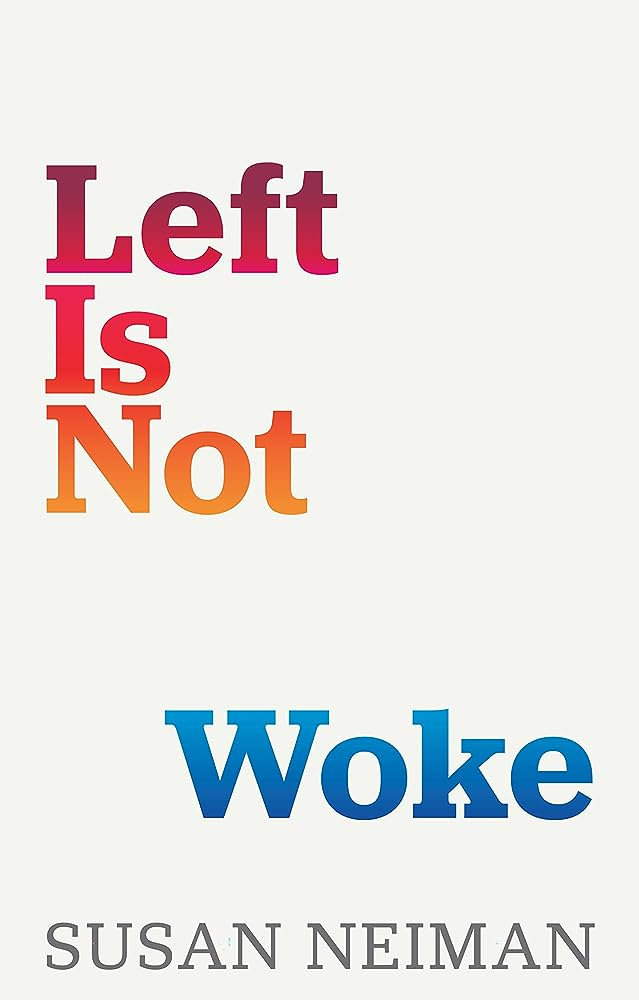
Mirror-Universe Foucault in a land without Marx: The bizarre phantasmagoria of Left is Not Woke by Susan Neiman

This book is not what I expected.

When I initially opened the cover and was confronted by the statement that, “Except as occasional targets, they {‘leftist’ ideas of universalism, justice and belief in the possibility of progress} are hard to find in contemporary discourse. This has led a number of my friends in several countries to conclude, morosely, that they no longer belong to the left. Despite lifetimes of commitment to social justice, they’re estranged by developments on what’s called the woke left, or the far left, or the radical left.” I assumed this was the tired Sam Harris style grift whereby a centrist liberal declares themselves the real left and, glancing at progressive liberals, declares them the far left, ignoring entirely the existence of communists, socialists and anarchists.

That’s not this book though. Instead the book is far stranger than that. This isn’t to say that the book is good. It is perhaps the second-worst work of pop-philosophy I’ve ever read (the worst being the absolutely execrable How To Be Perfect by TV producer Michael Schur). Where it differs, and how it ultimately exceeds the worst-of-the worst is in the clear breadth of Neiman’s reading. However this makes some of the remarkable exclusions in the text even more baffling. Things I could pass off as ignorance on the part of Schur are burdened with significance in Neiman’s book.

Now, since I’ve said the book is not a typical right-reframing of the Overton window a-la Sam Harris or his sad ilk the question should be raised as to what exactly the book is. And this book actually has a laser-sharp focus which is elided by its unfortunate, and overly-broad, title. This book is an attempt by Neiman to accuse Michel Foucault of smuggling Naziism into leftist philosophy. There is a secondary objective of this book – and that is to reestablish the primacy of Immanuel Kant as the champion of progress and to defend him from accusations of racism.

This comes together in her essay when Neiman makes the absurd proposition that Enlightenment philosophers can be distinguished from “practitioners of theory” in that these later “practitioners of theory” write in impenetrable jargon while the enlightenment philosophers “wrote clearly, without jargon, in the interest of reaching the widest number of readers. (Even Kant, the most difficult of Enlightenment philosophers , wrote fifteen perfectly intelligible essays for a general audience.)”

As somebody who has read both Discipline and Punish and the Critique of Pure Reason about the only thing I can say about such a claim is ‘LOL; LMAO.’

However this is ultimately a bit of a misleading passage for what follows as it becomes clear that Neiman has read both Foucault and a sufficient number of his critics to recognize that he wrote essays that were quite clear and accessible to a general audience. Rather she’s concerned that Foucault’s work depends on a method whereby it “hypnotizes” the audience rather than depending on rational argumentation.

For the first half of the book Neiman cannot mention Foucault (and she mentions Foucault quite a lot) without also bringing up the Nazi jurist Carl Schmitt and although she’s never quite bold enough to say so openly it really does seem like what Neiman wants her audience to believe about Foucault is that he was some sort of secret Nazi. She certainly doesn’t hesitate to call the concept of Power-knowledge reactionary.

But I do believe a lot of the disconnect in Neiman’s very unsympathetic reading of Foucault boils down to the old idealist / materialist split. For Neiman there are three fundamental elements to the left wing project, three precepts, that she believes Foucault’s work violates:

  1. Universalism
  2. Justice
  3. Progress

Now with progress, Neiman has a very careful and specific definition which she applies. Unfortunately she reserves defining this term to the conclusion of the book which is a poor structural choice as her failure to properly define progress at the outset significantly weakens her argument.

“It’s a matter of changing direction: Rather than thinking of progress as directed to a particular goal it can be useful to think of progress from a problematic situation to one that is less constrained.” Now this is very close to Beauvoir’s idea from The Ethics of Ambiguity regarding the movement toward an open future as the objective of a Left-wing ethic. It’s a real shame that Neiman never thinks to cite Beauvoir. Although Kantians ignoring Beauvoir’s ethic is something of a perennial complaint of mine it’s remarkable how this specific Kantian manages to arrive at some of Beauvoir’s conclusions without giving her predecessor even the most cursory recognition. However what Neiman fails to do at all is demonstrate how Foucault violates this revised precept of progress.

Certainly Foucault is critical of readings of history as progressive. His project examines how power changes form in relationship to changing epistemologies and how politics acts as a form of open warfare between parties. But Neiman takes from Foucault’s historicism that his writing makes it “hard to avoid concluding that any attempt to improve things will only make them worse.” This is a wild reading of Foucault to say the least.

At one of her most charitable episodes Neiman compares Foucault’s critique to that of Rousseau but argues that after Rousseau constructed his critique he spent the rest of his life trying to fix the world.

However this appears to be Neiman treating both of these writers as their texts alone. Certainly Foucault’s academic work remained diagnostic rather than prescriptive but it could be argued just as easily that Rousseau’s diagnosis was incomplete when he abandoned it in favour of spinning off a bunch of proposals that history demonstrated failed to lead to mass liberation. Meanwhile Foucault worked hard toward prison abolition.

Neiman briefly addresses Foucault’s abolitionism but only to suggest that Foucault’s motivations for doing so were amoral and that this means these activist activities somehow didn’t count. She loves going on about the supposed moral void of Foucault’s work, citing Chomsky calling him evil, citing Améry calling him problematic. But she fails to contend with the idea that Foucault limited his academic work pretty specifically to epistemology and never pretended to be writing an ethic; not everything has to be an ethic to be useful.

Despite Neiman’s relatively nuanced perspective on progress she still falls into the broad progressivist trap of seeing an arc of history bending inexorably toward justice, saying of the Kennedy administration’s record on civil rights in the United States that, “A world where all citizens have equal rights to eat, ride and study where they want to is better than a world where they do not, and no amount of dialectical sophistication would lead a black Southerner who lived through segregation to deny it.” There are, of course, two issues with such valorizations of incremental progress. The first is that Neiman is choosing to look at a specific change in a specific historical moment and to weigh it ethically as being “more good than what immediately preceded it” but in doing so fails to contend with the possibility of reversals throughout the history prior. This is unsurprising. Neiman believes that focusing “too much” on history blocks the path to progress.

The other problem is that Neiman seems unable to believe that anyone would write a philosophical text that explicitly avoids ethical statements and keeps trying to read an ethic back into Foucault where there is none. When she succeeds she calls this ethic perverse. When she fails she decries him as amoral. Using these two positions she characterizes the extra-academic actions Foucault took which have an ethical dimension as being perverse and amoral even when he was actively fighting for liberation.

On progress Neiman frequently raises and explores the question of the State of Nature. Much of this is to defend enlightenment thinkers from accusations of racism or colonialism. Neiman is careful to cite African philosophers regularly and I will say makes a convincing argument that she is on the right side of history when it comes to black liberation. This makes her blind spots concerning Indigenous North Americans all the more bizarre. Neiman insists on talking about “tribalism” and “tribes” throughout the book, saying that she prefers the word because it conjures the idea of barbarism. She openly admits that somebody (possibly a sensitivity reader) told her she shouldn’t say that but she did it anyway. And yet, for all of this, there are only two citations to anthropologists: David Graeber, who she is dismissive of, and Claude Lévi-Strauss, who she treats as having tried to test Rousseau’s state of nature hypotheses.

She certainly fails to address the writings of anyone of the ilk of Pierre Clastres – whose work helped to scientifically repudiate the racist idea of a progression from savagery to civilization. In fact between her vehement defense of Kant against charges of racism and her insistence of tribalism, I described the first half of this book, excluding the critique of Foucault thus: someone called Kant racist and she called them a tribalist and then that same someone said that’s racist and she got so mad she wrote a whole book about it. Of course Neiman cites no Indigenous sources.

Before departing from the topic of the state of nature I will say that some of the best material in this book is a thorough, vicious and insightful critique of Richard Dawkins and of Evolutionary Psychology. She easily recognizes the misogyny at the heart of evo-psych and she pulls no punches. More strangely she claims that evo-psych is broadly accepted as settled science by left and right alike (this is news to me) and she makes a weak attempt to tie this abortion of pseudoscience back to Foucault. Foucault was, of course, quite hostile to the idea of human nature as such. This makes attempts to blame him for some of the worst of the “just human nature” crowd rather absurd. To her marginal credit it seems even Neiman recognizes she’s stretching here and so we end up with a third of a chapter mostly about how Foucault is a secret Nazi that diverges into a good critique of a contemporary reactionary movement without much connection to the rest of her thesis.

On justice she believes Foucault to be of an accord with Schmitt that there is none. She’s aghast at Foucault’s account of juridicalism and is deeply discomforted by the contents of Discipline and Punish. But there’s an odd dance Neiman often does in her critique of that book whereby she will complain about some position Foucault took there, then will generalize it to the entirety of his being, constructing an essential Foucault, then justify that essential Foucault with quotations from Nietzsche, Genealogy, History.

However it’s worth also noting that Neiman has a view of justice that is both vulgarly-progressive (she believes society has become more just over time) and that is very much in the Kantian idealist mode whereby justice is a noumen of which any given application of justice is a phenomenon reaching (necessarily) imperfectly toward it. As such she excuses contemporary injustice as a work in progress while insisting both that the prison is preferable to the gallows and also that Foucault thought the opposite. She is poorly equipped to handle a materialist view of justice as a historically-bound system of power relations.

And here is where we must address the glaring omission in the heart of Neiman’s book because she has penned an entire book about “the left” that mentions “Marxists” twice (neither complimentary), Engels once and Marx never at all. She cites Fanon a lot but of him she says, “Fanon was a universalist who sought justice and believe in the possibility of progress.” This is made even more baffling by her vague assertion that ‘the Left’ has abandoned Diderot along with the rest of the enlightenment. Diderot is brought up in her text in close proximity to Fanon.

Now it’s notable that Karl Marx, who Fanon studied with care, was very fond of Diderot. As such there is actually a philosophical lineage that can be drawn directly between Fanon and Diderot. It’s just that, for this to be intelligible, you have to admit that Karl Marx existed.

On universalism Neiman is on the weakest ground. She realizes that the colonial project of civilizing the savage was a product of universalist thought and repeatedly argues, passionately and at length, that colonial powers misappropriated enlightenment thought that was critical of their project. Again there is an idealism here that wants to separate out what a thought is in itself from how it is used. Kant criticized colonialism so the use of his work by colonial powers is irrelevant. He’s not to blame for how his work was used.

It seems like Neiman cannot imagine a molecular justice or progress. She insists the left, to have a meaningful project, must pursue the same outcome (justice and progress) for all people everywhere. What makes this absurd is that she might be much more capable of making this argument if she abandoned Kant even briefly and spoke in Marxist terms. While many contemporary Marxists (such as myself) have read enough Deleuze to recognize the value of the micropolitical and the local on praxis there is a wealth of thoroughly universalist Marxist writing she could have drawn from. I mean Trotsky is right there. As a result Neiman’s deep loyalty to Kant ultimately severely hamstrings her ability to claim that universalism is a good. She’s far too concerned with defending the reputations of Kant (especially Kant), Voltaire, Rousseau, Montesquieu and Diderot to succeed in creating a persuasive argument for the necessity of universalism on the left.

I think I understand Neiman’s hesitance around Marx though and it’s because I don’t actually believe Foucault was the real target of her critique. Frankly Neiman’s Foucault is a straw man among straw men. Anyone with even a basic grounding in Foucault can either dismantle or brush away most of her criticisms without difficulty. Foucault was amoral? So what? Does that make his epistemology incorrect? But what’s going on here is that Neiman has a deep distrust of historical materialism.

Historical materialism is a demystifying way of looking at the world as a set of contingent material conditions where progress is not assured, where justice is described in non-moral terms and where universality is ultimately impossible. If you accept a view of history as a series of conflicts between classes then the progress toward justice rapidly becomes the playing out of conflicting powers rather than reason fumbling toward a nouminous good. “We have no compassion and we ask no compassion from you. When our turn comes, we shall not make excuses for the terror,” Marx said and this was a recognition that the proletarian struggle was not one of seeking progress toward an ideal. It was a threat, “we are coming for you.”

But as much as Neiman is obviously uncomfortable with the lack of idealism in Marx she cannot bring herself to attack him. It becomes clear in her conclusion that, despite some boomerish language, her preferred political project is far too close to socialism to openly attack Marx. As I mentioned before her idea of progress is incredibly close to Beauvoir’s (Marxist) idea of freedom. To openly disavow Marx would be to destroy the basis for her own project.

And I do think Neiman constitutes a leftist, even if one with some troubling unexamined baggage around Indigenous North Americans. So I don’t think she wants to undermine that basis. Instead she has produced this remarkably bad book. She sets up a caricature of Foucault for demolition and, in his place she raises up Kant as the father of the Left. Neiman acts as if Marx never existed and as if his students and friends hardly did either (excepting Fanon whose tie to Marx she elides) and, having erased him from history she rebuilds social democracy from a basis of the categorical imperative.

Neiman’s book is thorough and, on those rare occasions she isn’t talking about Foucault, it’s logical. But the problem is that it seems to have been written from a mirror universe with significant differences from ours. Now I’ve seen enough American radlibs who know the words to liberation but who don’t understand the beat, the sort of people who will say that it’s actually doing fascist work to de-platform a fascist if, in the process of that de-platforming, a marginalized person might come to harm. But it’s absurd to call these failures of education the far-left. That is still composed principally of Marxists and Anarchists who are usually more sensible. And it’s even more absurd to suggest such frivolous appropriations of the language of social justice are the fault of Michel Foucault. Hopefully this book will be forgotten by the history whose interrogation its author fears.

Zhuangzi in Carcosa – a review of The Wingspan of Severed Hands by Joe Koch

I’ve been wanting to get my hands on this one for ages. The Wingspan of Severed Hands is a 2020 novella written by Joe Koch and I was aware of it since before its release but after its initial publication I struggled to find a print copy for purchase in Canada. Weirdpunk Books recently issued a second print run of the book and this seems to have broken the digital-only barrier I was facing as I was able to finally buy a copy and I’m very glad I did because The Wingspan of Severed Hands is one of the most fascinating works of weird fiction I’ve ever read, a perfect example of avant-garde literature that challenges its reader both with the complexity of its imagery and the artfulness of its themes.

This book is a weird fiction story which gestures directly toward the work of Ambrose Bierce and Robert W. Chambers but it is also a startling interrogation of the question of what it means to be sane and of the ancient Taoist question of whether one can differentiate between objects.

We might start by interrogating a genealogy, or perhaps an archaeology, of Carcosa. This storied city appears first in Bierce’s An Inhabitant of Carcosa in which it is an ancient and ghostly ruin. I say ghostly rather specifically because Bierce’s story is an interrogation of death and the persistence of the spirit, chronicling the revelation that an ailing man is, in fact, a ghost, long dead, who has approached his own grave and in doing so come to the revelation of his spectral nature. Bierce’s story opens with a quote, accredited to “Hali” (likely derived from one of two Arabic alchemists) which proposes different permutations of death as a phenomenon:

“For there be divers sorts of death—some wherein the body remaineth; and in some it vanisheth quite away with the spirit. This commonly occurreth only in solitude (such is God’s will) and, none seeing the end, we say the man is lost, or gone on a long journey—which indeed he hath; but sometimes it hath happened in sight of many, as abundant testimony showeth. In one kind of death the spirit also dieth, and this it hath been known to do while yet the body was in vigor for many years. Sometimes, as is veritably attested, it dieth with the body, but after a season is raised up again in that place where the body did decay.”

Ambrose Bierce – An Inhabitant of Carcosa – 1886

The affective character of this silent and ruined city under the red disc of a darkening sun, ripe with the psychopompic significance of the owl and the lynx was then appropriated by Chambers for The King in Yellow and it’s from Chambers that much of the shared weird-fiction motifs that surround Carcosa – the idea of it as an alien landscape as opposed to (or in addition to) it being a spirit realm, the King in Yellow as the monarch of the ruined city, the eponymous play about the king which brings madness, and the Yellow Sign – derive. In the story The Yellow Sign the model Tessie says, of the awful man who upsets the narrator, “‘he reminds me of a dream,—an awful dream I once had. Or,’ she mused, looking down at her shapely shoes, ‘was it a dream after all?'”

This short story treats these semiotic markers of Carcosa – the play, the sign – as occupying a liminal space between life and death. The agent of the King in Yellow who comes to recover the amulet marked by the Yellow Sign is a cemetery watchman long-dead, the same man who haunted the dreams of Tessie and the narrator. And as such it’s via Cambers that we begin to see Carcosa as a place of questioning boundaries – the boundary between waking and dream, the boundary between life and death.

In the second chapter of the Zhuangzi is one of the philosopher’s most famous fragments:

The Outline said to the Shadow, “First you are on the move then you are standing still; you sit down and then you stand up. Why can’t you make up your mind?”

Shadow replied, “Do I have to look to something else to be what I am? Does this something else itself not have to rely on yet anther something? Do I have to depend upon the scales of the snake or the wings of a cicada? How can I tell how things are? How can I tell how things are not?

Once upon a time, I, Zhuangzi, dreamed that I was a butterfly, flitting around and enjoying myself. I had no iea I was Zhuangzi. Then suddenly I woke up and was Zhuangzi again. But I could not tell, had I been Zhuangzi dreaming I was a butterfly or a butterfly dreaming I was Zhuangzi? However, there must be some sort of difference between Zhuangzi and a butterfly! We call this the transformation of things.

The Book of Zhuangzi – Translated by Martin Palmer (with minor alterations) – 1996 (original text ~300 BCE)

The simplest interpretation of this is to treat it as a question of boundaries and this is so, to a certain extent. It’s true that Zhuangzi calls into question the division between waking and dreaming. But more to the point Zhuangzi calls into question the existence of discrete objects. The Shadow treats itself as an object and points out that its constant fluctuations, first standing still, then sitting down, then standing up should not be tied to a single cause because all causes are interdependent. This prefaces Zhuangzi’s argument that to dream of being otherwise is to be transformed. Instead of discrete objects we see a universe of motion wherein forms are contingent and disruptive change ever-present.

This provides with a basis for grappling with Koch’s challenging text.

The Wingspan of Severed Hands focuses on, perhaps, three interconnected beings. The first is Adira – a daughter of a harsh and controlling mother, someone raised with too much religion and not enough money. The second is Director Bennet – a scientist leading an initiative to rescue civilization from an epidemic of madness brought about by the semiotic contagion of the Yellow Sign. The third is the Weapon – possibly an angel, possibly a butterfly and possibly a god – the weapon is Bennet’s vehicle of global deliverance and Adira’s vehicle of personal deliverance.

The stories of Adira and Bennett begin seeming like disconnected views of the same global phenomenon. Bennet shelters in her bunker building plans to rescue the world from the cultic calamity that Adira lives within. Her mother raises her with the judgmental furor of an evangelical Christian but as the story progresses it becomes clear that her’s mothers theological convictions are not so simple.

Looming over this is the Queen in Yellow – a dead or dying mother god, the monarch of Carcosa, our liminal city where dream and lucidity, death and life, madness and sanity collide in a shattering of dialectical poles.

However as the story progresses the boundaries between these characters become indistinct. We discover that Director Bennet is properly named Adira Bennet and many aspects of her personal history align with those of Adira’s present. Adira suffers a series of shocking mortifications and transformations that harken back to Bierce’s claim that sometimes the spirit, “dieth with the body, but after a season is raised up again in that place where the body did decay”

This progression, and the dual nature of the Weapon as Bennet’s project and Adira’s guardian angel, come about to a climax which is effectively a textual approach to semiotic collapse as the groundings of formal unities are cut out from under the audience one after another. The entire book occupies “the last waking moment between the blackness of sleep and the lucidity of dreaming,” while also taking place as a giant butterfly built of steel and flesh dreams the death of a mad goddess and while also chronicling an abused woman escaping from an ailing but domineering mother for whom she will never be good enough.

It’s not the right question to ask if Adira and Bennet are the same person. Nor is it right to ask whether Adira and Bennet are acting at the same time. It’s even more futile to ask whether Adira is cut to pieces by a mad cult in a disused school pool building only to be resurrected in the bowels of a cosmic hound. This book defies an easy division between the action of the text and the metaphor by which the action is described. These semiotic structures of fiction collapse under the power of Koch’s vision.

I think one of the delightful challenges of this book is the way that it obliterates the idea of narrative fiction as existing within time. If everything is in a constant state of flux and change then time itself must be seen as contingent. Certainly this metastable conception of material law is a thread in philosophy that runs from Zhuangzi to Meillassoux, intrinsically tied to various iterations of dialetheism and I think this provides a lens for looking at the truth of this book. The Wingspan of Severed Hands contradicts itself constantly while simultaneously reifying its own unity. Adira is the history of Bennet. Adira is the ally of Bennet. She is one person, she is not the same person. Carcosa has always been a liminal space and in this book it exists at the boundary between being and the void. It both is and is not; there is a chronological thread: The weapon is made. The weapon gestates. The weapon is unleashed and flies to Carcosa. But simultaneously the weapon appears on Adira’s wedding day, born of her severed hands. It’s made of flesh and metal and language. The weapon is not a tulpa, it is no mere thought-form but it is a thought-form and an angel and a machine. This (non)contradiction is what makes this brief text such a challenging read and I do want to note that this is not an easy book to read. I found myself rereading passages in this as often as I do when picking my way through complicated metaphysical monographs to make sure I understood what I was reading on a scene to scene level. And yet this difficulty is not from any sort of sloppiness. Koch is a powerfully controlled writer with an exceptional grasp of language both as a tool for communicating metaphor and as a sound-based artform: “Shamed by the mirror, by her mother’s hand, hot and damp with uncontrollable, anxious sweat, in the dress so tight it doubled every flaw, flowers in her hair, flowers in her eyes, no time to cry. the teal church carpet reddened Adira’s slapped cheek. She was a ruddy sow marched to slaughter.”

Furthermore Koch has mastered a skill I wish more genre authors would – using all of the senses within his work. The sensory data of this book is like a stack overflow. It’s so abundant that the mind struggles to contain the (non)contradictory sights, sounds, smells, tastes and feelings of the world. Koch tells us to take it all in but what it all is, is madness. And yet for all of this jumble of metaphor and reality, for all that this book is a work of asynchronous subversion of time and identity, it remains a taught thriller about trying to save the world from madness.

But can the world be rescued from madness or only be driven further into it? Is the Yellow Sign a sigil from beyond the stars or the random adornment on the side of an empty journal? It is both. It is neither. And so we have a world that is (not)saved. We have a protagonist who is (not)unified in her own identity.

The Wingspan of Severed Hands is a masterwork of literature. It is as insufficient to call this book weird fiction as it would be to call An Inhabitant of Carcosa weird fiction. It is certainly weird in the Fisherian sense of an overabundance of presence but this is an insufficient description of it. It is such a singular text that the only way to describe it would be to repeat the entirety of it verbatim and so, in the end, I can only say that the only way to grasp this book, let alone to understand it, is to read it. I would encourage people to do so.

Note regarding the WGA and SAG/AFTRA strikes

After listening to both SAG members and other members of the critical community I have decided that I will withhold reviews for any film currently released by a struck studio. This means that while I will continue to review movies from independent studios that are outside the bounds of the current strike action any planned reviews of films from struck studios will not be released until after the conclusion of the strike.

Please donate to WGA and SAG/AFTRA and show solidarity with striking workers worldwide.

This Shit is Bananas

In 1954 the United Fruit Company (which later rebranded as Chiquita Bananas) conspired with the CIA to overthrow the democratically elected government of Guatamala. This became an exemplar of a category of 20th century political apparatuses called “banana republics” – autocratic dictatorships, generally in the global south, which were supported by the United States with the express purpose of supporting the unimpeded flow of cheap commodities into the imperial core. Other such banana republics included the turn-of-the-century government of Honduras, the state of Hawaii, and at various times Panama, the Philippines, Mexico, Nicaragua, the Dominican Republic, Haiti and, of course, Cuba.

This phenomenon was so called because of the centrality of both fruit companies to the series of coups and dictatorships and because of the instability they fostered – republics with the shelf life of a banana. However it must be clear that the objective of the United States in supporting often brutal regimes like that of Batista in Cuba was explicitly capitalist in nature. In many cases, throughout the first two decades of the 20th century, the US military, supporting American bankers and fruit sellers, took direct control over the political levers of many of these countries including, notably, Honduras, Nicaragua and Cuba.

Bananas have never failed to be political.

Now aside from the blood fertilizing so many export fruit crops, the desolation of indigenous kingdoms like Hawaii and of independent, democratic, republics like that of Guatamala prior to the 1954 coup there is another big problem with the tropical fruit trade: its carbon footprint. The production and shipping of each single banana contributes 80g of carbon to the atmosphere. For comparison, a locally grown apple, if raised organically (the caveats of “local” and “organic” here are important for later) extracts carbon from the atmosphere at a rate of 15,000 kg/year/acre. This works out, very roughly, to a net carbon reduction of 19g per apple.

And this gets to the two hearts of our recent “bananas under communism” discourse. See certain social democrats and left-liberals don’t like to believe that the imperial core would have to make any lifestyle changes at all if we were to overthrow capitalism and bring about a true economic revolution. For them the idea that communists are proposing they should not eat bananas is tantamount to betraying the very principles of socialism, this idea that we must unleash productive potential in some vulgar Stakhnovist sense of the word.

However what many eco-socialists, green-anarchists and other materialist communists are telling them is that one significant and necessary economic transformation that has to happen around the world is a pivot to a focus on local food production with the objective of feeding people where they live. Global supply chains that give the imperial core tropical fruit year-round and at cheap prices are still, to this day, lubricated with blood. Much of the world’s supply of inexpensive chocolate depends on child-slavery.

Beyond this, the carbon cost of growing and shipping cash crops like chocolate, bananas and other tropical fruit is exorbitant compared to the better option of growing abundant fruit trees local to any given population and that population eating that fruit.

Because this is the thing that a lot of the liberal banana-defenders miss: we aren’t saying some sort of scolding moral imperative like “you don’t deserve bananas filthy American” but, rather, we are saying, “grow your own damn fruit and share it with your own damn community.”

This will, of course, mean that availability of fruit will become more seasonal and consumer choice in the imperial core will shrink. That’s actually good though. Because, as other left-permaculturalists have pointed out, there’s another problem with mass production of out-of-season tropical fruit: it mostly sucks.

Tropical fruit bred to ship from Honduras or Guatamala to Prince Edward Island in the dead of winter is bred for shelf-life and hardiness. It must travel, by boat and truck, thousands of kilometers and across days to reach grocery shelves unblemished enough for the discerning imperial core consumer. In order to achieve this with a fragile banana the hardiest breeds are selected. If they taste good this is incidental. The logic of capital persists across all fruit strains. Most important is that as much of the fruit as possible is saleable at market. Second most is that it costs next to nothing to produce. Next is that it look pretty. If it tastes and smells good this is a nice bonus.

It’s not sufficient that we switch from bananas to apples. Apples put a lot of carbon back into the atmosphere via pesticides, artificial fertilizer and shipping. The same logic that gives us hard, aroma-free, green bananas on our store shelves also created and distributed the abomination that is the “red delicious” apple. Instead we should be putting fruit right where people live. Municipalities should plant local fruit trees for shade. Orchards should grow crops for sale within a local range of 100km or less as their principal targets. We should avoid pesticides and carbon-intensive nitrogen fertilizers in our fruit production and select fruit not for shelf hardiness but for aroma and flavour. This way of looking at fruit, especially the part about growing it freely in cities for anyone to eat, is the most critical aspect of what the environmentalist left is calling for. We’re not trying to take away your banana. We’re trying to give you pawpaws for free.

However, as a concession to our Banana-loving Stahknovists we must also remind them that it’s not just a bunch of revisionist ecological hippies saying this. It’s Karl Marx. “The determination of the market-value of products, including therefore agricultural products, is a social act, albeit a socially unconscious and unintentional one. It is based necessarily upon the exchange-value of the product, not upon the soil and the differences in its fertility.” Marx says in Capital Vol. 3 – part of an extended exegesis regarding differential rents on agricultural land – but this statement makes something very clear: capital is incapable of caring about soil health.

Now Marx goes on to make a very cogent point, that as the price of rents on land will be derived from the market price on crops grown on the least-fertile land a movement away from capitalism would ultimately lead to a reduction in the price of agricultural commodities that “would have the same effect as a reduction in price of the product to the same amount resulting from foreign imports.” In other words we can get more abundance by using land in a rational, non-capitalist sense, locally and, as such, side-step the need for imports.

And this is important because the liberals of the imperial core so worried that communists will take their tasty treats away are forgetting a key question of global revolution: if we overthrew capitalism what would you do to compel the global South to keep producing your bananas? Are you going to do what the United States did in 1954 and re-inscribe empire in order to keep the treat flowing in? Will we keep watering the cocoa trees with the blood of child slaves at gunpoint even under communism?

The truth is the decision will not ultimately belong to what is now the imperial core. If a revolution were to come the flow of cheap out of season tropical fruit would die back considerably as local farmers began to focus first on feeding themselves and their families rather than growing cocoa, coffee and bananas for export. The perverse economic incentives to produce cash crops don’t exist outside of capitalist compulsion and exploitation. To abolish capitalism will abolish green $0.80 per lb bananas on your grocery shelves. But this doesn’t mean the global North will starve. The socialist relationship to food, which no longer gears price to the rent that can be gained from the worst productive land, will allow for local crops to be available and affordable for us too.

There’s an old phrase, “farmers feed cities,” and it’s true. But right now many of these farmers live in the global South and starve to feed the cities of the imperial core. This is the injustice that must end. Right now these farmers watch as climate crisis hits them with wet bulb temperatures, heightened hurricane seasons and drought. The global South is the frontline of the devastation of climate change. And so, ultimately, the shit that is really bananas is that comfortable progressives in the imperial core think they’ll have any choice at all when the revolution finally does arrive.

Your bananas will go. Better learn to like apples.

Kid’s Stuff – The Double Binds of Barbie

Barbie (2023) is perhaps the most thoroughly postmodern children’s movie produced to date. The marketing material for this film promised that it was the movie for you whether you loved Barbie or hated Barbie and the film delivers almost precisely this – a story that attempts to shatter any grand narrative surrounding this toy. This is done from a variety of directions: first by establishing, as the premise of the film, that Barbieland is perfect – for Barbies – and that the Barbies who live there are comfortable in the knowledge that through the nebulous and infinitely transforming nature of Barbie they have created an avatar that allows girls, and by extension women, to be anything. The film then sends Barbie out of Barbieland and to the real world – in which the lie to that statement is revealed in full.

And yet, the Barbie movie also refuses to fully let go of the idea of Barbie as a mystical avatar for modern femininity. This creates one of the central double-binds of the film. The Barbie movie wants to demonstrate both that Barbie is representative of the aspirational desires of women but also that it is insufficient to the task.

These sorts of double-binds proliferate the text quite openly such as a late scene in which Gail, the Mattel executive assistant and frustrated mother whose spiritual bond with Margot Robbie’s “stereotypical Barbie” leads, in part, to the action of the film delivers a monologue saying, “You have to be a career woman, but also look out for other people.

“You have to answer for men’s bad behavior which is insane but if you point that out you’re accused of complaining.

“Because you’re supposed to stay pretty for men but not so pretty you tempt them too much or you threaten other women. Because you’re supposed to be part of the sisterhood but always stand out.

“You have to never get old, never be rude, never show off, never be selfish, never fall down, never fail, never show fear, never get out of line. It’s too hard, its too contradictory, and nobody gives you a medal and says thank you.”

Many critics have been fast to point out that much of the feminist content of this film is reminiscent of “girlboss feminism” – a kind of reintegration of third-wave Feminism that has been fully subsumed by capitalism. But this, too, is a bit of a simplification of a central double-bind for the film in which the CEO of Mattel mumbles that the company is built of women and that two prior CEOs were women while standing amongst a cadre of nameless male executives but in which the ghost of Ruth Handler maintains an office and seems, in some way, to still be running the company. This is a film in which Mattel is proven incapable of taking action of any moral significance because it is restricted by the profit motive but also one in which Mattel will also take moral action because it is restricted by the profit motive. The theme of the Barbie movie is so fragmentary as to be almost fractal.

And, of course, the Barbie movie shares a common concern with other postmodern films such as The Matrix with regard to authenticity and the order of simulacra. However, where the latter settles toward a Kierkegaardian celebration of the leap toward the authentic against all rational odds this movie instead spends two of its three acts reveling in probing the boundary between simulacra and the real. Barbieland is like a town in Sweden. However, when the pedal hits the metal the Barbie movie collapses any vestige of a division between simulacra and the real in favour of a Beauvoirian recognition of the necessity of self-announcement of being.

However let’s not suggest that Gerwig and Baumbach were able to get ahead of the greatest existentialist ethicist with their script. The script introduces our Barbie in a role that maps to Beauvoir’s description of narcissism. “Her memories become fixed, her behavior stereotyped, she dwells on the same words, repeats gestures that have lost all meaning: this is what gives the impression of poverty found in “secret diaries” or “feminine autobiographies”; so occupied in flattering herself, the woman who does nothing becomes nothing and flatters a nothing.”

And from there the film charts her evolution toward a kind of liberation, while attempting to recognize the fundamental incompleteness of the struggle. It’s, honestly, one of the better interpretations of existentialism in any recent scripts. I’ve commented elsewhere that Gerwig and Baumbach appear to grasp Beauvoir far better than the Daniels did Camus and, while I still think Nope did a better job of interrogating questions of recognition and the look, this was in part because Nope was a movie for adults and, as such, could get darker than a children’s comedy. And the script here is very good. It’s funny – very funny – and designed in a way that stays alert both to the child audience who are the primary targets of the film and the inevitable parents who will be escorting their kids there.

But, for all that the film uses Beauvoir’s feminism to strong effect they miss something very critical that Beauvoir said of liberation. “These civic liberties remain abstract if there is no corresponding economic autonomy; the kept woman—wife or mistress—is not freed from the male just because she has a ballot paper in her hands; while today’s customs impose fewer constraints on her than in the past, such negative licenses have not fundamentally changed her situation; she remains a vassal, imprisoned in her condition.”

The action of the Barbie movie comes to a head as the Barbies manage to protect legal rights via legal democratic action. Their economic dependence upon Mattel is, not only not abolished, it’s reaffirmed when Mattel realize that certain progressive doll ideas put forward by Gail would be very profitable. And this is the realm in which the incomplete double-binds of Barbie really strike at it. “Woman’s fate is intimately bound to the fate of socialism,” Beauvoir says, and the film is unable to follow her down such socialist lines of inquiry.

It does appear that the film is aware of this. There is a self-conscious and recursive auto-critique of Mattel present throughout the movie that treats capitalism as being bleak, dangerous, byzantine and ritualistic in ways that recognize both the libidinal irrationality of capitalism and its tendency to co-opt its own critique. The situationist double-bind of the intrinsic spectacle of capitalist critique is fully present in this film and there’s no effort made to conceal that it is the simulacrum of a criticism rather than anything actually cutting. Mattel makes out like the subject of a televised roast.

But this is a children’s movie. Am I saying I want children’s movies to be socialist propaganda? I mean yes. But that’s neither here nor there for navigating the central tension I’m picking at with this film between its postmodern obsession with the real and the fake and its attempt to create a Beauvoirian thesis regarding objectification. Because this gets to something I’ve danced around until now: how much of the film is predicated upon the conflict intrinsic in “Barbie has a great day everyday. Ken only has a great day if Barbie looks at him.”

It’s kind of funny that one defense I’ve seen of the film is that it might encourage little girls to ask about what the Patriarchy is. And that’s all for the good although mine actually just asked what a gynecologist was. But we do have a moment in the movie where Ken says he grew bored with patriarchy once he realized it didn’t have anything to do with horses.

Ultimately the film correctly places patriarchy as being, in part, a failure of the Kens to be for-itself. (I know, it would be lovely to get through an issue of Kid’s Stuff without bringing in Heideggerian phenomenological terminology but, like, it was Gerwig and Baumbach who decided to put this much Beauvoir into their discourse so here we are, again.) Effectively Ken depends upon the gaze of Barbie in order to validate his being. He doesn’t have much of a stable identity. His job is “beach” – not lifeguard. Just beach. But Barbie, being something of a body without organs, escapes the for-itself / for-others dichotomy a bit more than Ken who is oriented so thoroughly to validation via Barbie that he ends up existing only for Barbie. Barbie is effectively nothing because she contains the potential to be anything. Ken is just Ken: hyper-determined in his transfiction in the gaze of the other.

This is, honestly, where it becomes clear that the scriptwriters understand Beauvoir at least outside of her socialism. There is more depth of feminist theory to the psychological landscape of Ken than there is in the boilerplate “girlboss” feminist speeches of Gail and her daughter. Instead Ken’s catharsis comes about from the realization that he needs to understand who he is when he’s not with Barbie. His antagonistic turn and dalliances with patriarchy arise out of the frustration he feels at his own superfluity. Ken tries to bring down Barbieland because he can only have a good day when Barbie looks at him. And Barbie has her own shit going on right now and kind of just doesn’t need constantly validating Ken’s existence to be her focus. The central mystery of where Kens go when Barbies aren’t with them is never resolved because Ken ends the film beginning the search for the answer to that question. And meanwhile Barbie is taken up by God (I mean the ghost of Ruth Handler) and is told that she cannot ask for humanity. No power can give her authentic being for itself. She has to announce it for herself.

I liked the Barbie movie quite a lot. It’s very funny. It’s well-written, well-shot and well-designed. A central scene in the real world in which Barbie is overcome by the beauty of the natural world and is brought to tears demonstrated that Gerwig’s pretensions to indy artistry were strong enough to survive into what should be an over-glorified toy commercial. It helps that it’s very well peformed with Robbie delivering some of her best work of her career in this film. Initially comparisons to The Lego Movie might seem appropriate but that would be doing this film a disservice. Greta Gerwig has created a very good children’s film on the back of Margot Robbie and Ryan Gosling’s considerable talent and chemistry. They’re both excellent comedic actors and displaying their talents very well here. There is a remarkable strangeness to this film with its ghosts and ritualistic CEOs, with its plastic other-world and its metaphysical bond between toys and people that is honestly refreshing and that resists boiling down to “parent-child trauma” the way so many of these other toy movies do. In fact the closest this movie gets to that is making it clear that a parent is ultimately not responsible for choosing who her child will grow into.

I like that this movie is one that infuriates all the very worst people. It amuses to imagine Ben Shapiro furiously marking down a tick on a notepad every time somebody says the word Patriarchy in this movie. However the Barbie movie demonstrates a key problem with taking the work of materialist leftist theorists and divorcing them from their economic contexts. The Beauvoir of the Barbie movie is a remarkable work of fictional reproduction. But it’s incomplete through the absence of a coherent economic critique. The Barbies save the day with a vote to protect the constitution and via protecting the liberal character of the supreme court. This failure of the Barbie movie to be as cogent about formal politics and capitalism as it is of cultural criticism of patriarchy is an obvious artifact of the “toy commercial” aspect of what Mattel wanted from this movie. This is to its detriment.

And yet still it is a movie that is satisfied with presenting the messy facticity of life and telling the girls who are its primary audience that it’s alright to be mixed up, frustrated and confused just as long as they keep working toward being for themselves and that nobody will give them this. They must announce it.

Hauntology and social reproduction: Stranger Things, Starship Velociraptor and Starlight Patrol

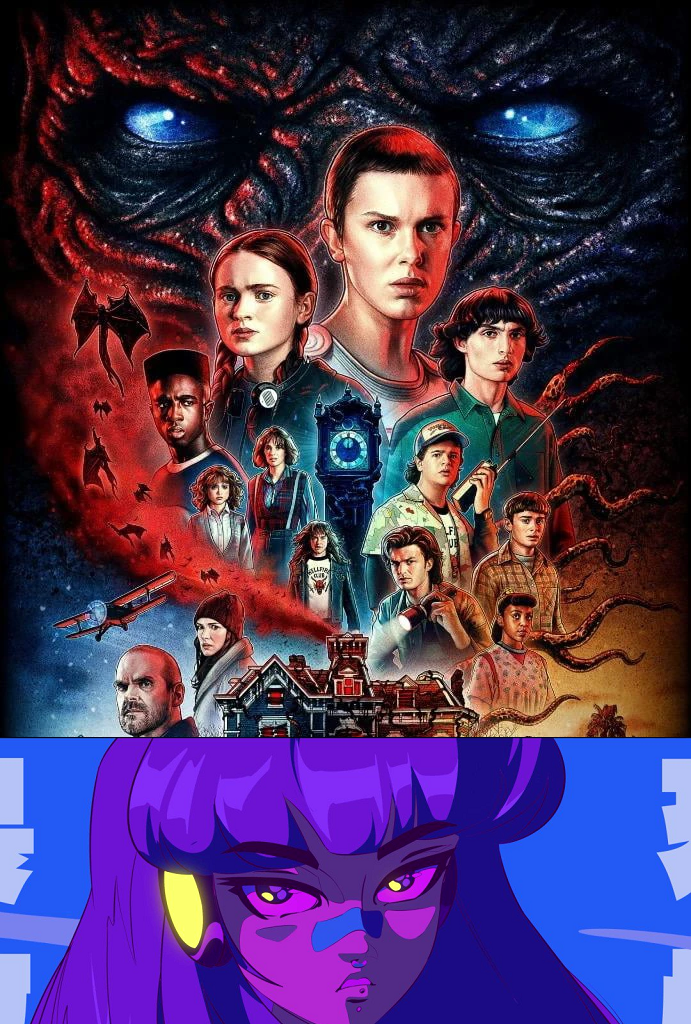
A collage of key images for Stranger Things Season 4 and the Jonathan Young song Starship Velociraptor

The general sense in the public discourse is that Stranger Things is a product of nostalgia but that’s not quite right. I’ve struggled to write about this television show – I’ve been promising a review since June 2022 and yet nothing ever came together.

Part of the problem has been that I’ve struggled with the question of who Stranger Things is for. Certainly it’s most popular among kids. My daughter is a big fan. Many of her classmates and team-mates likewise enjoy the show.

But why make a television show so explicitly loyal to the 1980s as an aesthetic if your target audience consists of people who were born a decade into the 21st century?

Stranger Things presents as a form of nostalgia programming, harkening back to Red Dawn and A Nightmare on Elm Street (right down to a Robert Englund cameo). But its primary audience can’t possibly be nostalgic for the 80s. It’s a past they never experienced.

Recently a few pieces fell into place for me that made writing about this television show a bit more viable. The key was that the Youtube algorithm, trained by my fondness for Gorillaz started serving me more animated music videos. Two of these that I ended up watching were Starlight Brigade by TWRP and Starship Velociraptor by Jonathan Young. Now both of these are actually very similar to Stranger Things in a few critical ways: first they’re pretty obviously targeting kids. This is especially apparent with Starship Velociraptor that includes the following quite-childish lyrics:

It's got a dozen restrooms inside
In case we all just have to
Sit on the comfy leather seats
Comes with a fridge that's full of meat, oh

But as I was listening to these two songs it struck me that they weren’t precisely 1980s pastiche. For all that Starlight Brigade, as a work of visual art, attempts to replicated the haze of VHS and for all that both songs as audio works are marked by the synth-pop-rock fusion sound that characterizes public perceptions of the 1980s as a musical period they’re both far too polished there is a clarity and velocity to the songs that belies their announced ties to the past. These are very much simulacra of the 1980s. They present a false 80s – a past that never exactly was. This, oddly enough, situates these kid-friendly cartoon songs in the domain of Panos Cosmatos‘s superb Mandy in that they treat the 1980s hauntologically, allowing us to engage in a deconstruction of the aesthetics of the era via the powers of the false. Except there’s the question of target audience again. Mandy is made by people who lived through the 1980s and its target audience is likewise people old enough to remember the decade. Panos Cosmatos was 10 in 1984. Nicholas Cage was 20. Producer Elijah Wood was born in 1981 as was Andrea Risenborough (who played the title character.)

Mandy, made by children of the 1980s to interrogate the 1980s, was, most importantly, intended for an audience of people who experienced the 1980s. And as a result it makes a kind of internal sense. But these shows that use the same aesthetic indicators but are marketing them to kids age 6-14 don’t have this sort of logic. Why interrogate a decade your audience has never seen?

But of course their parents have experienced that decade. At least our parents had the decency to just force us to listen to the Beatles instead of fabricating an update to their childhood ready-made to make their own childhoods legible to their children. There’s a concession to the inevitable progress of time about these songs. “This ship is fire,” they say in Starship Velociraptor. But, of course, “x is fire” to mean “x is good and also contemporary” is a phrase out of the mid-2010s. It’s slang old enough to be legible to the Generation X and Millennial children of the 1980s who might have cause to reproduce their aesthetics in their children but also to their children.

And so far this isn’t any worse than that old Onion article about the “cool dad” who raises his daughter on his media. These songs may be a bit goofy and childish but there’s nothing ominous about their hauntological musings – which are, at worst, a little cringe. The video for Starship Velociraptor may contain some puerile puns and the video for Starlight Brigade might be an empty bit of fluff but neither has ambitions that outstrip the ability of their artists and, in fact, both have some redeeming qualities via some good synth-riffs and visual aesthetics that draw from 80s and 90s anime but with no more fidelity than the music. This simulacrum of an era then, via the falseness of its particularity, actually does something moderately novel. The risk of something more insidious lies in a common comment that appears on both these videos, “you should make this into a show.”

And this is where this relatively harmless exercise in aesthetic update and reproduction takes a turn for the sinister. Because somebody has made this into a show. It’s called Stranger Things.

What’s interesting about Stranger Things is that it creates a no more accurate rendition of the 1980s than Mandy or Starlight Brigade. The 1980s of Stranger Things is remarkably devoid of the racism that would have been endemic in suburban Indiana while the misogyny and homophobia of the era, while addressed, have been toned down sufficiently to avoid offending contemporary sensibilities too thoroughly. This is a United States where the local shopping mall is a cover for a KGB mad science lab and paranoia about reds under the bed are apropos.

And it’s a 1980s America where the absolute and most critical relationships that exist are between a mother and son or between a father and daughter. Stranger Things is not a show about the 1980s. Instead it’s a show about the importance of the family as a site of social reproduction. Stranger Things looks at technological change, social transformation, and economic opposition to capitalism and then centers the family as the method of holding the disruptive aspects of these transformations at bay.

This is a far older trick than any sort of Derridean hauntological deconstruction. In fact, even as far back as Engels we were aware of how the family is a site of social reproduction. “In the great majority of cases today, at least in the possessing classes, the husband is obliged to earn a living and support his family, and that in itself gives him a position of supremacy, without any need for special legal titles and privileges. Within the family he is the bourgeois and the wife represents the proletariat. In the industrial world, the specific character of the economic oppression burdening the proletariat is visible in all its sharpness only when all special legal privileges of the capitalist class have been abolished and complete legal equality of both classes established,” Engels says in Origins of the Family, Private Property, and the State, suggesting that the family becomes a primary site for the construction of the legal and structural basis of the capitalist class antagonism, creating, via the vehicles of social and economic coercion a situation wherein two legally equal parties can recreate the lord and bondsman dialectic.

Now many will rightly point out that Engels’ anthropological work is deeply flawed and we’d be ill-advised to rest on his description of the family and social reproduction as authoritative. Happily Anti-Oedipus exists.

“Oedipus restrained is the figure of the daddy-mommy-me triangle, the familial constellation in person,” Deleuze and Guattari say, establishing that to discuss Oedipus is to discuss a specific form of familial construction that centers psychological inquiry upon the triangulation between a child and their parents. However, they contend that the way in which Oedipus is deployed leads to something far vaster than simply a triangulation between three parties in a relationship, creating, “an Oedipal structure as a system of positions and functions that do not conform to the variable figure of those who come to occupy them in a given social or pathological formation: a structural Oedipus (3 + 1) that does not conform to a triangle, but performs all the possible triangulations by distributing in a given domain desire, its object, and the law.”

By structuring the relationship between how we produce want, what we want and what we are permitted along familial lines we also, again, trace the family as the site of social reproduction. In fact Deleuze and Guattari take this further, arguing that it is necessary to colonize the formation of the family in order to colonize a people. Alert to the colonial character of Oedipus, they call for a shattering of “the iron collar of Oedipus” so as to “rediscover everywhere the force of desiring-production.”

Oedipus overcodes desire – it shapes the ways in which we want to follow certain socially prescribed boundaries – and to establish at an unconscious level the ways in which we should feel about that social reproduction. Oedipus, in the context of this work, represents the forces of unconscious repression that operate to shape the desiring subject into an appropriate subject for capitalism.

Family is the predominant binding thread that ties the otherwise disparate seasons of Stranger Things together. This is book-ended by the mother-son relationship of Will and Joyce which dominates the first season and the father-daughter relationship of Eleven and Hopper that slowly becomes the predominant focus.

And these familial ties are explored in considerable depth. Instability is introduced via the tired will-they / won’t-they antics that trap Joyce and Hopper. Joyce serves as a surrogate mother to Hopper’s daughter when he disappears to a secret Soviet Monster Gulag (perhaps the Siberian monster death camps were a policy Gorbachev reversed after Glasnost) and Hopper is positioned as the ultimate patriarchal authority: cop as action hero as dad. This story charts the ways in which parents reproduce their social milieu in their children via a narrative structure in which the parents have an adventure that parallels the children’s adventure, culminating in a uniting cathartic moment. These include both the finale of season two, in which Eleven and Hopper seal the gate to the upside down and that of season four, in which the nonsense Hopper and Joyce get up to in Siberia manages to synch itself perfectly to the children’s confrontation with Vecna and his minions. This process of reproduction is made quite explicitly textual in the fourth season in which a preponderance of fathers as the interplay of “Papa” Brenner with Eleven and with Henry Creel is demonstrated to be something of an original sin – a kind of a primordial filial rebellion against the father that leads to the fracture of law and the intrusion of the upside-down-outside.

This rebellion was presaged by Henry’s first attempt to overthrow his patriarch via his failed murder of Victor Creel, his father. However, in an entirely un-subtle nod to Oedipus and King Lear, Victor gouges out his own eyes as a form of self-punishment for his failure to uphold the law. To fail as a patriarch is to make one’s self blind.

But we aren’t done with fathers yet as Eleven manages a third via Sam Owens. Through him we now have three possible models of patriarchy through which to orient Eleven: Brenner’s clinical authoritarianism, Owens’ kinder clinical model and then Hopper: the Good Father.

And this is where can see most clearly how, in contrast to Mandy‘s hauntological deconstruction of the 1980s, Stranger Things uses this nostalgia for a past that never existed for the purposes of reproduction. Because the challenge for Eleven is not to go beyond the patriarch but rather to develop the psychic strength to recognize the just patriarch. Each of these patriarchal figures is a man of law. Brenner is a psychological professional and a high-ranking government agent. The same is true of Owens who represents the factionalism of government: two psychologists, one government, two aims. And, of course, Hopper is a cop, a monster-slayer and a commie-killer (which, to the show, is basically saying the same thing in three different ways). Stranger Things instructs us that Eleven must cleave to this pig of a man in order to come to a greater understanding of herself.

Ultimately Stranger Thing presents a world in which nothing is more important than the law of the father as bounded by capitalism. If Government science interferes, if communism interferes, if any other authority beyond the bounds of the family intrudes or if the father’s law is insufficient to discipline the child then a gate (a mother gate even, unsubtle in its subtext with its gash-like structure) will open and the dangerous monstrous Outside will come flooding in to turn parochial suburbia upside down.

But why did it have to be this way? Was this inevitable just like “cool dads” will inevitably make their kids sit down and have a serious listen to The Dark Side of the Moon?

I would say no. This is because of our prior counter-examples of the hauntological 80s. Certainly capitalism intrudes onto Starship Velociraptor. But it’s far more parodic:

You're looking for a starship lately
Something with comfort, speed and style
I'll get you to agree that maybe
There's just one ship that's worth your while
The secret is a core reactor
To make the light-years feel like miles
With just a little antimatter
And hardwood floors instead of tile

You've got to get it
You can buy on credit
Our payment plan, you won't regret it, yeah

In this case the same puerile humour that made me refer to this song as cringe-inducing introduces sufficient parody into the hyper-capitalism it depicts to make it not such a blatant reproduction of capitalist desire. There’s no outside-monstrosity-communism complex in this song. Starlight Brigade departs even farther from this reproduction of capitalism. It also has an entirely inverse relationship to the concept of the outside from Stranger Things as the visual storytelling of the video shows us an escape story. This is reinforced by the lyrics stating:

I hear a voice in the back of my head
Screaming "this is suicide! Did you hear what I said?"
But then it fades into nothing with the rest of the light and sound
I'm on my way out!

While Starlight Brigade is very beholden to the idea of justice, which sits approximate enough to law to warrant interrogation it does so not from the perspective of the directive passed down from the father but rather of the volunteer who puts themselves in the way of the unjust. This could be seen as a relatively straightforward imperialistic read if not for the clear text of the early verses which describes the recruit to the Starlight Brigade as one who escapes imprisonment. It’s hardly a revolutionary text but, put beside the patriarchal ordering of the world that is Stranger Things, it might as well be written by Engels himself.

This all demonstrates a valuable lesson on the importance of asking what a text does. Both Starlight Brigade and Stranger Things blend the aesthetics of the 1980s and the 2010s creating a false-past that never was. Starlight Brigade does this as a single artifact: a condensation of a Saturday morning cartoon that never aired. Stranger Things does this via a network of nested references blending explicit citation and allusion to create a tapestry of an imagined suburban 1980s that has more to do with contemporaneous media depictions of suburban life in the 1980s than it does the material reality of the time. Neither one of these things has an intrinsic political character. You can, with the same basic structural material, make Mandy, Starlight Brigade or Stranger Things. However how this container is used matters and, in the case of Stranger Things, that container carries Oedipus, a closed family unit, ruled by a cop and paranoid of outside infection.

And, of course, all cops are bastards. Especially that communist-murdering brute Jim Hopper.

Adaptation and the Powers of the False: A Review of The Water Outlaws by S. L. Huang

Cover for the book The Water Outlaws by S. L. Huang.

(I try to avoid “spoiler warnings” but, as a courtesy, since this book is not yet published I will note that my approach to review will include discussion of plot elements including from the end of the book. Please consider yourself forewarned.)

This book kind of drove me crazy.

The Water Outlaws is an upcoming 2023 novel written by S.L. Huang and published by Tordotcom. It is a loose adaptation of a little more than the first half of the classic 水浒传 (variously translated as Water Margin, Outlaws of the Marsh and All Men are Brothers – I will prefer the first of these translations throughout this review) – one of the four classics of Chinese literature and one of the first structurally modern novels in the world.

I have to admit that when I first heard of this novel I knew immediately I had to read it. After all Water Margin is a favourite of mine and the proposed premise: a gender-swapped version of the text in which the Liangshan bandits are principally women was a very compelling pitch. After all, the question of gendered violence looms very large within the original material. In particular the early stories of Song Jiang and Lu Zhishen provide contrasting lens on the violence men do to women and the ethical questions that this violence raises as Lu murders an abusive butcher for mistreating a concubine and must conceal himself in a monastery and as Song shows no interest in his wife who takes a lover and whose entanglements leads to his murder of them both. It would not be a stretch, in the slightest, to describe Song Jiang as textually a gay character. Later within the story he falls in with the savage Li Kuei and the homoerotic frisson between the two is palpable – which adds pathos to their tragic end.

However it’s somewhat surprising how much of that angle Huang’s book ignores. Certainly the question of gendered violence against women looms large within The Water Outlaws while nods are made toward queer sexualities via the presence of trans and gender-fluid secondary characters but what is kind of strange is the extent to which the queer content of the text being adapted is backgrounded in favour of the introduction of novel elements to stand in for it. A less charitable reader might be inclined to suggest that Huang wanted to make the aspect of the queer less problematic by smoothing the jagged edges off Song Jiang and by distancing her from Li Kuei within the adapted text but I’m not sure that was Huang’s aim. After all, it’s not like Huang shies away from some of the protagonistic violence intrinsic to this story, including a scene of ritual retributive cannibalism that honestly took me by surprise with its dissonance from prior chapters. This becomes then one of the tensions in this adaptation that demonstrates some of what has been driving me crazy.

In Cinema 2 Deleuze discusses a concept called “the powers of the false” which is a novel method for addressing the question of simulacra and the real. In it he discusses how Leibniz attempts to defend the idea of truth within time via the concept of the incompossible and suggests that Leibniz only postpones the problem of truth within time, putting forward what he calls “Borges’s reply to Leibniz: the straight line as force of time, as labyrinth of time, is also the line which forks and keeps on forking, passing through incompossible presents, returning to not-necessarily true pasts.”

An adaptation creates an incompossible present within a work. Clearly The Water Outlaws is an adaptation of Water Margin – and not a half-bad one at that. There is a very strong truncated translation of the first 65 chapters of Water Margin here. This translation actually demonstrates, to a certain extent, the superfluity of the headline grabbing gender-swap. Lin Chong and Lu Da are still very much themselves regardless of whether the pronoun “he” or “she” is applied to them. Specific incidents are also rendered with care, attention and substantial craft. The wine dipping robbery is adapted far better in this work than by Guy Gavriel Kay when he mined the same text for River of Stars. It’s impossible to come away from The Water Outlaws without being absolutely certain that Huang is deeply familiar with and has a great deal of reverence for the work being adapted.

However this is also, undoubtedly and with certainty not a translation of Water Margin. As already mentioned Song Jiang’s rough edges are smoothed down and she ends up somewhat less queer than her namesake. In addition other characters retain little more than a name, their stories contorted to such an extent that it’s difficult to map them onto the characters they are derived from. Fan Rui is dissimilar to her counterpart in almost every single capacity and Lu Junyi is likewise transformed, brought into the story far earlier and with a different set of relationships than anything from the original.

Some of this is tied to the method in which the book interrogates gendered violence, making of Gao Qiu and Cai Jing even broader and more caricatured representations of their historical counterparts than in Water Margin – a task which is no mean feat considering the negative light the original casts these two officials in. But the other reason has to do with the second book that The Water Outlaws is. Because, on top of being a decent truncated translation of Water Margin, The Water Outlaws is a passable secondary world fantasy story. These novel fantasy elements aren’t built entirely on air. Several characters within Water Margin are sorcerers and magicians with magic powers. Dai Zong has magical talismans that allow him to travel 800 li in a day (approximately 400 kilometers) and Gongsun Sheng is a powerful mystic and instructor in magic to several other magically inclined characters. However, again, there is an odd doubling at play here as Gongsun Sheng is mentioned in passing only as being unavailable for recruitment and Dai Zong is not mentioned at all.

Instead a magical talisman is given to Lu Da (Lu Zhishen) and Lu Junyi and Fan Rui are sequestered into an entirely original storyline regarding Cai Jing’s plot to fabricate and mass-produce magical talismans for the military. These talismans tie into a metaphysical other-space that also serves to flesh out the relationship between Lu Da and Lin Chong – whose sisterhood is the central relationship of Huang’s book – but both the metaphysical character of that other-space and how these talismans relate to the “scholar’s powers” which are The Water Outlaws‘ version of the neigong and qinggong powers of wuxia stories is left decidedly vague. I’m somewhat glad of this. I’ve mentioned previously that I am not fond of systematics in magic and the lack of causal definition around the various manifestations of magic in Huang’s book is satisfactorily non-systematic. However it does then return us to our incompossible texts. The Water Outlaws is simultaneously both an iteration of Water Margin and not at all.

“Narration ceases to be truthful, that is, to claim to be true, and becomes fundamentally falsifying. This is not at all a case of ‘each has its own truth’, a variability of content. It is a power of the false which replaces and supersedes the form of the true, because it poses the simultaneity of incompossible presents, or the coexistence of not-necessarily true pasts.” Deleuze says and certainly this idea of the adaptation as the false is entirely apropos here. However I do want to step back and mention that Deleuze says, and I agree, that the regime of the false is described by the Nietzschean will to power. Deleuze argues that it is Nietzsche rather than Leibniz who settles the problem of truth in time, “in opposition to Leibniz, in favour of the false and its artistic, creative power.” In this sense it’s in its incompossibilty that the adaptation becomes a creative work. When I’ve spoken before about translation and the idea of the false-aleph I’ve argued effectively that all translation is likewise incompossible with the original text. As such much of what gives Huang’s work value is its deviation from its source.

First, of course, is the truth that there is a vast distance between the prose style of an early-modern novel penned in 14th century China and a contemporary English language work of genre fiction published by Tordotcom. Huang does hold many of the hallmarks of the Tordotcom curatorial style. Characters are rendered in very close third person. We have multiple perspective characters but from a limited roster of about five total characters out of a far-larger cast. There is considerable attention paid to the emotional lives of the protagonists and antagonists alike when they hold the perspective and the audience is immediately privy to their reflections upon their immediate situation however that internal voice is almost entirely in the moment. The narrator can tell us how Lin Chong feels now but gives much less narrative attention to how Lin Chong’s affect may have changed over time. Instead this is inferred by the audience via the stream of consciousness throughout the various episodes. The visual character of environments is rendered in loving and careful detail but I’d be hard pressed to tell you what anything in the world of the novel smelled or tasted like. In fact, beyond the realm of sight and sound the material sensations of our perspective characters are limited to only one item: pain.

It’s remarkable the way Huang is able to use the immediacy of her protagonists’ internality in order to describe how they hurt, how they are injured, and how they react to hurt. Lin Chong’s tendency to deny her pain, to minimize it and push it to the back of her mind becomes a useful vehicle for understanding her. What is odd though is that it’s not merely Lin Chong’s sublimated masochism that use the percept of pain to communicate but rather a whole host of other affects. Meanwhile nothing tastes, nothing smells, and nothing feels good. This is an evolution of the Novelization Style to a certain extent. Interiority is reintroduced but we are still mostly left with a book that would be easily adapted to a screen.

There is also the question of tone. This book cuts off almost immediately before the tragic turn in Water Margin. In the original text the first two imperial invasions happen in much the same way that the end battle transpires in The Water Outlaws. The 108 Stars of Destiny hold their grand assembly and begin engaging in heroics against corrupt ministers throughout the country. This is where Huang’s book ends: our heroes happy in their sisterhood (if made bittersweet by the death of a small number of secondary characters) and transforming empire via truth and justice.

But of course this isn’t how things pan out for Water Margin.

The empire grants the bandits of Liangshan an amnesty, yes, but then throws them into a meatgrinder of bandit raids and border skirmishes which slowly whittles their numbers down. In all two thirds of the 108 stars die in combat. Lin Chong is paralyzed, Lu Zhishen achieves enlightenment and dies in meditation. Song Jiang is compelled by Cai Jing to drink poison and, fearing that Li Kuei would create havoc to avenge him, he poisons Li Kuei with the same poison. They die together. Water Margin serves as a tragedy. The tragic flaw of our heroes is the very loyalty to the Emperor which is also their great virtue. Song Jiang is incapable of escaping Cai Jing’s web because of his proximity to the emperor. The corrupt ministers win. By ending around chapter 60 Huang is able to sustain the illusion that Liangshan really can transform empire – that patriarchy can be overcome without overcoming the other power structures in which it’s inextricably entangled. Cai Jing dies with a tent spar through his mangled guts, dispatched by Lu Junyi in secret and so he will never poison Song Jiang.

Pivoting the conclusion of this story from tragic acceptance that to be governed is to be governed by corrupt ministers to one where our heroes all bask in the warm glow of the possibility of change is the most incompossible element of The Water Outlaws and it leaves me deeply ambivalent. There is a part of me that wants Huang to revisit this well and tell the rest of the story but it isn’t the same story. The Water Outlaws derives its creative vitality from its deviation from the story. Certainly this story contains a few elements of fiction that often irritate me: It is triumphal in its liberalism, its certainty that empire can be reformed. It passes by problematic queer content in favour of a universalist view of sisterhood that is simpler to parse in moral terms (although it is never precisely moralizing). But, on the other hand, it is honest about the horrific character of violence, even when it is being executed by a perspective protagonist. Huang’s talent for visual description extends to the grotesque and to the strange and things are described with clarity and artistry. We have a clear sense of the emotional life of our protagonists and if the narrative voice is something of a house style at this point it is, at least, a very well executed example of the house style. And while I was somewhat disappointed with the changes to Song Jiang I persist in thinking that it wasn’t a matter of Huang cringing away from a difficult topic so much as a desire to focus on Lin Chong and Lu Da rather than Song Jiang. I think ultimately my frustration is this: This is a good book. It’s well worth reading if you are a fantasy reader. But there is, on the page, a better book that is caught in a tangle of insertions that bring it down from the heights it could otherwise have achieved. It’s this third, mutually incompossible, text that I most want to read.

Terrifier 2 and the Master-Slave Dialectic

Terrifier 2 is a horror movie for the horror fan who thinks they’ve seen it all. A long film, clocking in at 2 hours and 18 minutes, it is nonetheless so impeccably paced that you wouldn’t notice if you didn’t check. This small-budget horror movie (budget estimates at $250,000) is yet another entry (along with Skinamarink and Psycho Goreman) that demonstrates how much inventive and truly alarming horror can be conjured without blockbuster budgets.

Anchoring the film are two standout performances: Lauren LaVera as Sienna and David Howard Thornton as the capering Art the Clown. LaVera is a very new actor with few credits to her name but I expect her to join the ranks of Mia Goth, Jenna Ortega and Samara Weaving among the new generation of high-talent scream queens on the back of her performance here as a grieving and anxious artist struggling with her family’s recent and tragic losses and the unwanted attention of an immortal murder-clown. Thornton, meanwhile, has some significant prior experience in television although much of this is off the back of his turn as Art the Clown in Terrifier (2016). He brings such impeccable manic energy to his performance as Art that this demon clown should be treated among the rank of the slasher killer greats like Freddy and the Ghostface Killer. Art is a mute and un-killable force of pure malevolence who, despite never speaking a word, manages to give one of the most expressive performances in horror cinema. Please believe me that favorable comparisons to Robert Englund and Roger L. Jackson are entirely apropos.

The film picks up where the prior Terrifier movie left off, with the cannibalistic clown awakening from his suicide at the conclusion of the prior film and murdering a coroner before escaping the morgue. He makes his way to a laundromat where he meets his unnerving psychopomp – “The Little Pale Girl” – a sometimes invisible child clown who acts as his guide and accomplice.

From there Sienna and Art’s existences will collide in a conflict that leaves a bloody trail of torture and extreme gore across the social circle of the young woman.

The special effects here are a treat, if you have the stomach for them. Terrifier 2 has been referred to as one of the goriest films of all time and, with a scene in which one of Sienna’s friends (Allie) has her eye cut off, is scalped, has an arm cut off, is given caustic chemical burns and then subjected to a form of slow-slicing torture, all while horribly alive, marks this film as one not for the faint of heart or the soft of stomach. But this is a movie, more than any other I’ve seen, that puts lie to the idea of “torture porn.” Certainly torture is depicted. It is depicted graphically and at length. Damien Leone, the director, was also responsible for the special effects (all practical, of course) and makeup in this film. He is a remarkable artist of the macabre and the disgusting. But part of what makes him effective is that the terrible violence depicted on the screen never seems to encourage any sort of prurient pornographic titillation. In fact, Leone has made statements in the past which indicate that part of the project of Terrifier 2 is to critique the tendency of audiences to root for the killer in slasher movies. Art the Clown is charismatic in a horrible and vile way. He’s also fully inhuman, cruel beyond measure and petty to boot.

In a middle scene of the film Sienna is at a Halloween store to replace a costume element that was destroyed in a fire (more on that later) and Art follows her to the store where he hangs around leering and making an ass of himself. He grabs a bike horn, one of those ones with the black rubber bulb that go “oogah” and he approaches Sienna and squeezes it in her ear over and over. The clerk at the store tells him to stop and Sienna makes her escape. Art immediately locks the store and murders the clerk for daring to speak back to him. It’s entirely evident through the narrative framing that, even as you are captivated by the cannibal clown, you should be rooting firmly for Sienna to overcome the un-killable foe.

Of course this raises a few questions: 1) why would an artist depict such torture? The torture of Allie by Art is a far more drawn out affair than many high-water marks of cinematic torture (such as the hammer scene in The Texas Chainsaw Massacre). In fact it’s so extreme that it belabors believability that anyone could survive such abuse at all. As a result no claim to verisimilitude can be made here. This isn’t representing torture as it is in the world. In the world if you did to a person what Art the Clown did to Allie the victim would die of shock and blood loss far before he was done with her. So if it isn’t there for prurient purposes why display it at all? 2) What sort of audience would enjoy watching such a movie?

It would be all too easy for me to gesture, as I often do, in the direction of Georges Bataille and Story of The Eye, to discuss the Freudian proximity of Thanatos and Eros and to argue that art has no moral imperative to be comforting. I could go from there to a discussion of limit experiences and the idea of horror as a cinema of discomfort. For my kind readership this is all rather old-hat by now though, isn’t it? To do this would be to disregard the label of “pornography” as irrelevant and to play the Nietzschean “Yes Sayer” who denies nothing. Except this would be doing a disservice to this film because the truth is that the gore isn’t prurient; there’s nothing sexy about it at all. It’s almost pure and distilled abjection. And it occludes a key theme of the movie: recognition.

Before we talk too much about recognition, let us briefly refresh ourselves on the figure of the final girl. In Men, Women and Chainsaws, Carol Clover describes the Final Girl thus: “the one who did not die: the survivor, or Final Girl. She is the one who encounters the mutilated bodies of her friends and perceives the full extent of the preceding horror and of her own peril; who is chased, cornered, wounded; whom we see scream, stagger, fall, rise, and scream again. She is abject terror personified. If her friends knew they were about to die only seconds before the event, the Final Girl lives with the knowledge for long minutes or
hours. She alone looks death in the face, but she alone also finds the strength either to stay the killer long enough to be rescued (ending A) or to kill him herself (ending B).”

Much as Clover is confident that Craven read Freud I am pretty confident that Leone has read Clover because much of Clover’s later interrogation of the gendered nature of a final girl’s heroism, focusing on the feminine coding of abjection, the gender-play of the final girl vis her role as an investigator and the use of gendered gazes (with a male gaze applied to the killings inverted when the final girl enters an investigative mode and gazes upon the killer) is problematized by the film. So I guess we haven’t entirely escaped Freud. But in this film it falls to the final girl to run to the rescue of a male character – her brother Jonathan, kidnapped by Art the Clown to lure her to him. Sienna doesn’t look death in the face alone. She does it with her little brother. But, yet, a gendered problematic remains a valuable lens to look at this film from. While Art the Clown happily murders men and women alike and while both Sienna and her brother take the position of “final girls” within the story this is unquestionably a film about the violence men visit upon women and the consequences of that trauma.

Throughout the film we discover that Sienna’s father, who died shortly before the start of the film, suffered from a brain tumor. This gave him prophetic visions related to Art the Clown and his metaphysically bonded relationship to Sienna. But it also made him violently abusive and self-destructively violent. He died, burning to death, in a crashed car. This legacy of sickness, dark transformation and abuse has left traumatic scars on Sienna’s family. Her mother, Barbara, is fragile, drinking and throwing back pills to keep things together while snapping variously at Sienna or Jonathan and refusing to believe them when they repeatedly tell her that they believe the various misfortunes that have befallen them to be the doing of the clown. Jonathan has become obsessed with serial killers and other dark figures of fiction and history. At the start of the film Sienna suspects her brother might be a bit of a sociopath. As the high weirdness that surrounds Art the Clown invades their situation Sienna’s suspicions of her brother subside; but her mother’s suspicions are heightened.

Sienna is fragile. She is also taking valium to keep level and, despite this, is prone to anxiety attacks and depressive ideation. Sienna actually does very little of the “investigative gazing” that Clover describes. She, much like Sidney Prescott, would prefer to avoid the killer. Unfortunately she is no more able to do so than Prescott.

You may have noticed I’ve mentioned Craven’s oeuvre a fair bit so far. I would propose that Wes Craven’s New Nightmare should be treated as a key influence on this film but it also contains much of the original Nightmare on Elm Street and of Scream in its DNA. This manifests in a variety of ways: early scenes in the film treat the idea of a slasher-killer fandom in much the same way that Wes Craven’s New Nightmare does. Sienna is, as I mentioned before, a final girl in the mold of Sidney in how she subverts the final girl trope – although there is no Gail Weathers equivalent to create a whole final girl in the way the first four Scream movies did. There is also something of a spiritual tie between her and Art the Clown that is evocative of the relationship between Nancy and Freddy Krueger. Art the Clown also demonstrates the ability to invade Sienna’s dreams, and some of the actions taken in dreams manifest in the waking world (in her dream Art the Clown attacks Sienna with a flame thrower which she parries with a gladius gifted to her by her father. The flames burn her bedroom in the waking world while leaving the sword remarkably unscathed. The Freudian idea of the sword as a phallus passed from father to daughter would likely catch Clover’s notice, especially with how it blends the waking and sleeping world).

But while Art is tied to Sienna in a metaphysical way, the specifics of why remain unclear. And this is where we can finally bid farewell to the Final Girl and talk properly about recognition of the other and the Master-Slave dialectic. (Yes I know Hegel calls it the lord-bondsman dialectic for the pedants in my audience but, let’s be honest, any non-Hegel scholars who know about it would be likely to use Master-Slave as the language.)

So in brief the Master-Slave dialectic is a parable from The Phenomenology of Spirit regarding the construction of self-awareness via the process of mutual recognition by unequal entities. Hegel describes two people coming into conflict. This conflict will proceed to a struggle to the death but, crucially, self-awareness fails if one party kills the other. Instead the lord must subordinate the bondsman by force. However this subordination is unstable and ultimately the master discovers that he is entirely dependent upon the recognition (and labour) of the bondsman while the bondsman, via the immediacy of his labour, is able to come to a place of more authentic self-recognition. This ultimately makes the lord the slave of the bondsman via his oppression of them. While Hegel saw this as suggesting that liberation occurred through the process of servitude Marx turned this on its head and used this dialectic as a basis for describing class struggle, whereby the stakes become not self-recognition so much as class self-liberation from servitude.

Art the Clown has a fraught relationship with recognition. The mute clown stands out, regularly making an ass of himself when he appears in public. He strips naked in a laundromat and silently laughs at newspaper articles about car crashes. He hangs out in the Halloween store mugging and playing with crap. He has bad manners. But, for all Art tries to attract attention to himself, he responds with lethal force to anyone who actually recognizes him. When he’s in the laundromat a sleeping man wakes up and sees him playing paddy-cake with an invisible partner (The Little Pale Girl) and he kills the man for seeing his display. At the Halloween store he kills the clerk who threatens to call the cops on him. When Jonathan sees him and the Little Pale Girl playing with a dead opossum he chases Jonathan.

“Just as life is the natural setting of consciousness, independence without absolute negativity, so death is the natural negation of consciousness, negation without independence, which thus remains without the required significance of recognition. Death certainly shows that each staked his life and held it of no account, both in himself and in the other; but that isn’t for those who survived this struggle. They put an end to their consciousness in its alien setting of natural existence, that is to say, they put an end to themselves, and are done away with as extremes wanting to be for themselves, or to have an existence of their own,” Hegel says. And so, within the context of this dialectic Art’s tendency to murder anyone who observes him prevents him from any sort of independent experience.

To be blunt: this film tells us that, without a final girl, the slasher killer cannot live. Art the Clown is immortal. He cannot be killed. But likewise the text of the movie is that he cannot kill Sienna. She arrives to rescue her brother, adorned in her warrior-angel costume to find that Art has stolen the sword her father gave her – the sword she refused to take up earlier in the movie – and when Art stabs her with the sword and drowns her something magical happens and she is resurrected seemingly by a sympathetic tie to the blood on her blade. Just as there is no death for the killer so too is there no death for the heroine.

Sienna, occupying the position of the bondsman within this dialectic, overcomes Art, beheading him with her father’s magic sword, but, much as the Hegelian idea of history depends on a continuous process of these dialectical arrangements, so too does this film end ambiguously as the Pale Little Girl retrieves Art’s severed head and as his only surviving victim from the first film, a deformed mad woman marred by his cannibal hunger, gives birth to his living head.

Clearly this is a deeply odd movie. What it isn’t is a prurient one. Terrifier 2 traffics in extremes of abjection in part to demonstrate the necessity of the final girl to the slasher killer. Much of the focus of the deconstructive horror wave starting in the 1990s has been to interrogate the interiority of the victim but this often leaves the villain not much more than a foil. Even the best slashers of this subgenre (by which I mean our old friend the Ghostface Killer) ultimately amount to not much more than this. But, for all these attempt to deconstruct the early slashers they riff off of, this leaves them still confined pretty clearly within the Freudian bounds Clover set in her seminal work. Craven may have been responding to Clover in Scream but he never succeeded in getting past her.

Clover said here’s what the final girl is and Craven said “and here’s what that can mean.” Leone explodes this via a strange, bloody and surreal experiment poking not only at the same gender puzzles Clover speaks of but also of something simultaneously phenomenological but also deeply mystical.

So what kind of people would like a movie as disgusting as this one? Me for one. But more broadly this is a movie for people who love horror and also its critical interrogation. Much like Craven’s later works Terrifier 2 is as much a work of criticism as it is a work of art. It interrogates the limits of what has become a staid trope of a genre now in its fifth decade and asks not “what is this thing” but rather “why do we keep coming back to this thing?”

Sienna is the immortal final girl. She is the form of this trope raised up not just for deconstructive interrogation but for reintegration into our own collective spirit as horror fans. This collapses the comfortable distance Clover describes between a (male) audience and the (female) victim and gives immediacy to her struggle as part of a historically bound dialectical process. There may not be any more of a teleological end to the final girl than there is to history but, by showing us how Art the Clown is incapable of recognizing himself without her, by showing us that nobody needs the Final Girl more completely than the slasher killer, Terrifier 2 gives horror fans that one thing they often crave most: something completely new.

Regarding adults and children’s media

I didn’t want to talk any more about this.

My principal reason for writing In Praise of Discomfort was because The Mary Sue deceptively used links to my words in the service of a bizarre and gender-essentialist read of the horror genre. This is something that I, as a horror critic and reader, wasn’t about to sit back and allow.

And now…

It’s happening again.

Specifically a book reviewer and writer of no particular talent but rather great popularity on the fan circuit, Cora Buhlert, has scrawled her latest volley in an ongoing dispute between two loosely defined cliques of genre writers, readers and critics.

In the process she brings me and my friend Raquel S. Benedict up at length in order to attempt to pillory us for the crime of disagreeing that the people pushing the marketing category of “cozy horror” will be good for horror in general. And even Buhlert cannot deny that “cozy horror” is effectively just marketing buzzwords, saying, “In fact, I should maybe try to rebrand the Hallowind Cove series (which started out as an attempt to write horror and became a sort of horror parody set in a quirky small town) as cozy horror, since nothing else has worked to help those stories find their market. “

With apologies to Buhlert I’ve read a small amount of one of her Hallowind Cove books and being mis-marketed is not, in fact, why she fails to sell:

He’d once asked Ian, Landlord of The Croaking Foghorn and the closest thing Paul had to a friend here in Hallowind Cove, about the raven.

“Oh that’s just Hugo,” Ian had said, “Never mind him. He likes to pretend he’s a harbinger of doom, but he’s really quite harmless.”

“Wa-atch out,” Hugo croaked again, “Wa-atch out”

Cora Buhlert – The Revenant of Wrecker’s Cove – Hallowind Cove Book 1

With sub-Gaimanesque prose stylings like this and a cover containing clipart so obvious that you can still see the edge of the .jpg overlay in one place, her work lacks both the quality and the commitment to professional standards necessary to be worthy of much attention. I doubt marketing this piffle as “cozy horror” is likely to improve her sales much.

However it’s not Buhlert at her most honest here that warrants a response. I’d have been happy to keep quiet on my opinions of her stories much like I am on the work of countless other amateur story-writers had she not also said the following:

“As for why Benedict, McNeil and Sullivan object to the existence of cozy horror, there are several arguments, most of them familiar from previous debates. McNeil’s main point is that he believes that horror should make people uncomfortable and that cozy horror is therefore an oxymoron. He also dismisses several of the examples given in The Mary Sue article, particularly the 2014 animated series Over the Garden Wall, as “children’s media”. Now Over the Garden Wall may well be aimed at children – I haven’t seen it. Besides, as I’ve pointed out above, horror is a genre that appeals to the young. However, there is a certain sneering undertone in the way McNeil dismisses “children’s media” that you often find with a certain type critic, who tend to conflate “I don’t like this” or “I’m not the target audience for this” with “This is YA”, whereby YA is inevitably viewed as a bad thing.”

And again we’re seeing the same, sad, attempt to smear critics playing out in Buhlert’s blog that we did in the original Mary Sue article. And Buhlert fundamentally misunderstands my concern about adult consumption of children’s media.

See I actually think children’s media is quite important. Even moreso I expect it to be good. This was actually a focus on a significant sub-series of my blog, “kids stuff” and I would dearly appreciate if the next person to accuse me of “sneering” at children’s media would start by reading these articles and noting some of the things I have to say about children’s media.

For instance, I concluded my review of The Mitchells vs the Machines, by saying, “It’s to be expected that a movie financed by Sony and Netflix and created by a team that brought you a hyper-stylized comic book and a 101 minute toy commercial would fail to create something critical of capitalism, that they’d be unable to recognize that the subject of critique in PAL’s nihilism and Mark’s disregard for relationship was somehow connected to a psychology that triangulates social relations against a patriarch or that both were tied inextricably to capital. It’s a challenge because I do want to see media going the direction The Mitchells vs the Machines goes. It’s just that it doesn’t go anywhere near as far as art must.” This echoes my conclusion regarding the Netflix limited series Wednesday, ” Jenna Ortega is a talented new actress and I’m glad to see her getting a larger role after playing a second-fiddle in recent outings like Scream (2022) and X. But it really drives home that you can’t expect a coherent critique of normativity from Tim Burton. And we can all, perhaps, admit at last that it was good he passed on the 1991 film and cleared the path for Barry Sonnenfeld to direct in his stead. Because, building largely on the aesthetic legacy of Sonnenfeld’s movie and on the hastily redacted fan-series of Melissa Hunter, Burton managed to make… a mess.”

Talking about the classic children’s novel, A Wizard of Earthsea, I said “Ged is the wellspring of power that rises out of the primordial origin of all things. He is the doer, the agent of action in the story. The gebbeth is the un-doer, the reactive, the end of things. Ged, to come into an understanding of himself, must see his end as clearly as his beginning. He must be as aware of the ways in which he un-does as the ways he does. Unexamined, Ged’s shadow-self seeks revenge against Jasper and it is let loose, it rampages. It kills. It hounds Ged from crisis to crisis. But when faced, when Ged points to his own darkness and calls it with his name, it comes; it becomes; it comes into being. But by coming into being it is done away with because it becomes nothing but the awareness Ged has of his own potential toward death. There is no other here. There isn’t a wanderer and his shadow – there is a river, all of it, from its spring to its sinking in the sea.”

In short what I expect of children’s media is, for the most part, what I expect of adult media: that it can stand up to critical scrutiny, that it is well-crafted and that it communicate a clear and consistent theme. But it’s also true that I’m rather critical of adults fans of children’s programming.

This is because there’s one other element of children’s media that absolutely must be true: children’s media must be legible to children.

Now I know from experience that creating legibility for a child requires a process of a certain simplification. I joked about that in the Earthsea essay, qualifying its inclusion in children’s literature by saying, “However, despite these hallmarks of children’s fictions, this is a book with a density of theme and topic that could prove challenging for an undergraduate university student to fully disentangle. While I have positive things to say about some of the very inventive structural and pedagogical things done in modern children’s lit, for instance, Elizabetta Dami‘s use of modified type to emphasize key words is a very interesting artistic choice, and one with an obvious pedagogical benefit, I don’t think there’s a single voice in children’s literature in the 21st century who would tackle the very abstract topics like the ones that are at the center of Le Guin’s book.”

And this absence of abstraction is a key problem. Adults should be accustomed to paying attention to abstract and dense topics. That’s part of being an adult. As Paul’s first epistle to the Corinthians says, “When I was a child, I spoke as a child, I understood as a child, I thought as a child: but when I became a man, I put away childish things.” As a person grows and develops out of childhood they need to be able to observe phenomena through a lens that simply isn’t available to children because it is dependent on the experience of growing into adulthood. For one’s taste to remained mired in children’s media isn’t a problem because children’s media is bad but rather because children’s media is good for children. I would expect adults to find it limiting in precisely the same way they would find the shoes they wore when they were six limiting: because they have outgrown it.

So, no, YA is not, “inevitably a bad thing.” It’s a perfectly good thing for twelve to fourteen year-olds. But if you are a fourty year-old and you’re still shopping for books principally in the YA aisle you have some growing up to get on with.

I am happy to see that Buhlert reacts with discomfort to the use of gentrification in this discussion as a metaphor. “Though personally I find the metaphor hugely problematic, because gentrification does untold harm in the real world by displacing and destroying whole neighbourhoods,” she says. And, yes, it’s very true that gentrification really is that bad. But perhaps she should note that I’m the same person who simultaneously said leftists should be uncomfortable with folk horror because of the way the subgenre deploys reactionary volkishness on one hand and then recommended leftists should watch folk horror so as to interrogate their discomfort on the other. I recommended In the Earth as a good one. Basically I don’t write to make people comfortable and if Buhlert is made uncomfortable by the idea that the genre fiction scene shares characteristics with real-world gentrification then she has a wonderful opportunity to interrogate that discomfort.

Moreau Vazh has laid out with clarity and precision exactly what I mean when I talk about gentrification within this metaphorical context, saying of the SFF publishing mainstream, “When the sub-reddit has been quiet for months and the last specialist bookfluencer has stopped coming up with themed dances to celebrate book releases, they bust out the joint and light a match. The old shit is dead and oppressive… It is tiring having to talk about it… It sucks all the air out of the room when we should be talking about the new shit.”

Effectively, when Buhlert says she thinks it’s “problematic” to use the gentrification metaphor to describe what SFF does as it, to paraphrase Vazh, hops from sinking ship to sinking ship, what she’s really saying is that she doesn’t like what I’m implying about her and her friends – that they are gentrifiers.

But this is the old liberal / leftist mismatch on language at play. Liberals, poisoned by the individual and atomized subject-concept of their decrepit ideology, see any reference to a systemic problem, such as gentrification, and assume it must be made up of a category of individuals who are essentially gentrifiers. Whereas a leftist such as myself denies that a subject is individual at all to begin with.

I don’t think Buhlert is a gentrifier. The truth is that, when she hasn’t deigned to impose herself upon me, I don’t think about Buhlert at all. But I don’t assign any personal blame to Buhlert. It’s not morally wrong to be an untalented short story writer. But it is, at the very best, gauche and a little pathetic to make veiled accusations regarding the politics of one’s critics because they happen not to be on board with the marketing category you’ve decided will be a silver bullet for the fortunes of your amateur story-writing efforts.

I sincerely hope this will be the last thing I ever have to say about “cozy” Horror.