Protect critics

I am sure people know that I’m not a fan of the Digital Millennium Copyright Act. While I do consider copyright, as an institution, to have a pernicious impact on the arts I’m also painfully aware artists have to eat. As a result, I don’t advocate the abolition of copyright outside of the frame of a revolutionary reworking of the arts industry.

However this specific law has the very specific impact of allowing copyright owners to silence online critique of their products via false DMCA strikes. And right now this is being exploited in a very specific way by an artist to do just that.

At issue here specifically is how indie game developer Gilson B. Pontes appears to have been using DMCA takedown notices to remove videos produced by James Stephanie Sterling from YouTube that are critical of Pontes’ skill as a game developer. Sterling does use footage of Pontes’ games within their reviews, but their use of these elements is fully within the bounds of fair use – Sterling is a critic engaging in art criticism. The idea that they should not be able to show the games is as ludicrous as the idea that I might review a book without including quotes or showing the cover.

Game criticism is all too often treated as an armature of games marketing and Sterling is one of the very few independent games industry critics who has resisted that tide. Their work on the social impact of loot boxes, in particular, is incredibly valuable, as a work of criticism, and there is almost nobody else in the field who is doing it. I’d also draw people’s attention to Sterling’s work on the material conditions of labour at AAA games studios. Needless to say, I consider Sterling to be precisely the sort of critic we need more of – fiercely independent, carefully researched, courageous in the face of pressure. We should, as critics, as artists and as audiences, be advocating for protecting important critics like Sterling.

I’ve included a link to Sterling’s Patreon; you’d be doing a solid to an important working critic to kick them a buck-fifty a month. Supporting criticism is supporting the arts.

History and lineage in A Hero Born – Book 1 of the Holmwood translation of Legend of the Condor Heroes

One of the unexpected impacts of the Coronavirus crisis of 2020-21 has been the delay of certain expected book releases. Originally I’d intended to read all four volumes of the recent translation of Legend of the Condor Heroes back to back and then to write an essay after completing that effort. Then I discovered that the fourth volume had been pushed back from a March release date to an August one… on the day I went to the store to buy it. Needless to say I put it under pre-order. However I did decide I’d space out my reading of the volumes to allow me to better keep up with my theory reading and to allow me to read a few other books that I have planned essays about (look for essays about A Wizard of Earthsea and a return to The Invisibles in the intermediate future – I want to make some revisions from my too-surface Hegelian read of the latter work.)

I have previously read Legend of the Condor Heroes via fan translations. In fact, while it’s quite rough around the edges, my essay about Hong Qigong was a test balloon for much of what I’ve been trying to do in this space recently.

Writing about Jin Yong was also my original introduction to literary criticism and represents my earliest attempt to work in the field. I frequently refer to Jin Yong as my favourite author, and this isn’t empty hyperbole. Legend of the Condor Heroes is one of the greatest works of fantasy literature written, and the sprawling text provides vast opportunities for engagement and assessment. I want to start by providing the most basic information: A Hero Born is the first of four volumes within this translation of Legend of the Condor Heroes – this volume was translated by Anna Holmwood and she was either the translator or the editor for each subsequent volume. There are other translators involved in the project, but I will be referring to this edition of the overall work as the Holmwood translation throughout as a matter of expedience. I will make sure to name other credited translators when I review future volumes of course.

This volume covers the Condor Heroes story from its start to the escape of Yang Tiexin and Bao Xiruo from the palace of Wanyan Honglie. This also means that this book does the heavy lifting of introducing the principals (Guo Jing, Huang Rong, Yang Kang, Mu Nianci, Wanyan Honglie, Ouyang Ke) but aside from allusions and the repeated appearance of Huang Yaoshi’s student, Mei Chaofeng, the Five Greats are absent from the story. The ending-point feels well-chosen. There was never going to be a spot in the first quarter of this novel that wouldn’t have seemed abrupt, but the conclusion of the action at the palace is a strong choice for where to leave off.

Holmwood proves an excellent translator; she has a sharp eye for prose and, most importantly when translating Jin Yong, seems to understand the purpose that underlies some of his odder structural choices. Many adaptations of Jin Yong’s work (such as the 2017 TV adaptation of Legend of the Condor Heroes) will gloss over Jin Yong’s frequent asides, and re-order events in order to bring characters into the story more quickly. We want to see Huang Rong and Guo Jing interacting faster, so we put those scenes before the failed attempt of Ouyang Ke’s retainers to steal his horse: that sort of thing. Happily Holmwood does not do this. The end result is a text that might prove a challenge to people who are accustomed to either linear structures or the in-media-res – flashback – climax structure preferred in English and American fantasy but, if you can get past the structural alienness of the text, there is an incredibly rewarding book on the other side.

Holmwood’s translation is a welcome upgrade from the era of fan translations; but comes with a welcome call-back in the form of illustrations from a past Chinese edition of the book. If you are a reader either of fantasy fiction or a fan of Dumas, Scott, and other 19th century romance-adventure authors (to whom Jin Yong owes a deep debt) then I would heartily recommend this book. But I suppose there’s not much point in me trying to hype a new translation of the best-selling fiction book of all time. So let’s, instead, turn our attention to the question of how Jin Yong’s book creates a sense of the self in opposition to Descarte’s Cogito.

What is the self anyway

The Guo family must have descendants.

Let’s start with the super-nutshell version. Descartes was pretty much the OG skeptic. And he systematically tried to demonstrate that anything was beyond the possibility of doubt. In the end Decartes could find only one thing that he could not doubt. That there was a self who doubted. This idea, that the ability of a subject to be conscious, became the ground upon which most modern liberal conceptions of self are based. We like to think of ourselves as being singular, atomic, individual.

You might have noticed that I regularly state, “we are dividual” and various other formations of the same throughout my prior writing. This is not some strangely pervasive spelling error but is rather one of the two approaches of attack to the idea of the cartesian cogito. You can attack whether the cogito is, in fact, one thing or many things. If we imagine the subject that doubts not as a solid kernel of identity but rather as a frothing process of force, potential and change then we problematize Descartes. This helps to restore the validity of self-doubt, which became a topic of significant focus for early existentialists like Kierkegaard and Nietzsche, but also raises the specter of nihilism since, if we cannot even be certain that the cogito that thinks is an accurate approximation of our self, what can we be certain of?

So that’s one way to attack the cogito – to question whether the self could be divided into multiple components – but there is another thing you can do to the self to break the hold of the cogito and that is to situate identity as being part of a process that is larger than the single person. In this case, the boundaries of the self dissolve into that of the community. As John Mbiti put it, “I am because we are, and since we are, therefore I am.” While this viewpoint is most often expressed through the ideas of Ubuntu philosophy, this also is the form of self that Jin Yong presents in this text.

An example.

In the first chapter of the book, Guo Xiaotian and Yang Tiexin have encountered the Taoist priest Qiu Chuji who has just completed a mission to murder and ritually mutilate a government official who sold out the Song to Jin invaders. As you’d expect from a person currently carrying a man’s head, heart and liver in a sack, Qiu is feeling a bit paranoid and so when Guo and Yang invite him to come and have a drink with them (they’ve noticed his kung fu and think he seems cool) he assumes an ambush and picks a fight.

Now the book has informed us already that Guo and Yang are patriots and the descendants of heroes. Yang, in particular, is descended from a retainer of Yue Fei, so when he starts fighting with Qiu, the Taoist recognizes the way he fights as being his family’s famous spear technique. As Qiu comes to this realization, the action shifts from the fight (literally mid-movement) into an extended description of Yang’s famous ancestor, including his achievements in battle and his heroic death:

He gave his life for his country on that battlefield. When the Jin army burned his body, over two jin1 of molten metal flowed into the mud beneath him. After that battle the Yang family spear became famous across China's great planes.

The recognition Qiu is able to give to Yang is not because of his own merits. Or at least it’s not entirely because of his own merits. Qiu recognizes Yang is a good spearman. He is appreciative of Yang’s ability, but what tells Qiu that Yang is probably not an agent of the Jin come to ambush him isn’t the quality of his spearmanship but its lineage. Yang isn’t Yang Tiexin the man; he is Yang Tiexin the descendant of a heroic soldier, and the father of Yang Kang who is not yet born. His identity is a node in the ongoing flow of history. It may have its singularity in the moment, but its significance as an identity is superseded by the collective identity of the Yang family and the Yang spear pedagogical lineage.

Obligation and history

This pattern continues to repeat throughout the story. Whenever a new person is introduced, especially when that person’s physicality is introduced, it will be coupled with the history of their family or of their school. When Guo Jing’s eventual teachers, the Seven Freaks of Jiangnan, are introduced, Jin Yong provides the following introduction to one of them:

In ancient times, the two southern kingdoms of Yue and Wu were long at war. The King of Yue, Gou Qian, kept himself ready for combat at all times bysleeping on a bed of straw and drinking from a gall bladder. But the Wu army was universally acknowledged to be superior, mainly due to General Wu Zixu's strategic prowess, learned under the master tactician Sun Tzu. One day, however, a beautiful young woman, accomplished in the art of the sword, arrived in Jiaxing, then located just inside the Yue border. One of the kingdom's highest-ranking ministers, Fan Li, asked if she would teach them her skills so they might defeat the Wu. So it happened that Jiaxing came to be the home of this particular sword technique, passed from master to disciple, generation to generation. 

Just as in the first example, this aside, which is actually a synopsis of Jin Yong’s Sword of the Yue Maiden happens mid-way through a physical movement which is intended to tell us about what the character (Han Xiaoying) but diverts temporally from the narrative to tell us, in brief, why her lineage matters. This is how she is introduced because she is the product of that lineage and the one upon whom it rests to pass that lineage on into the future. This is how we can understand who she is.

And this gets at the specific relationship that a subject in the present of this story has toward the past and that is continuity. When Guo Xiaotian is killed during Wanyan Honglie’s kidnapping of Bao Xiruo, Qiu’s first (and honestly only) thought is that the Guo family must continue. He is so obsessed with preserving the life of Guo’s widow, and more importantly the unborn child she carries, that he bursts into a Buddhist monastery, wrecks up the place and then picks a fight with the heroic Seven Freaks of Jiangnan, all just to ensure that Li Ping delivers her baby in safety. And when he realizes she’s gone missing he proposes the famous bet with the Seven Freaks that holds within it the very same relationship of obligation to history and to the future that positions identity.

Specifically he proposes that he pursue Bao Xiruo (and the unborn Yang Kang) and the Seven Freaks will pursue Li Ping (and Guo Jing). Should either he or the Seven Freaks find their child alive, they will train the child in their martial arts. Upon their eighteenth birthday, they will each bring their pupil to the same place to have a martial arts match (the Seven Freaks and Qiu are evenly matched and uncertain who is the stronger martial artist) after which, if both children are boys they’ll be sworn together as oath brothers and if one is a boy and the other a girl they will be married, thus ensuring the continuation of the Guo family, the Yang family, the teachings of the Seven Freaks and the teachings of Qiu Chuji, regardless of the outcome.

To Jin Yong, history is not a thing that happened in a past. Rather history is a fluid process that every subject is enmeshed within. We all move within history, molded by the situation of our times, becoming the people we are as a result of decisions made long before we were born. The decision of a general in the Spring and Autumn period to ask for the help of the Yue Maiden in his dynastic conflict gives rise to Guo Jing as much as the murder of his father mere weeks before he was born in the heart of a Mongolian snowstorm. Yang Kang’s eventual refusal of the lineage of his dead heroic ancestor, his willingly assuming of the position of Xiao Wangye (little prince – the son of a prince to be specific) within the Jin, isn’t immoral because there is anything fundamentally evil about the Jin. Jin Yong problematizes that quite well in the sequel which inverts the alliance patterns between Jin, Han and Mongol. It’s immoral because it is a severing off of Yang Kang from that flow of lineage. He is not part of the history of the Jin. His insertion of himself into that history, escaping from the history of heroic last stands of the Song dynasty Han in the process, is a selfish betrayal as sharp as any of the cruelties he visits upon Mu Nianci in time.

The Materialism of Jin Yong

History intrudes upon the narrative of A Hero Born constantly. And this history informs the people of the story, their places in the world and the decisions that they make. The central section of A Hero Born details Guo Jing’s childhood on the steppes of Mongolia and his eventual growth from a stubborn, honest and generous child into the youngest general of Ghengis Khan and the heroic himbo that we all know and love.

This episode of the story is one of the parts that interfaces most directly with a sort of historical fiction and it demonstrates the other very important relationship which Jin Yong has to history. History might be a present force which a subject is obligated to but it isn’t mystical. Jin Yong’s conception of history is classically materialist; it is the product of the social structures, the alliances and economies, that underpin it. Throughout the Mongolian chapters, the Jin are a constant threat. They are anxious about the boisterous, mobile and war-like Mongolians and are particularly anxious about Temujin, a modernizer who has been attempting to unite the rival clans of Mongolia. The Jin dispatch Wanyan Honglie (because of course it’s him again) and another prince of the dynasty to give Temujin a formal rank within the Jin empire and effectively to reinforce the empire-client relationship between the Jin and the two clans that Temujin has the greatest pull over.

However, the Mongols prove resistant to flattery, proud and scornful of bribes and honeyed words, and it becomes clear that Temujin is building up a force of capable generals and so instead the Jin decide to sow dissent between Temujin and his closest allies.

This plot comes to fruition with an attempted wedding party massacre, only the future Ghengis Khan proves a bit harder to catch than certain Starks we might remember, and Temujin, his closest retainers and Guo Jing end up encircled upon a hilltop. During the siege, a parlay occurs and we get the following exchange:

Jamuka rose to his feet. "you surrendered in the past when you were weaker than you are now. You give the spoils of war to your soldiers, telling them it belongs to them, not to the whole tribe. In this, again the clan leaders say you do wrong. It's against our traditions."
"But it pleases my young fighters! The clan leaders claim they cannot keep it because they want it for themselves. Such traditions make the fighters angry. Who do we need more? Brave soldiers or greedy, stupid clan leaders?"
"Brother you have always acted alone, as if you didn't need the help or advice of the other clan leaders. You have also been sending messengers to persuade my soldiers to surrender and join you, promising them riches, that the livestock won't be shared among all the people of the tribe. Do you think I was blind to what you have been doing?"

Jamuka is Temujin’s oath brother, and he’s speaking to his brother from the position of historical tradition, which Temujin will disrupt with his, strategically effective, economic revisions. But think for a second of the ridiculousness of a pause in a battle in Tolkien so that the rival generals can get together and have an argument over the distribution of horses and sheep. History is a force that subsumes the individual and it is a force that is driven by the material conditions of life. The fracture that the Jin exploit to drive a wedge between Temujin and Jamuka is economic. The dispute between these two historical figures is one over the distribution of soldiers, their place in society and the obligations those soldiers have to society. History is this vast material thing that binds us all together, it is the fabric out of which people are formed.

Guo Jing is a bundle of obligations that predate his birth. He is obliged to his family, to continue it and to carry forward its traditions. He is obliged to his teachers, the Seven Freaks of Jiangnan, to be a good person, a strong fighter, an exemplar of their teachings. He is obliged to Yang Kang to marry them if they’re a girl or to become their brother if they’re a boy. He is obliged to Ghengis Khan for taking in his family. After the failure of the marriage alliance between Temujin and Jamuka, Temujin betroths his daughter Huazheng to Guo Jing and this becomes yet another obligation. Guo Jing is all of these competing strands of history, bound into a knot of perspective, coincidence and desire, and sent out into the world. Then he meets the daughter of Old Heretic Huang who demonstrates how these various obligations create antinomies and how the discovery of how to reconcile these contradictions leads on the path to heroism.


1: A jin is a Chinese measure of weight approximately equivalent to a half-kilogram. Please treat distinctly from the Jin (the Jin dynasty) or Jin Yong (the pen name of Louis Cha Leung-yung, which roughly translates to “golden trifle”). Isn’t Chinese a fun language?

The loving destruction of The Hu’s Sad but True

I’m very fond of The Hu.

I heard about them first when Wolf Totem dropped in November 2018 and was immediately taken by this novel fusion of Mongolian folk music and crunching hard rock. The Hu are masters of rhythm, and their singles are often marked by distinctive rhythms, whether it is the patterned call and response of Wolf Totem, the cowboyish syncopation of Yuve Yuve Yue or the intense pulsing forward motion of The Great Chinggis Khaan, the Hu’s infusion of rock instrumentation into a sonic landscape dominated by throat singing, Morin Khuur and Tovshuur was a fresh and exciting change from what folk metal had offered before. Even other Mongolian metal bands like Tengger Cavalry and Nine Treasures hadn’t managed to hit quite that right note as they both leaned harder into the tropes of heavy metal and ended up becoming more a sort of international folk metal with a Mongolian flare.

But no, the Hu are something unique. They aren’t just folk metal only with horse stuff; there is a terroir to their work that could only come from the steppes. The fact that they allow the folk aspect of folk metal to be so predominant, and their deliberate and pervasive engagement with Mongolian metaphysics is how the Hu, rather than any of these other bands, managed to produce something as singular as Song of Women. Or as Sad But True.

But wait, you might say, Sad But True is a cover. It’s a Metallica song. It’s from the Black Album. Surely you’ve heard of it.

And yeah. But just have a listen:

I mean, yes, it’s the same song. But the changes to the arrangement are a precise example of the destruction of transformation. The trembling, tenuous and sharp screech of the three-stringed fiddle in the Hu’s arrangement draws out the intro. The first drum hit of the key motif of Sad But True is 22 seconds into the Metallica song. It’s 41 seconds into the Hu arrangement. The extra 18 seconds not only gives time to introduce the elemental symbology of the visual aspect of this work of art but also establishes an entirely different sonic palette. The Hu chant over the introductory riff, a simple, multi-voiced repetition: “Hu Hu-hu,” in counterpoint to the guitar. It adds additional layers to the rhythm of the section. The Hu arrangement is sharper, it has been shifted subtly to allow the inclusion of the delicate treble of the Mongolian strings and when they finally begin to sing in earnest, the Hu roar like lions.

Don’t get me wrong. James Hetfield does justice to the vocals here but he’s unable to hold a candle to the vocal force of these four powerful singers. Everything about the Hu arrangement is bigger, sharper and more open. It broadens out and refreshes a song that has become foundational to metal in a way that breaks apart the original and shows us something entirely new.

This also operates on the aspect of the visual presentation of the song. The lyrics are a translation close enough to almost constitute a gloss. But the Hu have created a video that takes this lyrical content along with the auditory motifs they introduce and weaves it into an abstract parable about reincarnation, karma and the eternal return.

In it our protagonist reincarnates into a garden and disregards the beauty around him in favour of gold. He is alone in the garden aside from the psychopomp but despite his solitude he systemically destroys the garden to draw gold out of the earth. Each reincarnation he views the garden with new eyes and finds joy or sorrow in it. Each death is marked by sorrow and the watchful eye of the psychopomp. The psychopomp allows the man to be tormented by demons (the band) in a state of Bardo before he is born again and again and again. In the final reincarnation of the song, the protagonist weeps at the desolation of the garden and discovers just one little shoot of green left. He devotes the rest of his life to caring for this sapling weeping his final breath beside it. The fate of the sapling is uncertain at the end of the song, it shivers as if it were an animal struggling in the cold. But we know what comes next – the man will reincarnate again and will destroy, or heal, again.

The Metallica video for Sad but True is concert footage.

The Hu end their video with a text message in English. It reads, “Like millions of people around the world , Metallica has been a huge inspiration for us as music fans and musicians. We admire their 40 years of relentless touring and the timeless, unique music they have created. It is a great honor to show them our respect and gratitude by recording a version of ‘Sad But True’ in our language and in the style of The Hu.” It is clear, brilliantly and evidently clear, that The Hu love Metallica and this song. They say as much.

This, then, gets to the heart of the idea of loving destruction. The Hu’s Sad But True is theirs. You cannot deny that it is derived from Metallica’s Sad But True but it is equally impossible to deny that it is a singular work of art. This singularity, this difference, is stark both in the song-as-a-song and in the song as a work of multimedia audio-visual art. So much, from tone, to vocal style, to instrumentation, to symbolism has been changed between Metallica’s work and this that there is hardly anything left. Despite Metallica being masters of rhythm (Lars Ulrich is undeniably a masterful drummer) The Hu take the familiar beats of Sad But True and make them new again. They draw out and open up the song in novel and appealing ways. The Hu infuse a sense of shamanic weight into what is otherwise a relatively shallow song about agency which happens to have an incredibly catchy hook. But here’s the thing: I’m walking a tenuous line between bashing Metallica and praising them not because it’s uncool to like Metallica but because I want to make the paradox here clear. The Hu can only destroy Sad But True as thoroughly as they do, they can only take ownership of this song as completely as they do, because they love it. And there is undeniably some cruelty in that love. To create Sad But True, the Hu must bring the song to Bardo. It is tormented by the vocal force of four unified singers, by the screech of the Morin Khuur and by the weight of the symbolism forced upon it in the video. It is reborn anew, a unique creation.

Kid’s Stuff: Labyrinth and the illusion of adulthood

Nothing is what it seems
Live without your sunlight
Love without your heartbeat
I, I can't live within you
---- David Bowie, Within You

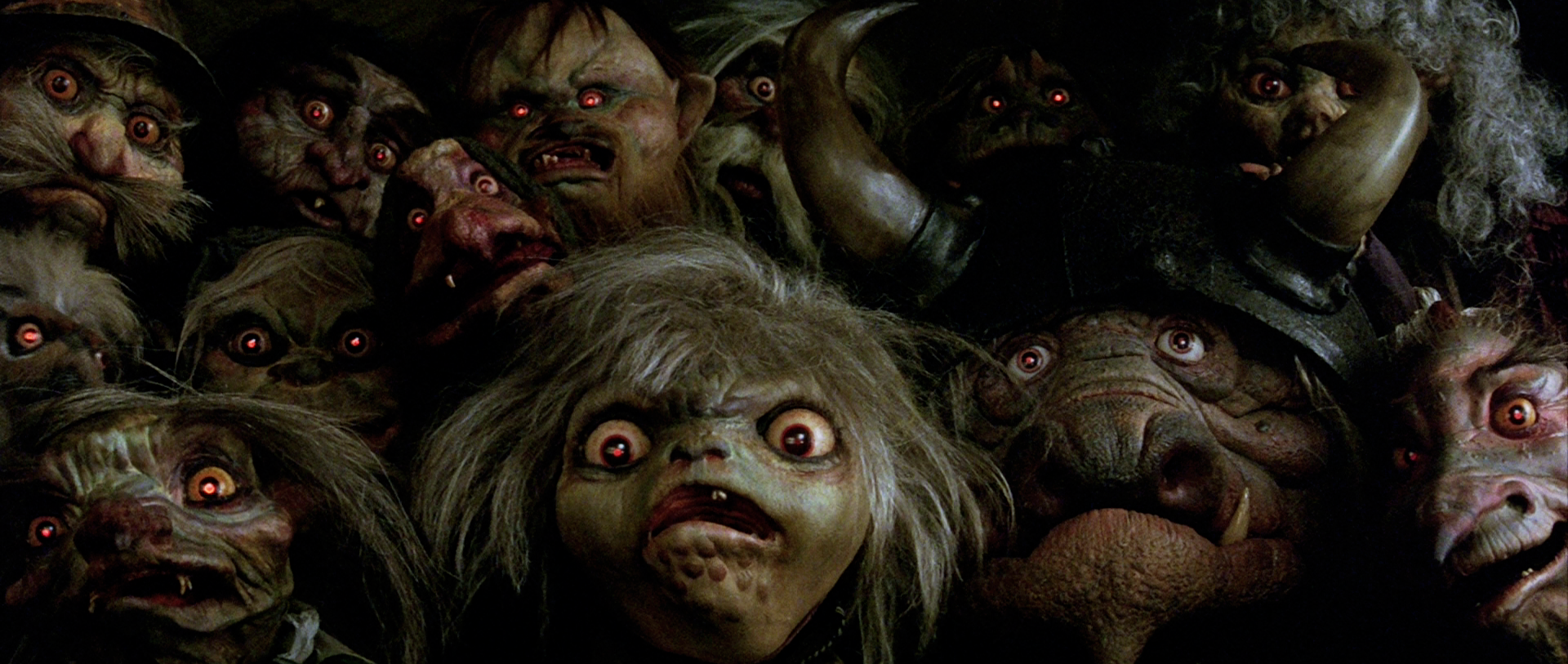
Labyrinth is a bit of an off-putting film at first glance. It’s the creative collaboration of several very disparate artists, with the input of George Lucas, Brian Froud, Terry Jones, Jim Henson and David Bowie contributing to a work of art that is nearly as lumpy and misshapen as the goblin puppets it features. Our two principal leads are Sarah and Jareth – played by Jennifer Connelly in one of her earliest major roles and David Bowie. One of these performers struggles somewhat heroically to bring a grounded sense of seriousness to a movie principally populated by puppets. The other is David Bowie in all his strange glory.

I feel a sense of sympathy for Connelly, whose performance was not well rated by viewers at the time that Labyrinth was released because she needed to, at sixteen, perform a role that depended on a fair bit of nuance, where growth is more explicit than the gesture of a forgotten line of a play but also kept largely and, at times uncomfortably subtextual. Not only this, but she has to do it when she is only ever sharing a screen with either a panoply of Jim Henson puppet masterworks or, (even harder) David Bowie’s mad kabuki wizard. It is always difficult to have to be the emotional ground tasked with responding to a scenery chewer but Connelly soldiers on gamely and ultimately delivers a sincere performance of a young woman forced by social pressure and the inevitable march of time to assume a new place in the world.

The remainder of the cast consists of Sarah’s father and step-mother, the baby Toby and a whole bunch of absolutely wild puppets. It’s something of a misfortune that Sarah’s role in a film that is as aggressively internal as Labyrinth has been overshadowed within the form of its cult following by the strangeness of Bowie’s performance and by these wondrous puppets but they do demonstrate clearly the legacy of the Henson company – and their peerless ability to realize things that are simultaneously grotesque and beautiful.

Just look at these darlings. Don’t you want to just hug them

The challenge we have to confront when reviewing Labyrinth though is that it is entirely and completely Sarah’s movie. There’s hardly a scene she isn’t in, her quest is the action of the film, and even from the film’s first gestures, Labyrinth situate the story as being one that happens within Sarah. A reading of this film that tries to interface with its themes must thus situate all the wild and bizarre goblins, monsters, and even the antagonistic Jareth as aspects of Sarah. This gives way to one of Labyrinth’s chief illusions: A movie about a maze that seems at odds with its own clearly deliberate directionality. Labyrinth situates Sarah in a place where movement in all directions is possible, but the story always only moves inward and downward.

Directionality

Labyrinth begins by demonstrating Sarah, lingering in a park and in a state of forgetfulness having to rush home in the rain. She argues with her step-mother over the question of responsibility and goes to hide in her room: a quintessential sanctum filled up with the bric-a-brac of a young life.

As she flees her unnamed step-mother, the (honestly decent and reasonable) woman shouts out at Sarah that she almost wishes the girl had been out with a boy. That would have been a normal thing for a sixteen year old to do. Instead, Sarah is lingering in a park and struggling to memorize the lines in a play. We get a sense she intends to audition but we are never told. Even this early on we see a movement inward within the film. Sara moves from an open park to the street to the foyer to the sanctum of her room. She is only forced out of her childish sulking when she discovers one of her favourite toys, a teddy bear named Lancelot, is missing. The film uses establishing photography effectively, if not with subtlety, to give us a sense of the sort of girl Sarah is. She reads the Wizard of Oz and names her toys for Arthurian figures. She has multiple books about fairy tales, and still reads Maurice Sendak at the age of sixteen. In its establishing scenes we get a clear visual sense of who Sarah is: an intelligent but immature girl, introverted and self-contained, loving of her childhood and too nostalgic. Labyrinth, as a film, is deeply hostile to nostalgia.

Driven out of her sanctuary to find her errant toy, Sarah finds Lancelot on the floor of her infuriating half-brother’s nursery. He is standing at the edge of his crib crying. No matter how Sarah pleads, coddles or scolds Toby he won’t stop crying so she mostly monologues at him about how insufferable it is to have a baby in the house. The unspoken looms in the background – that with the entrance of Toby into the home, Sarah isn’t the baby anymore. The presence of this toddler has made it more urgent that Sarah grow up and assume the responsibilities of adulthood.

By accident, she casts a spell and summons the Goblin King who promises to take away Toby and leave, in exchange, a crystal ball that will let Sarah see her deepest dreams. The Goblin King is a liar in this, like in everything he does, and his baubles full of dreams are just illusions. But his promise to take away the baby is all too real. When Sarah begs that she didn’t mean for her brother to really be kidnapped, Jareth gives her a quest instead: traverse his labyrinth in thirteen hours to claim her brother or lose him forever.

The rest of the movie involves Sarah moving into the labyrinth. This movement involves a process not just of continual inwarness but also of descent. Sarah moves always toward Jareth. She might want to claim her brother, but in the final moments there is just her and the Goblin King: her quest might be motivated by a desire to rescue her brother but its object is the moment of confrontation with him.

Irrational Psychopomp

Jareth is the antagonist of the film but he’s a singular one. Jareth is far more like a psychopomp or the assigner of heroic trials than he is a villain. At times, when it seems like the challenge put forward to Sarah is too easy, Jareth will personally intercede, he will tempt Sarah, try to persuade her to give up. He always seems quite sincere in his efforts to stop her, but he is also the one who set the initial conditions of the challenge. Jareth is the on who brought Sarah to the edge of his labyrinth and who told her to seek him at its heart.

Jareth manipulates Hoggle and tries to force him to betray Sarah through his fear. But when Jareth finally makes good on his threat that if Sarah ever kisses Hoggle he’ll be thrown into the Bog of Eternal Stench, they encounter Sir Didymus who immediately undertakes to help Sarah with her quest, and whose courage is ultimately instrumental to Sarah’s success. It seems a little strange that the Goblin King, this ever-present sovereign who can be anywhere at any time, who can reshape time itself to his whims, would work so hard to force Sarah into the very place where she needs to be to meet an important ally. Critics of Labyrinth have previously pointed out that the film struggles as the stakes often seem undercut by the action. This is in part because Jareth imposes obstacles that are designed to be overcome. He wants Sarah to progress toward him. It’s just important to Jareth not just that she confront him in his palace but that she do so at the final moment.

So Jareth is not an adversary so much as a guide. Sarah walks his labyrinth and he leads her on her path. He sets out trials for her of cunning, and compassion, of will and perseverance and he ensures that Sarah always understands her choice. She can retreat, or she can advance, knowing that the reward for success will be the chance to undertake another trial. Jareth wants Sarah to recognize that she needs him and he gives her a quest that is designed to seduce her over to that view. He also gives her ample opportunity to turn aside, but for all that he might bluster, the last thing Jareth wants is for Sarah to do that. She must march onward and face Jareth directly. This is in part because we must recognize, the film primes us to recognize, that Jareth, Hoggle, Sir Didymus and all the rest are aspects of Sarah and her symbolic quest is one into herself.

The beauty and terror of adulthood

Sarah is standing at a boundary – this isn’t uncommon in coming of age stories. A map of Labyrinth onto Campbell’s hero’s journey is almost trivially easy.

But Labyrinth isn’t simply wearing the idea of coming of age as a frame for an exciting story targeted at children who are themselves on the boundary of mature responsibility. Rather, Labyrinth is a film that examines that boundary and then asks whether it is there at all.

It’s no secret that Sarah is reluctant to leave childhood behind. She needs the figures of her childhood: children’s books, toys and memorabilia. Even her more mature interests – in theatre and performance – are grounded in play and childishness. She can’t remember her lines!

Sarah has responsibilities and would like very desperately to forget this. But she doesn’t want to forget everything. Instead, she wants to forget about the future. What comes next will sort itself out, but in her room she can hide and remember when she was the baby, when her family was whole. Jareth then is adulthood. He’s the terror of responsibility; the agony of deadlines; he’s the challenge of conflicting loyalties that have complexified beyond mommy and daddy; he’s the allure of sex. Sarah rejects adulthood when she demands goblins take her baby brother and Jareth comes to remind her that becoming an adult is not a choice she can just opt out of. He forces her to assume that root of responsibility – an obligation to a helpless other – and he gives her challenges that require her to employ the talents of an adult. She must deal with false friends, contend with logic puzzles, confront death and danger, show compassion, make judgments that disregard the superficial; she must accept the allure of the sensual, accept it is a field she will be able to operate within, but also develop the tools to decide when it’s time to leave the party and get back to work. She must reject nostalgia. Through it all, Jareth sets the pace, calls the tune and arranges the pieces to entice Sarah with this aspect of childhood or with that promise of pleasure.

We really have to hand it to the costumer too.

He offers her dreams. He offers her drugs. He offers her himself. It’s unsurprising that many fan-interpretations of the film propose Jareth as a Byronic hero. Heathcliff from Wuthering Heights is acknowledged as one of his antecedents. Many fan works suggest that Sarah is an avatar of some lost and eternal love, that Jareth’s simultaneous attraction and repulsion of Sarah is a courtship and that what he wants is her love. But Jareth doesn’t say he can’t live without her. He says he can’t live within her. Jareth doesn’t want Sarah to take what he’s offering. He just wants her to continue walking the labyrinth. Remember that labyrinth walking is a spiritual and meditative act. The process of slowly walking the winding circumference of a labyrinth is itself a movement into the mind and into contemplation. And for all the times Jareth tells Sarah to turn back we cannot possibly disregard the extent to which he is the architect of her trials. We should reject the surface read: that Jareth wants Sarah to marry him in favour of this, more internal, reading of the character. Jareth wants Sarah to become him. Jareth is the master over all these child’s things because Jareth is adulthood. He is the good and the bad, he beautiful and the terrifying, the master and the obligated. He calls Sarah to walk his labyrinth and to undertake his trials so that she can take upon herself his aspect – so that she can be her own sovereign. But then Sarah does something entirely unexpected: in the final moment, she rejects him. Sarah discovers that she doesn’t need to take up the sovereign and reject childhood. There is no threshold to cross. She may have changed but she is still herself. She can be more responsible and still be the child who loves fairy tales. But she is not unchanged. In order for Sarah to unify the child hiding in her room with the Goblin King, in order for her to be able to reject Jareth in the way an adult would rather than the way a child would she needs to integrate who she is now into her sense of self. She must learn what of the child is still her, the Wild Thing, and what is just nostalgia for a past that is gone.

Nostalgia is death

The most terrifying moment of Labyrinth is also one of the most gentle. Having escaped Jareth’s masquerade dream, Sarah falls into a junkyard. While there she meets a goblin woman who leads her into a cave, and that cave is her bedroom. The Junk Lady sits her down at a mirror and begins piling all the objects of her childhood that are dear to Sarah around her. Piece by piece, Sarah’s profile is obscured by the lumpy, misshapen, mass of all the things she owns and invests with value. The Junk Lady attempts to entomb Sarah in the living death of being ever-trapped in the recollection of the past.

The original idea of nostalgia was the pain and anxiety of being away from home and uncertain if you would ever see it again. It is a sadness that reflects death in the future in the mirror of memory. Sarah is standing on a threshold and unsure if she should cross it, and one of the principle obstacles is the fear that if she crosses, she cannot return. Jareth promises the pleasures and pains of adulthood, and one of those things is the recognition of death. By the time Sarah reaches the city of the goblins this is explicit enough that the threat of war is mobilized upon her. Jareth, the avatar of adulthood, also promises forgetting. But it isn’t the forgetting of the future Sarah wanted, it’s forgetting of the past, a putting away of childish things. And Sarah is terrified of the idea she might forget this. Instead she clings to her past, terrified that if she lets go of it she will die before she ever returns to it.

But staring in the mirror, as the Junk Lady entombs her in the living death of nostalgia, Sarah is filled with revulsion. She rips the walls of her bedroom down with her bare hands, smashes out into the uncertain future and joins her friends to confront the Goblin King.

Sarah doesn’t take everything the Goblin King promises. When she confronts him at the stroke of the thirteenth hour she says to him, “you have no power over me,” and in the remembering of the forgotten line she succeeds in her trials. Jareth fails to make Sarah into him. She does not have to set aside childhood. ” Well, if that is the way it is done, then that is the way you must do it. But, should you need us…” Sir Didymus says. And this integration of the child into the woman is the mode of integration that lets her escape the illusion of Jareth’s adulthood. In the end, her puppet friends remain there, when she needs them, when responsibility is hard and has to lean on the wonder of the child.

But they aren’t the toys she curated like exhibits in a museum, they’re the living, breathing, feeling creatures she met on her journey into understanding. Sarah reconciles the obligation of adulthood, which Jareth wants her to take up, forgetting the child, with the joy and wonder of childhood. She’s obviously a creative child, an artistic and literary soul, and there’s nothing wrong in wanting to keep that element of childhood. She doesn’t need to forget it. What she cannot do any longer is be its prisoner. Obligation occurs. Eventually we all grow and change. Rejecting nostalgia doesn’t have to be a forgetting; it can instead reconcile the joy of childhood into the maturity of adulthood. We must not let our past entomb us.

Idea Landlords

The internet is being silly again and it’s kind of Dr. Seuss’ fault.

I promise this is going somewhere that isn’t tedious internet culture war silliness but we need to set the stage: two days ago, the business that administers Dr. Seuss’ estate announced that they would be withdrawing six books from future reprints. This led to conservatives across the internet, who had never previously expressed any interest in Seuss, or in children’s literature at all, to pull a collective wobbler that Seuss was being cancelled.

The books in question featured racially stereotyping images of Inuit, Chinese people, Japanese people and Black people. In one case, the racial stereotyping of Chinese people was so archaic that some of its coding (a Qing dynasty queue and clothes that might have been appropriate to a late 18th century official) might seem entirely foreign to a modern reader – while still managing to have the cringiness associated with an image that considers a person eating with chopsticks a wild and strange sight when on a daily walk. The images of Japanese people that Seuss had drawn as a propagandist during the second world war went far beyond merely being cringey or orientalist, explicitly calling Japanese Americans the fifth column. The remainder fell between these two poles of insensitivity.

The business made the business decision that they could continue profiting from Seuss best by burying these images that are so inappropriate in 21st century culture. And when it became clear to conservatives that this was not censorship but rather a business decision, this led some of them to have the epiphany that, perhaps, copyright is a problem. After all, if businesses believe it’s to the best interest of their bottom line to bury an historical artwork, copyright prevents anybody else from legally, “rescuing,” said racist art.

And this has sparked yet another round of debate regarding copyright between children who call artist-ownership of art, “idea landlordism,” and adult artists who should know better than to argue with children online. Two things are true: idea landlordism is an incredibly silly and surface understanding of the problems of copyright, and copyright still operates as the enclosing of a commons in which major media companies operate on a rentier business model. There are two principal problems with this idea landlordism description of copyright. The first is that the people making the claims fail to generate a cohesive material analysis of the power structures that underlie the ownership of art. The second is that they don’t go anywhere near far enough.

Artist, class and wasteful action

Artists, individual working artists, present a quandry for a basic class analysis because they seem, on the surface, to resemble petit bourgeoisie. Often an artist owns the means of their artistic production. I have a studio space, an easel I built, brushes I own, paints I bought, a computer and writing software which is mine to use. The petite bourgeoisie was once principally composed of individual skilled artisans: shoe makers, tailors, jewelers and such. They were people who earned their living by the means of production which they owned but who were generally too small-scale to exploit the labour of many workers like the big boys of the bourgeois proper. It’s also somewhat true that the principal body of the petit bourgeoisie in the modern era is the renter class. It’s small-scale landlords who derive a modest income off renting, buying and selling a small number of buildings. As such, tying the idea of rent seeking to petite bourgeoisie and from them to copyright holders is attractive.

However this disregards what the production of art is, and what is produced with regard to art within capitalism.

Principally art is waste.

You are taking the labour of the people who ground the pigment; who wove the canvas; who cut the wood; who mined copper, smelted it and shaped it into nails; who shaped the frame, stretched the canvas, jessoed it and packaged it, who operated the machines that produced the brushes, who stocked the shelves at the art store, and you are expending it.

The end product, a work of art, has no use value. Its value, in being aesthetic, is only in the pleasure we derive from it. Furthermore there is a significant break between the labour of the people who produce the material inputs to art and the labour of the artist. The value of art has no correlation to the material value of the labour and materials of the inputs. Nor does the value of art have a direct correlation to the labour of the artist. Rather, the labour of all these people is wasted. The act of artistic creation destroys the inputs as clearly when they are tubes of paint as when they are previous artistic iterations. An artist spends more or less time on a work of art in order to produce that which is pleasing to themselves. Later an audience will decide if the art is pleasing to them too. This is its value. We cannot claim the training of the artist is the source of value because no specific unit of training can be apportioned against a specific artwork. We cannot claim their labour in making the art is the source because a photograph produced in 1/32 of a second might very well be as artistically valid as a sculpture that takes a decade to complete.

Capitalism cannot handle waste well. It likes to forget waste. And so capital assigns exchange value to art. It says that this Picasso is more valuable than this child’s finger-painting because the market will bear $95 million as the purchase price of Dora Maar Au Chat but nobody wants to buy the child’s painting.

However to a parent, perhaps somebody who is something of a philistine, their own child’s painting may have far more value than a painting by yet another dead French dude.

“My kid could do that,” they might scoff when what they mean to say is, “I enjoy the art my kid does more.” The paint used on the Picasso and that of the child are both equally wasted. No further use can be made of it except in the receipt of subjective pleasure.

And so the means of production of art within capital isn’t about producing the objet d’art but rather about its marketing. And this is a place in which the individual artist is entirely alienated. If you self-publish you aren’t likely doing so by typesetting, printing and binding. You’re selling it on Kindle Unlimited – owned and operated by Amazon. If you write a cartoon you aren’t hand-drawing every cell and projecting it in your back-yard. You’re showing it on Netflix or Disney+. The individual artist is a proletarian. Their labour is exploited to make the actual rentiers of the artistic world – the marketers, distributors and copyright-buyers – wealthy even though these Bob Chapeks and Jeff Bezoses create nothing artistic in the slightest.

The real copyright rentiers

In fact, it is in the refusal to waste anything that might still hold exchange value that entities like Disney become antagonistic to the arts. Copyright, although conceived as a form of labour protection for working artists, has been reclaimed by capital as a tool by which these big corporations can extract rent. But a proper class analysis should demonstrate that the problem with copyright isn’t that an individual author can exercise some measure of control over the exchange of their work, it arises when the very wealthy are able to buy work rights the same way that one buys a house.

This commodification in turn causes real harm to real working artists. And not just from Disney claiming it bought the right to publish a work but not the contractual obligation to pay the artist. This is a widespread pattern of abuse. For instance, Nintendo is notorious for disregarding fair-use provisions in its prosecution of copyright matters.

Copyright, in its current form has metastasized from a worker-protection to yet another tool of capitalist exploitation. However, as is often the case when capital territorializes something, the occupation is incomplete. Foucault liked to point out that the arising of a new episteme didn’t obliterate the one that came before it. The systems of power and knowledge that underpinned one period remained, with the new systems superimposed on top. The end of the power of sovereign kings and their retributive justice gave way to the juridicial disciplinary state. But that didn’t eliminate retribution from justice. Likewise many working writers depend on royalties and other down-stream consequences of copyright to eat even though copyright is principally a tool of their exploitation.

Copyright is part of the superstructure of the arts. But it isn’t sufficiently modular to be plucked out of the rest of that superstructure. Furthermore, while it is critical that artists create an artistic superstructure that is built to suit the demands of art, the root of the exploitation endemic in the arts is a matter of the cultural base from which the superstructure arises. To put it bluntly, we cannot abolish copyright without ensuring that artists can continue eating, living indoors, and creating art. Certainly a strong case can be made for strictly limiting copyright and doing away with pernicious laws like DCMA. And I do think that it is best to do away with copyright, but this must be in the context of a revolutionary transformation of society and its relationship to art.

Moral right

And finally, those children who contend against copyright absent class analysis or with a flawed and incomplete one must still contend with the question of moral right. Simply put, the failure to respect the right of an artist to say, “this is my creation,” is one that copyright protects against poorly, but it remains one of the few protections that exists. We must make sure whatever wondrous new world we create in which copyright is not necessary still protects the moral right of an artist to be the artist of this work. All art is iterative but all art contains differences from what comes before into which an artist encodes meaning. And in fact the true value of the art is found here. Artists need to eat. Artists also need to be able to command that this is their art.

I said before that putting a work of art into the world is a gamble the artist makes: that the artwork may face a cruel reception. However the other side of this gamble, that an artist must allow themselves to be open to this violence, is that we affirm the art is theirs.

I sincerely believe the task of dismantling capitalism and replacing it with something different is an artistic task, the Body Without Organs, too, is the moral right of artists. And I also believe there is an urgency to this task – I don’t want to put off the abolition of copyright with a calm, “yes but not today.” However I do want every person who advocates against copyright to understand clearly and with intent what they are advocating to undertake. Nothing short of a revolutionary transformation of society will allow for the conditions of an abolition of copyright. We must raze the entire superstructure of art to the ground and then keep going, cutting at the roots of the art world with an axe, if we wish to do away with copyright. And then we must create something more pleasing from its ruins.

Art, qualification and risk

When I talk about art, I think it’s important to understand first that I think art is a fundamentally proletarian thing to do. By this, I mean that art is something that all people have the capacity to do, that all people can intrinsically participate in. There is no barrier to entry to be an artist, there are no qualifications required.

Qualification and scholarship

Like any activity that can be undertaken, art has associated skills that can be trained. Art schools, writer’s workshops and such are important for developing those skills, but we should always remain alert to Gramsci‘s warning that the formalization of intellectual life into schools and narrow disciplines serves only hegemony. As artists are schooled and formalized they become intellectuals who, “are the dominant group’s ‘deputies’ exercising the subaltern functions of social hegemony and political government.”

Of particular interest to Gramsci is the way in which formal education into hegemonic systems allows for the arising of a false sort of, “spontaneous consent given by the great masses of the population to the general direction imposed on social life by the dominant fundamental group.”

Or, as Assata Shakur said much more plainly, “No one is going to give you the education you need to overthrow them.”

As such, while formal schooling in art can lead to the improvement of technical skill and intellectual study which can, in turn, allow an artist to create better art, this is neither a guaranteed path nor one without its dangers. After all, channeling artistic impulses down specific canals cuts off other possible avenues of exploration.

Gramsci and Shakur both believed it was necessary, in a revolutionary context, for the oppressed classes to bring about, within themselves, a specifically proletarian intellectualism that spoke with the voice of the oppressed. This would arise through auto-didacticism, study groups and other forms of mutual and shared communities of study and critique. Within art, this speaks to the necessity of oppressed people to speak in their voice about their struggles. Authors like Barker are critical within queer spaces because their art arises from the dark places of oppression that are the shared understanding of the non-straight to what we now call cisheteronormatvity – the hegemony of desire within the anglosphere that predominated in the late-20th century, when he began writing.

The arising of such queer voices is a necessary and critical thing. And it has been instrumental for weakening the hegemonic power of dominant institutions. However it does not follow that an artist must only speak with their own voice to create good art. Kipo and the Age of Wonderbeasts is a good work of art. It is thoughtful, thorough and has interesting things to say. Its characters are voiced in a sincere manner that treats them first as realized people rather than tropes. It achieves the principal artistic objective of communicating something novel about the world.

But its credited creators are a pair of white men, despite the subjects of the story being people of colour and mostly girls. There’s no talk of license here. There’s no talk of qualification. It’s not that Barker and his ilk have an exclusive qualification to speak to the queer experience, it’s that those voices that come from within oppressed groups are necessary and deserving of critical and audience attention.

The failure to put own-voice authors forward does not come from artists creating art outside of their lane. It comes from editors, publishers, and critics failing to give them the attention they are due, and it must be viewed as a systemic problem rather than one of an individual, personal, failure. As such, it’s very frustrating to see advice given to artists that they should see themselves as unqualified to create this work or that on the basis of an intrinsic lack. This misses the point of organic scholarship, it, in fact, inverts the relationship and seeks to exclude people from creating art rather than seeking to break down the hegemonic systems that create that exclusion.

The exclusion is, in fact, the problem. Just as factory workers and their experience was excluded from the intellectual games of the bourgeois, so too are the experiences of queer people, women, people of colour, disabled people and people who suffer under systemic oppression excluded from the hegemonic understanding of art on the basis of the superstructure of art. As such, a library administrator who caves to public pressure and cancels drag queen story events and an algorithm trained on a dataset that assumes queer media is intrinsically more adult than heterosexual media are far more pressing problems than a straight artist writing about the gays.

The liberal response is to try and make a bigger tent – to identify those ways in which the existing superstructure can be modified in order to allow the inclusion of previously excluded subjects. This is toward the good as far as it goes. However, these modular adjustments to the superstructure ultimately fail to address the presence of a base condition which will reproduce hegemonic exclusion in new and novel forms. Or which will only allow the inclusion of oppressed voices by taming them and slotting them into a worldview that will not disrupt hegemony.

The Marxist suggestion is to, instead, create a rival superstructure. Gramsci was a university drop-out. He was also deeply and fundamentally committed to working class people making contributions to explicitly working class bodies of knowledge. Gramsci believed we could create an epistemological rupture by operating within these processes of organic scholarship which required, as part of their basis, systems of dissemination, communication, critique and response that had to operate explicitly within the interests of the class of people it served.

To return it to the art world, it was essential not just that there be queer authors but also queer agents, editors, publishers, distributors, booksellers, and in fact queer understandings of the nature of literature and its communication.

Art and quality

Of course although we champion difference within art we cannot reject quality. For this, I want to turn to Kierkegaard. And, especially as this essay is principally situating itself within discussion of queer representation, I do want to start by mentioning that I use Kierkegaard for value here particularly because he represents one of the key antecedents to what we understand as queer theory.

There’s a small body of historicism suggesting that Kierkegaard was, himself, not straight. But he’d caution us away from making any declarative statements about his identity. And this is part of the thing. Kierkegaard saw identity as a matter of deep personal anxiety. Authenticity was a goal but even a person living an authentic life could not be certain they were, in fact, being authentic. Nor could they communicate a state of authenticity to any outside party. Instead, a person had to live with the anxiety and doubt intrinsic to being and to leap over the leveling scythe of (dialectical) reason toward authenticity.

Kierkegaard was worried that dialectics destroyed value. So let’s back up once again to describe what dialectics, and particularly the Hegelian dialectics that informs the Marxists I discussed above, is. The common-repeated mantra of thesis-antithesis-synthesis does not derive from Hegel. Instead it was the work of a contemporary German idealist, Fichte. This error, attributing Fichte’s dialectic to Hegel and via him to Marx and the Marxists has given rise to the hilariously misinformed “problem-reaction-solution” interpretation of dialectics put forward mostly by David Icke. I bring up these mistakes in dialectics because in understanding why Kierkegaard criticized dialectics specifically on the quality of value it is first necessary to understand what the predominant Hegelian dialectic was.

The simplest way to describe the Hegelian dialectic is to imagine a magnet. It has a left pole and a right pole. But it is one magnet. If you cut the magnet in half you get two magnets each with a left and a right pole and not two magnetic monopoles. Hegelian dialectics was in fact a manner of observing how phenomena contain their own negation or opposite such that everything can sort of fold-upward to oneness: a singular universal phenomenon which contains everything and thus is everything.

But if everything is just one then nothing has value. Art, to be valuable within a dialectical model, must also be worthless. This worried Kierkegaard greatly. And it should worry artists too because once we reject that formal artistic training is the source of value in art, as we must if we are to adopt a position that favours organic scholarship, we have to reject that the value of art comes from the labour of formal education. We could decide to assign art a value based on market forces. But I have detailed elsewhere how dependence on a market to define artistic value is corrosive. The challenge before us is to devise an artistic value that allows for difference and that allows for the many.

In the introduction to Difference and Repetition, Deleuze proposes a solution in Kierkegaard that might suffice us here:

Furthermore, if repetition concerns the most interior element of the will, this is because everything changes around the will,
 in accordance with the law of nature. According to the law of nature, repetition is impossible. For this reason, Kierkegaard condemns as aesthetic repetition every attempt to obtain repetition from the laws of nature by identifying with the legislative principle, whether in the Epicurean or the Stoic manner.

Deleuze has a great deal more to say on the topics of difference, and I’ve already alluded to that somewhat through my references to Bataille and Deleuze in previous essays. However for the purpose of establishing a sense that art can have value discrete from market value it is enough to propose a rough draft for a method of assessing good art:

  1. Does it overcome its antinomies sufficiently to communicate a message?
  2. Is the communicated message aesthetically pleasing?
  3. Is the communication novel?
  4. Is the communication authentic?

Grounding art in difference requires us to concede that all art contains within it antinomies that must be reconciled in some way. In Cabal, Lori is the subject who desires. As the book centers around the idea of being monstrous, this situates Lori in the fundamentally queer position of desiring monstrosity, of (if we do away with the metaphor) wanting to be queer. However, in the film adaptation, the scene where Lori tours Midian, which in the book is central for showing us her desire for monstrosity, sits more external and Lori is presented as an intruding outsider, a metaphor for the gentrifying gaze of the hets in love with this strange community, wanting to save it, and damning it in the process. The intertextual relationship between the film and the book are such that this becomes like a magic-eye picture. Once seen her intrusion is there in the book too. Once seen her desire to be a monster is there in the film too.

These different reads of Lori must coexist within the text. And they are at odds with each other but they are not each other’s negation. In both cases, Lori’s desire is central. The difference arises in whether her desire represents a homecoming or an intrusion. And these two are not opposites that negate into unity. If we affirm difference is we must accept that any text will contain such dialectically incomplete contradictions. As such, the irreconcilable and irreducible differences of a text will act as a form of semiotic interference. If the interference is so great that nothing is communicated by the art, it is not good art.

Aesthetic pleasure is a more challenging question as it is bound so closely to subjectivity. I previously touched on the difficulty of assigning beauty in my moral case for spoilers, and I think that using a position of moral judgment may be useful for ascertaining what an aesthetically pleasing communication might resemble. If we deny that there is a clear and delineated boundary between the good and the beautiful we eventually concede that at least some moral arguments are sufficiently aesthetic for them to hold some weight in assigning value to art. However morality, like aesthetics, remains a subjective concern. I might find it morally repugnant to euthanize stray cats. Someone else might find it morally repugnant to keep them alive when they predate local bird populations. We might situate De Beauvoir’s demand that we serve a movement toward an open future as an ethical absolute, especially since it also serves our rejection of the One in favour of difference well; but beyond these highly abstract ethical requirements the ambiguity of the situation interferes and leaves this an area up to the interpretation of the critic to respond and call this or that work good through their ability to articulate their aesthetic response to it.

Squaring the circle of novelty and repetition remains one of my central aesthetic concerns. The truth is that the repetitive and parodic character of art is inescapable. Bataille went so far as to say, “the world is purely parodic, in other words, that each thing seen is the parody of another,” and if the whole world is a sequence of parodies then art can hardly escape. So where do we find novelty but in those things that transform within the process of iteration. This is why it is so essential to grasp the loving destruction of the artistic mode of engaging with art. Each artwork is a parody of other art it is, as Bataille said, “the same thing in a deceptive form.” Each artwork however introduces differences, and in the pattern of these differences arises novelty. An artwork must be a transformation and not just a repetition back of precisely the same thing it was before. There is no artistry in disassembling a chair, laying all the pieces out and then reassembling again the precise same chair. Nothing was transformed, it merely underwent a change and then was restored. And so we begin to see a definition of good art accrete out of these definitions: good art creates an aesthetically pleasing pattern of difference from that which came before, and this pattern encodes a message powerful enough to overcome the contradictions that are intrinsic to any system that rejects the One.

But then there is the final question of authenticity – and as you may recall from when I touched on this before – Kierkegaard believes authenticity to be incommunicable and ultimately a vector of self-doubt that can only be overcome through irrational faith. A personal example: as one reading these essays can likely tell I care a great deal about queer representation in art. I am myself openly bisexual and find great significance in exploring those aspects of who I am. However I was closeted for a long time, and being closeted is easy. I married a woman. This isn’t at all uncommon for bisexual men. Many of us are monogamous or at least indifferent enough to the question of monogamy and polyamory to find comfort in a monogamous relationship. And based on simple demography the likelihood that a monogamously-inclined bisexual is to end up in a long-term relationship with a heterosexual partner or with a partner with whom the relationship maintains the veneer of het-passing (IE: with partners who are trans or non-binary but present enough like cis members of the opposite sex to pass and bisexual partners of the opposite sex) is approximately eight times greater than for such a person to end up in a non-het-passing long term relationship assuming the subject has no preferences regarding partner sex or gender whatsoever. Frankly, there’s simply a lot more heterosexuals than there are us queers. While closeted there were occasions when I wanted to submit art to queer calls for work and did not because I didn’t feel my bisexuality was authentic-enough. The truth is that I could have been a member of a sense8 cluster and still probably have reason to doubt if I was queer enough to be in queer spaces because bisexuality is a liminal condition that thrives and sustains itself on the same ambiguity that leaves space for doubt to undermine authenticity.

Nobody but the artist can know whether an artistic expression is authentic and even the artist will have cause to doubt. “Perhaps I only painted it that way because I was watching a video about Matisse, that day. Maybe it’s not really what I meant to make.” And yet, authenticity is necessary for good art.

A critic, called upon to judge a work may very well instead attempt to apply an heuristic. One is to substitute this last question for a reiteration of the second: but did this communication please me? Did I, the audience, have an authentic reaction to it? This is probably the correct approach. The second is to deny that an artist might possibly be authentic. This dismissive attitude says, well it’s just a parody of something better after all. Or it says, this artist couldn’t possibly have made this art. This sort of a priori assumption about authenticity should be avoided by a good critic as the critical moment only arises after exposure to the text.

Risk and the hostile critic

So far this might seem like a defense of problematic art. And it is insofar as my personal aesthetic sentiment is such that art which problematizes nothing is generally boring. Remember to problematize something is to force additional questions, to dig deeper to get to the roots, the mycelia and rhizomatic stems, that undergird the phenomena of the world. However this must not be taken as a defense of bad art nor of systems that allow for the creation of bad art. Frankly most colloquial uses of, “problematic,” could easily be replaced with, “bad,” and would be better arguments for their clarity.

Rather it is a matter of addressing the apportionment of blame. A bad artist is not to blame for failing to realize his art communicates ugly ideas, or communicates in such a muddled way that it communicates nothing, or is just an inferior copy of a better work. A bad artist is even not to be blamed for failing to realize that his work is hollow because, well, we all might be hollow. But presentation of art includes an implicit contract: the artist must be willing to expose their work to the critic and, more horrifying still, to other artists. An artist, who has put out a work of art, has nobody to blame but themselves if critics engage with the art and say cruel things about it. They have nobody to blame but themselves if other artists make cruel transformations. Critics owe art their attention. They owe artists nothing. Art is built upon the violence of transformation and the art community is rarely nice. Although these cruelties and schisms are often decried as being a wrong thing, they are in fact part of what art is. In Desert Islands and Other Texts, Deleuze said, “Good destruction requires love,” and that’s true. Love is as indivisible from art as cruelty, but there is cruelty in these destructive acts, and it, too is indivisible from art.

And now we should return to the idea of a rival superstructure because what we are doing here is effectively an artistic project. The creation of a queer artistic superstructure includes within it the loving destruction of the straight one. And that loving destruction will look like appropriating their queer coded villains, it will look like excluding straights from anthologies and it will look like the sort of critical action that led to Laura Mixon’s wrong-headed and mean-spirited Hugo award winning complaint. It will look like a disregard for copyright law and it will look like a refusal on the part of oppressed artists, critics and fans to accept the demand we behave in accordance with the decorum necessary to be allowed to remain in the big tent.

This, therefore is the artistic gamble:

To move art toward the open future we must deny no artist the right to create art. There is no qualification to be set. There is no barrier to entry. But when hegemony silences oppressed artists, it is right for them to create structures hostile to the hegemonic. As a critic we have a duty to grapple with art before we review and not to pre-judge it. But we likewise have a duty to be cruel when we must. As artists we must love art. And we must destroy it. There is no artistic unity. All that there is, is difference. But herein lies the path to us creating a value for art aside from the market or the demands of formality. By recognizing that some differences please us and others do not, we affirm that art has significance, has meaning, has value that goes beyond numbers in a ledger.

Putting away Chekov’s gun

Abigail Thorn
PhilosophyTube Feb 21 Chekhov: Remove everything that has no relevance to the story - if there is a gun on the wall in the first chapter it must go off by the end! Nabokov: My father owned 500 guns that I will describe obliquely and at length. None of them are relevant but they all made me horny.

Recently the popular youtuber, Abigal Thorn posted this joke to her twitter account. On the surface, this is a pretty typical Twitter-style sensible chuckle. Most people with any familiarity with the authors mentioned would get the joke easily enough; it’s hardly like Nabokov’s tendency toward baroque prose and toward sexually charged topics isn’t well known.

But she is picking at the edge of something interesting and relevant here with regard to the structural concerns of a novel. To whit: why are parsimonious novels? In the case of Chekhov, the reasons for his desire toward narrative utility and parsimony are easily identified. A playwright has a very limited time in which to tell his story, a short story author has strict length limits imposed by her style. But novels are not generally intended to be read in a single sitting like a play or a short story. And certainly the origin of the novel wasn’t one particularly concerned with parsimony. One of the earliest novels ever written, arguably the first structurally modern novel depending on how you choose to define the term, was Romance of the Three Kingdoms which was ~800,000 words. Moving forward to more modern works, many novels (the Count of Monte Cristo, David Copperfield and the first structurally modern European novel – Don Quixote) each weighed in at significantly over 300,000 words. And, of course, Proust’s À la recherche du temps perdu clocked in at 1,267,000 words (I do need to get around to reading this one but it’ll have to wait until I’ve cleared out the reading back-log a bit.) Meanwhile the writing advice given to authors is to put their novels pretty carefully between a range of 70,000 to 120,000 words. This is, on its own, a strange discrepancy. But a survey conducted in 2015 demonstrated another interesting trend: book lengths on high-selling books increased by a mean rate of 4.4% between 1999 and 2015. While this survey was not academically rigorous, it does provide a reasonable benchmark to consider that the length of novels is growing. The same survey also posited that the range of possible word-lengths was growing. So we have here two obvious trends. First, sometime between the time of the 19th century classics and the end of the 20th century, the length of the novel shrank and standardized. Second, throughout the 21st century, this trend seems to have reversed as novels increased in word length, and range of length diversified.

The answer, of course, comes down to the material circumstances of novel publishing: money and distribution. The Legend of the Condor Heroes, one of Jin Yong’s most significant and popular works was published as a serial in a newspaper – its 918,000 word count didn’t have a material impact on distribution or on profit because it came out in newspapers of generally uniform size. Its column inches may have been considered, but considering the popularity of the author’s fiction in the newspaper, I doubt too many limits were put on him there. In addition, as it was published as a serial, the author was free to take his time getting where he was going.

This serial publication was a feature of many early novels. The Count of Monte Cristo and David Copperfield were published as serials. Don Qixote was printed in exceptionally small production runs and books were shipped overseas in order to fetch higher unit prices. The idea of the standard novel length wasn’t so necessary because there wasn’t yet, standardized distribution of novels or even standard pricing.

However, starting in the late 19th century this changed. We can begin to see the progressive standardization of book distribution in moments like the founding of the International Publishers Association which, it should be noted, was formed principally to protect copyright for publishers. A commodification of a market requires, as part of it, a standardization of the market. Audiences for books cannot effectively purchase books if they don’t know where to buy them and if they aren’t able to budget their cost. This process coincided with a general process of maturation of a form of epistemological framework that informed society – what Foucault would call a disciplinary society.

Disciplinary societies thrived on standardization, as much of the demands of the disciplinary society had to do with the demands for workers in assembly-line facilities. But this had a side-effect of creating a culture much like an assembly line: people would have distinct roles, like the parts of a machine. Each would serve this role and the output of one person’s effort would become the initial input of another’s. This was reflected across institutions as a process of movement from one enclosed space to another: from the family to the school, from the school to the barracks, from the barracks to the factory. And of course from any of these to the prison or the hospital when a subject needed correction beyond what could be provided by the more normative disciplinary institutions.

This can be seen as a process of standardizing and regulating bodies; is it any wonder a similar process happened to bodies of text?

And so an author would produce a manuscript that would be bought by a publisher. The manuscript would then be corrected by editors who would send it to a printer. The books would be bound and shipped to a distributor and the distributor would then apportion books to booksellers for the consumption of an audience. And all of this labour had to meet assembly-line like requirements. Publishers needed to produce enough volume of manuscript to make sales targets as would distributors and as would book sellers. And standardization is at odds with irregularity in form and in distribution. Booksellers, depending on a standard throughput of books to make their profits, measured books in shelf-inches, that is the number of inches wide a spine of a book was displayed on a shelf. Books on a shelf of irregular width made for a challenge to sell. And books of multiple volumes also introduced irregularity in purchase patterns. Rather than producing seven volumes of Proust all in a go, or for that matter one volume of Lord of the Rings, as Tolkien originally intended, it was better to apportion books into smaller, shorter, and more standard volumes. Longer works could be serialized with a relatively standard release schedule of one year per volume. Failure to meet that standard still provokes considerable distress among the book buying public. By the time that disciplinary societies were declining, this had come to be what is considered, in the generally received wisdom, to be the standard length of 75,000 to 120,000 words for a book targeting adult audiences. This was not a reflection of any sort of artistic ideal, unless we want to suggest that Proust is more artistic than Chekov because he wrote long books, or alternatively, that Chekov was more artistic in his parsimony.

Of course, nothing ever stays the same forever, and in time the patterns of the disciplinary society gave way to what Gilles Deleuze described as a society of control. Within the societies of control, this sense of moving from one enclosed space to another was supplanted by a constant process of modularity; Deleuze described people as dividual. What we were wasn’t some indivisible soul to be perfected but rather modular beings. The institution of the school gave way to lifelong learning. The factory gave way to the corporation and the watchword to the password. And the bookseller gave way to Amazon.

The arrival of Amazon to the book publishing industry was likely one of the most disruptive moments since the beginnings of standardization a century prior. And simultaneous to Amazon’s arrival came another technological change with the e-book reader. Suddenly spine inches didn’t matter. The bookseller was gone – Amazon is more akin to a distributor, selling books by the box from a warehouse. And even then, in many cases, the physical media upon which a book was printed was gone, replaced with the pure information of digital ephemera.

Of course this had its threats. The ability of Amazon to reach into a users e-book reader and withdraw access to a downloaded book was remarked upon by many people as shocking. But I suspect it would have elicited a shrug from Deleuze. Such antics are the reasons he admonished readers to search for new weapons. And so we have a narrative that explains the rise and fall of the standardized novel. It was a product of disciplinary societies that was rendered obsolete by the advent of the societies of control.

But this isn’t the only reason for parsimony in fiction, is it?

We still, thirty years after Deleuze heralded the advent of the societies of control, council parsimony in writing. The advice of Chekov, to only show those elements that are relevant to the story, and of Hemmingway, to write with careful precision and minimal extraneous language, remain received wisdom among authors. Unbound as we are from the tyranny of the shelf-inch why can’t we put down Chekov’s gun?

I will admit that I used to be very much in the camp that this was an artistically superior decision. It created a clear text, one which guided an audience through and told a story in a straightforward way that didn’t have the author’s own cleverness get in the way of the message being communicated. I largely repudiate that previously held position now. Rather, I have come to be much more firmly in favour of artistic agency. I think an artist should create the work of art they desire to create, unbound by the expectation of the audience. An audience’s response to the art is critical to the ongoing process of creation of art. But it should never be something an artist attempts to anticipate; if a dividual is operating in the mode of the artist they must set aside the mode of the critic, or the fan. This isn’t who they are in this moment. This perspective situates art as a moment within a flowing process: from artist to critic to artist to critic, art rising and falling like a phoenix. Any given work is just an explosion of fire in this cycle. Why should an artist anticipate that an audience wants a straightforward story, told without artifice? Is this not, ultimately, just a call for unchallenging and standardized art?

Adam Shaftoe, a dear friend and an excellent art critic, was talking with me about this topic recently and suggested that this is because these straightforward, easy, texts are still, ultimately, more marketable than something more baroque. Audiences enjoy the sensation of anticipating a story. They like the excitement of a clean narrative that moves like an arrow from a beginning to an ending that they can see approaching from the start.

Amusingly, this puts narrative parsimony at odds with spoiler aversion. After all, there can’t be any reversal too surprising or you’ve failed to adequately foreshadow. As one famous author recently remarked: a book can tolerate one ridiculous coincidence but if too many pile up, you lose suspension of disbelief. This is not to say narrative parsimony is anti-artistic. I’m not suggesting that a fondness for clear, declarative language or a distaste for unnecessary adverbs is corrosive to art in the way that franchise entertainment is. Rather, it’s an error of authors to treat this stylistic choice as the only right one. It is fully possible that the art an artist desires to create is a meandering and florid affair showing off their ability to navigate baroque sentence structures, piling coincidence upon coincidence and adverb upon adverb into a vast ants-nest of a story. And if the artist can execute this art in a way that pleases them and that communicates a cohesive message which is able to survive its antinomies, this is a successful work of art.

It may, however, not be commercially successful. And so, once again, we approach the point where the influence of capitalism proves a threat to the diversity and openness of artistic creation. The demands of marketing remain, as always, at odds with the demands of the artist because an artist savagely creates and destroys with little regard for little matters like ownership, markets or profitability. Bataille saw art, especially grand art, as a use of the accursed share: an output of waste. This is at odds with the corporate need to acquire, too accumulate and to grow. Nothing should be needlessly expended. Nothing should be wasted. Not even words.


A little post-script

I just wanted to add that my next blog post may be in a couple of weeks. I’m presently reading the first volume Anna Holmwood’s excellent translation of Legend of the Condor Heroes – A Hero Born – and do intend a major essay about this translation. When I last read Legend of the Condor Heroes, it was only available as a fan translation and this represents the first time I’ve had the opportunity to read two very different translations of the same book. As I mentioned previously, Legend of the Condor Heroes is a long book and I suspect the Holmwood translation, by the time I get through all four volumes, will clock in north of 500,000 words. It may take me a minute to read it all. Don’t worry. I’m not gone. I’m just reading a long book.

The vexatiousness of the culture wars in SFF – Baen’s Bar and the fantasy of total community

Oh did we all think that ended with the collapse of the Sad Puppy movement into genral Trumpism? Of course it didn’t. And the latest salvo is turning into a wild ride.

Buckle in.

On February 15, 2021, Jason Sandford published an exposé of a pattern of discourse at Baen’s Bar – a forum managed by Toni Weisskopf on behalf of the storied SF publisher Baen Books – which included racist comments and, most alarmingly, advocacy for violence perpetrated not just by regular participants at the forum but also its moderation team.

Sandford started receiving messages which he interpreted as death threats from prominent Baen’s Bar forum members. This was reported on by File 770 with a link to a twitter thread in which Sandford compiled screenshots of the threatening messages, however Sandford has since locked his Twitter account and these screenshots are unavailable at this time. That being said, I did see them prior to Sandford locking his account, and they include the “helicopter ride” meme which is a far-right reference to the Death Flights of the fascist Pinochet regime of Chile.

Further calls for violence have surfaced on Twitter – the screenshot above is an example available at time of posting which references Tacitus’ account of Emperor Nero of Rome burning Christians as lamps – and so Sandford’s decision to take his online presence more private is not surprising.

Weisskopf closed Baen’s Bar for the immediate future, stating:

We have received no complaints about the content of the Bar from its users.
That said, it has come to our attention that allegations about the Bar have been made elsewhere. We take these allegations seriously, and consequently have put the Bar on hiatus while we investigate. But we will not commit censorship of lawful speech.

How reassuring that the users who said, “I can see a smallish force with good skills at explosive handling, bringing a large city to its knees just through a few well-placed booms at some of the points I mentioned,” and, “Trump losing is a good thing. IF he had won things would be better for a while but the Dims would keep up the garbage. Now they will do the stupid power mad grab that will set off what NEEDS to happen. Which is ACW21. Those that claim its already happening as usual cannot understand reality. A real civil war is killing in job lots and all that goes with it,” saw no reason to complain that a privately operated message board allowed them to express such violent rhetoric openly and unopposed. It is also worth noting that, for all of Weisskopf’s claims to be an advocate for unrestricted free speech, certain topics are, in fact, banned at Baen’s Bar, such as Mercedes Lackey and her fraught relationship with the publisher. So we can posit that Baen, as a company, finds speculation as to the specific tactics of a conservative-led civil war within the United States to be less controversial than the idea that some authors did not enjoy good working relations with Jim Baen.

Regardless, this has led to profuse defensive posturing from all the ususal suspects, including, as reported by File 770 at the link above, attempts to downplay the rhetoric from David Weber, claims that Baen Books was “attacked by cancel culture” from Larry Correia and far more unhinged statements from the various sad-rabids who operate at the periphery of the science fiction world.

Now simultaneous to all of this, Toni Weisskopf was scheduled to be the guest of honour at Discon III – the 2021 Wordcon, an in-person science fiction convention being held in Washington DC. In the light of the report on Baen’s Bar, and Weisskopf’s response to it, there has been pressure applied to Discon III to disinvite her as guest of honour on the basis that her presence would make the science fiction convention an unsafe environment for reasons other than the inadvisability of holding a convention in the age of COVID-19.

And here we return to two central questions that have been at the heart of genre fiction’s long-running culture war, just who is this community and what, if anything are its standards?

We have here a situation where the genre fiction “communty” consists of several disparate actual groups of people. These people have mutually exclusive definitions of the ideal present notwithstanding what they may want to see in fiction about the future, the past or other worlds. The attempts of mass conventions like DisCon III to serve these vastly disparate communities means it’s ultimately impossible to serve any.

Now I’m honestly quite shocked that there is going to be an in-person WorldCon this year. Between international travel restrictions and the clear and present danger of mass gatherings, it really feels like a live convention in 2021 is unsafe quite regardless of who the editor guest of honour is. With this said, while I do believe that Sandford turning over this particular rock exposed the peril lying under the surface of science fiction I don’t think de-platforming Weiskopf is going to make the convention any less dangerous for anyone unwilling to tow the American conservative line. Frankly, Toni Weiskopf isn’t the problem, she’s merely a symptom of it. Baen, and its stable of Trumpist malcontents is in fact only a symptom of the systemic problem that is the faulty assumption at the core of the SFF communities that there is some overarching and totalizing community for all to contribute to.

It was never true.

All that has changed is that those people who once hadn’t enough power to speak out about John Campbell’s racism, Orson Scott Card’s homophobia or Harlan Ellison’s busy hands have achieved enough power through adoption of new technology, changes in social understanding and various civil rights movements to fight back against the people who once kept them silent.

And the ideological descendants of these once-powerful men are the constituent backbone of the reactionary movement within SFF communities. And that brings us to the unfortunate materiality of these “culture wars” because we are in a position where we will have to fight, rhetorically, for command over what any genre community actually is.

We do have to do the work of excluding people and that probably includes Weisskopf. Because she is a part of the overall reactionary movement in genre and that movement must be entirely excised if there is to be anything like an actual community here. It is insufficient to cow the reactionary movement, tell them they have lost and allow them to sit and stew, because as we can see from their various words, they fantasize about doing real violence to us.

The damage is done for Worldcon 2021. If Weisskopf is barred, the convention will be unsafe every time a reactionary raises her de-platforming as a grievance. If she is not, the convention will be unsafe because of the risk potentially violent reactionaries will see her presence as a victory. And above all this looms COVID-19 and the questionable decision to hold an in-person convention in the United States in 2021 at all and for any pretense. However the idea that has been percolating for a while, that concoms must show some discernment in selecting who is considered within the community, has become much more pressing. We have moved beyond it being enough to point at this or that missing stair and ask why he was allowed to buy a membership. We must start considering the ideological messaging of our shared spaces. There is no neutral space in which a fascist and a socialist can both feel safe. Sides were drawn long ago and the people bound up in the liberal delusion that the rift is curable need to let go of the fantasy that they can exist without ideology.

We forget that we are all within our ideologies at our peril. Baen’s Bar is a community of between 1,000 and 8,000 people who share a lot of ideological markers. They know and are committed to their ideology and I find it revolting. The Baen’s Bar members are not part of any community I consider myself a part of, even if they like books with space ships too.


Update: February 19, 2021: DisCon III has announced that they have removed Weisskopf as the editor guest of honour:

We knew simply saying those words with no actions to back them up would be unacceptable. Too often, we have seen individuals and organizations say they are on the right side of issues yet do nothing to act on those words. We knew we had to take a hard look at our own position and take action based on our established policies.

As a result, after discussion with her, we have notified Toni Weisskopf we are removing her as a Guest of Honor for DisCon III.

We know this decision was not as quick as some of you would have wanted, and we understand your frustration. Our committee’s leadership was always in full agreement that there was a fundamental difference between the values Worldcon strives to uphold and the values allowed to be espoused on the forums-in-question.

I will say this is a good statement, and specifically the admission that there is a, “fundamental difference between the values Worldcon strives to uphold and the values allowed to be espoused on the forums-in-question,” strongly echoes my point previously – that there is, in fact, a fundamental ideological disconnect between the Baen’s Bar community and other SFF communities.

I still question the advisability of holding a Worldcon live this year and hope they make the decision to transition to an online format. In addition, I do stand by my statements that censuring Weisskopf is unlikely to create a tangibly safer environment for convention-goers.

With that said, I suspect that, with regard to this specific incident, the concom for DisCon III did the best they could in a bad situation,


1: ACW2 stands for “American Civil War 2”

On the artist – critic relationship, a response to “On Fanfiction, Fandom, and Why Criticism Is Healthy,” by Stitch

This letter serves as a brief response to the excellent editorial recently brought forward by Stitch at Teen Vogue, “On Fanfiction, Fandom and Why Criticism is Healthy.” In it, Stitch puts forward an argument for why there should be space for criticism within fanfiction communities, and I do agree with the general broad strokes of their assertion.

Stitch explores, in much the same vein that I did, how fannishness leans into a sense of enthusiasm that precludes other emotional responses to art being seen as valid and proposes that, again as I have in the past, that critique of an artform represents a legitimate form of art enjoyment. A critic enjoys the act of criticism. However I do have a small dispute with some of Stich’s framing, which I hope they will take in good faith.

Specifically, Stitch does something very common in discussion of “fan” phenomena and imagines fandom as a territory or space. Fandom, in such a structure, is the terrain in which artists responding to a work, critics dissecting it and enthusiasts of an artwork congregate and share their thoughts. The conflict that thus arises is one of belonging. Fans are people who like a thing which is why it seems like critics must fight for a space within fandom. The critical impulse to reveal a piece of media’s secret contours and to, as Lyotard might put it, “work as the sun does when you’re sunbathing or taking grass,” often seems at odds with the enthusiasm of the fan in much the same way that the enthusiasm of a butcher might seem out of place at a meeting of a pot-bellied pig fancier’s club.

I do think this is a mistake – fandom isn’t a place you are so much as a face you present. What’s more, people are dividual and may present different faces at different places and different times. So when I talk about the contradictions between these faces of response to art, please don’t think I’m totalizing any given person to just one of these identities that they must choose like some team. Rather I’m talking about the tensions that occur when engaging with art.

I tend to treat response to art as having three principal faces with the third divided into two sub-modes. The first is indifference. The indifferent response to art could be mild amusement or even strong revulsion but it is a reaction that desires to disengage from the art. It doesn’t find the art something it wants to respond to. The indifferent has no interest in any form of communication with the art.

The second face is the fannish face. This is representative of the person who wants to express enthusiasm for the art. It is something of a limited opposite to the indifferent face except that enthusiasm is the only allowable mode of response. People presenting a fannish face, defined by their absolute enthusiasm for a work, frequently act as gatekeepers and norm-setters. I dislike the extent to which this face has been given precedence in discourse surrounding art, including the extent to which the idea of the “fan” has come to subsume the final face which is that of the artist/critic.

I am uncomfortable with the categories of the fan-artist, the fan-critic or the fan-critic-of-fan-artist. This is because, while there is vast overlap between the revelations of the artist or critic, I find both of these responses to art to be mutually exclusive from fannish totalizing enthusiasm. A fan polices the boundaries of spoilers because the being in the know is one of the perimeters that delineates who may authentically wear the fan face.

An artist authentically presents the face of the artist by doing art. A critic authentically presents the face of the critic by doing critique. Neither of these play nicely with fannish territoriality. Now, again, people are dividual. A person can be a fan and be an artist both. But thy cannot be a fan in the moment they go about creating art. The “fanfiction writer” is thus a misnomer. There’s no fan in their fiction. They are an artist responding to art.

Enter the critic. If we treat (fan)fiction as a form of responsive art, a transformative repetition that takes the familiar elements of the art and creates something new from it, then we approach that non-productive boundary of undifferentiation from which production arises. The artist destroys to create. But this destruction is not uncontrolled. The process of disassembling art, revealing its secrets, spreading out its parts, “like smooth sleeping dolphins,” is the act of critique, which, Lyotard also reminds us, is a form of religious act. I would say it becomes something of a ritual sacrifice, ending the old artwork in a manner that makes space for new growth. While, for some artists, the critique – the moment of sacrifice where the work upon the altar is cut apart and its secrets revealed – is the end, artists must also be critics to create art. They must come to know the secrets of a work to transform it.

Artists are sometimes tricked into believing their passion is equivalent to fannish enthusiasm. Blake understood this intimately when he said, “the reason Milton wrote in fetters when he wrote of Angels and God, and at liberty when of Devils and Hell, is because he was a true poet, and of the Devil’s party without knowing it.” Milton’s fannish enthusiasm for God rings hollow next to the damning critique of the Devil. This is because, as Blake says, Milton was a true poet; and a true artist is also a critic in their nature rather than a fan.

I believe (fan)fiction writers would be well served to remember that they are also critics. If their work creates critique all this means is that the art has broken the barrier of the indifferent face and inspired another person to engage authentically with it. Enthusiasm is a childish aim in the appreciation of art next to the sacred sacrifice of critique and the promethean act of creation. The territory of fandom is an imagined place. The police on the borders are children who, by the act of showing only enthusiasm for art, cannot defend it.

Where there are artists there are also critics. The face of the critic is indivisible from the face of the artist. An artist enjoys their art and so too does a critic enjoy their critique. I derive as much passion, as much joie de vivre from savaging a truly awful art as I do from gushing about a true masterpiece. Excluding the more frightening passions of the critic ultimately only harms artists. (Fan)fiction writers, embrace the satanic critic. You are of our party anyhow.

A Moral Case for Spoilers

Phillipa Georgiu will return to Star Trek, Quicksilver will return to the MCU and it is immoral to participate in the policing of spoilers.

Now first I want to be precise when I talk about the word, “moral.” The boundaries between concepts are unclear. We have two questions that are particularly difficult to separate – the question of what is good and the question of what is beautiful: Ethics and Aesthetics.

There are many methods of chopping these two discussions of value in order to say this is one thing or it is another. It is good to dispense justice. A painting is beautiful; but there is certainly overlap. The presence of religion gives testament to this as many religious programs attempt to simultaneously define both what is good and what is beautiful in connection to each other. A Christian might say it is Good to live in God’s divine light – but preference for light over darkness is an aesthetic concern.

The truth is that humans don’t easily divide the good from the beautiful. A bigot, upon seeing two men kissing, might excuse himself by saying, “It’s not that what they are doing is wrong, I just don’t want to have to look at it.” These edge conditions multiply persistently wherever we might look for them. How many people would think they have an ethical obligation to their neighbours to keep the façade of their home beautiful? Morality, in the sense I am deploying it here, is to describe a thing that has one foot each in the realm of the ethical and of the aesthetic.

For instance, it is an ethical proposition to suggest an actor has less bargaining power than a multinational corporation. If an actor, in his enthusiasm for a role, announces he will play a part, but the studio, for reasons of marketing, wishes to keep that role silent and the studio then punishes the actor we can hardly side against the actor. After all, some corporations might monopolize the opportunities for an actor to ply his trade; he may have no choice but to sign odious confidentiality clauses or choose against having a career. When facing such a systemic inequality we can hardly call these contracts ones that are negotiated in good faith. And if a corporation has compelled a worker to accept unpleasant working conditions on fear of being unable to work, how could a decent and clear-thinking person say that this worker just should have honored his word? The words that came out of his mouth were never his. This is an ethical concern.

However the problem of spoilers is far more involved merely than a single material relationship between a worker, or even a class of workers, and a powerful avatar of capital. It involves both other ethical concerns, power relationships and the question of group formation, but also questions of what makes for good art.

But before we can address these questions we must first answer a more basic question: what, really, is a spoiler?

To spoil is to rot or to put beyond all utility. Food spoils when eating it makes you sick. But art isn’t food. The problem, I think, is that franchise media wants to make art into a meal: not into something an audience engages with, enters into communication with. But something they dumbly consume. But if art spoils in the same way food spoils, this raises a problem: why would knowing the shape of the plot prior to consuming a work of art make one ill? Perhaps it would be best to push back against the idea of art as something we eat, and to look at art as a vehicle of communication instead. So how do we decompose the utility of art as a vehicle of communication?

We could suggest that a work of art is spoiled when the artist or some third party, through malice or error, eliminates its ability to communicate a coherent message. We would have to put the art into a position of such irreconcilable internal contradiction that it could say nothing at all to truly spoil a work of art.

Monkey Jesus is not a spoiled artwork

Even if we look at grand artistic mistakes such as the amateur restoration off the Borja Ecce Homo fresco, we can see the communication of meaning within the art. Christ’s occluded black eyes and faint hint of a mouth, the abstracted plane of his nose and the indistinct boundaries of hair and flesh all present a contradiction with the subject: Ecce Homo. And yet, behold the man! “Monkey Jesus,” gives a wonderful hint into the animal character of humanity, it puts lie to the suggestion of divinity in a way which still creates a meaningful and significant, if accidental message.

Cecilia Giménez’s Ecce Homo is not a spoiled artwork. It is, in fact, a shockingly successful artwork, as her attempts to restore the fresco, and the beautiful and surprising way she failed to restore it have attracted increased attention to her community and her church. If this Ecce Homo can survive such a transformation unspoiled, why are franchise artworks so fragile that they collapse if only the aspect of surprise is taken from them?

Because this is ultimately the only thing spoiled for the audience. The surprise. Are we, as a culture, so limited that we believe the surprise of reversal to be something fundamental to the quality of art? What then of Romeo and Juliet? How are we to enjoy the art of this famous tragedy when it begins:

Two households, both alike in dignity,
In fair Verona, where we lay our scene,
From ancient grudge break to new mutiny,
Where civil blood makes civil hands unclean.
From forth the fatal loins of these two foes
A pair of star-cross'd lovers take their life;
Whose misadventured piteous overthrows
Do with their death bury their parents' strife.
The fearful passage of their death-mark'd love,
And the continuance of their parents' rage,
Which, but their children's end, nought could remove,
Is now the two hours' traffic of our stage;
The which if you with patient ears attend,
What here shall miss, our toil shall strive to mend.

(Emphasis mine)

Any art so vacuous that it is ruined beyond recovery simply by the knowing of a fact is not art worth anyone’s effort. As such we should contend that, no, art is not spoiled even when the surprise is. But the thing is that while policing of spoilers is about knowledge, it isn’t really about surprise. Rather it’s about secrecy.

Specifically, the spoiler is the inevitable companion of the mystery box. So whose experience of art is truly spoiled by the spoiler? It is the marketer. This becomes painfully clear when we look at how artists are put behind the demands of marketing for secrecy. Tom Holland is given incomplete scripts. He is not allowed to know the secrets of the movie in which he is the star because of the fear he might disclose a secret. His ability to be an actor is hampered so that the marketers can have their way. We cannot have the audience knowing Quicksilver will in fact return before the moment, even if any given audience member with even the slightest spark of critical insight might mark it as likely, because our marketing cycle is built upon the revelation to the press at this time or that of the cameo, of the actor who plays the role, and of all the mystery boxes that will be put in view of the audience with this revelation. And, with its dependence on continuity, and on the interconnection of properties, especially in the case of the MCU with its heavy dependence on lore delivered via cameo-coda, the franchise becomes precisely this: a box containing boxes, containing boxes, containing boxes. Each box carries the promise that there is something inside, some meaning, a kernel of a reason for the art. But the meaning is nothing but an empty box and the endless deferment of the moment of transformation in favour of simulations of catharsis. We cannot spoil the franchise; it’s already rotted to bone, to dust, to void.

Ultimately, the purpose of a franchise artwork is not about anything resembling meaningful communication between an artist or artists and an audience. It’s about the construction of a community, a lifestyle, a fandom. Fandom, with its desire to catalog, to be encyclopedists, to be those who are in the know, polices the spoiler because it allows them to identify those who are to be included as fans and those who are not. An altogether common, and altogether revolting conversation about a work of art on social media will begin: “No spoilers, but OMG, franchise title.” This is a is such an awful exclusionary tactic. It says, “I would love to talk to you, but only after you pay the franchise owner with your time and money.” It denies that anyone might engage with a work of art but as a fan. It denies that any passion should be allowed in response to art but enthusiasm.

This idea, that only enthusiasm is permitted in public discourse surrounding art is summed up in perfect vacuity by the “let people enjoy things,” meme.

But I am, in fact enjoying myself, get your hands off my mouth you irritating twit.

This is an infantilization of an audience. The fan has invested so much of their identity in being a fan of this franchise or that, of being a trekker or of being a Marvel fan, of loving Barbie or loving Batman, that any criticism of the art for its technical execution, its message, its deployment of novelty or of repetition becomes a violence committed against the fan.

Recently, I made the mistake of discussing my opinion of WandaVision on social media, and I said that I thought it was, and this is a complete quote that would not be transformed by context, “Not… good.” Two words, one ellipses. Not… good. A fan replied, “I feel like you kicked me.” Like I had kicked them. My statement, that I denied the quality of this work of art in which they had invested their identity, was seen as being indistinguishable from an assault upon them. Confronted with an artwork consisting of empty boxes, this fan put their heart inside. When I opened up the box and declared it empty, it was as if I had nullified their heart. But fannishness is the worst form of art appreciation. It is nothing but a surrender to the art. It denies that the audience has anything to say about the art, that the audience has any role beyond a mouth chewing.

Fannishness is full of pointless activity – the curation of wikis, the argumentation over “fan theories” and “head canons,” the hunt for easter eggs – but for all this wasted effort in sorting the franchise into digestible bites, easier to chew, there isn’t really anything for a fan to do. To become an artist, to take the work and to make something of it, involves a tearing down of the art to the ground. The once-fan-become-artist unmakes the old art to create the new. This is an escape from fandom; the fanfiction artist has set themselves apart from fandom through the act of responding to the art. Likewise a critic cannot be a fan. Criticism is an act of cutting. We slice apart the art, open up its hidden layers, expose its secret parts to sunlight. A critic must keenly look for the hidden box, rip off the lid and announce its contents to the world. Marketers who want to hide the interiority of the art because they know it to be lacking are enemies of critics in the same way copyright lawyers are enemies of artists.

And so we come to the point where a fan can be identified as what they truly are: an unpaid brand manager. Of course we’ve seen from fandoms what toxicity this ambassadorship can engender.

The best movie I saw in theatres in 2020, and the best superheroic movie released within any franchise since Black Panther in 2018, the only comic book movie worth the effort of watching since the release of Black Panther, was Birds of Prey and the Fantabulous Emancipation of One Harley Quinn. This movie took the only redeemable kernel of value from the otherwise putrid Suicide Squad – Margot Robbie’s excellent performance, which managed to shine through even the monstrous editing of this film – and crafted from it a brash and explosive movie which shamelessly obliterated the authoritarian apparatus of the superheroic genre in a riot of glitter and cocaine.

So, of course, the brand ambassadors of the “Snyderverse” have taken to voluntarily sticking advertisements for their preferred version of the DC brand on the front of dvd boxes for this far-better film. This is just marketing. Unpaid marketing, marketing as competent as the art-restoration skills of Cecilia Giménez’s but with infinitely less charm. And likewise, those discussions that demand we refuse to become either artists or critics, that demand we express nothing but enthusiasm for the next bite of our pablum, are nothing but marketing.

Furthermore, this fannish preoccupation with avoidance of spoilers is a particularly cheap marketing ploy that factionalizes social groups to those who are in the know and those who must get caught up lest they be left out. Let’s be blunt. People who oppose the disclosure of spoilers make their demands in the name of respect but spoiler aversion isn’t about respect for friends. If my friend was about to dig into a steaming plate of offal because some slick liar persuaded them it was steak, I would be a good friend to say, “don’t eat that, it’ll make you sick.” Refusing to discuss art like a critic or like an artist, demanding all public discussion of art permit only enthusiasm is not respect for your friends. In fact, it is deeply disrespectful to your artist friends who would burn down the old work to create the new, or to the critic who enjoy laying the secrets of the artwork visible. Policing spoilers is fundamentally disrespectful to everybody but the brand ambassador. It is respect of the franchise alone.

And this means it is just a roundabout way to lick a particularly polished boot. An empty one at that. There is one final definition of “spoil” I think we could address. One spoils a child by giving in to their childish impulses, by allowing them to dictate what should be done even when their guardians know better. A spoiled child demands that their parents do and say the things they like or they will throw a tantrum. Fandom is an infantilization of the audience. Perhaps we should stop spoiling their detrimental impulses and start talking about art without averting our eyes.