The Scold

This comes as an additional reflection arising from, not so much the Neiman book from yesterday’s review, as the media campaign that originally brought it to my attention. See Neiman was interviewed by CBC and the interview, which led me to expect the typical centrist hand-wringing over “Wokeness” was largely focused not around Neiman’s impassioned defense of Kant nor her burning hatred of Foucault but rather of a theme that only really arises briefly in her introduction and conclusion: the idea that there exists a “radical” or “woke” left who can be meaningfully juxtaposed against more reasonable leftist elements.

This is a statement I’ve always rather vehemently denied but the reasons why I deny that this is a meaningful phenomenon of “the left” are neither a no-true-Scotsman approach where I’m excluding these types from “the left” nor do I treat the subject of the scold, who will be the principal target of this discussion as being a good thing or as being a delusion of the right.

But while Neiman’s book is, honestly, almost entirely mute on the figure of the scold some of my private conversations yesterday with friends and colleagues have circled back to this subject. And so I felt it would be prudent to lay out a piece addressing a few questions:

  1. What do I mean when I talk about the left?
  2. Why do I say that the scold is not a left-wing phenomenon?
  3. What, if anything, must the left do about the scold?

So let’s start by defining our terms. I have a very clear and specific definition of the left. The left is composed of non-liberal political actors who are against capitalism and for global liberation. As such the principle contingent of the left is built from various forms of socialist, anarchist and communist. Now note that I see these phrases as being broadly overlapping. I regularly call myself a Marxist and a search through this website to references to Marx will bring up many hits. I also often call myself an Anarchist as I am anti-statist and see the “socialism in one state” model as being against the goal of liberation. I don’t call myself a Leninist but, while I have little patience for Stalinists and none for red-browns, I am quite generally open to the positions of Maoists, Leninists and Trotskyists and have read political writing by all three.

I often joke that the only reasonable political center is that between Anarchism and Marxism-Leninism and, being honest, I’m not really joking. This, then, is the constellation of ideologies and tendencies I see as the left. It’s a fractious group which contains very different views on the tactical approach to overthrowing capitalism and forwarding the objective of liberation so I don’t see the left as a unified ideological clique. Rather it is a collection of several disparate and sometimes conflicting political ideologies and tendencies that happen to share two key strategic aims. Notably this definition excludes certain tendencies like Anarcho-Capitalism, which doesn’t seek to overthrow capitalism, Dengism (for the same reason), and progressive liberalism.

So now that we’ve established what I mean by “the left” the next question is to treat the figure of the scold with similar rigor. The scold is principally (although not entirely) an online phenomenon. This figure is someone who has spent enough time in online discourses to learn some academic terminology but, through inexperience, disinterest or malice, does not understand how to use that language well. Frequently this leads to scolds going so far as to invert the intrinsic meaning behind academic terminology. I will provide a few examples:

In 1989 Dr. Peggy McIntosh, a very senior humanities professor who has worked in English, Women’s Studies and Pedagogy condensed a prior work on the topic of “privilege” down to a briefer work called White Privilege: Unpacking the Invisible Knapsack. It’s very important to historicize this work in the context of her founding position at the National SEED Project on Inclusive Curriculum IE: privilege, in her work, is explicitly a pedagogical tool designed to close epistemological and ontological gaps.

McIntosh saw this as being a positive pedagogical problem. Privilege wasn’t merely a matter of blind spots but of having been taught in specific ways: “I think whites are carefully taught not to recognize white privilege, as males are taught not to recognize male privilege.” She says that there is an intentionality surrounding the invisibility of privilege but this intentionality is not a deliberate blindness on the part of the privileged subject – it’s a matter of having been instructed. Social reproduction creates the invisibility of privilege and, as a matter of pedagogy, it is a situation that can be corrected.

“I was taught to see myself as an individual whose moral state depended on her individual moral will,” McIntosh writes, establishing that this view is incorrect. This is something which I personally agree on although my (Deleuzean) tendency to shatter the “individual” and show how easily the subject can be divided may not be what she was aiming for. I suspect McIntosh was more pointing toward collective modes of subjectivation. This is, of course, a non-liberal viewpoint that reaches toward the goal of global liberation. This situates McIntosh as being one “destroy Capitalism” away from achieving my definition of leftist. McIntosh then enumerates a list of conditions she can expect, on account of her whiteness, that she has recognized are unavailable to black people.

In her essay McIntosh seems to stumble across the idea that was previously elucidated by Antonio Gramsci of hegemony – that there is a dominant cultural force operating superstructurally upon subjects which shapes their subjectivities. But it’s interesting to note that McIntosh sees privilege of consisting of two categories: privileges that should rightly be enjoyed by all and privileges that should be enjoyed by nobody. She is also quite clear that this systemic process of domination is corrosive to all the subjects within it saying, “In any case, we need to do more work in identifying how they {privileges} actually affect our daily lives. Many, perhaps most, of our white students in the U.S. think that racism doesn’t affect them because they are not people of color; they do not see “whiteness” as a racial identity.”

Now McIntosh made a small error here in that there certainly is a category of Americans who see “whiteness” as a racial identity – white supremacists – but the awareness of white supremacists that they can openly dominate is less her aim here than those people who have been instructed by white supremacist systems to ignore the system they live within. “In my class and place, I did not see myself as a racist because I was taught to recognize racism only in individual acts of meanness by members of my group, never in invisible systems conferring unsought racial dominance on my group from birth.”

Ultimately what McIntosh wanted to do was to make subjects that were taboo matters for open conversation. She wanted to close the epistemic gap between subjugated and dominating subjects within a hegemonic social milieu and to use privilege as a method of creating a clearer compassion and empathy for dominated people among the privileged classes. She ends her paper by saying that, while she was uncertain this would work, she wanted those people who had been conferred power via privilege to use said power to break it down.

However in the hands of the scold this is inverted. Privilege becomes a matter of epistemic closure. ‘You cannot understand this experience because you have privilege,’ the scold says. ‘You should not speak because you have privilege,’ the scold says. Privilege is taken from a recognition of systemic collective hegemony and turned into a personal failing. To have privilege is, in the hands of the scold, to be personally evil. I’ve joked that people should not use “privilege” in online discourse if they don’t know who McIntosh is and this is because McIntosh is a white woman, highly educated and slightly too old to count as a member of the baby boom. McIntosh is, by her assessment in 1989 and by the standards of privilege as a received discursive tool, a privileged subject and that the origin of privilege comes from privilege is context its author makes clear as significant. She wants to change how privileged subjects are educated such that they can recognize hegemony and work to dismantle it.

Effectively the scold, in the context of left-discourses, is a person, generally but not always a progressive liberal, who hasn’t done the readings. As such they’ve missed key contexts (treatment of privilege as a pedagogical tool to bridge epistemic gaps, privilege as a systemic issue rather than an individual one, the necessity for collective action to level privilege by both extending privilege to subjugated people and by withdrawing perverse privileges from all, privilege as a method for furthering understanding and compassion) and instead use the term inexactly and in manners that forward the objective of excluding people who annoy them online.

Now it’s important to note that annoying a scold does not make a person good any more than coming from a privileged class makes a person bad. Frankly the other hallmark of the scold, beyond their tendency to mis-apply academic language they clearly don’t understand, is how easily they are annoyed. It is harmful to tell a scold they should read if they wish to be a good writer. This is flattened to being of the same class of problem as making bigoted statements. Either might cause the scold to lash out. It’s quite clear that these expressions contain a moral difference. But the moral certainty and the moral flattening of the scold also undermines their ability to argue their case well. Because the scold replaces a clear grasp of the concepts they use with moral fury and righteousness a single scold becomes very easy to discount and scolds in aggregate become just… annoying.

But, while the tendency to treat privilege as an individual failing rather than a hegemonic construction of the social superstructure tends to situate that particular class of scold among progressive liberals there can certainly be scolds among other ideologies including leftists. The problem isn’t one of ideological viewpoint – it’s one of a combination of incomplete education and extreme discursive sensitivity. As such we also see scolds very frequently among the right.

In fact the principal difference between liberal and leftist scolds on one hand and conservative scolds on the other is that liberal and leftist scolds are mostly nobodies. They might amass clout on social media platforms but this isn’t really any more of an accomplishment than being particularly good at a video game.

Right wing scolds get money and political power.

Look, for example, at Jordan Peterson. This man is treated as a clinical psychologist (although perhaps not for much longer) and his notoriety comes from his purported expertise as a Jungian scholar and analyst. And yet his self-help work demonstrates a remarkably poor grasp of key Jungian terms such as archetypes.

First off Peterson tends to inflate the importance of the conscious ego over the unconscious. This isn’t surprising since it’s hard to sell self-help books that treat the self as an ocean of concepts and affects over which the ego is a little boat floating around the top of. But also Peterson tends to flatten the Jungian unconscious of archetypes down to only those which are useful. He writes a lot about the shadow but never about the animus and anima.

After all an area of repression where the parts of the self the ego is afraid to look at is useful to his reactionary political project while the idea that there exists a feminine image in the psyche of every man and a masculine image within the psyche of every woman upsets the gender binary he cares so deeply for.

Peterson is, thus, poorly educated and regularly uses academic language he clearly doesn’t understand. It is an indictment of the Canadian educational system that this man was ever allowed to teach students but it appears his years of failing to understand the requirements of his own profession are catching up to him. It’s unfortunate that this will do little to tamp down his notoriety or his influence since neither are, at this point, tied to his membership in a professional organization.

Peterson is also incredibly sensitive to discursive offense and flattens all responses down to a uniform kind of harm. “Up yours woke moralists!” may be his most famous utterance but it’s equally evident in his participation in lawsuits over curricular restrictions placed upon TAs.

And so when I say that scolds aren’t a problem for the left it’s because scolds are a problem more generally of online culture. Part of the issue is that academics are some of the most terminally online people and academic language, both social justice language, therapy language and other specialized language regularly filters outward from academics to those for whom ‘doing the reading’ largely meant seeing a word on Tumblr, Twitter or Facebook. I still persist in arguing that scolds are, in fact, less common on the actual far-left than in other spaces with their pervasiveness and influence growing the more conservative the audience although, again, I qualify this to say there are plenty of leftist scolds. In fact the left has something of a different problem with scolds from the right in that much of the language of social justice – one of the favourite categories of misappropriated language among non-conservative scolds – is widely used correctly by leftists. Separating out people talking about privilege as a method of articulating hegemony in pedagogical spaces from those using it as a cudgel for shouting down annoying people on Twitter is thus somewhat more fraught than in other discursive spaces.

And this acts to get at my third question: what should we do about scolds.

Frankly we should encourage them to do the readings. Here Gramsci is useful again. Gramsci argued for a proletarian education by and for proletarians. He saw these as taking the forms of reading groups and discussion circles. One of the best way to inure us against scolds without falling down the rabbit hole of “the left has gone mad” reactionary types is to help people discover how to make appropriate use of this specialized language.

This blog was largely intended for a similar purpose – I wanted to introduce a body of philosophical and critical work into the discourses surrounding genre criticism – and it has been a very successful project among leftists in genre spaces. (It has also made me deeply unpopular with liberals in genre.) Pedagogy is important and, for those of us who want to take on such a role, it can be good to read pedagogical and epistemological work so that we can develop effective strategies for disseminating a clear understanding of not just the words behind social justice but the appropriate use of those words.

This also requires us to rein in our worst impulses. A Gramscian perspective on education by and for the proletariat requires us to enter discursive spaces prepared to both speak and to listen. In McIntosh’s reflection her objective was to correct deficiencies in the education of fellow white people but this required of her a fair bit of autocriticism. And there is an important lesson there in that McIntosh didn’t see her white privilege concept as being a tool to educate marginalized subjects (notwithstanding her recognition of intersectional marginalization) but to make visible the invisible to normative subjects so that the would seek to change that state of affairs.

We should not start by engaging with scolds. This way lies the sort of almost ressentimental frustration that leads to the penning of very bad books. But also we should all probably be less online in general. One of the big problems with the scold as a figure is how they flatten out discourses into simple binaries – generally ethical binaries where there is a clear good side and a clear bad side. However the structure of social media websites also flattens discourse. A look at how Twitter has allowed conspiracy theories about the forest fires in Hawaii to proliferate is a perfect example of this discursive flattening in action. A post from a literal fascist promoting fascism and a post from an annoying person being a nuisance both look effectively the same: a small rectangle of text perhaps with a link and an image. Even by the standards of textual communication the post is incredibly homogenous and this structural homogeneity makes it far too easy to treat the message of a post as homogenous.

I am very critical of McLuhan’s “medium is the message idea” in that I find the contents of a container more relevant than the form of the container but this doesn’t mean the form of the container is irrelevant and the flat homogeneity of the post as a container is something that tends to flatten an audience reception of a post. When a sensitive person sees, in aggregate, a dozen posts from scolds and two dozen that correctly identify an issue with their rhetoric they will likely just see three dozen scolds.

So what should the left do to combat scolds? We should use tactics such as those proposed by McIntosh and Gramsci to make more leftists. And we should all get the fuck off Twitter.
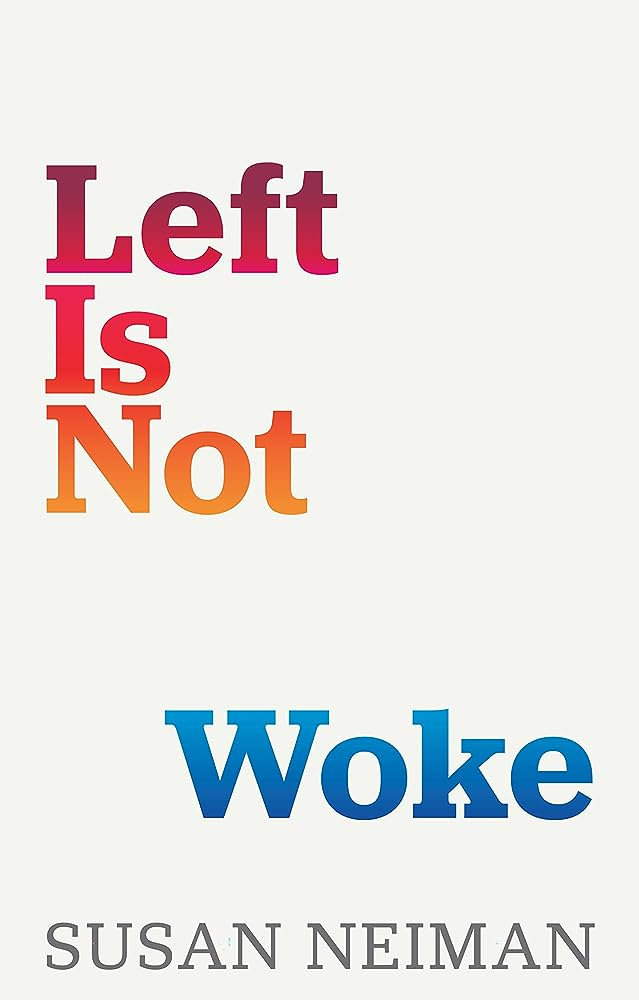
Mirror-Universe Foucault in a land without Marx: The bizarre phantasmagoria of Left is Not Woke by Susan Neiman

This book is not what I expected.

When I initially opened the cover and was confronted by the statement that, “Except as occasional targets, they {‘leftist’ ideas of universalism, justice and belief in the possibility of progress} are hard to find in contemporary discourse. This has led a number of my friends in several countries to conclude, morosely, that they no longer belong to the left. Despite lifetimes of commitment to social justice, they’re estranged by developments on what’s called the woke left, or the far left, or the radical left.” I assumed this was the tired Sam Harris style grift whereby a centrist liberal declares themselves the real left and, glancing at progressive liberals, declares them the far left, ignoring entirely the existence of communists, socialists and anarchists.

That’s not this book though. Instead the book is far stranger than that. This isn’t to say that the book is good. It is perhaps the second-worst work of pop-philosophy I’ve ever read (the worst being the absolutely execrable How To Be Perfect by TV producer Michael Schur). Where it differs, and how it ultimately exceeds the worst-of-the worst is in the clear breadth of Neiman’s reading. However this makes some of the remarkable exclusions in the text even more baffling. Things I could pass off as ignorance on the part of Schur are burdened with significance in Neiman’s book.

Now, since I’ve said the book is not a typical right-reframing of the Overton window a-la Sam Harris or his sad ilk the question should be raised as to what exactly the book is. And this book actually has a laser-sharp focus which is elided by its unfortunate, and overly-broad, title. This book is an attempt by Neiman to accuse Michel Foucault of smuggling Naziism into leftist philosophy. There is a secondary objective of this book – and that is to reestablish the primacy of Immanuel Kant as the champion of progress and to defend him from accusations of racism.

This comes together in her essay when Neiman makes the absurd proposition that Enlightenment philosophers can be distinguished from “practitioners of theory” in that these later “practitioners of theory” write in impenetrable jargon while the enlightenment philosophers “wrote clearly, without jargon, in the interest of reaching the widest number of readers. (Even Kant, the most difficult of Enlightenment philosophers , wrote fifteen perfectly intelligible essays for a general audience.)”

As somebody who has read both Discipline and Punish and the Critique of Pure Reason about the only thing I can say about such a claim is ‘LOL; LMAO.’

However this is ultimately a bit of a misleading passage for what follows as it becomes clear that Neiman has read both Foucault and a sufficient number of his critics to recognize that he wrote essays that were quite clear and accessible to a general audience. Rather she’s concerned that Foucault’s work depends on a method whereby it “hypnotizes” the audience rather than depending on rational argumentation.

For the first half of the book Neiman cannot mention Foucault (and she mentions Foucault quite a lot) without also bringing up the Nazi jurist Carl Schmitt and although she’s never quite bold enough to say so openly it really does seem like what Neiman wants her audience to believe about Foucault is that he was some sort of secret Nazi. She certainly doesn’t hesitate to call the concept of Power-knowledge reactionary.

But I do believe a lot of the disconnect in Neiman’s very unsympathetic reading of Foucault boils down to the old idealist / materialist split. For Neiman there are three fundamental elements to the left wing project, three precepts, that she believes Foucault’s work violates:

  1. Universalism
  2. Justice
  3. Progress

Now with progress, Neiman has a very careful and specific definition which she applies. Unfortunately she reserves defining this term to the conclusion of the book which is a poor structural choice as her failure to properly define progress at the outset significantly weakens her argument.

“It’s a matter of changing direction: Rather than thinking of progress as directed to a particular goal it can be useful to think of progress from a problematic situation to one that is less constrained.” Now this is very close to Beauvoir’s idea from The Ethics of Ambiguity regarding the movement toward an open future as the objective of a Left-wing ethic. It’s a real shame that Neiman never thinks to cite Beauvoir. Although Kantians ignoring Beauvoir’s ethic is something of a perennial complaint of mine it’s remarkable how this specific Kantian manages to arrive at some of Beauvoir’s conclusions without giving her predecessor even the most cursory recognition. However what Neiman fails to do at all is demonstrate how Foucault violates this revised precept of progress.

Certainly Foucault is critical of readings of history as progressive. His project examines how power changes form in relationship to changing epistemologies and how politics acts as a form of open warfare between parties. But Neiman takes from Foucault’s historicism that his writing makes it “hard to avoid concluding that any attempt to improve things will only make them worse.” This is a wild reading of Foucault to say the least.

At one of her most charitable episodes Neiman compares Foucault’s critique to that of Rousseau but argues that after Rousseau constructed his critique he spent the rest of his life trying to fix the world.

However this appears to be Neiman treating both of these writers as their texts alone. Certainly Foucault’s academic work remained diagnostic rather than prescriptive but it could be argued just as easily that Rousseau’s diagnosis was incomplete when he abandoned it in favour of spinning off a bunch of proposals that history demonstrated failed to lead to mass liberation. Meanwhile Foucault worked hard toward prison abolition.

Neiman briefly addresses Foucault’s abolitionism but only to suggest that Foucault’s motivations for doing so were amoral and that this means these activist activities somehow didn’t count. She loves going on about the supposed moral void of Foucault’s work, citing Chomsky calling him evil, citing Améry calling him problematic. But she fails to contend with the idea that Foucault limited his academic work pretty specifically to epistemology and never pretended to be writing an ethic; not everything has to be an ethic to be useful.

Despite Neiman’s relatively nuanced perspective on progress she still falls into the broad progressivist trap of seeing an arc of history bending inexorably toward justice, saying of the Kennedy administration’s record on civil rights in the United States that, “A world where all citizens have equal rights to eat, ride and study where they want to is better than a world where they do not, and no amount of dialectical sophistication would lead a black Southerner who lived through segregation to deny it.” There are, of course, two issues with such valorizations of incremental progress. The first is that Neiman is choosing to look at a specific change in a specific historical moment and to weigh it ethically as being “more good than what immediately preceded it” but in doing so fails to contend with the possibility of reversals throughout the history prior. This is unsurprising. Neiman believes that focusing “too much” on history blocks the path to progress.

The other problem is that Neiman seems unable to believe that anyone would write a philosophical text that explicitly avoids ethical statements and keeps trying to read an ethic back into Foucault where there is none. When she succeeds she calls this ethic perverse. When she fails she decries him as amoral. Using these two positions she characterizes the extra-academic actions Foucault took which have an ethical dimension as being perverse and amoral even when he was actively fighting for liberation.

On progress Neiman frequently raises and explores the question of the State of Nature. Much of this is to defend enlightenment thinkers from accusations of racism or colonialism. Neiman is careful to cite African philosophers regularly and I will say makes a convincing argument that she is on the right side of history when it comes to black liberation. This makes her blind spots concerning Indigenous North Americans all the more bizarre. Neiman insists on talking about “tribalism” and “tribes” throughout the book, saying that she prefers the word because it conjures the idea of barbarism. She openly admits that somebody (possibly a sensitivity reader) told her she shouldn’t say that but she did it anyway. And yet, for all of this, there are only two citations to anthropologists: David Graeber, who she is dismissive of, and Claude Lévi-Strauss, who she treats as having tried to test Rousseau’s state of nature hypotheses.

She certainly fails to address the writings of anyone of the ilk of Pierre Clastres – whose work helped to scientifically repudiate the racist idea of a progression from savagery to civilization. In fact between her vehement defense of Kant against charges of racism and her insistence of tribalism, I described the first half of this book, excluding the critique of Foucault thus: someone called Kant racist and she called them a tribalist and then that same someone said that’s racist and she got so mad she wrote a whole book about it. Of course Neiman cites no Indigenous sources.

Before departing from the topic of the state of nature I will say that some of the best material in this book is a thorough, vicious and insightful critique of Richard Dawkins and of Evolutionary Psychology. She easily recognizes the misogyny at the heart of evo-psych and she pulls no punches. More strangely she claims that evo-psych is broadly accepted as settled science by left and right alike (this is news to me) and she makes a weak attempt to tie this abortion of pseudoscience back to Foucault. Foucault was, of course, quite hostile to the idea of human nature as such. This makes attempts to blame him for some of the worst of the “just human nature” crowd rather absurd. To her marginal credit it seems even Neiman recognizes she’s stretching here and so we end up with a third of a chapter mostly about how Foucault is a secret Nazi that diverges into a good critique of a contemporary reactionary movement without much connection to the rest of her thesis.

On justice she believes Foucault to be of an accord with Schmitt that there is none. She’s aghast at Foucault’s account of juridicalism and is deeply discomforted by the contents of Discipline and Punish. But there’s an odd dance Neiman often does in her critique of that book whereby she will complain about some position Foucault took there, then will generalize it to the entirety of his being, constructing an essential Foucault, then justify that essential Foucault with quotations from Nietzsche, Genealogy, History.

However it’s worth also noting that Neiman has a view of justice that is both vulgarly-progressive (she believes society has become more just over time) and that is very much in the Kantian idealist mode whereby justice is a noumen of which any given application of justice is a phenomenon reaching (necessarily) imperfectly toward it. As such she excuses contemporary injustice as a work in progress while insisting both that the prison is preferable to the gallows and also that Foucault thought the opposite. She is poorly equipped to handle a materialist view of justice as a historically-bound system of power relations.

And here is where we must address the glaring omission in the heart of Neiman’s book because she has penned an entire book about “the left” that mentions “Marxists” twice (neither complimentary), Engels once and Marx never at all. She cites Fanon a lot but of him she says, “Fanon was a universalist who sought justice and believe in the possibility of progress.” This is made even more baffling by her vague assertion that ‘the Left’ has abandoned Diderot along with the rest of the enlightenment. Diderot is brought up in her text in close proximity to Fanon.

Now it’s notable that Karl Marx, who Fanon studied with care, was very fond of Diderot. As such there is actually a philosophical lineage that can be drawn directly between Fanon and Diderot. It’s just that, for this to be intelligible, you have to admit that Karl Marx existed.

On universalism Neiman is on the weakest ground. She realizes that the colonial project of civilizing the savage was a product of universalist thought and repeatedly argues, passionately and at length, that colonial powers misappropriated enlightenment thought that was critical of their project. Again there is an idealism here that wants to separate out what a thought is in itself from how it is used. Kant criticized colonialism so the use of his work by colonial powers is irrelevant. He’s not to blame for how his work was used.

It seems like Neiman cannot imagine a molecular justice or progress. She insists the left, to have a meaningful project, must pursue the same outcome (justice and progress) for all people everywhere. What makes this absurd is that she might be much more capable of making this argument if she abandoned Kant even briefly and spoke in Marxist terms. While many contemporary Marxists (such as myself) have read enough Deleuze to recognize the value of the micropolitical and the local on praxis there is a wealth of thoroughly universalist Marxist writing she could have drawn from. I mean Trotsky is right there. As a result Neiman’s deep loyalty to Kant ultimately severely hamstrings her ability to claim that universalism is a good. She’s far too concerned with defending the reputations of Kant (especially Kant), Voltaire, Rousseau, Montesquieu and Diderot to succeed in creating a persuasive argument for the necessity of universalism on the left.

I think I understand Neiman’s hesitance around Marx though and it’s because I don’t actually believe Foucault was the real target of her critique. Frankly Neiman’s Foucault is a straw man among straw men. Anyone with even a basic grounding in Foucault can either dismantle or brush away most of her criticisms without difficulty. Foucault was amoral? So what? Does that make his epistemology incorrect? But what’s going on here is that Neiman has a deep distrust of historical materialism.

Historical materialism is a demystifying way of looking at the world as a set of contingent material conditions where progress is not assured, where justice is described in non-moral terms and where universality is ultimately impossible. If you accept a view of history as a series of conflicts between classes then the progress toward justice rapidly becomes the playing out of conflicting powers rather than reason fumbling toward a nouminous good. “We have no compassion and we ask no compassion from you. When our turn comes, we shall not make excuses for the terror,” Marx said and this was a recognition that the proletarian struggle was not one of seeking progress toward an ideal. It was a threat, “we are coming for you.”

But as much as Neiman is obviously uncomfortable with the lack of idealism in Marx she cannot bring herself to attack him. It becomes clear in her conclusion that, despite some boomerish language, her preferred political project is far too close to socialism to openly attack Marx. As I mentioned before her idea of progress is incredibly close to Beauvoir’s (Marxist) idea of freedom. To openly disavow Marx would be to destroy the basis for her own project.

And I do think Neiman constitutes a leftist, even if one with some troubling unexamined baggage around Indigenous North Americans. So I don’t think she wants to undermine that basis. Instead she has produced this remarkably bad book. She sets up a caricature of Foucault for demolition and, in his place she raises up Kant as the father of the Left. Neiman acts as if Marx never existed and as if his students and friends hardly did either (excepting Fanon whose tie to Marx she elides) and, having erased him from history she rebuilds social democracy from a basis of the categorical imperative.

Neiman’s book is thorough and, on those rare occasions she isn’t talking about Foucault, it’s logical. But the problem is that it seems to have been written from a mirror universe with significant differences from ours. Now I’ve seen enough American radlibs who know the words to liberation but who don’t understand the beat, the sort of people who will say that it’s actually doing fascist work to de-platform a fascist if, in the process of that de-platforming, a marginalized person might come to harm. But it’s absurd to call these failures of education the far-left. That is still composed principally of Marxists and Anarchists who are usually more sensible. And it’s even more absurd to suggest such frivolous appropriations of the language of social justice are the fault of Michel Foucault. Hopefully this book will be forgotten by the history whose interrogation its author fears.

Zhuangzi in Carcosa – a review of The Wingspan of Severed Hands by Joe Koch

I’ve been wanting to get my hands on this one for ages. The Wingspan of Severed Hands is a 2020 novella written by Joe Koch and I was aware of it since before its release but after its initial publication I struggled to find a print copy for purchase in Canada. Weirdpunk Books recently issued a second print run of the book and this seems to have broken the digital-only barrier I was facing as I was able to finally buy a copy and I’m very glad I did because The Wingspan of Severed Hands is one of the most fascinating works of weird fiction I’ve ever read, a perfect example of avant-garde literature that challenges its reader both with the complexity of its imagery and the artfulness of its themes.

This book is a weird fiction story which gestures directly toward the work of Ambrose Bierce and Robert W. Chambers but it is also a startling interrogation of the question of what it means to be sane and of the ancient Taoist question of whether one can differentiate between objects.

We might start by interrogating a genealogy, or perhaps an archaeology, of Carcosa. This storied city appears first in Bierce’s An Inhabitant of Carcosa in which it is an ancient and ghostly ruin. I say ghostly rather specifically because Bierce’s story is an interrogation of death and the persistence of the spirit, chronicling the revelation that an ailing man is, in fact, a ghost, long dead, who has approached his own grave and in doing so come to the revelation of his spectral nature. Bierce’s story opens with a quote, accredited to “Hali” (likely derived from one of two Arabic alchemists) which proposes different permutations of death as a phenomenon:

“For there be divers sorts of death—some wherein the body remaineth; and in some it vanisheth quite away with the spirit. This commonly occurreth only in solitude (such is God’s will) and, none seeing the end, we say the man is lost, or gone on a long journey—which indeed he hath; but sometimes it hath happened in sight of many, as abundant testimony showeth. In one kind of death the spirit also dieth, and this it hath been known to do while yet the body was in vigor for many years. Sometimes, as is veritably attested, it dieth with the body, but after a season is raised up again in that place where the body did decay.”

Ambrose Bierce – An Inhabitant of Carcosa – 1886

The affective character of this silent and ruined city under the red disc of a darkening sun, ripe with the psychopompic significance of the owl and the lynx was then appropriated by Chambers for The King in Yellow and it’s from Chambers that much of the shared weird-fiction motifs that surround Carcosa – the idea of it as an alien landscape as opposed to (or in addition to) it being a spirit realm, the King in Yellow as the monarch of the ruined city, the eponymous play about the king which brings madness, and the Yellow Sign – derive. In the story The Yellow Sign the model Tessie says, of the awful man who upsets the narrator, “‘he reminds me of a dream,—an awful dream I once had. Or,’ she mused, looking down at her shapely shoes, ‘was it a dream after all?'”

This short story treats these semiotic markers of Carcosa – the play, the sign – as occupying a liminal space between life and death. The agent of the King in Yellow who comes to recover the amulet marked by the Yellow Sign is a cemetery watchman long-dead, the same man who haunted the dreams of Tessie and the narrator. And as such it’s via Cambers that we begin to see Carcosa as a place of questioning boundaries – the boundary between waking and dream, the boundary between life and death.

In the second chapter of the Zhuangzi is one of the philosopher’s most famous fragments:

The Outline said to the Shadow, “First you are on the move then you are standing still; you sit down and then you stand up. Why can’t you make up your mind?”

Shadow replied, “Do I have to look to something else to be what I am? Does this something else itself not have to rely on yet anther something? Do I have to depend upon the scales of the snake or the wings of a cicada? How can I tell how things are? How can I tell how things are not?

Once upon a time, I, Zhuangzi, dreamed that I was a butterfly, flitting around and enjoying myself. I had no iea I was Zhuangzi. Then suddenly I woke up and was Zhuangzi again. But I could not tell, had I been Zhuangzi dreaming I was a butterfly or a butterfly dreaming I was Zhuangzi? However, there must be some sort of difference between Zhuangzi and a butterfly! We call this the transformation of things.

The Book of Zhuangzi – Translated by Martin Palmer (with minor alterations) – 1996 (original text ~300 BCE)

The simplest interpretation of this is to treat it as a question of boundaries and this is so, to a certain extent. It’s true that Zhuangzi calls into question the division between waking and dreaming. But more to the point Zhuangzi calls into question the existence of discrete objects. The Shadow treats itself as an object and points out that its constant fluctuations, first standing still, then sitting down, then standing up should not be tied to a single cause because all causes are interdependent. This prefaces Zhuangzi’s argument that to dream of being otherwise is to be transformed. Instead of discrete objects we see a universe of motion wherein forms are contingent and disruptive change ever-present.

This provides with a basis for grappling with Koch’s challenging text.

The Wingspan of Severed Hands focuses on, perhaps, three interconnected beings. The first is Adira – a daughter of a harsh and controlling mother, someone raised with too much religion and not enough money. The second is Director Bennet – a scientist leading an initiative to rescue civilization from an epidemic of madness brought about by the semiotic contagion of the Yellow Sign. The third is the Weapon – possibly an angel, possibly a butterfly and possibly a god – the weapon is Bennet’s vehicle of global deliverance and Adira’s vehicle of personal deliverance.

The stories of Adira and Bennett begin seeming like disconnected views of the same global phenomenon. Bennet shelters in her bunker building plans to rescue the world from the cultic calamity that Adira lives within. Her mother raises her with the judgmental furor of an evangelical Christian but as the story progresses it becomes clear that her’s mothers theological convictions are not so simple.

Looming over this is the Queen in Yellow – a dead or dying mother god, the monarch of Carcosa, our liminal city where dream and lucidity, death and life, madness and sanity collide in a shattering of dialectical poles.

However as the story progresses the boundaries between these characters become indistinct. We discover that Director Bennet is properly named Adira Bennet and many aspects of her personal history align with those of Adira’s present. Adira suffers a series of shocking mortifications and transformations that harken back to Bierce’s claim that sometimes the spirit, “dieth with the body, but after a season is raised up again in that place where the body did decay”

This progression, and the dual nature of the Weapon as Bennet’s project and Adira’s guardian angel, come about to a climax which is effectively a textual approach to semiotic collapse as the groundings of formal unities are cut out from under the audience one after another. The entire book occupies “the last waking moment between the blackness of sleep and the lucidity of dreaming,” while also taking place as a giant butterfly built of steel and flesh dreams the death of a mad goddess and while also chronicling an abused woman escaping from an ailing but domineering mother for whom she will never be good enough.

It’s not the right question to ask if Adira and Bennet are the same person. Nor is it right to ask whether Adira and Bennet are acting at the same time. It’s even more futile to ask whether Adira is cut to pieces by a mad cult in a disused school pool building only to be resurrected in the bowels of a cosmic hound. This book defies an easy division between the action of the text and the metaphor by which the action is described. These semiotic structures of fiction collapse under the power of Koch’s vision.

I think one of the delightful challenges of this book is the way that it obliterates the idea of narrative fiction as existing within time. If everything is in a constant state of flux and change then time itself must be seen as contingent. Certainly this metastable conception of material law is a thread in philosophy that runs from Zhuangzi to Meillassoux, intrinsically tied to various iterations of dialetheism and I think this provides a lens for looking at the truth of this book. The Wingspan of Severed Hands contradicts itself constantly while simultaneously reifying its own unity. Adira is the history of Bennet. Adira is the ally of Bennet. She is one person, she is not the same person. Carcosa has always been a liminal space and in this book it exists at the boundary between being and the void. It both is and is not; there is a chronological thread: The weapon is made. The weapon gestates. The weapon is unleashed and flies to Carcosa. But simultaneously the weapon appears on Adira’s wedding day, born of her severed hands. It’s made of flesh and metal and language. The weapon is not a tulpa, it is no mere thought-form but it is a thought-form and an angel and a machine. This (non)contradiction is what makes this brief text such a challenging read and I do want to note that this is not an easy book to read. I found myself rereading passages in this as often as I do when picking my way through complicated metaphysical monographs to make sure I understood what I was reading on a scene to scene level. And yet this difficulty is not from any sort of sloppiness. Koch is a powerfully controlled writer with an exceptional grasp of language both as a tool for communicating metaphor and as a sound-based artform: “Shamed by the mirror, by her mother’s hand, hot and damp with uncontrollable, anxious sweat, in the dress so tight it doubled every flaw, flowers in her hair, flowers in her eyes, no time to cry. the teal church carpet reddened Adira’s slapped cheek. She was a ruddy sow marched to slaughter.”

Furthermore Koch has mastered a skill I wish more genre authors would – using all of the senses within his work. The sensory data of this book is like a stack overflow. It’s so abundant that the mind struggles to contain the (non)contradictory sights, sounds, smells, tastes and feelings of the world. Koch tells us to take it all in but what it all is, is madness. And yet for all of this jumble of metaphor and reality, for all that this book is a work of asynchronous subversion of time and identity, it remains a taught thriller about trying to save the world from madness.

But can the world be rescued from madness or only be driven further into it? Is the Yellow Sign a sigil from beyond the stars or the random adornment on the side of an empty journal? It is both. It is neither. And so we have a world that is (not)saved. We have a protagonist who is (not)unified in her own identity.

The Wingspan of Severed Hands is a masterwork of literature. It is as insufficient to call this book weird fiction as it would be to call An Inhabitant of Carcosa weird fiction. It is certainly weird in the Fisherian sense of an overabundance of presence but this is an insufficient description of it. It is such a singular text that the only way to describe it would be to repeat the entirety of it verbatim and so, in the end, I can only say that the only way to grasp this book, let alone to understand it, is to read it. I would encourage people to do so.

Note regarding the WGA and SAG/AFTRA strikes

After listening to both SAG members and other members of the critical community I have decided that I will withhold reviews for any film currently released by a struck studio. This means that while I will continue to review movies from independent studios that are outside the bounds of the current strike action any planned reviews of films from struck studios will not be released until after the conclusion of the strike.

Please donate to WGA and SAG/AFTRA and show solidarity with striking workers worldwide.