Fame and Death: a review of MaXXXine

MaXXXine (2024), the capstone installment in Ti West‘s X trilogy, took me somewhat by surprise. Considering the ground tread in the prior films, X and Pearl, I expected, going into the film, something that might tread similar ground to Scream 3. This was very much not the case.

Instead, MaXXXine delivers a thematically messy conclusion to a thematically messy trilogy which largely serves as a vehicle for demonstrating the talent of Mia Goth and for showing off the variety of movies that West, personally likes to watch.

Maxine, having escaped from the clutches of Pearl and Howard at the conclusion of X has built a career for herself in Los Angeles as a porn star. But the hard-working and celebrity obsessed Maxine has her sights set higher than a career in dirty pictures and peep shows, telling horror director Elizabeth Bender, that women in pornography “age like bread, not wine.” Now approaching her mid-thirties Maxine needs an off-ramp and she believes horror cinema is her ticket.

Bender sees an intensity in Maxine’s audition that she believes belies talent and casts her, over the objection of the studio which is already facing protests for the film – “The Puritan 2” – a sequel to a previous breakout satanic possession movie which transports the action to the 1950s. Bender, for her part, wants to strip the veneer from the 50s and demonstrate the rot at the core of America’s mythologized decade of innocence.

Two complications interfere with Maxine’s plans for an ascent to stardom: the first is the unwanted attention of a slimy private detective John Labat, played with an amusing level of scenery chewing by Kevin Bacon, who has discovered her involvement in the murders in Texas years previous. The second is the omnipresent shadow of real-life serial killer Richard Ramirez, the Night Stalker. When Maxine’s friends and colleagues begin turning up dead, brutalized and branded with the mark of the pentagram, police investigating the Night Stalker believe they have a copycat on their hands – and believe Maxine has information that can lead them to this killer.

With as much drawn from the oeuvre of James Ellroy and Raymond Chandler and from the style of Mario Bava as from more conventional iterations of the slasher, Ti West continues trying to demonstrate his artistic chops throughout the film. “I’m an artist,” Elizabeth Bender says. “This isn’t just a video nasty,” she says of film-within-the-film The Puritan 2. She insists she has a message to communicate. But, despite turning out an entertaining story with some beautiful aesthetics Ti West struggles to communicate a coherent message. He hints again at the idea of doubling in this story as the copycat killer is doubled against the Night Stalker, but ultimately struggles to resolve the original doubling from X. We’re left wondering what exactly is being communicated with how the story compares Maxine to Pearl.

Pearl is a yawning absence at the center of this film because, of course, Pearl never got to Hollywood. But Maxine starts off in Hollywood and, despite John Labat’s bluster and the unwanted attention of both police and a serial killer the one thing that never really seems threatened throughout the movie is her notoriety. Maxine’s fame is assured. The only question that seems unanswered until the resolution is whether she’ll be a famous star or a famous victim.

The film opens with the Bette Davis quote, “In this business, until you’re known as a monster you’re not a star,” and Elizabeth Bender almost explicitly incites Maxine to vigilante violence, first comparing her horror protagonist to Dirty Harry or Paul Kersey and then telling Maxine to take a weekend to resolve whatever personal issues might be interfering with the production schedule. But, despite a capacity for violence, Maxine’s antagonists are so openly monstrous that it’s hard to see her actions as rising above the level of many protagonists of the slasher and rape-revenge genres. By the time she dispatches Labat he’s already blackmailed her, followed her with a camera at the behest of an employer we know to be the killer and chased her about the Bates Motel set with a revolver, explicitly threatening her life. He’s pursued her into the bathroom of a dance club and claimed to be a criminal while, again, waving a gun. Other targets of Maxine’s violence include a Buster Keaton impersonator who follows her down an alley with a switchblade and, of course, the killer and his cultists. Frankly there’s only two moments in the film where her actions rise above the most unambiguous examples of explicit self-defense. With this in mind Maxine’s actions don’t feel like a person giving into monstrosity in order to achieve stardom. They feel like a woman pushed to the edge by a host of monsters assailing her from all sides.
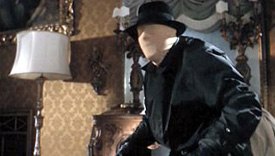
The killer from Blood and Black Lace

I do think a psychoanalytic read of MaXXXine is stronger and here is where comparisons to gialli become relevant. Frankly Ti West begs the comparisons by dressing his killer, until the final act, in a near carbon-copy of the costume of the killer in Blood and Black Lace. But for all that the film uses POV shots from the black-gloved killer and red filters over the set lamps to invoke the aesthetic of the giallo it misses the significance of the mystery aspect.

I think there was an attempt to make this movie into a mystery or detective film of a sort. The killer is, through the first two acts, a mute pair of hands or a shadow in a corner. His rage at seeing Maxine in a peep show is palpable but the reason remains opaque in the moment. But this is a problem because there really isn’t any mystery in this film. The victims, excepting one, all tell Maxine where they’re going before they disappear and Labat literally hand-delivers Maxine an invitation. The identity of the killer is telegraphed in the literal first frame of the movie and the eventual reveal carries entirely no shock as a result. With the killer kept silent for so much of the movie there are many missed opportunities to establish what Maxine is actually fighting against, what ideology she opposes to juxtapose against the mentorship off Elizabeth Bender. But, perhaps, it’s sufficient to signal that, as many woman-fronted Giallo films were deliberately seeking psycho-sexual reads, that we should interpret this film such too. Maybe that’s all West wanted to signal to the audience with these indicators.

But this returns us to the problem of how we are supposed to parse the doubling of Maxine and Pearl. Certainly Pearl is a psychosexual thriller far more than a conventional slasher. Mia Goth’s portrayal of the dust-bowl era farm girl striving for fame and sexual self-determination and instead finding violence and death was deeply internal in its focus and her moment of pained realization at the end that she had trapped herself in a life of domesticity with Howard was one of the best final frames in horror cinema. But sex, for Maxine, is just work. When the casting directors ask her to show her breasts she does so with business-like neutrality. Her work in porn is coming to a conclusion not because of any issues with sex so much as a concern that she has a limited duration career in a business that prioritizes youth. She desperately wants to be famous. But, again, her fame, as such, is never in peril, only the tenor of it.

Mia Goth does an excellent job. Maxine feels like a fully realized character both in her quiet moments watching movies with her video-store-clerk best friend Leon, in her coke-fueled moments of frenzied work and in her carefully plotted trap for Labat. Her moments of vulnerability at Bates Motel and during the head cast scene communicate the depths of the character well. But Mia Goth is a very talented performer and her doing a good job bringing full life to a character is kind of what I would just expect from her. The film wants to tell us that the unresolved core conflict in Maxine’s psyche is oedipal. She was set up to desire fame by her father, a televangelist cum cult-leader, who saw her as the future leadership of the church until she set him aside. This would tend to suggest a straightforward Freudian read that, by blasting her cult-leading, serial-murdering, moral-majority doomsday preacher of a father’s head off with a shotgun, she has resolved her Oedipus complex and is able to resolve herself as an individual. Except, of course, Pearl, our failed would-be star, also killed her father and still ended up trapped in a life of obscurity.

Maxine seems to accredit her success to hard work, and certainly she does work hard. In fact it often seems like her rampant cocaine usage is principally so that she can power through three jobs at once while also being stalked by a killer and his pet detective. But it doesn’t really seem like the other victims across this trilogy lacked her effort or her ambition. Lorraine, in X, had plenty of ambition and seemed perfectly willing to work hard. Maxine survived and she did not mostly due to dumb luck.

The series occasionally dallies with the idea that stardom depends on a nebulous and impossible to define x-factor but never commits to the theme sufficiently to drive this message home.

The film, and in fact the whole series, is also quite ambivalent on the moral character of art and exploitation. It’s honestly kind of odd to see a movie so intimately possessed with the idea of gaze that doesn’t really have anything at all coherent to say about it.

The movie is critical of religion, certainly, this has been consistent throughout the trilogy, which always codes its antagonists as hardcore Christians. But, despite a deathbed conversion, Labat is an avowed atheist while Maxine seems unwilling to say much about religion one way or the other. The third-act revelation that the supposedly satanic killings were being conducted by a Christian sect that wanted to rescue its collective daughters from the satanic influence of Hollywood was well foreshadowed by scenes of Christian morality protesters at the studio gates and a grumbling speech from Bender about studio fears around censorship and the opinions of moral crusaders. But leaving the killer so completely off-screen for the first two acts as this film did undercuts this message. We never really hear from him at all until he’s in his “revealing my whole plan” monologue period. This is somewhere where West could have taken a lesson from Wes Craven whose killers never shut up and, as a result, are able to elucidate what motivates them thematically before they reveal the mechanics of their plot.

All in all what we get with this trilogy of films, and with its final installment in specific, is a thematic mess that fails to commit to a theme. Instead we get three or four half-baked themes. However I still really liked the movie. It’s very funny. There were several laugh-out-loud moments across the film and none of the obvious jokes failed to land. Giancarlo Esposito (who plays Maxine’s agent) and Kevin Bacon both steal their respective scenes largely on the strength of their comedic timing. It’s also a beautiful film, with strong cinematography, makeup and lighting throughout. The script works well on a scene-to-scene level and the characterization is consistently strong. I enjoyed spending time with these characters. The kills were somewhat perfunctory but this movie is not exactly a slasher film so I can live with that. And the practical effects were well done throughout.

I think MaXXXine is, ultimately, a perfectly appropriate capstone for the X trilogy. It is a showcase for the talent of very well cast actors who are clearly bringing their a-games and it is a clearinghouse for the various cinematic influences Ti West seems to love. The sense of people doing a thing they like doing with technical virtuosity pervades both this movie and the trilogy as a whole. If West can learn to commit to a theme and explore it with a bit more care in the future he can probably become a great director. Until then he’s doing particularly well-performed mashups of horror’s greatest hits. But it is, at least, a very entertaining ride.

Terrifier 2 and the Master-Slave Dialectic

Terrifier 2 is a horror movie for the horror fan who thinks they’ve seen it all. A long film, clocking in at 2 hours and 18 minutes, it is nonetheless so impeccably paced that you wouldn’t notice if you didn’t check. This small-budget horror movie (budget estimates at $250,000) is yet another entry (along with Skinamarink and Psycho Goreman) that demonstrates how much inventive and truly alarming horror can be conjured without blockbuster budgets.

Anchoring the film are two standout performances: Lauren LaVera as Sienna and David Howard Thornton as the capering Art the Clown. LaVera is a very new actor with few credits to her name but I expect her to join the ranks of Mia Goth, Jenna Ortega and Samara Weaving among the new generation of high-talent scream queens on the back of her performance here as a grieving and anxious artist struggling with her family’s recent and tragic losses and the unwanted attention of an immortal murder-clown. Thornton, meanwhile, has some significant prior experience in television although much of this is off the back of his turn as Art the Clown in Terrifier (2016). He brings such impeccable manic energy to his performance as Art that this demon clown should be treated among the rank of the slasher killer greats like Freddy and the Ghostface Killer. Art is a mute and un-killable force of pure malevolence who, despite never speaking a word, manages to give one of the most expressive performances in horror cinema. Please believe me that favorable comparisons to Robert Englund and Roger L. Jackson are entirely apropos.

The film picks up where the prior Terrifier movie left off, with the cannibalistic clown awakening from his suicide at the conclusion of the prior film and murdering a coroner before escaping the morgue. He makes his way to a laundromat where he meets his unnerving psychopomp – “The Little Pale Girl” – a sometimes invisible child clown who acts as his guide and accomplice.

From there Sienna and Art’s existences will collide in a conflict that leaves a bloody trail of torture and extreme gore across the social circle of the young woman.

The special effects here are a treat, if you have the stomach for them. Terrifier 2 has been referred to as one of the goriest films of all time and, with a scene in which one of Sienna’s friends (Allie) has her eye cut off, is scalped, has an arm cut off, is given caustic chemical burns and then subjected to a form of slow-slicing torture, all while horribly alive, marks this film as one not for the faint of heart or the soft of stomach. But this is a movie, more than any other I’ve seen, that puts lie to the idea of “torture porn.” Certainly torture is depicted. It is depicted graphically and at length. Damien Leone, the director, was also responsible for the special effects (all practical, of course) and makeup in this film. He is a remarkable artist of the macabre and the disgusting. But part of what makes him effective is that the terrible violence depicted on the screen never seems to encourage any sort of prurient pornographic titillation. In fact, Leone has made statements in the past which indicate that part of the project of Terrifier 2 is to critique the tendency of audiences to root for the killer in slasher movies. Art the Clown is charismatic in a horrible and vile way. He’s also fully inhuman, cruel beyond measure and petty to boot.

In a middle scene of the film Sienna is at a Halloween store to replace a costume element that was destroyed in a fire (more on that later) and Art follows her to the store where he hangs around leering and making an ass of himself. He grabs a bike horn, one of those ones with the black rubber bulb that go “oogah” and he approaches Sienna and squeezes it in her ear over and over. The clerk at the store tells him to stop and Sienna makes her escape. Art immediately locks the store and murders the clerk for daring to speak back to him. It’s entirely evident through the narrative framing that, even as you are captivated by the cannibal clown, you should be rooting firmly for Sienna to overcome the un-killable foe.

Of course this raises a few questions: 1) why would an artist depict such torture? The torture of Allie by Art is a far more drawn out affair than many high-water marks of cinematic torture (such as the hammer scene in The Texas Chainsaw Massacre). In fact it’s so extreme that it belabors believability that anyone could survive such abuse at all. As a result no claim to verisimilitude can be made here. This isn’t representing torture as it is in the world. In the world if you did to a person what Art the Clown did to Allie the victim would die of shock and blood loss far before he was done with her. So if it isn’t there for prurient purposes why display it at all? 2) What sort of audience would enjoy watching such a movie?

It would be all too easy for me to gesture, as I often do, in the direction of Georges Bataille and Story of The Eye, to discuss the Freudian proximity of Thanatos and Eros and to argue that art has no moral imperative to be comforting. I could go from there to a discussion of limit experiences and the idea of horror as a cinema of discomfort. For my kind readership this is all rather old-hat by now though, isn’t it? To do this would be to disregard the label of “pornography” as irrelevant and to play the Nietzschean “Yes Sayer” who denies nothing. Except this would be doing a disservice to this film because the truth is that the gore isn’t prurient; there’s nothing sexy about it at all. It’s almost pure and distilled abjection. And it occludes a key theme of the movie: recognition.

Before we talk too much about recognition, let us briefly refresh ourselves on the figure of the final girl. In Men, Women and Chainsaws, Carol Clover describes the Final Girl thus: “the one who did not die: the survivor, or Final Girl. She is the one who encounters the mutilated bodies of her friends and perceives the full extent of the preceding horror and of her own peril; who is chased, cornered, wounded; whom we see scream, stagger, fall, rise, and scream again. She is abject terror personified. If her friends knew they were about to die only seconds before the event, the Final Girl lives with the knowledge for long minutes or
hours. She alone looks death in the face, but she alone also finds the strength either to stay the killer long enough to be rescued (ending A) or to kill him herself (ending B).”

Much as Clover is confident that Craven read Freud I am pretty confident that Leone has read Clover because much of Clover’s later interrogation of the gendered nature of a final girl’s heroism, focusing on the feminine coding of abjection, the gender-play of the final girl vis her role as an investigator and the use of gendered gazes (with a male gaze applied to the killings inverted when the final girl enters an investigative mode and gazes upon the killer) is problematized by the film. So I guess we haven’t entirely escaped Freud. But in this film it falls to the final girl to run to the rescue of a male character – her brother Jonathan, kidnapped by Art the Clown to lure her to him. Sienna doesn’t look death in the face alone. She does it with her little brother. But, yet, a gendered problematic remains a valuable lens to look at this film from. While Art the Clown happily murders men and women alike and while both Sienna and her brother take the position of “final girls” within the story this is unquestionably a film about the violence men visit upon women and the consequences of that trauma.

Throughout the film we discover that Sienna’s father, who died shortly before the start of the film, suffered from a brain tumor. This gave him prophetic visions related to Art the Clown and his metaphysically bonded relationship to Sienna. But it also made him violently abusive and self-destructively violent. He died, burning to death, in a crashed car. This legacy of sickness, dark transformation and abuse has left traumatic scars on Sienna’s family. Her mother, Barbara, is fragile, drinking and throwing back pills to keep things together while snapping variously at Sienna or Jonathan and refusing to believe them when they repeatedly tell her that they believe the various misfortunes that have befallen them to be the doing of the clown. Jonathan has become obsessed with serial killers and other dark figures of fiction and history. At the start of the film Sienna suspects her brother might be a bit of a sociopath. As the high weirdness that surrounds Art the Clown invades their situation Sienna’s suspicions of her brother subside; but her mother’s suspicions are heightened.

Sienna is fragile. She is also taking valium to keep level and, despite this, is prone to anxiety attacks and depressive ideation. Sienna actually does very little of the “investigative gazing” that Clover describes. She, much like Sidney Prescott, would prefer to avoid the killer. Unfortunately she is no more able to do so than Prescott.

You may have noticed I’ve mentioned Craven’s oeuvre a fair bit so far. I would propose that Wes Craven’s New Nightmare should be treated as a key influence on this film but it also contains much of the original Nightmare on Elm Street and of Scream in its DNA. This manifests in a variety of ways: early scenes in the film treat the idea of a slasher-killer fandom in much the same way that Wes Craven’s New Nightmare does. Sienna is, as I mentioned before, a final girl in the mold of Sidney in how she subverts the final girl trope – although there is no Gail Weathers equivalent to create a whole final girl in the way the first four Scream movies did. There is also something of a spiritual tie between her and Art the Clown that is evocative of the relationship between Nancy and Freddy Krueger. Art the Clown also demonstrates the ability to invade Sienna’s dreams, and some of the actions taken in dreams manifest in the waking world (in her dream Art the Clown attacks Sienna with a flame thrower which she parries with a gladius gifted to her by her father. The flames burn her bedroom in the waking world while leaving the sword remarkably unscathed. The Freudian idea of the sword as a phallus passed from father to daughter would likely catch Clover’s notice, especially with how it blends the waking and sleeping world).

But while Art is tied to Sienna in a metaphysical way, the specifics of why remain unclear. And this is where we can finally bid farewell to the Final Girl and talk properly about recognition of the other and the Master-Slave dialectic. (Yes I know Hegel calls it the lord-bondsman dialectic for the pedants in my audience but, let’s be honest, any non-Hegel scholars who know about it would be likely to use Master-Slave as the language.)

So in brief the Master-Slave dialectic is a parable from The Phenomenology of Spirit regarding the construction of self-awareness via the process of mutual recognition by unequal entities. Hegel describes two people coming into conflict. This conflict will proceed to a struggle to the death but, crucially, self-awareness fails if one party kills the other. Instead the lord must subordinate the bondsman by force. However this subordination is unstable and ultimately the master discovers that he is entirely dependent upon the recognition (and labour) of the bondsman while the bondsman, via the immediacy of his labour, is able to come to a place of more authentic self-recognition. This ultimately makes the lord the slave of the bondsman via his oppression of them. While Hegel saw this as suggesting that liberation occurred through the process of servitude Marx turned this on its head and used this dialectic as a basis for describing class struggle, whereby the stakes become not self-recognition so much as class self-liberation from servitude.

Art the Clown has a fraught relationship with recognition. The mute clown stands out, regularly making an ass of himself when he appears in public. He strips naked in a laundromat and silently laughs at newspaper articles about car crashes. He hangs out in the Halloween store mugging and playing with crap. He has bad manners. But, for all Art tries to attract attention to himself, he responds with lethal force to anyone who actually recognizes him. When he’s in the laundromat a sleeping man wakes up and sees him playing paddy-cake with an invisible partner (The Little Pale Girl) and he kills the man for seeing his display. At the Halloween store he kills the clerk who threatens to call the cops on him. When Jonathan sees him and the Little Pale Girl playing with a dead opossum he chases Jonathan.

“Just as life is the natural setting of consciousness, independence without absolute negativity, so death is the natural negation of consciousness, negation without independence, which thus remains without the required significance of recognition. Death certainly shows that each staked his life and held it of no account, both in himself and in the other; but that isn’t for those who survived this struggle. They put an end to their consciousness in its alien setting of natural existence, that is to say, they put an end to themselves, and are done away with as extremes wanting to be for themselves, or to have an existence of their own,” Hegel says. And so, within the context of this dialectic Art’s tendency to murder anyone who observes him prevents him from any sort of independent experience.

To be blunt: this film tells us that, without a final girl, the slasher killer cannot live. Art the Clown is immortal. He cannot be killed. But likewise the text of the movie is that he cannot kill Sienna. She arrives to rescue her brother, adorned in her warrior-angel costume to find that Art has stolen the sword her father gave her – the sword she refused to take up earlier in the movie – and when Art stabs her with the sword and drowns her something magical happens and she is resurrected seemingly by a sympathetic tie to the blood on her blade. Just as there is no death for the killer so too is there no death for the heroine.

Sienna, occupying the position of the bondsman within this dialectic, overcomes Art, beheading him with her father’s magic sword, but, much as the Hegelian idea of history depends on a continuous process of these dialectical arrangements, so too does this film end ambiguously as the Pale Little Girl retrieves Art’s severed head and as his only surviving victim from the first film, a deformed mad woman marred by his cannibal hunger, gives birth to his living head.

Clearly this is a deeply odd movie. What it isn’t is a prurient one. Terrifier 2 traffics in extremes of abjection in part to demonstrate the necessity of the final girl to the slasher killer. Much of the focus of the deconstructive horror wave starting in the 1990s has been to interrogate the interiority of the victim but this often leaves the villain not much more than a foil. Even the best slashers of this subgenre (by which I mean our old friend the Ghostface Killer) ultimately amount to not much more than this. But, for all these attempt to deconstruct the early slashers they riff off of, this leaves them still confined pretty clearly within the Freudian bounds Clover set in her seminal work. Craven may have been responding to Clover in Scream but he never succeeded in getting past her.

Clover said here’s what the final girl is and Craven said “and here’s what that can mean.” Leone explodes this via a strange, bloody and surreal experiment poking not only at the same gender puzzles Clover speaks of but also of something simultaneously phenomenological but also deeply mystical.

So what kind of people would like a movie as disgusting as this one? Me for one. But more broadly this is a movie for people who love horror and also its critical interrogation. Much like Craven’s later works Terrifier 2 is as much a work of criticism as it is a work of art. It interrogates the limits of what has become a staid trope of a genre now in its fifth decade and asks not “what is this thing” but rather “why do we keep coming back to this thing?”

Sienna is the immortal final girl. She is the form of this trope raised up not just for deconstructive interrogation but for reintegration into our own collective spirit as horror fans. This collapses the comfortable distance Clover describes between a (male) audience and the (female) victim and gives immediacy to her struggle as part of a historically bound dialectical process. There may not be any more of a teleological end to the final girl than there is to history but, by showing us how Art the Clown is incapable of recognizing himself without her, by showing us that nobody needs the Final Girl more completely than the slasher killer, Terrifier 2 gives horror fans that one thing they often crave most: something completely new.