MaXXXine (2024), the capstone installment in Ti West‘s X trilogy, took me somewhat by surprise. Considering the ground tread in the prior films, X and Pearl, I expected, going into the film, something that might tread similar ground to Scream 3. This was very much not the case.
Instead, MaXXXine delivers a thematically messy conclusion to a thematically messy trilogy which largely serves as a vehicle for demonstrating the talent of Mia Goth and for showing off the variety of movies that West, personally likes to watch.
Maxine, having escaped from the clutches of Pearl and Howard at the conclusion of X has built a career for herself in Los Angeles as a porn star. But the hard-working and celebrity obsessed Maxine has her sights set higher than a career in dirty pictures and peep shows, telling horror director Elizabeth Bender, that women in pornography “age like bread, not wine.” Now approaching her mid-thirties Maxine needs an off-ramp and she believes horror cinema is her ticket.
Bender sees an intensity in Maxine’s audition that she believes belies talent and casts her, over the objection of the studio which is already facing protests for the film – “The Puritan 2” – a sequel to a previous breakout satanic possession movie which transports the action to the 1950s. Bender, for her part, wants to strip the veneer from the 50s and demonstrate the rot at the core of America’s mythologized decade of innocence.
Two complications interfere with Maxine’s plans for an ascent to stardom: the first is the unwanted attention of a slimy private detective John Labat, played with an amusing level of scenery chewing by Kevin Bacon, who has discovered her involvement in the murders in Texas years previous. The second is the omnipresent shadow of real-life serial killer Richard Ramirez, the Night Stalker. When Maxine’s friends and colleagues begin turning up dead, brutalized and branded with the mark of the pentagram, police investigating the Night Stalker believe they have a copycat on their hands – and believe Maxine has information that can lead them to this killer.
With as much drawn from the oeuvre of James Ellroy and Raymond Chandler and from the style of Mario Bava as from more conventional iterations of the slasher, Ti West continues trying to demonstrate his artistic chops throughout the film. “I’m an artist,” Elizabeth Bender says. “This isn’t just a video nasty,” she says of film-within-the-film The Puritan 2. She insists she has a message to communicate. But, despite turning out an entertaining story with some beautiful aesthetics Ti West struggles to communicate a coherent message. He hints again at the idea of doubling in this story as the copycat killer is doubled against the Night Stalker, but ultimately struggles to resolve the original doubling from X. We’re left wondering what exactly is being communicated with how the story compares Maxine to Pearl.
Pearl is a yawning absence at the center of this film because, of course, Pearl never got to Hollywood. But Maxine starts off in Hollywood and, despite John Labat’s bluster and the unwanted attention of both police and a serial killer the one thing that never really seems threatened throughout the movie is her notoriety. Maxine’s fame is assured. The only question that seems unanswered until the resolution is whether she’ll be a famous star or a famous victim.
The film opens with the Bette Davis quote, “In this business, until you’re known as a monster you’re not a star,” and Elizabeth Bender almost explicitly incites Maxine to vigilante violence, first comparing her horror protagonist to Dirty Harry or Paul Kersey and then telling Maxine to take a weekend to resolve whatever personal issues might be interfering with the production schedule. But, despite a capacity for violence, Maxine’s antagonists are so openly monstrous that it’s hard to see her actions as rising above the level of many protagonists of the slasher and rape-revenge genres. By the time she dispatches Labat he’s already blackmailed her, followed her with a camera at the behest of an employer we know to be the killer and chased her about the Bates Motel set with a revolver, explicitly threatening her life. He’s pursued her into the bathroom of a dance club and claimed to be a criminal while, again, waving a gun. Other targets of Maxine’s violence include a Buster Keaton impersonator who follows her down an alley with a switchblade and, of course, the killer and his cultists. Frankly there’s only two moments in the film where her actions rise above the most unambiguous examples of explicit self-defense. With this in mind Maxine’s actions don’t feel like a person giving into monstrosity in order to achieve stardom. They feel like a woman pushed to the edge by a host of monsters assailing her from all sides.
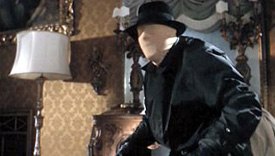
The killer from Blood and Black Lace
I do think a psychoanalytic read of MaXXXine is stronger and here is where comparisons to gialli become relevant. Frankly Ti West begs the comparisons by dressing his killer, until the final act, in a near carbon-copy of the costume of the killer in Blood and Black Lace. But for all that the film uses POV shots from the black-gloved killer and red filters over the set lamps to invoke the aesthetic of the giallo it misses the significance of the mystery aspect.
I think there was an attempt to make this movie into a mystery or detective film of a sort. The killer is, through the first two acts, a mute pair of hands or a shadow in a corner. His rage at seeing Maxine in a peep show is palpable but the reason remains opaque in the moment. But this is a problem because there really isn’t any mystery in this film. The victims, excepting one, all tell Maxine where they’re going before they disappear and Labat literally hand-delivers Maxine an invitation. The identity of the killer is telegraphed in the literal first frame of the movie and the eventual reveal carries entirely no shock as a result. With the killer kept silent for so much of the movie there are many missed opportunities to establish what Maxine is actually fighting against, what ideology she opposes to juxtapose against the mentorship off Elizabeth Bender. But, perhaps, it’s sufficient to signal that, as many woman-fronted Giallo films were deliberately seeking psycho-sexual reads, that we should interpret this film such too. Maybe that’s all West wanted to signal to the audience with these indicators.
But this returns us to the problem of how we are supposed to parse the doubling of Maxine and Pearl. Certainly Pearl is a psychosexual thriller far more than a conventional slasher. Mia Goth’s portrayal of the dust-bowl era farm girl striving for fame and sexual self-determination and instead finding violence and death was deeply internal in its focus and her moment of pained realization at the end that she had trapped herself in a life of domesticity with Howard was one of the best final frames in horror cinema. But sex, for Maxine, is just work. When the casting directors ask her to show her breasts she does so with business-like neutrality. Her work in porn is coming to a conclusion not because of any issues with sex so much as a concern that she has a limited duration career in a business that prioritizes youth. She desperately wants to be famous. But, again, her fame, as such, is never in peril, only the tenor of it.
Mia Goth does an excellent job. Maxine feels like a fully realized character both in her quiet moments watching movies with her video-store-clerk best friend Leon, in her coke-fueled moments of frenzied work and in her carefully plotted trap for Labat. Her moments of vulnerability at Bates Motel and during the head cast scene communicate the depths of the character well. But Mia Goth is a very talented performer and her doing a good job bringing full life to a character is kind of what I would just expect from her. The film wants to tell us that the unresolved core conflict in Maxine’s psyche is oedipal. She was set up to desire fame by her father, a televangelist cum cult-leader, who saw her as the future leadership of the church until she set him aside. This would tend to suggest a straightforward Freudian read that, by blasting her cult-leading, serial-murdering, moral-majority doomsday preacher of a father’s head off with a shotgun, she has resolved her Oedipus complex and is able to resolve herself as an individual. Except, of course, Pearl, our failed would-be star, also killed her father and still ended up trapped in a life of obscurity.
Maxine seems to accredit her success to hard work, and certainly she does work hard. In fact it often seems like her rampant cocaine usage is principally so that she can power through three jobs at once while also being stalked by a killer and his pet detective. But it doesn’t really seem like the other victims across this trilogy lacked her effort or her ambition. Lorraine, in X, had plenty of ambition and seemed perfectly willing to work hard. Maxine survived and she did not mostly due to dumb luck.
The series occasionally dallies with the idea that stardom depends on a nebulous and impossible to define x-factor but never commits to the theme sufficiently to drive this message home.
The film, and in fact the whole series, is also quite ambivalent on the moral character of art and exploitation. It’s honestly kind of odd to see a movie so intimately possessed with the idea of gaze that doesn’t really have anything at all coherent to say about it.
The movie is critical of religion, certainly, this has been consistent throughout the trilogy, which always codes its antagonists as hardcore Christians. But, despite a deathbed conversion, Labat is an avowed atheist while Maxine seems unwilling to say much about religion one way or the other. The third-act revelation that the supposedly satanic killings were being conducted by a Christian sect that wanted to rescue its collective daughters from the satanic influence of Hollywood was well foreshadowed by scenes of Christian morality protesters at the studio gates and a grumbling speech from Bender about studio fears around censorship and the opinions of moral crusaders. But leaving the killer so completely off-screen for the first two acts as this film did undercuts this message. We never really hear from him at all until he’s in his “revealing my whole plan” monologue period. This is somewhere where West could have taken a lesson from Wes Craven whose killers never shut up and, as a result, are able to elucidate what motivates them thematically before they reveal the mechanics of their plot.
All in all what we get with this trilogy of films, and with its final installment in specific, is a thematic mess that fails to commit to a theme. Instead we get three or four half-baked themes. However I still really liked the movie. It’s very funny. There were several laugh-out-loud moments across the film and none of the obvious jokes failed to land. Giancarlo Esposito (who plays Maxine’s agent) and Kevin Bacon both steal their respective scenes largely on the strength of their comedic timing. It’s also a beautiful film, with strong cinematography, makeup and lighting throughout. The script works well on a scene-to-scene level and the characterization is consistently strong. I enjoyed spending time with these characters. The kills were somewhat perfunctory but this movie is not exactly a slasher film so I can live with that. And the practical effects were well done throughout.
I think MaXXXine is, ultimately, a perfectly appropriate capstone for the X trilogy. It is a showcase for the talent of very well cast actors who are clearly bringing their a-games and it is a clearinghouse for the various cinematic influences Ti West seems to love. The sense of people doing a thing they like doing with technical virtuosity pervades both this movie and the trilogy as a whole. If West can learn to commit to a theme and explore it with a bit more care in the future he can probably become a great director. Until then he’s doing particularly well-performed mashups of horror’s greatest hits. But it is, at least, a very entertaining ride.
The four Scream movies contain both the best movies in the slasher genre and represent the most consistently good movies in the slasher genre. As with a lot of auteurial projects part of what allowed this consistence in quality in Scream is the involvement of a consistent team as Wes Craven directed all four, Kevin Williamson wrote three of four, Patrick Lussier edited three of four, Peter Deming was director of photography for three out of four and Marco Beltrami provided the score for all four films, On the other side of the camera, quite unusually for a slasher franchise, the lead cast remained consistent across the four movies with Neve Campbell, Courtney Cox, Roger L. Jackson and David Arquette reprising their roles in every successive film. In short these movies aren’t excellent because Craven was a singular genius but because a central core of creative workers came together to make something good and kept doing so. I say this because I will be treating the scream movies as very specifically auteurial throughout this review and I want to avoid a reductive conclusion that this is something that can be collapsed just to Craven or even to Craven and Williamson.
The scream series also charts the arc of satire at the end of its life in Hollywood. This wasn’t intentional – Scream didn’t kill satire, it was rather the last great flourishing of it. After all, the shattering of the American self-image of the 1990s in 2001 effectively forbade Hollywood from ever doing something as introspective as Scream again.
Scream: The rules of horror and the unexamined
The subject of satire in the initial Scream movie is reasonably evident. The Scream team were not being subtle in what is, effectively a reasonably straightforward criticism of the slasher genre. It’s become somewhat commonplace to read Scream as being largely a filmic equivalent to Carol J. Clover’s Men, Women, and Chainsaws. Having the kids of Scream being aware of slasher cinema in specific to the point where Randy is able to declare the rules: “you can never have sex, you can never drink or do drugs, and never (ever, under any circumstances) say “I’ll be right back”.” But it’s interesting the extent to which Randy’s rules for survival elide the role of the final girl considering the extent to which the text of scream becomes an interrogation of that trope in particular. Scream is gesturing desperately toward this absence, telling us, look the kids in this movie, watching these movies, missed something.
And so, of course the killer is somebody close to the final girl. Of course she’s been pre-selected to be the final girl not because she followed some byzantine rules of horror but because the killer wanted to hurt her, in particular. The idea of the slasher killer as a moral arbiter is shown to be a bald lie by Scream as Billy lashes out at Sidney and her friends for his mother’s departure. Casey and Steven didn’t break any slasher movie rules. Nor was anything about Casey’s presentation in the opening sequence indicative of any kind of moral failing. She’s making popcorn for a quiet night in for goodness sakes. Principal Himbry is just in the wrong place at the wrong time. Tatum is getting a beer, yes, for one of the killers, because he asked her to do so in order to present the opportunity to murder her. Kenny is also just in the wrong place at the wrong time. Rather, as Clover suggests, the killers of Scream are boy-children whose all-too-oedipal (Clover points out, of Craven, that, “at least some horror filmmakers read Freud,”) sexual hang-ups inform their crimes. Billy is mad because Sidney’s promiscuous mother seduced his father. Stu is along for the ride because of a fawning libidinal investment in Billy’s approval. Also in line with Clover’s assessment of the formal elements of the slasher genre, the boys use a knife. Right up until they don’t. It’s an interesting, and regularly repeated, characteristic that the final stand-offs of Scream films almost always involve a handgun entering into what has, until then, been a knife fight.
But, of course, all this problematizes Clover’s thesis a bit. After all, “In the slasher film, sexual transgressors of both sexes are scheduled for early destruction,” but the only person who is killed for a sexual transgression is Maureen Prescott, murdered off-screen before the action of the film has ever begun. But this is not so much a contradiction as it is a filmic way of under-lining what Clover gets at a little bit later, “always the main ones, die—plot after plot develops the motive—because they are female. Just as Norman Bates’s oedipal psychosis is such that only female victims will do, so Michael’s sexual anger toward his sister (in the Halloween series) drives him to kill her—and after her a string of sister surrogates.”
This fits the nature of the killings depicted well. Scream carefully balances male and female on-screen killings. Of six victims, three are men and three are women. But as I mentioned above, of the men, only Steven is deliberately targeted by the killers. An he is only targeted because of his relationship to their principal target, Casey. He’s killed so that they can terrify her before they kill her.
And so this brings us full-circle back to Sidney, the final girl, and how her specific abjection is deployed by Scream. Clover says that the final girl is, “abject terror personified, ” and this tracks for this poor girl who is pinballed between possible suspects across the film, uncertain and increasingly afraid as her friends die for her to discover. There is a ritualistic element at play. Much as Steven is killed explicitly to frighten Casey, every death by the hand of the Ghostface killers is orchestrated explicitly to frighten Sidney. It’s not enough for them to kill her, they need her to suffer.
Billy justifies this as wanting Sidney to feel an abandonment like his. As if her friends abandoning her into death will balance the pain of her mother’s loss. But it’s ultimately not revenge. Sidney didn’t do anything to hurt Billy even by accident – she fingers Cotton Weary as her mother’s killer, letting him off the hook for his original revenge-murder. And, of course, this film, in particular, seeks to absolve the audience. Billy and Stu don’t kill because they watch scary movies. They kill because they’re awful, sexually frustrated, mean little boys who don’t have a functioning conscience between them. They kill because they’re sexist assholes who see the girls and women in their lives as playthings. It’s fun when she screams. Billy’s selfish desire to torture Sidney is what anoints her as the final girl rather than any choice she or her friends make. This, again does the interesting dance of revealing Clover’s argument precisely by problematizing it. Clover argues that “The gender of the Final Girl is likewise compromised from the outset by her masculine interests, her inevitable sexual reluctance, her apartness from other girls, sometimes her name. At the level of the cinematic apparatus, her unfemininity is signaled clearly by her exercise of the “active investigating gaze” normally reserved for males and punished in females when they assume it themselves; tentatively at first and then aggressively, the Final Girl looks for the killer, even tracking him to his forest hut or his underground labyrinth, and then at him, therewith bringing him, often for the first time, into our vision as well.”
And some of this does ring true in Sidney. She’s reluctant, at first, to have sex with Billy. But then she relents and sleeps with him at a party. She isn’t apart from other girls. She’s popular and well-liked by her peers; her main apartness is, rather, that her mother died and she was a key witness at the trial of the man accused of her killing. Sidney doesn’t engage in anywhere near as much ‘active investigation’ in this film as she does in the sequels or as Emma does in the sadly below-par Scream TV series. In fact, she spends most of the run-time trying to avoid the killer as much as possible. She flees her home and stays with a friend. She attends a party with lots of people at it. She sticks close to her boyfriend. Scream deliberately accentuates the femininity of its final girl. In fact the investigative character of the final girl is forked off into Gail Weathers, who does most of the actual detective work throughout, being honest, the entire quadrilogy. And, of course, Gail is also a final girl. It’s almost as if Scream intentionally divides the tangled sexual depiction of the final girl between these two women: the arch-femme Sidney and the tomboyish, investigative, Gail and shows us how these two elements together allow a final girl to be the survivor. But again this difference from Clover’s thesis serves, within the medium of satire, to emphasize the same point. Scream is a movie about the connection between sex and death in the popular consciousness that is perfectly aware of what it is saying. But it plays a careful bit of legerdemain in the establishment of Randy’s very incomplete rules being presented to us with all seriousness while in the background the story shows us just how much Randy missed. And in this duplication of the final girl and these responses to abjection, Scream hammers home far more about her construction within horror than they could have with Sidney alone.
Turning the camera: Scream 2 and the horror audience
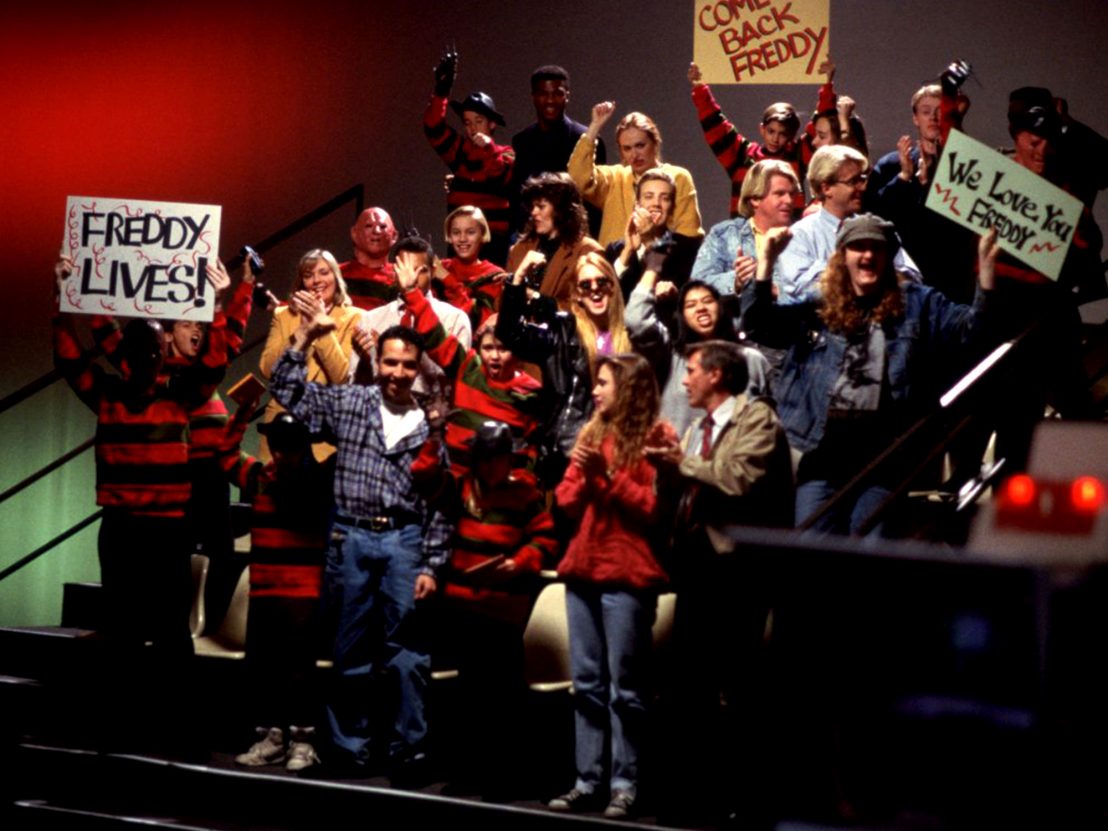
In Scream, the opening sequence serves to skewer the slasher genre expectation of the killer as moral arbiter. It presented us a genre-aware victim who had done nothing wrong within the context of the genre she was within. In Scream 2 the action opens in a movie theater. The victims are again a young couple, a man and a woman on a date. The film is Stab – an in-universe cinematization of the events of the first movie but Stab is not as self-aware a horror so instead of situating Casey getting ready for a quiet night in, it situates her in the shower. Phil has dragged Maureen out to the movie on opening night and people are excited. Ghost face masks and rubber knives are in abundance in the audience in something of an explicit callback to Wes Craven’s New Nightmare.
Maureen isn’t happy about this state of affairs though – the attempts of Stab to place sex and death so explicitly close at the start through the inserted nudity of Casey-the-character is upsetting her. It’s just too sexist. She insists that Phil buy her a snack to make up for dragging her into this mess. Ghostface dispatches Phil in a bathroom stall and then joins Maureen at her seat. As the Ghostface-the-character murders Casey on the screen, Ghostface begins stabbing Maureen. She staggers up from her seat and stumbles to the front of the theater but nobody helps her; nobody really even notices her. She climbs up in front of the screen and presents her very real wounds to an audience who slowly begin to realize that this woman is dying in front of them. She dies as the title card pops up for Stab. The audience is indicted.
The conflict at the heart of Scream 2 is largely about how horror stories are disseminated to audiences and how the audiences use them. Gale has been making hay over the exoneration of Cotton Weary and has been trying to force a confrontation between Cotton and Sidney – it’ll be good for her career. Meanwhile the events of the first film have spawned Stab – the first of many films-within-films that the Scream series presents. These two threads – the non-fiction recounting and the fictionalization create a matrix of notoriety that the new Ghostface killers exploit. Audiences are no help. Randy’s rules for a sequel are that there will be more deaths an that the kills will be more elaborate. And both of these rules play true but it doesn’t help the audience. If we treat Randy as being our principal stand-in for the audience, well, Randy doesn’t make it out alive.
Between the deaths of Phil and Maureen first and of Randy in the second act of the film, the audience of the horror movie is subject to a more complete evisceration than the sequel as a filmic concept. The main bit of critical heavy-lifting this satire does is to gesture in the direction of its divided final girl. Sidney and Gail have a much more involved, and complicated, relationship in this than in the first film. Gail remains the investigator, the digger, while Sidney would prefer to withdraw. These instincts, between retreat and attack, are positioned in complete contradiction at the start of the film where Sidney decks Gail over ambushing her with Cotton. But in the final conflict this dialectic has been resolved with Sidney and Gail shooting Mickey repeatedly in concert. The final girl is shown, in a moment of cathartic release, to no longer be divided against herself. This is something Clover nearly anticipates as her treatment of Craven’s early cites sources that describe specific forms of familial dialectics as being an “obsession” of Craven’s. But resolving this divided final girl and a wink in the direction of sequels having unique rules compared to the pure cinema that establishes slasher franchises do little to advance a discourse about horror movies qua horror movies. Instead we get a killer who is a reporter, we get a killer who is a film critic – we get people whose role is to talk about horror stories. And these killers are juxtaposed against the actual reporter, the actual final girl. Scream 2 thus hints at themes more thoroughly explored in the superior two movies that follow it. No. The principal target of Scream 2 is the reception of horror stories. It’s a film about how we, as a public, respond to stories of abjection.
Mickey craves the notoriety of being the source of abjection. He wants to be caught and to go to trial so that he can be at the center of the circus. He wants the audience to look at him. And yet he isn’t satisfied with fictionalized versions of abjection. That’s why he has to collapse the artifice of the Stab premiere by killing two people for real there. Mickey knows that the audience has an affective response to true abjection that differs from a cathartic response to fictionalized abjection. He is unsatisfied with this real / unreal divide between fiction and history so, just as Sidney and Gail undergo a dialectic unification to complete the picture of the final girl so too does Mickey try to collapse the dialectic of the audience response to horror and to real-world cruelty. But the unity of these two elements is the final cruelty to the audience. Because, when push came to shove, the audience couldn’t tell real abjection from a simulation of it. Maureen dies in front of a theater full of people and the deafening silence of their slow realization is a final condemnation. There is an interesting twist here though because you would think this would reposition the slasher killer as a moral arbiter, but it doesn’t. Much like in the first film, Ghostface murders based on their own selfish desires and not based on any personal transgression of a victim. Randy wasn’t in the opening night audience for Stab. While he may stand in for an audience he is not the audience being indicted and yet he is the audience who is cut up. There’s this tension at the heart of Scream 2 which is never fully resolved. Mickey wants to say that audiences of horror movies are a problem and much of the film agrees with him. But he doesn’t get the final say. Instead he’s removed from the discourse when Mrs. Loomis wounds him and attempts to reinsert a familial conflict dialectic such as the one Clover calls out in her response to The Hills Have Eyes.
Hollywood, exploitation and the fake in Scream 3
Scream 3 contains one of the greatest action sequences in the history of cinema. Sidney has wandered onto the soundstage for Stab 3. This is actually the soundstage for Scream only with the camera pulled back far enough to reveal its artifice. She encounters the specter of her dead mother, who has been haunting her throughout the first act of the film, and she encounters Ghostface, back again.
Sidney flees Ghostface across the set and operates instinctively as if the geography of her home would map onto the set. Only it’s all fake and none of the doors open onto the right rooms. She escapes the set/house/memory and is found by Dewy and the police. They find no sign of the killer. The film never lands fully on an answer as to whether the killer chased her or whether it was all a figment of her imagination.
Set, as it is, on the set of the filming of Stab 3, Scream 3 is a film that revels in picking at the real / fake boundary that Scream 2 gestured toward. In an hilarious cameo, Carrie Fisher appears playing a receptionist who is regularly mistaken for Carrie Fisher. Gale is followed, throughout nearly the whole film, by Jennifer Jolie – an actress playing Gale in Stab 3. The second kill-scene in Scream 3 involves an actress complaining to the director that she is only in two scenes before her character becomes the victim of the second kill-scene in Stab 3. Her death is her second scene. The film is actively hostile to the idea of the fake and the real and wants to collapse reality and simulation into each other. This is used to good effect considering that Scream 3 picks up the feminist thread of the first film by approaching the original sin of the Scream universe as being Hollywood sexual exploitation of starlets. Possibly the single most damning scene of the Scream trilogy is when Gale interrogates producer John Milton:
“It was in the 70’s, everything was different. I was well known for my parties, Rina knew what they were. It was for girls like her to meet men, men who could get them parts, if they made the right impression. Nothing happened to her that she didn’t invite, in one way or another, no matter what she said afterwards.”
Consider that Harvey Weinstein was the executive producer. Milton gets his throat perfunctorily slit not long after this scene.
If Scream wanted to interrogate the construction of the horror movie and Scream 2 wanted to look at how it communicated with an audience then Scream 3 is aimed squarely and viciously at the institution of the film studio. I prefer Scream 3 to Scream 2 precisely because it has such a singular and intense focus. Scream 2 is a bit of a messy affair, it’s uncertain whether it’s a critique of the audience or whether it’s a dialectical interrogation of the relationships between subjects from the first film. Scream 3 points back at Hollywood and roars “from hell’s heart I stab at thee.”
As such its collapse of the real and the simulation serves the purpose of arguing that there’s no simulation; it’s all real. The fictional abjection of the final girl at the hands of the slasher killer is born out of a system of exploitation that produces its very own forms of abjection. Maureen Prescott is reframed not as a dead mother, a pre-film victim, but as a previous final girl: one who survived the all-too-real horror of being treated as a sexual commodity by wealthy and powerful men. In the final confrontation, Roman returns to the Freudian well saying, “And who’s our hero? The sole survivor, the one who bravely faced down the psychopath and fucked her with her own knife. You’re gonna pay for the life you stole from me Sid. For the mother, and for the family, and for the stardom, and for, goddammit, everything you had that should’ve been mine!” But Sidney rejects his familial psychodrama and stabs him, incapacitating him until he pops up to die in a hail of gunfire when Gail and Dewey finally arrive.
There’s an interesting arc in Sidney’s story. She tries to put the events of Scream behind her in Scream 2 but she fails and becomes a recluse despite the promise of a dialectical unity with Gail proposed by the conclusion. The third film ends instead with Sidney rejecting the position as final girl. She denies Roman’s deliberate application of narrative convention to her life and situates him as being another pathetic psycho. Scream is unique in how pathetic Ghostface is. You don’t ever root for the killer like you would Jason or Freddy in some of their outings. Ghostface pops up like a demented jack-in-the-box from beneath window sills and it’s honestly always very funny but that’s as far as “funny” goes for Ghostface who doesn’t quip. Ghostface only ever threatens. And when the latest Ghostface is inevitably revealed they’re shown in all their petty humanity. This becomes the final collapse of the artificial and the real. Ghostface is always just a person in a mask with a knife. No zombie killers. No unstoppable madmen. No ghost rippers. Just an asshole with a chip on their shoulder, a hatred of women and some serious mommy issues.
Scream 4 and the desire for the final girl
There’s an interesting shift of focus in Scream 4. It is the only entry in the series filmed after September 11, 2001 and the only entry to exist in a Hollywood that had otherwise abandoned satire. I mentioned at the top that the American film industry became reflexively incapable of the sort of introspection necessary for satire and this is largely true. It’s difficult to prove an absence but, between 2001 and 2010, the most famous explicit satires in cinema were almost exclusively foreign films. Within Hollywood there was the insufferable parody Idiocracy, which sometimes is mischaracterized as a satire (and Whedon’s Cabin in the Woods would bravely tread the exact same ground as Scream but absent any of the feminist text that made the earlier film a stand-out in what is otherwise a very clear Whedon-pastiche) but more straightforward satirical films like Get Out and Knives Out were still many years away and, honestly, the genre has never fully recovered.
This means that Scream 4 occupies a strange place as a piece of critical work. A surface read suggests a fair bit of cultural anxiety concerning social media and an always-online culture that’s hungry for fame but this is where that auteurial character I mentioned at the top becomes critical. Because this is the same team that created the three previous Scream movies and, as a cohesive team, they recognized the ground they’d already tread and used this new focus on the online subject to circle back around and interrogate the final girl from a new direction asking, “why would somebody want to be a final girl?”
This film is set ten years after Scream 3 and a full 25 years since the first Scream. Sidney and Gail are now middle aged and have lived the sorts of complete lives that final girls are usually denied. Gail’s married. Sidney has her own book out. Everybody has moved on. Except that Ghostface begins stalking Sidney’s young cousin and murdering a new batch of media-aware teenagers. What we get is possibly the most meta-fictional film in the series yet. As with Scream 2, the opening kill helps establish this well as the first kill is shown to be a fake-out, the opening sequence to Stab 6. The scene cuts to Chloe and Rachel (in a delightful pair of cameos by Kristen Bell and Anna Paquin) debating the merits of the movie which Rachel derides, saying, “It’s been done to death. The whole self-aware, post- modern meta-shit is over. Stick a fork in 1996 already.” As Rachel sits down on the couch, Chloe stabs her in the gut, snarling that she never shuts up. It’s the opening to Stab 7, which is being watched by the actual first victims of Scream 4. The film-criticism aspect of Scream 4 is, on the surface, a little perfunctory. It’s not happy about the remakes that filled the Hollywood horror scene during the first decade of the 2000s. Sidney eventually nails this to a wall when she says, “don’t fuck with the original,” in the final stand-off with the latest Ghostface. However there is a far more interesting critical thread in Scream 4 in its treatment of the final girl. Because this latest iteration of Ghostface wants to be the final girl.
Since we are reading the Scream series largely as a reification of Clover’s work let’s return again to the description Clover provides of the final girl in full:
“She is the one who encounters the mutilated bodies of her friends and perceives the full extent of the preceding horror and of her own peril; who is chased, cornered, wounded; whom we see scream, stagger, fall, rise, and scream again. She is abject terror personified. If her friends knew they were about to die only seconds before the event, the Final Girl lives with the knowledge for long minutes or hours. She alone looks death in the face, but she alone also finds the strength either to stay the killer long enough to be rescued or to kill him herself.“
Scream 4 looks at this and says, “why in the world would anybody want to be this badly enough to kill for it?” And this is a fascinating question. But I think it deserves a moment to step back from it and look at how this target of satire varies from what’s come before in the Scream series. Scream films always previously targeted an institution: the horror film, the audience, the studio. This time though the target isn’t an institution. The new Ghostface isn’t a stand-in for Twitter. Rather the film is interrogating a form of individual subjectivity. It is almost as if Hollywood still wasn’t ready to look at itself in the mirror, nor even at the audience it created. Instead it had to look at this one person and ask, why is she like this?
Scream 4 is still a satire and it is a good movie but this is a fundamental difference from the previous films in the franchise and this marked difference is significant – one very much of a piece with the failure of Hollywood to create satire in the 21st century. Even this satire is compromised by an unwillingness to focus its fury on an institution. Eventually it seems to land on a fundamental failure of recognition. Sidney has been through some shit. Across the three previous attempts on her life, Sidney has been stabbed and bludgeoned she’s been shot and she’s been betrayed by people she loved. She’s become a recluse and then managed to come through the other side. But all Jill can see is Sidney is Famous. She has a book, an annoying publicist, rich friends, a personal story that eclipses the family story. Her mom is Maureen Prescott’s sister but the only person anyone cares about is Sidney because Sidney survived.
And so Jill tries to engineer becoming the final girl because she sees this woman forced into a direct confrontation with death, this woman who arises with strength in the face of abjection and fails to realize how fundamentally awful that would be. She sets up cameras everywhere so she can re-live being the killer, so that she can see the victims die again and again but she never seems to apprehend fully the character of her actions because she has stars in her eyes. Ultimately this is the concern that arises about social media: not the collective experience of Twitter mobs or Facebook Nazis but rather the idea that subjects would subject themselves and others to all manner of awful things for the chance to be famous. The real / unreal divide that Scream 3 worked so hard to collapse is already destroyed and everybody lives in this hyperreal space where the fundamental materiality of the signifier is already manifest. Sidney’s command not to fuck with the original serves a double purpose, first to take a shot at the remakes that Craven, at the very least, hated remakes. His back catalog was not well served by that period. But there’s another purpose there in reifying a kind of authentic experience. Sidney is famous for events that were out of her control and that she never wanted to happen. She survived three separate mass killers – that’s not something anyone should want. Attempting to engineer the circumstances where one becomes a final girl isn’t just monstrous because of all the killing along the way. It’s also monstrous because it fails to recognize the facticity of being the final girl. Sidney’s life isn’t an identity somebody can try on like a shirt. It’s dependent on 25 years of being through the meat grinder of life. And, at the end of things, Scream 4 says this is something that can’t be reproduced as a packaged identity.
The Scream series was the last great flourishing of satire in Hollywood before the rise of Jordan Peele as a film maker. Across their four films they managed to come full circle, interrogating the slasher killer – final girl relationship, the role of the audience and how tragedy is communicated, the exploitation of Hollywood in the creation of horror films and a dialectic collapse of the final girl into the slasher killer in the finale. In their attempt to pick apart the slasher movies of the 70s and 80s they managed, instead, to create the greatest series of slasher films yet. The scream series are a testament to the collaborative efforts of a committed team with a clear vision, something to say and the will to say it.


 Simon McNeil