World-building: a genealogical approach

…In that Empire, the Art of Cartography attained such Perfection that the map of a single Province occupied the entirety of a City, and the map of the Empire, the entirety of a Province. In time, those Unconscionable Maps no longer satisfied, and the Cartographers Guilds struck a Map of the Empire whose size was that of the Empire, and which coincided point for point with it. The following Generations, who were not so fond of the Study of Cartography as their Forebears had been, saw that that vast Map
was Useless, and not without some Pitilessness was it, that they delivered it up to the Inclemencies of Sun and Winters. In the Deserts of the West, still today, there are Tattered Ruins of that Map, inhabited by Animals and Beggars; in all the Land there is no other Relic of the Disciplines of Geography.

—Suarez Miranda,Viajes devarones prudentes, Libro IV,Cap. XLV, Lerida, 1658

Jorge Luis Borges – On Exactitude in Science

There has recently been a surge of interest in Vajra Chandrasekera’s 2023 essay The Lone and Level Sands.

Chandrasekera is largely arguing from a position contra Jason Kehe in Wired regarding the quality of Brandon Sanderson. “Kehe—who is obviously a fan, who else could read 17 to 20 novels by any given author and be familiar enough with the lore to claim bona fides—takes the criticism of Sanderson as a poor writer of prose to a very familiar place: story over sentences, worlds over writing,” he says.

Chandrasekera ends his essay calling for, “a place where the sentences matter, and are the whole of the matter,” arguing for prose quality over the encyclopedic tendency of the world builder. However, with the recent resurfacing of this essay there has been some discussion regarding the vagaries of the definition. Simply put, it seems that for some world-building means any construction of setting; for others world-building is the insertion of setting that is extraneous to the utility of the story; for others world-building is a specific method of systematic de-mystification which seeks to provide an authoritative claim as to the truth of the setting.

How one feels about world-building thus becomes multi-varied based on two questions: which definition of world-building does a person adhere to and how do they feel about that?

The earliest approaches to the idea of world-building refer to the construction of simplified “worlds” for the use in scientific thought-experiment. In the 1920 work Space Time and Gravitation: An Outline of the General Relativity Theory, Arthur Eddington says, “The reader will easily see that a being confined to the surface of a sphere and not cognisant of a third dimension, will, so to speak, lose one of his dimensions altogether when he watches things occurring at a point 90° away. He regains it if he visits the spot and so adapts himself to the two dimensions which prevail there.

“It might seem that this kind of fantastic world-building can have little to do with practical problems. But that is not quite certain. May we not be able actually to observe the slowing down of natural phenomena at great distances from us?”

For Eddington there is a pedagogical and epistemological purpose to the built world – to provide a setting in which a difference allows for the exploration of the consequences of the laws of physics. Another of Eddingon’s examples involves the movement of light through an impossibly vast and free-floating body of water in space. The difference between the “absolute world” that Eddington describes and these simplified possible worlds is a useful tool to explicate how similar functions interact with difference – meanwhile their simplification creates a sort of scientific parsimony wherein the built world contains only those elements necessary for the thought experiment. The body of water is only water. It doesn’t contain land or creatures, there is no passing debris beyond light swallowed by it. It’s water because water contains the qualities necessary to make transparent how gravitation effects light in this case.

An oft-cited early essay on literary world-building is Tolkien’s On Fairy Stories from 1939. Now this is an interesting inclusion considering the extent to which Tolkien argues against rationalization in it, saying, ” I suspect that this flower-and-butterfly minuteness was also a product of “rationalization,” which transformed the glamour of Elfland into mere finesse, and invisibility into a fragility that could hide in a cowslip or shrink behind a blade of grass. It seems to become fashionable soon after the great voyages had begun to make the world seem too narrow to hold both men and elves; when the magic land of Hy Breasail in the West had become the mere Brazils, the land of red-dye-wood.” Tolkien argues against treating “fairy” to narrowly – to signify fairies or elves as the subjects of stories – and, instead argues that fairy stories are stories about the condition of faerie – a totalizing setting that contains the creatures of faerie, their lived environments and their metaphysical bounds. This is critical because, for Tolkien, fairy stories should be true in a metaphysical sense of the world and that truth depends not on a rationalization but rather on a mystification of the audience.

In fact Tolkien is quite critical of the scientific urge within literature, saying of anthropologists and folklorists that they are, “people using the stories not as they were meant to be used, but as a quarry from which to dig evidence, or information, about matters in which they are interested. ” Tolkien believes that folklorists tend to flatten stories: “We read that Beowulf “is only a version of Dat Erdmänneken”; that “The Black Bull of Norroway is Beauty and the Beast,” or “is the same story as Eros and Psyche”; that the Norse Mastermaid (or the Gaelic Battle of the Birds and its many congeners and variants) is “the same story as the Greek tale of Jason and Medea.””

Ultimately Tolkien seeks to create a form of belief in the audience and argues that creating a mode in which an audience can believe the truth of a fairy story is the ideal mode for the creation of those things that are valuable in a fairy story. Tolkien sets up the author as a demiurge, the secondary-world is the creation of the author just as the world is the creation of God. We should create a world crammed full of all the things in existence when creating a world. We aren’t seeking the parsimonious model of Eddington’s scientific worlds but rather to create a reflection of divine Truth. And this must mean that the world of the story is even vaster than what the author sets to the page. For Tolkien a fairy story must exist in an unbounded world: “Endings of this sort suit fairy-stories, because such tales have a greater sense and grasp of the endlessness of the World of Story than most modern “realistic” stories, already hemmed within the narrow confines of their own small time. A sharp cut in the endless tapestry is not unfittingly marked by a formula, even a grotesque or comic one. It was an irresistible development of modern illustration (so largely photographic) that borders should be abandoned and the “picture” end only with the paper.”

Richard Lupoff’s description of Edgar Rice Burroughs, in 1965, is interesting in how it fuses together these seemingly incompossible forms of worldbuilding. He says, “In short, Burroughs had created a fully-visualized hero – thirty years in apparent age but actually ageless, a professional soldier, an adventurer – and had transported him to a fully visualized alien world, the planet Barsoom, which we call Mars. Barsoom was fully equipped, far beyond even VanArnam’s description, with geography, history, mythology, flora and fauna, human and inhuman inhabitants, science, politics, religion, architecture, law, and every other institution to be expected in a fully developed world.”

For Lupoff the question of building a world was a matter of craft. That genre fiction is replete with fantastical settings is a given. Instead it is a question of how an author goes about realizing this world such that an audience will enjoy reading stories set within it. These, then, help us to see how our different definitions of world building arise: genre fiction has often shared a readership with scientific non-fiction where the construction of simple and parsimonious worlds was, even in the early 20th century, a well-established method for considering problems. Tolkien, held in the highest esteem created an argument not for parsimony in constructing worlds but rather in a kind of lush overabundance of detail designed to help an audience suspend disbelief and experience the demiurgic creation as a form of truth. These two strains then filter into practical craft considerations: put in a lot of setting detail so that we have a world that can be believed in. But, being rational Men of Science, we had best make sure that these worlds are systematic and consistent; the irrational might be disbelieved.

Hilariously this chimera would likely have Tolkien and Eddington both rolling in their respective graves. But this is all rather old news. Lupoff’s book about Edgar Rice Burroughs was published in 1965. Surely we’ve progressed the discourse subsequently.

In 2007 M. John Harrison approached the subject – arguing ultimately that world-building was unnecessary. “It is the great clomping foot of nerdism. It is the attempt to exhaustively survey a place that isn’t there. A good writer would never try to do that, even with a place that is there. It isn’t possible, & if it was the results wouldn’t be readable: they would constitute not a book but the biggest library ever built, a hallowed place of dedication & lifelong study.” It’s Borges’ map that was a perfect replica of its territory. But if Harrison sees world-building as Sisyphean then the question arises as to why he’s so specifically critical of this Sisyphean task over any of the other Sisyphean tasks in writing. For Harrison this is a matter that what he calls worldbuilding fiction, “becomes less an act of imagination than the literalisation of one.”

“This kind of worldbuilding actually undercuts the best and most exciting aspects of fantastic fiction, subordinating the uncontrolled, the intuitive & the authentically imaginative to the explicable; and replacing psychological, poetic & emotional logic with the rationality of the fake,” Harrison says, bringing into the conversation the Barthean idea that fiction doesn’t consist of an active authority and a passive audience but exists in the discursive interplay between author and audience. The author, putting too much labour into world-building, is subordinating the audience too much to their authority.

The author chokes out the possibility of imaginative agency for the audience by grounding the fiction too much in the detail of the world. Harrison is concerned with the ideology surrounding this chimerical world-building, calling it, “It’s a secularised, narcissised version of the fundamentalist Christian view that the world’s a watch & God’s the watchmaker.” It’s interesting that this criticism functions poorly for the openly theological ideas of Tolkien’s essay specifically because Tolkien did not view fairy stories as watches. Tolkien believes that fairy stories end with just-so vagaries in order to demonstrate that the world of the story necessarily extended out beyond the bounds of the page. However it works well against the successors to Tolkien who, taking a page from Lupoff, have bonded the parsimony of scientific world building to the pursuit of Truth in Tolkien’s. Though Harrison is happy to leave this mess at Tolkien’s feet it does, in fact, depend on a much more protestant religiosity than Tolkien could ever possess. There is a desire in the SFF idea of world building to create a rationally realized world rather than one that feels True. But I sometimes question whether SF fans even notice the difference. Harrison does hit the nail on the head toward the end of his essay when he treats this form of world-building as a remnant of a “fossilised remains of the postmodern paradigm.” Of course the separate world-building concepts of Eddington and Tolkien were themselves very modernist – each attempted to present a grand an unifying narrative about the world: Eddington’s was scientific and Tolkien’s religious. However the syncretic desire to merge these two together is, certainly, a postmodern affectation.

In 2014 Michael Moorcock spoke with John Picacio from Locus Magazine about his then-forthcoming novel The Whispering Swarm. In that article, Moorcock argued he dislikes being called a world-builder because he believed it, as a notion, belied a “failure of literary sophistication.” Moorcock, with characteristic bluntness, calls worldbuilding “anti-romantic rationalization” and lays blame at the feet of John W. Campbell. He also says, “I’m not trying to convince you this is going to be real. I’m trying to convince you these ideas have to be considered, that what’s going on in the world has to be thought about.” And so we can see that Moorcock shares Harrison’s concern regarding the tendency of an over-sufficiency of authorial instruction to limit the avenues for audience imagination. Campbell, who demanded the stow-away die at the end of the Cold Equations, could be something of a perfect vector for the protestant syncretization of parsimonious scientific modeling and a Christian pursuit of Truth via secondary creation. It would certainly fit with the John W. Campbell who assisted L. Ron Hubbard in the founding of Dianetics after all. However, as has been pointed out by the blogger who operates under the “heresiarch” pseudonym, Moorcock’s demand for the necessity of character is no less vulnerable to historicization than the world-builders focus on setting is. They argue stridently, and convincingly, against the idea of necessity as appropriate to any discussion of literature. Effectively nothing in literature is strictly needed.

They also say, “To condemn all of worldbuilding, you ought to be going after the strongest cases: this IMO means Le Guin’s Always Coming Home, a book which sadly no one has read,” and this is interesting specifically because of what Always Coming Home is: it’s a work of speculative science.

Specifically, Le Guin constructed an ethnography for a possible future people of California. It does all the things ethnographies do – it analyzes their writing, explores the structure of their myth and poetry, it interrogates how their folkways interface with their material culture. Always Coming Home is hardly a novel although it is certainly an excellent work of literature. But, rather, it’s attacking Tolkien from the opposite end, so to speak, and giving the anthropologists and folklorists their due, telling Tolkien that his search for an idealized Truth via the whole-cloth construction of myth missed the point of considering what a myth, in its specificity, might be for when not for the construction of an English national identity.

Le Guin’s work plays well both to problematize Tolkien and to knock some of the wind out of Moorcock’s sails by demonstrating that literature need not be a character study to be, well, literary. However I don’t think that Le Guin works well to particularly problematize Harrison except in as far as her work demonstrates that there are other ways to get at building a world and reasons to do so beyond reifying a protestant ideological mode of treating the world as a watchmaker’s product. But I think one would be a fool to fail to situate Le Guin, especially, within the postmodern mode that Harrison criticizes in his essay.

In 2020 Helen Marshall interrogated Harrison’s critique of world-building along with some of the critiques of it. She cites Charles Stross who says, “The implicit construction of an artificial but plausible world is what distinguishes a work of science fiction from any other form of literature. It’s an alternative type of underpinning to actually-existing reality, which is generally more substantial (and less plausible – reality is under no compulsion to make sense.)”

Marshall points out that, “If, as he says, reality is under no compulsion to make sense, how can art ever produce a plausible and coherent yet realistic world? In fact Stross wants the opposite of this sort of messy, inexplicable real-realism. Instead he turns to fiction because ‘worldbuilding provides a set of behavioural constraints that make it easier to understand the character of my fictional protagonists.”‘

She claims that Stross is openly advocating for the construction of hyperrealities, the very thing that Harrison critiqued previously, because it it allows Stross to make-visible those things that were invisible before.

In short Marshall points back to Eddington and his massive globe of water and says, “you’re just doing this again.”

But if what Stross is doing is simply a fictional version of Eddington’s thought exercise then how can we take his claim seriously that science fiction is unique in all forms of literature from doing so? Philosophy and science have been eating science fiction’s lunch for a few hundred years now in that regard. And this is the problem with trying to disentangle this chimera. Without Tolkien’s idealism, without his explicitly theological search for Truth, then all that is left of world-building is the thought experiment. Without the thought experiment we’re just still writing fairy stories. In either case the encyclopedic impulse of the world-builder becomes a bit of fannish silliness forced upon the audience by an author who won’t get out of the way of their own text.

Marshall argues that this is largely an economic activity, Echoing several prior authors she notes that market conditions prefer “encyclopedic, extendible, franchisable, consumable” art. Authors simply follow suit. This mirrors Chandrasekera’s argument that much of Brandon Sanderson’s tendency toward world-building is tied into his position as a business-person, as a start-up founder more than as an author. Sanderson has a financial incentive to be interested in a consistent ecosystem of products that locks in readers. If a reader is conditioned to expect the systematics of a Cosmere book they might look askance at Mordew or Ambergris.

Marshall argues that what Harrison is seeking is, “a mode of attack that would destabilize and unsettle, that would reveal the world as incoherent and painful rather than unified and offering the possibility of choice.”

She chronicles Harrison as having a nearly Brechtian desire to demystify fantasy for material reasons – “We learn to run away from fantasy and into the world, write fantasies at the heart of which by some twist lies the very thing we fantasise against,” she quotes him as saying. She places Harrison into a lineage including Mervyn Peake and China Mieville, citing Jeff and Ann VanderMeer regarding the foundation of the New Weird movement.

Ultimately Marshall proposes three solutions to Harrison’s attack on world-building. The first is to, like China Mieville, double-down on world-building, and use it to allow the creation of a fantasy that “interrogates the relationship between belief and reality.”

The second is to operate within the mode of Jeff VanderMeer and, as he suggested in Wonderbook to argue for “sufficient mystery and unexplored vistas, consistent inconsistency, multicultural representation, extended, literalised metaphors, multiple operational realities, collective and individual memory and imperfect comprehension.” The third is to follow Timothy Morton’s path into speculative realism. I have explored the relationship between VanderMeer and Morton previously and found this argument of particular interest.

She argues that Harrison ultimately rejects the idea that readers should believe (or even enjoy) built worlds as if they were real.

And so what we have is a story of a century of progression through modernity and into the postmodern followed by the recognition that the postmodern condition has reached its limits. World-building is a postmodern chimera of modernist rationalism and equally modernist reaction against rationalism. It paradoxically demands a multitudinous panoply of detail in order to make transparent problem-worlds fit for solving problems.

If we express skepticism for world-building it should be clear to an audience that this is not a matter of being skeptical of the power of setting. However we must not make the error of Stross and believe that setting only exists within the confines of genre, or that any setting is more or less artificial than another.

In fact, we can abandon Baudrillard’s anxiety in favor of a Deleuzian recognition of the powers of the false. We may not agree with Tolkien that there is any Truth to be found in an act of demiurgic creation but we can recognize how both Tolkien’s unbounded abundance and Eddington’s careful parsimony create a false image of the world – and that their capacity for action depends on that falsity. As Marshall points out, a built world cannot be as inherently contradictory as reality. There’s too much of the watchmaker’s stink upon any setting. And heresiarch is quite correct to point out that the watchmaker’s simplification applies as much to the inner setting of character as to the external setting of mise en scène.

But, just as this is the case, a built world allows us to highlight contradiction and inconsistency. VanderMeer’s ideas of consistent inconsistency, the blending of extended literalised metaphor into the assumed real stratum of a story and Morton’s use of the hauntological and the eschatological allow us to interrogate socio-cultural problems with the same sort of transparent clarity that Eddington sought for the mathematical problems of special relativity. Always Coming Home provides an excellent precedent for this sort of an operation, showing how a focus on setting can allow us to interrogate our own relationship between folkway and material culture as if we were anthropologists in the future.

Perhaps what sits so hard in the mouth of many critics regarding Brandon Sanderson’s school of world-building is that it becomes too systematic for its own sake without doing much of interest with it. Sanderson is not a talented enough writer to really tell us anything about his characters but his fantasy worlds are ultimately derivative enough that they don’t have much to say about our world. They become floating escapist signifiers that exist principally to entrap an audience in a labyrinth of rules and sour them on anything that doesn’t adhere to these arbitrary laws.

This is, however, not a critique of world-building qua world-building. It’s a critique of Sanderson’s prioritization of business over art.

As Harrison rightly points out, world-building is inherently political. But Marshall is right to problematize this by demonstrating how any given politic within fiction can be subverted by a cunning enough writer. As such we would, perhaps, be wise not to condemn world-building entirely but rather to guide artists to consider what their worlds are for. When you decide what is consistent and what is inconsistent, when you decide what to show and what to hide, whether to write about trees or whales or the layout of fantastical cities, ask yourself why. Ask yourself not whether the world will convince an audience of its truth but rather what it can do with its falsehood. What games are you playing with the audience and to what end?


This is just getting absurd: Hugo 2023 fallout

Where do I even start?

A brief chronology:

  • On January 21 Ada Palmer published a blog post on the topic of self-censorship. This became relevant to subsequent discourse.
  • On February 7, File 770 and Jason Sandford’s blog co-published a report derived from Diane Lacey’s now-public comments regarding her role in censoring the Hugo Awards. The report surfaced two important details that had previously been left to speculation: first that the English speaking members of the concom, apparently without any feedback from the Chinese members of the concom had assembled dossiers on people who they suspected might be upsetting to the Chinese government. Some of these people (notably Paul Weimer, Xiran Jay Zhao and R. F. Kuang) were subsequently determined to be ineligible, again by the Western contingent of the concom on the basis of these dossiers. In many cases the texts declared ineligible were not read by the people assembling the dossiers. Second that this act of censorship was in concert with a decision, apparently made by Dave McCarty in specific, to exclude several works of Chinese fiction from consideration on the basis that he believed them to have been slated. Many of these works would have likely been finalists in their respective categories, making it highly questionable that the English language works that eventually won those categories would have even made the ballot if not for this intercession.
  • On February 19, Meg Frank stated that Dave McCarty had been “emotionally abusive, generally manipulative, and has sexually harassed myself and numerous others,” and that they’d previously made code of conduct complaints against him that had failed to gain traction due to his history of community service and concomitant popularity in the Worldcon set.
  • Also on February 19, Cheryl Morgan announced her resignation from the Hugo Award Marketing Committee and expressed fears that she, and others who had volunteered for the Hugo Awards may have become open to threat of lawsuit in the United States due to the handling of the trademark by the Chengdu concom.
  • Still on February 19, Xiran Jay Zhao stated they’d been contacted by a representative of the House Select Committee on Strategic Competition Between the United States and the Chinese Communist Party. This led to speculation among various Worldcon adjacent people that the United States might be considering punitive action against Worldcon on the basis that China Telecom, a sanctioned company in the United States, made financial contributions to Worldcon which subsequently may have donated money to the Mark Protection Committee or Worldcon Intellectual Property. According to these speculations, this might be interpreted as laundering money into a US organization from a sanctioned company – which is not an entirely dissimilar state of affairs to what led to the Meng Wanzhou diplomatic incident.

Needless to say, it has been an eventful month.

So let’s begin with self-censorship. Starting with largely around the time the February 7 report came out the discourse from within fandom was to say, “OK so maybe McCarty was principally involved in the exclusions but it was self-censorship because China is so censorious he felt he had to. This is largely in keeping with Palmer’s argument that a line cannot be drawn “between state censorship and private or civilian censorship.”

However this approach ignores an important question: if we assume that a censorious regime is imposing power such that the English speaking members of the concom self-censor, which censorious regime is it? The obvious answer is that they did it based on their beliefs of what might be problematic to the Chinese state. However this raises a second, very important question, where did the concom’s ideas of what would or would not upset the Chinese state come from?

This points back to my question surrounding the exclusion of Kuang’s book from my last Hugo piece. R.F. Kuang has a book deal in China. The book that was censored says nothing bad about China and instead principally addresses questions about English colonialism. Contending that the Chinese state is censorious the next question is why somebody would think, knowing what the Chinese state tends to censor, that this book would be likely to face censure. First we must consider who was doing the censoring. Based on the leaked emails reported on by Barkley and Sanford the vetting subcommittee was hand-picked by Dave McCarty and excluded all Chinese concom members. In a leaked email from June 6, regarding Babel, Kat Jones said Babel, “has a lot about China. I haven’t read it, and am not up on Chinese politics, so cannot say whether it would be viewed as ‘negatives of China.’”

Note that she had not read the book. It was excluded because Jones understood, somehow, that the book spoke at length about China. This must be contextualized together with Dave McCarty’s decision (seemingly alone) to invalidate votes for Chinese language work that appeared on recommended reading lists produced by the publisher Qidian and by the world’s largest science fiction magazine, Science Fiction World.

The ultimate result of this censorship was the systematic exclusion of Chinese and Chinese diaspora authors from the Hugo ballot, ultimately favoring many of the same fandom-proximate figures who have become Hugo perennials. It ended up with a remarkably white set of Hugo awards. Can we really suggest that a person with first-hand knowledge of Chinese censorship practices would respond by removing all the Chinese people from the ballot? So if this constitutes self-censorship (which depends on a narrow read of self-censorship as any form of censorship undertaken by a private party at the assumed behest of a state) what was the state who was being appeased? Because it seems like this censorship does more to reify the general American misconceptions of China than anything from within China. If we call this self-censorship then it’s as valid to say the censorious regime was the US State Department as it is to say it was the CCP. After all, many of these fantasies about China come, ultimately from there.

This is categorically not something that China would want. In fact a quick perusal of Chinese media reveals that about all that was of concern within China regarding Worldcon was the presence of Chinese authors. The wrap-up article in the China Daily contained a single line regarding the (English language) winner of Best Novel before devoting a paragraph to Hai Ya and then shorter writeups for every other Chinese national who won their category. Zhao Enzhe gets a significant quotation, saying, “I always recommend the style of Chinese ancient paintings, graceful and full of vitality,” and “ancient Chinese culture provides the best style for sci-fi and with my efforts, I hope I can bring more sci-fi artworks with Chinese philosophical thinking to foreign audiences.” South China Morning Post also published a glowing feature on Hai Ya. This should tell western audiences the direction of Chinese propaganda surrounding this event. Excluding Chinese nationals from the ballot was something explicitly contrary to these aims. Notably there is nothing published in Chinese state affiliated media subsequent to the revelation of the irregularities. But considering how the profiles of Hai Ya and Zhao Enzhe contained superlative statements regarding the significance and prestige of the Hugo awards I’d suspect that nobody in the Chinese propaganda apparatus is too happy with the western members of the concom right now.

All this is to say that if self-censorship is to be brought forward as affecting the concom’s aims and if we should tie this directly to the power of the state, per Palmer’s argument, we must interrogate which state’s power was being projected by ensuring the international audience that, even at an award ceremony held in China, American literature remained dominant.

We should also consider the possibility that this is not the first Hugo award to have faced irregularities. Mary Robinette Kowal has said that Dave McCarty created proprietary software for Hugo vote tabulation this software gives him scrutiny over which people voted for which finalists but he will not show anybody the code underlying it. Considering the preponderance of sources suggesting that McCarty was the leader of the censorship effort at Chengdu it raises the question of how many other votes may have had his finger on the scales. From what I can see McCarty’s was modelling voting data as early as 2016; this could potentially call into question every Hugo finalist since the start of the EPH process. And considering the known irregularities that led to the adoption of EPH this could, in turn, suggest there hasn’t been a single Hugo Award since 2013 that is above suspicion of tampering either by the antics of the reactionary Sad Puppies or by the so-called SMOFs of the World Science Fiction Society (WSFS) putting their fingers on the scale.

Now this is where it’s relevant to bring up the accusations of harassment against Dave McCarty. These have been going around fandom for some time. As Meg Frank said, McCarty is not a missing stair. Rather he’s a man who was protected from the consequences of his actions. Complaints of groping and other abusive behaviour surfaced at 2011 SMOFCON and were largely brushed off. Meg Frank has reported that this is a pattern of behaviour demonstrated by McCarty and his enablers.

What is concerning is that treating these irregularities as solely the Dave McCarty screw-up is letting too many others off the hook. This one man didn’t amass such influence and immunity without a score of friends and helpers. If we can look at Chengdu and call it Dave McCarty’s fiefdom it’s only because of the many people who called him friend and helped him establish it. This man should have been asked to leave in 2011. Here we are, 13 years later, reaping the consequence of his enablement. And this is where we should pivot to a discussion of the byzantine finances of WSFS and its affiliated bodies.

If we look at Cheryl Morgan’s public statement following her resignation from the Hugo Award Marketing Committee we can note a rather anomalous point where she says, “Having seen legal advice on the subject, I am confident that the contracts I issued from Wizard’s Tower Press are structured in such a way that no one suing me, either individually or as an officer of WSFS, will be able to obtain the rights to any of the works published by Wizard’s Tower.” And at the time I thought this quite odd as I couldn’t think of any good reason why anyone would sue Morgan over her rather tangential involvement.

So I asked her. And she provided me with some answers which I took to a few other people. And from what I can put together Morgan had said on social media some time previous that it would be pointless to sue WSFS because WSFS barely exists as an organization and has no money. Whereupon a legal academic informed her that a litigant could always sue the membership in such a case as US law has stipulations for suits against non-incorporated entities like WSFS. And this apparently alarmed Morgan sufficient to make her want to distance herself from any element of WSFS quite vociferously to avoid ending up party to a lawsuit for something she had absolutely nothing to do with aside from managing a webpage.

Now neither Morgan nor myself are Americans and while I cannot speak for her I would never pretend to be a legal expert even within the bounds of Canadian law. I cannot adjudicate the level of actual risk Morgan faced.

It’s at this point we must turn to address Worldcon finances. During the debacle surrounding Discon III I actually tried to dig into Worldcon finances and what I found was a disorganized mess that took me down a few blind alleys and ultimately led nowhere. Frankly, from publicly available sources, it was impossible for me to figure out where Discon III money had gone. At the time I set it aside as largely irrelevant to my point surrounding the ethics of allowing an arms manufacturer as a sponsor of a literary event. Although this was not originally a particular focus of this piece it ultimately sent me down a remarkable rabbit hole due to the non-standardized and difficult to balance nature of Worldcon financial reporting year over year.

See WSFS is non-incorporated and consists of the voting membership of WSFS in any given year. That’s true. But there is a non-profit organization called Worldcon Intellectual Property (WIP) which exists to, according to Kevin Standlee, “pursue registration of marks outside the United States.” According to information compiled by Jay Blanc, the Worldcon Marks Protection Committee (MPC) seems to have unilaterally determined that the MPC would take ownership of Worldcon related trademarks within the USA as they came up for renewal. It is worth noting that the initial board of the MPC in 2015, when these decisions were made included Dave McCarty, Kevin Standlee and Ben Yalow, among others. Blanc’s investigation points out both that this appears to have been structured specifically to keep both the MPC and WIP not legally responsible for WSFS but in such a manner that it would normally require that 33% of its annual income be taken from individual small donors. Blanc asserts that WIP’s income is taken in the form of a single grant from the yearly Worldcon. According to the most recently published financial statement for WIP, WIP earned $3,100 before September 11, 2023. $3,000 from Chicon 8 and $100 listed as “Deposit, Misc.” According to minutes published in December 3, 2023 for a special meeting of the Mark Protection Committee, “There are no dues outstanding since we just received nearly $3,000 from Chengdu” A footnote indicates, “The money from Chengdu is not part of the $18,800 noted as our bank balance, since it had just been received.” It is unclear whether this means the money had yet to be deposited into WIP accounts or whether it means the money had yet to be accounted for. There is no mention of a near-$3,000 expense item in the agenda of the Worldcon Business Meeting from Chengdu dated October 19-22. Which likely indicates the payment happened after October 22 and before December 3 however there’s no audit trail I can find for it at that time.

And I want to note that this is not a Chengdu-specific problem. However it’s worth noting that it’s not uncommon for there to be a remarkably low level of granularity in financial reports from Worldcons. For instance: the Discon III financial report from September 9 2023 includes an expense item of “Art Sales Reimbursements | $30,698.78” with no immediate context as to why these reimbursements occurred. There is no references to art sales reimbursements in the minutes of either the business meeting minutes for Discon III or Chicon 8. I would expect that a reimbursement of that size would at least warrant some discussion at a business meeting or at least some explication on the financial documentation.

However such vagaries are somewhat par for the course among Worldcons. Also a challenge is that most conventions (with the exception of Chengdu) report their finances in local currency and little detail goes into describing money conversion among pass-along funds. This makes an independent third-party balancing of Worldcon finances difficult year over year.

The difficulty of transferring money in and out of China only compounded this problem. The solution that was arrived at by the conrunners was to create a separate business entity – a 501c3 incorporated in Wyoming and headquartered at the residence of one of its board members – called the Development Center for Chengdu Worldcon (DCCW) whose responsibility it was to handle US finances for Worldcon. However, it should be noted, the articles of incorporation don’t mention that as the mission of the DCCW – instead saying that its mission is to “Facilitate the education and study of literary works internationally and in the United States.”

This caused several issues. First: the delays in allowing for registration in Chengdu Worldcon proved vexatious for some attendees. Allen Tipper went so far as to call for censure of the concom, though they were prohibited by meeting rules at Chicon8 from elaborating on the minuted records, telling me, “their skirting of the rules with regards to allowing memberships to be purchased was making me lose confidence in their ability to run a Worldcon. I would have specifically noted that I could buy a membership for Glasgow before I could buy one for Chengdu.”

Based on my research of the timeline surrounding the creation of DCCW, this was likely the root cause of this issue.

The administrators of DCCW seem to have been hard-pressed to keep up with the requirements of running the charitable organization. Wyoming state records indicate that the 501c3 became delinquent in its filings on August 2, 2023 and were administratively dissolved on October 9, 2023. This state of affairs was not rectified until February 2, 2024, when their annual report to the state was filed and their status was restored.

It seems somewhat alarming that this entity was in a legally tenuous position throughout the period of the convention itself, especially considering how finances were handled between the DCCW and the Chengdu Worldcon organization (which appears to have been the legal structure of the convention within China).

Now I will admit that what follows here is something of a guess. But the financial report for the Chengdu Worldcon contains a column for China funds and overseas funds before providing a total across both categories. The China funds are reported both in CNY and in USD while overseas funds are reported only in USD. It should note that this is actually somewhat better detail than most conventions financial reports provide.

As of August 31, the date on the financial report given at the October Worldcon, income in China funds totals to $279,704.43 while overseas income comes to $236,359.60. Expenses in China funds: $94,799.14 and in the overseas funds column it is $46,844.07. This leads to a reported net income of $184,905.29 in China funds and $189,515.53 in overseas funds. What’s interesting is when we look at the reported bank balances we see that the 2032 Chengdu Worldcon bank account is listed at $184,905.29 and the bank balance reported for the DCCW is listed at $189,515.53. This would seem to indicate, although I cannot be entirely sure, that the China funds column refers to income and expenses incurred by Chengdu Worldcon while the overseas fund column refers to income and expenses incurred by DCCW.

Now it is somewhat alarming that, at the time the report was produced the DCCW was delinquent in its filings with Wyoming and by the time the report was delivered to the membership of WSSF the DCCW had been dissolved. There is no mention of this dissolution within the agenda and I have been unable to find the minutes for the business meeting although they have apparently been published. However there are other challenges that arise from my interpretation of this report in this way.

For instance pass-along payments from CoNZealand and Discon3 are split between the two organizations. The split for CoNZealand was 75% / 25% – $37,500 went to Chengdu Worldcon while $12,500 went to DCCW. On the other hand the split for Discon 3 was 70% / 30% – of $28,528 passed along $19,928 went to Chengdu Worldcon and $8,600 went to DCCW. It’s unclear why these were handled differently.

Also unclear is the $57,428 Chicon 8 Pass-along waiver expense against Chengdu Worldcon that does not touch DCCW finances at all. I tried to find references to the pass-along waiver in the minutes of Chicon 8 and was unsuccessful. The pass-along waiver does appear as income on the Chicon 8 budget as of August 31, 2023. Again it’s unclear why this decision was made.

Another oddity is how small the amount of money was spent by either organization on international travel. DCCW paid $34,173.05 on international travel. Of that $26,522.45 was for an all-staff meeting in June. The remaining $7,650.60 was paid to convention guests. This is odd considering the number of accounts that have come out of convention panelists being comped flights and or accommodation. Tied to this oddity is the presence of only two corporate sponsors on the Chengdu financial document: Chengdu Technology Innovation New City Investment and Development Co., Ltd. – which appears to be a property development concern – and Chengdu Media Group – a media production company which also seems involved in the redevelopment efforts of the former company to some extent.

However reviewing the programming book for the Chengdu Worldcon reveals several other sponsors. Notably China Telecom, a company currently under US sanctions, was listed as a “2023 Chengdu Worldcon Starseeker” tier sponsor. Huawei, another telecommunications company under US sanctions, meanwhile does not appear as a sponsor but is an exhibitor, hosted an event attended by Worldcon panelists, and gave awards to participants (entirely distinct from the Hugos). This discrepancy is explained by statements made by Ben Yalow at Smofcon 40, previously reported by File 770, “None of that appears on our financial report because we didn’t get any money out of the deal. The convention never saw that money. What the convention saw was Hugo finalists who would show up and their plane ticket was taken care of and their hotel room was taken care of. It means that our financial report is completely accurate and totally misleading.” If I am parsing Yalow’s statement correctly this means that many of the line items that appeared remarkably low on the Chengdu budget were so because sponsors provided contributions in kind. While I will not profess to have any particular knowledge of US law regarding 501c3 reporting requirements I will say, as someone with prior experience in the not-for-profit sector, that it is not best-practice to exclude contributions in kind from financial records. You end up with “totally misleading” financial statements that way.

What makes this somewhat disconcerting is that there does not appear to be any sort of impermeability between DCCW and Chengdu Worldcon finances. Payments were divided between the two and it is unclear from the records I have access to why these payment decisions were handled in this way. If it were simply a matter of handling payments from the United States, why were pass-along payments split? If there is a good reason for this then why was the ratio of these splits different for each line item?

When we include an event that included participation of companies on US sanctions lists it would have been wise to maintain books that clearly indicated that no China Telecom or Huawei contributions entered the accounting of DCCW. As they were left entirely off the books this is opaque to me.

What I really want to highlight here is that this is a culmination of a series of decisions that significantly predate the Chengdu Worldcon. The absence of a unified financial reporting model is present for the same reason as the absence of any overarching formal guiding body for the WSFS. An old libertarian drive to resist incorporation has blocked any sort of year-to-year consistency surrounding standards and practices since ~1953. Hilariously a key fear appears to have been that incorporation would provide a method for incompetent volunteers to remain in positions of authority of for various cliques to exercise out-sized influence. Of course, now, this simply happens informally as many perennial volunteers, of various levels of competence, reoccur year over year and, in fact, decade over decade.

In fact, the Chengdu financial reports are more detailed than many other Worldcons. The financial report of Worldcon 76 has no entry for legal expenses despite a $4,000 settlement to Jon Del Arroz. Worldcon 79 has no line item for charitable donation expenses despite their board having publicly said they would do so.

NASFiC 15 provided a four-line financial statement claiming both a deficit of $24,468 and a cash balance of $5,964.27. Their notes include that they expect additional income and expenses but aside from statements regarding an application for a tourism grant they provide no real detail on how they will close this deficit gap. Nor is it clear, with how WSFS is structured, who would be responsible for paying the deficit if they cannot balance their accounts. Probably Cansmof.

Finally there is the involvement of the office of Representative Mike Gallagher. Xiran Jay Zhao says that a representative of his office contacted them saying that Gallagher was interested in this situation. This isn’t entirely surprising. Gallagher is described as a “China watchdog” and probably apprehended the existence of this issue from early reporting that suggested the big story here was CCP censorship of an international literary award. Gallagher is the chair of the United States House Select Committee on Strategic Competition between the United States and the Chinese Communist Party – a republican-led committee which lacks any Chinese diaspora members and that tends to issue inflammatory rhetoric and little else. Gallagher also has prior history of being interested in nerd shit having issued a strongly worded letter to Activision Blizzard over their rather shameful behaviour during the Hong Kong protests of 2019.

However Gallagher is in a tight position over his recent refusal to vote to impeach the Homeland Security Secretary Alejandro Mayorkas. The end result is that Gallagher will not be seeking re-election. This is to say that this is an ineffective politician from an ineffective subcommittee. I would suggest the likelihood of a congressional star-chamber for members of the concom is vanishingly small. The fact that he contacted Zhao is telling. Xiran Jay Zhao is a celebrity. They’re well-known, have a large online platform via Tik Tok and have been vociferous with their criticism of the CCP. If we treat Gallagher as a propagandist, which we honestly should, then they’re pretty much perfect for his purposes. But I doubt he has the influence in Congress, as it is currently composed, to do much beyond write another strongly worded letter. Frankly Zhao is, at best, a peripheral person to this whole mess. The people who would be best situated to answer questions about what the heck the concom were thinking are a collection of volunteer conrunners scattered across the United States, not a Canadian Tik Tok star.

I will note that there is a small silver lining here as two of the Hugo winners, Samantha Mills and Adrian Tchaikovsky, have renounced their Hugo wins from 2023 on the basis of the blanket exclusion of Chinese authors. I didn’t personally like Rabbit Test much on aesthetic and structural grounds but I do want to say that Mills, who was the first Hugo winner to make this move, deserves recognition for her strong ethics. I hope more of the Hugo winning authors will follow the example set by Mills and Tchaikovsky.

The hilarious truth is that of all the broad assortment of people and organizations involved in this bizarre story one of the most blameless is the CCP. Dave McCarty actually seems to have foiled the main CCP objective of the Chengdu Worldcon by excising Chinese authors so thoroughly from the ballot. Instead we see the American SMOF contingent at the heart of year-over-year conrunning struggling to adapt the calcified traditions of an 85 year-old institution that has aggressively resisted means and standards to an international context that desperately requires means and standards.

Please don’t take this to mean I am bringing forth the shadow of WSFS Inc. once more. Because the truth is that I don’t believe there’s anything of value left to Worldcon. As a vehicle of international connection it’s a failure: the immediate response of the Worldcon core audience to irregularities was to blame foreigners when the call was coming from inside the house. As a vehicle for a prestigious award it’s a failure: there is no good reason to believe that there has been a clean Hugo award in the last decade. I have alluded to this previously but the only period, in the history of the Hugo Awards, in which non-white authors won for Best Novel was between 2015 and 2018; it seems like the interest in honoring diverse authors dropped off sharply once the Sad Puppies were safely vanquished back to the margins. I’m sure many of the voters who gave N.K. Jemisin three Hugos in a row and then never awarded another Black author would have also voted for Obama a third time if they could.

Worldcon is a millstone around the neck of the genre community. Genre authors should not seek its awards. The WSFS should wrap itself up and any bank balances remaining on its various threadbare books should be donated to charities that can persist more than a year without falling into delinquency. Should some other international Science Fiction gathering present itself, perhaps one not so intrinsically tied to a late-1930s schism between libertarians from New Jersey and New York communists, then there could potentially be a successor to Worldcon in the future. But not as Worldcon. It’s a year-over-year embarrassment. Let it die.

Dune: Realism and the metaphorical register

I’ve an ambivalent opinion of Denis Villeneuve’s Dune.

I’ve said before that I find it weakest during the scenes of massive space crafts hovering over landscapes. This isn’t an issue with shot composition. Villeneuve brings a photographer’s eye to every frame of this expansive film and he cannot be faulted on these grounds. Rather the reason why I struggle with these more spectacular moments of Dune is precisely tied to why I like other parts of the film. In short it’s a matter of realism.

There’s an overarching tendency within blockbuster cinema to demand verisimilitude. We call a blockbuster good in part if it makes us feel like the events of the film are really happening. We don’t want to be reminded of the artifice behind it all. And this creates a very powerful tension in Dune. The film is very good at bringing verisimilitude – at bringing a vulgar sort of realism – to its broad, expansive spectacle shots. By comparison every actor excepting one is pushes aggressively against any sort of verisimilitude in their performances. These performances are Dune’s strong-suit. Because verisimilitude in Science Fiction is death.

Science Fiction has always had the potential to be the great literature of the now. Certainly this was the case during the origins of science fiction. Frankenstein didn’t imagine a future where men could reanimate the dead – it spoke to the anxiety of the scientific and industrial revolutions ongoing during the early 1800s. The important part of Frankenstein’s title is it’s subtitle: A Modern Prometheus. Frankenstein was not the Prometheus of tomorrow but rather of the now of the moment it was published. Frankenstein is a book that uses its speculative elements in a metaphorical register to speak to the responsibility of scientists and engineers to socialize their creations. The creature, like any piece of technology, is a moral tabula rasa. What shapes him is how he is used (and abused). Victor Frankenstein’s abandonment of him is a sin of carelessness far more than fear or disgust. That the action of the story is framed upon a doomed sailing expedition where the party, pursuing discovery, have carelessly become trapped in the ice acts to demonstrate this metaphoric register. Frankenstein, like all good science fiction, thus becomes a palimpsest. There are words displayed on the page but this is not where the principal meaning of the text resides.

This is not to say that science fiction should be allegorical. We do not pursue a metaphorical mode to create a one-to-one substitution of objects. Aslan being Jesus is not even approaching this metaphorical mode of fiction. Instead the purpose of the employment of a pervasive metaphoric register is to fold into a text meaning upon meaning upon meaning. The danger of careless discovery pervades Frankenstein but so does a read of nature as cold, cruel and unfeeling. The creature haunts wind-swept mountains and arctic ice. As well as being a piece of technology it is a subject who experiences a cold and indifferent world. The creature is also a product of disrespect to the dead, a theft from the gods. Thus Frankenstein is Prometheus. Meaning, in a great work of science fiction, is a monad from which, as Deleuze describes it, “everything is drawn out of it, and nothing goes out or comes in from the outside.”

This overabundance of meaning is the value of a metaphoric register. There must be an infinity of folds within it containing more and more meaning: lines and lines of text written atop one another such that only the uppermost level can be read directly but which contains, folded under, everything else: the entire moment of time in which it is created. The surface text is a barrier that obscures the full interior while still being a part of the interior, folded over. A great science fiction it creates an inexhaustible text from which nothing escapes, nothing more can go in (it is already fully pregnant with meaning) and from which everything can be draw out.

And this returns us to Villeneuve’s Dune and why it is best when it shows the least spectacle.

Verisimilitude aggressively pushes against inexhaustibility. The realist mode says, “this thing stands for only one thing – the space ship hovering above this plain is simply that – a space ship.” Instead of folding the entirety of now into the text, realism seeks to create a representation of the future that stands only for the surface of the future. Spectacle isn’t exactly a hollowing out. It’s, “an outside without an inside.” Realist spectacle can show us anything as long as what it shows us is as exactly that thing as it might possibly be. Ultimately these attempts to construct a verisimilitudinous future are the construction of a facade – something with doors and windows but no interior – holes but no void. And as Laozi reminds us it is the void that is,

“Empty yet structured,
It moves, inexhaustibly giving.”

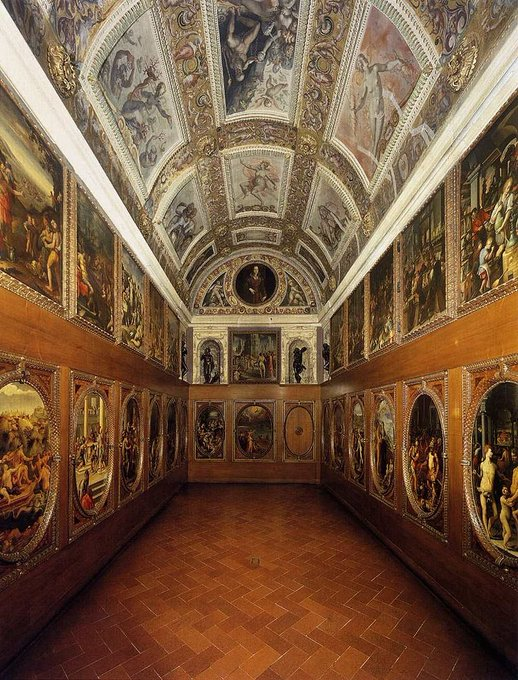
Studiolio de Fransisco I

This monadic dialectic – a palimpsest where meaning collides and an inexhaustible, inescapable void – is something Deleuze captures handily in his reference to the Studiolio de Fransisco I. Deleuze describes this as a first out-flowing of the baroque: a hidden room where the prince could hide, conduct research, and store his precious objects – a bank vault and a laboratory both and (fitting for our purposes) one dedicated to Prometheus.

But this then lets us situate our metaphoric register as a baroque mode. The baroque was, to the people who first coined the term, a state of absurd complexity; much like a palimpsest which can thus become the template for the baroque within text.

And the thing is that this is something that Villeneuve does quite well in Dune whenever big space ships are absent from the scene. Much of his film consists of two people having a conversation in which far more is said than what is said.

REVEREND MOTHER MOHIAM
I hold at your neck the gom jabbar.
A poison needle. Instant death.
This test is simple. Remove your
hand from the box, and you die.
PAUL
What’s in the box?
REVEREND MOTHER MOHIAM
Pain.

What’s most interesting about the Gom Jabbar scene is what is changed and excluded from the initial text. Rather than the perspective remaining on Paul reciting the Litany Against Fear in his mind we cut back and forth between Paul inside and Jessica, standing guard outside, unsure if her son is dead. Meanwhile the Reverend Mother’s description of the purpose of the test is winnowed down. Rather than explaining the eugenic project of separating men from beasts to Paul she simply tells him an animal caught in a trap will gnaw off its own leg and asks him directly what he would do.

This elision of some of the book’s more expository elements combined with the rigidly formal blocking of the scene creates a remarkable transformation in the text. Certainly the eugenicist project of the Bene Gesserit has not been removed. But rather than make the divide between “man” and “animal” obvious and then deliberately place Paul on the side of “man” this text moves the question far more into the register of metaphor. An animal would do this – what would you do? Paul’s internality is far more constrained than in the text of the book from which it is based. And, thanks in part at least to Villeneuve’s excellent direction of people, the performances delivered by Chalamet and Rampling are enigmatic and withdrawn.

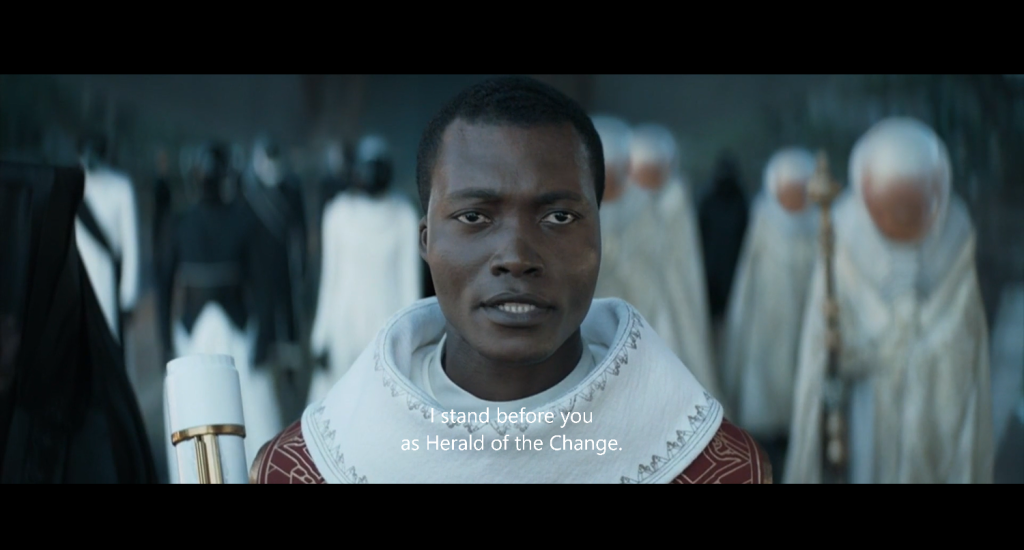
This combination of rigid blocking and enigmatic delivery is even more obvious in the scenes of the Herald of the Change and it is obvious that Benjamin Clémentine understood perfectly how to deliver an unreal performance that contained within it inexhaustibility. I do hope to see far more from this actor going forward. In this scene, especially, we, as an audience, get a sense of the monumental and the portentous from subtleties of gesture and inflection.

This scene, and the later scene where we are introduced to the Sardukar suggest a ritualized way of life and a very other sort of subjectivity on display on the screen. We can see the fifty thousand years of religion and politics we are supposed to feel under the skin of Dune here in this scene. It is a palimpsest.

In all of these scenes, and in fact in nearly any scene in this film involving its human characters who aren’t named Duncan Idaho, it seems like the direction received was to avoid a naturalistic performance in favour of this reserved, enigmatic ritualism.

But what use is inexhaustibility and what does that have to do with science fiction as the literature of the modern? Well, this is why I am of mixed opinions of Villeneuve’s Dune. Because whenever we cut away from the interactions between people in favour of their vehicles and of the worms the movie returns to being a normal spectacle-driven blockbuster – a carefully painted facade – no longer an interior without an exterior but rather an outside that opens onto other outsides. By trying to imagine what a real space ship or a real ornithopter would be like the film opens up too much. It stops trying to be deep black water and becomes instead a window into a possible imagined future.

And this is all rather useless for doing that thing which Science Fiction is best suited for as a literature, which is to point toward the present. Dune is ultimately a story about how the weight of history invades the present. Fremen war with imperial nobles because of the history of the Zensunni wanderers. The wanderers are in the vast beyond of space because of the vast religious upheavals of early space travel. Paul’s prescient power arises from a more perfect understanding of the past. Dune, as a film, thus is in a perfect position to reflect on the present moment as it was formed through its historical antecedents. There is none of that in a hyper-stylized gleaming chrome torus hovering above a desert. You can pack so much more into the riot of Sardukar ritual and the twist at the end of a herald’s smile.

The purpose of science fiction is to make a monad of the present, to encapsulate it all and fold it baroquely into itself such that we make of the present an origami doll like E. Gaff in Blade Runner. While the folds may produce the shape of a rocket, a robot or a giant worm, what matters is that they contain within them everything of their moment. Science fiction explodes into the future because the future is the only space big enough to hold everything in the present, no matter how tight the folds. Simply put the spaceship isn’t the point of science fiction. It’s merely what it looks like all folded up. This is how The Player of Games manages to be a space opera, a spy thriller, a story about a board game tournament, an essay on the relationship between linguistics and ontology and an anarchist political tract all at once. Banks, a master of Science Fiction, has folded all these late 20th century concerns together into the board of Azad. This is likewise how more recent experts of science fiction such as Leckie, Rajaniemi and Muir go about the construction of their stories. Ancillary Justice, The Fractal Prince and Harrow the Ninth occupy the monadic position that Banks achieves so deftly and that Villeneuve almost achieves in Dune whenever he isn’t endeavoring to show us beautiful photographs of shapes in space. It is, perhaps, unsurprising that a through-line of The Player of Games, The Fractal Prince, Ancillary Justice, Harrow the Ninth and Villeneuve’s Dune are ontological questions where we are invited to ask how the protagonists experiences the world and what gives shape to that experience. This becomes a method for drawing forth metaphor from the inexhaustible void at the heart of these great works of art.

Ultimately this creates a paradox. Science fiction tells us something real best when it is least interested in a verisimilitudinous sort of realism. Within cinema this is what sets apart great works of science fiction like The Matrix Reloaded from the mass-produced dross of empty spectacle. Science fiction can best do what it must by reveling in its artifice and refusing to be realistic.

Retro Review: Consider Phlebas

I first heard of Iain M. Banks when the Hydrogen Sonata was released in 2012. I know, I know, I was a few decades late to the game there. Anyway, I read the glowing reviews of the Hydrogen Sonata and thought, “perhaps I should read this guy.” Then I took a look at the length of the Culture series, 10 novels of weighty length and said, “maybe later.”

Fast-forward two and a half years and a Culture book finally came up to the top of my TBR pile. Thus me posting this review nearly thirty years too late. (Also, being fair, Consider Phlebas would have been a challenging read for me at age eight. I didn’t even start on Asimov until I was about 11 or 12.)

Ok, enough with apologia, I read this book and I have thoughts! Thoughts and opinions! Fair warning, this review will include spoilers. I know, shock, spoilers for a 28 year old novel.

Life at the edge of utopia

I do want to like Consider Phlebas, and I will probably read other Culture books in the future, and the way it explores ideas of utopia is key to that. The universe of Consider Phlebas is one at war. On one side, a giant species of tripedal religious fanatics and on the other a vast network of human-like and post-human (but interestingly, not Earthling) species and subspecies who have formed what is effectively a post-scarcity communist utopia.

The tripeds believe that it’s their relgious and moral duty to subjugate lesser species, while the utopians of the Culture have been engaging in a much gentler form of subjugation, contacting younger species and occasionally manipulating their development in order to increase the likelihood that these species will see the light of AI mitigated utopia.

I find it very interesting that Banks makes it evident immediately that there is a moral grey zone here. Our first encounter with the Culture is a diplomat who has detected and outed a spy serving the tripedal Idirans. He’s going to be executed in a truly vulgar and awful manner, and she makes a half-hearted attempt to commute his sentence.

But when his spymaster comes to rescue him, she’s found to be bristling with weapons and seems to be every bit as much of a spy as he was. She turns out to be an inveterate survivor, and in the later scene handily manipulates this same spy, and the team of mercenaries he’s managed to wrestle control over into accomplishing her goals for her while she stands back and watches.

By the time the story ends it becomes very clear that she could have wrestled control of the spy’s team and his vessel away from him at any time, but chose instead to provide a finger on the scales, reserving her hidden capacity for violence until the most opportune moment.

By contrast, the theocratic Idirans are booming, loud, overt, petulantly destructive and strangely impatient for a species Banks makes such a point of repeatedly reminding the audience is effectively immortal.

And this gets to where Consider Phlebas falls down worst – its treatment of religion.

Religion’s Bad, Mmmkay


Parts of Consider Phlebas come across as a castigation of religion every bit as severe as His Dark Materials.

This point is driven home with jackhammer subtlety during an episode in which the protagonist, the Idiran-serving spy from the beginning has become stranded in a freshwater ocean on a three-million kilometer diameter ring shaped space habitat due to be demolished as part of the war.

For some reason the administration of this satellite have allowed a cult of cannibals, ruled over the most cartoonishly “monstrous because he’s fat” character since Baron Harkonnen who somehow has convinced all of these people to murder any passers-by or each other in an orgy religiously motivated self-degradation.

Meanwhile a Culture shuttle with an artificial intelligence sits there, blithely ignorant to what’s going on literally right next to it. Apparently the AI which is tasked with flying the ship doesn’t bother switching on external cameras when it’s on the ground.

The takeaway from the misadeventure is that religion brings people to make irrational and destructive choices that harm both themselves and everybody around them.

Later, we encounter two Idirans whose names I’ve chosen to forget in favour of calling them Dumb and Dumber. These two collossal assholes have managed to sneak onto a world which is believed to hold a highly advanced AI belonging to the Culture. The protagonist of the story has been sent, by the Idirans, to recover this AI and bring it in for interrogation.

However the Idirans, woefully ill-equipped to complete their mission have decided, against all logic, that it’d be better to destroy the AI and lose its intel. Furthermore, when the spy turns up, claiming to be working for them and with a Culture agent rather obviously his prisoner, they decide, for religious reasons, nope, gonna just kill everybody instead.

Irrational, self-harming, destructive.

Dumb forces the mercenaries to keep him as a prisoner and promises to be a bad one, despite repeat assurances from the spy that he’ll be brought home alive and successful in his mission, if he just cooperates.

Instead he makes two escape attempts, killing people each time.

Dumber decides to kill everybody, including himself, with a giant fusion powered armored train. Because religion. Yeah!

The good, the bad and the ugly

It’s interesting that Banks could manage so successfully to, with only a few characters create a nuanced, interesting view on what impact a post-scarcity technologically mitigated utopia would have on the universe, while failing so wholly to provide the same nuance about religious civilizations occupying the same milieu. On one hand the Culture, its agents, and the mercenaries who occupy its periphery are crafted with loving detail. These are intricate characters with complex inner lives beautifully rendered.

Even the stock tropes (the reluctant spy who must One Last Job during which he discovers camaraderie with his enemies, the smart-ass robot who is too useful to be discarded for his attitude, the decadent space casino, the mystery world)  are done with the loving detail of pinhead’s puzzle box.

And then the Eaters and the Idirans stomp all over chewing scenery and being cartoonishly evil because their religions tell them to. And it makes for a jarring juxtaposition.

I understand this is one of Banks’ early works, and the things he does with the Culture are interesting enough that I’ll probably pick up another of the books in that series in time. It’s fine to be critical of religion in fiction. I am very fond of Pullman. But to treat most characters with such delicacy and then to have a bunch of stock religious zealots crash the party (literally) makes for a disconnect in tone and structure which wounds an otherwise engaging read.