Prophesy and Silence

As part of our ongoing dialog over leftist praxis and AI, Nicolas Villareal recently put forward an article regarding the position of prophesy in theology and the question of the future. In it Villareal points toward prophesy as a universal of religion on a par with Herbert’s statement regarding the religious concern for the condition of the soul. Villareal argues prophesy is necessary for the formation of an ethic at social scale, saying, “In our everyday lives we can make decisions based solely on what we deem is a virtuous action, or whatever animates our personal cosmologies, but when we seek to affect the whole of the social world, changing the very foundations of society and the processes which shape people’s souls, there is a deeper set of consequences and difficulties. It is at this juncture that we must consult prophecies,” before arguing, contra Benjamin, that the character of the angel of history is that of a destroyer, that there will be an end to history and that it will be entropic, so entropic, in fact that “History will end with the end of destruction, on one level of abstraction or another.” This is a logical position to reach when you attempt to reassert a position for the timeless into one’s metaphysics such as by tracing the position of a single electron throughout the duration of all time.

There is quite a lot that is very fascinating here to discuss on topics theological, ethical and metaphysical but, as this discussion has largely centered around the position of theology within praxis, I think it might be best to begin by interrogating the claim that prophesy is a theological universal.

We can start by interrogating prophesy directly. We can start by looking at Acts 1:7 which reads, “When they therefore were come together, they asked of him, saying, Lord, wilt thou at this time restore again the kingdom to Israel? And he said unto them, It is not for you to know the times or the seasons, which the Father hath put in his own power.”

It is not for you to know.

This fundamental anxiety is something which Kierkegaard grappled with in Fear and Trembling and it is from his chosen pseudonym, Johannes de Silentio, that we see a universal counter-principle to prophesy within religion in the form of silence. Religion arises, to no small part, out of the silence of the gods. People, posing questions to being itself receive back nothing, there is no answer to the prayer. For Kierkegaard this silence was critical to any true display of faith. In Fear and Trembling de Silentio speaks of a story from Aristotle regarding the Delphic Oracle. In it a man is due to be married when the auguries warn that the wedding will bring him grave misfortune. He makes a decision in light of the prophesy to forego the wedding and the vengeful family of his bride conceal temple goods among his possessions, dooming him to death for his transgression.

De Silentio details some choices the suitor could have made and suggests, “shall he keep silent and give up celebrating the wedding? In this case he must embroil himself in a mystifictition by which he reduces himself to naught in relation to her. Aesthetics would perhaps approve of this. The catastrophe might then be fashioned like that of the real story, except that at the last instant an explanation would be
forthcoming–however, that would be after it was all over, since aesthetically viewed it is a necessity to let him die … unless this science should see its way to annul the fateful prophecy.”

And so what we have here is prophesy as doom. The words of the Oracle are order-word, words that, “bring immediate death if they do not obey, or a death they must themselves inflict, take elsewhere.” Here the prophetic order-word of the Delphic Oracle literally brings the immediate death of the suitor whether he obeys or no. Marry and suffer misfortune. Heed the prophesy and die. The only hope for the suitor lies not in prophesy but in silence.

For de Silentio it is not merely the destructiveness of prophesy that brings him to prefer silence but also that he sees silence as the wellspring of faith. He describes silence as a method whereby a doubter can transform his silence to guilt and thereby absolve himself of the sin of his doubt, “Even the New Testament would approve of such a silence,” he announces.

Silence provides a barrier to knowability but not to meaning. Faith is not to be found in any sort of majoritarian meaning but in silence: “It is not as though Abraham would thereby become more intelligible, but in order that the unintelligibility might become more desultory. For, as I have said, Abraham I cannot understand, I can only admire him.”

Abraham’s duty to God exceeds any sort of ethic and it is this strange aim of de Silentio to divide the concept of duty to God directly from any intelligible ethic. Abraham doesn’t serve God because he knows it to be good. He does not have the comfort of prophesied knowledge to guide him. Abraham serves God because it is to God he owes his ultimate loyalty irrespective of ethical concerns. Meanwhile these machine gods of capitalism talk too much, as do their priests.

For Derrida this silence extends beyond the text as given and at least to the signature by which the book was signed: de Silentio. “This pseudonym keeps silent, it expresses the silence that is kept. Like all pseudonyms, it seems destined to keep secret the real name as patronym, that is, the name of the father of the work, in fact the name of the father of the father of the work.”

But names are a slippery thing and Derrida puts no more weight behind the patronym than LeGuin does in A Wizard of Earthsea. Rather Derrida suggests this act of self-naming is ultimately more meaningful than the legalities of patronym. The power behind a name comes from the, “secret name by which one calls oneself.”

It is almost as if Derrida were to create a minor language out of the pseudonym. If we treat the patronym as prophesy – a statement at birth that this person is destined for this experience – then this self-secret name, the pseudonym and the silent name in the heart of a subject becomes the undoing of that order-word. We see Paul Attreides too attempting to escape the face of his father in the names Usul, Muad’dib. And his visions are uncertainty. He sees history as an ever-unfolding topology of rise and fall. The doom of Muad’dib is that prophesy fails to become an order-word because of what must be kept silent. When Leto II arises, robed in the name of the father of the father of his work, he brings with him the golden path and the peril of prophesy once more.

In Herbert’s cosmology prophesy presented the risk of stultification. A people who knew too clearly the path before them would be complacent or fatalistic. Likewise, the doom that comes to Aristotle’s suitor comes from fatalistically denying his bride for fear of prophesy. Is, then, prophesy a true universal of religious experience or is it the method by which social power harnesses the mystic impulse of the masses?

The way you can go isn’t the real way.
The name you can say isn’t the real name.
Heaven and earth begin in the unnamed:
name’s the mother of the ten thousand things.
So the unwanting soul sees what’s hidden,
and the ever-wanting soul sees only what it wants.

LeGuin’s treatment of the Tao Te Ching touches on this idea of the divine as the silent and the hidden. This is an odd text: a political and spiritual treatise for kings rendered into an anarchist metaphysics, the great surpassing of Heidegger in a short translation assembled hodge-podge from other translations. Le Guin obliterates the idea of an original root text here and instead takes her meaning where she can find it. It is, as translations go, one marked by a kind of desultory elimination of meaning, so occupying contradiction as to become a cypher. Of the first verse, Le Guin said ” A satisfactory translation of this chapter is, I believe, perfectly impossible. It contains the book. I think of it as the Aleph, in Borges’s story: if you see it rightly, it contains everything.”

But if this is so, why translate at all? If this passage, seen right, allows one to see everything why not simply write, “道可道,非常道。名可名,非常名。无名天地之始;有名万物之母。故常无欲,以观其妙;常有欲,以观其徼。此两者,同出而异名,同谓之玄。玄之又玄,众妙之门,” and say, this contains within it the universe? But, of course, this is LeGuin toying with her readers. “I believe that the Aleph of Calle Garay was a false Aleph,” the story says before detailing other possible false manifestations of this totality. “Does that Aleph exist, within the heart of a stone? Did I see it when I saw all things, and then forget it? Our minds are permeable to forgetfulness; I myself am distorting and losing, through the tragic erosion of the years, the features of Beatriz.” The silence of the forgotten creates doubt in the most total of all visions. And the act of translation, if we take Le Guin at her word, necessarily reduces the meaning of the statement. Otherwise a perfect translation would not be impossible. It is, perhaps, that a maximal quantity of meaning is necessarily harmful to intelligibility. If one did, in fact, see everything, all at once, how would they possibly remember it? The name you can say is not the real name. The careful ordering of meaning in the patronym collapses in the face of the secret name.

Marx, certainly, cautioned against the pride of prophesy writing against, “recipes for the cook-shops of the future,” as it would depend on knowledge that was unavailable. And this presents us with a dilemma: the act of prophesy necessarily cuts off avenues to the future. The act of giving voice to this or that future necessarily attempts to render Abraham understandable again at whatever cost to our faith.

In the end, perhaps we are all fools for treating religion as a monolith when there are clearly majority and minority threads running throughout it. Religion is a field of contestation for political power. And those people who would assume power will find the order-word of prophesy a tool to their liking. For those who would rather destitute power the mystical silence that speaks to the unknowable of the divine will serve far better.

Intelligibility is not coextensive with meaning. Meaning requires an ecstatic apprehension to be grasped fully. It also requires mortality, as Borges so plainly says in The Immortal, “Homer composed the Odyssey; given infinite time, with infinite circumstances and changes, it is impossible that the Odyssey should not be composed at least once… Everything in the world of mortals has the value of the irrecoverable and contingent. Among the Immortals, on the other hand, every act (every thought) is the echo of others that preceded it in the past.” Immortality is anathema to meaning.

Meaning is not found in the hyper-legibility of AI that Villareal proposes but is rather found in the brief ecstatic moments that break even the reverie of the Immortals, “the ancient elemental pleasure of the rain.” Meaning isn’t found in the legible text of a complete set of all words and their relationships to other words but in the silence that follows when a body experiences the world.

“Action introduces the known (the manufactured); then understanding, which is linked to it, relates the non-manufactured, unknown elements, one after the other, to the known. But desire, poetry, laughter, unceasingly cause life to slip in the opposite direction, moving from the known to the unknown. Existence in the end discloses the blind spot of understanding and right away becomes completely absorbed in it,” Bataille says, pointing out that these forms of beauty that make life worth living depend not on legibility. There’s no words to a laugh. And Beauvoir reminds us, ” If the satisfaction of an old man drinking a glass of wine counts for nothing, then production and wealth are only hollow myths; they have meaning only of they are capable of being retrieved in individual and living joy.”

If we are to look to the Angelus Novus as a destroying angel then we must ask whether our project is tied to raising up a power or to striking one down. We have seen the fruits of prophetic revolution. In nearly every case it has turned back around to embrace capital and a hierarchy of powers. True Communism may, as they say, have never been attempted but Thich Nhat Hanh situated true communism in the silent contemplation of the Sangha saying of Buddhist monastic life, “we are the true communists.” Perhaps we should consider whether the theology operating the mechanical Turk of historical materialism might better be a silent, secret, invisible one: a mystical theology that has no truck with prophesy as the construction of limits that it is.

Perhaps the puissance of a revolution that can bring down the order of things is one that exceeds limits, that takes the world whole. The Denma Translation Group describes taking whole, an ontological concept from the Sunzi, as a perspective on the word as a “multitude of shifting, interrelating aspects.” This is in keeping with a classical Chinese metaphysics that describes reality as the fluid interplay between forces. The Denma group counsels us to treat objects as ever-shifting interactions. This is, again, the constantly transforming topology of Muad’dib’s vision which we must contrast with Asimov’s psychohistory.

At first blush it might seem as if Hari Seldon’s great science were taking the universe whole. The first axiom of pyschohistory was that a population had to be sufficiently large to be treated probabilistically, in a manner akin to Brownian motion. This movement of particles has been a fascination of metaphysicians and physicists alike at least since the time of Lucretius who saw in the flitting of dust particles within the air a satisfactory response to the fallacy of the prime mover. For Lucretius, an atomist, it was sufficient to suggest that the atoms moved themselves. Einstein later demonstrated that the dance of particles was the result of one particle being acted upon by many other smaller particles. this is inconvenient because it tends to reintroduce the problem of the prime mover. This is a tendency Meillassoux argues against, saying, “our claim is that it is possible to sincerely maintain that objects could actually and for no reason whatsoever behave in the most erratic fashion, without having to modify our usual everyday relation to things.” In other words: Leucretius was right. When you eventually get to something monadically small, so small there is no more sense of fluid to jostle it around in, objects move themselves. Meillassoux considers the most common responses to Hume’s questions regarding causality unfounded. Dismissing both Popper’s view as insufficient to addressing Hume’s complaint and also saying, “the nature of the problem is actually unaffected by the question of whether or not natural laws will turn out to be probabilistic.” This introduces contingency back into the microscopic realm of very small particles, Einstein be damned. Meillassoux, in fact, seeks to out-Hume Hume, saying of the great skeptic, “The self-evidence of this necessity is never called into question. This is obvious in the case of the metaphysical and the transcendental solutions, since they both proceed by trying to demonstrate its truth, but what is less obvious is that Hume too never really doubts causal necessity – he merely doubts our capacity to ground the latter through reasoning.” Meillassoux proposes that there is no reason to assume physical laws operate the same in all places and in all times just because they operate here and now. Specifically he argues that the assumption “If the laws could actually change without reason – i.e. if they were not necessary – they would frequently change for no reason,” is a logical stretch to say the least. Meillassoux then spends considerable time working through how contemporary set theory demonstrates how one cannot create a totality of all possible sets since any totalization would infer the possibility of a further set still greater. (After Finitude, Continuum International Publishing Group, 2011, pages 99-106)

Meillassoux’s eventual conclusion is that, “Kant’s belief in the necessity of laws is thereby revoked as an instance of aleatory reason’s unwarranted pretension to reach beyond the limits of experience.” But, of course the limits of experience are the very thing that Leftist consciousness raising exercises such as those of Fisher and the previous attempts of Acéphale seek to go beyond.

And so we can begin to see the flaws in Hari Seldon’s mathematical prophesies. He depends on the assumption that a totality of possible sets of future histories as the basis of his predictions. This assumption regarding randomness does not hold true. Of course most of Asimov’s further axioms regarding Psychohistory attempt to limit it further but mostly by proposing limits of consistency such as the consistent response of humanity and the presence of only humanity as sentient beings within the universe. These do nothing to counter the critique that Seldon’s account of randomness among vast populations would not necessarily have predictive power.

And then there is the Mule.

This is the point at which the Foundation books tip their hand regarding the ideological assumptions that underpin their fantastical science: Asimov wants to herald the potency of the individual. In fact, throughout the books from Second Foundation onward this becomes the principal discourse: how a single, individual subject might upset probabilistic mathematics and invalidate prophesy.

But, of course, this individual subject is precisely the object voided by the soul of subjective multiplicity. Rather we have a subject who can be divided infinitely. Kierkegaard and Nietzsche may not have understood the mathematics underlying the inference but there is a mathematically unknowable self lurking under the set-theoretical assumptions of Meillassoux.

Villareal suggests the role of prophesy is to, “remember the future as we would the past.” But the consistency of the past is no more secure than the consistency of the future. As with the face of Borges’s lover the past is a changing place from the perspective of the future we now occupy. Our shared referent in Sartre certainly codified that existence comes before essence, that what we see as the essential ontological character of a being arises only as a result of that being having a real existence. But this same ontology argues we can never see an object in its totality, not because of Meillassoux’s computations of the non-total character of sets of infinities but rather simply because every object arises into being as an infinite sequence of appearances. We may be able to mathematically grasp infinities but they still don’t fit in the mind of a normal subject.

And so if we are to salvage prophesy at all it will depend on shattering normativity. The Delphic oracle chewed oleander and inhaled cave fumes to bring upon them the prophetic state: a consumption of poisons that must have brought her perilously close to the limit that is death. Sunzi’s council to take whole depends on a simultaneous occupation of two dissimilar ontological perspectives. One must see the army both as a mass that operates as a body but also as an ever-flowing interplay of relationships each of which is impactful in its particularity. To be a sage one must observe both of these perspectives simultaneously and without a process of dialectical flattening. Dividual subjects in their interrelation and the mass bodies they form both in the process of individuation and in the process of mass formation require the attention of a liberative politic. It isn’t enough for a vanguard to take it upon themselves to say, “the future must go this way” but rather to raze the debris that blocks the view of an infinity of disparate possible futures. This requires a fundamental break from the very idea of norms. Any leftist prophet must be so estranged to the normative as to seem alien. In short: if we are to salvage prophesy we must shatter the normative limits of the prophetic subject.

For Bataille, “What one calls ‘being’ is never simple, and if it has a lasting unity, it only possesses it when imperfect: it is undermined by its profound inner division, it remains poorly closed and, at certain points, attackable from the outside.” This is to say that the normative subject was to be seen as contingent. This might seem good news if we want to salvage any role for prophesy within our project except that we must, to achieve this limit-breaking non-normative self engage in the torturous process of bringing about inner experience and this runs counter to project.

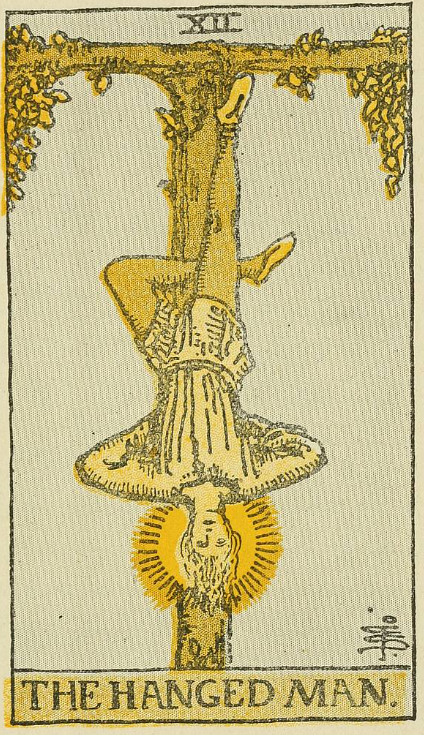
For prophesy to be useful to the Left we must suspend ourselves like Odin and the Hanged Man and even then the strongest prophesy we could hope to gain is the ever-fluctuating topography of Muad’dib – no true future-remembrance. But Muad’dib’s visions, even in their mutability, foreclosed upon the future and doomed him to watch his beloved die. Even a contingent prophesy is an order-word that is subordinate to the direct and ecstatic apprehension of meaning and that seals the fate of the subject of prophesy. If we allow the hyper-legible text lists of AI to serve us as an oracle we will be faced with the hollow Kantian prophesies of Hari Seldon but doom lives even in using a mystical mode of prophesy like that of Muad-Dib. For all that his future was a contingent one, an ever-shifting fabric of transforming possibility, his visions doomed him to watch his true love die and to wander the desert, a blind and raving ascetic. Instead we should focus our sights on a true and full apprehension of immediate material conditions. In this immediacy AI is revealed not as a prophet but simply as another weapon in the unending cycle of primitive accumulation. Instead of building utopia in a preordained future we must discover it here and now in the immediacy of falling rain and in the movement of a body of troops around a camp. The future is always spontaneously erupting. We can access a transformed future by setting it free of the chains of prophesy.

Magic and Lawlessness

Do what thou wilt shall be  the whole of the law.

I have an almost irrational distaste for “hard” magic systems in literature. This is not because of any particular aversion to stories getting metaphysical. I have absolutely no problem there but it is instead because I think attempts to systematize magic have a tendency to strip the magic out of it. There is a famous quote from Arthur C. Clarke that “any sufficiently advanced technology will be indistinguishable from magic.” It’s one of Clarke’s three laws. We will return to the other two. But I would propose that this construction, taken absent Clarke’s other two laws, has led to many attempts by fantasy authors to make magic into nothing but another technology. This is a bad thing that should be discouraged.

However to demonstrate both the problematic created by attempts to make a technology of magic and also why this is ultimately a bad endeavor for literature, surely, and also for metaphysics, it will be necessary for us to define some terms and the first of those is technology.

Skolnikoff echoes Harvey Brooks in describing technology as, “knowledge of how to fulfill certain human purposes in a specifiable and reproducible way,” and while he admits this definition lacks a certain level of precision it does capture the key issue with technology that need addressing:

  1. Technology fulfills specific human purposes
  2. Technology is specifiable and reproducible

These are the qualities that systematization imparts to magic that makes it like a technology.

Now, of course, we can see something of this vulgar materialism in the works of Jim Butcher, whose wizards frequently manipulate physics such as moving heat to create fire in one place and ice in another or to draw an object out of a stable orbit. In these cases wizardry, as a form of scholasticism, is very much a tool of executing a specific human purpose. The wizard has an objective – such as freezing a body of water – and an understanding of the forces required to cause a body of water to freeze. The heat within the water is taken up by the wizard who, acting as a conduit for this force, shunts it to his focus which disperses the captured heat as fire. This technological magic is specific and it is reproducible. A wizard, faced with a problem and a situation, will be able to derive the necessary technique in order to execute a task in a replicable manner. But where is the magic here? It’s all mathematics and physics equations. For all that Butcher might ground the magic of his wizards in a kind of materialist interpretation of the world as an interlocking system of energetic forces which can be manipulated, it’s all quite static. A magical feat, once undertaken, can always be accomplished again.

Frankly there’s a human project in these systems of magic. But should magic be bound in these standard, repeatable, goal-oriented systems? What about the magic of a shaft of sunlight piercing a forest canopy? What about the magic of the random fall of blood on a stone? Why must we exorcise the ineffable from magic?

I am proposing, as a counter to these project-derived visions of magic, one guided far more by inner experience which, as Bataille suggests, “cannot have any other concern nor other goal than itself.” I propose this, in part, because there’s no need for a technology called magic. As Clarke points out any sufficiently mystifying technology will serve just as well. The very use of his half-assed vulgar materialism is precisely the same thing that makes Butcher’s magic indistinguishable from a sufficiently obscured technology. However if we abandon a materialist metaphysics we run into other problems. Plato’s realm of ideal forms is destructive to the idea of change. For Plato all learning was just a remembrance as the ideal form of any given object always already existed. For anything truly new to be possible we need a materialist metaphysics. And so this leaves us at an impasse. Must we have our literature either abandon change or abandon magic? Of course this is where Bataille is useful for resolving this paradox. We simply must posit magic as being outside the boundary of project. Magic is indifferent to project, it is not a replicable system of knowledge that fulfills human purposes. It’s something else, something ineffable.

Magic is the creation of the new.

Speaking of magic within literature we are operating within an ontological mode. Magic exists in the experience of the text. Moving beyond a text magic exists in the immediate experience of the world. We become aware of magic when something new arises that was not there before. But Sartre quite rightly points out that, “every theory of knowledge… presupposes a metaphysics” if we treat the experience of magic as an awareness of the new then that must, in turn, be grounded in a metaphysics that allows new things to exist. As such let us discuss Sartre’s dialectic of being and nothingness not as his ontology but as the underlying metaphysical suppositions it makes.

For Sartre nothingness arises in the awareness of absence. “My friend is not here.” The absence of the friend is indicative of the nothingness within him. Now Sartre was quite careful to keep his nothing and his being entirely ontological – nothingness for Sartre isn’t a metaphysical void so much as a negation within awareness.

However there is a metaphysical requirement for being to arise from nothingness and that requirement is time. Simply put for being to arise there must be time within which it arises; change can only occur within a temporal field. How then do we handle the in-between moments when something is neither fully absent nor fully present – how do we handle the statement “my friend is not here yet?”

This is the domain of becoming. And becoming is where the magic lives. The systematic approach to magic supported by Butcher as described earlier doesn’t work well with becoming because it assumes magic to simply be the will of the magic-user. Tool-like the magic in his books has a specific teleology. It’s a tool a character uses to advance the action of the story. But while this tool-magic is in motion, while it advances the story, it isn’t fertile. It doesn’t make anything. Because becoming sits as a third term between being and nothingness it occupies a position of partially fulfilled potential. Effectively anything that exists at null-intensity has infinite potential for becoming. A non-thing might become anything. As nothingness enters into time it must begin to take form and this is becoming – the process of the foreclosure of potential into actuality. We can see an example of this in the work of Douglas Adams.

“Please do not be alarmed,” it said, “by anything you see or hear around you. You are bound to feel some initial ill effects as you have been rescued from certain death at an improbability level of two to the power of two hundred and seventy-­six thousand to one against possibly much higher. We are now cruising at a level of two to the power of twenty-­‐five thousand to one against and falling, and we will be restoring normality just as soon as we are sure what is normal anyway.”

Douglas Adams – Hitchiker’s Guide to the Galaxy.

The Infinite Improbability Drive enumerates the likelihood that any given event will occur in an infinite universe and then sees to it that any given improbable event is reified at its point of likelihood. “There’s an infinite number of monkeys outside who want to talk to us about this script for Hamlet they’ve worked out.” But this works quite well for the idea of the collapse of potential into being. Through the process of becoming the possibility of unlikely rescues and Hamlet writing monkeys are either brought into being or are discarded as normalcy, an end to magical time, begins.

And this points to Clarke’s much less often cited second law: “The only way of discovering the limits of the possible is to venture a little way past them into the impossible.”

But perhaps we’ve beat around the bush enough. It’s time to interrogate Brandon Sanderson’s, “laws of magic.” These are:

  1. An author’s ability to solve conflict with magic is directly proportional to how well the reader understands said magic.
  2. Limitations > power
  3. Expand on what you have already, before you add something new.

Sanderson has a “zeroth law” as well, “Err on the side of awesome.” Apparently “awesome” in this case is to be considered in the colloquial sense but I would honestly agree with it provided we use the formal definition of awesome as being that which provokes the sensation of awe.

Now to address Sanderson’s first law I’d say this depends on a functionalist, plot-centric read of magic. Magic is never the most expedient method of resolving plot. Sanderson seems aware of that but seems unable to look up past plot for how else one might want to use magic. As such he spends an entire law writing apologia for using magic the wrong way.

But if magic is not best used to serve the advancement of the plot what is it for? Magic allows us to directly visualize the impossible. This is critical to the communication of two functions within fiction: psychology and metaphysics. In discourses around psychology the ability to visualize the impossible is valuable for the construction and communication of a limit experience. Bataille argued that philosophy was restricted by the limit of knowledge as a goal. He believed it was necessary for philosophy to break this limit and he believed an inner experience would be the method of doing so. Returning to Sartre (and a careful reader will note that these two authors are marked by their very different interpretations of Heidegger – make of my synthesis what you will) we can recall that Sartre wanted to propose a non-intellectual being within itself. But his is a relatively sterile and analytic approach to this question: what is self when it isn’t reflective? Bataille wanted to explain how it felt to be a self that wasn’t reflective. Sartre found in appearance the truth of the absence of essence. The essential character of a perceived object, including the self as a perceived object, is its series of appearances. Bataille responds, “One must grasp the meaning from the inside.”

But doing this: identifying the core of a character without resorting to self-reflection and its infinitely regressing hall of mirrors is no easy feat and it isn’t one that can easily be approached from without. In order to communicate this to an audience you need something that engenders a purely affective, purely intensive response. Consider the following,

“The old man… sprang to his feet and leaped to the top of a large rock. There he stood… towering above them. His hood and his grey rags were flung away. His white garments shone. He lifted up his staff, and Gimli’s axe leaped from his grasp and fell ringing on the ground. The sword of Aragorn, stiff in his motionless hand, blazed with a sudden fire. Legolas gave a great shout and shot an arrow high into the air: it vanished in a flash of flame.”

JRR Tolkien – The Lord of the Rings: The Two Towers

From a plot perspective there is nothing in this scene that requires magic. All that needs to happen is that the three hunters need to meet an old friend and discover he’s different than he was before. And yet Tolkien goes to great length to show us something of Gandalf’s magic and, in doing so, to tell us something about how he has changed within.

The old Mithrandir would not have burned Legolas’ arrows to ash, he would not have ripped Gimli’s axe from his hands nor set alight Andruil. We don’t have any insight into how Gandalf accomplished this feat nor was it necessary to solve the conflict. Gandalf could have solved it in a word by saying “yo Aragorn, it’s ya boi,” but we have magic anyway. And it is, in fact, awesome. We see an experience of awe as these three eminently capable heroes are rendered useless before Gandalf. Their weapons cannot avail them because of the holy fire that suffuses the revived wizard. Gandalf has changed, he has become different to himself, and this ontological and psychological transformation is why we have magic here. The magic doesn’t serve story-conflict. It doesn’t serve plot. It serves character.

Another example of magic serving character is basically the entirety of A Wizard of Earthsea. Now considering how we are dallying with Heidegger in this question it might not be surprising that I bring up my favourite left-Heideggerian piece of theory-fiction. I have spoken at length about this book as a phenomenological exploration of being-toward-death. In my essay on A Wizard of Earthsea I concluded by describing Ged as the wellspring of power that rises out of the primordial origin of all things and the Gebbeth as the un-doer, the ender, the void into which all things fall. But in his unification at the resolution of the story, “Light and darkness met, and joined and were one.” In this case the whole book about wizardry and magic is nothing but a method of understanding who Ged is, what a life is, and what it is to live in the world. The flow of creation and destruction resides with becoming as a time-bound process of what is not to what is. Magic, in this work of literature, allows us to break into the impossibility of gebbeth ghost-shadows in order to probe the boundaries of a life to explore the limits and to cross the low-stone wall.

LeGuin does provide a whisper of systematics to magic in the deep discourse on the question of the name as a way of dividing being into discrete objects but this isn’t a system of spells at all. There’s no mechanic for the strength of the Gebbeth, it just gets weaker the more willing Ged is to take it into himself, to annihilate that name-driven division.

There is another reason for magic though and that is for a text to communicate something close enough to the limit of intelligibility to require us to push into the impossible to map the bounds of the possible. Fiction often serves metaphysical aims and this is a place where magic can be a critical exploratory tool. Consider the following from Legend of the Condor Heroes by Jin Yong.

The zheng was known for its melancholic twang, and this variety from the Western Regions was particularly mournful. Guo Jing had no ear for music, yet he noticed that each time a string rattled, his heart pulsed. As Viper Ouyang played faster his heart throbbed along uncomfortably, as if it were about to burst out of his chest.

Realizing he could die if the tempo increased further, he sat down to gather his spirit and still his thoughts in the Quanzhen way. As he channeled his internal energy around his body, his heartbeat slowed and soon he found he was no longer ensnared by the music.

Jin Yong – Legend of the Condor Heroes – A Bond Undone

Jin Yong goes on for several pages describing how the music of Ouyang Feng and Huang Yaoshi is used as a weapon by which they can pit their internal strength. But by making the fight so abstract he’s in turn able to discuss the ideas that Sunzi would call node and shih – or what we might call flow and event. “From hollowness, luminosity grows,” Guo Jing considers. We could consider how close this is to saying that being arises from nothingness. But regardless of the specifics of how this dialectic of void and object is described what we have is a section of text that simultaneously describes a magical duel played between martial masters and that goes into the Taoist metaphysics that underpins both Guo Jing as a character and the world in which the story occurs. This doesn’t do anything for the story really. It serves as an overture between two more plot-significant incidents. And no conflict is resolved. The musical duel ends in a draw. But the magic is incredibly valuable to the story as it communicates an idea about how our world functions.

Ultimately Sanderson’s first law of magic isn’t even wrong. It’s not even asking the right question.

His second law of magic might almost be useful if I were confident he understood what he was implying with it. Specifically, as I’ve mentioned previously through my exploration of Clarke’s second law the use of magic in a work of fiction should ultimately be entirely in service to the exploration of the limits – limits of speech, limits of experience, limits of knowledge – but I doubt this is what he means. Mr. Sanderson is so monomaniacally focused on plot-utility with his laws I’m sure what he means to say is that magic itself should be limited, should not be able to do too much. Whereas I champion an idea of magic as the wellspring of all that is, that vehicle that brings objects back over the limit of nothingness and into being.

But there’s another way that we should treat magic as limited – or rather we should treat the magician as limited. The wizard, as a figure of knowledge, is not a king. He may council the king. He may instruct the king. But he isn’t a ruler. To grasp magic, to truly understand it, requires an understanding of the limits of how one should act with it. Consider Ogion in A Wizard of Earthsea,

Three days went by and four days went by and still Ogion had not spoken a single charm in Ged’s hearing, and had not taught him a single name or rune or spell.
Though a very silent man he was so mild and calm that Ged soon lost his awe of him, and in a day or two more he was bold enough to ask his master, “When will my apprenticeship begin, Sir?”
“It has begun,” said Ogion.
There was a silence, as if Ged was keeping back something he had to say. Then he said it: “But I haven’t learned anything yet!”
“Because you haven’t found out what I am teaching,” replied the mage, going on at his steady, long-legged pace along their road, which was the high pass between Ovark and Wiss.

Ursula K. LeGuin – A wizard of Earthsea

Ogion is perhaps the clearest exemplar of the figure of the wizard in fiction. LeGuin introduces the Taoist concept of wuwei into the body of the wise teacher exemplified by Gandalf and T. H. White’s Merlyn and this helps to drive home how the form of knowledge that wizardry represents acts to limit the deeds of the wizard directly.

Fourfoil, they call it.” Ogion had halted, the coppershod foot of his staff near the little weed, so Ged looked closely at the plant, and plucked a dry seedpod from it, and finally asked, since Ogion said nothing more, “What is its use, Master?”
“None I know of.”

“When you know the fourfoil in all its seasons root and leaf and flower, by sight and scent and seed, then you may learn its true name, knowing its being: which is more than its use. What, after all, is the use of you? or of myself? Is Gont Mountain useful, or the Open Sea?” Ogion went on a half mile or so, and said at last, “To hear, one must be silent.”

Ursula K. LeGuin – A Wizard of Earthsea

Ogion positions himself and, transitively, wizardry, beyond the question of utility and of human project. Wizardry is silence. Magic is to know and not to speak. “when it rained Ogion would not even say the spell that every weatherworker knows, to send the storm aside” Ultimately LeGuin shows that this wisdom, the perfect limit of a Wizard, is one they all come to know when the Summoner says to Ged,

“You thought, as a boy, that a mage is one who can do anything. So I thought, once. So did we all. And the truth is that as a man’s real power grows and his knowledge widens, ever the way he can follow grows narrower: until at last he chooses nothing, but does only and wholly what he must.”

Ursula K. LeGuin – A Wizard of Earthsea

Of course LeGuin’s Taoist wizards are not the only ones who limit themselves such. Consider Merlyn,

“I cannot do any magic for Kay,” he said slowly, “except my own magic that I have anyway. Backsight and insight and all that. Do you mean anything I could do with that?”

“What does your backsight do?”

“It tells me what you would say is going to happen, and the insight sometimes says what is or was happening in other places.”

T. H. White – The Once and Future King

Again we have a wizard who has capacity for great magic. And again he refuses to freely-use his power not because of a metaphysical limit of his ability to cast a spell but because his knowledge makes it clear that he should not.

And, of course, the whole purpose of the Istari in the Lord of the Rings was not to confront Sauron’s power directly but rather to provide knowledge, succor and diplomacy. The powers of the Istari are never particularly codified. We know they live long lives. We know they are not easily killed. They wield powerful artifacts such as Gandalf’s ring or Saruman’s Palantir. But the magic that suffuses them is all luminance and splendor, not systematics. Gandalf’s magic isn’t a tool for accomplishing a project; it’s his being itself.

And so, in this, we almost agree. A magician, as a character, should be limited. To grasp magic is to hold the knowledge that magic is not a tool. To try and seize and use it for project leads to the Gebbeth and Ged’s failings. There can be no wizard-kings. But is this the limit that Sanderson meant? I honestly doubt it. Let’s examine Sanderson’s argument regarding limits:

 What makes Superman interesting, then? Two things: his code of ethics and his weakness to kryptonite.

Think about it for a moment. Why can Superman fly? Well, because that’s what he does. Why is he strong? Comic book aficionados might go into him drawing power from the sun, but in the end, we don’t really care why he’s strong. He just is.

But why is he weak to kryptonite? If you ask the common person with some familiarity with Superman, they’ll tell you it’s because kryptonite–this glowing green rock–is a shard from his homeworld, which was destroyed. The kryptonite draws you into the story, gets into who Superman is and where he comes from. Likewise, if you ask about his code of ethics–what he won’t do, rather than what he can do–we’ll go into talking about his family, how he was raised. We’ll talk about how Ma and Pa Kent instilled solid values into their adopted son, and how they taught him to use his strength not to kill, but to protect.

Superman is not his powers. Superman is his weaknesses.

Brandon Sanderson – Sanderson’s second law.

Now let us start by interrogating the idea that a code of ethics constitutes a weakness. This is somewhat alarming rhetoric being honest. I would contend that the idea of Superman as an ethical being is, in fact, a much more significant reserve of strength than his bullet-proof skin. The treatment of the green rock macguffin as if it says something profound about the character is plot-driven story rhetoric in all its glory.

Mr. Sanderson proceeds to, again, mistake restraint for weakness when he says, “The {LotR} films, it should be noted, played this concept up much more than the books did, as the director realized Aragorn became far more interesting when he was reluctant to become king. His weakness gave him much more depth than his abilities.” This is not a weakness. Self-restraint, self-doubt and morality are not weaknesses imposed on characters to make the plot more exciting. They’re opportunities to interrogate the world.

When Mr. Sanderson digs into advice for authors the plot centrism rears its head in full again. He describes the systematics underlying the tedious magic of Wheel of Time, a series of books he wrote the concluding volumes of, and focuses entirely on the weaving metaphor as representing a structural weakness that limits characters actions within magic. He is trying to cut magic down to size, to make it into a function that achieves a goal.

While discussing Mr. Sanderson’s first law I repeatedly argued that this misses why magic is used in literature. There will always be a more parsimonious method to drive plot forward than magic. Why bother with a fireball when you can bash the other guy’s brains in with a rock? If magic isn’t probing the limits of the inexpressible why are we even bothering with it? Magic in Lord of the Rings represents the interplay of spirit and matter as set forth by the song of Eru and Morgoth’s Ring. Magic in A Wizard of Earthsea is a reflection of Ged’s own being toward death. Magic in Legend of the Condor Heroes is an opportunity to expound on flow and event, on the dynamic interplay of yin and yang. In all these cases the magic doesn’t exist to move the action along but to interrogate something that would be difficult to access otherwise. I mean have you tried to just read Being and Time? Or the Daodejing? Magic gives us a vehicle to make these very abstract discourses concerning ontology and metaphysics into something which can be interrogated even by a child. Limits. The reason why wizards are limited, why the Summoner tells Ged a wizard does only and wholly what he must, why Merlyn refuses to cast spells for Wart’s friend and why Gandalf doesn’t raze the gates of Mordor and cast down Barad Dur with his own hands is because magic cannot be limited. It is the inexhaustible wellspring. And to try and command that, to use it as a tool, is akin to trying to draw down the sun to warm your house. To try and command magic is to be consumed. This is the wisdom that limits the wizard.

Sanderson’s third law is the most tedious of the bunch. “Expand what you already have before you add something new,” he says and, frankly what can I say beyond that this is the very antithesis of magic. Earlier I described Magic as being best a representation of becoming – magic is the bringing forth of nothingness into being. In this I’d gladly cite the historical use of alchemy to create long life, gold or simply to create the capacity for creation. And, of course, alchemists failed in part because their knowledge of the things they were trying to create was incomplete and flawed and in part because they’d failed to learn the Summoner’s commandment, “do only and wholly what you must.” This statement is not, however absent from the teachings of historical magi. For instance there is Crowley’s famous proclamation, “Do what thou wilt shall be the whole of the law.”

The Book of the Law continues, “pure will, unassuaged of purpose, delivered from the lust of result, is every way perfect.” And this begins to hint at what Crowley means by will. Because Crowley’s pure will is “delivered from the lust of result” – the mage does not seek project. Rather Pure Will is what Nietzsche would describe as Amor Fati.

I want to learn more and more to see as beautiful what is necessary in things; then I shall be one of those who make things beautiful. Amor fati: let that be my love henceforth! I do not want to wage war against what is ugly. I do not want to accuse; I do not even want to accuse those who accuse. Looking away shall be my only negation. And all in all and on the whole: some day I wish to be only a Yes-sayer.

Fredrich Nietzsche – The Gay Science

Pure will represents an aesthetic and ethical acceptance of what one only and wholly must do. In the face of the limitless font of all being there is no wisdom but wuwei. Zhuangzi says “the noble master who finds he has to follow some course to govern the world will realize that actionless action (wuwei) is the best course. By no-action, he can rest in the real substance of his nature and destiny.”

For Zhuangzi the world is far too vast for any person to command – to attempt to command it is to throw it into disarray. Only through this letting go, this retreat, can one grasp what one must do. There is an arrogance to the belief that a person can narrow magic and shape it into a human project. This arrogance caused alchemists to chase dreams of gold or to drink mercury and cinnabar, poisoning themselves out of a desire for eternal life. Do what thou wilt shall be the whole of the law. As magic is becoming, is the very process by which the new arises, it’s laughable to instruct authors to pare it back, to build a logical system.

Sanderson has a “zeroth” law. He enumerated it thusly to match Asimov’s laws of robotics. This is laughable as the laws of robotics were diegetic laws – not advice to writers. But it’s the best of the bunch so I do want to give it mention despite its silly allusion to classic SF. “Err on the side of awesome.” On this we agree in a way. When I described the value of magic in literature as being purely affective, pure intensity, I was gesturing in the direction of awe. Awe is equal parts beauty and terror. There is awe in the scene of Gandalf’s meeting with the three hunters. There is awe in Guo Jing listening to the musical duel. But awe is an ecstatic sensation. It’s what Bataille would call a limit experience. Awe, in fiction, should grip the reader like the hooks and chains of a cenobite. It should leave the reader exposed and discomforted. Awe is not an experience bound by law. The colloquial use of “awesome” to mean “agreeable,” or “enjoyable” is a failure of understanding of the magic not written into a story but working upon the reader through engagement with the story. A writer provokes awe not by putting magic into the story but by making magic of the story.

Magic is not cybernetic. It must be taken whole: like the sun in a forest, like blood on a stone. It doesn’t need to be limited if it is used correctly. There’s no point to building a gun that is fueled by willpower points rather than bullets. That isn’t what magic is for in fiction. Magic makes the invisible visible. It makes the impossible possible. It makes nothingness into being. There is no law here that governs magic; the only law is that which governs the mage: wuwei, amor fati, pure will. And so my advice to writers is to abandon all laws. Do what thou wilt shall be the whole of the law. Find the magic in your work, the real magic, not the technology of pyrotechnics and telekinesis. And surrender to it.