Fame and Death: a review of MaXXXine

MaXXXine (2024), the capstone installment in Ti West‘s X trilogy, took me somewhat by surprise. Considering the ground tread in the prior films, X and Pearl, I expected, going into the film, something that might tread similar ground to Scream 3. This was very much not the case.

Instead, MaXXXine delivers a thematically messy conclusion to a thematically messy trilogy which largely serves as a vehicle for demonstrating the talent of Mia Goth and for showing off the variety of movies that West, personally likes to watch.

Maxine, having escaped from the clutches of Pearl and Howard at the conclusion of X has built a career for herself in Los Angeles as a porn star. But the hard-working and celebrity obsessed Maxine has her sights set higher than a career in dirty pictures and peep shows, telling horror director Elizabeth Bender, that women in pornography “age like bread, not wine.” Now approaching her mid-thirties Maxine needs an off-ramp and she believes horror cinema is her ticket.

Bender sees an intensity in Maxine’s audition that she believes belies talent and casts her, over the objection of the studio which is already facing protests for the film – “The Puritan 2” – a sequel to a previous breakout satanic possession movie which transports the action to the 1950s. Bender, for her part, wants to strip the veneer from the 50s and demonstrate the rot at the core of America’s mythologized decade of innocence.

Two complications interfere with Maxine’s plans for an ascent to stardom: the first is the unwanted attention of a slimy private detective John Labat, played with an amusing level of scenery chewing by Kevin Bacon, who has discovered her involvement in the murders in Texas years previous. The second is the omnipresent shadow of real-life serial killer Richard Ramirez, the Night Stalker. When Maxine’s friends and colleagues begin turning up dead, brutalized and branded with the mark of the pentagram, police investigating the Night Stalker believe they have a copycat on their hands – and believe Maxine has information that can lead them to this killer.

With as much drawn from the oeuvre of James Ellroy and Raymond Chandler and from the style of Mario Bava as from more conventional iterations of the slasher, Ti West continues trying to demonstrate his artistic chops throughout the film. “I’m an artist,” Elizabeth Bender says. “This isn’t just a video nasty,” she says of film-within-the-film The Puritan 2. She insists she has a message to communicate. But, despite turning out an entertaining story with some beautiful aesthetics Ti West struggles to communicate a coherent message. He hints again at the idea of doubling in this story as the copycat killer is doubled against the Night Stalker, but ultimately struggles to resolve the original doubling from X. We’re left wondering what exactly is being communicated with how the story compares Maxine to Pearl.

Pearl is a yawning absence at the center of this film because, of course, Pearl never got to Hollywood. But Maxine starts off in Hollywood and, despite John Labat’s bluster and the unwanted attention of both police and a serial killer the one thing that never really seems threatened throughout the movie is her notoriety. Maxine’s fame is assured. The only question that seems unanswered until the resolution is whether she’ll be a famous star or a famous victim.

The film opens with the Bette Davis quote, “In this business, until you’re known as a monster you’re not a star,” and Elizabeth Bender almost explicitly incites Maxine to vigilante violence, first comparing her horror protagonist to Dirty Harry or Paul Kersey and then telling Maxine to take a weekend to resolve whatever personal issues might be interfering with the production schedule. But, despite a capacity for violence, Maxine’s antagonists are so openly monstrous that it’s hard to see her actions as rising above the level of many protagonists of the slasher and rape-revenge genres. By the time she dispatches Labat he’s already blackmailed her, followed her with a camera at the behest of an employer we know to be the killer and chased her about the Bates Motel set with a revolver, explicitly threatening her life. He’s pursued her into the bathroom of a dance club and claimed to be a criminal while, again, waving a gun. Other targets of Maxine’s violence include a Buster Keaton impersonator who follows her down an alley with a switchblade and, of course, the killer and his cultists. Frankly there’s only two moments in the film where her actions rise above the most unambiguous examples of explicit self-defense. With this in mind Maxine’s actions don’t feel like a person giving into monstrosity in order to achieve stardom. They feel like a woman pushed to the edge by a host of monsters assailing her from all sides.
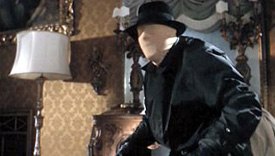
The killer from Blood and Black Lace

I do think a psychoanalytic read of MaXXXine is stronger and here is where comparisons to gialli become relevant. Frankly Ti West begs the comparisons by dressing his killer, until the final act, in a near carbon-copy of the costume of the killer in Blood and Black Lace. But for all that the film uses POV shots from the black-gloved killer and red filters over the set lamps to invoke the aesthetic of the giallo it misses the significance of the mystery aspect.

I think there was an attempt to make this movie into a mystery or detective film of a sort. The killer is, through the first two acts, a mute pair of hands or a shadow in a corner. His rage at seeing Maxine in a peep show is palpable but the reason remains opaque in the moment. But this is a problem because there really isn’t any mystery in this film. The victims, excepting one, all tell Maxine where they’re going before they disappear and Labat literally hand-delivers Maxine an invitation. The identity of the killer is telegraphed in the literal first frame of the movie and the eventual reveal carries entirely no shock as a result. With the killer kept silent for so much of the movie there are many missed opportunities to establish what Maxine is actually fighting against, what ideology she opposes to juxtapose against the mentorship off Elizabeth Bender. But, perhaps, it’s sufficient to signal that, as many woman-fronted Giallo films were deliberately seeking psycho-sexual reads, that we should interpret this film such too. Maybe that’s all West wanted to signal to the audience with these indicators.

But this returns us to the problem of how we are supposed to parse the doubling of Maxine and Pearl. Certainly Pearl is a psychosexual thriller far more than a conventional slasher. Mia Goth’s portrayal of the dust-bowl era farm girl striving for fame and sexual self-determination and instead finding violence and death was deeply internal in its focus and her moment of pained realization at the end that she had trapped herself in a life of domesticity with Howard was one of the best final frames in horror cinema. But sex, for Maxine, is just work. When the casting directors ask her to show her breasts she does so with business-like neutrality. Her work in porn is coming to a conclusion not because of any issues with sex so much as a concern that she has a limited duration career in a business that prioritizes youth. She desperately wants to be famous. But, again, her fame, as such, is never in peril, only the tenor of it.

Mia Goth does an excellent job. Maxine feels like a fully realized character both in her quiet moments watching movies with her video-store-clerk best friend Leon, in her coke-fueled moments of frenzied work and in her carefully plotted trap for Labat. Her moments of vulnerability at Bates Motel and during the head cast scene communicate the depths of the character well. But Mia Goth is a very talented performer and her doing a good job bringing full life to a character is kind of what I would just expect from her. The film wants to tell us that the unresolved core conflict in Maxine’s psyche is oedipal. She was set up to desire fame by her father, a televangelist cum cult-leader, who saw her as the future leadership of the church until she set him aside. This would tend to suggest a straightforward Freudian read that, by blasting her cult-leading, serial-murdering, moral-majority doomsday preacher of a father’s head off with a shotgun, she has resolved her Oedipus complex and is able to resolve herself as an individual. Except, of course, Pearl, our failed would-be star, also killed her father and still ended up trapped in a life of obscurity.

Maxine seems to accredit her success to hard work, and certainly she does work hard. In fact it often seems like her rampant cocaine usage is principally so that she can power through three jobs at once while also being stalked by a killer and his pet detective. But it doesn’t really seem like the other victims across this trilogy lacked her effort or her ambition. Lorraine, in X, had plenty of ambition and seemed perfectly willing to work hard. Maxine survived and she did not mostly due to dumb luck.

The series occasionally dallies with the idea that stardom depends on a nebulous and impossible to define x-factor but never commits to the theme sufficiently to drive this message home.

The film, and in fact the whole series, is also quite ambivalent on the moral character of art and exploitation. It’s honestly kind of odd to see a movie so intimately possessed with the idea of gaze that doesn’t really have anything at all coherent to say about it.

The movie is critical of religion, certainly, this has been consistent throughout the trilogy, which always codes its antagonists as hardcore Christians. But, despite a deathbed conversion, Labat is an avowed atheist while Maxine seems unwilling to say much about religion one way or the other. The third-act revelation that the supposedly satanic killings were being conducted by a Christian sect that wanted to rescue its collective daughters from the satanic influence of Hollywood was well foreshadowed by scenes of Christian morality protesters at the studio gates and a grumbling speech from Bender about studio fears around censorship and the opinions of moral crusaders. But leaving the killer so completely off-screen for the first two acts as this film did undercuts this message. We never really hear from him at all until he’s in his “revealing my whole plan” monologue period. This is somewhere where West could have taken a lesson from Wes Craven whose killers never shut up and, as a result, are able to elucidate what motivates them thematically before they reveal the mechanics of their plot.

All in all what we get with this trilogy of films, and with its final installment in specific, is a thematic mess that fails to commit to a theme. Instead we get three or four half-baked themes. However I still really liked the movie. It’s very funny. There were several laugh-out-loud moments across the film and none of the obvious jokes failed to land. Giancarlo Esposito (who plays Maxine’s agent) and Kevin Bacon both steal their respective scenes largely on the strength of their comedic timing. It’s also a beautiful film, with strong cinematography, makeup and lighting throughout. The script works well on a scene-to-scene level and the characterization is consistently strong. I enjoyed spending time with these characters. The kills were somewhat perfunctory but this movie is not exactly a slasher film so I can live with that. And the practical effects were well done throughout.

I think MaXXXine is, ultimately, a perfectly appropriate capstone for the X trilogy. It is a showcase for the talent of very well cast actors who are clearly bringing their a-games and it is a clearinghouse for the various cinematic influences Ti West seems to love. The sense of people doing a thing they like doing with technical virtuosity pervades both this movie and the trilogy as a whole. If West can learn to commit to a theme and explore it with a bit more care in the future he can probably become a great director. Until then he’s doing particularly well-performed mashups of horror’s greatest hits. But it is, at least, a very entertaining ride.

The Terror of Psychosexual Development under Patriarchy: A review of Poor Things

I don’t know how to start this review. There’s a challenge to introducing a thing so singularly odd as the 2023 film Poor Things. This movie, directed by the esteemed Greek director Yorgos Lanthimos, with cinematography by Robbie Ryan (who previously worked with Lanthimos on The Favourite), costume design by Holly Waddington and with art direction by Géza Kerti is a visual feast. With a setting in an alternate 1888 (estimated on state of Eiffel tower construction) in which Europe is bedecked in a baroque style reminiscent of the steampunk aesthetic at its best, the film balances on a line between German Expressionism and the French Fantastique in style. It’s as if the dream-like intrusion of the unnatural in Fantastique has forced its way into an Expressionist stage play.

The sets and costumes eschew realism; Bela’s dresses, in particular, are cloud-like confections of knit wool and silk while, for all the characters, there is a kind of heightened reality of late 19th century styles on display.

Continuing with expressionist elements we must address the performances. This will likely be a career-defining performance for Emma Stone; it has certainly been one of her most controversial both for the extensive position of sex in her performance and also for the questions regarding the realism of her “toddler” scenes.

I think those people who have criticized Stone for these earlier parts of the performance have missed that literally nobody in the film is trying for realism – these are expressionist performances top to bottom. I was, honestly, shocked by how effectively Mark Ruffalo chewed the scenery in his performance as the cad Duncan Wedderburn. He delivers the best performance of a weird little creep of a man I’ve seen since Brad Dourif stepped into the role of Grima Wormtongue. Taken together with Willem Dafoe in the same fine form as we might recall from his performance in The Lighthouse and even smaller roles like Kathryn Hunter as Swiney and we see a picture of a film where any sort of “realism” or verisimilitude in performance was hardly the point to begin with.

And honestly should we expect realism from the performance of an infant mind suddenly thrust into the body of an adult woman in the first place? All in all, Stone’s remarkable performance in this film has me curious to see The Favourite which she was also in.

But, continuing with influences, I do believe that this film has been mis-categorized as a sci-fi comedy or a comedy-drama by a lot of reviewers. I think, rather, it should be treated as a horror comedy. Now I should note that Ashley Darrow and Jonathan Greenaway of Horror Vanguard fame have talked a lot about the proximity of comedy and horror. Both are modes of cinema that aspire to do something to the body of the audience. So we can treat as a given that there is slippage between comedy and horror most of the time.

However, looking at this from a cinematographic perspective, I couldn’t help but note how the shot selection, with its preference for low-angle photography, fish-eye lenses and a pinhole camera effect, reflected a horror-cinema specific visual construction. There is a kind of embodied voyeurism to the camera that suggests not only somebody looking in on the action but, specifically, somebody looking in who should not be. Think Black Christmas. We are constantly treated to a perspective extremity – the camera shows us too much or too little. Contemporary Hollywood often pursues a kind of full-coverage sufficiency where the audience is asked to forget that there is a camera mediating the experience of the film. This is not the case here and it works to excellent, if occasionally alienating, effect. This contributes to the pervasive sense of discomfort that marks this film. I’ve said before that horror is the art of discomfort. If so then we have to recognize the horror present in Poor Things. Now this would not be Ryan’s first attempt at horror if we treat it that way, he previously worked on Isolation and I Am Not a Serial Killer while Lanthimos has previously worked in the genre via The Killing of a Sacred Deer so it’s not an absurd proposition that this team would work within a horror mode. But situating this film as a horror film still might challenge how it’s been received by much of the film press.

Additional evidence exists in the form of Ryan’s comments regarding key cinematographic referents. Because, according to Ryan, the most significant film that influenced the lighting and shot selection of Poor Things was Bram Stoker’s Dracula, which Lanthimos reportedly asked the crew to refer back to regularly throughout the production of the film. Shot like a horror film indeed. Considering the extent to which Poor Things serves as a callback to Frankenstein, in particular, it is also interesting that a Dracula movie, tied as it is to the same milieu of the 19th century British Gothic, would be selected.

Certainly expressionism has played an outsized influence in horror performance with stand-outs like the Evil Dead series and Mandy being particularly relevant. However horror, as a form of cinema, goes beyond shot selection, body reaction and an eschewing of verisimilitude in performance. But most horror contains something to be afraid of, generally a monster of either the literal or metaphorical varieties, and has something to say about fear or abjection.

This is also something very true about Poor Things.

Poor Things is, in fact, singularly fascinated with the figure of the monster. One of the first things we hear about Godwin Baxter is that he is a monster. Baxter, who presents as a cold and amoral man of science for most of the film’s runtime, is a grotesquerie. Covered in scars, Baxter was subjected to cruel medical experimentation by his father. Unable to produce his own gastric juices as a result of his father’s surgeries, Godwin must connect himself to a contraption in order to eat. a side-effect of this is that he loudly belches bubbles which drift about the room at mealtimes. Godwin’s amorality is very nearly secondary to his monstrosity as grotesquerie but this becomes something he seems sincerely proud of. Not only is he quite open about his gastronomic (and other) disabilities, cheerfully describing the circumstances that led to his disfigurement, but he also surrounds himself with grotesqueries: dogs with the grafted heads of geese, chickens with the grafted heads of dogs and other such chimera wander about his property. And then there are Bella and Felicity who are not grotesque in form but both of whom become grotesque via their behaviour.

This idea of the grotesque is also partially explored through Swiney – the heavily tattooed madam who occasionally becomes so overcome by her desire for youth and beauty that she will bite – literally trying to consume the beauty of others.

Bella will, eventually, also be called a monster, particularly by Duncan, because of his inability to control her and his unfounded belief that she is the author of his misfortune. A third figure of the monster arises via Alfie, an aristocrat and a military man so hated by the servants he casually abuses that he’s taken to carrying a revolver with him everywhere he goes, a man who drove his wife to suicide but cannot let go of her even in death, a grasping anti-moral being whose existence is marked entirely by his desire to subjugate, command and, ultimately, own other people.

This creates an interesting dichotomy surrounding what we consider monstrous: is the monster the grotesque? Is the monster the thing from outside that cannot be commanded or is the monster the thing from within that demands to command?

It’s interesting to note, however, that the monsters in Poor Things are not, generally, the source of terror in the film. Grotesque Dr. Baxter dies smiling, surrounded by people who care for him. He doesn’t stand in Bella’s way in any of her attempts to forge a sense of self and he is rewarded with her love in the end. Swiney, too, lets Bella go without a struggle and all the grotesques of Baxter’s home become either family or pets.

Duncan’s accusations of monstrosity toward Bella are almost immediately obvious as bad-faith. Duncan may believe, in some way, that Bella is the author of his misfortune but the film has established, ahead of time, that the man is entirely to blame for the things that befall him. He’s a lawyer who can’t spell, a drunk, a gambler and a scoundrel. For all his claims toward a rakish libertinism, he cannot tolerate the idea of a woman exercising the very freedom he starts by advocating and so we can add hypocrite to his plethora of character defects. He’s a small Wormtongue of a man. And by the time he calls Bella a monster the audience knows this all too well to be taken in.

We could possibly see Alfie as a source of terror if not for how readily Bella resolves him as a challenge. Alfie isn’t so much a source of terror for Bella as he is a final test of her commitment to self-development.

But this isn’t to say that there isn’t terror in the film. The terror, instead, comes from the question of individuation and how it ties into a very Freudian model of psychosexual development. Here is where the central conceit of Bella’s creation becomes useful, and how it plays games with the Frankensteinian notion of tabula rasa.

Because Bella is, of course, an infant mind implanted into the body of an adult woman. The conceit is that this specific mind (and with the very different development of Felicity it is clear that there is a clear specificity at play here) is developing toward adulthood at an accelerated rate. And throughout her development we see a clear progression of classical Freudian developmental stages at play.

Except for one very specific difference: Bella, throughout her development, insists upon her own agency. She forcefully asserts that she will be the author of every one of her decisions, the master of her ship, from her first stumbling steps to the moment she cuts out Alfie’s brain and replaces it with that of a goat. This leads to an interesting challenge to Freud here. Bella may experience the anal and phallic stages of development but she refuses to submit to Oedipus.

Deleuze and Guattari describe Oedipus and its impact on individuation, saying “With the same movement the Oedipus complex inserts desire into triangulation, and prohibits desire from satisfying itself with the terms of the triangulation. It forces desire to take as its object the differentiated parental persons, and, brandishing the threats of the undifferentiated, prohibits the correlative ego from satisfying its desires with these persons, in the name of the same requirements of differentiation.”

But Bella is, bluntly, her own mother. Her existence collapses the differentiation between differentiated global people such as “mother,” and “father” and the undifferentiated threat through the way in which she hacks at its basis.

She may call Dr. Baxter her father but she is not beholden to him. She leaves his side and he stands aside and lets her go. He attempts to arrange a marriage for her and she, instead, runs off with a rake so she can learn about the world. But this is not framed as a violation of parental law; instead it’s the great howling void of absolute freedom being embraced with gusto.

“Oedipus says to us: either you will internalize the differential functions that rule over the exclusive
disjunctions, and thereby “resolve” Oedipus, or you will fall into the neurotic night of imaginary identifications.” But Bella does neither. Instead she individuates. She forges an identity that is not Dr. Baxter nor is it a rejection of him. She does not fall into neurosis, far from it, she forges a fully structured and functional frame of being entirely on her own terms.

In fact, Bella’s development is almost messianic thanks to the second text that lurks in the background of Poor Things, adjacent Frankenstein: Siddhartha. In some sense this is tied to the very Buddhist realization of the nature of suffering that Bella experiences on the cruise ship. Her discovery of the slums and her subsequent renunciation of wealth fits cleanly into the Buddhist story of the Four Sights but, rather than becoming an ascetic following this renunciation, Bella becomes a prostitute. This fits closely together with Hess’ argument in Siddhartha, “I saw a man, Siddhartha thought, a single man, before whom I would have to lower my glance. I do not want to lower my glance before any other, not before any other.”

And, of course, this leads Bella to the heights of moral development: socialism. It’s delightful that Bella’s full development into adulthood happens in a Paris winter during which her girlfriend invites her to a Socialist reading group. There’s a wonderful balance present here wherein a rejection of ascetic renunciation of individuality gives way to an enlightened sense of the collective value of humanity.

““I know it,” said Siddhartha; his smile shone golden. “I know it, Govinda. And behold, with this we are right in the middle of the thicket of opinions, in the dispute about words. For I cannot deny, my words of love are in a contradiction, a seeming contradiction with Gotama’s words. For this very reason, I distrust in words so much, for I know, this contradiction is a deception.”

Bella recognizes fully well, as an individuated subject, that a socialist liberation of humanity is a condition that can allow people to develop themselves. And she wants this so clearly and so forcefully that she will exercise extreme violence to protect this, destroying Alfie entirely rather than submitting to him.

Again, the contradiction is a deception. Bella takes away any hint of Alfie’s agency and reduces him to a goat munching grass in her yard specifically to protect the agency of herself, of Alfie’s beleaguered servants and as an attack upon the patriarchal systems that can produce Alfie to begin with. Bella’s story ends showing us that she is the owner of every one of her mistakes and every one of her triumphs but that, simultaneously, she does so via the community she is a part of. She honors the betrothal to Max that Dr. Baxter arranged but simultaneously insists on bringing Toinette into her family life as an equal partner. Max, for his part, freely accepts that to be husband to Bella means to freely accept her freedom. Many horrors and reversals befall Bella, almost all of them she is the author of. She freely goes with Alfie to his mansion. She could have refused. And when he tries to subjugate her, to shape her body to be the vessel of his will, she destroys him just as freely.

There is a terror in the tension between the clarity of which the film accepts a Freudian account of development and the way in which Bella refuses to succumb to it. But, in the end, the contradiction is the deception. Frankenstein is the monster and so is her maker but if Bella is the monstrous tabula rasa then she is the revelation that only by being a monstrous tabula rasa can one accept the burden of one’s own freedom.

Hauntology and social reproduction: Stranger Things, Starship Velociraptor and Starlight Patrol

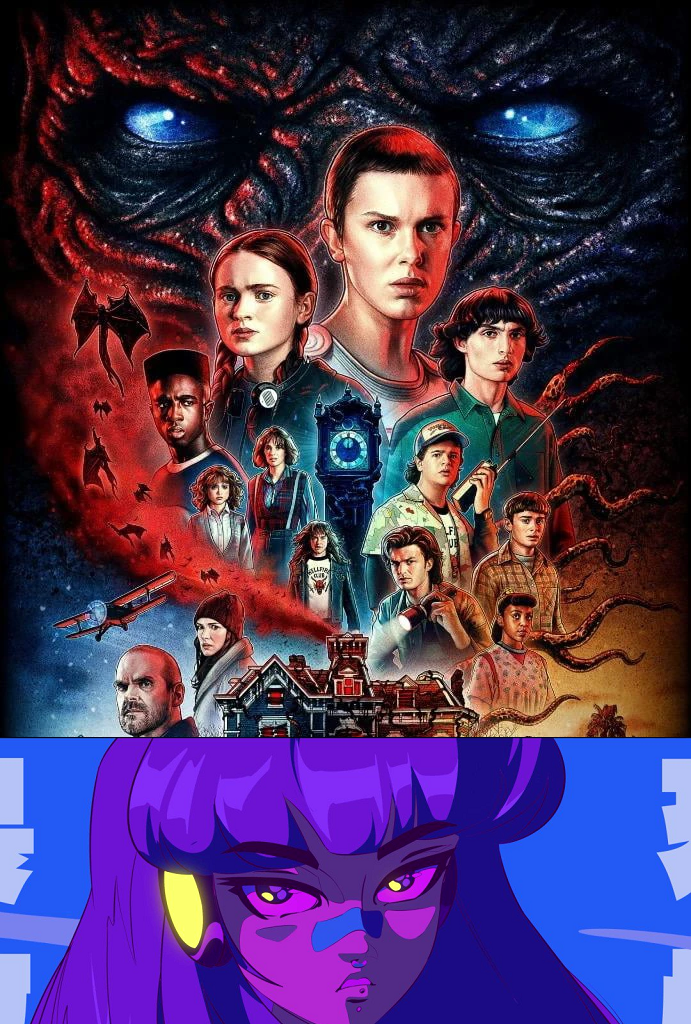
A collage of key images for Stranger Things Season 4 and the Jonathan Young song Starship Velociraptor

The general sense in the public discourse is that Stranger Things is a product of nostalgia but that’s not quite right. I’ve struggled to write about this television show – I’ve been promising a review since June 2022 and yet nothing ever came together.

Part of the problem has been that I’ve struggled with the question of who Stranger Things is for. Certainly it’s most popular among kids. My daughter is a big fan. Many of her classmates and team-mates likewise enjoy the show.

But why make a television show so explicitly loyal to the 1980s as an aesthetic if your target audience consists of people who were born a decade into the 21st century?

Stranger Things presents as a form of nostalgia programming, harkening back to Red Dawn and A Nightmare on Elm Street (right down to a Robert Englund cameo). But its primary audience can’t possibly be nostalgic for the 80s. It’s a past they never experienced.

Recently a few pieces fell into place for me that made writing about this television show a bit more viable. The key was that the Youtube algorithm, trained by my fondness for Gorillaz started serving me more animated music videos. Two of these that I ended up watching were Starlight Brigade by TWRP and Starship Velociraptor by Jonathan Young. Now both of these are actually very similar to Stranger Things in a few critical ways: first they’re pretty obviously targeting kids. This is especially apparent with Starship Velociraptor that includes the following quite-childish lyrics:

It's got a dozen restrooms inside
In case we all just have to
Sit on the comfy leather seats
Comes with a fridge that's full of meat, oh

But as I was listening to these two songs it struck me that they weren’t precisely 1980s pastiche. For all that Starlight Brigade, as a work of visual art, attempts to replicated the haze of VHS and for all that both songs as audio works are marked by the synth-pop-rock fusion sound that characterizes public perceptions of the 1980s as a musical period they’re both far too polished there is a clarity and velocity to the songs that belies their announced ties to the past. These are very much simulacra of the 1980s. They present a false 80s – a past that never exactly was. This, oddly enough, situates these kid-friendly cartoon songs in the domain of Panos Cosmatos‘s superb Mandy in that they treat the 1980s hauntologically, allowing us to engage in a deconstruction of the aesthetics of the era via the powers of the false. Except there’s the question of target audience again. Mandy is made by people who lived through the 1980s and its target audience is likewise people old enough to remember the decade. Panos Cosmatos was 10 in 1984. Nicholas Cage was 20. Producer Elijah Wood was born in 1981 as was Andrea Risenborough (who played the title character.)

Mandy, made by children of the 1980s to interrogate the 1980s, was, most importantly, intended for an audience of people who experienced the 1980s. And as a result it makes a kind of internal sense. But these shows that use the same aesthetic indicators but are marketing them to kids age 6-14 don’t have this sort of logic. Why interrogate a decade your audience has never seen?

But of course their parents have experienced that decade. At least our parents had the decency to just force us to listen to the Beatles instead of fabricating an update to their childhood ready-made to make their own childhoods legible to their children. There’s a concession to the inevitable progress of time about these songs. “This ship is fire,” they say in Starship Velociraptor. But, of course, “x is fire” to mean “x is good and also contemporary” is a phrase out of the mid-2010s. It’s slang old enough to be legible to the Generation X and Millennial children of the 1980s who might have cause to reproduce their aesthetics in their children but also to their children.

And so far this isn’t any worse than that old Onion article about the “cool dad” who raises his daughter on his media. These songs may be a bit goofy and childish but there’s nothing ominous about their hauntological musings – which are, at worst, a little cringe. The video for Starship Velociraptor may contain some puerile puns and the video for Starlight Brigade might be an empty bit of fluff but neither has ambitions that outstrip the ability of their artists and, in fact, both have some redeeming qualities via some good synth-riffs and visual aesthetics that draw from 80s and 90s anime but with no more fidelity than the music. This simulacrum of an era then, via the falseness of its particularity, actually does something moderately novel. The risk of something more insidious lies in a common comment that appears on both these videos, “you should make this into a show.”

And this is where this relatively harmless exercise in aesthetic update and reproduction takes a turn for the sinister. Because somebody has made this into a show. It’s called Stranger Things.

What’s interesting about Stranger Things is that it creates a no more accurate rendition of the 1980s than Mandy or Starlight Brigade. The 1980s of Stranger Things is remarkably devoid of the racism that would have been endemic in suburban Indiana while the misogyny and homophobia of the era, while addressed, have been toned down sufficiently to avoid offending contemporary sensibilities too thoroughly. This is a United States where the local shopping mall is a cover for a KGB mad science lab and paranoia about reds under the bed are apropos.

And it’s a 1980s America where the absolute and most critical relationships that exist are between a mother and son or between a father and daughter. Stranger Things is not a show about the 1980s. Instead it’s a show about the importance of the family as a site of social reproduction. Stranger Things looks at technological change, social transformation, and economic opposition to capitalism and then centers the family as the method of holding the disruptive aspects of these transformations at bay.

This is a far older trick than any sort of Derridean hauntological deconstruction. In fact, even as far back as Engels we were aware of how the family is a site of social reproduction. “In the great majority of cases today, at least in the possessing classes, the husband is obliged to earn a living and support his family, and that in itself gives him a position of supremacy, without any need for special legal titles and privileges. Within the family he is the bourgeois and the wife represents the proletariat. In the industrial world, the specific character of the economic oppression burdening the proletariat is visible in all its sharpness only when all special legal privileges of the capitalist class have been abolished and complete legal equality of both classes established,” Engels says in Origins of the Family, Private Property, and the State, suggesting that the family becomes a primary site for the construction of the legal and structural basis of the capitalist class antagonism, creating, via the vehicles of social and economic coercion a situation wherein two legally equal parties can recreate the lord and bondsman dialectic.

Now many will rightly point out that Engels’ anthropological work is deeply flawed and we’d be ill-advised to rest on his description of the family and social reproduction as authoritative. Happily Anti-Oedipus exists.

“Oedipus restrained is the figure of the daddy-mommy-me triangle, the familial constellation in person,” Deleuze and Guattari say, establishing that to discuss Oedipus is to discuss a specific form of familial construction that centers psychological inquiry upon the triangulation between a child and their parents. However, they contend that the way in which Oedipus is deployed leads to something far vaster than simply a triangulation between three parties in a relationship, creating, “an Oedipal structure as a system of positions and functions that do not conform to the variable figure of those who come to occupy them in a given social or pathological formation: a structural Oedipus (3 + 1) that does not conform to a triangle, but performs all the possible triangulations by distributing in a given domain desire, its object, and the law.”

By structuring the relationship between how we produce want, what we want and what we are permitted along familial lines we also, again, trace the family as the site of social reproduction. In fact Deleuze and Guattari take this further, arguing that it is necessary to colonize the formation of the family in order to colonize a people. Alert to the colonial character of Oedipus, they call for a shattering of “the iron collar of Oedipus” so as to “rediscover everywhere the force of desiring-production.”

Oedipus overcodes desire – it shapes the ways in which we want to follow certain socially prescribed boundaries – and to establish at an unconscious level the ways in which we should feel about that social reproduction. Oedipus, in the context of this work, represents the forces of unconscious repression that operate to shape the desiring subject into an appropriate subject for capitalism.

Family is the predominant binding thread that ties the otherwise disparate seasons of Stranger Things together. This is book-ended by the mother-son relationship of Will and Joyce which dominates the first season and the father-daughter relationship of Eleven and Hopper that slowly becomes the predominant focus.

And these familial ties are explored in considerable depth. Instability is introduced via the tired will-they / won’t-they antics that trap Joyce and Hopper. Joyce serves as a surrogate mother to Hopper’s daughter when he disappears to a secret Soviet Monster Gulag (perhaps the Siberian monster death camps were a policy Gorbachev reversed after Glasnost) and Hopper is positioned as the ultimate patriarchal authority: cop as action hero as dad. This story charts the ways in which parents reproduce their social milieu in their children via a narrative structure in which the parents have an adventure that parallels the children’s adventure, culminating in a uniting cathartic moment. These include both the finale of season two, in which Eleven and Hopper seal the gate to the upside down and that of season four, in which the nonsense Hopper and Joyce get up to in Siberia manages to synch itself perfectly to the children’s confrontation with Vecna and his minions. This process of reproduction is made quite explicitly textual in the fourth season in which a preponderance of fathers as the interplay of “Papa” Brenner with Eleven and with Henry Creel is demonstrated to be something of an original sin – a kind of a primordial filial rebellion against the father that leads to the fracture of law and the intrusion of the upside-down-outside.

This rebellion was presaged by Henry’s first attempt to overthrow his patriarch via his failed murder of Victor Creel, his father. However, in an entirely un-subtle nod to Oedipus and King Lear, Victor gouges out his own eyes as a form of self-punishment for his failure to uphold the law. To fail as a patriarch is to make one’s self blind.

But we aren’t done with fathers yet as Eleven manages a third via Sam Owens. Through him we now have three possible models of patriarchy through which to orient Eleven: Brenner’s clinical authoritarianism, Owens’ kinder clinical model and then Hopper: the Good Father.

And this is where can see most clearly how, in contrast to Mandy‘s hauntological deconstruction of the 1980s, Stranger Things uses this nostalgia for a past that never existed for the purposes of reproduction. Because the challenge for Eleven is not to go beyond the patriarch but rather to develop the psychic strength to recognize the just patriarch. Each of these patriarchal figures is a man of law. Brenner is a psychological professional and a high-ranking government agent. The same is true of Owens who represents the factionalism of government: two psychologists, one government, two aims. And, of course, Hopper is a cop, a monster-slayer and a commie-killer (which, to the show, is basically saying the same thing in three different ways). Stranger Things instructs us that Eleven must cleave to this pig of a man in order to come to a greater understanding of herself.

Ultimately Stranger Thing presents a world in which nothing is more important than the law of the father as bounded by capitalism. If Government science interferes, if communism interferes, if any other authority beyond the bounds of the family intrudes or if the father’s law is insufficient to discipline the child then a gate (a mother gate even, unsubtle in its subtext with its gash-like structure) will open and the dangerous monstrous Outside will come flooding in to turn parochial suburbia upside down.

But why did it have to be this way? Was this inevitable just like “cool dads” will inevitably make their kids sit down and have a serious listen to The Dark Side of the Moon?

I would say no. This is because of our prior counter-examples of the hauntological 80s. Certainly capitalism intrudes onto Starship Velociraptor. But it’s far more parodic:

You're looking for a starship lately
Something with comfort, speed and style
I'll get you to agree that maybe
There's just one ship that's worth your while
The secret is a core reactor
To make the light-years feel like miles
With just a little antimatter
And hardwood floors instead of tile

You've got to get it
You can buy on credit
Our payment plan, you won't regret it, yeah

In this case the same puerile humour that made me refer to this song as cringe-inducing introduces sufficient parody into the hyper-capitalism it depicts to make it not such a blatant reproduction of capitalist desire. There’s no outside-monstrosity-communism complex in this song. Starlight Brigade departs even farther from this reproduction of capitalism. It also has an entirely inverse relationship to the concept of the outside from Stranger Things as the visual storytelling of the video shows us an escape story. This is reinforced by the lyrics stating:

I hear a voice in the back of my head
Screaming "this is suicide! Did you hear what I said?"
But then it fades into nothing with the rest of the light and sound
I'm on my way out!

While Starlight Brigade is very beholden to the idea of justice, which sits approximate enough to law to warrant interrogation it does so not from the perspective of the directive passed down from the father but rather of the volunteer who puts themselves in the way of the unjust. This could be seen as a relatively straightforward imperialistic read if not for the clear text of the early verses which describes the recruit to the Starlight Brigade as one who escapes imprisonment. It’s hardly a revolutionary text but, put beside the patriarchal ordering of the world that is Stranger Things, it might as well be written by Engels himself.

This all demonstrates a valuable lesson on the importance of asking what a text does. Both Starlight Brigade and Stranger Things blend the aesthetics of the 1980s and the 2010s creating a false-past that never was. Starlight Brigade does this as a single artifact: a condensation of a Saturday morning cartoon that never aired. Stranger Things does this via a network of nested references blending explicit citation and allusion to create a tapestry of an imagined suburban 1980s that has more to do with contemporaneous media depictions of suburban life in the 1980s than it does the material reality of the time. Neither one of these things has an intrinsic political character. You can, with the same basic structural material, make Mandy, Starlight Brigade or Stranger Things. However how this container is used matters and, in the case of Stranger Things, that container carries Oedipus, a closed family unit, ruled by a cop and paranoid of outside infection.

And, of course, all cops are bastards. Especially that communist-murdering brute Jim Hopper.

Terrifier 2 and the Master-Slave Dialectic

Terrifier 2 is a horror movie for the horror fan who thinks they’ve seen it all. A long film, clocking in at 2 hours and 18 minutes, it is nonetheless so impeccably paced that you wouldn’t notice if you didn’t check. This small-budget horror movie (budget estimates at $250,000) is yet another entry (along with Skinamarink and Psycho Goreman) that demonstrates how much inventive and truly alarming horror can be conjured without blockbuster budgets.

Anchoring the film are two standout performances: Lauren LaVera as Sienna and David Howard Thornton as the capering Art the Clown. LaVera is a very new actor with few credits to her name but I expect her to join the ranks of Mia Goth, Jenna Ortega and Samara Weaving among the new generation of high-talent scream queens on the back of her performance here as a grieving and anxious artist struggling with her family’s recent and tragic losses and the unwanted attention of an immortal murder-clown. Thornton, meanwhile, has some significant prior experience in television although much of this is off the back of his turn as Art the Clown in Terrifier (2016). He brings such impeccable manic energy to his performance as Art that this demon clown should be treated among the rank of the slasher killer greats like Freddy and the Ghostface Killer. Art is a mute and un-killable force of pure malevolence who, despite never speaking a word, manages to give one of the most expressive performances in horror cinema. Please believe me that favorable comparisons to Robert Englund and Roger L. Jackson are entirely apropos.

The film picks up where the prior Terrifier movie left off, with the cannibalistic clown awakening from his suicide at the conclusion of the prior film and murdering a coroner before escaping the morgue. He makes his way to a laundromat where he meets his unnerving psychopomp – “The Little Pale Girl” – a sometimes invisible child clown who acts as his guide and accomplice.

From there Sienna and Art’s existences will collide in a conflict that leaves a bloody trail of torture and extreme gore across the social circle of the young woman.

The special effects here are a treat, if you have the stomach for them. Terrifier 2 has been referred to as one of the goriest films of all time and, with a scene in which one of Sienna’s friends (Allie) has her eye cut off, is scalped, has an arm cut off, is given caustic chemical burns and then subjected to a form of slow-slicing torture, all while horribly alive, marks this film as one not for the faint of heart or the soft of stomach. But this is a movie, more than any other I’ve seen, that puts lie to the idea of “torture porn.” Certainly torture is depicted. It is depicted graphically and at length. Damien Leone, the director, was also responsible for the special effects (all practical, of course) and makeup in this film. He is a remarkable artist of the macabre and the disgusting. But part of what makes him effective is that the terrible violence depicted on the screen never seems to encourage any sort of prurient pornographic titillation. In fact, Leone has made statements in the past which indicate that part of the project of Terrifier 2 is to critique the tendency of audiences to root for the killer in slasher movies. Art the Clown is charismatic in a horrible and vile way. He’s also fully inhuman, cruel beyond measure and petty to boot.

In a middle scene of the film Sienna is at a Halloween store to replace a costume element that was destroyed in a fire (more on that later) and Art follows her to the store where he hangs around leering and making an ass of himself. He grabs a bike horn, one of those ones with the black rubber bulb that go “oogah” and he approaches Sienna and squeezes it in her ear over and over. The clerk at the store tells him to stop and Sienna makes her escape. Art immediately locks the store and murders the clerk for daring to speak back to him. It’s entirely evident through the narrative framing that, even as you are captivated by the cannibal clown, you should be rooting firmly for Sienna to overcome the un-killable foe.

Of course this raises a few questions: 1) why would an artist depict such torture? The torture of Allie by Art is a far more drawn out affair than many high-water marks of cinematic torture (such as the hammer scene in The Texas Chainsaw Massacre). In fact it’s so extreme that it belabors believability that anyone could survive such abuse at all. As a result no claim to verisimilitude can be made here. This isn’t representing torture as it is in the world. In the world if you did to a person what Art the Clown did to Allie the victim would die of shock and blood loss far before he was done with her. So if it isn’t there for prurient purposes why display it at all? 2) What sort of audience would enjoy watching such a movie?

It would be all too easy for me to gesture, as I often do, in the direction of Georges Bataille and Story of The Eye, to discuss the Freudian proximity of Thanatos and Eros and to argue that art has no moral imperative to be comforting. I could go from there to a discussion of limit experiences and the idea of horror as a cinema of discomfort. For my kind readership this is all rather old-hat by now though, isn’t it? To do this would be to disregard the label of “pornography” as irrelevant and to play the Nietzschean “Yes Sayer” who denies nothing. Except this would be doing a disservice to this film because the truth is that the gore isn’t prurient; there’s nothing sexy about it at all. It’s almost pure and distilled abjection. And it occludes a key theme of the movie: recognition.

Before we talk too much about recognition, let us briefly refresh ourselves on the figure of the final girl. In Men, Women and Chainsaws, Carol Clover describes the Final Girl thus: “the one who did not die: the survivor, or Final Girl. She is the one who encounters the mutilated bodies of her friends and perceives the full extent of the preceding horror and of her own peril; who is chased, cornered, wounded; whom we see scream, stagger, fall, rise, and scream again. She is abject terror personified. If her friends knew they were about to die only seconds before the event, the Final Girl lives with the knowledge for long minutes or
hours. She alone looks death in the face, but she alone also finds the strength either to stay the killer long enough to be rescued (ending A) or to kill him herself (ending B).”

Much as Clover is confident that Craven read Freud I am pretty confident that Leone has read Clover because much of Clover’s later interrogation of the gendered nature of a final girl’s heroism, focusing on the feminine coding of abjection, the gender-play of the final girl vis her role as an investigator and the use of gendered gazes (with a male gaze applied to the killings inverted when the final girl enters an investigative mode and gazes upon the killer) is problematized by the film. So I guess we haven’t entirely escaped Freud. But in this film it falls to the final girl to run to the rescue of a male character – her brother Jonathan, kidnapped by Art the Clown to lure her to him. Sienna doesn’t look death in the face alone. She does it with her little brother. But, yet, a gendered problematic remains a valuable lens to look at this film from. While Art the Clown happily murders men and women alike and while both Sienna and her brother take the position of “final girls” within the story this is unquestionably a film about the violence men visit upon women and the consequences of that trauma.

Throughout the film we discover that Sienna’s father, who died shortly before the start of the film, suffered from a brain tumor. This gave him prophetic visions related to Art the Clown and his metaphysically bonded relationship to Sienna. But it also made him violently abusive and self-destructively violent. He died, burning to death, in a crashed car. This legacy of sickness, dark transformation and abuse has left traumatic scars on Sienna’s family. Her mother, Barbara, is fragile, drinking and throwing back pills to keep things together while snapping variously at Sienna or Jonathan and refusing to believe them when they repeatedly tell her that they believe the various misfortunes that have befallen them to be the doing of the clown. Jonathan has become obsessed with serial killers and other dark figures of fiction and history. At the start of the film Sienna suspects her brother might be a bit of a sociopath. As the high weirdness that surrounds Art the Clown invades their situation Sienna’s suspicions of her brother subside; but her mother’s suspicions are heightened.

Sienna is fragile. She is also taking valium to keep level and, despite this, is prone to anxiety attacks and depressive ideation. Sienna actually does very little of the “investigative gazing” that Clover describes. She, much like Sidney Prescott, would prefer to avoid the killer. Unfortunately she is no more able to do so than Prescott.

You may have noticed I’ve mentioned Craven’s oeuvre a fair bit so far. I would propose that Wes Craven’s New Nightmare should be treated as a key influence on this film but it also contains much of the original Nightmare on Elm Street and of Scream in its DNA. This manifests in a variety of ways: early scenes in the film treat the idea of a slasher-killer fandom in much the same way that Wes Craven’s New Nightmare does. Sienna is, as I mentioned before, a final girl in the mold of Sidney in how she subverts the final girl trope – although there is no Gail Weathers equivalent to create a whole final girl in the way the first four Scream movies did. There is also something of a spiritual tie between her and Art the Clown that is evocative of the relationship between Nancy and Freddy Krueger. Art the Clown also demonstrates the ability to invade Sienna’s dreams, and some of the actions taken in dreams manifest in the waking world (in her dream Art the Clown attacks Sienna with a flame thrower which she parries with a gladius gifted to her by her father. The flames burn her bedroom in the waking world while leaving the sword remarkably unscathed. The Freudian idea of the sword as a phallus passed from father to daughter would likely catch Clover’s notice, especially with how it blends the waking and sleeping world).

But while Art is tied to Sienna in a metaphysical way, the specifics of why remain unclear. And this is where we can finally bid farewell to the Final Girl and talk properly about recognition of the other and the Master-Slave dialectic. (Yes I know Hegel calls it the lord-bondsman dialectic for the pedants in my audience but, let’s be honest, any non-Hegel scholars who know about it would be likely to use Master-Slave as the language.)

So in brief the Master-Slave dialectic is a parable from The Phenomenology of Spirit regarding the construction of self-awareness via the process of mutual recognition by unequal entities. Hegel describes two people coming into conflict. This conflict will proceed to a struggle to the death but, crucially, self-awareness fails if one party kills the other. Instead the lord must subordinate the bondsman by force. However this subordination is unstable and ultimately the master discovers that he is entirely dependent upon the recognition (and labour) of the bondsman while the bondsman, via the immediacy of his labour, is able to come to a place of more authentic self-recognition. This ultimately makes the lord the slave of the bondsman via his oppression of them. While Hegel saw this as suggesting that liberation occurred through the process of servitude Marx turned this on its head and used this dialectic as a basis for describing class struggle, whereby the stakes become not self-recognition so much as class self-liberation from servitude.

Art the Clown has a fraught relationship with recognition. The mute clown stands out, regularly making an ass of himself when he appears in public. He strips naked in a laundromat and silently laughs at newspaper articles about car crashes. He hangs out in the Halloween store mugging and playing with crap. He has bad manners. But, for all Art tries to attract attention to himself, he responds with lethal force to anyone who actually recognizes him. When he’s in the laundromat a sleeping man wakes up and sees him playing paddy-cake with an invisible partner (The Little Pale Girl) and he kills the man for seeing his display. At the Halloween store he kills the clerk who threatens to call the cops on him. When Jonathan sees him and the Little Pale Girl playing with a dead opossum he chases Jonathan.

“Just as life is the natural setting of consciousness, independence without absolute negativity, so death is the natural negation of consciousness, negation without independence, which thus remains without the required significance of recognition. Death certainly shows that each staked his life and held it of no account, both in himself and in the other; but that isn’t for those who survived this struggle. They put an end to their consciousness in its alien setting of natural existence, that is to say, they put an end to themselves, and are done away with as extremes wanting to be for themselves, or to have an existence of their own,” Hegel says. And so, within the context of this dialectic Art’s tendency to murder anyone who observes him prevents him from any sort of independent experience.

To be blunt: this film tells us that, without a final girl, the slasher killer cannot live. Art the Clown is immortal. He cannot be killed. But likewise the text of the movie is that he cannot kill Sienna. She arrives to rescue her brother, adorned in her warrior-angel costume to find that Art has stolen the sword her father gave her – the sword she refused to take up earlier in the movie – and when Art stabs her with the sword and drowns her something magical happens and she is resurrected seemingly by a sympathetic tie to the blood on her blade. Just as there is no death for the killer so too is there no death for the heroine.

Sienna, occupying the position of the bondsman within this dialectic, overcomes Art, beheading him with her father’s magic sword, but, much as the Hegelian idea of history depends on a continuous process of these dialectical arrangements, so too does this film end ambiguously as the Pale Little Girl retrieves Art’s severed head and as his only surviving victim from the first film, a deformed mad woman marred by his cannibal hunger, gives birth to his living head.

Clearly this is a deeply odd movie. What it isn’t is a prurient one. Terrifier 2 traffics in extremes of abjection in part to demonstrate the necessity of the final girl to the slasher killer. Much of the focus of the deconstructive horror wave starting in the 1990s has been to interrogate the interiority of the victim but this often leaves the villain not much more than a foil. Even the best slashers of this subgenre (by which I mean our old friend the Ghostface Killer) ultimately amount to not much more than this. But, for all these attempt to deconstruct the early slashers they riff off of, this leaves them still confined pretty clearly within the Freudian bounds Clover set in her seminal work. Craven may have been responding to Clover in Scream but he never succeeded in getting past her.

Clover said here’s what the final girl is and Craven said “and here’s what that can mean.” Leone explodes this via a strange, bloody and surreal experiment poking not only at the same gender puzzles Clover speaks of but also of something simultaneously phenomenological but also deeply mystical.

So what kind of people would like a movie as disgusting as this one? Me for one. But more broadly this is a movie for people who love horror and also its critical interrogation. Much like Craven’s later works Terrifier 2 is as much a work of criticism as it is a work of art. It interrogates the limits of what has become a staid trope of a genre now in its fifth decade and asks not “what is this thing” but rather “why do we keep coming back to this thing?”

Sienna is the immortal final girl. She is the form of this trope raised up not just for deconstructive interrogation but for reintegration into our own collective spirit as horror fans. This collapses the comfortable distance Clover describes between a (male) audience and the (female) victim and gives immediacy to her struggle as part of a historically bound dialectical process. There may not be any more of a teleological end to the final girl than there is to history but, by showing us how Art the Clown is incapable of recognizing himself without her, by showing us that nobody needs the Final Girl more completely than the slasher killer, Terrifier 2 gives horror fans that one thing they often crave most: something completely new.

Revisiting the House of the Dragon

At the start of the season I reviewed the first episode of House of the Dragon. At the time I anticipated a story that explored dynasticism, social change and the process of historicization.

This proved to be mostly accurate. Certainly the ten-episode season fixated on the question of dynasty and on what constituted a family. Lord Corlys’ insistence that history books remember names rather than blood opened a fascinating dialectic regarding the nature of bastardry. While Rhaenyra’s two eldest sons certainly didn’t look like their father – a gay man who the show informs us tried and failed to sire legitimate children for his wife – the acceptance of their grandfather prioritizes historical record as being the principal significance of the dynasty. It won’t matter, after all this is over, what his heirs looked like, only that they carried his name and that they did these deeds.

Ultimately Corlys ends up being the carrier of the principal discourse concerning the nature of dynastism and how an orientation toward dynastic goals might impact one’s political decisions. His willingness to bite back slights to blood – such as Daemon’s beautifully gory decapitation of his brother for treason – in order to preserve the historical position of his house ends up saying far more about what a dynasty is about, as a political unit, than Viserys’ constant ruminations on prophetic dreams and the significance of heirs. But there was another key theme regarding power that was established in the first episode of this series and that I entirely missed: the question of what power does to the body.

Of course we can see this most obviously in two key examples: the physical decomposition of Viserys throughout the season and the multitudinous deaths that occur as a result of pregnancy.

Let’s start with Viserys as his example is perhaps the least-subtle. Our good-man king is uneasy on the iron throne. The barbs and blades of it cut him and these cuts become infected. As the show progresses and the child-characters of Rhaenyra and Alicent age into their adult performances Daemon, Corlys and most of the initially adult cast remain basically the same. But not so for Viserys as Paddy Constantine becomes increasingly smothered in makeup and special effects depicting the steady disintegration of a man. We can only see this as being quite explicitly the physical toll of power. It is the throne that does this to him and yet he sits upon it. By the time Viserys spends the last of his life desperately attempting to persuade Rhaenyra and Alicent to bury the hatchet despite the worm-tongued whispering of Otto Hightower and the impulsive violence of his brother and son-in-law Daemon he’s already half a corpse, barely able to walk, missing digits, missing an eye.

The loss of an eye is something of an obsession of this text. Not only does Viserys display the terminal signs of decay via a skull-like orbital cavity but also the eye is the price Aemond pays for power. He loses his own eye immediately after he claims Vhagar: the largest of the dragons. In the finale, Aemond’s desire to make Lucerys pay for this with an eye of his own precipitates the manslaughter of Rhaenyra’s son and becomes the first blow in the war which will occupy the future seasons of this show. Lucerys demurs to lose an eye and is barred from power.

It would be easy to treat this as an Odinic metaphor – Viserys loses an eye to sip from Mimr’s well – but this doesn’t fit comfortably as Aemond has no particular wisdom. Rather, Aemond represents nearly the opposite: vast power with all the restraint one would expect of a violently disfigured adolescent. Instead it is an indicator of the toll power takes upon the body.

This idea of power as something physical that eats up its carriers is bound together with the dynastic discourse via the wages of birthing heirs. Of course the death of Aemma was a principal focus of my review of the first episode. But this is echoed across the season. First we see it through the death-in-childbirth of Laena Velaryon. Laena finds herself in the same position as Aemma however, unlike Aemma, Laena takes agency over the matter of her death. Aware that Daemon will be faced with the same decision as his brother – to kill the wife to possibly save the child or to watch both die – she chooses to die, commanding Vhagar (who was her dragon at that time) to immolate her. In this case two sources of power: the power to bring about life and the power to destroy it both take a toll on her body and leave her nothing but ash. Finally, in the last episode of the season we have a third horrific childbirth as Rhaenyra’s discovery of her father’s death and Alicent’s treason seems to precipitate a miscarriage of her fifth child. She survives and, in a truly horrific scene, pulls the still-born baby from her own womb with her own hands, refusing to let the doctors or maids assist her. All the time she is undergoing labour she commands her sons to prevent anyone making decisions in her absence. The childbirth scene then becomes a reflection of Rhaenyra’s willingness to accept the physical toll of power. In this case those powers of life and death at play in the death of Laena are inverted – still-birth and an ascension into a position of command.

But of course all this inter-tangling of childbirth into a discourse around legitimacy (as Otto is quick to point out legitimacy is largely a symbolic affair), dynastism and the position of blood cannot help but touch on the elephant in the room – the incestuous relationship between Daemon and Rhaenyra. Certainly there is plenty to chew on here about blood and its relationship to power in how Daemon slowly seduces Rhaenyra over the years, eventually plotting with her and her husband to fake the latter’s death in order to clear the path for him to wed his niece after the death of Laena. On the topic of incest Freud quotes Frazer, saying, “the law only forbids men to do what their instincts incline them to do; . . . Instead of assuming, therefore, from the legal prohibition of incest that there is a natural aversion to incest, we ought rather to assume that there is a natural instinct in favor of it.” Thus a straight Freudian reading might argue that the incestuous marriage is another method of showing power: Daemon and Rhaenyra can choose to overcome law with their power and thus achieve something desired.

But Deleuze and Guattari are skeptical of this Freudian reading of incest, saying, “By placing the distorting mirror of incest before desire (that’s what you wanted, isn’t it?), desire is shamed, stupefied, it is placed in a situation without exit, it is easily persuaded to deny “itself” in the name of the more important interests of civilization (what if everyone did the same, what if everyone married his mother or kept his sister for himself? there would no longer be any differentiation, any exchanges possible).” This sarcastic response to the Freudian read of incest and the right of kings leads them to say, “Although we can see social production’s interest in such an operation, it is less clear what makes this operation possible from the point of view of desiring-production itself.” In other words: what does it matter to the formation of the self whether a desired object is a mother, a sister, a niece, an uncle?

They relate the incest prohibition (via the work of Clastres) to prohibitions among the Guanyaki people against a hunter eating his own kill. This circulation of spouses then becomes a pro-social act that helps to distribute power and keep its twin, desire, flowing. In this case the issue with incest that leads to its inscription as a taboo becomes not one of power over law but rather of selfishness over pro-sociality and as one online commenter pointed out House of the Dragon is a show about incredibly selfish people – “as if each of the Kardashians had a nuclear-capable F-22.” So perhaps we can treat Daemon and Rhaenyra’s romance as being an indicator of the same sort of selfishness that might lead a person to drive a continent into a war that Rhaenyra says would create a kingdom of fire and ash over the grief of two dead children.

But even this doesn’t quite cut to the heart of it. Turning again to Deleuze and Guattari, later discussing the work of Claude Levi-Strauss they say, talking specifically of the distinction between mother-son incest on one hand and uncle-niece incest on the other, “the mixing of the generations in the son-mother case has the same effect as their correspondence in the case of the uncle-sister, that is, it testifies to one and the same intensive germinal filiation that must be repressed in both cases. In short, a somatic system in extension can constitute itself only insofar as the filiations become extended, correlatively to lateral alliances that become established.”

This then situates the incest prohibition again in the position of power. Why is incest prohibited? Because it closes the door to political marriage. And boy howdy but there’s a lot of political marriage in this story. Both of Daemon’s first two marriages and Rhaenyra’s first marriage are purely political. The same can be said of Alicent’s marriage to Viserys and of every other marriage barring that of Rhaenyra to Daemon. In all these cases marriage exists to spread the net of power, to secure advantage, to maneuver through the process of alliance. These children become markers of alliances as clear as the green and black clothes of the two factions. What this says, then, of Daemon and Rhaenyra is that their political marriages have accomplished the extent of what they believe they can do. Principally this has been to entangle the Velaryon into the Blacks. We have seen, from Corlys already, that for many of the characters in this show names mean far more than blood and they have tied the name of Velaryon ever tighter via their inter-marriage. This then situates the Hightowers as having played a different game, insinuating Alicent into a marriage to achieve power but then spreading the children and grandchildren that arose from this family among many families in order to achieve more power, more influence.

Otto Hightower believes that power is a matter of symbols and trappings – a crown, a sword, the cheers of the masses, and of marriages. But Rhaenyra and Daeamon know that power is something else: the ability to give and take life. The birthing bed and the fire of the dragon. Having secured all of that power they thought they needed why not let their taboo desires flow?

Nostalgia and the metastasis of regret in Masters of the Universe: Revelation

Masters of the Universe: Revelation Debuts Killer New Poster
(Ok you had to know there was a non-zero chance I’d do this.)

Here be spoilers if you care about that sort of thing.

I was honestly and pleasantly surprised by Masters of the Universe: Revelation. I didn’t have high expectations for a He-Man cartoon run by Kevin Smith. In general I’m not a huge fan of Smith. I quite liked Dogma but haven’t had anything positive to say about his work in the 22 years (oh god it’s been 22 years since Dogma) since. I suppose his autobiographical stand-up routine was alright.

And the truth is that this cartoon series contains some of the hallmarks of Smith’s worse tendencies. The script is prurient. It assaults viewers with atrocious accumulations of arbitrary alliteration. What isn’t composed in this strangely (and unpleasantly) poetic recall of 1980s cartoon writing is either straight up call-backs to the cartoon (protective bubble) or just clangs.

The voice actors do their best. Mark Hamill is, as always, an absolute delight and casting him as Skeletor was the right call. Sarah Michelle Gellar also accomplishes the astounding feat of elevating Teela above the clunky script and injecting actual pathos into her portrayal. Her pairing with Leena Headley as the principals in the show was another strong choice, as Headley has been on a roll of moving from strength to strength for years, and Evil-Lyn conjures so many of the morally dubious schemers that have become her bread and butter. However good voice acting alone is not enough to elevate a script as truly and fundamentally atrocious as those in the five episodes Netflix released. But, despite the acutely painful dialog and over-abundant call-backs to a 40 year-old toy commerial, Smith’s Masters of the Universe series actually accomplishes quite a lot, and manages to utilize its own weaknesses to create something actually worth watching.

Now I should note that I am not talking exclusively about the way this series sidelines He-Man in favour of concentrating on Teela and Evil-Lyn. Of course this, alone, is what has led to the coordinated campaign of typical online CHUDS to review-bomb the show. As fun as it is to point and laugh at people like Jeremy Hambly exclaiming that the show is, “a WORSE betrayal than The Last Jedi,” the attempt by the show to admit that Teela was poorly treated as a character in the original cartoon wouldn’t, in and of itself, be particularly remarkable. After all, She-Ra and the Princesses of Power already dug into what would happen if one were to invert many of the gendered assumptions of these stories. It would hardly be new ground. But instead, remarkably by keeping the story within the continuity (such as it is) of the original Masters of the Universe cartoon, Smith has managed to dig into a heartfelt and remarkable dissection of nostalgia and how it connects to regret.

Magic and childhood

The first episode of Masters of the Universe: Revelation opens the series as Skeletor takes advantage of a court ceremony to commemorate Teela’s promotion to the to the position of Man-at-Arms to raid Castle Grayskull. Using disguise and decoy he is able to slip through the outer defenses and then uses superior numbers to overwhelm the sorceress and achieve access to a hidden inner sanctum.

However an alarm is raised and the forces of the Eternian monarchy rally to the castle. Once inside things proceed largely like a particularly well-animated episode of the older show right until the moment that, during the fight with Skeletor in the inner sanctum, Sleketor brutally murders He-Man’s ally Moss Man. This understandably upsets He-Man, who until then seems to live in the sort of magical child’s world where the people always jump off the floating tank before it explodes and nobody ever dies.

So he runs Skeletor through with his sword, pinning him to the obelisk in the center of the sanctum. Skeletor’s last words are to congratulate him on finally using his sword as it was intended – as a key to said obelisk – and it opens revealing an orb containing all the magic in the universe. However the orb explodes and the only thing that prevents the immediate destruction of the universe is He-Man channeling the power through his sword. This act splits the sword into two constituent blades and kills He-Man. The swords vanish, returning to Subternia and Preternia – which the show reveals are afterlives analogous to heaven and hell, and are the wellsprings of magic.

Randor is so distraught over the death of his son that he banishes Man-At-Arms from court and orders him executed if he ever does man-at-arms type things again. This show is generally not kind to monarchy, which is refreshing in a fantasy landscape that so often wants to treat royals as somehow redeemable. Teela, grieving the death of her friend and ally and suddenly discovering that said friend deceived her for their whole lives together, resigns from the Eternian court and takes up work as a mercenary.

There is a time-jump and after that we discover that magic is dying in Eternia. Without the orb and the sword all the magic is returning to its sources in the afterlives. And this is killing Eternia. What’s more, should Eternia die, it will herald the extinction of every world in the universe. Eternia, the oldest planet, is critical to universal wellbeing and Eternia cannot survive without magic.

Now it’s important to note how magic is mapped onto childhood by the series. The sorceress ages dramatically when the magic fades and aside from her the most magical creatures, notably Orko, Cringer / Battle Cat and Adam / He-Man are all the most childish (or at least child-like) characters in the show. When Adam is encountered in Preternia he remains in his “young prince” form – something which is quite textually a choice he made and one that amuses the small cadre of heroes who also occupy this Elysium. And the Smith rendering of Adam vs He-Man makes Adam look all the more like a child with the over-sized stature that He-Man has even compared to the other hulks in this muscle-bound show. Orko and Cringer are the most unchanged characters in this new version. And, while we see little of the cat, it becomes readily clear that the loss of magic from the world is killing Orko far quicker than anyone else. He cannot live without magic. The moment that magic is banished from the world is also one that is inaugurated by the introduction of death with the killing of Moss Man, of Skeletor and the heroic sacrifice of He-Man. This awareness of mortality entering into Eternia, the effective end of eternity, also indicates a crossing of a threshold from childhood into maturity. This show is not the first one to forge these bonds between death, magic and the threshold between childhood and adulthood. Famously Hogfather by Terry Pratchett was built entirely on the premise of a child-place being one where death could not go, and of the belief of children being a particularly potent magic.

Perhaps this is where the sense of betrayal from childish Jeremys arises more than even their unexamined misogyny. Smith’s He-Man understands that you have to grow up. Staying a child forever is stunting. We see this in a coarse fashion through Orko’s arc in which he comes to terms with his sense that he’s failed to fulfil the expectations his parents put on him. We see it with more nuance in Teela’s arc, in which she discovers that living in the shadow of He-Man has limited her from achieving all that she otherwise could. Teela starts the show being given the mantle of adulthood but she never really assumes it. A monarch asks her to, as her first act, remove her own father. (How very Oedipal.) And she refuses this call and instead goes galavanting off to make her own way in the world. But this isn’t maturity; rather maturity arises when she’s forced to confront that people who she loved dearly and who loved her hid parts of themselves from her. It comes from her recognition of her own capacity for growth and her ability to forge an identity not built around following in her father’s footsteps or running after He-Man but rather of doing her own things in her own way.

Modernity and techno-cults

One of the odder insertions into this show is Triklops and his technocult. In Skeletor’s absence Triclops has taken control of Snake Mountain and staffed it with only the most cybernetic members of the former cadre (such as Lockjaw). He’s established a cult devoted to the Motherboard and is feeding dronification potions to apparently willing supplicants who are thus transformed into technological monstrosities. Triklops is trying to destroy any remnants of magic that remain. He hates magic because he believes Skeletor’s reliance on magic is the reason for their repeated failures in the past. This is largely to serve as a foil to Teela who also detests magic at this point in the story for what it did to her and the people she cares about. So we get this sense that if magic is tied to childhood then technology, cold and practical but unable to nourish, is bonded to adulthood and the putting away of childish things.

Of course this loss of magic is also killing the world. And so we see this delicate balance that Smith attempts to pull off between knowing the magical world of kings and heroes is a childish fantasy to grow beyond but also recognizing that the alienated modern sense of adulthood is sterile and ultimately deadening. Triklops can’t be allowed to win because his focus on technology is literally toxic; he is hastening the end of the world with his acts. And this is before the show gets all cosmological.

Subternia and Preternia

The afterlife depicted in this show is wild. This is, in part, because of how sparsely populated it is. Subternia is really just where Scare Glow hangs out alone despite characters repeatedly calling it “hell” and while Preternia gets called “heaven” on multiple occasions it is, as I alluded above, far much more akin to Elysium: a reward where select heroes, blessed with immortality, engage in athletic feats that would have been remarkably legible to Pindar. Rather than punishment and reward, Subternia and Preternia represent fear and happiness respectively. The grinning and contesting heroes of Preternia want for nothing while Scare Glow feeds on the fear of the unlucky who stumble into his chthonic domain.

But there’s a third emotion that lurks in both of these afterlives and it’s the thing that ultimately binds all this strangeness together: regret.

Regret is, in fact, the thread that ties everyone together in this show. Teela regrets so much. She regrets the secrets kept from her and she regrets the fight she had with her father. She regrets ever getting mixed up with He-Man in the first place and she regrets that he’s gone. Man-At-Arms is regretful too, regretting his failure to protect Adam and his banishment. Orko regrets failing his parents. Evil-Lyn regrets living in Skeletor’s shadow and Triklops regrets this too, though his regret manifests differently. After Adam is encountered in Preternia he regrets his enjoyment of his elysian reward and chooses to follow Teela back to Eternia even with the repeated warning that he will not be granted entry to the garden a second time. And this is where we finally find the meat of the theme here: Smith takes all the trappings of nostalgia – a deliberately anachronistic script, a childish view of life and death, and a yearning for an inaccessible past – and he demonstrates how it is all rooted in regret.

Nostalgia as a Haunting

Regret is one of the most hauntological emotions. It conjures a state of searching for an absent agent in that you are looking back at the choices you made and considering what you might have done differently. Of course the past is inaccessible to us. There is no returning to childhood. We can allow the strata of our childhood development to rupture to the surface but this is no more the childhood we had than Mount Everest is the floor of the ocean.

Nostalgia is what happens when we allow regret to boil over into a sickness. The nostalgic is like Orko wasting away in his bed for lack of magic to sustain him. This nostalgia drives Triklops to his world-destroying actions. After all, “A Nihilist is the man who says of the world as it is, that it ought not to exist, and of the world as it ought to be, that it does not exist.”1 Triklops’s technocultic nihilism is thus rendered intelligible by the desire to reconcile the world as it is with the world he believes ought to be. And bringing about this world fundamentally requires the destruction of the world that is. These characters regret that they made this choice or that in the past. They regret that they served Skeletor or that they allowed Adam to deceive them. They yearn to return to the simple world of magic but they know they can’t. A nostalgic cannot possibly recover what is lost. There are only two courses out of the sickness of nostalgia: to lean into their nihilism and obliterate themselves or their world or to let go of their regret and move forward into the future.

Honestly it should come as no surprise that the most nostalgic of fans felt betrayed in a fundamental way by Smith’s interpretation of this material. They were promised a return to childhood and the fulfillment of their nostalgic urge. But as nostalgia is rooted in regret for the irretrievable this would never be possible. As much as the toxic fans of the world would like to return to a kind of palingenetic childhood they never will. Even if their childhood passions rupture forth into the present in their spasmodic reactions to a cartoon, they are still unable to retrieve their childhood. This is why they so often believe that reimaginings of childhood media are destroying their childhood – these reiterations put the fan into direct contact with the irretrievable nature of his own past. He reaches for his childhood but it slips through his fingers like the Power Sword falling from Adam’s grasp in the fifth episode.

Smith leaves off the five-episode run with a warning. The Eternal Return lurks over the proceedings and raises the risk that, even in attempts to move to the future, we might find ourselves falling into atavistic patterns. Evil-Lyn serves an excellent foil for Teela in this. Teela still hasn’t fully moved into her future at the end of episode five. The sorceress has already told her that she is the one who has to wield the Power Sword but instead she gives it back to Adam. And by opening the door to the return of old patterns, Skeletor is able to re-emerge too, and drag Evil-Lyn away from her own confrontation with the limiting impact of her nostalgic affect. The victory of nostalgia is the victory of Skeletor. He can only be vanquished by moving forward into an uncertain future. We are, of course, not at the end of the first season. We have seen only the first act of this story. However in establishing both that these characters all feel nostalgia and that nostalgia is harmful to their development and growth, Smith has established a clear and explicit thematic message that belies the childishness of the premise. In 2019, Smith said, “Used to be happy, now I’m vegan.” But, of course, he is also still alive and able to grow because of his lifestyle changes – changes necessitated by a heart attack that could have killed him.

It seems as if this brush with death has provided Smith with the impetus not just to change his diet but to re-examine his life-long connection to childhood media. It’s not enough to be Silent Bob larping Batman in a mall anymore. The past may come around again in some form or another but when it does, it is something that must be resisted. Preternia is an empty heaven. Growth occurs in Subternia, where we confront fear and the specter of death. Death always lurks in the future but clinging to the past just draws it closer via sickness. We must imagine a Prince Adam who must not be He-Man any longer. We must imagine a Teela who has grown beyond the soft sisterly figure of the 80s cartoon or the sassy girlfriend of the 2002 revival, a Teela who has a life and regrets of her own but the will to rise above those regrets. We have to consider the idea that the past is gone and we must grow and change into the future.


1: Nietzsche, The Will to Power, 585