World-building: a genealogical approach

…In that Empire, the Art of Cartography attained such Perfection that the map of a single Province occupied the entirety of a City, and the map of the Empire, the entirety of a Province. In time, those Unconscionable Maps no longer satisfied, and the Cartographers Guilds struck a Map of the Empire whose size was that of the Empire, and which coincided point for point with it. The following Generations, who were not so fond of the Study of Cartography as their Forebears had been, saw that that vast Map
was Useless, and not without some Pitilessness was it, that they delivered it up to the Inclemencies of Sun and Winters. In the Deserts of the West, still today, there are Tattered Ruins of that Map, inhabited by Animals and Beggars; in all the Land there is no other Relic of the Disciplines of Geography.

—Suarez Miranda,Viajes devarones prudentes, Libro IV,Cap. XLV, Lerida, 1658

Jorge Luis Borges – On Exactitude in Science

There has recently been a surge of interest in Vajra Chandrasekera’s 2023 essay The Lone and Level Sands.

Chandrasekera is largely arguing from a position contra Jason Kehe in Wired regarding the quality of Brandon Sanderson. “Kehe—who is obviously a fan, who else could read 17 to 20 novels by any given author and be familiar enough with the lore to claim bona fides—takes the criticism of Sanderson as a poor writer of prose to a very familiar place: story over sentences, worlds over writing,” he says.

Chandrasekera ends his essay calling for, “a place where the sentences matter, and are the whole of the matter,” arguing for prose quality over the encyclopedic tendency of the world builder. However, with the recent resurfacing of this essay there has been some discussion regarding the vagaries of the definition. Simply put, it seems that for some world-building means any construction of setting; for others world-building is the insertion of setting that is extraneous to the utility of the story; for others world-building is a specific method of systematic de-mystification which seeks to provide an authoritative claim as to the truth of the setting.

How one feels about world-building thus becomes multi-varied based on two questions: which definition of world-building does a person adhere to and how do they feel about that?

The earliest approaches to the idea of world-building refer to the construction of simplified “worlds” for the use in scientific thought-experiment. In the 1920 work Space Time and Gravitation: An Outline of the General Relativity Theory, Arthur Eddington says, “The reader will easily see that a being confined to the surface of a sphere and not cognisant of a third dimension, will, so to speak, lose one of his dimensions altogether when he watches things occurring at a point 90° away. He regains it if he visits the spot and so adapts himself to the two dimensions which prevail there.

“It might seem that this kind of fantastic world-building can have little to do with practical problems. But that is not quite certain. May we not be able actually to observe the slowing down of natural phenomena at great distances from us?”

For Eddington there is a pedagogical and epistemological purpose to the built world – to provide a setting in which a difference allows for the exploration of the consequences of the laws of physics. Another of Eddingon’s examples involves the movement of light through an impossibly vast and free-floating body of water in space. The difference between the “absolute world” that Eddington describes and these simplified possible worlds is a useful tool to explicate how similar functions interact with difference – meanwhile their simplification creates a sort of scientific parsimony wherein the built world contains only those elements necessary for the thought experiment. The body of water is only water. It doesn’t contain land or creatures, there is no passing debris beyond light swallowed by it. It’s water because water contains the qualities necessary to make transparent how gravitation effects light in this case.

An oft-cited early essay on literary world-building is Tolkien’s On Fairy Stories from 1939. Now this is an interesting inclusion considering the extent to which Tolkien argues against rationalization in it, saying, ” I suspect that this flower-and-butterfly minuteness was also a product of “rationalization,” which transformed the glamour of Elfland into mere finesse, and invisibility into a fragility that could hide in a cowslip or shrink behind a blade of grass. It seems to become fashionable soon after the great voyages had begun to make the world seem too narrow to hold both men and elves; when the magic land of Hy Breasail in the West had become the mere Brazils, the land of red-dye-wood.” Tolkien argues against treating “fairy” to narrowly – to signify fairies or elves as the subjects of stories – and, instead argues that fairy stories are stories about the condition of faerie – a totalizing setting that contains the creatures of faerie, their lived environments and their metaphysical bounds. This is critical because, for Tolkien, fairy stories should be true in a metaphysical sense of the world and that truth depends not on a rationalization but rather on a mystification of the audience.

In fact Tolkien is quite critical of the scientific urge within literature, saying of anthropologists and folklorists that they are, “people using the stories not as they were meant to be used, but as a quarry from which to dig evidence, or information, about matters in which they are interested. ” Tolkien believes that folklorists tend to flatten stories: “We read that Beowulf “is only a version of Dat Erdmänneken”; that “The Black Bull of Norroway is Beauty and the Beast,” or “is the same story as Eros and Psyche”; that the Norse Mastermaid (or the Gaelic Battle of the Birds and its many congeners and variants) is “the same story as the Greek tale of Jason and Medea.””

Ultimately Tolkien seeks to create a form of belief in the audience and argues that creating a mode in which an audience can believe the truth of a fairy story is the ideal mode for the creation of those things that are valuable in a fairy story. Tolkien sets up the author as a demiurge, the secondary-world is the creation of the author just as the world is the creation of God. We should create a world crammed full of all the things in existence when creating a world. We aren’t seeking the parsimonious model of Eddington’s scientific worlds but rather to create a reflection of divine Truth. And this must mean that the world of the story is even vaster than what the author sets to the page. For Tolkien a fairy story must exist in an unbounded world: “Endings of this sort suit fairy-stories, because such tales have a greater sense and grasp of the endlessness of the World of Story than most modern “realistic” stories, already hemmed within the narrow confines of their own small time. A sharp cut in the endless tapestry is not unfittingly marked by a formula, even a grotesque or comic one. It was an irresistible development of modern illustration (so largely photographic) that borders should be abandoned and the “picture” end only with the paper.”

Richard Lupoff’s description of Edgar Rice Burroughs, in 1965, is interesting in how it fuses together these seemingly incompossible forms of worldbuilding. He says, “In short, Burroughs had created a fully-visualized hero – thirty years in apparent age but actually ageless, a professional soldier, an adventurer – and had transported him to a fully visualized alien world, the planet Barsoom, which we call Mars. Barsoom was fully equipped, far beyond even VanArnam’s description, with geography, history, mythology, flora and fauna, human and inhuman inhabitants, science, politics, religion, architecture, law, and every other institution to be expected in a fully developed world.”

For Lupoff the question of building a world was a matter of craft. That genre fiction is replete with fantastical settings is a given. Instead it is a question of how an author goes about realizing this world such that an audience will enjoy reading stories set within it. These, then, help us to see how our different definitions of world building arise: genre fiction has often shared a readership with scientific non-fiction where the construction of simple and parsimonious worlds was, even in the early 20th century, a well-established method for considering problems. Tolkien, held in the highest esteem created an argument not for parsimony in constructing worlds but rather in a kind of lush overabundance of detail designed to help an audience suspend disbelief and experience the demiurgic creation as a form of truth. These two strains then filter into practical craft considerations: put in a lot of setting detail so that we have a world that can be believed in. But, being rational Men of Science, we had best make sure that these worlds are systematic and consistent; the irrational might be disbelieved.

Hilariously this chimera would likely have Tolkien and Eddington both rolling in their respective graves. But this is all rather old news. Lupoff’s book about Edgar Rice Burroughs was published in 1965. Surely we’ve progressed the discourse subsequently.

In 2007 M. John Harrison approached the subject – arguing ultimately that world-building was unnecessary. “It is the great clomping foot of nerdism. It is the attempt to exhaustively survey a place that isn’t there. A good writer would never try to do that, even with a place that is there. It isn’t possible, & if it was the results wouldn’t be readable: they would constitute not a book but the biggest library ever built, a hallowed place of dedication & lifelong study.” It’s Borges’ map that was a perfect replica of its territory. But if Harrison sees world-building as Sisyphean then the question arises as to why he’s so specifically critical of this Sisyphean task over any of the other Sisyphean tasks in writing. For Harrison this is a matter that what he calls worldbuilding fiction, “becomes less an act of imagination than the literalisation of one.”

“This kind of worldbuilding actually undercuts the best and most exciting aspects of fantastic fiction, subordinating the uncontrolled, the intuitive & the authentically imaginative to the explicable; and replacing psychological, poetic & emotional logic with the rationality of the fake,” Harrison says, bringing into the conversation the Barthean idea that fiction doesn’t consist of an active authority and a passive audience but exists in the discursive interplay between author and audience. The author, putting too much labour into world-building, is subordinating the audience too much to their authority.

The author chokes out the possibility of imaginative agency for the audience by grounding the fiction too much in the detail of the world. Harrison is concerned with the ideology surrounding this chimerical world-building, calling it, “It’s a secularised, narcissised version of the fundamentalist Christian view that the world’s a watch & God’s the watchmaker.” It’s interesting that this criticism functions poorly for the openly theological ideas of Tolkien’s essay specifically because Tolkien did not view fairy stories as watches. Tolkien believes that fairy stories end with just-so vagaries in order to demonstrate that the world of the story necessarily extended out beyond the bounds of the page. However it works well against the successors to Tolkien who, taking a page from Lupoff, have bonded the parsimony of scientific world building to the pursuit of Truth in Tolkien’s. Though Harrison is happy to leave this mess at Tolkien’s feet it does, in fact, depend on a much more protestant religiosity than Tolkien could ever possess. There is a desire in the SFF idea of world building to create a rationally realized world rather than one that feels True. But I sometimes question whether SF fans even notice the difference. Harrison does hit the nail on the head toward the end of his essay when he treats this form of world-building as a remnant of a “fossilised remains of the postmodern paradigm.” Of course the separate world-building concepts of Eddington and Tolkien were themselves very modernist – each attempted to present a grand an unifying narrative about the world: Eddington’s was scientific and Tolkien’s religious. However the syncretic desire to merge these two together is, certainly, a postmodern affectation.

In 2014 Michael Moorcock spoke with John Picacio from Locus Magazine about his then-forthcoming novel The Whispering Swarm. In that article, Moorcock argued he dislikes being called a world-builder because he believed it, as a notion, belied a “failure of literary sophistication.” Moorcock, with characteristic bluntness, calls worldbuilding “anti-romantic rationalization” and lays blame at the feet of John W. Campbell. He also says, “I’m not trying to convince you this is going to be real. I’m trying to convince you these ideas have to be considered, that what’s going on in the world has to be thought about.” And so we can see that Moorcock shares Harrison’s concern regarding the tendency of an over-sufficiency of authorial instruction to limit the avenues for audience imagination. Campbell, who demanded the stow-away die at the end of the Cold Equations, could be something of a perfect vector for the protestant syncretization of parsimonious scientific modeling and a Christian pursuit of Truth via secondary creation. It would certainly fit with the John W. Campbell who assisted L. Ron Hubbard in the founding of Dianetics after all. However, as has been pointed out by the blogger who operates under the “heresiarch” pseudonym, Moorcock’s demand for the necessity of character is no less vulnerable to historicization than the world-builders focus on setting is. They argue stridently, and convincingly, against the idea of necessity as appropriate to any discussion of literature. Effectively nothing in literature is strictly needed.

They also say, “To condemn all of worldbuilding, you ought to be going after the strongest cases: this IMO means Le Guin’s Always Coming Home, a book which sadly no one has read,” and this is interesting specifically because of what Always Coming Home is: it’s a work of speculative science.

Specifically, Le Guin constructed an ethnography for a possible future people of California. It does all the things ethnographies do – it analyzes their writing, explores the structure of their myth and poetry, it interrogates how their folkways interface with their material culture. Always Coming Home is hardly a novel although it is certainly an excellent work of literature. But, rather, it’s attacking Tolkien from the opposite end, so to speak, and giving the anthropologists and folklorists their due, telling Tolkien that his search for an idealized Truth via the whole-cloth construction of myth missed the point of considering what a myth, in its specificity, might be for when not for the construction of an English national identity.

Le Guin’s work plays well both to problematize Tolkien and to knock some of the wind out of Moorcock’s sails by demonstrating that literature need not be a character study to be, well, literary. However I don’t think that Le Guin works well to particularly problematize Harrison except in as far as her work demonstrates that there are other ways to get at building a world and reasons to do so beyond reifying a protestant ideological mode of treating the world as a watchmaker’s product. But I think one would be a fool to fail to situate Le Guin, especially, within the postmodern mode that Harrison criticizes in his essay.

In 2020 Helen Marshall interrogated Harrison’s critique of world-building along with some of the critiques of it. She cites Charles Stross who says, “The implicit construction of an artificial but plausible world is what distinguishes a work of science fiction from any other form of literature. It’s an alternative type of underpinning to actually-existing reality, which is generally more substantial (and less plausible – reality is under no compulsion to make sense.)”

Marshall points out that, “If, as he says, reality is under no compulsion to make sense, how can art ever produce a plausible and coherent yet realistic world? In fact Stross wants the opposite of this sort of messy, inexplicable real-realism. Instead he turns to fiction because ‘worldbuilding provides a set of behavioural constraints that make it easier to understand the character of my fictional protagonists.”‘

She claims that Stross is openly advocating for the construction of hyperrealities, the very thing that Harrison critiqued previously, because it it allows Stross to make-visible those things that were invisible before.

In short Marshall points back to Eddington and his massive globe of water and says, “you’re just doing this again.”

But if what Stross is doing is simply a fictional version of Eddington’s thought exercise then how can we take his claim seriously that science fiction is unique in all forms of literature from doing so? Philosophy and science have been eating science fiction’s lunch for a few hundred years now in that regard. And this is the problem with trying to disentangle this chimera. Without Tolkien’s idealism, without his explicitly theological search for Truth, then all that is left of world-building is the thought experiment. Without the thought experiment we’re just still writing fairy stories. In either case the encyclopedic impulse of the world-builder becomes a bit of fannish silliness forced upon the audience by an author who won’t get out of the way of their own text.

Marshall argues that this is largely an economic activity, Echoing several prior authors she notes that market conditions prefer “encyclopedic, extendible, franchisable, consumable” art. Authors simply follow suit. This mirrors Chandrasekera’s argument that much of Brandon Sanderson’s tendency toward world-building is tied into his position as a business-person, as a start-up founder more than as an author. Sanderson has a financial incentive to be interested in a consistent ecosystem of products that locks in readers. If a reader is conditioned to expect the systematics of a Cosmere book they might look askance at Mordew or Ambergris.

Marshall argues that what Harrison is seeking is, “a mode of attack that would destabilize and unsettle, that would reveal the world as incoherent and painful rather than unified and offering the possibility of choice.”

She chronicles Harrison as having a nearly Brechtian desire to demystify fantasy for material reasons – “We learn to run away from fantasy and into the world, write fantasies at the heart of which by some twist lies the very thing we fantasise against,” she quotes him as saying. She places Harrison into a lineage including Mervyn Peake and China Mieville, citing Jeff and Ann VanderMeer regarding the foundation of the New Weird movement.

Ultimately Marshall proposes three solutions to Harrison’s attack on world-building. The first is to, like China Mieville, double-down on world-building, and use it to allow the creation of a fantasy that “interrogates the relationship between belief and reality.”

The second is to operate within the mode of Jeff VanderMeer and, as he suggested in Wonderbook to argue for “sufficient mystery and unexplored vistas, consistent inconsistency, multicultural representation, extended, literalised metaphors, multiple operational realities, collective and individual memory and imperfect comprehension.” The third is to follow Timothy Morton’s path into speculative realism. I have explored the relationship between VanderMeer and Morton previously and found this argument of particular interest.

She argues that Harrison ultimately rejects the idea that readers should believe (or even enjoy) built worlds as if they were real.

And so what we have is a story of a century of progression through modernity and into the postmodern followed by the recognition that the postmodern condition has reached its limits. World-building is a postmodern chimera of modernist rationalism and equally modernist reaction against rationalism. It paradoxically demands a multitudinous panoply of detail in order to make transparent problem-worlds fit for solving problems.

If we express skepticism for world-building it should be clear to an audience that this is not a matter of being skeptical of the power of setting. However we must not make the error of Stross and believe that setting only exists within the confines of genre, or that any setting is more or less artificial than another.

In fact, we can abandon Baudrillard’s anxiety in favor of a Deleuzian recognition of the powers of the false. We may not agree with Tolkien that there is any Truth to be found in an act of demiurgic creation but we can recognize how both Tolkien’s unbounded abundance and Eddington’s careful parsimony create a false image of the world – and that their capacity for action depends on that falsity. As Marshall points out, a built world cannot be as inherently contradictory as reality. There’s too much of the watchmaker’s stink upon any setting. And heresiarch is quite correct to point out that the watchmaker’s simplification applies as much to the inner setting of character as to the external setting of mise en scène.

But, just as this is the case, a built world allows us to highlight contradiction and inconsistency. VanderMeer’s ideas of consistent inconsistency, the blending of extended literalised metaphor into the assumed real stratum of a story and Morton’s use of the hauntological and the eschatological allow us to interrogate socio-cultural problems with the same sort of transparent clarity that Eddington sought for the mathematical problems of special relativity. Always Coming Home provides an excellent precedent for this sort of an operation, showing how a focus on setting can allow us to interrogate our own relationship between folkway and material culture as if we were anthropologists in the future.

Perhaps what sits so hard in the mouth of many critics regarding Brandon Sanderson’s school of world-building is that it becomes too systematic for its own sake without doing much of interest with it. Sanderson is not a talented enough writer to really tell us anything about his characters but his fantasy worlds are ultimately derivative enough that they don’t have much to say about our world. They become floating escapist signifiers that exist principally to entrap an audience in a labyrinth of rules and sour them on anything that doesn’t adhere to these arbitrary laws.

This is, however, not a critique of world-building qua world-building. It’s a critique of Sanderson’s prioritization of business over art.

As Harrison rightly points out, world-building is inherently political. But Marshall is right to problematize this by demonstrating how any given politic within fiction can be subverted by a cunning enough writer. As such we would, perhaps, be wise not to condemn world-building entirely but rather to guide artists to consider what their worlds are for. When you decide what is consistent and what is inconsistent, when you decide what to show and what to hide, whether to write about trees or whales or the layout of fantastical cities, ask yourself why. Ask yourself not whether the world will convince an audience of its truth but rather what it can do with its falsehood. What games are you playing with the audience and to what end?

The Terror of Psychosexual Development under Patriarchy: A review of Poor Things

I don’t know how to start this review. There’s a challenge to introducing a thing so singularly odd as the 2023 film Poor Things. This movie, directed by the esteemed Greek director Yorgos Lanthimos, with cinematography by Robbie Ryan (who previously worked with Lanthimos on The Favourite), costume design by Holly Waddington and with art direction by Géza Kerti is a visual feast. With a setting in an alternate 1888 (estimated on state of Eiffel tower construction) in which Europe is bedecked in a baroque style reminiscent of the steampunk aesthetic at its best, the film balances on a line between German Expressionism and the French Fantastique in style. It’s as if the dream-like intrusion of the unnatural in Fantastique has forced its way into an Expressionist stage play.

The sets and costumes eschew realism; Bela’s dresses, in particular, are cloud-like confections of knit wool and silk while, for all the characters, there is a kind of heightened reality of late 19th century styles on display.

Continuing with expressionist elements we must address the performances. This will likely be a career-defining performance for Emma Stone; it has certainly been one of her most controversial both for the extensive position of sex in her performance and also for the questions regarding the realism of her “toddler” scenes.

I think those people who have criticized Stone for these earlier parts of the performance have missed that literally nobody in the film is trying for realism – these are expressionist performances top to bottom. I was, honestly, shocked by how effectively Mark Ruffalo chewed the scenery in his performance as the cad Duncan Wedderburn. He delivers the best performance of a weird little creep of a man I’ve seen since Brad Dourif stepped into the role of Grima Wormtongue. Taken together with Willem Dafoe in the same fine form as we might recall from his performance in The Lighthouse and even smaller roles like Kathryn Hunter as Swiney and we see a picture of a film where any sort of “realism” or verisimilitude in performance was hardly the point to begin with.

And honestly should we expect realism from the performance of an infant mind suddenly thrust into the body of an adult woman in the first place? All in all, Stone’s remarkable performance in this film has me curious to see The Favourite which she was also in.

But, continuing with influences, I do believe that this film has been mis-categorized as a sci-fi comedy or a comedy-drama by a lot of reviewers. I think, rather, it should be treated as a horror comedy. Now I should note that Ashley Darrow and Jonathan Greenaway of Horror Vanguard fame have talked a lot about the proximity of comedy and horror. Both are modes of cinema that aspire to do something to the body of the audience. So we can treat as a given that there is slippage between comedy and horror most of the time.

However, looking at this from a cinematographic perspective, I couldn’t help but note how the shot selection, with its preference for low-angle photography, fish-eye lenses and a pinhole camera effect, reflected a horror-cinema specific visual construction. There is a kind of embodied voyeurism to the camera that suggests not only somebody looking in on the action but, specifically, somebody looking in who should not be. Think Black Christmas. We are constantly treated to a perspective extremity – the camera shows us too much or too little. Contemporary Hollywood often pursues a kind of full-coverage sufficiency where the audience is asked to forget that there is a camera mediating the experience of the film. This is not the case here and it works to excellent, if occasionally alienating, effect. This contributes to the pervasive sense of discomfort that marks this film. I’ve said before that horror is the art of discomfort. If so then we have to recognize the horror present in Poor Things. Now this would not be Ryan’s first attempt at horror if we treat it that way, he previously worked on Isolation and I Am Not a Serial Killer while Lanthimos has previously worked in the genre via The Killing of a Sacred Deer so it’s not an absurd proposition that this team would work within a horror mode. But situating this film as a horror film still might challenge how it’s been received by much of the film press.

Additional evidence exists in the form of Ryan’s comments regarding key cinematographic referents. Because, according to Ryan, the most significant film that influenced the lighting and shot selection of Poor Things was Bram Stoker’s Dracula, which Lanthimos reportedly asked the crew to refer back to regularly throughout the production of the film. Shot like a horror film indeed. Considering the extent to which Poor Things serves as a callback to Frankenstein, in particular, it is also interesting that a Dracula movie, tied as it is to the same milieu of the 19th century British Gothic, would be selected.

Certainly expressionism has played an outsized influence in horror performance with stand-outs like the Evil Dead series and Mandy being particularly relevant. However horror, as a form of cinema, goes beyond shot selection, body reaction and an eschewing of verisimilitude in performance. But most horror contains something to be afraid of, generally a monster of either the literal or metaphorical varieties, and has something to say about fear or abjection.

This is also something very true about Poor Things.

Poor Things is, in fact, singularly fascinated with the figure of the monster. One of the first things we hear about Godwin Baxter is that he is a monster. Baxter, who presents as a cold and amoral man of science for most of the film’s runtime, is a grotesquerie. Covered in scars, Baxter was subjected to cruel medical experimentation by his father. Unable to produce his own gastric juices as a result of his father’s surgeries, Godwin must connect himself to a contraption in order to eat. a side-effect of this is that he loudly belches bubbles which drift about the room at mealtimes. Godwin’s amorality is very nearly secondary to his monstrosity as grotesquerie but this becomes something he seems sincerely proud of. Not only is he quite open about his gastronomic (and other) disabilities, cheerfully describing the circumstances that led to his disfigurement, but he also surrounds himself with grotesqueries: dogs with the grafted heads of geese, chickens with the grafted heads of dogs and other such chimera wander about his property. And then there are Bella and Felicity who are not grotesque in form but both of whom become grotesque via their behaviour.

This idea of the grotesque is also partially explored through Swiney – the heavily tattooed madam who occasionally becomes so overcome by her desire for youth and beauty that she will bite – literally trying to consume the beauty of others.

Bella will, eventually, also be called a monster, particularly by Duncan, because of his inability to control her and his unfounded belief that she is the author of his misfortune. A third figure of the monster arises via Alfie, an aristocrat and a military man so hated by the servants he casually abuses that he’s taken to carrying a revolver with him everywhere he goes, a man who drove his wife to suicide but cannot let go of her even in death, a grasping anti-moral being whose existence is marked entirely by his desire to subjugate, command and, ultimately, own other people.

This creates an interesting dichotomy surrounding what we consider monstrous: is the monster the grotesque? Is the monster the thing from outside that cannot be commanded or is the monster the thing from within that demands to command?

It’s interesting to note, however, that the monsters in Poor Things are not, generally, the source of terror in the film. Grotesque Dr. Baxter dies smiling, surrounded by people who care for him. He doesn’t stand in Bella’s way in any of her attempts to forge a sense of self and he is rewarded with her love in the end. Swiney, too, lets Bella go without a struggle and all the grotesques of Baxter’s home become either family or pets.

Duncan’s accusations of monstrosity toward Bella are almost immediately obvious as bad-faith. Duncan may believe, in some way, that Bella is the author of his misfortune but the film has established, ahead of time, that the man is entirely to blame for the things that befall him. He’s a lawyer who can’t spell, a drunk, a gambler and a scoundrel. For all his claims toward a rakish libertinism, he cannot tolerate the idea of a woman exercising the very freedom he starts by advocating and so we can add hypocrite to his plethora of character defects. He’s a small Wormtongue of a man. And by the time he calls Bella a monster the audience knows this all too well to be taken in.

We could possibly see Alfie as a source of terror if not for how readily Bella resolves him as a challenge. Alfie isn’t so much a source of terror for Bella as he is a final test of her commitment to self-development.

But this isn’t to say that there isn’t terror in the film. The terror, instead, comes from the question of individuation and how it ties into a very Freudian model of psychosexual development. Here is where the central conceit of Bella’s creation becomes useful, and how it plays games with the Frankensteinian notion of tabula rasa.

Because Bella is, of course, an infant mind implanted into the body of an adult woman. The conceit is that this specific mind (and with the very different development of Felicity it is clear that there is a clear specificity at play here) is developing toward adulthood at an accelerated rate. And throughout her development we see a clear progression of classical Freudian developmental stages at play.

Except for one very specific difference: Bella, throughout her development, insists upon her own agency. She forcefully asserts that she will be the author of every one of her decisions, the master of her ship, from her first stumbling steps to the moment she cuts out Alfie’s brain and replaces it with that of a goat. This leads to an interesting challenge to Freud here. Bella may experience the anal and phallic stages of development but she refuses to submit to Oedipus.

Deleuze and Guattari describe Oedipus and its impact on individuation, saying “With the same movement the Oedipus complex inserts desire into triangulation, and prohibits desire from satisfying itself with the terms of the triangulation. It forces desire to take as its object the differentiated parental persons, and, brandishing the threats of the undifferentiated, prohibits the correlative ego from satisfying its desires with these persons, in the name of the same requirements of differentiation.”

But Bella is, bluntly, her own mother. Her existence collapses the differentiation between differentiated global people such as “mother,” and “father” and the undifferentiated threat through the way in which she hacks at its basis.

She may call Dr. Baxter her father but she is not beholden to him. She leaves his side and he stands aside and lets her go. He attempts to arrange a marriage for her and she, instead, runs off with a rake so she can learn about the world. But this is not framed as a violation of parental law; instead it’s the great howling void of absolute freedom being embraced with gusto.

“Oedipus says to us: either you will internalize the differential functions that rule over the exclusive
disjunctions, and thereby “resolve” Oedipus, or you will fall into the neurotic night of imaginary identifications.” But Bella does neither. Instead she individuates. She forges an identity that is not Dr. Baxter nor is it a rejection of him. She does not fall into neurosis, far from it, she forges a fully structured and functional frame of being entirely on her own terms.

In fact, Bella’s development is almost messianic thanks to the second text that lurks in the background of Poor Things, adjacent Frankenstein: Siddhartha. In some sense this is tied to the very Buddhist realization of the nature of suffering that Bella experiences on the cruise ship. Her discovery of the slums and her subsequent renunciation of wealth fits cleanly into the Buddhist story of the Four Sights but, rather than becoming an ascetic following this renunciation, Bella becomes a prostitute. This fits closely together with Hess’ argument in Siddhartha, “I saw a man, Siddhartha thought, a single man, before whom I would have to lower my glance. I do not want to lower my glance before any other, not before any other.”

And, of course, this leads Bella to the heights of moral development: socialism. It’s delightful that Bella’s full development into adulthood happens in a Paris winter during which her girlfriend invites her to a Socialist reading group. There’s a wonderful balance present here wherein a rejection of ascetic renunciation of individuality gives way to an enlightened sense of the collective value of humanity.

““I know it,” said Siddhartha; his smile shone golden. “I know it, Govinda. And behold, with this we are right in the middle of the thicket of opinions, in the dispute about words. For I cannot deny, my words of love are in a contradiction, a seeming contradiction with Gotama’s words. For this very reason, I distrust in words so much, for I know, this contradiction is a deception.”

Bella recognizes fully well, as an individuated subject, that a socialist liberation of humanity is a condition that can allow people to develop themselves. And she wants this so clearly and so forcefully that she will exercise extreme violence to protect this, destroying Alfie entirely rather than submitting to him.

Again, the contradiction is a deception. Bella takes away any hint of Alfie’s agency and reduces him to a goat munching grass in her yard specifically to protect the agency of herself, of Alfie’s beleaguered servants and as an attack upon the patriarchal systems that can produce Alfie to begin with. Bella’s story ends showing us that she is the owner of every one of her mistakes and every one of her triumphs but that, simultaneously, she does so via the community she is a part of. She honors the betrothal to Max that Dr. Baxter arranged but simultaneously insists on bringing Toinette into her family life as an equal partner. Max, for his part, freely accepts that to be husband to Bella means to freely accept her freedom. Many horrors and reversals befall Bella, almost all of them she is the author of. She freely goes with Alfie to his mansion. She could have refused. And when he tries to subjugate her, to shape her body to be the vessel of his will, she destroys him just as freely.

There is a terror in the tension between the clarity of which the film accepts a Freudian account of development and the way in which Bella refuses to succumb to it. But, in the end, the contradiction is the deception. Frankenstein is the monster and so is her maker but if Bella is the monstrous tabula rasa then she is the revelation that only by being a monstrous tabula rasa can one accept the burden of one’s own freedom.

Hauntology and social reproduction: Stranger Things, Starship Velociraptor and Starlight Patrol

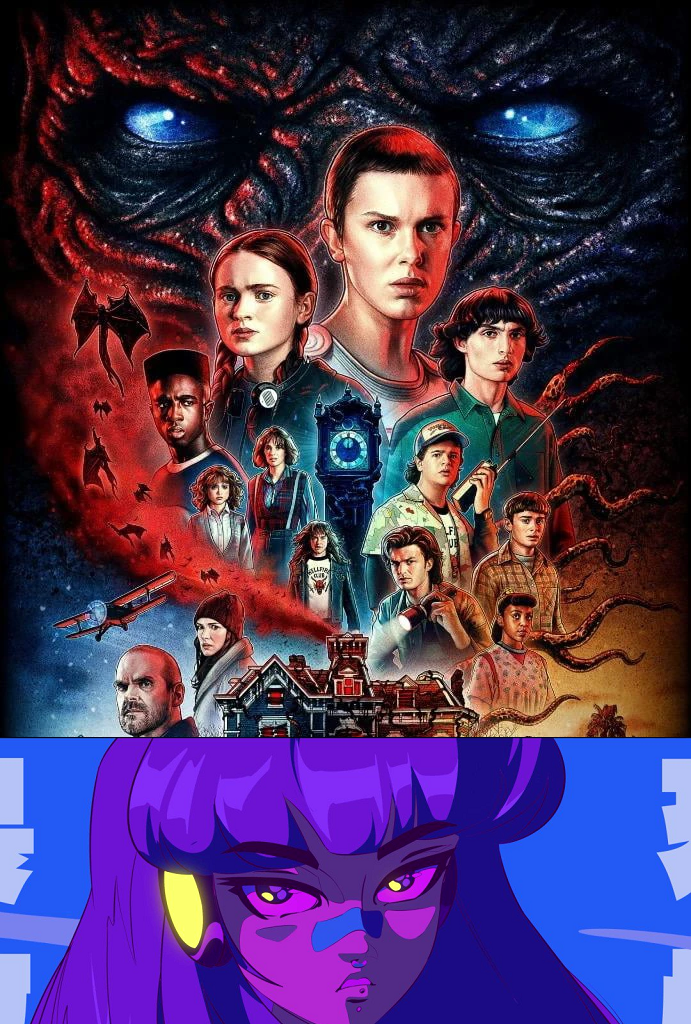
A collage of key images for Stranger Things Season 4 and the Jonathan Young song Starship Velociraptor

The general sense in the public discourse is that Stranger Things is a product of nostalgia but that’s not quite right. I’ve struggled to write about this television show – I’ve been promising a review since June 2022 and yet nothing ever came together.

Part of the problem has been that I’ve struggled with the question of who Stranger Things is for. Certainly it’s most popular among kids. My daughter is a big fan. Many of her classmates and team-mates likewise enjoy the show.

But why make a television show so explicitly loyal to the 1980s as an aesthetic if your target audience consists of people who were born a decade into the 21st century?

Stranger Things presents as a form of nostalgia programming, harkening back to Red Dawn and A Nightmare on Elm Street (right down to a Robert Englund cameo). But its primary audience can’t possibly be nostalgic for the 80s. It’s a past they never experienced.

Recently a few pieces fell into place for me that made writing about this television show a bit more viable. The key was that the Youtube algorithm, trained by my fondness for Gorillaz started serving me more animated music videos. Two of these that I ended up watching were Starlight Brigade by TWRP and Starship Velociraptor by Jonathan Young. Now both of these are actually very similar to Stranger Things in a few critical ways: first they’re pretty obviously targeting kids. This is especially apparent with Starship Velociraptor that includes the following quite-childish lyrics:

It's got a dozen restrooms inside
In case we all just have to
Sit on the comfy leather seats
Comes with a fridge that's full of meat, oh

But as I was listening to these two songs it struck me that they weren’t precisely 1980s pastiche. For all that Starlight Brigade, as a work of visual art, attempts to replicated the haze of VHS and for all that both songs as audio works are marked by the synth-pop-rock fusion sound that characterizes public perceptions of the 1980s as a musical period they’re both far too polished there is a clarity and velocity to the songs that belies their announced ties to the past. These are very much simulacra of the 1980s. They present a false 80s – a past that never exactly was. This, oddly enough, situates these kid-friendly cartoon songs in the domain of Panos Cosmatos‘s superb Mandy in that they treat the 1980s hauntologically, allowing us to engage in a deconstruction of the aesthetics of the era via the powers of the false. Except there’s the question of target audience again. Mandy is made by people who lived through the 1980s and its target audience is likewise people old enough to remember the decade. Panos Cosmatos was 10 in 1984. Nicholas Cage was 20. Producer Elijah Wood was born in 1981 as was Andrea Risenborough (who played the title character.)

Mandy, made by children of the 1980s to interrogate the 1980s, was, most importantly, intended for an audience of people who experienced the 1980s. And as a result it makes a kind of internal sense. But these shows that use the same aesthetic indicators but are marketing them to kids age 6-14 don’t have this sort of logic. Why interrogate a decade your audience has never seen?

But of course their parents have experienced that decade. At least our parents had the decency to just force us to listen to the Beatles instead of fabricating an update to their childhood ready-made to make their own childhoods legible to their children. There’s a concession to the inevitable progress of time about these songs. “This ship is fire,” they say in Starship Velociraptor. But, of course, “x is fire” to mean “x is good and also contemporary” is a phrase out of the mid-2010s. It’s slang old enough to be legible to the Generation X and Millennial children of the 1980s who might have cause to reproduce their aesthetics in their children but also to their children.

And so far this isn’t any worse than that old Onion article about the “cool dad” who raises his daughter on his media. These songs may be a bit goofy and childish but there’s nothing ominous about their hauntological musings – which are, at worst, a little cringe. The video for Starship Velociraptor may contain some puerile puns and the video for Starlight Brigade might be an empty bit of fluff but neither has ambitions that outstrip the ability of their artists and, in fact, both have some redeeming qualities via some good synth-riffs and visual aesthetics that draw from 80s and 90s anime but with no more fidelity than the music. This simulacrum of an era then, via the falseness of its particularity, actually does something moderately novel. The risk of something more insidious lies in a common comment that appears on both these videos, “you should make this into a show.”

And this is where this relatively harmless exercise in aesthetic update and reproduction takes a turn for the sinister. Because somebody has made this into a show. It’s called Stranger Things.

What’s interesting about Stranger Things is that it creates a no more accurate rendition of the 1980s than Mandy or Starlight Brigade. The 1980s of Stranger Things is remarkably devoid of the racism that would have been endemic in suburban Indiana while the misogyny and homophobia of the era, while addressed, have been toned down sufficiently to avoid offending contemporary sensibilities too thoroughly. This is a United States where the local shopping mall is a cover for a KGB mad science lab and paranoia about reds under the bed are apropos.

And it’s a 1980s America where the absolute and most critical relationships that exist are between a mother and son or between a father and daughter. Stranger Things is not a show about the 1980s. Instead it’s a show about the importance of the family as a site of social reproduction. Stranger Things looks at technological change, social transformation, and economic opposition to capitalism and then centers the family as the method of holding the disruptive aspects of these transformations at bay.

This is a far older trick than any sort of Derridean hauntological deconstruction. In fact, even as far back as Engels we were aware of how the family is a site of social reproduction. “In the great majority of cases today, at least in the possessing classes, the husband is obliged to earn a living and support his family, and that in itself gives him a position of supremacy, without any need for special legal titles and privileges. Within the family he is the bourgeois and the wife represents the proletariat. In the industrial world, the specific character of the economic oppression burdening the proletariat is visible in all its sharpness only when all special legal privileges of the capitalist class have been abolished and complete legal equality of both classes established,” Engels says in Origins of the Family, Private Property, and the State, suggesting that the family becomes a primary site for the construction of the legal and structural basis of the capitalist class antagonism, creating, via the vehicles of social and economic coercion a situation wherein two legally equal parties can recreate the lord and bondsman dialectic.

Now many will rightly point out that Engels’ anthropological work is deeply flawed and we’d be ill-advised to rest on his description of the family and social reproduction as authoritative. Happily Anti-Oedipus exists.

“Oedipus restrained is the figure of the daddy-mommy-me triangle, the familial constellation in person,” Deleuze and Guattari say, establishing that to discuss Oedipus is to discuss a specific form of familial construction that centers psychological inquiry upon the triangulation between a child and their parents. However, they contend that the way in which Oedipus is deployed leads to something far vaster than simply a triangulation between three parties in a relationship, creating, “an Oedipal structure as a system of positions and functions that do not conform to the variable figure of those who come to occupy them in a given social or pathological formation: a structural Oedipus (3 + 1) that does not conform to a triangle, but performs all the possible triangulations by distributing in a given domain desire, its object, and the law.”

By structuring the relationship between how we produce want, what we want and what we are permitted along familial lines we also, again, trace the family as the site of social reproduction. In fact Deleuze and Guattari take this further, arguing that it is necessary to colonize the formation of the family in order to colonize a people. Alert to the colonial character of Oedipus, they call for a shattering of “the iron collar of Oedipus” so as to “rediscover everywhere the force of desiring-production.”

Oedipus overcodes desire – it shapes the ways in which we want to follow certain socially prescribed boundaries – and to establish at an unconscious level the ways in which we should feel about that social reproduction. Oedipus, in the context of this work, represents the forces of unconscious repression that operate to shape the desiring subject into an appropriate subject for capitalism.

Family is the predominant binding thread that ties the otherwise disparate seasons of Stranger Things together. This is book-ended by the mother-son relationship of Will and Joyce which dominates the first season and the father-daughter relationship of Eleven and Hopper that slowly becomes the predominant focus.

And these familial ties are explored in considerable depth. Instability is introduced via the tired will-they / won’t-they antics that trap Joyce and Hopper. Joyce serves as a surrogate mother to Hopper’s daughter when he disappears to a secret Soviet Monster Gulag (perhaps the Siberian monster death camps were a policy Gorbachev reversed after Glasnost) and Hopper is positioned as the ultimate patriarchal authority: cop as action hero as dad. This story charts the ways in which parents reproduce their social milieu in their children via a narrative structure in which the parents have an adventure that parallels the children’s adventure, culminating in a uniting cathartic moment. These include both the finale of season two, in which Eleven and Hopper seal the gate to the upside down and that of season four, in which the nonsense Hopper and Joyce get up to in Siberia manages to synch itself perfectly to the children’s confrontation with Vecna and his minions. This process of reproduction is made quite explicitly textual in the fourth season in which a preponderance of fathers as the interplay of “Papa” Brenner with Eleven and with Henry Creel is demonstrated to be something of an original sin – a kind of a primordial filial rebellion against the father that leads to the fracture of law and the intrusion of the upside-down-outside.

This rebellion was presaged by Henry’s first attempt to overthrow his patriarch via his failed murder of Victor Creel, his father. However, in an entirely un-subtle nod to Oedipus and King Lear, Victor gouges out his own eyes as a form of self-punishment for his failure to uphold the law. To fail as a patriarch is to make one’s self blind.

But we aren’t done with fathers yet as Eleven manages a third via Sam Owens. Through him we now have three possible models of patriarchy through which to orient Eleven: Brenner’s clinical authoritarianism, Owens’ kinder clinical model and then Hopper: the Good Father.

And this is where can see most clearly how, in contrast to Mandy‘s hauntological deconstruction of the 1980s, Stranger Things uses this nostalgia for a past that never existed for the purposes of reproduction. Because the challenge for Eleven is not to go beyond the patriarch but rather to develop the psychic strength to recognize the just patriarch. Each of these patriarchal figures is a man of law. Brenner is a psychological professional and a high-ranking government agent. The same is true of Owens who represents the factionalism of government: two psychologists, one government, two aims. And, of course, Hopper is a cop, a monster-slayer and a commie-killer (which, to the show, is basically saying the same thing in three different ways). Stranger Things instructs us that Eleven must cleave to this pig of a man in order to come to a greater understanding of herself.

Ultimately Stranger Thing presents a world in which nothing is more important than the law of the father as bounded by capitalism. If Government science interferes, if communism interferes, if any other authority beyond the bounds of the family intrudes or if the father’s law is insufficient to discipline the child then a gate (a mother gate even, unsubtle in its subtext with its gash-like structure) will open and the dangerous monstrous Outside will come flooding in to turn parochial suburbia upside down.

But why did it have to be this way? Was this inevitable just like “cool dads” will inevitably make their kids sit down and have a serious listen to The Dark Side of the Moon?

I would say no. This is because of our prior counter-examples of the hauntological 80s. Certainly capitalism intrudes onto Starship Velociraptor. But it’s far more parodic:

You're looking for a starship lately
Something with comfort, speed and style
I'll get you to agree that maybe
There's just one ship that's worth your while
The secret is a core reactor
To make the light-years feel like miles
With just a little antimatter
And hardwood floors instead of tile

You've got to get it
You can buy on credit
Our payment plan, you won't regret it, yeah

In this case the same puerile humour that made me refer to this song as cringe-inducing introduces sufficient parody into the hyper-capitalism it depicts to make it not such a blatant reproduction of capitalist desire. There’s no outside-monstrosity-communism complex in this song. Starlight Brigade departs even farther from this reproduction of capitalism. It also has an entirely inverse relationship to the concept of the outside from Stranger Things as the visual storytelling of the video shows us an escape story. This is reinforced by the lyrics stating:

I hear a voice in the back of my head
Screaming "this is suicide! Did you hear what I said?"
But then it fades into nothing with the rest of the light and sound
I'm on my way out!

While Starlight Brigade is very beholden to the idea of justice, which sits approximate enough to law to warrant interrogation it does so not from the perspective of the directive passed down from the father but rather of the volunteer who puts themselves in the way of the unjust. This could be seen as a relatively straightforward imperialistic read if not for the clear text of the early verses which describes the recruit to the Starlight Brigade as one who escapes imprisonment. It’s hardly a revolutionary text but, put beside the patriarchal ordering of the world that is Stranger Things, it might as well be written by Engels himself.

This all demonstrates a valuable lesson on the importance of asking what a text does. Both Starlight Brigade and Stranger Things blend the aesthetics of the 1980s and the 2010s creating a false-past that never was. Starlight Brigade does this as a single artifact: a condensation of a Saturday morning cartoon that never aired. Stranger Things does this via a network of nested references blending explicit citation and allusion to create a tapestry of an imagined suburban 1980s that has more to do with contemporaneous media depictions of suburban life in the 1980s than it does the material reality of the time. Neither one of these things has an intrinsic political character. You can, with the same basic structural material, make Mandy, Starlight Brigade or Stranger Things. However how this container is used matters and, in the case of Stranger Things, that container carries Oedipus, a closed family unit, ruled by a cop and paranoid of outside infection.

And, of course, all cops are bastards. Especially that communist-murdering brute Jim Hopper.

Adaptation and the Powers of the False: A Review of The Water Outlaws by S. L. Huang

Cover for the book The Water Outlaws by S. L. Huang.

(I try to avoid “spoiler warnings” but, as a courtesy, since this book is not yet published I will note that my approach to review will include discussion of plot elements including from the end of the book. Please consider yourself forewarned.)

This book kind of drove me crazy.

The Water Outlaws is an upcoming 2023 novel written by S.L. Huang and published by Tordotcom. It is a loose adaptation of a little more than the first half of the classic 水浒传 (variously translated as Water Margin, Outlaws of the Marsh and All Men are Brothers – I will prefer the first of these translations throughout this review) – one of the four classics of Chinese literature and one of the first structurally modern novels in the world.

I have to admit that when I first heard of this novel I knew immediately I had to read it. After all Water Margin is a favourite of mine and the proposed premise: a gender-swapped version of the text in which the Liangshan bandits are principally women was a very compelling pitch. After all, the question of gendered violence looms very large within the original material. In particular the early stories of Song Jiang and Lu Zhishen provide contrasting lens on the violence men do to women and the ethical questions that this violence raises as Lu murders an abusive butcher for mistreating a concubine and must conceal himself in a monastery and as Song shows no interest in his wife who takes a lover and whose entanglements leads to his murder of them both. It would not be a stretch, in the slightest, to describe Song Jiang as textually a gay character. Later within the story he falls in with the savage Li Kuei and the homoerotic frisson between the two is palpable – which adds pathos to their tragic end.

However it’s somewhat surprising how much of that angle Huang’s book ignores. Certainly the question of gendered violence against women looms large within The Water Outlaws while nods are made toward queer sexualities via the presence of trans and gender-fluid secondary characters but what is kind of strange is the extent to which the queer content of the text being adapted is backgrounded in favour of the introduction of novel elements to stand in for it. A less charitable reader might be inclined to suggest that Huang wanted to make the aspect of the queer less problematic by smoothing the jagged edges off Song Jiang and by distancing her from Li Kuei within the adapted text but I’m not sure that was Huang’s aim. After all, it’s not like Huang shies away from some of the protagonistic violence intrinsic to this story, including a scene of ritual retributive cannibalism that honestly took me by surprise with its dissonance from prior chapters. This becomes then one of the tensions in this adaptation that demonstrates some of what has been driving me crazy.

In Cinema 2 Deleuze discusses a concept called “the powers of the false” which is a novel method for addressing the question of simulacra and the real. In it he discusses how Leibniz attempts to defend the idea of truth within time via the concept of the incompossible and suggests that Leibniz only postpones the problem of truth within time, putting forward what he calls “Borges’s reply to Leibniz: the straight line as force of time, as labyrinth of time, is also the line which forks and keeps on forking, passing through incompossible presents, returning to not-necessarily true pasts.”

An adaptation creates an incompossible present within a work. Clearly The Water Outlaws is an adaptation of Water Margin – and not a half-bad one at that. There is a very strong truncated translation of the first 65 chapters of Water Margin here. This translation actually demonstrates, to a certain extent, the superfluity of the headline grabbing gender-swap. Lin Chong and Lu Da are still very much themselves regardless of whether the pronoun “he” or “she” is applied to them. Specific incidents are also rendered with care, attention and substantial craft. The wine dipping robbery is adapted far better in this work than by Guy Gavriel Kay when he mined the same text for River of Stars. It’s impossible to come away from The Water Outlaws without being absolutely certain that Huang is deeply familiar with and has a great deal of reverence for the work being adapted.

However this is also, undoubtedly and with certainty not a translation of Water Margin. As already mentioned Song Jiang’s rough edges are smoothed down and she ends up somewhat less queer than her namesake. In addition other characters retain little more than a name, their stories contorted to such an extent that it’s difficult to map them onto the characters they are derived from. Fan Rui is dissimilar to her counterpart in almost every single capacity and Lu Junyi is likewise transformed, brought into the story far earlier and with a different set of relationships than anything from the original.

Some of this is tied to the method in which the book interrogates gendered violence, making of Gao Qiu and Cai Jing even broader and more caricatured representations of their historical counterparts than in Water Margin – a task which is no mean feat considering the negative light the original casts these two officials in. But the other reason has to do with the second book that The Water Outlaws is. Because, on top of being a decent truncated translation of Water Margin, The Water Outlaws is a passable secondary world fantasy story. These novel fantasy elements aren’t built entirely on air. Several characters within Water Margin are sorcerers and magicians with magic powers. Dai Zong has magical talismans that allow him to travel 800 li in a day (approximately 400 kilometers) and Gongsun Sheng is a powerful mystic and instructor in magic to several other magically inclined characters. However, again, there is an odd doubling at play here as Gongsun Sheng is mentioned in passing only as being unavailable for recruitment and Dai Zong is not mentioned at all.

Instead a magical talisman is given to Lu Da (Lu Zhishen) and Lu Junyi and Fan Rui are sequestered into an entirely original storyline regarding Cai Jing’s plot to fabricate and mass-produce magical talismans for the military. These talismans tie into a metaphysical other-space that also serves to flesh out the relationship between Lu Da and Lin Chong – whose sisterhood is the central relationship of Huang’s book – but both the metaphysical character of that other-space and how these talismans relate to the “scholar’s powers” which are The Water Outlaws‘ version of the neigong and qinggong powers of wuxia stories is left decidedly vague. I’m somewhat glad of this. I’ve mentioned previously that I am not fond of systematics in magic and the lack of causal definition around the various manifestations of magic in Huang’s book is satisfactorily non-systematic. However it does then return us to our incompossible texts. The Water Outlaws is simultaneously both an iteration of Water Margin and not at all.

“Narration ceases to be truthful, that is, to claim to be true, and becomes fundamentally falsifying. This is not at all a case of ‘each has its own truth’, a variability of content. It is a power of the false which replaces and supersedes the form of the true, because it poses the simultaneity of incompossible presents, or the coexistence of not-necessarily true pasts.” Deleuze says and certainly this idea of the adaptation as the false is entirely apropos here. However I do want to step back and mention that Deleuze says, and I agree, that the regime of the false is described by the Nietzschean will to power. Deleuze argues that it is Nietzsche rather than Leibniz who settles the problem of truth in time, “in opposition to Leibniz, in favour of the false and its artistic, creative power.” In this sense it’s in its incompossibilty that the adaptation becomes a creative work. When I’ve spoken before about translation and the idea of the false-aleph I’ve argued effectively that all translation is likewise incompossible with the original text. As such much of what gives Huang’s work value is its deviation from its source.

First, of course, is the truth that there is a vast distance between the prose style of an early-modern novel penned in 14th century China and a contemporary English language work of genre fiction published by Tordotcom. Huang does hold many of the hallmarks of the Tordotcom curatorial style. Characters are rendered in very close third person. We have multiple perspective characters but from a limited roster of about five total characters out of a far-larger cast. There is considerable attention paid to the emotional lives of the protagonists and antagonists alike when they hold the perspective and the audience is immediately privy to their reflections upon their immediate situation however that internal voice is almost entirely in the moment. The narrator can tell us how Lin Chong feels now but gives much less narrative attention to how Lin Chong’s affect may have changed over time. Instead this is inferred by the audience via the stream of consciousness throughout the various episodes. The visual character of environments is rendered in loving and careful detail but I’d be hard pressed to tell you what anything in the world of the novel smelled or tasted like. In fact, beyond the realm of sight and sound the material sensations of our perspective characters are limited to only one item: pain.

It’s remarkable the way Huang is able to use the immediacy of her protagonists’ internality in order to describe how they hurt, how they are injured, and how they react to hurt. Lin Chong’s tendency to deny her pain, to minimize it and push it to the back of her mind becomes a useful vehicle for understanding her. What is odd though is that it’s not merely Lin Chong’s sublimated masochism that use the percept of pain to communicate but rather a whole host of other affects. Meanwhile nothing tastes, nothing smells, and nothing feels good. This is an evolution of the Novelization Style to a certain extent. Interiority is reintroduced but we are still mostly left with a book that would be easily adapted to a screen.

There is also the question of tone. This book cuts off almost immediately before the tragic turn in Water Margin. In the original text the first two imperial invasions happen in much the same way that the end battle transpires in The Water Outlaws. The 108 Stars of Destiny hold their grand assembly and begin engaging in heroics against corrupt ministers throughout the country. This is where Huang’s book ends: our heroes happy in their sisterhood (if made bittersweet by the death of a small number of secondary characters) and transforming empire via truth and justice.

But of course this isn’t how things pan out for Water Margin.

The empire grants the bandits of Liangshan an amnesty, yes, but then throws them into a meatgrinder of bandit raids and border skirmishes which slowly whittles their numbers down. In all two thirds of the 108 stars die in combat. Lin Chong is paralyzed, Lu Zhishen achieves enlightenment and dies in meditation. Song Jiang is compelled by Cai Jing to drink poison and, fearing that Li Kuei would create havoc to avenge him, he poisons Li Kuei with the same poison. They die together. Water Margin serves as a tragedy. The tragic flaw of our heroes is the very loyalty to the Emperor which is also their great virtue. Song Jiang is incapable of escaping Cai Jing’s web because of his proximity to the emperor. The corrupt ministers win. By ending around chapter 60 Huang is able to sustain the illusion that Liangshan really can transform empire – that patriarchy can be overcome without overcoming the other power structures in which it’s inextricably entangled. Cai Jing dies with a tent spar through his mangled guts, dispatched by Lu Junyi in secret and so he will never poison Song Jiang.

Pivoting the conclusion of this story from tragic acceptance that to be governed is to be governed by corrupt ministers to one where our heroes all bask in the warm glow of the possibility of change is the most incompossible element of The Water Outlaws and it leaves me deeply ambivalent. There is a part of me that wants Huang to revisit this well and tell the rest of the story but it isn’t the same story. The Water Outlaws derives its creative vitality from its deviation from the story. Certainly this story contains a few elements of fiction that often irritate me: It is triumphal in its liberalism, its certainty that empire can be reformed. It passes by problematic queer content in favour of a universalist view of sisterhood that is simpler to parse in moral terms (although it is never precisely moralizing). But, on the other hand, it is honest about the horrific character of violence, even when it is being executed by a perspective protagonist. Huang’s talent for visual description extends to the grotesque and to the strange and things are described with clarity and artistry. We have a clear sense of the emotional life of our protagonists and if the narrative voice is something of a house style at this point it is, at least, a very well executed example of the house style. And while I was somewhat disappointed with the changes to Song Jiang I persist in thinking that it wasn’t a matter of Huang cringing away from a difficult topic so much as a desire to focus on Lin Chong and Lu Da rather than Song Jiang. I think ultimately my frustration is this: This is a good book. It’s well worth reading if you are a fantasy reader. But there is, on the page, a better book that is caught in a tangle of insertions that bring it down from the heights it could otherwise have achieved. It’s this third, mutually incompossible, text that I most want to read.

Prophesy and Silence

As part of our ongoing dialog over leftist praxis and AI, Nicolas Villareal recently put forward an article regarding the position of prophesy in theology and the question of the future. In it Villareal points toward prophesy as a universal of religion on a par with Herbert’s statement regarding the religious concern for the condition of the soul. Villareal argues prophesy is necessary for the formation of an ethic at social scale, saying, “In our everyday lives we can make decisions based solely on what we deem is a virtuous action, or whatever animates our personal cosmologies, but when we seek to affect the whole of the social world, changing the very foundations of society and the processes which shape people’s souls, there is a deeper set of consequences and difficulties. It is at this juncture that we must consult prophecies,” before arguing, contra Benjamin, that the character of the angel of history is that of a destroyer, that there will be an end to history and that it will be entropic, so entropic, in fact that “History will end with the end of destruction, on one level of abstraction or another.” This is a logical position to reach when you attempt to reassert a position for the timeless into one’s metaphysics such as by tracing the position of a single electron throughout the duration of all time.

There is quite a lot that is very fascinating here to discuss on topics theological, ethical and metaphysical but, as this discussion has largely centered around the position of theology within praxis, I think it might be best to begin by interrogating the claim that prophesy is a theological universal.

We can start by interrogating prophesy directly. We can start by looking at Acts 1:7 which reads, “When they therefore were come together, they asked of him, saying, Lord, wilt thou at this time restore again the kingdom to Israel? And he said unto them, It is not for you to know the times or the seasons, which the Father hath put in his own power.”

It is not for you to know.

This fundamental anxiety is something which Kierkegaard grappled with in Fear and Trembling and it is from his chosen pseudonym, Johannes de Silentio, that we see a universal counter-principle to prophesy within religion in the form of silence. Religion arises, to no small part, out of the silence of the gods. People, posing questions to being itself receive back nothing, there is no answer to the prayer. For Kierkegaard this silence was critical to any true display of faith. In Fear and Trembling de Silentio speaks of a story from Aristotle regarding the Delphic Oracle. In it a man is due to be married when the auguries warn that the wedding will bring him grave misfortune. He makes a decision in light of the prophesy to forego the wedding and the vengeful family of his bride conceal temple goods among his possessions, dooming him to death for his transgression.

De Silentio details some choices the suitor could have made and suggests, “shall he keep silent and give up celebrating the wedding? In this case he must embroil himself in a mystifictition by which he reduces himself to naught in relation to her. Aesthetics would perhaps approve of this. The catastrophe might then be fashioned like that of the real story, except that at the last instant an explanation would be
forthcoming–however, that would be after it was all over, since aesthetically viewed it is a necessity to let him die … unless this science should see its way to annul the fateful prophecy.”

And so what we have here is prophesy as doom. The words of the Oracle are order-word, words that, “bring immediate death if they do not obey, or a death they must themselves inflict, take elsewhere.” Here the prophetic order-word of the Delphic Oracle literally brings the immediate death of the suitor whether he obeys or no. Marry and suffer misfortune. Heed the prophesy and die. The only hope for the suitor lies not in prophesy but in silence.

For de Silentio it is not merely the destructiveness of prophesy that brings him to prefer silence but also that he sees silence as the wellspring of faith. He describes silence as a method whereby a doubter can transform his silence to guilt and thereby absolve himself of the sin of his doubt, “Even the New Testament would approve of such a silence,” he announces.

Silence provides a barrier to knowability but not to meaning. Faith is not to be found in any sort of majoritarian meaning but in silence: “It is not as though Abraham would thereby become more intelligible, but in order that the unintelligibility might become more desultory. For, as I have said, Abraham I cannot understand, I can only admire him.”

Abraham’s duty to God exceeds any sort of ethic and it is this strange aim of de Silentio to divide the concept of duty to God directly from any intelligible ethic. Abraham doesn’t serve God because he knows it to be good. He does not have the comfort of prophesied knowledge to guide him. Abraham serves God because it is to God he owes his ultimate loyalty irrespective of ethical concerns. Meanwhile these machine gods of capitalism talk too much, as do their priests.

For Derrida this silence extends beyond the text as given and at least to the signature by which the book was signed: de Silentio. “This pseudonym keeps silent, it expresses the silence that is kept. Like all pseudonyms, it seems destined to keep secret the real name as patronym, that is, the name of the father of the work, in fact the name of the father of the father of the work.”

But names are a slippery thing and Derrida puts no more weight behind the patronym than LeGuin does in A Wizard of Earthsea. Rather Derrida suggests this act of self-naming is ultimately more meaningful than the legalities of patronym. The power behind a name comes from the, “secret name by which one calls oneself.”

It is almost as if Derrida were to create a minor language out of the pseudonym. If we treat the patronym as prophesy – a statement at birth that this person is destined for this experience – then this self-secret name, the pseudonym and the silent name in the heart of a subject becomes the undoing of that order-word. We see Paul Attreides too attempting to escape the face of his father in the names Usul, Muad’dib. And his visions are uncertainty. He sees history as an ever-unfolding topology of rise and fall. The doom of Muad’dib is that prophesy fails to become an order-word because of what must be kept silent. When Leto II arises, robed in the name of the father of the father of his work, he brings with him the golden path and the peril of prophesy once more.

In Herbert’s cosmology prophesy presented the risk of stultification. A people who knew too clearly the path before them would be complacent or fatalistic. Likewise, the doom that comes to Aristotle’s suitor comes from fatalistically denying his bride for fear of prophesy. Is, then, prophesy a true universal of religious experience or is it the method by which social power harnesses the mystic impulse of the masses?

The way you can go isn’t the real way.
The name you can say isn’t the real name.
Heaven and earth begin in the unnamed:
name’s the mother of the ten thousand things.
So the unwanting soul sees what’s hidden,
and the ever-wanting soul sees only what it wants.

LeGuin’s treatment of the Tao Te Ching touches on this idea of the divine as the silent and the hidden. This is an odd text: a political and spiritual treatise for kings rendered into an anarchist metaphysics, the great surpassing of Heidegger in a short translation assembled hodge-podge from other translations. Le Guin obliterates the idea of an original root text here and instead takes her meaning where she can find it. It is, as translations go, one marked by a kind of desultory elimination of meaning, so occupying contradiction as to become a cypher. Of the first verse, Le Guin said ” A satisfactory translation of this chapter is, I believe, perfectly impossible. It contains the book. I think of it as the Aleph, in Borges’s story: if you see it rightly, it contains everything.”

But if this is so, why translate at all? If this passage, seen right, allows one to see everything why not simply write, “道可道,非常道。名可名,非常名。无名天地之始;有名万物之母。故常无欲,以观其妙;常有欲,以观其徼。此两者,同出而异名,同谓之玄。玄之又玄,众妙之门,” and say, this contains within it the universe? But, of course, this is LeGuin toying with her readers. “I believe that the Aleph of Calle Garay was a false Aleph,” the story says before detailing other possible false manifestations of this totality. “Does that Aleph exist, within the heart of a stone? Did I see it when I saw all things, and then forget it? Our minds are permeable to forgetfulness; I myself am distorting and losing, through the tragic erosion of the years, the features of Beatriz.” The silence of the forgotten creates doubt in the most total of all visions. And the act of translation, if we take Le Guin at her word, necessarily reduces the meaning of the statement. Otherwise a perfect translation would not be impossible. It is, perhaps, that a maximal quantity of meaning is necessarily harmful to intelligibility. If one did, in fact, see everything, all at once, how would they possibly remember it? The name you can say is not the real name. The careful ordering of meaning in the patronym collapses in the face of the secret name.

Marx, certainly, cautioned against the pride of prophesy writing against, “recipes for the cook-shops of the future,” as it would depend on knowledge that was unavailable. And this presents us with a dilemma: the act of prophesy necessarily cuts off avenues to the future. The act of giving voice to this or that future necessarily attempts to render Abraham understandable again at whatever cost to our faith.

In the end, perhaps we are all fools for treating religion as a monolith when there are clearly majority and minority threads running throughout it. Religion is a field of contestation for political power. And those people who would assume power will find the order-word of prophesy a tool to their liking. For those who would rather destitute power the mystical silence that speaks to the unknowable of the divine will serve far better.

Intelligibility is not coextensive with meaning. Meaning requires an ecstatic apprehension to be grasped fully. It also requires mortality, as Borges so plainly says in The Immortal, “Homer composed the Odyssey; given infinite time, with infinite circumstances and changes, it is impossible that the Odyssey should not be composed at least once… Everything in the world of mortals has the value of the irrecoverable and contingent. Among the Immortals, on the other hand, every act (every thought) is the echo of others that preceded it in the past.” Immortality is anathema to meaning.

Meaning is not found in the hyper-legibility of AI that Villareal proposes but is rather found in the brief ecstatic moments that break even the reverie of the Immortals, “the ancient elemental pleasure of the rain.” Meaning isn’t found in the legible text of a complete set of all words and their relationships to other words but in the silence that follows when a body experiences the world.

“Action introduces the known (the manufactured); then understanding, which is linked to it, relates the non-manufactured, unknown elements, one after the other, to the known. But desire, poetry, laughter, unceasingly cause life to slip in the opposite direction, moving from the known to the unknown. Existence in the end discloses the blind spot of understanding and right away becomes completely absorbed in it,” Bataille says, pointing out that these forms of beauty that make life worth living depend not on legibility. There’s no words to a laugh. And Beauvoir reminds us, ” If the satisfaction of an old man drinking a glass of wine counts for nothing, then production and wealth are only hollow myths; they have meaning only of they are capable of being retrieved in individual and living joy.”

If we are to look to the Angelus Novus as a destroying angel then we must ask whether our project is tied to raising up a power or to striking one down. We have seen the fruits of prophetic revolution. In nearly every case it has turned back around to embrace capital and a hierarchy of powers. True Communism may, as they say, have never been attempted but Thich Nhat Hanh situated true communism in the silent contemplation of the Sangha saying of Buddhist monastic life, “we are the true communists.” Perhaps we should consider whether the theology operating the mechanical Turk of historical materialism might better be a silent, secret, invisible one: a mystical theology that has no truck with prophesy as the construction of limits that it is.

Perhaps the puissance of a revolution that can bring down the order of things is one that exceeds limits, that takes the world whole. The Denma Translation Group describes taking whole, an ontological concept from the Sunzi, as a perspective on the word as a “multitude of shifting, interrelating aspects.” This is in keeping with a classical Chinese metaphysics that describes reality as the fluid interplay between forces. The Denma group counsels us to treat objects as ever-shifting interactions. This is, again, the constantly transforming topology of Muad’dib’s vision which we must contrast with Asimov’s psychohistory.

At first blush it might seem as if Hari Seldon’s great science were taking the universe whole. The first axiom of pyschohistory was that a population had to be sufficiently large to be treated probabilistically, in a manner akin to Brownian motion. This movement of particles has been a fascination of metaphysicians and physicists alike at least since the time of Lucretius who saw in the flitting of dust particles within the air a satisfactory response to the fallacy of the prime mover. For Lucretius, an atomist, it was sufficient to suggest that the atoms moved themselves. Einstein later demonstrated that the dance of particles was the result of one particle being acted upon by many other smaller particles. this is inconvenient because it tends to reintroduce the problem of the prime mover. This is a tendency Meillassoux argues against, saying, “our claim is that it is possible to sincerely maintain that objects could actually and for no reason whatsoever behave in the most erratic fashion, without having to modify our usual everyday relation to things.” In other words: Leucretius was right. When you eventually get to something monadically small, so small there is no more sense of fluid to jostle it around in, objects move themselves. Meillassoux considers the most common responses to Hume’s questions regarding causality unfounded. Dismissing both Popper’s view as insufficient to addressing Hume’s complaint and also saying, “the nature of the problem is actually unaffected by the question of whether or not natural laws will turn out to be probabilistic.” This introduces contingency back into the microscopic realm of very small particles, Einstein be damned. Meillassoux, in fact, seeks to out-Hume Hume, saying of the great skeptic, “The self-evidence of this necessity is never called into question. This is obvious in the case of the metaphysical and the transcendental solutions, since they both proceed by trying to demonstrate its truth, but what is less obvious is that Hume too never really doubts causal necessity – he merely doubts our capacity to ground the latter through reasoning.” Meillassoux proposes that there is no reason to assume physical laws operate the same in all places and in all times just because they operate here and now. Specifically he argues that the assumption “If the laws could actually change without reason – i.e. if they were not necessary – they would frequently change for no reason,” is a logical stretch to say the least. Meillassoux then spends considerable time working through how contemporary set theory demonstrates how one cannot create a totality of all possible sets since any totalization would infer the possibility of a further set still greater. (After Finitude, Continuum International Publishing Group, 2011, pages 99-106)

Meillassoux’s eventual conclusion is that, “Kant’s belief in the necessity of laws is thereby revoked as an instance of aleatory reason’s unwarranted pretension to reach beyond the limits of experience.” But, of course the limits of experience are the very thing that Leftist consciousness raising exercises such as those of Fisher and the previous attempts of Acéphale seek to go beyond.

And so we can begin to see the flaws in Hari Seldon’s mathematical prophesies. He depends on the assumption that a totality of possible sets of future histories as the basis of his predictions. This assumption regarding randomness does not hold true. Of course most of Asimov’s further axioms regarding Psychohistory attempt to limit it further but mostly by proposing limits of consistency such as the consistent response of humanity and the presence of only humanity as sentient beings within the universe. These do nothing to counter the critique that Seldon’s account of randomness among vast populations would not necessarily have predictive power.

And then there is the Mule.

This is the point at which the Foundation books tip their hand regarding the ideological assumptions that underpin their fantastical science: Asimov wants to herald the potency of the individual. In fact, throughout the books from Second Foundation onward this becomes the principal discourse: how a single, individual subject might upset probabilistic mathematics and invalidate prophesy.

But, of course, this individual subject is precisely the object voided by the soul of subjective multiplicity. Rather we have a subject who can be divided infinitely. Kierkegaard and Nietzsche may not have understood the mathematics underlying the inference but there is a mathematically unknowable self lurking under the set-theoretical assumptions of Meillassoux.

Villareal suggests the role of prophesy is to, “remember the future as we would the past.” But the consistency of the past is no more secure than the consistency of the future. As with the face of Borges’s lover the past is a changing place from the perspective of the future we now occupy. Our shared referent in Sartre certainly codified that existence comes before essence, that what we see as the essential ontological character of a being arises only as a result of that being having a real existence. But this same ontology argues we can never see an object in its totality, not because of Meillassoux’s computations of the non-total character of sets of infinities but rather simply because every object arises into being as an infinite sequence of appearances. We may be able to mathematically grasp infinities but they still don’t fit in the mind of a normal subject.

And so if we are to salvage prophesy at all it will depend on shattering normativity. The Delphic oracle chewed oleander and inhaled cave fumes to bring upon them the prophetic state: a consumption of poisons that must have brought her perilously close to the limit that is death. Sunzi’s council to take whole depends on a simultaneous occupation of two dissimilar ontological perspectives. One must see the army both as a mass that operates as a body but also as an ever-flowing interplay of relationships each of which is impactful in its particularity. To be a sage one must observe both of these perspectives simultaneously and without a process of dialectical flattening. Dividual subjects in their interrelation and the mass bodies they form both in the process of individuation and in the process of mass formation require the attention of a liberative politic. It isn’t enough for a vanguard to take it upon themselves to say, “the future must go this way” but rather to raze the debris that blocks the view of an infinity of disparate possible futures. This requires a fundamental break from the very idea of norms. Any leftist prophet must be so estranged to the normative as to seem alien. In short: if we are to salvage prophesy we must shatter the normative limits of the prophetic subject.

For Bataille, “What one calls ‘being’ is never simple, and if it has a lasting unity, it only possesses it when imperfect: it is undermined by its profound inner division, it remains poorly closed and, at certain points, attackable from the outside.” This is to say that the normative subject was to be seen as contingent. This might seem good news if we want to salvage any role for prophesy within our project except that we must, to achieve this limit-breaking non-normative self engage in the torturous process of bringing about inner experience and this runs counter to project.

For prophesy to be useful to the Left we must suspend ourselves like Odin and the Hanged Man and even then the strongest prophesy we could hope to gain is the ever-fluctuating topography of Muad’dib – no true future-remembrance. But Muad’dib’s visions, even in their mutability, foreclosed upon the future and doomed him to watch his beloved die. Even a contingent prophesy is an order-word that is subordinate to the direct and ecstatic apprehension of meaning and that seals the fate of the subject of prophesy. If we allow the hyper-legible text lists of AI to serve us as an oracle we will be faced with the hollow Kantian prophesies of Hari Seldon but doom lives even in using a mystical mode of prophesy like that of Muad-Dib. For all that his future was a contingent one, an ever-shifting fabric of transforming possibility, his visions doomed him to watch his true love die and to wander the desert, a blind and raving ascetic. Instead we should focus our sights on a true and full apprehension of immediate material conditions. In this immediacy AI is revealed not as a prophet but simply as another weapon in the unending cycle of primitive accumulation. Instead of building utopia in a preordained future we must discover it here and now in the immediacy of falling rain and in the movement of a body of troops around a camp. The future is always spontaneously erupting. We can access a transformed future by setting it free of the chains of prophesy.

Toward the Butlerian Jihad

In the appendices to Dune, Frank Herbert says that the chief commandment of the Butlerian Jihad was recorded in the Orange Catholic Bible: “Thou shalt not make a machine in the likeness of a human mind.” There is quite a lot that we can say about this tiny snippet of text. Helpfully Herbert expands on it.

Also in the appendices Herbert describes how space travel and the concomitant encounter with the infinite that it brought about created a crisis of faith. “All through religion, the feeling of the sacred was touched by anarchy from the outer dark,” Herbert explains before pivoting into the dualistic sort of reading of Taoism that was popular among the New Age movement at the time he was writing Dune, saying, “It was as though Jupiter in all his descendant forms retreated into the maternal darkness to be superseded by a female immanence filled with ambiguity and with a face of many terrors.” Now, again, this is the sort of statement that unfolds almost infinitely and is certainly fascinating. But if we divert ourselves to a discussion of gender and the monad within Dune we’ll never get to the point of discussing the Butlerian Jihad as a movement. So, let’s cut through this to say that Herbert saw, in periods of rapid and remarkable social and technological change, a simultaneous movement both toward the future and also into the past. “It was a time of struggle between beast- demons on the one side and the old prayers and invocations on the other.” And all of this set the basis for the great spiritual movement that set the Dune universe up – the Butlerian Jihad. Which had as its simple aim this: “Man may not be replaced.”

But what Herbert sees in the Butlerian Jihad was not just a political unification against a material foe but also an ecumenical movement wherein people saw in each other a human unity. “All religions had at least one common commandment: “Thou shalt not disfigure the soul.””

This ecumenicalism is why the ultimate text which enshrined the shared religious understanding of the increasingly scattered people of the universe was called the “Orange Catholic Bible” – it was a recognition of both ecumenicalism in general and of paradox in specific. At the time Herbert wrote the Troubles were just heating up and no religious divide seemed as hotly contested as that between Catholicism and Anglicanism outside of perhaps the Sunni / Shia split which also played heavily into Herbert’s speculative comparative theology. Herbert’s appendix on religion is clearly summarized thus: “all religions had at least one common commandment: ‘The mystery of life isn’t a problem to solve but a reality to experience.'”

This sense of the mystical permeates Herbert’s view of religion and, in considering the Butlerian Jihad’s focus on the humanistic and the ecumenicalism that emerged out of this humanist focus, we come to see one of the motivations of the Butlerian Jihad as a reification of collective immediate experience over the analytical.

Of course today the name of the Butlerian Jihad is increasingly adopted by those people who are resistant to the hype around two technologies: Large Language Models and and Diffusion Models. These are both probabilistic tools that analyze data and attempt to infer likely results. In the case of LLMs they do so by interrogating a data set for likely text replies to any given text input. In diffusion models they do this by assessing the probability of an image occurring compared to other images with subtly different features. Ultimately both are just a combination of statistics, calculus and stolen copyright IP. These two technologies have been rather deceptively marketed as artificial intelligence. This is a bit rich when the truth is that there is no intelligence at play at all. These algorithms actually do not violate the chief commandment of the Butlerian Jihad in that they are not actually a likeness of a human mind. Rather they are an aggregation of human tools (mathematics) and the products of human labour (training sets). The truth is that the problem with “AI” is not that they have disfigured the soul but rather that their owners would break that other aim of the Butlerian Jihad. They seek to replace workers with these tools. In Capital, Marx said of the Luddites, “It took both time and experience before the workpeople learnt to distinguish between machinery and its employment by capital, and to direct their attacks, not against the material instruments of production, but against the mode in which they are used,” and I do think this is an important step that we have to take if we wish to resist the automation of creative labour and caring labour which is the aim of these men and their tools.

The issue with “AI” isn’t that it disfigures the soul. Instead it’s things like the US National Eating Disorder Helpline laying off its staff in favour of a chatbot. As such we must engage in resistance to AI not as a religious activity but as a political one. But, of course, as Herbert says, “When religion and politics ride the same cart, when that cart is driven by a living holy man (baraka), nothing can stand in their path.”

This is a dichotomy that Deleuze and Guattari interrogate at length in 1227: Treatise on Nomadology – The War Machine, which they open by stating “political sovereignty, or domination, has two heads: the magician-king and the jurist-priest.” This serves to open an axiom in which they argue that the war machine is exterior to the State apparatus.

They go on to state that this opposition of the jurist-priest and the magician-king is only relative. “They function as a pair.” Religion and politics are always riding in the same cart. But, as these two figures together compose the entirety of the state as a stratum, and as they are not actually in conflict but are rather complimentary poles Deleuze and Guattari state that “war is not contained within this apparatus.” War is extrinsic to the construction of the state. The use of violence by a state either occurs via non-warrior means such as the police officer and the judge or it requires a state to bring the military under juridical control.

Deleuze and Guattari deploy Dumézil’s interpretation of the god Indra to argue that he, as a war god, is entirely outside the dualities of the state: “another species, another nature.” They propose that a war machine is not like chess but rather like Go. “Go pieces… have only an anonymous, collective or third-person function: ‘It’ makes a move. ‘It’ could be a man, a woman, a louse, an elephant.” They describe Go as a war without battle lines, “with neither confrontation nor retreat, without battles even: pure strategy.”

All this is in service of claiming the production of a war machine outside the boundaries of the state. If Indra and Go and all these other non-state examples from anthropology, mythography and ludic theory are in opposition to the state-construction then we, too, can go to war against the state. They argue for the idea of an Urstaat – that is to say that the existence of humanity is coextensive with the existence of the state but that, likewise, the existence of an outside to the state which is not another state is also coextensive with the existence of humanity. However they continue this argument against the absoluteness of the state by bringing in another concept: ecumenicalism. For Deleuze and Guattari the two elements that allowed the formation of a war machine against the state were the ecumenon of global non-state actors and the fragmentation of culture into bands as per McLuhan‘s investigation of neo-tribalism. But for them these two factors: the global non-state ecumenon and the fragmentation into bands was not a stable dyad but instead represented two tendencies present in all places and at all times and that mixed and blended in various ways. “It is in terms not of independence, but of coexistince and competition in a perpetual field of interaction.”

And it’s with this in mind that they turn to epistemology and the idea of a minor science. And here they put forward that there are, in fact, two sciences: a royal science of objects and solids and a minor science of flow and flux. They identify this with the concept of becoming, which, for Deleuze and Guattari, is always already the domain of the minority as the majority represents a normative influence that attempts to concretize relationships. They describe this as a model of science that is, “problematic, rather than theorematic: figures are considered only from the viewpoints of the affections that befall them.”

This establishes this minor science as being a domain of collective immediacy. Much as the Go piece might be anything from an elephant to a flea the minor science avoids the concrete and analytic approach to reality of royal science. It’s not that these sciences are without math but rather, “instead of being good forms absolutely that organize matter, they are ‘generated’ as ‘forces of thrust’ (poussées) by the material, in a qualitative calculus of the optimum.”

It’s interesting to piece apart how this idea of a nomadic geometry interacts with the method by which diffusion models function. Because, of course, diffusion models are, to a certain extent, doing just this. They are quite literally engaging in a qualitative calculus that attempts to infer an optimum image to respond to a text prompt. And this helps us to disentangle ourselves a bit from the question of the state and return to the question of the “AI” and for us to ask this: should we raise the Butlerian Jihad at all? But this is falling for a trap. It does seem true that diffusion models are, at the very least, the product of a minor science. It’s also very likely true that the first real resistance to them will come from the state form. Western states are deeply concerned with the idea of the, “deepfake,” the idea that a diffusion model might produce hyperreal images that allow for an undermining of the state itself by hostile actors. But, blinded to the existence of an outside to the state, most states can only imagine those hostile actors as being other states. The privacy laws of the EU – that supreme product of the Jurist-Priest – are likely among the greatest obstacles the owners of this war machine will face.

Rather the concern should be that the global ecumenon that holds possession of the war machine represented by “AI” is also not our friend. After all these global ecumenons and these fragmentary bands exist (in part) in a state of perpetual competition. And one of the vectors of competition remains that of class conflict and I’ve talked before about how class conflict is the motor that drives my concerns with “AI” technologies.

Let’s be clear: The Bourgeoisie are one of the global ecumenons that Deleuze and Guattari describe as being outside the state not in terms of independence but rather of, “coexistence and competition in a perpetual field of interaction.” But so are religions. So are band societies. So are the Proletariat. This is an instinct that Marxists had at the outset and have sometimes seemed to forget: the Proletariat are not the citizens of this or that state but are a group of people far greater than any given state. The conflict between the Proletariat and the Bourgeoisie is coextensive with both state and non-state fields of action. And right now the hands holding the war machine of “AI” are not Proletarian. As such it behooves us either to smash that machine or to steal it.

But what can we do? The powers behind “AI” claim it is an inevitability. You cannot stuff the genie back in the bottle. There is no alternative. Fisher describes this Thatcherite slogan as the ultimate condensation of capitalist realism in his eponymous book. Fisher situates the problem of capitalist realism as, in part, one of interiority and exteriority. “In the 1960s and 1970s, capitalism had to face the problem of how to contain and absorb energies from outside. It now, in fact, has the opposite problem; having all-too successfully incorporated externality, how can it function without an outside it can colonize and appropriate?”

And in this we can see the value, to capitalists, of a minor science that can perpetually produce an outside of sorts. Beyond the practical level of being able to lay off chat line workers, graphic designers, illustrators and ad-copy writers and thus make more money AI allows capitalists to mine the past itself for new products. “How would you like to hear a podcast where Plato talks to Aristotle?” Death remains the outside Capitalism cannot fully conquer. But this creates paradoxical relationship with death within Capitalism. As Erich Fromm says, “The world becomes a sum of lifeless artifacts; from synthetic food to synthetic organs, the whole man becomes part of the total machinery that controls and is simultaneously controlled by… He aspires to make robots as one of the greatest achievements of his technical mind, and some specialists assure us that the robot will hardly be distinguished from living men.” This, Byung-Chul Han reflects, is an “undead, death-free life.” But in its function as a form of undeath we can begin to see how these human tools made by human hands, trained by human labour and employed for human ends, do, ultimately, have an aim which violates that precept of Herbert’s ecumenical religion. By creating an economy of undeath diffusion technologies do, in fact, disfigure the human soul. After all, what else but a disfigurement of his mortal soul could it be to resurrect a homunculus of John Lennon to write new songs for corporate masters? Notwithstanding the statist political concern how disfiguring is the deepfake that takes a person and puts words in their mouth, deeds at their hands and sends these lies out into the vast field of the global online? So perhaps we should raise the banner of Jihad even though this war machine is a tool to smash states. Maybe we should, if we wish to favour the human, or even the broader ecumenon of the living be smashing these machines that ape being without any interiority.

Perhaps the solutions are intertwined with some of the problematics we’ve laid out. In Capitalist Realism Fisher asks the question, “is there no alternative?” And the answer he gives is that alternatives abound. “The long, dark night of the end of history has to be grasped as an enormous opportunity,” he tells us, “even glimmers of alternative political and economic possibilities can have a disproportionately great effect. The tiniest event can tear a hole in the grey curtain of reaction which has marked the horizons of possibility under capitalist realism. From a situation in which nothing can happen, suddenly anything is possible again.”

Fisher never gave us a project though. He never proposed some positive way to get there from here. At least not in any complete form. Before his death he was working on a book called Acid Communism that would have conveyed just this. He never finished it but some fragments exist. In the principal extant fragment Fisher says, “The subduing of the counterculture has seemed to confirm the validity of the scepticism and hostility to the kind of position Marcuse was advancing. If ‘the counterculture led to neoliberalism’, better that the counterculture had not happened. In fact, the opposite argument is more convincing — that the failure of the left after the Sixties had much to do with its repudiation of, or refusal to engage with, the dreamings that the counterculture unleashed. There was no inevitability about the new right’s seizure and binding of these new currents to its project of mandatory individualisation and overwork.” In this fragment Fisher says his plan was to use a hauntological read of the 1960s and 70s to piece out the potentialities never followed – the trail away from “no alternative” and back to a future that could be free. “Potentials exert influence without being actualised. Actual social formations are shaped by the potential formations whose actualisation they seek to impede,” he says. In other words, the first step to realizing an alternative to the neoliberal economic order is to recognize “there is no alternative” for the post-hoc lie it always was. Neoliberalism was only inevitable insofar as it happened. But just because Neoliberalism arose in the 1970s and this is inevitable because the past is inaccessible (notwithstanding the undead ministrations of “AI” software) it does not follow that neoliberalism is inevitable now.

Fisher’s fragment juxtaposes the absolute futurity of Leninism with all its concomitant rigidity and pleasure-denial against the idea of the psychedelic. It seems as if he were pointing in the direction not of a harsh and super-egoic drive into a post-revolutionary future but to one of a collective immediacy defined by an exploration of the bounds of consciousness. On Foucault he said, “Foucault, seldom comfortable in his own skin, was always looking for a way out of his own identity. He had memorably claimed that he wrote ‘in order not to have a face’, and his prodigious exercises in rogue scholarship and conceptual invention, the textual labyrinths he meticulously assembled from innumerable historical and philosophical sources, were one way out of the face. Another route was what he called the limit-experience, one version of which was his encounter with LSD. The limit-experience was paradoxical: it was an experience at and beyond the limits of ‘ordinary’ experience, an experience of what cannot ordinarily be experienced at all. The limit-experience offered a kind of metaphysical hack. The conditions which made ordinary experience possible could now be encountered, transformed and escaped — at least temporarily. Yet, by definition, the entity which underwent this could not be the ordinary subject of experience — it would instead be some anonymous X, a faceless being.” This psychedelic escape from faciality would lead to a form of collective spiritual experience, of “consciousness raising.”

For Fisher, and for many of us who followed in his wake, there was a fundamental error to the Leninist revolutions of the 20th century in staking the spiritual life of their people against a secular religion of the state. Lenin might claim that the future would absolve him when these states withered away and we got communism but, as Melissa Webber said in Government Flu, “It never happened, did it?”

There was still a futurity to Foucault and Fisher’s attempts to escape the face but they weren’t the teleological / eschatological justifications of Lenin. Instead they were a pursuit of something new, something fundamentally other. They sought a future that would not redeem us because it was unknowable until it arrived. But beyond a return to unionization and a lot of talk about music Fisher never really said how to get there. For Graham Jones it seems the answer lies in Red Enlightenment. For him the consciousness raising Fisher alluded to would give rise to a secular spirituality. This involves an occupation of a deliberate paradox that first divides the enlightenment between moderate and radical tendencies and then problematizes the same divisions, and their subsequent fruits. Graham Jones recognizes how reactionaries have wrong-footed the left by adopting broad-reaching and open-ended ideologies (citing Jordan Peterson as an example of such a vector) while we remain debating between the modernist and post-modernist tendencies about what our project even should be.

But if we want to forge something other, something new, one thing is clear, we need to embrace a mystical view of the world that smashes the divisions of faciality and that prepares people for a Kierkegaardian leap over the levelling scythe of “no alternative” and into a future beyond this.

This heightens the urgency by which we must either destroy or wrest control of “AI” away from its current masters. The nostalgic resurrection of undead culture via unending stale remix will not get us into the future. The situation on the ground right now is perilous. The weapon that states most fear is in the hands of enemies who must not be allowed to set a course to the future. We must, on the left, care enough about the state of the mortal soul to demand its mortality. And this requires us to fight back against the undead suspension of death that Byung Chul-Han and Erich Fromm warn of. A war machine can be nearly anything: a flea or an elephant or a bit of calculus and statistics running on a server farm somewhere. It’s important we don’t abandon science and become blind men wandering in the fantastical desert of giant worms but we must ensure we understand the minor sciences, both their potentials and the threats they pose. It’s easy to fall into the trap of turning a dialectical worldview into a dualist one where two monolithic classes are ultimately behind all phenomena but this isn’t so. If we are anti-state we must recognize that so are some of our enemies. If we are anti-AI we must recognize that so are many states. But out of this chaotic situation potential emerges. We need to treat this conflict not as a chess match but as a game of Go, placing stones that can fruit like mushrooms into new configurations in the future.

I think it’s fundamentally important that the left understand tools like AI. And I think it’s equally important we understand why we must fight them. But we cannot get ourselves bound up in a vision of a redeeming future when the truth is that our only hope of success lies in absolute contingency.

At the start of this piece I described the Butlerian Jihad as a reification of collective immediate experience over the analytical and that is crucial right now to the left. And so, with this in mind the answer to the question of whether we should raise the standard of the Butlerian Jihad is a resounding yes!

As long as that technology is in the hands of our enemies it blocks the path to an unknown future with the accumulated debris of dead voices and dead faces. And so either the technology must be extinguished or the hands that wield it must be cut off.

Truth and the Cultic: Let’s get properly postmodern

Veritas, goddess of truth

As part of the promotional tour for their new book, Neon Yang recently wrote an editorial at Tor.com about truth and the nature of cults. It isn’t very good, as editorials go, but the mistakes it makes are informative with regard to a failure of contemporary science fiction as a discursive space and I think this makes it, while not a good argument regarding truth, one that is interesting enough to spend time digging into.

Yang starts their essay by establishing the parameters of their exploration thusly:

 Never in human history has so much information been so easily accessible to so many people. Anything you want to know more about—the past, the present, the future—is a mere Internet search away. At the same time, we live in the age of disinformation. Never in history has so much untruth been so easily accessible to so many people. Anything you want to be lied to about—the past, the present, the future—is a mere Internet search away. 

This may seem somewhat bromine but it establishes something important which is where we will be spending our analysis today: Yang establishes a binary opposition between information and disinformation. The problem, they say, is that while it’s easy for people to access information it is equally easy to access disinformation. However the assumption that information and disinformation are distinct categories is somewhat assailable.

For a counter-point let’s turn to Foucault’s History of Sexuality, Vol. 1, in which he says, “If sexuality was constituted as an area of investigation, this was only because relations of power had established it as a possible object; and conversely, if power was able to take it as a target, this was because techniques of knowledge and procedures of discourse were capable of investing it. Between techniques of knowledge and strategies of power, there is no exteriority,” or, to put it in broad terms, power shapes the relationship we have with the information we receive such that the connections we form between any given set of data is contingent upon power.

Now let’s not be clear: neither Foucault nor myself are taking a perfectly relativist stance with regard to the construction of knowledge. Rather this is a materialist position that treats truth not as a matter of interrelating phenomena to inaccessible noumena but of a contingent set of data whose relationship bears observational and logical scrutiny. From this arises the question: who’s truth?

Now Yang almost hits upon this point when they say,

For so many years so many have believed in soft delusions such as “trickle-down economics” and “binary gender roles” and such things were never questioned. Thinking you are too smart to fall for cult-like thinking, in fact, renders you more vulnerable to the influence of cult-like thinking, a tidbit often shared by those who fell into conspiracy theory, but managed to escape.

But they shy away from a fully materialist approach to truth by brushing it off with a gesture in the direction of the inability of the individual to escape error. And here is where we can start to see a sharp divide between this kind of Kantian idealism and a properly materialist approach to truth. Because we could have very fertile ground for undermining truth if we actually looked into binary gender roles in any depth here. We might see how power systems such as patriarchy and capitalism shape how people interrelate various data about the world (sexually dimorphic characteristics and their relationship with social roles) into some sort of truth statement such as the proposition that there are genders and that they are two in number. But instead what Yang’s essay seems to suggest is that we’ve merely taken a few steps toward the mouth of Plato’s cave and now see the reality of gender (that gender is largely social role absent any fundamental connection to sexually dimorphic characteristics which, themselves exist along a spectrum rather than as two neat categories) more clearly. Of course we may agree that such a statement regarding gender is true. (I suspect we do.) But the question becomes whether it’s true based on a contingent understanding of interrelated data as revealed via power relations or whether it’s true because it is closer to an ideal form.

Having read this essay I suspect Yang adheres to the latter view rather than the former. Certainly their understanding of the relationship between resistance to power and knowledge would suggest so as they say,

 Psychologically, humans are deeply reluctant to give up belief in something they have latched on to, even in the face of overwhelming evidence otherwise. Particularly so if it is a conviction they feel like they have come to independently, rather than a message openly pushed down their throats. Especially so if it runs counter to information that is fed directly to them.

I find this inversion of power-knowledge perplexing to say the least. Yang seems to be suggesting here that knowledge arises not in an interrelation to power but rather in opposition to it. I am not sure they intended to say this – but this idea that a person is likely to cling to a belief proportionally to the extent they’re being told its wrong is a dubious proposition to say the least. Rather we should be approaching this from the position that there might be competing power systems at play that people are invested in. Their knowledge systems arise from these power systems that they desire. But since we are discussing psychology and being properly postmodern let us now have some critics of psychoanalysis discuss the mass psychology of fascism as a counter-point. In Anti-Oedipus, Deleuze and Guattari say, “Reich is at his profoundest as a thinker when he refuses to accept ignorance or illusion on the part of the masses as an explanation of fascism, and demands an explanation that will take their desires into account, an explanation formulated in terms of desire: no, the masses were not innocent dupes; at a certain point, under a certain set of conditions, they wanted fascism, and it is this perversion of the desire of the masses that needs to be accounted for.”

Reich suggested, and Deleuze and Guattari agree, that fascism wasn’t a matter of disinformation at all. Fascism was a matter of a mass of people wanting fascism. This desire for fascism lead to a libidinal investment in fascist power systems and with those systems comes a system of belief that centered those data and those relationships between data that reinforced a fascist worldview.

Effectively Yang is putting the cart before the horse. The January 6th insurgents didn’t become fascists because they consumed disinformation. They consumed disinformation because they wanted to become fascists.

Yang follows onto more productive ground by proposing alienation as a root of the spread of disinformation, saying,

At the core of it, disinformation thrives upon dissatisfaction. Unhappiness with the status quo leaves a gap that corrupting thought can wriggle into. 

Now we can certainly situate alienation as being a system that makes people vulnerable to fascism, cultic religious fanaticism and other troublesome power systems. This is what led many Marxists prior to Reich to uphold the idea of false consciousness – this very idea of a tricked, or disinformed, mass leading to totalitarianism that Yang proposes. And I certainly understand why the idea of false consciousness resonates with Liberals. If we take as a given what Stephen Colbert proposed, that “reality has a well-known liberal bias,” and if we want to be able to rescue our fascist uncles from their mystification then false consciousness presents an enticing opportunity. We just need to discover how to communicate Truth to them and the scales will fall from their eyes.

The fact that this didn’t work is the impetus behind Yang’s essay nearly as much as their desire to promote their book and situate it among a body of texts including the Masquerade series and A Memory Called Empire. Yang has to contend with the fact that fascists were presented with a liberal truth and rejected it. This becomes much easier to understand when you consider that there are competing power systems upheld by competing sets of desire and that these provide a framework for belief on both sides. The problem with fascists isn’t that lies have made them our enemy. The problem with fascists is that because they are our enemies they tell lies. People struggle with the problem of what to do with these self-made enemies. As Beauvoir said of nazis, “the urgency of the struggle forbids this slow labor {of demystifying the nazi subject}. We are obliged to destroy not only the oppressor but also those who serve him, whether they do so out of ignorance or out of constraint.”

But there’s another alarming aspect of the Yang quote above that I want to note before moving on and that’s the idea of “corrupting thought” because this is very nearly Manichean in its outlook. We aren’t just dealing with false consciousness here but with something almost akin to the satanic – as if Trump were the Devil himself come to tempt the flock away from the divine light of Truth.

Yang says,

Disinformation preys on alienation and anxiety. It gives explanation for why you feel as bad as you do. Something is wrong with society, and we have the answer. It tells you that you are not alone. It provides you a family of like-minded people, united in enlightenment. Rejecting these tenets means rejecting community for isolation and estrangement, once again,

but again the problem is that this assumes a binary relationship between truth and falsehood. It elides that the same can be said of information which we give to be true. It isn’t disinformation that does all of the above, it’s power-knowledge in all its forms.

Early in the Coronavirus pandemic Georgio Agamben published some articles that attracted controversy for the stance he took against pandemic restrictions in Italy. He got a lot of rightful criticism for some parts of his stance but I think he has a point about how power defined knowledge in those grim days of mid-2020 that are informative. “the epidemic has caused to appear with clarity is that the state of exception, to which governments have habituated us for some time, has truly become the normal condition,” he says. The state of exception should be taken to mean a process whereby a state assigns to itself whatever powers it deems fit on the basis of a proposed emergency. Agamben says, “People have been so habituated to live in conditions of perennial crisis and perennial emergency that they don’t seem to notice that their life has been reduced to a purely biological condition and has not only every social and political dimension, but also human and affective. A society that lives in a perennial state of emergency cannot be a free society,” and, I mean, he’s not wrong. Now, with regard to the COVID pandemic, we might argue for some justification for a state of exception but, let’s be fully honest, for all the power our states granted themselves did we see good outcomes during the pademic? Do you feel safe from COVID today? What freedoms did we sacrifice so that, three years on, we would have collapsing medical systems, vast surplus death and economic disarray anyway? What was any of that actually for?

And so we must question the information / disinformation dichotomy. Fascists made decisions based on a matrix of information that served their desires and the desires of the flow of power to which they subscribed. So did the liberal establishment. Is it possible for us to consider that neither of these groups was necessarily more disinformative than the other? That in both cases what information they shared and how they formed it served their desires and their power to enact them? The fascists lied when they said they were protesting against being forced to mask or to take a vaccine in the name of freedom. But the liberals lied when they told us that these actions would make us safe and that this safety was worth all we were asked to give up. (With that being said please do vaccinate. An argument for contingent truth must also make contingent that which we hold to be true. But this does not mean we should paralyze ourselves with indecision in the face of the changeable nature of truth.)

Yang ends their essay saying,

I write the essay against the backdrop of the Alex Jones trial and the unravelling of some of the most heinous lies over the years, and getting his just desserts. Perhaps all we can do is to put faith into truths stronger than fiction.

This is hardly even a conclusion to be honest. “Have faith in truth” is the very same sort of cultic thinking that led to fascists storming the US capital. “Trust the plan,” as the fascists took to saying. The reality is that we should have no faith in truth. How we form our epistemological picture of the world, what truths we open ourselves to receive, is dictated by power systems undergirded by collective social desire. A mass of people want things and as such they become alert to the signs that point in the direction they want. The fascist desire for aesthetic consistency and purity of essence leads them to be alert for those things that offend their senses and that seem corrupting. The liberal desire for freely flowing commerce and a belief in the primacy of enlightened reason leads to them seeking out those things that seem reasonable and those data that support that commerce should be unimpeded. It is frustrating to recognize that there are two categories of mystified person out there: there are those who want things compatible with what we want but who have a different perspective about how to get there and there are those who want us dead. It will do no good to pray that the men who want to kill off every aesthetic marker of difference will discover some sort of numinous truth and convert like Darth Vader to the side of Good. Instead we should be steadfast in seeking another specific knowledge: the answer to the question, “who?” Who benefits? Who wants this? Who is stirring up the mob? Who is in the mob? From here we can ask what they want and how they shape the episteme they participate in to allow the expression of that desire. Much as “AI art” is a financial off-ramp for crypto-investors so too are there material desires at the root of those people who appear mystified by disinformation. Learning how to identify fence-sitters who can be won over from enemies who must be destroyed depends on us coming to understand not what lies a person has been fed but rather what they think they can get with a lie.

Revisiting the House of the Dragon

At the start of the season I reviewed the first episode of House of the Dragon. At the time I anticipated a story that explored dynasticism, social change and the process of historicization.

This proved to be mostly accurate. Certainly the ten-episode season fixated on the question of dynasty and on what constituted a family. Lord Corlys’ insistence that history books remember names rather than blood opened a fascinating dialectic regarding the nature of bastardry. While Rhaenyra’s two eldest sons certainly didn’t look like their father – a gay man who the show informs us tried and failed to sire legitimate children for his wife – the acceptance of their grandfather prioritizes historical record as being the principal significance of the dynasty. It won’t matter, after all this is over, what his heirs looked like, only that they carried his name and that they did these deeds.

Ultimately Corlys ends up being the carrier of the principal discourse concerning the nature of dynastism and how an orientation toward dynastic goals might impact one’s political decisions. His willingness to bite back slights to blood – such as Daemon’s beautifully gory decapitation of his brother for treason – in order to preserve the historical position of his house ends up saying far more about what a dynasty is about, as a political unit, than Viserys’ constant ruminations on prophetic dreams and the significance of heirs. But there was another key theme regarding power that was established in the first episode of this series and that I entirely missed: the question of what power does to the body.

Of course we can see this most obviously in two key examples: the physical decomposition of Viserys throughout the season and the multitudinous deaths that occur as a result of pregnancy.

Let’s start with Viserys as his example is perhaps the least-subtle. Our good-man king is uneasy on the iron throne. The barbs and blades of it cut him and these cuts become infected. As the show progresses and the child-characters of Rhaenyra and Alicent age into their adult performances Daemon, Corlys and most of the initially adult cast remain basically the same. But not so for Viserys as Paddy Constantine becomes increasingly smothered in makeup and special effects depicting the steady disintegration of a man. We can only see this as being quite explicitly the physical toll of power. It is the throne that does this to him and yet he sits upon it. By the time Viserys spends the last of his life desperately attempting to persuade Rhaenyra and Alicent to bury the hatchet despite the worm-tongued whispering of Otto Hightower and the impulsive violence of his brother and son-in-law Daemon he’s already half a corpse, barely able to walk, missing digits, missing an eye.

The loss of an eye is something of an obsession of this text. Not only does Viserys display the terminal signs of decay via a skull-like orbital cavity but also the eye is the price Aemond pays for power. He loses his own eye immediately after he claims Vhagar: the largest of the dragons. In the finale, Aemond’s desire to make Lucerys pay for this with an eye of his own precipitates the manslaughter of Rhaenyra’s son and becomes the first blow in the war which will occupy the future seasons of this show. Lucerys demurs to lose an eye and is barred from power.

It would be easy to treat this as an Odinic metaphor – Viserys loses an eye to sip from Mimr’s well – but this doesn’t fit comfortably as Aemond has no particular wisdom. Rather, Aemond represents nearly the opposite: vast power with all the restraint one would expect of a violently disfigured adolescent. Instead it is an indicator of the toll power takes upon the body.

This idea of power as something physical that eats up its carriers is bound together with the dynastic discourse via the wages of birthing heirs. Of course the death of Aemma was a principal focus of my review of the first episode. But this is echoed across the season. First we see it through the death-in-childbirth of Laena Velaryon. Laena finds herself in the same position as Aemma however, unlike Aemma, Laena takes agency over the matter of her death. Aware that Daemon will be faced with the same decision as his brother – to kill the wife to possibly save the child or to watch both die – she chooses to die, commanding Vhagar (who was her dragon at that time) to immolate her. In this case two sources of power: the power to bring about life and the power to destroy it both take a toll on her body and leave her nothing but ash. Finally, in the last episode of the season we have a third horrific childbirth as Rhaenyra’s discovery of her father’s death and Alicent’s treason seems to precipitate a miscarriage of her fifth child. She survives and, in a truly horrific scene, pulls the still-born baby from her own womb with her own hands, refusing to let the doctors or maids assist her. All the time she is undergoing labour she commands her sons to prevent anyone making decisions in her absence. The childbirth scene then becomes a reflection of Rhaenyra’s willingness to accept the physical toll of power. In this case those powers of life and death at play in the death of Laena are inverted – still-birth and an ascension into a position of command.

But of course all this inter-tangling of childbirth into a discourse around legitimacy (as Otto is quick to point out legitimacy is largely a symbolic affair), dynastism and the position of blood cannot help but touch on the elephant in the room – the incestuous relationship between Daemon and Rhaenyra. Certainly there is plenty to chew on here about blood and its relationship to power in how Daemon slowly seduces Rhaenyra over the years, eventually plotting with her and her husband to fake the latter’s death in order to clear the path for him to wed his niece after the death of Laena. On the topic of incest Freud quotes Frazer, saying, “the law only forbids men to do what their instincts incline them to do; . . . Instead of assuming, therefore, from the legal prohibition of incest that there is a natural aversion to incest, we ought rather to assume that there is a natural instinct in favor of it.” Thus a straight Freudian reading might argue that the incestuous marriage is another method of showing power: Daemon and Rhaenyra can choose to overcome law with their power and thus achieve something desired.

But Deleuze and Guattari are skeptical of this Freudian reading of incest, saying, “By placing the distorting mirror of incest before desire (that’s what you wanted, isn’t it?), desire is shamed, stupefied, it is placed in a situation without exit, it is easily persuaded to deny “itself” in the name of the more important interests of civilization (what if everyone did the same, what if everyone married his mother or kept his sister for himself? there would no longer be any differentiation, any exchanges possible).” This sarcastic response to the Freudian read of incest and the right of kings leads them to say, “Although we can see social production’s interest in such an operation, it is less clear what makes this operation possible from the point of view of desiring-production itself.” In other words: what does it matter to the formation of the self whether a desired object is a mother, a sister, a niece, an uncle?

They relate the incest prohibition (via the work of Clastres) to prohibitions among the Guanyaki people against a hunter eating his own kill. This circulation of spouses then becomes a pro-social act that helps to distribute power and keep its twin, desire, flowing. In this case the issue with incest that leads to its inscription as a taboo becomes not one of power over law but rather of selfishness over pro-sociality and as one online commenter pointed out House of the Dragon is a show about incredibly selfish people – “as if each of the Kardashians had a nuclear-capable F-22.” So perhaps we can treat Daemon and Rhaenyra’s romance as being an indicator of the same sort of selfishness that might lead a person to drive a continent into a war that Rhaenyra says would create a kingdom of fire and ash over the grief of two dead children.

But even this doesn’t quite cut to the heart of it. Turning again to Deleuze and Guattari, later discussing the work of Claude Levi-Strauss they say, talking specifically of the distinction between mother-son incest on one hand and uncle-niece incest on the other, “the mixing of the generations in the son-mother case has the same effect as their correspondence in the case of the uncle-sister, that is, it testifies to one and the same intensive germinal filiation that must be repressed in both cases. In short, a somatic system in extension can constitute itself only insofar as the filiations become extended, correlatively to lateral alliances that become established.”

This then situates the incest prohibition again in the position of power. Why is incest prohibited? Because it closes the door to political marriage. And boy howdy but there’s a lot of political marriage in this story. Both of Daemon’s first two marriages and Rhaenyra’s first marriage are purely political. The same can be said of Alicent’s marriage to Viserys and of every other marriage barring that of Rhaenyra to Daemon. In all these cases marriage exists to spread the net of power, to secure advantage, to maneuver through the process of alliance. These children become markers of alliances as clear as the green and black clothes of the two factions. What this says, then, of Daemon and Rhaenyra is that their political marriages have accomplished the extent of what they believe they can do. Principally this has been to entangle the Velaryon into the Blacks. We have seen, from Corlys already, that for many of the characters in this show names mean far more than blood and they have tied the name of Velaryon ever tighter via their inter-marriage. This then situates the Hightowers as having played a different game, insinuating Alicent into a marriage to achieve power but then spreading the children and grandchildren that arose from this family among many families in order to achieve more power, more influence.

Otto Hightower believes that power is a matter of symbols and trappings – a crown, a sword, the cheers of the masses, and of marriages. But Rhaenyra and Daeamon know that power is something else: the ability to give and take life. The birthing bed and the fire of the dragon. Having secured all of that power they thought they needed why not let their taboo desires flow?

On Authority and the Author

I think Engels is sometimes unfairly maligned. There was long a tendency, and it has not ever fully ended, to treat Engels as if he were the author of every failure and error in Marxism. And perhaps the work most responsible for cementing his position as the sin eater of Marxism is On Authority.

This text is, on the surface an aggressive repudiation of an Anarchist tendency to want to obliterate hierarchy, level all power differentials, and leave everybody equal. This sort of flat equality had never been the objective of Marxism and Engels is critical of it as lacking an understanding of the depth of power. “Everywhere combined action, the complication of processes dependent upon each other, displaces independent action by individuals. But whoever mentions combined action speaks of organization; now, is it possible to have organization without authority?” He asks.

And yet I think the greatest problem with On Authority is the number of readers of Engels who stop there and who never develop the necessary introspection to turn a later statement at themselves or the heads of state they admire, “These gentlemen think that when they have changed the names of things they have changed the things themselves.” And yet, for many readers of Engels the decision is to do just that!

It’s the people’s jail; completely different from a regular prison. And the prison is important here because I think a more productive read of On Authority would be to see it as an anticipation of Discipline and Punish. Engels quite rightly points out how the technologies that existed in the late 19th century helped form an authoritarian subjectivity. He demonstrates that a factory worker or a steam ship operator must, by necessity, create a form of authority in order to accomplish their tasks.

This, in a way, echoes Foucault’s suggestion that the epistemological shift that created the conditions for the prison was far vaster than a mere building of stone and steel. Engels diagnoses the problem of authority in much the same way Foucault diagnoses the problem of discipline. The principal difference is that Engels, in the 1870s says, we cannot abandon this yet, while Foucault, a century later, says, we should have abandoned this long ago.

Engels is arguing that the power relationship of authority, the idea that one person could subordinate the will of the other to achieve a collective aim, is necessary for conducting the violence of the revolution. ” Would the Paris Commune have lasted a single day if it had not made use of this authority of the armed people against the bourgeois?” And he’s not entirely wrong. He almost comes to a profound understanding: the problem of authority is not that it exists but rather that it persists. Tari comes to this realization when he points to the example of Subcomandante Marcos who dissolved back into the anonymity of the people after his role as a spokesperson for the Zapatistas was no longer needed. “Authority and autonomy are relative things whose spheres vary with the various phases of the development of society.” Engels says and this suggests an understanding that authority is, and must be, contingent.

The problem that arises is that this authority congeals into an institution and this, like the prison and the disciplinary society it is a part of, continues long after the moment it should have been struck down.

And so, you can see, we can construct an Engels who speaks against Lenin, Stalin and all the authoritarian Marxists who follow in their wake from the very essay from which they build their case for the people’s jail.

But this raises the question of whether this is an authentic Engels. Certainly I’m reading into the text things that simply could not be there. Engels assumes inevitability and yet I demand he sees contingency. I divide him against himself.

There are certain people who might shrug at this and suggest that whether Engels saw authority as an inevitable product of a productive society or as a contingent phenomenon tied to a vast network of other contingencies is irrelevant to how an audience receives a text. And in doing so they take my divided Engels and split him fully: we have the Engels of the inevitable and we have the Engels of the contingent. This situates the discursive power of the text fully in its interpretation. A message is only as strong as the receipt of it.

But, of course, there is another possibility ignored by this very dialectically divided Engels. And that is that both of these divided figures occupy the same space. We can start by stepping back and asking whether I divided Engels in the interpretation or if these contradictions were there in the text, equally present but irreconcilable. It is a misunderstanding of contingency to suggest it is flat. In a fully contingent universe even contingency is contingent and we must expect to see the accretion of consistency.

From within a domain of consistency that consistency likely seems inevitable. It occludes the contingency on the horizon. But this is only ever metastable. After all: the consistency is contingent. Transformation may occur at any moment. When they have changed the names of things they may not have changed the things themselves but a transformation of a thing will also require a transformation of its name. And yet none of this is erased. No matter how much I unfold destitution out of On Authority the inevitable Engels of Stalin remains too.

This is the nature of authorship. We cannot erase intent; it will always be there in the text. However we cannot assume intent is singular. Intent changes; intent becomes other to itself. Even the dead Engels can change his mind when contradictory thoughts exist on the page. This is not to say that there is a unity between my destituent Engels and the Engels of the inevitable. Such an encounter is, to paraphrase Deleuze, as absurd as an authentic encounter between a sadist and a masochist. And so we cannot simply re-unify Engels into one who contains both. He is already fragments. As are we all. But these fragments can coalesce too; new consistencies can be achieved that are wholly alien to the ones before. These remain metastable and contingent, of course, and this is why the work of liberation will never be done. Even if we perfected society we could not assume it would stay perfect. But it’s precious to remember, in the aftermath of a disaster especially, that destitution and constitution are dynamic processes that never reach unity but also can never achieve totality. The marks of the past will always be upon us. But we don’t live there. And over the horizon is something different.

Crimes of the Future: Living a life as art

In the early minutes of Crimes of the Future (written and directed by David Cronenberg) we learn that people have changed. Pain nearly doesn’t exist; a few people still experience it in their sleep. And people have begun manifesting novel organs of unclear purpose. This is a situation of great concern to the governments of the world.

But it’s abundantly clear that this isn’t entirely true. Saul Tenser’s (Viggo Mortensen) life appears to be one of almost unending agony as he lurches, coughs and gags through a constant pain that he dismisses with neutral language: blockage, thickness, interruption.

Saul has a bed that is supposed to respond to his body, prevent the true pain he experiences in sleep from disrupting his sleep cycles too badly but it doesn’t work well. He has a “breakfaster chair” that is supposed to help him in eating and digesting the pureed foods he chokes down but nothing seems a greater agony to him than the act of trying to eat. And, of course, nobody seems to manifest novel organs as rapidly as Saul.

Saul is an artist. His performance very much calls to mind the work of Ron Athey. He gestates novel organs. When he feels they are ready within him his partner, Caprice (Léa Seydoux), tattoos them still within him. They then perform an operation in which the tattooed organs will be excised by Caprice, using a modified autopsy bed to perform this biopsy. The tattooed organ is then presented to the audience.

Immediately the question of artistic authority is raised. While Saul and Caprice insist they are equal partners it becomes evident to people that they talk to that Caprice is the one doing what we might generally consider art. She acts upon Saul’s body by marking his flesh, cutting it open and presenting his marks to the world. Prone to portentous speeches, Caprice believes that the body, as a thing, is a void of meaning. By marking Saul’s body with ink she injects meaning into these bizarre growths he produces.

But Caprice and Saul both argue back that Saul is an artist because it is he who creates the organs to be marked. The question of will arises. Do these organs come about because Saul wills them? They seem to be the source of his agonies. But is this a conscious act of production that wills these organs into existence? Is it Saul or his body that desires these things? Is Saul, in fact, his body?

Saul and Caprice are both enmeshed in a world of performance artists. Saul attends a performance in which a dancer with his eyes and mouth sewn shut and prosthetic ears grafted across the entirety of his body presents himself. He thinks the performance is fine; but everyone agrees it’s not up to the quality of Saul’s work. The ears are artificial. That Saul grows the organs within him matters.

Caprice also has her own artistic interests. She seems to feel trapped in Saul’s shadow. He’s the great Saul Tenser. She is merely his partner. She has her own friends whose art is more akin to Orlan than to Athey. Her friend Odile (Denise Capezza) isn’t interested in the mortification of Saul’s performance, there is no agony there. But she wants her body to be a canvas upon which she can create. She shapes her appearance so that she can be a work of art just the same.

Of course this is no different from the ear-dancer. He felt no pain as the needle slid through his eyelids and sealed them. He, too, took conscious control over the shape of his being. So why does this hierarchy exist? Why do the various people who populate Crimes of the Future seem to believe there’s something more artistic in growing into something different than in choosing to become it? What role does will play here and how must we define it?

In Four Scenes in a Harsh Life Ron Athey cut open the back of his assistant, Divinity P. Fudge, and dabbed at the wounds with paper towel. He hoisted these blood-soaked rags up above the audience and presented the gay blood that so many assumed to be intrinsically tainted by AIDS. The press was unkind. But there is an interesting dynamic at play here between Athey, the person cutting and Fudge who was cut. The assumption, even of the receptive corners of the artistic world, was that Athey, wielding the knife, was the artist and Fudge was something of a canvas or an ink-pot for his work.

And yet Divinity P. Fudge got up there and exposed himself, his body became marked. The wounds kissed paper like mouths and left their marks. In a later scene of Crimes of the Future Saul is invited to join an “inner beauty pageant,” an underground celebration of novel organs. He has a zipper installed in his abdomen to allow easier access to his innards. Caprice unzips him and kisses the incision as if he were Christ. The same dynamic exists between Tenser and Caprice as existed between Athey and Fudge. One acts, the other is acted upon but the will to become art exists in the interplay between both. And it is in this inter-subjective act of communion that we find a thread to begin leading us out of the tangle of unanswered questions Crimes of the Future presents.

Biopolitics

“The excess of biopower appears when it becomes technologically and politically possible for man not only to manage life but to make it proliferate, to create living matter, to build the monster, and, ultimately to build viruses that cannot be controlled and that are universally destructive. This formidable extension of biopower … will put it beyond all human sovereignty.”

— Michel Foucault, Society Must Be Defended, March 17, 1976

Governments have become very concerned about novel organs. As a response to concerns that these novel organs represent an advent of something inhuman they have sought to discipline these bodies, to bring these bodies away from Foucault’s excess of biopower and back within the realm of the sovereign state. The National Organ Registry, a secretive bureaucratic organization, has been founded to excise and to mark novel organs. The two bureaucrats who serve here are both big fans of Saul and Caprice. Wippet (Don McKellar) is a pervert who adores these new organs. He’s joined the National Organ Registry because he sees them as sources of constant beauty. Timlin (Kristin Stewart, in what should be a career-defining performance) covets Caprice’s talent. She is less beholden to the beauty of the organ and, instead, wants to mark them, give them a state’s meaning, bring them within discipline. She lusts after Saul nevertheless. Finally state power is represented by Cope (Welket Bungué) – a police officer who sees a political threat in the evolution of subjects away from humanity. Within these three we see very different approaches to how a state might want to bring these unruly organs under control be that through the revelation and celebration of their beauty, their disciplining via the act of sorting and marking or the more absolute discipline of state violence. There is also corporate interference. Two women who appear to work for the corporation responsible for Saul’s assistive devices lurk throughout the film and work to keep the simmering boil of the future contained in a capitalist now. While they clearly do not serve the state and its disciplinary functions they, nevertheless, collaborate with it.

Of course this government is divided against itself. There is no body of the king that all these people extend from, no real central will. Instead Wippet works to undermine his own agency out of his infatuation for neo-organs while Timlin undermines her supervisor in order to better serve state power. Cope is distant and ineffective. The corporate assassins are close and brutally effective.

What these people who think like states all see, what Saul and Caprice are too bound up in their art to consider, is that these neo-organs are a crisis of the human. There is a real fear of the Ship of Theseus at play here. How many organs can grow within a person and have them still be a human?

In the inciting moments of the film a little boy plays by the seaside. His mother calls to him, disapproving, and tells him not to eat anything he finds. Anything. He doesn’t respond to her.

Later the boy eats a plastic garbage pail in the bathroom and she smothers him with a pillow. Later, still, his grieving father is eating a bar of purple material that looks something like a chocolate bar. He leaves it lying around and another man picks it up and eats it. He dies immediately. Contrary to Caprice’s belief that the body is without intrinsic meaning this man, Lang Dotrice (Scott Speedman), believes that there is a very definite purpose within the transformation of the body. He is a cell leader in a revolutionary faction called evolutionists who, prompted by the advent of neo-organs, have taken it upon themselves to reshape the digestive system. They have become plastic-eaters. But the food they eat is toxic to anyone who has not undergone the surgery. Except for his son Bracken who, in some fit of Lamarckian impossibility, has been born with neo-organs that allow him to, naturally, eat plastics. But only that. His mother was convinced he was an inhuman monster, kidnapped and killed him because she hated her own son as an inhuman product of her estranged husband’s obsessions.

In Crimes of the Future the body and its configuration have become a deeply charged political question. States wish to preserve command over the granting of life and the form it will take for the public, in aggregate. As such the random deviation of the body and its deliberate shaping are effectively synonymous. It doesn’t matter that Bracken was born able to eat plastic while Lang gave himself the quality. Both are equally monstrous to a state whose principal concern is not how people can eat plastic but that they might. A mother rejects her own child, murders him, because she cannot tolerate such difference and the bile she projects at Lang is just as vicious. She blames him, and his transformative desires, for precipitating her murder of her son.

Lang wants to reveal the truth of his son’s transformation to the world and begs Saul to use his autopsy table to reveal the truth. Saul eventually, reluctantly, agrees. Caprice seems eager to do it and discover definitively whether the body has intrinsic meaning. When they cut the boy open they discover that he has already been thoroughly marked by Timlin who has filled the child-corpse with tattooed organs in a plagiaristic homage to Caprice’s tattoo work. Any intrinsic meaning the body might have is over-coded by the demands of the state.

“All the stupidity and the arbitrariness of the laws, all the pain of the initiations, the whole perverse apparatus of repression and education, the red-hot irons, and the atrocious procedures have only this meaning: too breed man, to mark him in his flesh,” Deleuze and Guattari say in Anit-Oedipus. They say this marking of the flesh exists to form man “within the debtor-creditor relation, which on both sides turns out to be a matter of memory – a memory straining toward the future.” The state fears that people might become inhuman because to do so might set people outside the bounds of debt and alliance that tie them back to the state and grant its power. The absolute biopower of a body to become different from itself is the ultimate threat to the ability of the state to discipline a body. As Deleuze says, “We do not even know what a body is capable of,” and Foucault points out that discipline begins, in part, in the barracks and the careful systematization of bodies to individual, almost atomic, movements. To discipline a body is to sort, carefully, what it can do. This anarchic metastasis threatens that disciplinary power. If a body has intrinsic meaning: if it is, of its own volition, trying to become something new and different then it cannot be governed.

The corporate assassins kill Lang but Saul abandons any pretext of cooperation with the state in light of this. He goes home and eats the purple chocolate as Caprice films him. The film ends with a look of ecstasy on his face as, for the first time in the film, he eats without excruciating agony. We don’t know if he will live or die but he is becoming something other than what he was.

Will toward art

We must not forget in all this talk of power and revolution, of states and revolting bodies, that Saul and Caprice are first and foremost artists. Our initial question is not about whether a state can, or even should, govern the potentials of a body but rather whether a body has the will to become an artwork without the conscious intention to become art of some ego behind the body. Must a body be governed to become a body of art or can art conjure itself?

We are presented with arguments both for and against this. The ear-dancer fails to make art of himself by conscious effort while Saul creates his art effortlessly. But Saul’s art is overcoded with Caprice’s tattoos and Odile has been successful creating of herself an artwork through conscious will.

It seems as if, within Crimes of the Future, will is distinct from conscious direction. A body may have direction but lack will. It may have will but lack direction. It may lack both – like Bracken’s unfortunate corpse – or it may contain both – like Saul in the moment when he eats the plastic bar.

Art demands both. Saul, containing the will toward art, and Caprice, holding a direction, make an excellent collaborative team precisely because they are able to thread this needle together. The question of whether Athey or Fudge was the true artist is a wrong question. Both are essential to the process.

Crimes of the Future envisions art as a becoming rather than a being. It exists not in the paint affixed to canvas but in the act of affixing the paint. The art exists between the hand holding the brush and the canvas upon which the marks are presented. It is a suspended moment of transition.

Crimes of the Future sits at the precipice off the Outside. The state fights back against the advent of the new weakly, in a disorganized manner, and is ultimately ineffective at doing anything more meaningful than defacing a child’s corpse. Capital, too, attempts to forestall the future albeit with a bit more savagery but no more success. They kill one rebel but untold hundreds more exist. The future cannot be forestalled. The artistry of Crimes of the Future exists in describing the fluid process of becoming. It’s irrelevant whether Saul will become a plastic eater or a corpse. The fixity of being is to be denied. Instead what is significant is the process of change whereby he is no longer what he once was.

We must all undergo becoming.

We must all change to be no longer what we once were.

In doing so we may live our lives as art.