This is just getting absurd: Hugo 2023 fallout

Where do I even start?

A brief chronology:

  • On January 21 Ada Palmer published a blog post on the topic of self-censorship. This became relevant to subsequent discourse.
  • On February 7, File 770 and Jason Sandford’s blog co-published a report derived from Diane Lacey’s now-public comments regarding her role in censoring the Hugo Awards. The report surfaced two important details that had previously been left to speculation: first that the English speaking members of the concom, apparently without any feedback from the Chinese members of the concom had assembled dossiers on people who they suspected might be upsetting to the Chinese government. Some of these people (notably Paul Weimer, Xiran Jay Zhao and R. F. Kuang) were subsequently determined to be ineligible, again by the Western contingent of the concom on the basis of these dossiers. In many cases the texts declared ineligible were not read by the people assembling the dossiers. Second that this act of censorship was in concert with a decision, apparently made by Dave McCarty in specific, to exclude several works of Chinese fiction from consideration on the basis that he believed them to have been slated. Many of these works would have likely been finalists in their respective categories, making it highly questionable that the English language works that eventually won those categories would have even made the ballot if not for this intercession.
  • On February 19, Meg Frank stated that Dave McCarty had been “emotionally abusive, generally manipulative, and has sexually harassed myself and numerous others,” and that they’d previously made code of conduct complaints against him that had failed to gain traction due to his history of community service and concomitant popularity in the Worldcon set.
  • Also on February 19, Cheryl Morgan announced her resignation from the Hugo Award Marketing Committee and expressed fears that she, and others who had volunteered for the Hugo Awards may have become open to threat of lawsuit in the United States due to the handling of the trademark by the Chengdu concom.
  • Still on February 19, Xiran Jay Zhao stated they’d been contacted by a representative of the House Select Committee on Strategic Competition Between the United States and the Chinese Communist Party. This led to speculation among various Worldcon adjacent people that the United States might be considering punitive action against Worldcon on the basis that China Telecom, a sanctioned company in the United States, made financial contributions to Worldcon which subsequently may have donated money to the Mark Protection Committee or Worldcon Intellectual Property. According to these speculations, this might be interpreted as laundering money into a US organization from a sanctioned company – which is not an entirely dissimilar state of affairs to what led to the Meng Wanzhou diplomatic incident.

Needless to say, it has been an eventful month.

So let’s begin with self-censorship. Starting with largely around the time the February 7 report came out the discourse from within fandom was to say, “OK so maybe McCarty was principally involved in the exclusions but it was self-censorship because China is so censorious he felt he had to. This is largely in keeping with Palmer’s argument that a line cannot be drawn “between state censorship and private or civilian censorship.”

However this approach ignores an important question: if we assume that a censorious regime is imposing power such that the English speaking members of the concom self-censor, which censorious regime is it? The obvious answer is that they did it based on their beliefs of what might be problematic to the Chinese state. However this raises a second, very important question, where did the concom’s ideas of what would or would not upset the Chinese state come from?

This points back to my question surrounding the exclusion of Kuang’s book from my last Hugo piece. R.F. Kuang has a book deal in China. The book that was censored says nothing bad about China and instead principally addresses questions about English colonialism. Contending that the Chinese state is censorious the next question is why somebody would think, knowing what the Chinese state tends to censor, that this book would be likely to face censure. First we must consider who was doing the censoring. Based on the leaked emails reported on by Barkley and Sanford the vetting subcommittee was hand-picked by Dave McCarty and excluded all Chinese concom members. In a leaked email from June 6, regarding Babel, Kat Jones said Babel, “has a lot about China. I haven’t read it, and am not up on Chinese politics, so cannot say whether it would be viewed as ‘negatives of China.’”

Note that she had not read the book. It was excluded because Jones understood, somehow, that the book spoke at length about China. This must be contextualized together with Dave McCarty’s decision (seemingly alone) to invalidate votes for Chinese language work that appeared on recommended reading lists produced by the publisher Qidian and by the world’s largest science fiction magazine, Science Fiction World.

The ultimate result of this censorship was the systematic exclusion of Chinese and Chinese diaspora authors from the Hugo ballot, ultimately favoring many of the same fandom-proximate figures who have become Hugo perennials. It ended up with a remarkably white set of Hugo awards. Can we really suggest that a person with first-hand knowledge of Chinese censorship practices would respond by removing all the Chinese people from the ballot? So if this constitutes self-censorship (which depends on a narrow read of self-censorship as any form of censorship undertaken by a private party at the assumed behest of a state) what was the state who was being appeased? Because it seems like this censorship does more to reify the general American misconceptions of China than anything from within China. If we call this self-censorship then it’s as valid to say the censorious regime was the US State Department as it is to say it was the CCP. After all, many of these fantasies about China come, ultimately from there.

This is categorically not something that China would want. In fact a quick perusal of Chinese media reveals that about all that was of concern within China regarding Worldcon was the presence of Chinese authors. The wrap-up article in the China Daily contained a single line regarding the (English language) winner of Best Novel before devoting a paragraph to Hai Ya and then shorter writeups for every other Chinese national who won their category. Zhao Enzhe gets a significant quotation, saying, “I always recommend the style of Chinese ancient paintings, graceful and full of vitality,” and “ancient Chinese culture provides the best style for sci-fi and with my efforts, I hope I can bring more sci-fi artworks with Chinese philosophical thinking to foreign audiences.” South China Morning Post also published a glowing feature on Hai Ya. This should tell western audiences the direction of Chinese propaganda surrounding this event. Excluding Chinese nationals from the ballot was something explicitly contrary to these aims. Notably there is nothing published in Chinese state affiliated media subsequent to the revelation of the irregularities. But considering how the profiles of Hai Ya and Zhao Enzhe contained superlative statements regarding the significance and prestige of the Hugo awards I’d suspect that nobody in the Chinese propaganda apparatus is too happy with the western members of the concom right now.

All this is to say that if self-censorship is to be brought forward as affecting the concom’s aims and if we should tie this directly to the power of the state, per Palmer’s argument, we must interrogate which state’s power was being projected by ensuring the international audience that, even at an award ceremony held in China, American literature remained dominant.

We should also consider the possibility that this is not the first Hugo award to have faced irregularities. Mary Robinette Kowal has said that Dave McCarty created proprietary software for Hugo vote tabulation this software gives him scrutiny over which people voted for which finalists but he will not show anybody the code underlying it. Considering the preponderance of sources suggesting that McCarty was the leader of the censorship effort at Chengdu it raises the question of how many other votes may have had his finger on the scales. From what I can see McCarty’s was modelling voting data as early as 2016; this could potentially call into question every Hugo finalist since the start of the EPH process. And considering the known irregularities that led to the adoption of EPH this could, in turn, suggest there hasn’t been a single Hugo Award since 2013 that is above suspicion of tampering either by the antics of the reactionary Sad Puppies or by the so-called SMOFs of the World Science Fiction Society (WSFS) putting their fingers on the scale.

Now this is where it’s relevant to bring up the accusations of harassment against Dave McCarty. These have been going around fandom for some time. As Meg Frank said, McCarty is not a missing stair. Rather he’s a man who was protected from the consequences of his actions. Complaints of groping and other abusive behaviour surfaced at 2011 SMOFCON and were largely brushed off. Meg Frank has reported that this is a pattern of behaviour demonstrated by McCarty and his enablers.

What is concerning is that treating these irregularities as solely the Dave McCarty screw-up is letting too many others off the hook. This one man didn’t amass such influence and immunity without a score of friends and helpers. If we can look at Chengdu and call it Dave McCarty’s fiefdom it’s only because of the many people who called him friend and helped him establish it. This man should have been asked to leave in 2011. Here we are, 13 years later, reaping the consequence of his enablement. And this is where we should pivot to a discussion of the byzantine finances of WSFS and its affiliated bodies.

If we look at Cheryl Morgan’s public statement following her resignation from the Hugo Award Marketing Committee we can note a rather anomalous point where she says, “Having seen legal advice on the subject, I am confident that the contracts I issued from Wizard’s Tower Press are structured in such a way that no one suing me, either individually or as an officer of WSFS, will be able to obtain the rights to any of the works published by Wizard’s Tower.” And at the time I thought this quite odd as I couldn’t think of any good reason why anyone would sue Morgan over her rather tangential involvement.

So I asked her. And she provided me with some answers which I took to a few other people. And from what I can put together Morgan had said on social media some time previous that it would be pointless to sue WSFS because WSFS barely exists as an organization and has no money. Whereupon a legal academic informed her that a litigant could always sue the membership in such a case as US law has stipulations for suits against non-incorporated entities like WSFS. And this apparently alarmed Morgan sufficient to make her want to distance herself from any element of WSFS quite vociferously to avoid ending up party to a lawsuit for something she had absolutely nothing to do with aside from managing a webpage.

Now neither Morgan nor myself are Americans and while I cannot speak for her I would never pretend to be a legal expert even within the bounds of Canadian law. I cannot adjudicate the level of actual risk Morgan faced.

It’s at this point we must turn to address Worldcon finances. During the debacle surrounding Discon III I actually tried to dig into Worldcon finances and what I found was a disorganized mess that took me down a few blind alleys and ultimately led nowhere. Frankly, from publicly available sources, it was impossible for me to figure out where Discon III money had gone. At the time I set it aside as largely irrelevant to my point surrounding the ethics of allowing an arms manufacturer as a sponsor of a literary event. Although this was not originally a particular focus of this piece it ultimately sent me down a remarkable rabbit hole due to the non-standardized and difficult to balance nature of Worldcon financial reporting year over year.

See WSFS is non-incorporated and consists of the voting membership of WSFS in any given year. That’s true. But there is a non-profit organization called Worldcon Intellectual Property (WIP) which exists to, according to Kevin Standlee, “pursue registration of marks outside the United States.” According to information compiled by Jay Blanc, the Worldcon Marks Protection Committee (MPC) seems to have unilaterally determined that the MPC would take ownership of Worldcon related trademarks within the USA as they came up for renewal. It is worth noting that the initial board of the MPC in 2015, when these decisions were made included Dave McCarty, Kevin Standlee and Ben Yalow, among others. Blanc’s investigation points out both that this appears to have been structured specifically to keep both the MPC and WIP not legally responsible for WSFS but in such a manner that it would normally require that 33% of its annual income be taken from individual small donors. Blanc asserts that WIP’s income is taken in the form of a single grant from the yearly Worldcon. According to the most recently published financial statement for WIP, WIP earned $3,100 before September 11, 2023. $3,000 from Chicon 8 and $100 listed as “Deposit, Misc.” According to minutes published in December 3, 2023 for a special meeting of the Mark Protection Committee, “There are no dues outstanding since we just received nearly $3,000 from Chengdu” A footnote indicates, “The money from Chengdu is not part of the $18,800 noted as our bank balance, since it had just been received.” It is unclear whether this means the money had yet to be deposited into WIP accounts or whether it means the money had yet to be accounted for. There is no mention of a near-$3,000 expense item in the agenda of the Worldcon Business Meeting from Chengdu dated October 19-22. Which likely indicates the payment happened after October 22 and before December 3 however there’s no audit trail I can find for it at that time.

And I want to note that this is not a Chengdu-specific problem. However it’s worth noting that it’s not uncommon for there to be a remarkably low level of granularity in financial reports from Worldcons. For instance: the Discon III financial report from September 9 2023 includes an expense item of “Art Sales Reimbursements | $30,698.78” with no immediate context as to why these reimbursements occurred. There is no references to art sales reimbursements in the minutes of either the business meeting minutes for Discon III or Chicon 8. I would expect that a reimbursement of that size would at least warrant some discussion at a business meeting or at least some explication on the financial documentation.

However such vagaries are somewhat par for the course among Worldcons. Also a challenge is that most conventions (with the exception of Chengdu) report their finances in local currency and little detail goes into describing money conversion among pass-along funds. This makes an independent third-party balancing of Worldcon finances difficult year over year.

The difficulty of transferring money in and out of China only compounded this problem. The solution that was arrived at by the conrunners was to create a separate business entity – a 501c3 incorporated in Wyoming and headquartered at the residence of one of its board members – called the Development Center for Chengdu Worldcon (DCCW) whose responsibility it was to handle US finances for Worldcon. However, it should be noted, the articles of incorporation don’t mention that as the mission of the DCCW – instead saying that its mission is to “Facilitate the education and study of literary works internationally and in the United States.”

This caused several issues. First: the delays in allowing for registration in Chengdu Worldcon proved vexatious for some attendees. Allen Tipper went so far as to call for censure of the concom, though they were prohibited by meeting rules at Chicon8 from elaborating on the minuted records, telling me, “their skirting of the rules with regards to allowing memberships to be purchased was making me lose confidence in their ability to run a Worldcon. I would have specifically noted that I could buy a membership for Glasgow before I could buy one for Chengdu.”

Based on my research of the timeline surrounding the creation of DCCW, this was likely the root cause of this issue.

The administrators of DCCW seem to have been hard-pressed to keep up with the requirements of running the charitable organization. Wyoming state records indicate that the 501c3 became delinquent in its filings on August 2, 2023 and were administratively dissolved on October 9, 2023. This state of affairs was not rectified until February 2, 2024, when their annual report to the state was filed and their status was restored.

It seems somewhat alarming that this entity was in a legally tenuous position throughout the period of the convention itself, especially considering how finances were handled between the DCCW and the Chengdu Worldcon organization (which appears to have been the legal structure of the convention within China).

Now I will admit that what follows here is something of a guess. But the financial report for the Chengdu Worldcon contains a column for China funds and overseas funds before providing a total across both categories. The China funds are reported both in CNY and in USD while overseas funds are reported only in USD. It should note that this is actually somewhat better detail than most conventions financial reports provide.

As of August 31, the date on the financial report given at the October Worldcon, income in China funds totals to $279,704.43 while overseas income comes to $236,359.60. Expenses in China funds: $94,799.14 and in the overseas funds column it is $46,844.07. This leads to a reported net income of $184,905.29 in China funds and $189,515.53 in overseas funds. What’s interesting is when we look at the reported bank balances we see that the 2032 Chengdu Worldcon bank account is listed at $184,905.29 and the bank balance reported for the DCCW is listed at $189,515.53. This would seem to indicate, although I cannot be entirely sure, that the China funds column refers to income and expenses incurred by Chengdu Worldcon while the overseas fund column refers to income and expenses incurred by DCCW.

Now it is somewhat alarming that, at the time the report was produced the DCCW was delinquent in its filings with Wyoming and by the time the report was delivered to the membership of WSSF the DCCW had been dissolved. There is no mention of this dissolution within the agenda and I have been unable to find the minutes for the business meeting although they have apparently been published. However there are other challenges that arise from my interpretation of this report in this way.

For instance pass-along payments from CoNZealand and Discon3 are split between the two organizations. The split for CoNZealand was 75% / 25% – $37,500 went to Chengdu Worldcon while $12,500 went to DCCW. On the other hand the split for Discon 3 was 70% / 30% – of $28,528 passed along $19,928 went to Chengdu Worldcon and $8,600 went to DCCW. It’s unclear why these were handled differently.

Also unclear is the $57,428 Chicon 8 Pass-along waiver expense against Chengdu Worldcon that does not touch DCCW finances at all. I tried to find references to the pass-along waiver in the minutes of Chicon 8 and was unsuccessful. The pass-along waiver does appear as income on the Chicon 8 budget as of August 31, 2023. Again it’s unclear why this decision was made.

Another oddity is how small the amount of money was spent by either organization on international travel. DCCW paid $34,173.05 on international travel. Of that $26,522.45 was for an all-staff meeting in June. The remaining $7,650.60 was paid to convention guests. This is odd considering the number of accounts that have come out of convention panelists being comped flights and or accommodation. Tied to this oddity is the presence of only two corporate sponsors on the Chengdu financial document: Chengdu Technology Innovation New City Investment and Development Co., Ltd. – which appears to be a property development concern – and Chengdu Media Group – a media production company which also seems involved in the redevelopment efforts of the former company to some extent.

However reviewing the programming book for the Chengdu Worldcon reveals several other sponsors. Notably China Telecom, a company currently under US sanctions, was listed as a “2023 Chengdu Worldcon Starseeker” tier sponsor. Huawei, another telecommunications company under US sanctions, meanwhile does not appear as a sponsor but is an exhibitor, hosted an event attended by Worldcon panelists, and gave awards to participants (entirely distinct from the Hugos). This discrepancy is explained by statements made by Ben Yalow at Smofcon 40, previously reported by File 770, “None of that appears on our financial report because we didn’t get any money out of the deal. The convention never saw that money. What the convention saw was Hugo finalists who would show up and their plane ticket was taken care of and their hotel room was taken care of. It means that our financial report is completely accurate and totally misleading.” If I am parsing Yalow’s statement correctly this means that many of the line items that appeared remarkably low on the Chengdu budget were so because sponsors provided contributions in kind. While I will not profess to have any particular knowledge of US law regarding 501c3 reporting requirements I will say, as someone with prior experience in the not-for-profit sector, that it is not best-practice to exclude contributions in kind from financial records. You end up with “totally misleading” financial statements that way.

What makes this somewhat disconcerting is that there does not appear to be any sort of impermeability between DCCW and Chengdu Worldcon finances. Payments were divided between the two and it is unclear from the records I have access to why these payment decisions were handled in this way. If it were simply a matter of handling payments from the United States, why were pass-along payments split? If there is a good reason for this then why was the ratio of these splits different for each line item?

When we include an event that included participation of companies on US sanctions lists it would have been wise to maintain books that clearly indicated that no China Telecom or Huawei contributions entered the accounting of DCCW. As they were left entirely off the books this is opaque to me.

What I really want to highlight here is that this is a culmination of a series of decisions that significantly predate the Chengdu Worldcon. The absence of a unified financial reporting model is present for the same reason as the absence of any overarching formal guiding body for the WSFS. An old libertarian drive to resist incorporation has blocked any sort of year-to-year consistency surrounding standards and practices since ~1953. Hilariously a key fear appears to have been that incorporation would provide a method for incompetent volunteers to remain in positions of authority of for various cliques to exercise out-sized influence. Of course, now, this simply happens informally as many perennial volunteers, of various levels of competence, reoccur year over year and, in fact, decade over decade.

In fact, the Chengdu financial reports are more detailed than many other Worldcons. The financial report of Worldcon 76 has no entry for legal expenses despite a $4,000 settlement to Jon Del Arroz. Worldcon 79 has no line item for charitable donation expenses despite their board having publicly said they would do so.

NASFiC 15 provided a four-line financial statement claiming both a deficit of $24,468 and a cash balance of $5,964.27. Their notes include that they expect additional income and expenses but aside from statements regarding an application for a tourism grant they provide no real detail on how they will close this deficit gap. Nor is it clear, with how WSFS is structured, who would be responsible for paying the deficit if they cannot balance their accounts. Probably Cansmof.

Finally there is the involvement of the office of Representative Mike Gallagher. Xiran Jay Zhao says that a representative of his office contacted them saying that Gallagher was interested in this situation. This isn’t entirely surprising. Gallagher is described as a “China watchdog” and probably apprehended the existence of this issue from early reporting that suggested the big story here was CCP censorship of an international literary award. Gallagher is the chair of the United States House Select Committee on Strategic Competition between the United States and the Chinese Communist Party – a republican-led committee which lacks any Chinese diaspora members and that tends to issue inflammatory rhetoric and little else. Gallagher also has prior history of being interested in nerd shit having issued a strongly worded letter to Activision Blizzard over their rather shameful behaviour during the Hong Kong protests of 2019.

However Gallagher is in a tight position over his recent refusal to vote to impeach the Homeland Security Secretary Alejandro Mayorkas. The end result is that Gallagher will not be seeking re-election. This is to say that this is an ineffective politician from an ineffective subcommittee. I would suggest the likelihood of a congressional star-chamber for members of the concom is vanishingly small. The fact that he contacted Zhao is telling. Xiran Jay Zhao is a celebrity. They’re well-known, have a large online platform via Tik Tok and have been vociferous with their criticism of the CCP. If we treat Gallagher as a propagandist, which we honestly should, then they’re pretty much perfect for his purposes. But I doubt he has the influence in Congress, as it is currently composed, to do much beyond write another strongly worded letter. Frankly Zhao is, at best, a peripheral person to this whole mess. The people who would be best situated to answer questions about what the heck the concom were thinking are a collection of volunteer conrunners scattered across the United States, not a Canadian Tik Tok star.

I will note that there is a small silver lining here as two of the Hugo winners, Samantha Mills and Adrian Tchaikovsky, have renounced their Hugo wins from 2023 on the basis of the blanket exclusion of Chinese authors. I didn’t personally like Rabbit Test much on aesthetic and structural grounds but I do want to say that Mills, who was the first Hugo winner to make this move, deserves recognition for her strong ethics. I hope more of the Hugo winning authors will follow the example set by Mills and Tchaikovsky.

The hilarious truth is that of all the broad assortment of people and organizations involved in this bizarre story one of the most blameless is the CCP. Dave McCarty actually seems to have foiled the main CCP objective of the Chengdu Worldcon by excising Chinese authors so thoroughly from the ballot. Instead we see the American SMOF contingent at the heart of year-over-year conrunning struggling to adapt the calcified traditions of an 85 year-old institution that has aggressively resisted means and standards to an international context that desperately requires means and standards.

Please don’t take this to mean I am bringing forth the shadow of WSFS Inc. once more. Because the truth is that I don’t believe there’s anything of value left to Worldcon. As a vehicle of international connection it’s a failure: the immediate response of the Worldcon core audience to irregularities was to blame foreigners when the call was coming from inside the house. As a vehicle for a prestigious award it’s a failure: there is no good reason to believe that there has been a clean Hugo award in the last decade. I have alluded to this previously but the only period, in the history of the Hugo Awards, in which non-white authors won for Best Novel was between 2015 and 2018; it seems like the interest in honoring diverse authors dropped off sharply once the Sad Puppies were safely vanquished back to the margins. I’m sure many of the voters who gave N.K. Jemisin three Hugos in a row and then never awarded another Black author would have also voted for Obama a third time if they could.

Worldcon is a millstone around the neck of the genre community. Genre authors should not seek its awards. The WSFS should wrap itself up and any bank balances remaining on its various threadbare books should be donated to charities that can persist more than a year without falling into delinquency. Should some other international Science Fiction gathering present itself, perhaps one not so intrinsically tied to a late-1930s schism between libertarians from New Jersey and New York communists, then there could potentially be a successor to Worldcon in the future. But not as Worldcon. It’s a year-over-year embarrassment. Let it die.
About that Iron Fist thing

I hesitated to write this post. As my hand hovers over publish, still I hesitate. Because I’m not sure the world really needs an attempt at a think piece on cultural appropriation from a white writer. To some extent I fear that this article might be seen as apologia, and it’s really not intended in that vein. But ultimately, I have some thoughts on some things I’ve seen, culminating with the Iron Fist casting thing and I don’t think I can express them in the brief space allowed on Facebook or Twitter.

So here goes.

I write martial arts stories. In general I’m a fantasist in my writing and I’m one who has a lot of the same influences as other fantasy writers: Dumas, Scott, Tolkien, LeGuin, Zelazny. But being a martial arts author specifically I’m also influenced by a few authors that might not be so well known: Luo Guanzhong, Shi Nai’anWu Cheng’en, Jin Yong. And what’s more, I wear the influence of their books on my sleeve just as openly as the influence of LeGuin’s A WIZARD OF EARTHSEA, Scott’s IVANHOE or Dumas’ COUNT OF MONTE CHRISTO. (Jin Yong is himself a fan of Dumas and so that influence ends up impacting me twice.)

Now that means that my stories play with Chinese tropes as often as they do British and French ones. But I’m also somebody who recognizes the problems posed by cultural appropriation and colonialism. I’m well versed in the damage of yellow peril narratives and orientalism in genre fiction. A bit of cognitive dissonance there. I’m aware of that.

The thing that makes appropriation and influence extra complex is that, unlike the orientalist view of monolithic cultures, people within a culture may have vastly different opinions on things surrounding their culture. When you add diasporas and cultural interaction within migrant populations into the mix that becomes even less clear which is how you get situations of kimono manufacturers in Japan targeting external markets at the same time that people of Japanese descent in the USA ask people to please stop using their ancestral dress as a costume. Because, you know, people are people shaped by personal experience everywhere, and how much comfort you have in living aspects of your inherited culture without fear of censure probably impact your desire to export elements of culture.

I suspect Canadians are more sensitive to the idea of cultural export than average, living as we do next to the biggest cultural exporter in the world. But the United States is far from the only cultural exporter. Britain, France and the other old colonial powers play that game, of course. Meanwhile the film industries in India and China and the music industry in South Korea have all begun targeting export markets aggressively.

A lot of this can be viewed through a Conflict Theory lens as a consequence of relative power; a film studio executive in Mumbai has a lot of it while the child of Indian immigrants getting bullied because her lunch smells different from bologna on white bread does not. It’s likely within that lens that they’ll develop differing views on how outsiders interact with their shared material culture.

Tropes are part of material culture. In fact they’re a huge part of material culture. Tropes present a shared vocabulary for understanding how to decode literature. Literature often becomes how cultures come to understand themselves. So in a way tropes are the basic building blocks of shared cultural understanding.

So using tropes from another culture is a big fucking deal, and can be a minefield. Some things to consider:

  • When you use the trope do you understand what it stands in for and how it connects to other tropes?
  • Are you perpetuating a harmful stereotype with your deployment of those tropes?
  • Are you showing respect to the culture that owns those tropes?
  • Is there a vast power differential between your culture and the parent culture for the tropes you intend to use? (EX: It’s not ever going to be appropriate for white people to mine First Nations tropes you know, since we were actively engaging in genocide against First Nations people within living memory and since they still represent the most repressed population in North America.)
  • Have you done your research? Seriously, do your bloody research.
  • Do you understand why you want to use these tropes? Is it a good reason?

So let’s look at Iron Fist.

Bill Everett got in on the martial arts movie craze in the US early – he says before Bruce Lee put out his first film (and he probably means before the theatrical release of the Big Boss in 1971 which means he was probably watching one of the late 1960s era Shaw Brothers / King Hu films, which included some true masterpieces like COME DRINK WITH ME, so right on for him being a fan.

In the 1971, Nixon and Mao hadn’t yet normalized relations between the USA and China, so what media there was came out of Hong Kong or Taiwan. But by the time Iron Fist hit comic stands in 1974 that had changed, and China was huge in American consciousness. Writing accessible stories that deployed tropes from China could be seen as reasonable. But it’s unfortunate that, along with those Chinese tropes, the author inserted the Orientalist trope of the white guy who goes to an exotic locale and becomes better at exotic stuff than the locals.

Marvel did some interesting stuff previously with Shang-Chi, who could be seen as a critique of Yellow Peril narratives, if somewhat accidentally, so Iron Fist was a bit of a step backward.

But the Iron Fist / Power Man team-up was kind of ground breaking in its own way and I’ve generally been content to see the Iron Fist comics as effectively benign. The aren’t an ideal way for white audiences to interact with Chinese tropes (I’d rather we got more works in translation instead) but they’re not that harmful either.

So we’re getting an Iron Fist show in the MCU and there’s been something of a three way debate over the casting of Iron Fist. This debate breaks down approximately like this:

  • Iron Fist should be played by an Asian actor because the MCU has been unwilling to give major roles to Asian characters. Considering the background of this character and the extent to which he’s built from Kung Fu movie tropes it’d be fitting to race-bend him.
  • Iron Fist should be played by a white actor because the character is white in the comics.
  • Iron Fist should not be played by an Asian actor because he’d be yet another Asian ninja character in a shared universe of film and TV that includes Asian characters, and actors of Asian descent portraying aliens only either as hand-to-hand combat specialists or doctors. Casting Iron Fist would act as a release valve for the MCU to improve the diversity of its lead casting.

I tend to support the first of these three positions. Arguably the biggest role in the MCU played by actors of Asian descent is in Agents of Shield in which Melinda May is a breakout character and in which we have Chloe Bennett (previously when discussing this issue on Facebook I forgot to mention her and felt a need to highlight her now) playing Daisy Johnson, a multi-talented hacker / spy / inhuman super-power. Still, arguably Phil Coulson is the actual lead on Agents of Shield. After Season One, Daisy was largely relegated to supporting lead status, a position that Melinda May has always been in. (Seriously can we just add May to the Agengers? Please?)

The same situation arises in Guardians of the Galaxy, where Dave Bautista (who is half-Filipino) plays a supporting lead as Drax the Destroyer. OTOH almost every MCU product includes a white lead. Certainly that’s the case for Hulk, Iron Man, Captain America, Thor, The Avengers, Ant Man, Daredevil, Jessica Jones, Guardians of the Galaxy and Agent Carter. I’ll give you that you could look at Agents of Shield as an ensemble cast in which Daisy and May play very large roles.

About the only thing to say positively regarding the second position is that white / black partnerships were rare at the time that Iron Fist teamed up with Power Man. Other than that, no, I don’t care. Race-bending is a thing that happens these days and just because the character was created as a blond guy doesn’t mean he has to stay blond. It’s not integral to the character of Danny Rand aside from as it relates to his relationship with Luke Cage.

The third position I have some sympathy for. The only thing I’d argue is that while it’s true that Daisy is basically the only named character played by an actor of Asian descent in the entirety of the MCU who is neither a martial artist first and foremost, nor a doctor, the population of the MCU is largely composed OF doctors and martial artists of one stripe or another, race notwithstanding. I’d say that it’s kind of sad that, for all its flaws, the MCU has done a better job of diverse casting than average for Hollywood. After all, we live in a world where this movie and this movie were both greenlit in close proximity to one another.

I certainly agree that the MCU could do a MUCH better job. And I’d much rather see either an Amadeus Cho fronted project or a Shang-Chi project come into the MCU than Iron Fist. That said, I understand why we’re getting Iron Fist instead.

I think casting Iron Fist as white is a missed opportunity. Iron Fist – the comic – is a harmless enough bit of trope stealing, especially considering both when it was inspired (at a time where the only contact the USA had with China was largely kung fu movies coming out of Hong Kong) and the context of the creator writing the comic as a reaction to how much he loved Hong Kong film. But this isn’t 1974 and it certainly isn’t 1971 anymore and standards have changed. The MCU has overwhelmingly allowed their properties to be fronted by white actors – and will continue to do so until Black Panther comes out.

Iron Fist, drawing, as it does, from the vast well of wuxia tropes, a well which is much more accessible if you do your research today than it was in 1974 would have been an ideal place to put an actor of Asian descent front and center.

You know, like they did in Into the Badlands.

The best show on TV.

Go watch Into the Badlands right now.

Um… what was I talking about? Oh yeah, Iron Fist. I hope that Marvel uses the show to highlight race relations through the Rand / Cage connection. Frankly BLM has brought a lot of stuff to the forefront of public consciousness that it would be good to give space to in pop culture. Establishing a friendship between Luke Cage and Danny Rand, in 2016, in the city of Eric Garner, and doing it in a way that demonstrates just how vast the gulf is between the privilege Rand enjoys and what Cage must endure could make for interesting television. But that’s the only even half-way compelling reason I can see to release an Iron Fist show and to cast Danny Rand with the same guy who played Ser Loras.

Refusing to let our enemies define us: the lesson Hong Qigong can teach us in the 21st century

ouyang feng fights hong qigongThere’s a section of Legend of the Condor Heroes / Eagle Shooting Heroes where most of the major characters are travelling across the East China Sea and in the process destroy several boats, lifeboats and rafts.
This section operates largely in broad-stroke morality, juxtaposing the murderous Ouyang Feng and his obsessively rapey nephewson Ouyang Ke against the stolid but dutiful Guo Jing, Huang Rong, who mostly just wants to be left alone to grieve and who wants to not have to avoid Ouyang Ke’s increasingly horrific advances on her, and their highly principled mentor Hong Qigong.

How many ships does it take to cross one sea?

The sequence begins when, following his engagement to Huang Rong, Guo Jing prepares to depart for the mainland from Peach Blossom Island, along with Hong Qigong and Zhou Botong.

Zhou Botong, who likes Guo Jing a lot but who likes causing trouble more, stirs up trouble between Guo Jing and his future father in law, Huang Yaoshi: a polymath who suffers from a host of psychological issues including an inability to handle anger in the slightest, and suicidal ideation.

As a result of this they aren’t sufficiently warned that the boat they’re on is an intricate death trap, designed by Huang Yaoshi as the instrument of his eventual suicide. It gets out to open sea and then begins collapsing.

Ship 1 down.

Ship 2

Ouyang Feng and Ouyang Ke had also come to Peach Blossom Island. Ouyang Ke wanted to take Huang Rong as his wife – this is creepy as all hell since he’s literally twice her age (he’s about 30 while she’s maybe 16) and since he’s previously made several aggressive advances toward her, all of which were quite thoroughly rebuffed. Seriously man, NO MEANS NO.

Anyway, having failed to convince Huang Rong’s father to give him her, the Ouyang family have decided to slink back off to their homes in some snake infested corner of the western hinterland.

However they see Guo Jing, Zhou Botong and Hong Qigong struggling against a sharknado (seriously) on the ruins of their sunken ship, and Zhou Botong and Guo Jing have something Ouyang Feng wants – so he rescues them.

It becomes clear that Zhou Botong won’t give Ouyang Feng what he wants so he manipulates the pranksterish old man into jumping back into the ocean, expecting him to be claimed by the waves. He then concentrates on extorting Guo Jing into giving him what he wants.

Guo Jing resists attempted poisonings, nighttime assaults, and a mass of snakes that would make Indiana Jones very unsettled.

And eventually it seems like Guo Jing is going to relent. So, of course Ouyang Feng immediately plots to murder everybody not named Ouyang basically immediately. And he does so by burning down the ship…

That he’s on…

Deliberately.

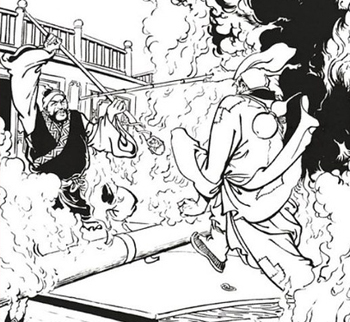
This ends up with Hong Qigong fighting him on the burning deck of his ship, while Guo Jing and Huang Rong (who arrives during the chaos and whose own ship becomes unavailable because her crew are shits) manage to secure the lifeboat.

A burning sail drops on Ouyang Feng and Hong Qigong does something inexplicable.

He saves the bastard.

Of course Ouyang Feng immediately stabs him in the back.

One boat, one island shipwreck and one raft later…

Everybody ends up shipwrecked on the same island. Hong Qigong is seriously injured from his fight with Ouyang Feng and Guo Jing and Ouyang Feng are nowhere to be found – believed at the time to be drowned.

Ouyang Ke begins trying to rape Huang Rong immediately. And she does a GOOD job of fighting him off. His first attempt, she stabs him in the leg, giving him a huge gushing gash.

The second time, she manages to use a set of armour that’s like mithril covered in needles to rebuff him.

The third time (you think he’d have got the message by now) she almost drowns him.

The fourth time (seriously, I said this guy was a creep) she drops a ten-ton boulder on his legs, pinning him where the inevitable tide WILL drown him, but only after half a day of excruciating agony.

So of course that’s when his dad turns up.

The long and short of it is that the good guys manage to survive Ouyang Feng’s visit to the island, and Guo Jing and Huang Rong are reunited, but the Ouyangs steal their raft off and disappear into the sea.

Of course not before Huang Rong sabotages the raft so that it’ll collapse the same way as ship #1.

They build a second raft and leave the island, heading back toward the mainland, when they hear the sounds of people screaming for help. It’s the Ouyangs, of course.

Huang Rong wants to leave the two villains to drown. Hong Qigong says no. They have to rescue the Ouyangs. Even though they’re both psychotics. Even though they almost certainly (and in fact do) try to murder everybody as soon as they’re on the new raft. And although I disagree with him on the action he chose, I think Huang Rong  was totally right here, I actually feel there’s something very important in the reasoning he uses as to why.

Because, of course, Huang Rong challenges him.

And he says it’s not about the quality of the Ouyangs. The Beggar’s Sect (the organization that Hong Qigong and Huang Rong are members of, the organization, in fact that he’s grooming her to become the new leader of) doesn’t leave people to drown or die.

Of course, Ouyang Feng immediately attacks (Huang Rong has efectively eliminated the threat that Ouyang Ke poses to anybody pretty much ever again, he’s just along for the ride at this point) and, just as with every other boat-oriented fight up to this point he ends up destroying the raft and dropping everybody back into the sea.

Now for all its absurdity (and it’s an incredibly absurd piece of fantasy, which will eventually end with Zhou Botong riding a shark like a horse) there are two things I love about this. And those things are in conflict.

First, I love that Huang Rong neutralizes Ouyang Ke all on her own. It’s a handling of rape that a lot of western books haven’t managed, even though this novel is over half a century old.

Ouyang Ke is a monster. And he gets his comeuppance repeatedly. Everytime he tries to abuse Huang Rong, he fails. And every time he fails he’s punished, by her, worse than the time before. By the time she’s done with him, he’s literally half the man he once was, his legs pulverized by ten tonnes of rock.

But I also love Hong Qigong’s unwillingness to let his enemies define him. He knows, by the time he rescues Ouyang Feng a second time, that his enemy won’t relent, won’t behave humanely. But for all of Ouyang’s monstrosity, he’s a person drowning on a ruined boat. And Hong Qigong follows a set of cultural norms that say “you don’t let people drown on ruined boats. Ever.” And he sticks to that.

Justice sometimes means being true to your ideals even when it might be a bad idea

But I said that there was a lesson here for the 21st century. And it’s not Huang Rong’s lesson – that it’s good to allow your fictional heroines to rescue themselves – though that’s a darn good lesson that a lot of authors should take to heart.

In fact it’s not a lesson for writers at all.

It’s a lesson for leaders and politicians.

In the early days of the 21st century we entered into a war in Afghanistan. The people our armies attacked there certainly acted inhumanely. They bullied civilians. They treated women as property to be used as they saw fit. They attacked indiscriminately at times, even when doing so might be as harmful to them as it was to their targets. The Taliban are, and were then, bad people.

But that doesn’t justify what we did.

Canadian culture in the second half of the 21st century is predicated on certain ideals: that war is cruel and that when our soldiers go abroad it should be as peacekeepers, not war makers; that torture is wrong; that child soldiers are victims; that people deserve due process under the law, that they are innocent until proven guilty.

In the first two decades of this century we’ve violated every one of those principles. Canadians have waged aggressive war. Canadians have sent child soldiers, knowingly to be tortured. Several people have been detained without due process. Declared guilty on a name and a skin colour.

Maher Arar – an innocent man, denied due process, detained and tortured.
Omar Khadr – a child soldier, a victim of the very same people who we called “enemy,” denied due process, detained and tortured.

And many others. They have been wronged. And we have wronged ourselves by allowing it. In the aftermath of something horrible, we decided we cared more about our loyalty to our neighbors to the south, to their anger and grief, than we did to the principles that define us.

In so doing we acted against a pretty awful group of people. But those actions caused us to betray our principles. We violated many of the better ideals that define us. And in so doing we acted with the same casual cruelty that we claimed to be fighting, harming victims and innocent people in our haste for imagined justice.

I’m all for villains getting their just desserts. When Huang Rong crushed Ouyang Ke under that boulder I cheered.

But I also see Hong Qigong’s point, not even so much in the particular, but in the abstract. If we want to be good people, if we want to be upright, it is important that we adhere to what is right.

And doing the right thing, being just, sometimes means the bad guys get away. And sometimes it means more trouble for us down the road when those same bad guys come around again and stir up more trouble.

That can happen. And that sucks.

But when the alternative is becoming the villains of our own story?

You know what? I can’t even really make a pretense of tying this back to the story from here on out. The torture report in the US is being back-paged by bullshit about Sony playing marketing games with a turkey of a movie because the opportunity to do so was handed to them by North Korea.

It’s cyinicism on all sides. The media reporting on the hacks: cynically driving clicks. Sony: cynically playing up patriotism and fear of the other to sell tickets. North Korea: cynically playing up the role of the crazy person to keep their enemies cautious and to feed their own propaganda machine. And the power brokers who own the media over here, cynically back-paging the relevant story, the one about the bad stuff happening in the States, bad stuff that we Canadans were fully complicit in, because they don’t necessarily hold the ideals of justice or uprightness in high regard. Not when there’s profit to be made.

Fuck Sony.

Fuck North Korea.

Here’s the torture report. Spread the word.

CIA Torture Report: "Committee Study of the Central Intelligence Agency's Detention and Interrogat…

https://www.scribd.com/embeds/249656256/content?start_page=1&view_mode=scroll&show_recommendations=true

Review: The Three Body Problem

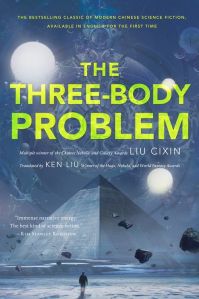
The-Three-Body-Problem-Liu-CixinIf you read one Science Fiction book this year, make it the Three Body Problem, by Liu Cixin, translated by Ken Liu. It is the first book in the Three Body trilogy, and an exceptional starting point for people interested in reading Chinese genre translations.

I really want to get into a thorough exploration of the work, but that’s going to tread into some spoilery territory, so what I’ll do is start with a brief review up top and then include the longer spoiler review at the bottom. I’ll provide ample warning, so if you haven’t read the Three Body Problem and want to be surprised you’ll get plenty of warning.

The non-spoiler review

The Three Body Problem starts with a gut-punch and never lets up from there. And that’s part of what makes this book so exceptional. Chinese fiction, especially, has a different pace and structure from western fiction. As a result, translations of Chinese novels often have issues with pace.

This is not the case here. Ken Liu has tread a very masterful line between preserving the cadence of speech and the structure of the story on one hand, while providing a book that flows correctly in English. If you’re familiar with works translated from Chinese it will still feel like a translation – but it’s one of the best I’ve ever seen, easily on a par with the Shapiro translation of Outlaw of the Marsh, which has long been my gold standard. In fact, Liu’s translation likely exceeds even that one.

The impeccably paced story starts in the throes of one of the most tumultuous periods of the Cultural Revolution, before jumping to the near future. It introduces us to a world populated by scientists an soldiers, plutocrats and police. One scientist, Wang Miao, is recruited to investigate an unusual rash of suicides among theoretical physicists. The extra-governmental cabal that recruits him hints darkly that these deaths are part of an ongoing secret war.

As Wang digs deeper into the mystery his whole world begins to fall apart. And then there is that tantalizing video game…

Themes

Exploring topics including cycles of history, chaos and order, the lasting impact of violence on the psyche of survivors, string theory and first contact, it would be an understatement to say that the Three Body Problem is an ambitious book. However it is not a book in which ambition outstrips ability, and Liu Cixin manages to keep several thematic balls in the air with apparent ease, deftly tying the suggestion  that, “other than Stable Eras, all times are Chaotic Eras,” both to mathematical problems in chaotic systems and to politics.

Madeline Ashby recently discussed how she would like to do away with the idea that there is a binary division between hard and soft SF. I think The Three Body Problem provides a valuable example for why she’s right. This story is a scientifically rigorous story about scientists. And that’s effectively the operating definition for the hardest of the hard SF. And yet this is also a story which is entirely driven by the internal lives of its protagonists (and antagonists), and one which is much more interested in the impact of a cultural movement on the world than the direct impact on technology. These are both hallmarks of soft SF. And being constrained by neither of these binary positions it’s a better novel.

Characters

A few characters stand out: Wang Miao is an interesting protagonist – at times sharp witted and incisive, at other times retreating and confused. We’re invited to empathize with his sense of awe with the circumstances he’s thrust into, his vulnerability in the face of something much bigger than himself, while still being able to understand why he is the central figure for much of the story.

Ye Wenjie is another example of a beautifully complex character. Sometimes a kindly grandmother, other times a stubborn intellectual, always somebody struggling with the remnants of post-traumatic stress that was never allowed to heal, she is the thread that connects the disparate times and themes of the book most closely and is wonderfully rendered.

Shi (Da Shi) Qiang would have been the hero of a lesser work. This morally suspect disgraced soldier and failing cop is a man whose main failing seems to be a total inability to keep his mouth shut. And yet his bluff charm, easy humour and impish ingenuity make him lovable, even when it becomes clear he’s pretty much a total psychopath. Positioning him as a foil to the cerebral Wang Miao helps to establish this story as happening in the world – and gives the story enough dirt under its nails to remove it from what might otherwise seem an ivory tower parlour mystery.

This is about all I can say without venturing into spoiler territory.

So be forewarned.

If you haven’t read the book and want to avoid spoilers turn back now.

The spoiler review

Chaotic systems and cyclical systems

Compare the Trisolarian statement that, “other than Stable Eras, all times are Chaotic Eras” with the thesis of the first Chinese novel, “a kingdom long united must divide, a kingdom long divided must unite,” and we can see a through-line in the idea of history as a cyclical process.

And yet, where Luo Guanzhong saw destiny and inevitability, Liu Cixin instead invites chaos and unpredictability. While it is true that history cycles between periods of relative stability and harmony, and periods of conflict, he proposes, we cannot know when such a period will end, or even the form the conflict will take.

The factional divides within the ETO mirror the previous factional divides in the Red Guard so closely. Both are born of idealism. Both invite the disaffected. Both fall first into fanaticism and then into nihilism and both are ultimately most vulnerable to internal divisions brought about by their own fanaticism.

What lends an air of cyclicality to this is the way in which Ye Wenjie is so effectively demonstrated as a victim of the Cultural Revolution. She watches her father be murdered for refusing to compromise his principles. She watches her mother morph into something she can barely recognize in order to survive. This is a relationship she is never able (or even particularly motivated) to recover. She learns second-hand of her sister’s death but we, as the audience, are given the opportunity to witness this otherwise disconnected event in almost lurid detail: the passion of the believer and the ultimate futility of her death presented in language more poetic than the rest of the book.

She suffers betrayal at the hands of a would-be friend because he is in a position to avoid punishment for daring to have a differing opinion by casting the blame on her. Her refuge is effective a prison overseen by the military – and by the time she arrives there, almost dead, she is more than willing to sign away any vestige of freedom in exchange for nothing more than security.

And so her decision that humanity is incapable of governing itself, and the extreme action she takes to ensure that the Trisolarians are able to discover the location of the earth are understandable as a person in the depths of powerful post-traumatic stress. The world stabilizes around her, but she doesn’t even notice because she’s so wrapped in her own pain.

And yet, the organization that grows out of her actions, the one she becomes the titular commander of (even if not so much in actual function) rapidly falls into the same factional in-fighting and extremism that informed the cultural revolution.

Out of her desire to save humanity from the destruction of its own Chaotic Eras, she sows the seeds for the collapse of the next Stable Era.

Wang Miao, on the other hand, is very much a product of stable times. When we first meet him, he tells a gang of police and generals to get lost, secure that his position of relative wealth and prestige is sufficient to protect him. And it works – they have to plead with him to come to a meeting with them. They can’t just compel cooperation from Wang like previous government forces did from Ye. Furthermore, though he might have been old enough to remember at least the end of the Cultural Revolution, we never learn much at all about what he was doing at that time. It’s the Deng era of opening up and stability that define his experience.

It’s unsurprising he’s reluctant to involve himself in a shadowy conflict when he’s got such a pleasant bourgeois life.

This makes his shock when the world starts twisting into something far weirder all the more intense and poignant.

While Ye, unable to recognize the arrival of peace, and unwilling to accept that the world has stabilized makes a terrible and portentous decision because she can’t accept peace, it is ultimately the idea that the world is descending into chaos that Wang struggles with most.

By the time he’s willingly stringing his monofilament lines across the Panama Canal, watching unflinchingly as it slices a sailor into several pieces, we realize how tenuous our sense of comfort is – how any time the world might descend into chaos.

Shi Qiang presents one final view of how people relate to chaos and stability. He’s not broken by chaos like Ye, nor must he learn to adapt like Wang. Rather he thrives off chaos.

This “demon” laughs, teases and boozes his way through situations that leave the people around him reeling. It’s Shi who sees something fishy in the “miracles” sent to confound Wang, Shi who suggests using Wang’s monofilament to take the Adventist base and  he expresses no remorse either at the deaths of all the Adventists, or of the limited civilian casualties the plan will cause. He even suggests attacking during the day to minimize the risk that sleeping Adventists might survive.

When the Trisolarians send their final message to Earth, declaring everyone there insects, Ye goes to watch the sun set on Humanity in the place where she doomed it. Wang descends into depression. And Qiang leads his allies to a town afflicted by locusts.

He points out that the locusts might be as beneath humans as the humans appear to be beneath Trisolarians. But the locusts still thrive, despite everything humanity does. Even though humans never had to deal with the madness of living on a planet in a trinary star system, adapting is something we’re adept at. Shi Qiang invites chaos. It’s his constant ally.

Science in the Three Body Problem

There are a few interesting branches of science discussed or extrapolated from in the Three Body Problem. Since it is science fiction I figured I should at least touch on them.

 The Three Body Problem

The titular problem is a classical physics dilemma. While two bodies act on each other in a predictable fashion, they move toward each other unless acted upon by an outside force, introducing a third body causes the system to become chaotic.

The near impossibility of the task occupies much of the Three Body game segments of the story – as Wang learns the history of the Trisolarian attempt to chart the behavior of their solar system sufficiently to be able to survive its Chaotic Eras and maximize its Stable Eras.

There’s also multiple instances of factions divided into threes within the book: Battle Command, the ETO and the Trisolarians for example, or within the ETO, the Adventists, Redemptionists and Survivalists. These allow this classical problem to both serve as a metaphor for the conflicts of disparate groups, and to be reflected by the chaotic actions of the various factions.

A solar antenna

I’m not certain how fantastical this is. But Liu’s description of Ye Wenjie using the sun as a supermassive antenna for trans-solar transmission is really cool. It made me want to learn more.

String theory

I’m still not entirely sold on string theory. It remains resistant to experimental verification and isn’t parsimonious. That said, the Trisolarian plot depends on unfolding protons from 11 dimensional string theoretical complexity into 2 dimensions in order to create proton-sized artificial intelligences. This leads to one of the most beautifully abstract areas of the text, which I loved every moment.

Nanotube Monofilament

These things are starting to exist in the real world. How long before we get Wang Miao’s weaponized version?

Wrap-up

The Three Body Problem is a tour de force of speculative fiction. It fluctuates frequently between wonder, humour and despair. Ultimately this is a story about how people break, and it breaks its protagonists beautifully. And yet, for all their brokenness it ends on a bitter note of hope.

This, when you consider the scope of Chinese fiction over the last 500 years, positions the story beautifully in the context of its antecedents.

If you regularly read translated SF you’ve probably already put the Three Body Problem on your to-read list.

If you don’t, this book is a perfect place to start, beautifully written and beautifully translated.