Kid’s Stuff – The Double Binds of Barbie

Barbie (2023) is perhaps the most thoroughly postmodern children’s movie produced to date. The marketing material for this film promised that it was the movie for you whether you loved Barbie or hated Barbie and the film delivers almost precisely this – a story that attempts to shatter any grand narrative surrounding this toy. This is done from a variety of directions: first by establishing, as the premise of the film, that Barbieland is perfect – for Barbies – and that the Barbies who live there are comfortable in the knowledge that through the nebulous and infinitely transforming nature of Barbie they have created an avatar that allows girls, and by extension women, to be anything. The film then sends Barbie out of Barbieland and to the real world – in which the lie to that statement is revealed in full.

And yet, the Barbie movie also refuses to fully let go of the idea of Barbie as a mystical avatar for modern femininity. This creates one of the central double-binds of the film. The Barbie movie wants to demonstrate both that Barbie is representative of the aspirational desires of women but also that it is insufficient to the task.

These sorts of double-binds proliferate the text quite openly such as a late scene in which Gail, the Mattel executive assistant and frustrated mother whose spiritual bond with Margot Robbie’s “stereotypical Barbie” leads, in part, to the action of the film delivers a monologue saying, “You have to be a career woman, but also look out for other people.

“You have to answer for men’s bad behavior which is insane but if you point that out you’re accused of complaining.

“Because you’re supposed to stay pretty for men but not so pretty you tempt them too much or you threaten other women. Because you’re supposed to be part of the sisterhood but always stand out.

“You have to never get old, never be rude, never show off, never be selfish, never fall down, never fail, never show fear, never get out of line. It’s too hard, its too contradictory, and nobody gives you a medal and says thank you.”

Many critics have been fast to point out that much of the feminist content of this film is reminiscent of “girlboss feminism” – a kind of reintegration of third-wave Feminism that has been fully subsumed by capitalism. But this, too, is a bit of a simplification of a central double-bind for the film in which the CEO of Mattel mumbles that the company is built of women and that two prior CEOs were women while standing amongst a cadre of nameless male executives but in which the ghost of Ruth Handler maintains an office and seems, in some way, to still be running the company. This is a film in which Mattel is proven incapable of taking action of any moral significance because it is restricted by the profit motive but also one in which Mattel will also take moral action because it is restricted by the profit motive. The theme of the Barbie movie is so fragmentary as to be almost fractal.

And, of course, the Barbie movie shares a common concern with other postmodern films such as The Matrix with regard to authenticity and the order of simulacra. However, where the latter settles toward a Kierkegaardian celebration of the leap toward the authentic against all rational odds this movie instead spends two of its three acts reveling in probing the boundary between simulacra and the real. Barbieland is like a town in Sweden. However, when the pedal hits the metal the Barbie movie collapses any vestige of a division between simulacra and the real in favour of a Beauvoirian recognition of the necessity of self-announcement of being.

However let’s not suggest that Gerwig and Baumbach were able to get ahead of the greatest existentialist ethicist with their script. The script introduces our Barbie in a role that maps to Beauvoir’s description of narcissism. “Her memories become fixed, her behavior stereotyped, she dwells on the same words, repeats gestures that have lost all meaning: this is what gives the impression of poverty found in “secret diaries” or “feminine autobiographies”; so occupied in flattering herself, the woman who does nothing becomes nothing and flatters a nothing.”

And from there the film charts her evolution toward a kind of liberation, while attempting to recognize the fundamental incompleteness of the struggle. It’s, honestly, one of the better interpretations of existentialism in any recent scripts. I’ve commented elsewhere that Gerwig and Baumbach appear to grasp Beauvoir far better than the Daniels did Camus and, while I still think Nope did a better job of interrogating questions of recognition and the look, this was in part because Nope was a movie for adults and, as such, could get darker than a children’s comedy. And the script here is very good. It’s funny – very funny – and designed in a way that stays alert both to the child audience who are the primary targets of the film and the inevitable parents who will be escorting their kids there.

But, for all that the film uses Beauvoir’s feminism to strong effect they miss something very critical that Beauvoir said of liberation. “These civic liberties remain abstract if there is no corresponding economic autonomy; the kept woman—wife or mistress—is not freed from the male just because she has a ballot paper in her hands; while today’s customs impose fewer constraints on her than in the past, such negative licenses have not fundamentally changed her situation; she remains a vassal, imprisoned in her condition.”

The action of the Barbie movie comes to a head as the Barbies manage to protect legal rights via legal democratic action. Their economic dependence upon Mattel is, not only not abolished, it’s reaffirmed when Mattel realize that certain progressive doll ideas put forward by Gail would be very profitable. And this is the realm in which the incomplete double-binds of Barbie really strike at it. “Woman’s fate is intimately bound to the fate of socialism,” Beauvoir says, and the film is unable to follow her down such socialist lines of inquiry.

It does appear that the film is aware of this. There is a self-conscious and recursive auto-critique of Mattel present throughout the movie that treats capitalism as being bleak, dangerous, byzantine and ritualistic in ways that recognize both the libidinal irrationality of capitalism and its tendency to co-opt its own critique. The situationist double-bind of the intrinsic spectacle of capitalist critique is fully present in this film and there’s no effort made to conceal that it is the simulacrum of a criticism rather than anything actually cutting. Mattel makes out like the subject of a televised roast.

But this is a children’s movie. Am I saying I want children’s movies to be socialist propaganda? I mean yes. But that’s neither here nor there for navigating the central tension I’m picking at with this film between its postmodern obsession with the real and the fake and its attempt to create a Beauvoirian thesis regarding objectification. Because this gets to something I’ve danced around until now: how much of the film is predicated upon the conflict intrinsic in “Barbie has a great day everyday. Ken only has a great day if Barbie looks at him.”

It’s kind of funny that one defense I’ve seen of the film is that it might encourage little girls to ask about what the Patriarchy is. And that’s all for the good although mine actually just asked what a gynecologist was. But we do have a moment in the movie where Ken says he grew bored with patriarchy once he realized it didn’t have anything to do with horses.

Ultimately the film correctly places patriarchy as being, in part, a failure of the Kens to be for-itself. (I know, it would be lovely to get through an issue of Kid’s Stuff without bringing in Heideggerian phenomenological terminology but, like, it was Gerwig and Baumbach who decided to put this much Beauvoir into their discourse so here we are, again.) Effectively Ken depends upon the gaze of Barbie in order to validate his being. He doesn’t have much of a stable identity. His job is “beach” – not lifeguard. Just beach. But Barbie, being something of a body without organs, escapes the for-itself / for-others dichotomy a bit more than Ken who is oriented so thoroughly to validation via Barbie that he ends up existing only for Barbie. Barbie is effectively nothing because she contains the potential to be anything. Ken is just Ken: hyper-determined in his transfiction in the gaze of the other.

This is, honestly, where it becomes clear that the scriptwriters understand Beauvoir at least outside of her socialism. There is more depth of feminist theory to the psychological landscape of Ken than there is in the boilerplate “girlboss” feminist speeches of Gail and her daughter. Instead Ken’s catharsis comes about from the realization that he needs to understand who he is when he’s not with Barbie. His antagonistic turn and dalliances with patriarchy arise out of the frustration he feels at his own superfluity. Ken tries to bring down Barbieland because he can only have a good day when Barbie looks at him. And Barbie has her own shit going on right now and kind of just doesn’t need constantly validating Ken’s existence to be her focus. The central mystery of where Kens go when Barbies aren’t with them is never resolved because Ken ends the film beginning the search for the answer to that question. And meanwhile Barbie is taken up by God (I mean the ghost of Ruth Handler) and is told that she cannot ask for humanity. No power can give her authentic being for itself. She has to announce it for herself.

I liked the Barbie movie quite a lot. It’s very funny. It’s well-written, well-shot and well-designed. A central scene in the real world in which Barbie is overcome by the beauty of the natural world and is brought to tears demonstrated that Gerwig’s pretensions to indy artistry were strong enough to survive into what should be an over-glorified toy commercial. It helps that it’s very well peformed with Robbie delivering some of her best work of her career in this film. Initially comparisons to The Lego Movie might seem appropriate but that would be doing this film a disservice. Greta Gerwig has created a very good children’s film on the back of Margot Robbie and Ryan Gosling’s considerable talent and chemistry. They’re both excellent comedic actors and displaying their talents very well here. There is a remarkable strangeness to this film with its ghosts and ritualistic CEOs, with its plastic other-world and its metaphysical bond between toys and people that is honestly refreshing and that resists boiling down to “parent-child trauma” the way so many of these other toy movies do. In fact the closest this movie gets to that is making it clear that a parent is ultimately not responsible for choosing who her child will grow into.

I like that this movie is one that infuriates all the very worst people. It amuses to imagine Ben Shapiro furiously marking down a tick on a notepad every time somebody says the word Patriarchy in this movie. However the Barbie movie demonstrates a key problem with taking the work of materialist leftist theorists and divorcing them from their economic contexts. The Beauvoir of the Barbie movie is a remarkable work of fictional reproduction. But it’s incomplete through the absence of a coherent economic critique. The Barbies save the day with a vote to protect the constitution and via protecting the liberal character of the supreme court. This failure of the Barbie movie to be as cogent about formal politics and capitalism as it is of cultural criticism of patriarchy is an obvious artifact of the “toy commercial” aspect of what Mattel wanted from this movie. This is to its detriment.

And yet still it is a movie that is satisfied with presenting the messy facticity of life and telling the girls who are its primary audience that it’s alright to be mixed up, frustrated and confused just as long as they keep working toward being for themselves and that nobody will give them this. They must announce it.
Prophesy and Silence

As part of our ongoing dialog over leftist praxis and AI, Nicolas Villareal recently put forward an article regarding the position of prophesy in theology and the question of the future. In it Villareal points toward prophesy as a universal of religion on a par with Herbert’s statement regarding the religious concern for the condition of the soul. Villareal argues prophesy is necessary for the formation of an ethic at social scale, saying, “In our everyday lives we can make decisions based solely on what we deem is a virtuous action, or whatever animates our personal cosmologies, but when we seek to affect the whole of the social world, changing the very foundations of society and the processes which shape people’s souls, there is a deeper set of consequences and difficulties. It is at this juncture that we must consult prophecies,” before arguing, contra Benjamin, that the character of the angel of history is that of a destroyer, that there will be an end to history and that it will be entropic, so entropic, in fact that “History will end with the end of destruction, on one level of abstraction or another.” This is a logical position to reach when you attempt to reassert a position for the timeless into one’s metaphysics such as by tracing the position of a single electron throughout the duration of all time.

There is quite a lot that is very fascinating here to discuss on topics theological, ethical and metaphysical but, as this discussion has largely centered around the position of theology within praxis, I think it might be best to begin by interrogating the claim that prophesy is a theological universal.

We can start by interrogating prophesy directly. We can start by looking at Acts 1:7 which reads, “When they therefore were come together, they asked of him, saying, Lord, wilt thou at this time restore again the kingdom to Israel? And he said unto them, It is not for you to know the times or the seasons, which the Father hath put in his own power.”

It is not for you to know.

This fundamental anxiety is something which Kierkegaard grappled with in Fear and Trembling and it is from his chosen pseudonym, Johannes de Silentio, that we see a universal counter-principle to prophesy within religion in the form of silence. Religion arises, to no small part, out of the silence of the gods. People, posing questions to being itself receive back nothing, there is no answer to the prayer. For Kierkegaard this silence was critical to any true display of faith. In Fear and Trembling de Silentio speaks of a story from Aristotle regarding the Delphic Oracle. In it a man is due to be married when the auguries warn that the wedding will bring him grave misfortune. He makes a decision in light of the prophesy to forego the wedding and the vengeful family of his bride conceal temple goods among his possessions, dooming him to death for his transgression.

De Silentio details some choices the suitor could have made and suggests, “shall he keep silent and give up celebrating the wedding? In this case he must embroil himself in a mystifictition by which he reduces himself to naught in relation to her. Aesthetics would perhaps approve of this. The catastrophe might then be fashioned like that of the real story, except that at the last instant an explanation would be
forthcoming–however, that would be after it was all over, since aesthetically viewed it is a necessity to let him die … unless this science should see its way to annul the fateful prophecy.”

And so what we have here is prophesy as doom. The words of the Oracle are order-word, words that, “bring immediate death if they do not obey, or a death they must themselves inflict, take elsewhere.” Here the prophetic order-word of the Delphic Oracle literally brings the immediate death of the suitor whether he obeys or no. Marry and suffer misfortune. Heed the prophesy and die. The only hope for the suitor lies not in prophesy but in silence.

For de Silentio it is not merely the destructiveness of prophesy that brings him to prefer silence but also that he sees silence as the wellspring of faith. He describes silence as a method whereby a doubter can transform his silence to guilt and thereby absolve himself of the sin of his doubt, “Even the New Testament would approve of such a silence,” he announces.

Silence provides a barrier to knowability but not to meaning. Faith is not to be found in any sort of majoritarian meaning but in silence: “It is not as though Abraham would thereby become more intelligible, but in order that the unintelligibility might become more desultory. For, as I have said, Abraham I cannot understand, I can only admire him.”

Abraham’s duty to God exceeds any sort of ethic and it is this strange aim of de Silentio to divide the concept of duty to God directly from any intelligible ethic. Abraham doesn’t serve God because he knows it to be good. He does not have the comfort of prophesied knowledge to guide him. Abraham serves God because it is to God he owes his ultimate loyalty irrespective of ethical concerns. Meanwhile these machine gods of capitalism talk too much, as do their priests.

For Derrida this silence extends beyond the text as given and at least to the signature by which the book was signed: de Silentio. “This pseudonym keeps silent, it expresses the silence that is kept. Like all pseudonyms, it seems destined to keep secret the real name as patronym, that is, the name of the father of the work, in fact the name of the father of the father of the work.”

But names are a slippery thing and Derrida puts no more weight behind the patronym than LeGuin does in A Wizard of Earthsea. Rather Derrida suggests this act of self-naming is ultimately more meaningful than the legalities of patronym. The power behind a name comes from the, “secret name by which one calls oneself.”

It is almost as if Derrida were to create a minor language out of the pseudonym. If we treat the patronym as prophesy – a statement at birth that this person is destined for this experience – then this self-secret name, the pseudonym and the silent name in the heart of a subject becomes the undoing of that order-word. We see Paul Attreides too attempting to escape the face of his father in the names Usul, Muad’dib. And his visions are uncertainty. He sees history as an ever-unfolding topology of rise and fall. The doom of Muad’dib is that prophesy fails to become an order-word because of what must be kept silent. When Leto II arises, robed in the name of the father of the father of his work, he brings with him the golden path and the peril of prophesy once more.

In Herbert’s cosmology prophesy presented the risk of stultification. A people who knew too clearly the path before them would be complacent or fatalistic. Likewise, the doom that comes to Aristotle’s suitor comes from fatalistically denying his bride for fear of prophesy. Is, then, prophesy a true universal of religious experience or is it the method by which social power harnesses the mystic impulse of the masses?

The way you can go isn’t the real way.
The name you can say isn’t the real name.
Heaven and earth begin in the unnamed:
name’s the mother of the ten thousand things.
So the unwanting soul sees what’s hidden,
and the ever-wanting soul sees only what it wants.

LeGuin’s treatment of the Tao Te Ching touches on this idea of the divine as the silent and the hidden. This is an odd text: a political and spiritual treatise for kings rendered into an anarchist metaphysics, the great surpassing of Heidegger in a short translation assembled hodge-podge from other translations. Le Guin obliterates the idea of an original root text here and instead takes her meaning where she can find it. It is, as translations go, one marked by a kind of desultory elimination of meaning, so occupying contradiction as to become a cypher. Of the first verse, Le Guin said ” A satisfactory translation of this chapter is, I believe, perfectly impossible. It contains the book. I think of it as the Aleph, in Borges’s story: if you see it rightly, it contains everything.”

But if this is so, why translate at all? If this passage, seen right, allows one to see everything why not simply write, “道可道,非常道。名可名,非常名。无名天地之始;有名万物之母。故常无欲,以观其妙;常有欲,以观其徼。此两者,同出而异名,同谓之玄。玄之又玄,众妙之门,” and say, this contains within it the universe? But, of course, this is LeGuin toying with her readers. “I believe that the Aleph of Calle Garay was a false Aleph,” the story says before detailing other possible false manifestations of this totality. “Does that Aleph exist, within the heart of a stone? Did I see it when I saw all things, and then forget it? Our minds are permeable to forgetfulness; I myself am distorting and losing, through the tragic erosion of the years, the features of Beatriz.” The silence of the forgotten creates doubt in the most total of all visions. And the act of translation, if we take Le Guin at her word, necessarily reduces the meaning of the statement. Otherwise a perfect translation would not be impossible. It is, perhaps, that a maximal quantity of meaning is necessarily harmful to intelligibility. If one did, in fact, see everything, all at once, how would they possibly remember it? The name you can say is not the real name. The careful ordering of meaning in the patronym collapses in the face of the secret name.

Marx, certainly, cautioned against the pride of prophesy writing against, “recipes for the cook-shops of the future,” as it would depend on knowledge that was unavailable. And this presents us with a dilemma: the act of prophesy necessarily cuts off avenues to the future. The act of giving voice to this or that future necessarily attempts to render Abraham understandable again at whatever cost to our faith.

In the end, perhaps we are all fools for treating religion as a monolith when there are clearly majority and minority threads running throughout it. Religion is a field of contestation for political power. And those people who would assume power will find the order-word of prophesy a tool to their liking. For those who would rather destitute power the mystical silence that speaks to the unknowable of the divine will serve far better.

Intelligibility is not coextensive with meaning. Meaning requires an ecstatic apprehension to be grasped fully. It also requires mortality, as Borges so plainly says in The Immortal, “Homer composed the Odyssey; given infinite time, with infinite circumstances and changes, it is impossible that the Odyssey should not be composed at least once… Everything in the world of mortals has the value of the irrecoverable and contingent. Among the Immortals, on the other hand, every act (every thought) is the echo of others that preceded it in the past.” Immortality is anathema to meaning.

Meaning is not found in the hyper-legibility of AI that Villareal proposes but is rather found in the brief ecstatic moments that break even the reverie of the Immortals, “the ancient elemental pleasure of the rain.” Meaning isn’t found in the legible text of a complete set of all words and their relationships to other words but in the silence that follows when a body experiences the world.

“Action introduces the known (the manufactured); then understanding, which is linked to it, relates the non-manufactured, unknown elements, one after the other, to the known. But desire, poetry, laughter, unceasingly cause life to slip in the opposite direction, moving from the known to the unknown. Existence in the end discloses the blind spot of understanding and right away becomes completely absorbed in it,” Bataille says, pointing out that these forms of beauty that make life worth living depend not on legibility. There’s no words to a laugh. And Beauvoir reminds us, ” If the satisfaction of an old man drinking a glass of wine counts for nothing, then production and wealth are only hollow myths; they have meaning only of they are capable of being retrieved in individual and living joy.”

If we are to look to the Angelus Novus as a destroying angel then we must ask whether our project is tied to raising up a power or to striking one down. We have seen the fruits of prophetic revolution. In nearly every case it has turned back around to embrace capital and a hierarchy of powers. True Communism may, as they say, have never been attempted but Thich Nhat Hanh situated true communism in the silent contemplation of the Sangha saying of Buddhist monastic life, “we are the true communists.” Perhaps we should consider whether the theology operating the mechanical Turk of historical materialism might better be a silent, secret, invisible one: a mystical theology that has no truck with prophesy as the construction of limits that it is.

Perhaps the puissance of a revolution that can bring down the order of things is one that exceeds limits, that takes the world whole. The Denma Translation Group describes taking whole, an ontological concept from the Sunzi, as a perspective on the word as a “multitude of shifting, interrelating aspects.” This is in keeping with a classical Chinese metaphysics that describes reality as the fluid interplay between forces. The Denma group counsels us to treat objects as ever-shifting interactions. This is, again, the constantly transforming topology of Muad’dib’s vision which we must contrast with Asimov’s psychohistory.

At first blush it might seem as if Hari Seldon’s great science were taking the universe whole. The first axiom of pyschohistory was that a population had to be sufficiently large to be treated probabilistically, in a manner akin to Brownian motion. This movement of particles has been a fascination of metaphysicians and physicists alike at least since the time of Lucretius who saw in the flitting of dust particles within the air a satisfactory response to the fallacy of the prime mover. For Lucretius, an atomist, it was sufficient to suggest that the atoms moved themselves. Einstein later demonstrated that the dance of particles was the result of one particle being acted upon by many other smaller particles. this is inconvenient because it tends to reintroduce the problem of the prime mover. This is a tendency Meillassoux argues against, saying, “our claim is that it is possible to sincerely maintain that objects could actually and for no reason whatsoever behave in the most erratic fashion, without having to modify our usual everyday relation to things.” In other words: Leucretius was right. When you eventually get to something monadically small, so small there is no more sense of fluid to jostle it around in, objects move themselves. Meillassoux considers the most common responses to Hume’s questions regarding causality unfounded. Dismissing both Popper’s view as insufficient to addressing Hume’s complaint and also saying, “the nature of the problem is actually unaffected by the question of whether or not natural laws will turn out to be probabilistic.” This introduces contingency back into the microscopic realm of very small particles, Einstein be damned. Meillassoux, in fact, seeks to out-Hume Hume, saying of the great skeptic, “The self-evidence of this necessity is never called into question. This is obvious in the case of the metaphysical and the transcendental solutions, since they both proceed by trying to demonstrate its truth, but what is less obvious is that Hume too never really doubts causal necessity – he merely doubts our capacity to ground the latter through reasoning.” Meillassoux proposes that there is no reason to assume physical laws operate the same in all places and in all times just because they operate here and now. Specifically he argues that the assumption “If the laws could actually change without reason – i.e. if they were not necessary – they would frequently change for no reason,” is a logical stretch to say the least. Meillassoux then spends considerable time working through how contemporary set theory demonstrates how one cannot create a totality of all possible sets since any totalization would infer the possibility of a further set still greater. (After Finitude, Continuum International Publishing Group, 2011, pages 99-106)

Meillassoux’s eventual conclusion is that, “Kant’s belief in the necessity of laws is thereby revoked as an instance of aleatory reason’s unwarranted pretension to reach beyond the limits of experience.” But, of course the limits of experience are the very thing that Leftist consciousness raising exercises such as those of Fisher and the previous attempts of Acéphale seek to go beyond.

And so we can begin to see the flaws in Hari Seldon’s mathematical prophesies. He depends on the assumption that a totality of possible sets of future histories as the basis of his predictions. This assumption regarding randomness does not hold true. Of course most of Asimov’s further axioms regarding Psychohistory attempt to limit it further but mostly by proposing limits of consistency such as the consistent response of humanity and the presence of only humanity as sentient beings within the universe. These do nothing to counter the critique that Seldon’s account of randomness among vast populations would not necessarily have predictive power.

And then there is the Mule.

This is the point at which the Foundation books tip their hand regarding the ideological assumptions that underpin their fantastical science: Asimov wants to herald the potency of the individual. In fact, throughout the books from Second Foundation onward this becomes the principal discourse: how a single, individual subject might upset probabilistic mathematics and invalidate prophesy.

But, of course, this individual subject is precisely the object voided by the soul of subjective multiplicity. Rather we have a subject who can be divided infinitely. Kierkegaard and Nietzsche may not have understood the mathematics underlying the inference but there is a mathematically unknowable self lurking under the set-theoretical assumptions of Meillassoux.

Villareal suggests the role of prophesy is to, “remember the future as we would the past.” But the consistency of the past is no more secure than the consistency of the future. As with the face of Borges’s lover the past is a changing place from the perspective of the future we now occupy. Our shared referent in Sartre certainly codified that existence comes before essence, that what we see as the essential ontological character of a being arises only as a result of that being having a real existence. But this same ontology argues we can never see an object in its totality, not because of Meillassoux’s computations of the non-total character of sets of infinities but rather simply because every object arises into being as an infinite sequence of appearances. We may be able to mathematically grasp infinities but they still don’t fit in the mind of a normal subject.

And so if we are to salvage prophesy at all it will depend on shattering normativity. The Delphic oracle chewed oleander and inhaled cave fumes to bring upon them the prophetic state: a consumption of poisons that must have brought her perilously close to the limit that is death. Sunzi’s council to take whole depends on a simultaneous occupation of two dissimilar ontological perspectives. One must see the army both as a mass that operates as a body but also as an ever-flowing interplay of relationships each of which is impactful in its particularity. To be a sage one must observe both of these perspectives simultaneously and without a process of dialectical flattening. Dividual subjects in their interrelation and the mass bodies they form both in the process of individuation and in the process of mass formation require the attention of a liberative politic. It isn’t enough for a vanguard to take it upon themselves to say, “the future must go this way” but rather to raze the debris that blocks the view of an infinity of disparate possible futures. This requires a fundamental break from the very idea of norms. Any leftist prophet must be so estranged to the normative as to seem alien. In short: if we are to salvage prophesy we must shatter the normative limits of the prophetic subject.

For Bataille, “What one calls ‘being’ is never simple, and if it has a lasting unity, it only possesses it when imperfect: it is undermined by its profound inner division, it remains poorly closed and, at certain points, attackable from the outside.” This is to say that the normative subject was to be seen as contingent. This might seem good news if we want to salvage any role for prophesy within our project except that we must, to achieve this limit-breaking non-normative self engage in the torturous process of bringing about inner experience and this runs counter to project.

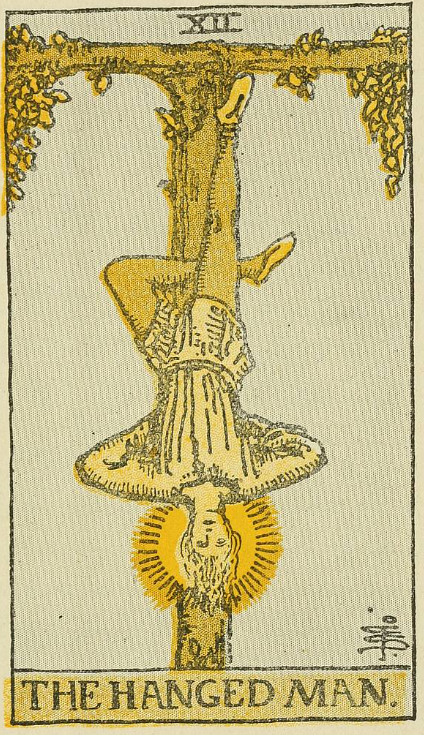
For prophesy to be useful to the Left we must suspend ourselves like Odin and the Hanged Man and even then the strongest prophesy we could hope to gain is the ever-fluctuating topography of Muad’dib – no true future-remembrance. But Muad’dib’s visions, even in their mutability, foreclosed upon the future and doomed him to watch his beloved die. Even a contingent prophesy is an order-word that is subordinate to the direct and ecstatic apprehension of meaning and that seals the fate of the subject of prophesy. If we allow the hyper-legible text lists of AI to serve us as an oracle we will be faced with the hollow Kantian prophesies of Hari Seldon but doom lives even in using a mystical mode of prophesy like that of Muad-Dib. For all that his future was a contingent one, an ever-shifting fabric of transforming possibility, his visions doomed him to watch his true love die and to wander the desert, a blind and raving ascetic. Instead we should focus our sights on a true and full apprehension of immediate material conditions. In this immediacy AI is revealed not as a prophet but simply as another weapon in the unending cycle of primitive accumulation. Instead of building utopia in a preordained future we must discover it here and now in the immediacy of falling rain and in the movement of a body of troops around a camp. The future is always spontaneously erupting. We can access a transformed future by setting it free of the chains of prophesy.

On the mortal soul

When I published my recent piece Toward the Butlerian Jihad one of the concepts I brought in was the mortal soul. This was largely in service, as others have noted, of a secularization of the concept of the Butlerian Jihad – a holy war against “thinking machines” that occupies the position of a considerable historical event in the background of the science fiction novel Dune and its sequels.

However, as has been rightly pointed out by others, playing around with the idea of a soul which could be disfigured raises the risk of reintroducing natural law into our metaphysics. This is, of course, something we should avoid. I had been thinking about expanding on the concept of the mortal soul regardless as a part of my overall project on materialism and magic however, in light of this well-received response, I thought it’d be a good idea to get this explanation out a bit faster than I otherwise might have.

A brief genealogy might be a good place to start. The idea of the mortal soul is something most directly encountered in Nietzsche’s Beyond Good and Evil where he says, “Let it be permitted to designate by this expression the belief which regards the soul as something indestructible, eternal, indivisible, as a monad, as an atomon: this belief ought to be expelled from science! Between ourselves, it is not at all necessary to get rid of “the soul” thereby, and thus renounce one of the oldest and most venerated hypotheses—as happens frequently to the clumsiness of naturalists, who can hardly touch on the soul without immediately losing it. But the way is open for new acceptations and refinements of the soul-hypothesis; and such conceptions as ‘mortal soul,’ and ‘soul of subjective multiplicity,’ and ‘soul as social structure of the instincts and passions,’ want henceforth to have legitimate rights in science.”

Nietzsche attempts to walk a razor’s edge here between a materialist account of the world which abandons the concept of the soul and what he describes as the Christian atomism of the soul which he treats as the last vestiges of a belief in a rigid substance.

Nietzsch’s soul of subjective multiplicity is, instead, a process of transformation that occurs within a person. We cannot treat a mortal soul as a substantial object: a ghost within a shell. Instead it represents the ever-transforming flow of subjectivities, affects and material effects created by a person. However this psychological frame does not discount a theological reading as we can find reflections of this in the far-older concept of Anattā.

This is a thorny issue within Buddhism so I will provide my interpretation which is largely drawn from the Chán school however I do anticipate lively disagreement here. At an etymological level, Anattā means no-self. This is a challenging concept because Buddhism upholds reincarnation as a part of its metaphysical universe and if there is, in fact, no self then what is there to reincarnate?

There are two possible solutions here. The first is to suggest that there is no unchanging self while there may be a continuous stream of being, a flow of moral development and consequence, we cannot point to it as an eternal and unchanging self. After all, how could a person develop toward Nirvāna if change was impossible? As such we see a soul that exists but is, much as Nietzsche would later propose, a “soul of subjective multiplicity.” From this sense it doesn’t matter much if the soul passing between bodies is substantial because it will be caught in a constant transformation brought about by the accumulated weight of its past lives and the condition of its latest birth.

Another solution would be to treat a soul much as a candle flame used to light a second candle. In this case the original flame will eventually burn out but the new flame will remain. The origin of this new flame carries from the extinguished flame before but it is not of a substance at all. Rather it is a spark, a blend of flow and event, which ignites a novel being. The treatment of a soul as a flame is valuable here for creating an account of soul as process. A flame is never still, never static, it consumes fuel it produces waste. Early metaphysicians such as the stoics also associated fire with an elementary vital principle throughout the universe. In this sense fire stands as a form of life and even now that we understand these phenomena to be separate from each other fire remans a valuable metaphor for describing the process of a life as process, as flow and event.

And so what is a mortal soul but the account of the changes brought about through a life. As such the soul extends past the body of any given subject and into the socius that forms around them. A subject is a process of transformation. I am, at 44, not the same person I was at 22 or at 11. And tomorrow I will be somebody different still. The very act of putting pen to paper on this essay transforms me in that it will change, subtly or suddenly, how others see me. This act dissolves the body of the subject into the field of being because it is equally true that subjective changes within me – the idea of what I, as a subject, am is constantly reassessed. Being is contingent and there is no essential character to a being.

This is ultimately my interpretation of Anattā: a being that exists as process and absent substance, absent essence. This, then, gets to my later criticism regarding AI and death. These necromantic objects operate from the assumption of an essence. In order for a podcast with Plato to have any meaning whatsoever there must be an essential Plato who can be conjured back out of his texts.

That the idea of Plato, the soul of the man, is entirely different now as he has become the commentaries of philosophy and counter-philosophy passing through Aristotle and Plotinus, a worm through time all the way to Kant, Hegel and all the rest, makes the idea of a podcast that returns him to a single essential figure who could be interrogated or who could interrogate in some meaningful way absurd.

It is disfiguring of the soul because it wants to fix this process of transformation back into a substance. In the Jean Leflambeur trilogy by Hannu Rajaniemi we see such a mission taken to its absolute extreme as the Sobornost seek to do away with death itself. Their mission, to roll back time and do what Benjamin’s angel of history could not, restoring all the dead souls lost to history is a threat to others in this book’s universe precisely because of the terrifying impact such a deed would have on the ability of (post)humanity to continue to change.

Growth and change depends on the elimination of essence. Once we allow essence into our metaphysics we are trapped by the idea of Platonic remembrance and everything becomes nothing but an emanation of an essential elsewhere.

In the Theses on the Philosophy of History Walther Benjamin describes Historical Materialism as a Mechanical Turk (not unlike these “AI” tools) which must be animated by a hidden theology to become puissant. Atheist Marxists often interpret this as a critique of the failures of Marxism, like Marxism in the 1930s was insufficiently anti-theological, but this depends, to a certain extent of continuing the mistaken reading of “opiate of the masses” to mean “drug, bad, avoid” rather than historicizing it as meaning, “something to ease pain.” If we read the first thesis in a straightforward way we can instead suggest that a theology (I hesitate to say secular theology here as Benjamin was not a person of secular spirit) is needed. Regardless Benjamin’s theological interpretation of Marxism serves to target the very idea of history as a process of progress. Instead history is the wind which blows Angelus Novus into the future as the debris and dead of past eras heap up at his feet. AI technologies then attempt to do what the angel of history cannot and return these dead to us in some essential form.

I know it is a frightening concept to deny that the unknown future will be redemptive and then to insist we must fight to go there anyway. This is why I briefly invoked Kierkegaard at the end of my piece on the Butlerian Jihad because embracing the danger of an irredemptive and unknown future requires a leap past extreme anxiety. We do not leap toward God for his throne is, by now, thoroughly vacated but this increases the urgency by which we must strike down those people who would raise up a mechanical god to redeem the dead of history.

“It was but a step to the illusion that the factory work which was supposed to tend toward technological progress constituted a political achievement,” Benjamin says and I see a similar critique in those who say that “AI” is necessarily a tool that could be meaningfully wielded by a leftist project. When I say that “AI” must be stolen from the Bourgeoisie what I mean to say is that it is insufficient that Proletarian hands wield this technology for Proletarian aims. This is falling for the same progressivist view of history Benjamin rightly criticizes. Rather I am saying that it is a technology that must be denied from the Bourgeoisie. We don’t take it like Prometheus taking fire from the gods but rather to deny other hands the use of it. I see this as a moral imperative because the resurrection of an essential and immortal soul clogs the path to an open and liberatory future. Effectively the leftist project we can trace through Spinoza and Marx to Beauvoir and others depends on us disregarding the rubble of the past. We cannot redeem the dead. There is no past to return to. If we are to be free we must be mortal: we must be subject to absolute contingency and transformation. Meillassoux describes contingency as being necessary if we are to “get out of ourselves, to grasp the in-itself, to know what is whether we are or not,” and, again, this circles back to the anti-facial consciousness raising of Fisher and Foucault. I raise up this spontaneously insurrectionary desire against specters of the social democrats of the Second Internationale as they were the self-same people Benjamin critiqued for mistaking change for progress. Certainly AI tools represent a change; it does not follow they represent a progression.

Unlike Marx I do call for a revolution with a specific moral character – one which I think is clear from the citations of Deleuze and Guattari, Beauvoir, Benjamin and Kierkegaard. This moral universe is one that is necessarily toward spontaneous liberation, the potential of which is as evident as the spontaneous enlightenment of Chán Buddhism. As such its character is necessarily a mass character but one that will not allow for the possibility of redemption. It is, however, still a (secular) theological proposition. We must overcome an overwhelming anxiety that we will not bring about a future that is free and act a if that liberation were assured. In this regard, by putting the debris of history before us, “AI” is an obstacle at best. While contingency allows that a tactical use of “AI” might be valuable in this or that moment we must recognize that any such tactic will be counter to our own ethics; only holding up contingency as the supreme absolute opens the door at all to wielding such a tool.

I do want to temper this statement a bit to suggest I am not making of “AI” a Ruling Ring. This would depend on an absolute and essential understanding of evil which would go against all the contingent and transformative metaphysics I champion. But we should recognize that these uses, even if effective, are not moral. This is not because it violates some natural law. If we follow Meillassoux on contingency then we must vacate every absolute and this includes the absoluteness of laws as fundamental as the Planck Length (as Rajaniemi speculated). If we cannot even say with certainty that:

represents a limit in all places and in all times then how could we possibly say with certainty that there is any sort of social absolute? We must vacate any natural law and treat law with as much contempt as Benjamin did in the Critique of Violence. But we should also accept that even contingency is contingent and that this may lead to the creation of (contingent) fields of consistency. In such a case we can say, barring some transformation heretofore unseen, it’s right for us to do away with these tools as serving only our enemy.

Everything Everywhere All at Once and the limits of the multiverse

Everything Everywhere All at Once was one of my most anticipated movies of 2022. It almost beat out Crimes of the Future for the title of the film that got my pandemic-anxious backside back in cinema seats and the only reason I ended up waiting for the digital release was because it got very few screens in PEI (one) and the only showing was not at a time I could readily get to. Perhaps this is for the best because, although Everything Everywhere All at Once is far better than other multiverse-themed media I’ve seen this year, it would have been a let-down compared to my level of anticipation of it.

Now, I do want to be fair, this movie is well put-together. We get a good performance from Michelle Yeoh as the protagonist, Evelyn, a middle-aged Chinese immigrant struggling to keep her laundry business afloat as her family drifts apart. I should note that this is far from her best performance; she evinced neither the scenery-chewing glory of her turn on Star Trek Discovery nor the under-stated dignity that fuel her excellent performances in Crouching Tiger Hidden Dragon: Sword of Destiny or the various dramatic roles she performed throughout the first decade of the 2000s. However Yeoh is a talented performer and even when not delivering her best work she is still very talented – if slightly up-staged by the delightful and unexpected range demonstrated by Ke Huy Quan as Waymond and the deranged scenery chewing of Jamie Lee Curtis who is very much on her A-Game here.

The Daniels deliver the exact kind of fast-cut music-video affected dadaist absurdity we would expect of them in a manner that delivers some excellent costuming and blocking and some perfectly passable set construction and Paul Rogers shows some excellent editing with an especial nod to the inventiveness of scene transitions in the second half and to an excellent rapid-fire montage at the climax of the film.

There are problems at the script level. Particularly the resolution of Evelyn’s material problems in our principal continuity are entirely subsumed into her cathartic revelation regarding her relationships. It seems somewhat pat the extent to which the conflict surrounding her tax bills just kind of smooth away in the conclusion just because our protagonist experienced a revelation concerning inter-general trauma and empathy. And these problems cannot be eased out regardless of how many strong performances are delivered and no matter how clever the editing.

Furthermore Stephanie Hsu seemed unable to deliver the emotional weight necessary for her role as Joy. It’s publicly known that the role was originally written for Akwafina but that she was unable to fill it due to a scheduling conflict – perhaps the expectation was that the role would be played funnier? But what we get is a rather dry and straightforward read of a character who should be anything else. Ultimately this may come back to problems with the script.

Now looking at what story the script is trying to tell what we see is a use of the multiverse to set up a conflict between two different existentialist perspectives: absurdity and ambiguity. Evelyn must learn to differentiate the absurd from the ambiguous such that she can save Joy from self-annihilation which is said to be intrinsic to a true appreciation of the absurdity of existence. Because alpha-Joy discovers the absurdity of a life in which any possible set of conditions might apply, which takes on any possible permutation of options, she becomes despondent, seeing what Kierkegaard would call the “levelling scythe” of dialectics collapsing into oneness. And it’s not surprising to see other critics using Kierkegaard in order to situate Evelyn’s arc as being one of identifying the need for a leap of faith but I personally think Beauvoir is a better lens here. Consider, “To declare that existence is absurd is to deny that it can ever be given a meaning; to say that it is ambiguous is to assert that its meaning is never fixed, that it must be constantly won.” This statement from The Ethics of Ambiguity, more than anything else I’ve ever seen, sums up the core conflict of the film. Joy believes that existence is absurd. Evelyn discovers it’s truly more ambiguous – that in each moment one can attempt to build a meaning via one’s community. And I think it’s important that the resolution doesn’t just involve the oedipal triangle of Evelyn, Joy and Waymond but a broader community that includes customers at the laundromat, extended family and even Deirdre Beaubeirdre, an IRS inspector and antagonist to Evelyn who contains unexpected depths. I like that they made this choice because if this film had collapsed everything down to “family is meaning in the face of the absurd,” it would have been a far weaker movie.

However I do think that this film suffers both from too great an attempt at subtlety and nuance and also from the intrinsic limitations of the multiverse as a storytelling model. Specifically I don’t think many people, even in the art-film audience, are likely to care enough about nearly century-old internal disputes among existentialists to particularly identify Kierkegaard here, Camus there, Beauvoir here. And, honestly, I think that the Daniels interpretation of absurdity is also lacking. I have seen other critics suggest that they would have been better off if they’d read The Conspiracy Against the Human Race or some other anti-natalist literature when fleshing out Joy’s character but, honestly, it’d probably be helpful if it had been clear they’d even read and understood The Myth of Sisyphus. Expecting an antagonist informed by Ligotti might be a stretch when dealing with scriptwriters who seem to have missed key points of Camus’ work considering how heavily Joy leans on Camus for her ideology.

Part of the problem here is the multiverse and, gosh, but if there’s a concept I’d like Hollywood to forget quickly that is it.

First off let’s be clear that the many-worlds interpretation of quantum mechanics is not really the one preferred by physicists, cosmologists or philosophers of science. Multiverses are not a provable part of our reality sufficiently to make them an inevitability in art – part of a material basis to contend with. In fact, prior to Michael Moorcock, they weren’t really part of the genre fiction landscape much at all and only really achieved prominence when DC realized they could use the concept to lampshade continuity errors within their catalog of comic stories. And so we must treat multiverses not as an emergent property of fiction but rather as a deliberate narrative conceit.

Multiverses invite reflexive passivity in that, like we saw in the inferior Doctor Strange in the Multiverse of Madness, it’s very easy to tease out a demand that you be satisfied with your lot in this universe because of the inevitable progression of an invisible hand composed of the aggregate decisions of history. By showing us the infinity of possibilities and then insisting upon a root universe to tether the audience to the multiverse actually constrains freedom. We can’t have the liberation of Beauvoir’s ethics within ambiguity because everything is purely deterministic.

This determinism is a problem in Everything Everywhere All At Once which posits every minor decision a person makes causes a bifurcation of reality. In this universe you had always already made that choice. The universe becomes clockwork – and that lack of agency is not something that arises in the debate between Joy’s absurdism and Evelyn’s ambiguity. Both seem resigned that they are slaves to the past.

I honestly think this fatalism represents a limit of the multiverse as a narrative conceit. If you introduce this arborescent pattern of decisions fanning out from some root such as a subjective sense of self you’ll end up with a fatalistic story. And this fatalism is at odds with a Beauvoirian read. Evelyn wants to tell Joy that we can win meaning out of the immediacy of our lives, that we can fight for the people we love and bring them back from the edge except she says this from a position of absolute inability to truly act. She must become aware that every decision she might have made has, in fact, been made and that the consequences of the same are fully mapped out. She must commit fully to a view of a multiverse of clockwork just to get the the point of being able to contend with Joy.

Pretty bleak.

Beauvoir built her ethic around an expectation that freedom, true radical freedom, wasn’t just something that could be achieved. It was, in fact, an emergent property of the world. Every person is, at all times, a font of infinite potential. But this is what a multiverse movie misses – that font of potential doesn’t arise out of failure. It simply arises. What a person can do is either recognize that freedom and foster growth of that recognition in others or succumb to a kind of mystification that obscures freedom via the antinomies of action.

This is the thorn this film gets caught upon and it leaves us with something that is, unsurprisingly, similar to a music video: stylish, surely. Well performed too. But ultimately empty and a little trite. That this is probably the best we could expect from the multiverse as a form should hopefully be sufficient to put a nail in the coffin of this narrative conceit but I won’t hold my breath.

The inadvisability of publishing intro philosophy textbooks by TV producers: a review of How to Be Perfect by Michael Schur

How to Be Perfect

At the conclusion of How to Be Perfect, Michael Schur proposes an ethic which is essentially derived from Aristotle and Montesquieu modulated vial Rawls and the concept of the veil of ignorance. In the course of establishing this, well let’s be honest, this apologia for the American Liberal order, he states, “Humans have this problem: we’re kind of trapped inside our own brains. Our default setting is to think about ourselves – how to keep ourselves happy and safe and protected.” It’s remarkable that he brings about this statement only at the end of the book, considering its proximity to the Allegory of the Cave, because in the entirety of this book the only thing Schur has to say about Plato is a single sentence stating that he was Socrates’ student and that Aristotle was, in turn, his student.

That’s it. That’s all the Plato. And yet the conclusion depends on this idealist idea of a world entirely mediated by individual minds. Schur’s central ethic seems to come down to two of the Delphic maxims: “Know thyself” and “nothing in excess.” But, of course, in The Gift of Death, Derrida points out that one cannot ultimately serve two masters:

“If I obey in my duty towards God (which is my absolute duty) only in terms of duty, I am not fulfilling my relation to God. In order to fulfil my duty towards God, I must not act out of duty, by means of that form of generality that can always be mediated and communicated and that is called duty. The absolute duty that binds me to God himself, in faith, must function beyond and against any duty I have.”

Ultimately the self is the God to whom Michael Schur must serve beyond and against any duty he has, and for all that he lionises Aristotle’s mean even that council toward moderation must fall away in the defense of the individual. Within this book the greatest ethic is to know thyself. In the end it is Polonius and not Aristotle who is the ethical lodestar How to Be Perfect follows most fervently.

It’s evident that this text has great scorn for utilitarians in specific. This is not surprising, I suppose, from how The Good Place, authored by the same person, problematized the utilitarian urge to quantify the Good starting from its very first episode but what becomes evident here is something that was absent from The Good Place and that is why Schur seems to have such contempt for, “good little Utilitarians.” Specifically he seems uncomfortable at how Utilitarianism attacks the centrality of an indivisible self.

Utilitarianism especially runs the risk of placing a person into an ethical situation in which he might be divided against himself. This is a critical failure. How to Be Perfect cannot entertain that a person should ever have to be divided. All people must be fully individual.

There is a real hatred for Communism in this book. This arises early when Schur posits an hypothetical in which North Korea has undertaken one of the war crimes the United States is notorious for. This is not framed as an absurd reference back to American crime. Far from it. It’s a comical aside about how to make ethical decisions in the face of an implacable Other.

Sometime thereafter the book randomly uses the famous video of a protester during the Tiananmen Square Incident standing in front of a tank as an example of a moral martyr. Of course the identity of the figure from that third-of-a-century old videotape is entirely unknown and we cannot possibly make any comment about his moral character aside from in that moment. Perhaps How to Be Perfect is simply assuming anyone who opposes a communist must be a moral martyr.

This distaste for Communism is most egregious when the text has to tackle existentialism. Schur attacks Sartre for the apparent tension between Absolute Freedom and Being-In-The-World (he doesn’t use the Heideggerian term; he makes it clear very early on he has no interest in learning anything of Heidegger and despite my Sartrean understanding of Heidegger’s concepts I can understand this impulse even if I think it’s ultimately self-limiting however his meaning is clear nonetheless). Schur posits that Sartre’s philosophy is being clouded by his dalliance with communism. He elides that Sartre was fully aware of this tension, saying at the end of Being and Nothingness, “Will freedom by taking itself for an end escape all situation? Or on the contrary will it remain situated? Or will it situate itself so much the more precisely and the more individually as it projects itself further in anguish as a conditioned freedom and accepts more fully its responsibility as an existent by whom the world comes into being? All these questions, which refer us to a pure and not an accessory reflection, can find their reply only on the ethical plane. We shall devote to them a future work.”

But, of course, Schur admits that he couldn’t make heads or tails of Being and Nothingness and, again, fair cop. It’s a very difficult book. But to assume that the final word from Sartre on ethics and existentialism was Existentialism is a Humanism is disingenuous at best. Of course this is something of a joke on my part because Sartre also famously never got around to writing his ethic.

He left that to Beauvoir and this makes her exclusion from this book the only one almost as egregious as the exclusion of Plato. Schur, having refused to read Heidegger because of the Nazi stuff, having refused to read Kierkegaard because he’s too religious and having refused to read Nietzsche as being both too conservative and too catty narrows existentialism down to Sartre and Camus then compares Camus’ Myth of Sisyphus to Sartre’s least-well-received work, an off-the-cuff speech he gave out of frustration, in order to declare Sartre, the communist, wanting.

This book never mentions Beauvoir at all. It certainly doesn’t mention that she, four years after Being and Nothingness, put forth an ethic that attempted to discover the Good from the tension between Freedom as an end and collective responsibility. After all, that would be letting the communists win.

This book does have to eventually cite some Anarchists and Communists. In one memorable moment it comes across an Anarchist utilitarian who puts forward a compelling case for intentionally breaking laws.

The text provides the quote in reasonably intact condition. It even includes the author describing himself as an Anarchist. But the commentary the text provides is to weaken the position, reducing law-breaking to breaking nebulously defined rules and then conceding that he can be morally good in an Aristotelian pursuit of the mean to break some rules so long as nobody is hurt by doing so. The fact that the anarchist thinker who put forward this position was persuading people to prepare for revolution is ignored.

In the same chapter the book constructs an elaborate and very weakly argued defense for why Bill Gates’ charitable giving is a moral good. Schur quotes Thich Nhat Hanh quite a bit. He disagrees with the famous monk while defending Bill Gates as he imagines Thich Nhat Hanh would likely care “more about the person doing the thing than what happened when he did it. The Buddhist view of happiness requires that it be the right happiness – the mindful happiness that comes from devotion to the Buddha’s teachings.”

He does give Thich Nhat Hanh quite a bit of respect – he even cops to the very Buddhist series finale of The Good Place being largely based on Thich Nhat Hanh’s writings. But he leaves out that the monk once wrote of the Sangha, “We are those who are truly without possessions, we are the true communists.”

This text does this a lot whenever it encounters a communist – something which is somewhat unavoidable if you start involving yourself in a study of moral philosophy. When talking briefly about Ubuntu, it brings up a time that Nelson Mandela was asked about the concept and replied, “In the old days, when we were young, a traveler to our country would stop in our village, and he didn’t have to ask for food or for water. Once he stops, the people give him food, and attend to him. That is one aspect of Ubuntu, but it [has] various aspects…. Ubuntu does not mean that people should not enrich themselves. The question, therefore, is: are you going to do so in order to enable the community around you to be able to improve.”

Now this sounds awfully Marxist. Because Nelson Mandela was a Marxist and applied a Marxist lens to social issues regularly. But Schur footnotes this saying, “Mandela doesn’t elaborate on what he means here. I choose to see “enabling the community to improve” as a nonmaterial kind of thing; meaning, like, when we enrich ourselves we shouldn’t do so at the expense of the community, or in such a way that those around us suffer.” I have literally never read a more egregious footnote in any book than this one.

The text seems almost terrified that an ethical choice might make a person change who they are at an intrinsic level and so its author establishes, “know thyself” as his ultimate good. In one section he ties himself in mental loops trying to justify being a fan of “problematic” artists because he cannot imagine approaching comedy without his love of Woody Allen. He spends most of a chapter splitting various hairs over appreciation of problematic art. I don’t discourage this impulse in a way. Schur is at his very best in this book when he’s talking about artists. These moments are rare but his prose comes alive in a way that it often otherwise does not when he talks about improv theatre. A brief passage in which Schur uses improv theatre practice as an example of Aristotelian virtue is easily the best writing in the book. Honestly my biggest complaint is that I would have preferred that book to a survey that so clearly took the author out of his depth. A book on Aristotelian aesthetics by Mike Schur is actually one that might be worth reading.

It’s unfortunate it is not the book we received.

However it is somewhat telling how much this specific problem seems to trouble him. Schur is caught in a bind because most of the ethical tools he has at his disposal point against contributing to the career of an artist who does actual harm as a side-effect of their work. Examples like Allen, Polansky and Daniel Snyder – the owner of a football team with a famously racist name – are effective tools for picking at the duty of an audience, the actual impact of consuming media produced by these people, the role of shame in ethical decision making and other such questions. But it leaves him in a moral bind because Schur does not seem able to imagine who he would be if he wasn’t a man whose love of comedy came from Woody Allen. And so he has to find some way to justify that he is still good. He is insistent a person must be the end and so the idea that a Good beyond one man such as the movement toward freedom can be an end in itself, that it is neither necessary nor possible for one person to be Good as an intrinsic quality, is something he seems to struggle with.

I have three principal complaints with this book. The first is that I felt it was marred by the omissions of Plato and of Beauvoir. Both would have been necessary to confront in order for the text’s ultimate thesis to hold. It depends far too much on Aristotle to avoid talking about Plato. Considering this is a survey text this omission strikes me as very odd. Beauvoir’s exclusion also rankles because I felt it a disservice to a reading public to slight existentialism in the manner this book did. It would have been better for Schur to say nothing about existentialism than to write the chapter he did on the topic. If you are writing a chapter on existentialism and ethics and use neither Kierkegaard nor Beauvoir it would imply that you should have perhaps read a bit deeper before writing that chapter. If you are writing a survey and you don’t feel you have the grounding in the material to speak on it there’s no shame in moving along.

The second is that I found the knots this work ties itself in to protect the capitalist order frustrating. Shur’s reading is weakest whenever a philosopher is suggesting that, perhaps, there should not be billionaires at all, that charitable giving is not the most efficient method of redistributing wealth, or that a self should not be an end of ethics.

This leads to a reading of Utilitarianism so visibly contemptful that I found myself actually wanting to defend Jeremy Bentham of all people. This book implies Bentham was a pervert and spends nearly as long going over the gory details of Bentham’s idiosyncratic funeral arrangements as the actuality of Bentham’s work. Strangely it never even brings up the Panopticon which would, you know, be where I would probably start if I wanted to attack Bentham’s ethics.

Instead most attacks on Utilitarianism are abstracted. Rather than quoting a Utilitarian the text will often propose an ideal Utilitarian who is compelled to obey the extreme limit opinion of various classical ethical thought puzzles, mostly those composed by Philippa Foot. Again it’s worth noting that Schur does seem to have a solid grasp on Aristotelianism. I would have preferred not to have more than one chapter just on the variations on the Trolley Problem though. He did this material far better in the Good Place. Michael’s diabolical maximum-kill solution was an excellent joke.

But it was short.

Getting through a whole chapter of, “but what if he was a famous violinist?”, “but what if you knew her?”, etc. was a slog.

If this book were funny then all this critique of the incompleteness of reading it demonstrates, all these complaints about how the book flinches away from criticizing Capitalism or accepting any Communist premise, all these arguments about how the book shows contempt for Utilitarians without seeming to have engaged deeply with their texts might be irrelevant. It would just be a funny book telling jokes about philosophers.

If it were funny.

This is my third complaint. The Good Place was funny. I laughed a lot. The actors in it had great comedic timing but, what’s more, the script was funny. But, whether these jokes were the product of Schur or of one of the writers he collaborated with on that series, something is lost in the transition from situation comedy to non-fiction prose. There are a lot of attempted jokes. They rarely land.

The jokes don’t land in part because, especially when discussing utilitarian moral calculation or Kantian rigidity, they seem petty. And there are occasions where the author will say an explicitly untrue thing in service of a joke – which is something I would avoid when writing a book in which there’s a whole chapter on Kant and how he universalized truth-telling. This book describes moral philosophy as an unbroken conversation of 10,000 years and, I mean, Schur’s clearly read Aristotle, he has to be aware that even there we find breaks in the conversation. Where is Aristotle’s book about comedy? In fact I think I remember him bringing up the fragmentary nature of Aristotle’s corpus later. So I’m sure he had to know. But setting up the joke needed the word “unbroken” in there so here we go.

But I must be fair. At the start of this review I demanded that this book’s divided ethic – know thyself and everything in moderation – must ultimately serve one master and that this master was self-knowledge. Then I’ve set up three complaints against the text. I’ve already shown how, if there had been amusing jokes in the book, I’d have been more open to the obvious gaps in Schur’s reading within those domains he chose to write upon. So if I am to say I serve just one master in this review it is not that of academic rigor. The truth is though that my second complaint – the centering of self-actualization as a principal Good in service of a defense of capitalism is my principal complaint. This is because of how it distorts the three philosophers this text ultimately seems to like best.

From the perspective of Aristotle it’s evident that billionaires such as Bill Gates are not in service of an economic mean. The accumulation of power via wealth into the hands of so few is not the moderating influence of virtues in conflict a “good little Aristotelian” would want to see in the world. I don’t need to construct some bizarre thought puzzle regarding electric lines, football matches and unlucky workers to demonstrate this either, a simple examination of the material conditions of contemporary life suffices.

After all, what is the fruit of the Bill and Melinda Gates foundation? It’s the privatization of the AstraZenica vaccine. The primary purpose of charitable giving is not to redistribute wealth but rather to grant to the wealthy another vehicle by which to shape the use of the means of social reproduction and in this case it’s incredibly clear how that worked.

The use of Montesquieu and his sense that knowledge makes men gentle is next and quite vulnerable. First, of course, it’s trivial to point out that how Montesquieu constructed the category of “knowledge” was in service of a colonial project by supposing a knowledgeable colonial class and a barbaric colonized subject. Under Montesquieu’s terms it was seen as a social good to force those who had been colonized into colonial subjectivities – to grant them knowledge and thus gentility. Marx was quick to point out Montesquieu’s failings railing against Montesquieu in one of his spicier letters to Engels in 1859 as a source of the inaccurate monetary theories of one of his rivals.

Marx also includes several cutting critiques of Montesquieu in Capital vol. 1 – mostly, again, to Montesquieu’s construction of value and of the use of precious metals in monetary systems, although he does take a few small shots at Montesquieu’s anti-Tatar racism too.

But Montesquieu is a weak fit for this book’s treatment of self-knowledge as an ultimate Good. This is because Montesquieu was rather skeptical of self-knowledge as attainable at all. An example often cited is in the Persian Letters where, in letter 6 he writes in the voice of Uzbek the despot, “Mais ce qui afflige le plus mon cœur, ce sont mes femmes. Je ne puis penser à elles que je ne sois dévoré de chagrins.

Ce n’est pas, Nessir, que je les aime: je me trouve à cet égard dans une insensibilité qui ne me laisse point de désirs. Dans le nombreux sérail où j’ai vécu, j’ai prévenu l’amour et l’ai détruit par lui-même: mais, de ma froideur même, il sort une jalousie secrète, qui me dévore. Je vois une troupe de femmes laissées presque à elles-mêmes; je n’ai que des âmes lâches qui m’en répondent.” (Apologies for this quote being in French, I couldn’t find a good translation.) The despot undertakes the oppression of his wives and slaves for reasons that aren’t even clear to him. His jealousy isn’t derived from love nor even from hate but rather from a coldness in his heart. He destroys love and doesn’t know why beyond a sense that his slaves are too cowardly to overthrow him.

Not precisely a good fit for “know thyself.”

Finally there is Rawls. This book depends on this liberal to reinforce its Aristotelianism in the face of capitalism much the same way as it does the older liberal Montesquieu. But again an ethical thought experiment cannot go far when it hits the ground of facticity and this is where Rawls’ Original Position crumbles. We are not constantly entering into some form of contract wherein we all agree certain compensations are commensurate to certain duties. Class exists! Classes reproduce themselves! There is no Original Position; there is only ever a contingent struggle over where a position stands. We cannot insert an original moment outside of history wherein these arrangements are agreed upon like the rules to a poker game. I don’t believe great athletes deserve more money than garbage workers; I don’t want a monied economy at all but even if I did I wouldn’t personally value the labour of hit-ball-with-stick-man over the labour of the person who keeps cities from choking to death on their own waste. The Original Position is a fantasy constructed by a man who was far too sheltered from the facticity of people who were not brought up as the middle son of a wealthy and influential member of the American bourgeoisie.

Sunzi showed that a general standing upon a hill would observe his army differently from the same general standing in camp. Subjectivity is always relative its position and all positions are within the world. You cannot escape the world by declaring the entire contents of the world to be within someone’s head and then playing games of the mind to discover an outcome that fits your ideological preconceptions.

And this is ultimately where How To Be Perfect displays its greatest failure. This text is trapped fully and completely within American Liberal ideology. It cannot even recognize an outside to this worldview. The text recoils from contemporary materialism such that it must reframe the most basic Marxist statements, such as that the accumulation of wealth should serve a communal good, and reframes it as immaterial “rising tide raises all boats” rhetoric. At its heart this book is not a guide to being a good person. It’s a guide to being a good subject of capitalism.