The Terror of Psychosexual Development under Patriarchy: A review of Poor Things

I don’t know how to start this review. There’s a challenge to introducing a thing so singularly odd as the 2023 film Poor Things. This movie, directed by the esteemed Greek director Yorgos Lanthimos, with cinematography by Robbie Ryan (who previously worked with Lanthimos on The Favourite), costume design by Holly Waddington and with art direction by Géza Kerti is a visual feast. With a setting in an alternate 1888 (estimated on state of Eiffel tower construction) in which Europe is bedecked in a baroque style reminiscent of the steampunk aesthetic at its best, the film balances on a line between German Expressionism and the French Fantastique in style. It’s as if the dream-like intrusion of the unnatural in Fantastique has forced its way into an Expressionist stage play.

The sets and costumes eschew realism; Bela’s dresses, in particular, are cloud-like confections of knit wool and silk while, for all the characters, there is a kind of heightened reality of late 19th century styles on display.

Continuing with expressionist elements we must address the performances. This will likely be a career-defining performance for Emma Stone; it has certainly been one of her most controversial both for the extensive position of sex in her performance and also for the questions regarding the realism of her “toddler” scenes.

I think those people who have criticized Stone for these earlier parts of the performance have missed that literally nobody in the film is trying for realism – these are expressionist performances top to bottom. I was, honestly, shocked by how effectively Mark Ruffalo chewed the scenery in his performance as the cad Duncan Wedderburn. He delivers the best performance of a weird little creep of a man I’ve seen since Brad Dourif stepped into the role of Grima Wormtongue. Taken together with Willem Dafoe in the same fine form as we might recall from his performance in The Lighthouse and even smaller roles like Kathryn Hunter as Swiney and we see a picture of a film where any sort of “realism” or verisimilitude in performance was hardly the point to begin with.

And honestly should we expect realism from the performance of an infant mind suddenly thrust into the body of an adult woman in the first place? All in all, Stone’s remarkable performance in this film has me curious to see The Favourite which she was also in.

But, continuing with influences, I do believe that this film has been mis-categorized as a sci-fi comedy or a comedy-drama by a lot of reviewers. I think, rather, it should be treated as a horror comedy. Now I should note that Ashley Darrow and Jonathan Greenaway of Horror Vanguard fame have talked a lot about the proximity of comedy and horror. Both are modes of cinema that aspire to do something to the body of the audience. So we can treat as a given that there is slippage between comedy and horror most of the time.

However, looking at this from a cinematographic perspective, I couldn’t help but note how the shot selection, with its preference for low-angle photography, fish-eye lenses and a pinhole camera effect, reflected a horror-cinema specific visual construction. There is a kind of embodied voyeurism to the camera that suggests not only somebody looking in on the action but, specifically, somebody looking in who should not be. Think Black Christmas. We are constantly treated to a perspective extremity – the camera shows us too much or too little. Contemporary Hollywood often pursues a kind of full-coverage sufficiency where the audience is asked to forget that there is a camera mediating the experience of the film. This is not the case here and it works to excellent, if occasionally alienating, effect. This contributes to the pervasive sense of discomfort that marks this film. I’ve said before that horror is the art of discomfort. If so then we have to recognize the horror present in Poor Things. Now this would not be Ryan’s first attempt at horror if we treat it that way, he previously worked on Isolation and I Am Not a Serial Killer while Lanthimos has previously worked in the genre via The Killing of a Sacred Deer so it’s not an absurd proposition that this team would work within a horror mode. But situating this film as a horror film still might challenge how it’s been received by much of the film press.

Additional evidence exists in the form of Ryan’s comments regarding key cinematographic referents. Because, according to Ryan, the most significant film that influenced the lighting and shot selection of Poor Things was Bram Stoker’s Dracula, which Lanthimos reportedly asked the crew to refer back to regularly throughout the production of the film. Shot like a horror film indeed. Considering the extent to which Poor Things serves as a callback to Frankenstein, in particular, it is also interesting that a Dracula movie, tied as it is to the same milieu of the 19th century British Gothic, would be selected.

Certainly expressionism has played an outsized influence in horror performance with stand-outs like the Evil Dead series and Mandy being particularly relevant. However horror, as a form of cinema, goes beyond shot selection, body reaction and an eschewing of verisimilitude in performance. But most horror contains something to be afraid of, generally a monster of either the literal or metaphorical varieties, and has something to say about fear or abjection.

This is also something very true about Poor Things.

Poor Things is, in fact, singularly fascinated with the figure of the monster. One of the first things we hear about Godwin Baxter is that he is a monster. Baxter, who presents as a cold and amoral man of science for most of the film’s runtime, is a grotesquerie. Covered in scars, Baxter was subjected to cruel medical experimentation by his father. Unable to produce his own gastric juices as a result of his father’s surgeries, Godwin must connect himself to a contraption in order to eat. a side-effect of this is that he loudly belches bubbles which drift about the room at mealtimes. Godwin’s amorality is very nearly secondary to his monstrosity as grotesquerie but this becomes something he seems sincerely proud of. Not only is he quite open about his gastronomic (and other) disabilities, cheerfully describing the circumstances that led to his disfigurement, but he also surrounds himself with grotesqueries: dogs with the grafted heads of geese, chickens with the grafted heads of dogs and other such chimera wander about his property. And then there are Bella and Felicity who are not grotesque in form but both of whom become grotesque via their behaviour.

This idea of the grotesque is also partially explored through Swiney – the heavily tattooed madam who occasionally becomes so overcome by her desire for youth and beauty that she will bite – literally trying to consume the beauty of others.

Bella will, eventually, also be called a monster, particularly by Duncan, because of his inability to control her and his unfounded belief that she is the author of his misfortune. A third figure of the monster arises via Alfie, an aristocrat and a military man so hated by the servants he casually abuses that he’s taken to carrying a revolver with him everywhere he goes, a man who drove his wife to suicide but cannot let go of her even in death, a grasping anti-moral being whose existence is marked entirely by his desire to subjugate, command and, ultimately, own other people.

This creates an interesting dichotomy surrounding what we consider monstrous: is the monster the grotesque? Is the monster the thing from outside that cannot be commanded or is the monster the thing from within that demands to command?

It’s interesting to note, however, that the monsters in Poor Things are not, generally, the source of terror in the film. Grotesque Dr. Baxter dies smiling, surrounded by people who care for him. He doesn’t stand in Bella’s way in any of her attempts to forge a sense of self and he is rewarded with her love in the end. Swiney, too, lets Bella go without a struggle and all the grotesques of Baxter’s home become either family or pets.

Duncan’s accusations of monstrosity toward Bella are almost immediately obvious as bad-faith. Duncan may believe, in some way, that Bella is the author of his misfortune but the film has established, ahead of time, that the man is entirely to blame for the things that befall him. He’s a lawyer who can’t spell, a drunk, a gambler and a scoundrel. For all his claims toward a rakish libertinism, he cannot tolerate the idea of a woman exercising the very freedom he starts by advocating and so we can add hypocrite to his plethora of character defects. He’s a small Wormtongue of a man. And by the time he calls Bella a monster the audience knows this all too well to be taken in.

We could possibly see Alfie as a source of terror if not for how readily Bella resolves him as a challenge. Alfie isn’t so much a source of terror for Bella as he is a final test of her commitment to self-development.

But this isn’t to say that there isn’t terror in the film. The terror, instead, comes from the question of individuation and how it ties into a very Freudian model of psychosexual development. Here is where the central conceit of Bella’s creation becomes useful, and how it plays games with the Frankensteinian notion of tabula rasa.

Because Bella is, of course, an infant mind implanted into the body of an adult woman. The conceit is that this specific mind (and with the very different development of Felicity it is clear that there is a clear specificity at play here) is developing toward adulthood at an accelerated rate. And throughout her development we see a clear progression of classical Freudian developmental stages at play.

Except for one very specific difference: Bella, throughout her development, insists upon her own agency. She forcefully asserts that she will be the author of every one of her decisions, the master of her ship, from her first stumbling steps to the moment she cuts out Alfie’s brain and replaces it with that of a goat. This leads to an interesting challenge to Freud here. Bella may experience the anal and phallic stages of development but she refuses to submit to Oedipus.

Deleuze and Guattari describe Oedipus and its impact on individuation, saying “With the same movement the Oedipus complex inserts desire into triangulation, and prohibits desire from satisfying itself with the terms of the triangulation. It forces desire to take as its object the differentiated parental persons, and, brandishing the threats of the undifferentiated, prohibits the correlative ego from satisfying its desires with these persons, in the name of the same requirements of differentiation.”

But Bella is, bluntly, her own mother. Her existence collapses the differentiation between differentiated global people such as “mother,” and “father” and the undifferentiated threat through the way in which she hacks at its basis.

She may call Dr. Baxter her father but she is not beholden to him. She leaves his side and he stands aside and lets her go. He attempts to arrange a marriage for her and she, instead, runs off with a rake so she can learn about the world. But this is not framed as a violation of parental law; instead it’s the great howling void of absolute freedom being embraced with gusto.

“Oedipus says to us: either you will internalize the differential functions that rule over the exclusive
disjunctions, and thereby “resolve” Oedipus, or you will fall into the neurotic night of imaginary identifications.” But Bella does neither. Instead she individuates. She forges an identity that is not Dr. Baxter nor is it a rejection of him. She does not fall into neurosis, far from it, she forges a fully structured and functional frame of being entirely on her own terms.

In fact, Bella’s development is almost messianic thanks to the second text that lurks in the background of Poor Things, adjacent Frankenstein: Siddhartha. In some sense this is tied to the very Buddhist realization of the nature of suffering that Bella experiences on the cruise ship. Her discovery of the slums and her subsequent renunciation of wealth fits cleanly into the Buddhist story of the Four Sights but, rather than becoming an ascetic following this renunciation, Bella becomes a prostitute. This fits closely together with Hess’ argument in Siddhartha, “I saw a man, Siddhartha thought, a single man, before whom I would have to lower my glance. I do not want to lower my glance before any other, not before any other.”

And, of course, this leads Bella to the heights of moral development: socialism. It’s delightful that Bella’s full development into adulthood happens in a Paris winter during which her girlfriend invites her to a Socialist reading group. There’s a wonderful balance present here wherein a rejection of ascetic renunciation of individuality gives way to an enlightened sense of the collective value of humanity.

““I know it,” said Siddhartha; his smile shone golden. “I know it, Govinda. And behold, with this we are right in the middle of the thicket of opinions, in the dispute about words. For I cannot deny, my words of love are in a contradiction, a seeming contradiction with Gotama’s words. For this very reason, I distrust in words so much, for I know, this contradiction is a deception.”

Bella recognizes fully well, as an individuated subject, that a socialist liberation of humanity is a condition that can allow people to develop themselves. And she wants this so clearly and so forcefully that she will exercise extreme violence to protect this, destroying Alfie entirely rather than submitting to him.

Again, the contradiction is a deception. Bella takes away any hint of Alfie’s agency and reduces him to a goat munching grass in her yard specifically to protect the agency of herself, of Alfie’s beleaguered servants and as an attack upon the patriarchal systems that can produce Alfie to begin with. Bella’s story ends showing us that she is the owner of every one of her mistakes and every one of her triumphs but that, simultaneously, she does so via the community she is a part of. She honors the betrothal to Max that Dr. Baxter arranged but simultaneously insists on bringing Toinette into her family life as an equal partner. Max, for his part, freely accepts that to be husband to Bella means to freely accept her freedom. Many horrors and reversals befall Bella, almost all of them she is the author of. She freely goes with Alfie to his mansion. She could have refused. And when he tries to subjugate her, to shape her body to be the vessel of his will, she destroys him just as freely.

There is a terror in the tension between the clarity of which the film accepts a Freudian account of development and the way in which Bella refuses to succumb to it. But, in the end, the contradiction is the deception. Frankenstein is the monster and so is her maker but if Bella is the monstrous tabula rasa then she is the revelation that only by being a monstrous tabula rasa can one accept the burden of one’s own freedom.
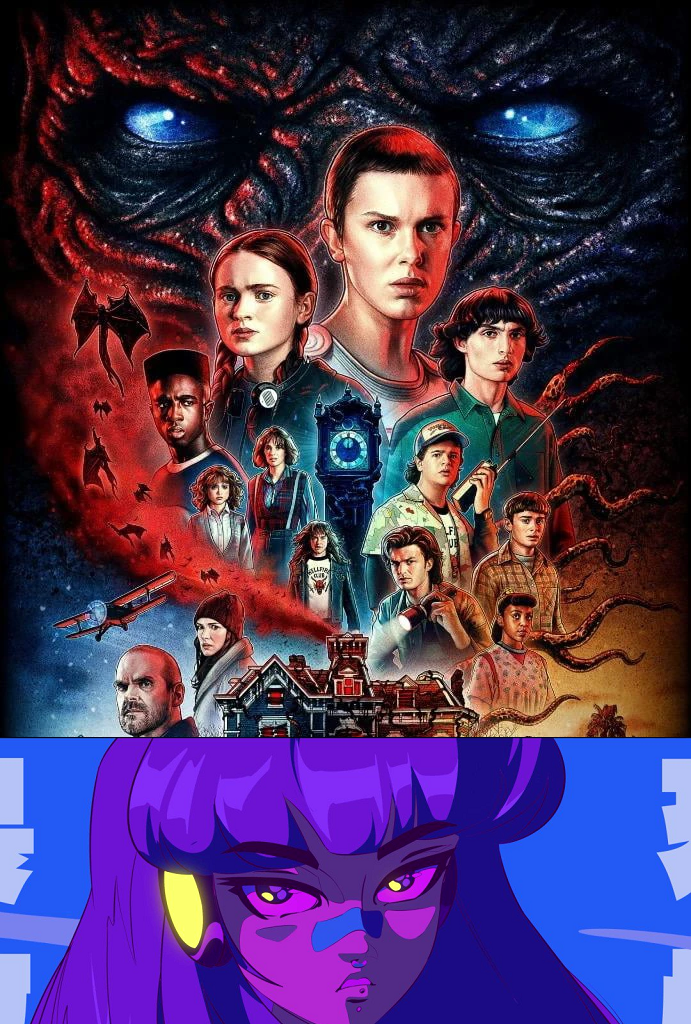
Hauntology and social reproduction: Stranger Things, Starship Velociraptor and Starlight Patrol

A collage of key images for Stranger Things Season 4 and the Jonathan Young song Starship Velociraptor

The general sense in the public discourse is that Stranger Things is a product of nostalgia but that’s not quite right. I’ve struggled to write about this television show – I’ve been promising a review since June 2022 and yet nothing ever came together.

Part of the problem has been that I’ve struggled with the question of who Stranger Things is for. Certainly it’s most popular among kids. My daughter is a big fan. Many of her classmates and team-mates likewise enjoy the show.

But why make a television show so explicitly loyal to the 1980s as an aesthetic if your target audience consists of people who were born a decade into the 21st century?

Stranger Things presents as a form of nostalgia programming, harkening back to Red Dawn and A Nightmare on Elm Street (right down to a Robert Englund cameo). But its primary audience can’t possibly be nostalgic for the 80s. It’s a past they never experienced.

Recently a few pieces fell into place for me that made writing about this television show a bit more viable. The key was that the Youtube algorithm, trained by my fondness for Gorillaz started serving me more animated music videos. Two of these that I ended up watching were Starlight Brigade by TWRP and Starship Velociraptor by Jonathan Young. Now both of these are actually very similar to Stranger Things in a few critical ways: first they’re pretty obviously targeting kids. This is especially apparent with Starship Velociraptor that includes the following quite-childish lyrics:

It's got a dozen restrooms inside
In case we all just have to
Sit on the comfy leather seats
Comes with a fridge that's full of meat, oh

But as I was listening to these two songs it struck me that they weren’t precisely 1980s pastiche. For all that Starlight Brigade, as a work of visual art, attempts to replicated the haze of VHS and for all that both songs as audio works are marked by the synth-pop-rock fusion sound that characterizes public perceptions of the 1980s as a musical period they’re both far too polished there is a clarity and velocity to the songs that belies their announced ties to the past. These are very much simulacra of the 1980s. They present a false 80s – a past that never exactly was. This, oddly enough, situates these kid-friendly cartoon songs in the domain of Panos Cosmatos‘s superb Mandy in that they treat the 1980s hauntologically, allowing us to engage in a deconstruction of the aesthetics of the era via the powers of the false. Except there’s the question of target audience again. Mandy is made by people who lived through the 1980s and its target audience is likewise people old enough to remember the decade. Panos Cosmatos was 10 in 1984. Nicholas Cage was 20. Producer Elijah Wood was born in 1981 as was Andrea Risenborough (who played the title character.)

Mandy, made by children of the 1980s to interrogate the 1980s, was, most importantly, intended for an audience of people who experienced the 1980s. And as a result it makes a kind of internal sense. But these shows that use the same aesthetic indicators but are marketing them to kids age 6-14 don’t have this sort of logic. Why interrogate a decade your audience has never seen?

But of course their parents have experienced that decade. At least our parents had the decency to just force us to listen to the Beatles instead of fabricating an update to their childhood ready-made to make their own childhoods legible to their children. There’s a concession to the inevitable progress of time about these songs. “This ship is fire,” they say in Starship Velociraptor. But, of course, “x is fire” to mean “x is good and also contemporary” is a phrase out of the mid-2010s. It’s slang old enough to be legible to the Generation X and Millennial children of the 1980s who might have cause to reproduce their aesthetics in their children but also to their children.

And so far this isn’t any worse than that old Onion article about the “cool dad” who raises his daughter on his media. These songs may be a bit goofy and childish but there’s nothing ominous about their hauntological musings – which are, at worst, a little cringe. The video for Starship Velociraptor may contain some puerile puns and the video for Starlight Brigade might be an empty bit of fluff but neither has ambitions that outstrip the ability of their artists and, in fact, both have some redeeming qualities via some good synth-riffs and visual aesthetics that draw from 80s and 90s anime but with no more fidelity than the music. This simulacrum of an era then, via the falseness of its particularity, actually does something moderately novel. The risk of something more insidious lies in a common comment that appears on both these videos, “you should make this into a show.”

And this is where this relatively harmless exercise in aesthetic update and reproduction takes a turn for the sinister. Because somebody has made this into a show. It’s called Stranger Things.

What’s interesting about Stranger Things is that it creates a no more accurate rendition of the 1980s than Mandy or Starlight Brigade. The 1980s of Stranger Things is remarkably devoid of the racism that would have been endemic in suburban Indiana while the misogyny and homophobia of the era, while addressed, have been toned down sufficiently to avoid offending contemporary sensibilities too thoroughly. This is a United States where the local shopping mall is a cover for a KGB mad science lab and paranoia about reds under the bed are apropos.

And it’s a 1980s America where the absolute and most critical relationships that exist are between a mother and son or between a father and daughter. Stranger Things is not a show about the 1980s. Instead it’s a show about the importance of the family as a site of social reproduction. Stranger Things looks at technological change, social transformation, and economic opposition to capitalism and then centers the family as the method of holding the disruptive aspects of these transformations at bay.

This is a far older trick than any sort of Derridean hauntological deconstruction. In fact, even as far back as Engels we were aware of how the family is a site of social reproduction. “In the great majority of cases today, at least in the possessing classes, the husband is obliged to earn a living and support his family, and that in itself gives him a position of supremacy, without any need for special legal titles and privileges. Within the family he is the bourgeois and the wife represents the proletariat. In the industrial world, the specific character of the economic oppression burdening the proletariat is visible in all its sharpness only when all special legal privileges of the capitalist class have been abolished and complete legal equality of both classes established,” Engels says in Origins of the Family, Private Property, and the State, suggesting that the family becomes a primary site for the construction of the legal and structural basis of the capitalist class antagonism, creating, via the vehicles of social and economic coercion a situation wherein two legally equal parties can recreate the lord and bondsman dialectic.

Now many will rightly point out that Engels’ anthropological work is deeply flawed and we’d be ill-advised to rest on his description of the family and social reproduction as authoritative. Happily Anti-Oedipus exists.

“Oedipus restrained is the figure of the daddy-mommy-me triangle, the familial constellation in person,” Deleuze and Guattari say, establishing that to discuss Oedipus is to discuss a specific form of familial construction that centers psychological inquiry upon the triangulation between a child and their parents. However, they contend that the way in which Oedipus is deployed leads to something far vaster than simply a triangulation between three parties in a relationship, creating, “an Oedipal structure as a system of positions and functions that do not conform to the variable figure of those who come to occupy them in a given social or pathological formation: a structural Oedipus (3 + 1) that does not conform to a triangle, but performs all the possible triangulations by distributing in a given domain desire, its object, and the law.”

By structuring the relationship between how we produce want, what we want and what we are permitted along familial lines we also, again, trace the family as the site of social reproduction. In fact Deleuze and Guattari take this further, arguing that it is necessary to colonize the formation of the family in order to colonize a people. Alert to the colonial character of Oedipus, they call for a shattering of “the iron collar of Oedipus” so as to “rediscover everywhere the force of desiring-production.”

Oedipus overcodes desire – it shapes the ways in which we want to follow certain socially prescribed boundaries – and to establish at an unconscious level the ways in which we should feel about that social reproduction. Oedipus, in the context of this work, represents the forces of unconscious repression that operate to shape the desiring subject into an appropriate subject for capitalism.

Family is the predominant binding thread that ties the otherwise disparate seasons of Stranger Things together. This is book-ended by the mother-son relationship of Will and Joyce which dominates the first season and the father-daughter relationship of Eleven and Hopper that slowly becomes the predominant focus.

And these familial ties are explored in considerable depth. Instability is introduced via the tired will-they / won’t-they antics that trap Joyce and Hopper. Joyce serves as a surrogate mother to Hopper’s daughter when he disappears to a secret Soviet Monster Gulag (perhaps the Siberian monster death camps were a policy Gorbachev reversed after Glasnost) and Hopper is positioned as the ultimate patriarchal authority: cop as action hero as dad. This story charts the ways in which parents reproduce their social milieu in their children via a narrative structure in which the parents have an adventure that parallels the children’s adventure, culminating in a uniting cathartic moment. These include both the finale of season two, in which Eleven and Hopper seal the gate to the upside down and that of season four, in which the nonsense Hopper and Joyce get up to in Siberia manages to synch itself perfectly to the children’s confrontation with Vecna and his minions. This process of reproduction is made quite explicitly textual in the fourth season in which a preponderance of fathers as the interplay of “Papa” Brenner with Eleven and with Henry Creel is demonstrated to be something of an original sin – a kind of a primordial filial rebellion against the father that leads to the fracture of law and the intrusion of the upside-down-outside.

This rebellion was presaged by Henry’s first attempt to overthrow his patriarch via his failed murder of Victor Creel, his father. However, in an entirely un-subtle nod to Oedipus and King Lear, Victor gouges out his own eyes as a form of self-punishment for his failure to uphold the law. To fail as a patriarch is to make one’s self blind.

But we aren’t done with fathers yet as Eleven manages a third via Sam Owens. Through him we now have three possible models of patriarchy through which to orient Eleven: Brenner’s clinical authoritarianism, Owens’ kinder clinical model and then Hopper: the Good Father.

And this is where can see most clearly how, in contrast to Mandy‘s hauntological deconstruction of the 1980s, Stranger Things uses this nostalgia for a past that never existed for the purposes of reproduction. Because the challenge for Eleven is not to go beyond the patriarch but rather to develop the psychic strength to recognize the just patriarch. Each of these patriarchal figures is a man of law. Brenner is a psychological professional and a high-ranking government agent. The same is true of Owens who represents the factionalism of government: two psychologists, one government, two aims. And, of course, Hopper is a cop, a monster-slayer and a commie-killer (which, to the show, is basically saying the same thing in three different ways). Stranger Things instructs us that Eleven must cleave to this pig of a man in order to come to a greater understanding of herself.

Ultimately Stranger Thing presents a world in which nothing is more important than the law of the father as bounded by capitalism. If Government science interferes, if communism interferes, if any other authority beyond the bounds of the family intrudes or if the father’s law is insufficient to discipline the child then a gate (a mother gate even, unsubtle in its subtext with its gash-like structure) will open and the dangerous monstrous Outside will come flooding in to turn parochial suburbia upside down.

But why did it have to be this way? Was this inevitable just like “cool dads” will inevitably make their kids sit down and have a serious listen to The Dark Side of the Moon?

I would say no. This is because of our prior counter-examples of the hauntological 80s. Certainly capitalism intrudes onto Starship Velociraptor. But it’s far more parodic:

You're looking for a starship lately
Something with comfort, speed and style
I'll get you to agree that maybe
There's just one ship that's worth your while
The secret is a core reactor
To make the light-years feel like miles
With just a little antimatter
And hardwood floors instead of tile

You've got to get it
You can buy on credit
Our payment plan, you won't regret it, yeah

In this case the same puerile humour that made me refer to this song as cringe-inducing introduces sufficient parody into the hyper-capitalism it depicts to make it not such a blatant reproduction of capitalist desire. There’s no outside-monstrosity-communism complex in this song. Starlight Brigade departs even farther from this reproduction of capitalism. It also has an entirely inverse relationship to the concept of the outside from Stranger Things as the visual storytelling of the video shows us an escape story. This is reinforced by the lyrics stating:

I hear a voice in the back of my head
Screaming "this is suicide! Did you hear what I said?"
But then it fades into nothing with the rest of the light and sound
I'm on my way out!

While Starlight Brigade is very beholden to the idea of justice, which sits approximate enough to law to warrant interrogation it does so not from the perspective of the directive passed down from the father but rather of the volunteer who puts themselves in the way of the unjust. This could be seen as a relatively straightforward imperialistic read if not for the clear text of the early verses which describes the recruit to the Starlight Brigade as one who escapes imprisonment. It’s hardly a revolutionary text but, put beside the patriarchal ordering of the world that is Stranger Things, it might as well be written by Engels himself.

This all demonstrates a valuable lesson on the importance of asking what a text does. Both Starlight Brigade and Stranger Things blend the aesthetics of the 1980s and the 2010s creating a false-past that never was. Starlight Brigade does this as a single artifact: a condensation of a Saturday morning cartoon that never aired. Stranger Things does this via a network of nested references blending explicit citation and allusion to create a tapestry of an imagined suburban 1980s that has more to do with contemporaneous media depictions of suburban life in the 1980s than it does the material reality of the time. Neither one of these things has an intrinsic political character. You can, with the same basic structural material, make Mandy, Starlight Brigade or Stranger Things. However how this container is used matters and, in the case of Stranger Things, that container carries Oedipus, a closed family unit, ruled by a cop and paranoid of outside infection.

And, of course, all cops are bastards. Especially that communist-murdering brute Jim Hopper.