Prophesy and Silence

As part of our ongoing dialog over leftist praxis and AI, Nicolas Villareal recently put forward an article regarding the position of prophesy in theology and the question of the future. In it Villareal points toward prophesy as a universal of religion on a par with Herbert’s statement regarding the religious concern for the condition of the soul. Villareal argues prophesy is necessary for the formation of an ethic at social scale, saying, “In our everyday lives we can make decisions based solely on what we deem is a virtuous action, or whatever animates our personal cosmologies, but when we seek to affect the whole of the social world, changing the very foundations of society and the processes which shape people’s souls, there is a deeper set of consequences and difficulties. It is at this juncture that we must consult prophecies,” before arguing, contra Benjamin, that the character of the angel of history is that of a destroyer, that there will be an end to history and that it will be entropic, so entropic, in fact that “History will end with the end of destruction, on one level of abstraction or another.” This is a logical position to reach when you attempt to reassert a position for the timeless into one’s metaphysics such as by tracing the position of a single electron throughout the duration of all time.

There is quite a lot that is very fascinating here to discuss on topics theological, ethical and metaphysical but, as this discussion has largely centered around the position of theology within praxis, I think it might be best to begin by interrogating the claim that prophesy is a theological universal.

We can start by interrogating prophesy directly. We can start by looking at Acts 1:7 which reads, “When they therefore were come together, they asked of him, saying, Lord, wilt thou at this time restore again the kingdom to Israel? And he said unto them, It is not for you to know the times or the seasons, which the Father hath put in his own power.”

It is not for you to know.

This fundamental anxiety is something which Kierkegaard grappled with in Fear and Trembling and it is from his chosen pseudonym, Johannes de Silentio, that we see a universal counter-principle to prophesy within religion in the form of silence. Religion arises, to no small part, out of the silence of the gods. People, posing questions to being itself receive back nothing, there is no answer to the prayer. For Kierkegaard this silence was critical to any true display of faith. In Fear and Trembling de Silentio speaks of a story from Aristotle regarding the Delphic Oracle. In it a man is due to be married when the auguries warn that the wedding will bring him grave misfortune. He makes a decision in light of the prophesy to forego the wedding and the vengeful family of his bride conceal temple goods among his possessions, dooming him to death for his transgression.

De Silentio details some choices the suitor could have made and suggests, “shall he keep silent and give up celebrating the wedding? In this case he must embroil himself in a mystifictition by which he reduces himself to naught in relation to her. Aesthetics would perhaps approve of this. The catastrophe might then be fashioned like that of the real story, except that at the last instant an explanation would be
forthcoming–however, that would be after it was all over, since aesthetically viewed it is a necessity to let him die … unless this science should see its way to annul the fateful prophecy.”

And so what we have here is prophesy as doom. The words of the Oracle are order-word, words that, “bring immediate death if they do not obey, or a death they must themselves inflict, take elsewhere.” Here the prophetic order-word of the Delphic Oracle literally brings the immediate death of the suitor whether he obeys or no. Marry and suffer misfortune. Heed the prophesy and die. The only hope for the suitor lies not in prophesy but in silence.

For de Silentio it is not merely the destructiveness of prophesy that brings him to prefer silence but also that he sees silence as the wellspring of faith. He describes silence as a method whereby a doubter can transform his silence to guilt and thereby absolve himself of the sin of his doubt, “Even the New Testament would approve of such a silence,” he announces.

Silence provides a barrier to knowability but not to meaning. Faith is not to be found in any sort of majoritarian meaning but in silence: “It is not as though Abraham would thereby become more intelligible, but in order that the unintelligibility might become more desultory. For, as I have said, Abraham I cannot understand, I can only admire him.”

Abraham’s duty to God exceeds any sort of ethic and it is this strange aim of de Silentio to divide the concept of duty to God directly from any intelligible ethic. Abraham doesn’t serve God because he knows it to be good. He does not have the comfort of prophesied knowledge to guide him. Abraham serves God because it is to God he owes his ultimate loyalty irrespective of ethical concerns. Meanwhile these machine gods of capitalism talk too much, as do their priests.

For Derrida this silence extends beyond the text as given and at least to the signature by which the book was signed: de Silentio. “This pseudonym keeps silent, it expresses the silence that is kept. Like all pseudonyms, it seems destined to keep secret the real name as patronym, that is, the name of the father of the work, in fact the name of the father of the father of the work.”

But names are a slippery thing and Derrida puts no more weight behind the patronym than LeGuin does in A Wizard of Earthsea. Rather Derrida suggests this act of self-naming is ultimately more meaningful than the legalities of patronym. The power behind a name comes from the, “secret name by which one calls oneself.”

It is almost as if Derrida were to create a minor language out of the pseudonym. If we treat the patronym as prophesy – a statement at birth that this person is destined for this experience – then this self-secret name, the pseudonym and the silent name in the heart of a subject becomes the undoing of that order-word. We see Paul Attreides too attempting to escape the face of his father in the names Usul, Muad’dib. And his visions are uncertainty. He sees history as an ever-unfolding topology of rise and fall. The doom of Muad’dib is that prophesy fails to become an order-word because of what must be kept silent. When Leto II arises, robed in the name of the father of the father of his work, he brings with him the golden path and the peril of prophesy once more.

In Herbert’s cosmology prophesy presented the risk of stultification. A people who knew too clearly the path before them would be complacent or fatalistic. Likewise, the doom that comes to Aristotle’s suitor comes from fatalistically denying his bride for fear of prophesy. Is, then, prophesy a true universal of religious experience or is it the method by which social power harnesses the mystic impulse of the masses?

The way you can go isn’t the real way.
The name you can say isn’t the real name.
Heaven and earth begin in the unnamed:
name’s the mother of the ten thousand things.
So the unwanting soul sees what’s hidden,
and the ever-wanting soul sees only what it wants.

LeGuin’s treatment of the Tao Te Ching touches on this idea of the divine as the silent and the hidden. This is an odd text: a political and spiritual treatise for kings rendered into an anarchist metaphysics, the great surpassing of Heidegger in a short translation assembled hodge-podge from other translations. Le Guin obliterates the idea of an original root text here and instead takes her meaning where she can find it. It is, as translations go, one marked by a kind of desultory elimination of meaning, so occupying contradiction as to become a cypher. Of the first verse, Le Guin said ” A satisfactory translation of this chapter is, I believe, perfectly impossible. It contains the book. I think of it as the Aleph, in Borges’s story: if you see it rightly, it contains everything.”

But if this is so, why translate at all? If this passage, seen right, allows one to see everything why not simply write, “道可道,非常道。名可名,非常名。无名天地之始;有名万物之母。故常无欲,以观其妙;常有欲,以观其徼。此两者,同出而异名,同谓之玄。玄之又玄,众妙之门,” and say, this contains within it the universe? But, of course, this is LeGuin toying with her readers. “I believe that the Aleph of Calle Garay was a false Aleph,” the story says before detailing other possible false manifestations of this totality. “Does that Aleph exist, within the heart of a stone? Did I see it when I saw all things, and then forget it? Our minds are permeable to forgetfulness; I myself am distorting and losing, through the tragic erosion of the years, the features of Beatriz.” The silence of the forgotten creates doubt in the most total of all visions. And the act of translation, if we take Le Guin at her word, necessarily reduces the meaning of the statement. Otherwise a perfect translation would not be impossible. It is, perhaps, that a maximal quantity of meaning is necessarily harmful to intelligibility. If one did, in fact, see everything, all at once, how would they possibly remember it? The name you can say is not the real name. The careful ordering of meaning in the patronym collapses in the face of the secret name.

Marx, certainly, cautioned against the pride of prophesy writing against, “recipes for the cook-shops of the future,” as it would depend on knowledge that was unavailable. And this presents us with a dilemma: the act of prophesy necessarily cuts off avenues to the future. The act of giving voice to this or that future necessarily attempts to render Abraham understandable again at whatever cost to our faith.

In the end, perhaps we are all fools for treating religion as a monolith when there are clearly majority and minority threads running throughout it. Religion is a field of contestation for political power. And those people who would assume power will find the order-word of prophesy a tool to their liking. For those who would rather destitute power the mystical silence that speaks to the unknowable of the divine will serve far better.

Intelligibility is not coextensive with meaning. Meaning requires an ecstatic apprehension to be grasped fully. It also requires mortality, as Borges so plainly says in The Immortal, “Homer composed the Odyssey; given infinite time, with infinite circumstances and changes, it is impossible that the Odyssey should not be composed at least once… Everything in the world of mortals has the value of the irrecoverable and contingent. Among the Immortals, on the other hand, every act (every thought) is the echo of others that preceded it in the past.” Immortality is anathema to meaning.

Meaning is not found in the hyper-legibility of AI that Villareal proposes but is rather found in the brief ecstatic moments that break even the reverie of the Immortals, “the ancient elemental pleasure of the rain.” Meaning isn’t found in the legible text of a complete set of all words and their relationships to other words but in the silence that follows when a body experiences the world.

“Action introduces the known (the manufactured); then understanding, which is linked to it, relates the non-manufactured, unknown elements, one after the other, to the known. But desire, poetry, laughter, unceasingly cause life to slip in the opposite direction, moving from the known to the unknown. Existence in the end discloses the blind spot of understanding and right away becomes completely absorbed in it,” Bataille says, pointing out that these forms of beauty that make life worth living depend not on legibility. There’s no words to a laugh. And Beauvoir reminds us, ” If the satisfaction of an old man drinking a glass of wine counts for nothing, then production and wealth are only hollow myths; they have meaning only of they are capable of being retrieved in individual and living joy.”

If we are to look to the Angelus Novus as a destroying angel then we must ask whether our project is tied to raising up a power or to striking one down. We have seen the fruits of prophetic revolution. In nearly every case it has turned back around to embrace capital and a hierarchy of powers. True Communism may, as they say, have never been attempted but Thich Nhat Hanh situated true communism in the silent contemplation of the Sangha saying of Buddhist monastic life, “we are the true communists.” Perhaps we should consider whether the theology operating the mechanical Turk of historical materialism might better be a silent, secret, invisible one: a mystical theology that has no truck with prophesy as the construction of limits that it is.

Perhaps the puissance of a revolution that can bring down the order of things is one that exceeds limits, that takes the world whole. The Denma Translation Group describes taking whole, an ontological concept from the Sunzi, as a perspective on the word as a “multitude of shifting, interrelating aspects.” This is in keeping with a classical Chinese metaphysics that describes reality as the fluid interplay between forces. The Denma group counsels us to treat objects as ever-shifting interactions. This is, again, the constantly transforming topology of Muad’dib’s vision which we must contrast with Asimov’s psychohistory.

At first blush it might seem as if Hari Seldon’s great science were taking the universe whole. The first axiom of pyschohistory was that a population had to be sufficiently large to be treated probabilistically, in a manner akin to Brownian motion. This movement of particles has been a fascination of metaphysicians and physicists alike at least since the time of Lucretius who saw in the flitting of dust particles within the air a satisfactory response to the fallacy of the prime mover. For Lucretius, an atomist, it was sufficient to suggest that the atoms moved themselves. Einstein later demonstrated that the dance of particles was the result of one particle being acted upon by many other smaller particles. this is inconvenient because it tends to reintroduce the problem of the prime mover. This is a tendency Meillassoux argues against, saying, “our claim is that it is possible to sincerely maintain that objects could actually and for no reason whatsoever behave in the most erratic fashion, without having to modify our usual everyday relation to things.” In other words: Leucretius was right. When you eventually get to something monadically small, so small there is no more sense of fluid to jostle it around in, objects move themselves. Meillassoux considers the most common responses to Hume’s questions regarding causality unfounded. Dismissing both Popper’s view as insufficient to addressing Hume’s complaint and also saying, “the nature of the problem is actually unaffected by the question of whether or not natural laws will turn out to be probabilistic.” This introduces contingency back into the microscopic realm of very small particles, Einstein be damned. Meillassoux, in fact, seeks to out-Hume Hume, saying of the great skeptic, “The self-evidence of this necessity is never called into question. This is obvious in the case of the metaphysical and the transcendental solutions, since they both proceed by trying to demonstrate its truth, but what is less obvious is that Hume too never really doubts causal necessity – he merely doubts our capacity to ground the latter through reasoning.” Meillassoux proposes that there is no reason to assume physical laws operate the same in all places and in all times just because they operate here and now. Specifically he argues that the assumption “If the laws could actually change without reason – i.e. if they were not necessary – they would frequently change for no reason,” is a logical stretch to say the least. Meillassoux then spends considerable time working through how contemporary set theory demonstrates how one cannot create a totality of all possible sets since any totalization would infer the possibility of a further set still greater. (After Finitude, Continuum International Publishing Group, 2011, pages 99-106)

Meillassoux’s eventual conclusion is that, “Kant’s belief in the necessity of laws is thereby revoked as an instance of aleatory reason’s unwarranted pretension to reach beyond the limits of experience.” But, of course the limits of experience are the very thing that Leftist consciousness raising exercises such as those of Fisher and the previous attempts of Acéphale seek to go beyond.

And so we can begin to see the flaws in Hari Seldon’s mathematical prophesies. He depends on the assumption that a totality of possible sets of future histories as the basis of his predictions. This assumption regarding randomness does not hold true. Of course most of Asimov’s further axioms regarding Psychohistory attempt to limit it further but mostly by proposing limits of consistency such as the consistent response of humanity and the presence of only humanity as sentient beings within the universe. These do nothing to counter the critique that Seldon’s account of randomness among vast populations would not necessarily have predictive power.

And then there is the Mule.

This is the point at which the Foundation books tip their hand regarding the ideological assumptions that underpin their fantastical science: Asimov wants to herald the potency of the individual. In fact, throughout the books from Second Foundation onward this becomes the principal discourse: how a single, individual subject might upset probabilistic mathematics and invalidate prophesy.

But, of course, this individual subject is precisely the object voided by the soul of subjective multiplicity. Rather we have a subject who can be divided infinitely. Kierkegaard and Nietzsche may not have understood the mathematics underlying the inference but there is a mathematically unknowable self lurking under the set-theoretical assumptions of Meillassoux.

Villareal suggests the role of prophesy is to, “remember the future as we would the past.” But the consistency of the past is no more secure than the consistency of the future. As with the face of Borges’s lover the past is a changing place from the perspective of the future we now occupy. Our shared referent in Sartre certainly codified that existence comes before essence, that what we see as the essential ontological character of a being arises only as a result of that being having a real existence. But this same ontology argues we can never see an object in its totality, not because of Meillassoux’s computations of the non-total character of sets of infinities but rather simply because every object arises into being as an infinite sequence of appearances. We may be able to mathematically grasp infinities but they still don’t fit in the mind of a normal subject.

And so if we are to salvage prophesy at all it will depend on shattering normativity. The Delphic oracle chewed oleander and inhaled cave fumes to bring upon them the prophetic state: a consumption of poisons that must have brought her perilously close to the limit that is death. Sunzi’s council to take whole depends on a simultaneous occupation of two dissimilar ontological perspectives. One must see the army both as a mass that operates as a body but also as an ever-flowing interplay of relationships each of which is impactful in its particularity. To be a sage one must observe both of these perspectives simultaneously and without a process of dialectical flattening. Dividual subjects in their interrelation and the mass bodies they form both in the process of individuation and in the process of mass formation require the attention of a liberative politic. It isn’t enough for a vanguard to take it upon themselves to say, “the future must go this way” but rather to raze the debris that blocks the view of an infinity of disparate possible futures. This requires a fundamental break from the very idea of norms. Any leftist prophet must be so estranged to the normative as to seem alien. In short: if we are to salvage prophesy we must shatter the normative limits of the prophetic subject.

For Bataille, “What one calls ‘being’ is never simple, and if it has a lasting unity, it only possesses it when imperfect: it is undermined by its profound inner division, it remains poorly closed and, at certain points, attackable from the outside.” This is to say that the normative subject was to be seen as contingent. This might seem good news if we want to salvage any role for prophesy within our project except that we must, to achieve this limit-breaking non-normative self engage in the torturous process of bringing about inner experience and this runs counter to project.

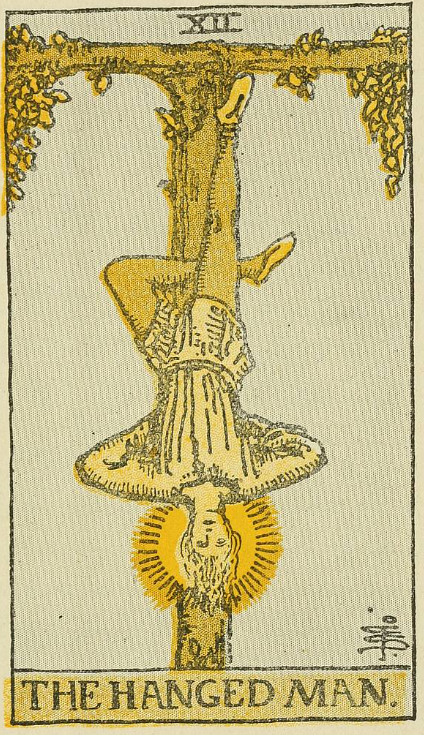
For prophesy to be useful to the Left we must suspend ourselves like Odin and the Hanged Man and even then the strongest prophesy we could hope to gain is the ever-fluctuating topography of Muad’dib – no true future-remembrance. But Muad’dib’s visions, even in their mutability, foreclosed upon the future and doomed him to watch his beloved die. Even a contingent prophesy is an order-word that is subordinate to the direct and ecstatic apprehension of meaning and that seals the fate of the subject of prophesy. If we allow the hyper-legible text lists of AI to serve us as an oracle we will be faced with the hollow Kantian prophesies of Hari Seldon but doom lives even in using a mystical mode of prophesy like that of Muad-Dib. For all that his future was a contingent one, an ever-shifting fabric of transforming possibility, his visions doomed him to watch his true love die and to wander the desert, a blind and raving ascetic. Instead we should focus our sights on a true and full apprehension of immediate material conditions. In this immediacy AI is revealed not as a prophet but simply as another weapon in the unending cycle of primitive accumulation. Instead of building utopia in a preordained future we must discover it here and now in the immediacy of falling rain and in the movement of a body of troops around a camp. The future is always spontaneously erupting. We can access a transformed future by setting it free of the chains of prophesy.

On the mortal soul

When I published my recent piece Toward the Butlerian Jihad one of the concepts I brought in was the mortal soul. This was largely in service, as others have noted, of a secularization of the concept of the Butlerian Jihad – a holy war against “thinking machines” that occupies the position of a considerable historical event in the background of the science fiction novel Dune and its sequels.

However, as has been rightly pointed out by others, playing around with the idea of a soul which could be disfigured raises the risk of reintroducing natural law into our metaphysics. This is, of course, something we should avoid. I had been thinking about expanding on the concept of the mortal soul regardless as a part of my overall project on materialism and magic however, in light of this well-received response, I thought it’d be a good idea to get this explanation out a bit faster than I otherwise might have.

A brief genealogy might be a good place to start. The idea of the mortal soul is something most directly encountered in Nietzsche’s Beyond Good and Evil where he says, “Let it be permitted to designate by this expression the belief which regards the soul as something indestructible, eternal, indivisible, as a monad, as an atomon: this belief ought to be expelled from science! Between ourselves, it is not at all necessary to get rid of “the soul” thereby, and thus renounce one of the oldest and most venerated hypotheses—as happens frequently to the clumsiness of naturalists, who can hardly touch on the soul without immediately losing it. But the way is open for new acceptations and refinements of the soul-hypothesis; and such conceptions as ‘mortal soul,’ and ‘soul of subjective multiplicity,’ and ‘soul as social structure of the instincts and passions,’ want henceforth to have legitimate rights in science.”

Nietzsche attempts to walk a razor’s edge here between a materialist account of the world which abandons the concept of the soul and what he describes as the Christian atomism of the soul which he treats as the last vestiges of a belief in a rigid substance.

Nietzsch’s soul of subjective multiplicity is, instead, a process of transformation that occurs within a person. We cannot treat a mortal soul as a substantial object: a ghost within a shell. Instead it represents the ever-transforming flow of subjectivities, affects and material effects created by a person. However this psychological frame does not discount a theological reading as we can find reflections of this in the far-older concept of Anattā.

This is a thorny issue within Buddhism so I will provide my interpretation which is largely drawn from the Chán school however I do anticipate lively disagreement here. At an etymological level, Anattā means no-self. This is a challenging concept because Buddhism upholds reincarnation as a part of its metaphysical universe and if there is, in fact, no self then what is there to reincarnate?

There are two possible solutions here. The first is to suggest that there is no unchanging self while there may be a continuous stream of being, a flow of moral development and consequence, we cannot point to it as an eternal and unchanging self. After all, how could a person develop toward Nirvāna if change was impossible? As such we see a soul that exists but is, much as Nietzsche would later propose, a “soul of subjective multiplicity.” From this sense it doesn’t matter much if the soul passing between bodies is substantial because it will be caught in a constant transformation brought about by the accumulated weight of its past lives and the condition of its latest birth.

Another solution would be to treat a soul much as a candle flame used to light a second candle. In this case the original flame will eventually burn out but the new flame will remain. The origin of this new flame carries from the extinguished flame before but it is not of a substance at all. Rather it is a spark, a blend of flow and event, which ignites a novel being. The treatment of a soul as a flame is valuable here for creating an account of soul as process. A flame is never still, never static, it consumes fuel it produces waste. Early metaphysicians such as the stoics also associated fire with an elementary vital principle throughout the universe. In this sense fire stands as a form of life and even now that we understand these phenomena to be separate from each other fire remans a valuable metaphor for describing the process of a life as process, as flow and event.

And so what is a mortal soul but the account of the changes brought about through a life. As such the soul extends past the body of any given subject and into the socius that forms around them. A subject is a process of transformation. I am, at 44, not the same person I was at 22 or at 11. And tomorrow I will be somebody different still. The very act of putting pen to paper on this essay transforms me in that it will change, subtly or suddenly, how others see me. This act dissolves the body of the subject into the field of being because it is equally true that subjective changes within me – the idea of what I, as a subject, am is constantly reassessed. Being is contingent and there is no essential character to a being.

This is ultimately my interpretation of Anattā: a being that exists as process and absent substance, absent essence. This, then, gets to my later criticism regarding AI and death. These necromantic objects operate from the assumption of an essence. In order for a podcast with Plato to have any meaning whatsoever there must be an essential Plato who can be conjured back out of his texts.

That the idea of Plato, the soul of the man, is entirely different now as he has become the commentaries of philosophy and counter-philosophy passing through Aristotle and Plotinus, a worm through time all the way to Kant, Hegel and all the rest, makes the idea of a podcast that returns him to a single essential figure who could be interrogated or who could interrogate in some meaningful way absurd.

It is disfiguring of the soul because it wants to fix this process of transformation back into a substance. In the Jean Leflambeur trilogy by Hannu Rajaniemi we see such a mission taken to its absolute extreme as the Sobornost seek to do away with death itself. Their mission, to roll back time and do what Benjamin’s angel of history could not, restoring all the dead souls lost to history is a threat to others in this book’s universe precisely because of the terrifying impact such a deed would have on the ability of (post)humanity to continue to change.

Growth and change depends on the elimination of essence. Once we allow essence into our metaphysics we are trapped by the idea of Platonic remembrance and everything becomes nothing but an emanation of an essential elsewhere.

In the Theses on the Philosophy of History Walther Benjamin describes Historical Materialism as a Mechanical Turk (not unlike these “AI” tools) which must be animated by a hidden theology to become puissant. Atheist Marxists often interpret this as a critique of the failures of Marxism, like Marxism in the 1930s was insufficiently anti-theological, but this depends, to a certain extent of continuing the mistaken reading of “opiate of the masses” to mean “drug, bad, avoid” rather than historicizing it as meaning, “something to ease pain.” If we read the first thesis in a straightforward way we can instead suggest that a theology (I hesitate to say secular theology here as Benjamin was not a person of secular spirit) is needed. Regardless Benjamin’s theological interpretation of Marxism serves to target the very idea of history as a process of progress. Instead history is the wind which blows Angelus Novus into the future as the debris and dead of past eras heap up at his feet. AI technologies then attempt to do what the angel of history cannot and return these dead to us in some essential form.

I know it is a frightening concept to deny that the unknown future will be redemptive and then to insist we must fight to go there anyway. This is why I briefly invoked Kierkegaard at the end of my piece on the Butlerian Jihad because embracing the danger of an irredemptive and unknown future requires a leap past extreme anxiety. We do not leap toward God for his throne is, by now, thoroughly vacated but this increases the urgency by which we must strike down those people who would raise up a mechanical god to redeem the dead of history.

“It was but a step to the illusion that the factory work which was supposed to tend toward technological progress constituted a political achievement,” Benjamin says and I see a similar critique in those who say that “AI” is necessarily a tool that could be meaningfully wielded by a leftist project. When I say that “AI” must be stolen from the Bourgeoisie what I mean to say is that it is insufficient that Proletarian hands wield this technology for Proletarian aims. This is falling for the same progressivist view of history Benjamin rightly criticizes. Rather I am saying that it is a technology that must be denied from the Bourgeoisie. We don’t take it like Prometheus taking fire from the gods but rather to deny other hands the use of it. I see this as a moral imperative because the resurrection of an essential and immortal soul clogs the path to an open and liberatory future. Effectively the leftist project we can trace through Spinoza and Marx to Beauvoir and others depends on us disregarding the rubble of the past. We cannot redeem the dead. There is no past to return to. If we are to be free we must be mortal: we must be subject to absolute contingency and transformation. Meillassoux describes contingency as being necessary if we are to “get out of ourselves, to grasp the in-itself, to know what is whether we are or not,” and, again, this circles back to the anti-facial consciousness raising of Fisher and Foucault. I raise up this spontaneously insurrectionary desire against specters of the social democrats of the Second Internationale as they were the self-same people Benjamin critiqued for mistaking change for progress. Certainly AI tools represent a change; it does not follow they represent a progression.

Unlike Marx I do call for a revolution with a specific moral character – one which I think is clear from the citations of Deleuze and Guattari, Beauvoir, Benjamin and Kierkegaard. This moral universe is one that is necessarily toward spontaneous liberation, the potential of which is as evident as the spontaneous enlightenment of Chán Buddhism. As such its character is necessarily a mass character but one that will not allow for the possibility of redemption. It is, however, still a (secular) theological proposition. We must overcome an overwhelming anxiety that we will not bring about a future that is free and act a if that liberation were assured. In this regard, by putting the debris of history before us, “AI” is an obstacle at best. While contingency allows that a tactical use of “AI” might be valuable in this or that moment we must recognize that any such tactic will be counter to our own ethics; only holding up contingency as the supreme absolute opens the door at all to wielding such a tool.

I do want to temper this statement a bit to suggest I am not making of “AI” a Ruling Ring. This would depend on an absolute and essential understanding of evil which would go against all the contingent and transformative metaphysics I champion. But we should recognize that these uses, even if effective, are not moral. This is not because it violates some natural law. If we follow Meillassoux on contingency then we must vacate every absolute and this includes the absoluteness of laws as fundamental as the Planck Length (as Rajaniemi speculated). If we cannot even say with certainty that:

represents a limit in all places and in all times then how could we possibly say with certainty that there is any sort of social absolute? We must vacate any natural law and treat law with as much contempt as Benjamin did in the Critique of Violence. But we should also accept that even contingency is contingent and that this may lead to the creation of (contingent) fields of consistency. In such a case we can say, barring some transformation heretofore unseen, it’s right for us to do away with these tools as serving only our enemy.

Toward the Butlerian Jihad

In the appendices to Dune, Frank Herbert says that the chief commandment of the Butlerian Jihad was recorded in the Orange Catholic Bible: “Thou shalt not make a machine in the likeness of a human mind.” There is quite a lot that we can say about this tiny snippet of text. Helpfully Herbert expands on it.

Also in the appendices Herbert describes how space travel and the concomitant encounter with the infinite that it brought about created a crisis of faith. “All through religion, the feeling of the sacred was touched by anarchy from the outer dark,” Herbert explains before pivoting into the dualistic sort of reading of Taoism that was popular among the New Age movement at the time he was writing Dune, saying, “It was as though Jupiter in all his descendant forms retreated into the maternal darkness to be superseded by a female immanence filled with ambiguity and with a face of many terrors.” Now, again, this is the sort of statement that unfolds almost infinitely and is certainly fascinating. But if we divert ourselves to a discussion of gender and the monad within Dune we’ll never get to the point of discussing the Butlerian Jihad as a movement. So, let’s cut through this to say that Herbert saw, in periods of rapid and remarkable social and technological change, a simultaneous movement both toward the future and also into the past. “It was a time of struggle between beast- demons on the one side and the old prayers and invocations on the other.” And all of this set the basis for the great spiritual movement that set the Dune universe up – the Butlerian Jihad. Which had as its simple aim this: “Man may not be replaced.”

But what Herbert sees in the Butlerian Jihad was not just a political unification against a material foe but also an ecumenical movement wherein people saw in each other a human unity. “All religions had at least one common commandment: “Thou shalt not disfigure the soul.””

This ecumenicalism is why the ultimate text which enshrined the shared religious understanding of the increasingly scattered people of the universe was called the “Orange Catholic Bible” – it was a recognition of both ecumenicalism in general and of paradox in specific. At the time Herbert wrote the Troubles were just heating up and no religious divide seemed as hotly contested as that between Catholicism and Anglicanism outside of perhaps the Sunni / Shia split which also played heavily into Herbert’s speculative comparative theology. Herbert’s appendix on religion is clearly summarized thus: “all religions had at least one common commandment: ‘The mystery of life isn’t a problem to solve but a reality to experience.'”

This sense of the mystical permeates Herbert’s view of religion and, in considering the Butlerian Jihad’s focus on the humanistic and the ecumenicalism that emerged out of this humanist focus, we come to see one of the motivations of the Butlerian Jihad as a reification of collective immediate experience over the analytical.

Of course today the name of the Butlerian Jihad is increasingly adopted by those people who are resistant to the hype around two technologies: Large Language Models and and Diffusion Models. These are both probabilistic tools that analyze data and attempt to infer likely results. In the case of LLMs they do so by interrogating a data set for likely text replies to any given text input. In diffusion models they do this by assessing the probability of an image occurring compared to other images with subtly different features. Ultimately both are just a combination of statistics, calculus and stolen copyright IP. These two technologies have been rather deceptively marketed as artificial intelligence. This is a bit rich when the truth is that there is no intelligence at play at all. These algorithms actually do not violate the chief commandment of the Butlerian Jihad in that they are not actually a likeness of a human mind. Rather they are an aggregation of human tools (mathematics) and the products of human labour (training sets). The truth is that the problem with “AI” is not that they have disfigured the soul but rather that their owners would break that other aim of the Butlerian Jihad. They seek to replace workers with these tools. In Capital, Marx said of the Luddites, “It took both time and experience before the workpeople learnt to distinguish between machinery and its employment by capital, and to direct their attacks, not against the material instruments of production, but against the mode in which they are used,” and I do think this is an important step that we have to take if we wish to resist the automation of creative labour and caring labour which is the aim of these men and their tools.

The issue with “AI” isn’t that it disfigures the soul. Instead it’s things like the US National Eating Disorder Helpline laying off its staff in favour of a chatbot. As such we must engage in resistance to AI not as a religious activity but as a political one. But, of course, as Herbert says, “When religion and politics ride the same cart, when that cart is driven by a living holy man (baraka), nothing can stand in their path.”

This is a dichotomy that Deleuze and Guattari interrogate at length in 1227: Treatise on Nomadology – The War Machine, which they open by stating “political sovereignty, or domination, has two heads: the magician-king and the jurist-priest.” This serves to open an axiom in which they argue that the war machine is exterior to the State apparatus.

They go on to state that this opposition of the jurist-priest and the magician-king is only relative. “They function as a pair.” Religion and politics are always riding in the same cart. But, as these two figures together compose the entirety of the state as a stratum, and as they are not actually in conflict but are rather complimentary poles Deleuze and Guattari state that “war is not contained within this apparatus.” War is extrinsic to the construction of the state. The use of violence by a state either occurs via non-warrior means such as the police officer and the judge or it requires a state to bring the military under juridical control.

Deleuze and Guattari deploy Dumézil’s interpretation of the god Indra to argue that he, as a war god, is entirely outside the dualities of the state: “another species, another nature.” They propose that a war machine is not like chess but rather like Go. “Go pieces… have only an anonymous, collective or third-person function: ‘It’ makes a move. ‘It’ could be a man, a woman, a louse, an elephant.” They describe Go as a war without battle lines, “with neither confrontation nor retreat, without battles even: pure strategy.”

All this is in service of claiming the production of a war machine outside the boundaries of the state. If Indra and Go and all these other non-state examples from anthropology, mythography and ludic theory are in opposition to the state-construction then we, too, can go to war against the state. They argue for the idea of an Urstaat – that is to say that the existence of humanity is coextensive with the existence of the state but that, likewise, the existence of an outside to the state which is not another state is also coextensive with the existence of humanity. However they continue this argument against the absoluteness of the state by bringing in another concept: ecumenicalism. For Deleuze and Guattari the two elements that allowed the formation of a war machine against the state were the ecumenon of global non-state actors and the fragmentation of culture into bands as per McLuhan‘s investigation of neo-tribalism. But for them these two factors: the global non-state ecumenon and the fragmentation into bands was not a stable dyad but instead represented two tendencies present in all places and at all times and that mixed and blended in various ways. “It is in terms not of independence, but of coexistince and competition in a perpetual field of interaction.”

And it’s with this in mind that they turn to epistemology and the idea of a minor science. And here they put forward that there are, in fact, two sciences: a royal science of objects and solids and a minor science of flow and flux. They identify this with the concept of becoming, which, for Deleuze and Guattari, is always already the domain of the minority as the majority represents a normative influence that attempts to concretize relationships. They describe this as a model of science that is, “problematic, rather than theorematic: figures are considered only from the viewpoints of the affections that befall them.”

This establishes this minor science as being a domain of collective immediacy. Much as the Go piece might be anything from an elephant to a flea the minor science avoids the concrete and analytic approach to reality of royal science. It’s not that these sciences are without math but rather, “instead of being good forms absolutely that organize matter, they are ‘generated’ as ‘forces of thrust’ (poussées) by the material, in a qualitative calculus of the optimum.”

It’s interesting to piece apart how this idea of a nomadic geometry interacts with the method by which diffusion models function. Because, of course, diffusion models are, to a certain extent, doing just this. They are quite literally engaging in a qualitative calculus that attempts to infer an optimum image to respond to a text prompt. And this helps us to disentangle ourselves a bit from the question of the state and return to the question of the “AI” and for us to ask this: should we raise the Butlerian Jihad at all? But this is falling for a trap. It does seem true that diffusion models are, at the very least, the product of a minor science. It’s also very likely true that the first real resistance to them will come from the state form. Western states are deeply concerned with the idea of the, “deepfake,” the idea that a diffusion model might produce hyperreal images that allow for an undermining of the state itself by hostile actors. But, blinded to the existence of an outside to the state, most states can only imagine those hostile actors as being other states. The privacy laws of the EU – that supreme product of the Jurist-Priest – are likely among the greatest obstacles the owners of this war machine will face.

Rather the concern should be that the global ecumenon that holds possession of the war machine represented by “AI” is also not our friend. After all these global ecumenons and these fragmentary bands exist (in part) in a state of perpetual competition. And one of the vectors of competition remains that of class conflict and I’ve talked before about how class conflict is the motor that drives my concerns with “AI” technologies.

Let’s be clear: The Bourgeoisie are one of the global ecumenons that Deleuze and Guattari describe as being outside the state not in terms of independence but rather of, “coexistence and competition in a perpetual field of interaction.” But so are religions. So are band societies. So are the Proletariat. This is an instinct that Marxists had at the outset and have sometimes seemed to forget: the Proletariat are not the citizens of this or that state but are a group of people far greater than any given state. The conflict between the Proletariat and the Bourgeoisie is coextensive with both state and non-state fields of action. And right now the hands holding the war machine of “AI” are not Proletarian. As such it behooves us either to smash that machine or to steal it.

But what can we do? The powers behind “AI” claim it is an inevitability. You cannot stuff the genie back in the bottle. There is no alternative. Fisher describes this Thatcherite slogan as the ultimate condensation of capitalist realism in his eponymous book. Fisher situates the problem of capitalist realism as, in part, one of interiority and exteriority. “In the 1960s and 1970s, capitalism had to face the problem of how to contain and absorb energies from outside. It now, in fact, has the opposite problem; having all-too successfully incorporated externality, how can it function without an outside it can colonize and appropriate?”

And in this we can see the value, to capitalists, of a minor science that can perpetually produce an outside of sorts. Beyond the practical level of being able to lay off chat line workers, graphic designers, illustrators and ad-copy writers and thus make more money AI allows capitalists to mine the past itself for new products. “How would you like to hear a podcast where Plato talks to Aristotle?” Death remains the outside Capitalism cannot fully conquer. But this creates paradoxical relationship with death within Capitalism. As Erich Fromm says, “The world becomes a sum of lifeless artifacts; from synthetic food to synthetic organs, the whole man becomes part of the total machinery that controls and is simultaneously controlled by… He aspires to make robots as one of the greatest achievements of his technical mind, and some specialists assure us that the robot will hardly be distinguished from living men.” This, Byung-Chul Han reflects, is an “undead, death-free life.” But in its function as a form of undeath we can begin to see how these human tools made by human hands, trained by human labour and employed for human ends, do, ultimately, have an aim which violates that precept of Herbert’s ecumenical religion. By creating an economy of undeath diffusion technologies do, in fact, disfigure the human soul. After all, what else but a disfigurement of his mortal soul could it be to resurrect a homunculus of John Lennon to write new songs for corporate masters? Notwithstanding the statist political concern how disfiguring is the deepfake that takes a person and puts words in their mouth, deeds at their hands and sends these lies out into the vast field of the global online? So perhaps we should raise the banner of Jihad even though this war machine is a tool to smash states. Maybe we should, if we wish to favour the human, or even the broader ecumenon of the living be smashing these machines that ape being without any interiority.

Perhaps the solutions are intertwined with some of the problematics we’ve laid out. In Capitalist Realism Fisher asks the question, “is there no alternative?” And the answer he gives is that alternatives abound. “The long, dark night of the end of history has to be grasped as an enormous opportunity,” he tells us, “even glimmers of alternative political and economic possibilities can have a disproportionately great effect. The tiniest event can tear a hole in the grey curtain of reaction which has marked the horizons of possibility under capitalist realism. From a situation in which nothing can happen, suddenly anything is possible again.”

Fisher never gave us a project though. He never proposed some positive way to get there from here. At least not in any complete form. Before his death he was working on a book called Acid Communism that would have conveyed just this. He never finished it but some fragments exist. In the principal extant fragment Fisher says, “The subduing of the counterculture has seemed to confirm the validity of the scepticism and hostility to the kind of position Marcuse was advancing. If ‘the counterculture led to neoliberalism’, better that the counterculture had not happened. In fact, the opposite argument is more convincing — that the failure of the left after the Sixties had much to do with its repudiation of, or refusal to engage with, the dreamings that the counterculture unleashed. There was no inevitability about the new right’s seizure and binding of these new currents to its project of mandatory individualisation and overwork.” In this fragment Fisher says his plan was to use a hauntological read of the 1960s and 70s to piece out the potentialities never followed – the trail away from “no alternative” and back to a future that could be free. “Potentials exert influence without being actualised. Actual social formations are shaped by the potential formations whose actualisation they seek to impede,” he says. In other words, the first step to realizing an alternative to the neoliberal economic order is to recognize “there is no alternative” for the post-hoc lie it always was. Neoliberalism was only inevitable insofar as it happened. But just because Neoliberalism arose in the 1970s and this is inevitable because the past is inaccessible (notwithstanding the undead ministrations of “AI” software) it does not follow that neoliberalism is inevitable now.

Fisher’s fragment juxtaposes the absolute futurity of Leninism with all its concomitant rigidity and pleasure-denial against the idea of the psychedelic. It seems as if he were pointing in the direction not of a harsh and super-egoic drive into a post-revolutionary future but to one of a collective immediacy defined by an exploration of the bounds of consciousness. On Foucault he said, “Foucault, seldom comfortable in his own skin, was always looking for a way out of his own identity. He had memorably claimed that he wrote ‘in order not to have a face’, and his prodigious exercises in rogue scholarship and conceptual invention, the textual labyrinths he meticulously assembled from innumerable historical and philosophical sources, were one way out of the face. Another route was what he called the limit-experience, one version of which was his encounter with LSD. The limit-experience was paradoxical: it was an experience at and beyond the limits of ‘ordinary’ experience, an experience of what cannot ordinarily be experienced at all. The limit-experience offered a kind of metaphysical hack. The conditions which made ordinary experience possible could now be encountered, transformed and escaped — at least temporarily. Yet, by definition, the entity which underwent this could not be the ordinary subject of experience — it would instead be some anonymous X, a faceless being.” This psychedelic escape from faciality would lead to a form of collective spiritual experience, of “consciousness raising.”

For Fisher, and for many of us who followed in his wake, there was a fundamental error to the Leninist revolutions of the 20th century in staking the spiritual life of their people against a secular religion of the state. Lenin might claim that the future would absolve him when these states withered away and we got communism but, as Melissa Webber said in Government Flu, “It never happened, did it?”

There was still a futurity to Foucault and Fisher’s attempts to escape the face but they weren’t the teleological / eschatological justifications of Lenin. Instead they were a pursuit of something new, something fundamentally other. They sought a future that would not redeem us because it was unknowable until it arrived. But beyond a return to unionization and a lot of talk about music Fisher never really said how to get there. For Graham Jones it seems the answer lies in Red Enlightenment. For him the consciousness raising Fisher alluded to would give rise to a secular spirituality. This involves an occupation of a deliberate paradox that first divides the enlightenment between moderate and radical tendencies and then problematizes the same divisions, and their subsequent fruits. Graham Jones recognizes how reactionaries have wrong-footed the left by adopting broad-reaching and open-ended ideologies (citing Jordan Peterson as an example of such a vector) while we remain debating between the modernist and post-modernist tendencies about what our project even should be.

But if we want to forge something other, something new, one thing is clear, we need to embrace a mystical view of the world that smashes the divisions of faciality and that prepares people for a Kierkegaardian leap over the levelling scythe of “no alternative” and into a future beyond this.

This heightens the urgency by which we must either destroy or wrest control of “AI” away from its current masters. The nostalgic resurrection of undead culture via unending stale remix will not get us into the future. The situation on the ground right now is perilous. The weapon that states most fear is in the hands of enemies who must not be allowed to set a course to the future. We must, on the left, care enough about the state of the mortal soul to demand its mortality. And this requires us to fight back against the undead suspension of death that Byung Chul-Han and Erich Fromm warn of. A war machine can be nearly anything: a flea or an elephant or a bit of calculus and statistics running on a server farm somewhere. It’s important we don’t abandon science and become blind men wandering in the fantastical desert of giant worms but we must ensure we understand the minor sciences, both their potentials and the threats they pose. It’s easy to fall into the trap of turning a dialectical worldview into a dualist one where two monolithic classes are ultimately behind all phenomena but this isn’t so. If we are anti-state we must recognize that so are some of our enemies. If we are anti-AI we must recognize that so are many states. But out of this chaotic situation potential emerges. We need to treat this conflict not as a chess match but as a game of Go, placing stones that can fruit like mushrooms into new configurations in the future.

I think it’s fundamentally important that the left understand tools like AI. And I think it’s equally important we understand why we must fight them. But we cannot get ourselves bound up in a vision of a redeeming future when the truth is that our only hope of success lies in absolute contingency.

At the start of this piece I described the Butlerian Jihad as a reification of collective immediate experience over the analytical and that is crucial right now to the left. And so, with this in mind the answer to the question of whether we should raise the standard of the Butlerian Jihad is a resounding yes!

As long as that technology is in the hands of our enemies it blocks the path to an unknown future with the accumulated debris of dead voices and dead faces. And so either the technology must be extinguished or the hands that wield it must be cut off.

Ghost of Ned Ludd in the Shell

“Ned Ludd Smashes a Loom” via an AI Art platform.

With the total collapse of the NFT market the financiers whose grift involves the full financialization of art has had to look to different tactics. Happily they have found just such a rhetorical tool in the emerging field of, “AI Art.”

AI Art, much like NFTs, has been around for a while but has had a recent influx of attention and cash from the tech sector. Google Deep Dream was likely the first exposure people had to this medium and it has been around since 2015. However recent iterations of the software have become more controllable than Deep Dream. The training sets have “improved” as long as one’s yard stick for improvement excludes exploitation. The result is that it’s easier to get aesthetically unified results from a prompt than it had been previously where you’d mostly just get animal chimera jammed into input images like distortion patterns.

There is currently a debate ongoing regarding AI art which asks a few questions:

  1. Is AI art actually art at all?
  2. Is AI art theft?
  3. Should AI art be resisted.

I will principally be discussing the third point here but I do want to address the first and second points to say the proponents of AI art are mostly correct in that what I’ve previously called Will Toward Art can be found in the cycles of prompt and iteration undertaken by an AI Artist. The automation and mediation by machinery present in AI art is just as present in photography. One is shot framing and selection from a field of material objects. The other is shot framing and selection from an iteration of an algorithm. As such it would be disingenuous to say that AI Art is not art.

Now that doesn’t mean it’s any good and the majority of AI art is at best, by the very nature of its iterative selection process, parodic and derivative. The algorithmic basis of AI art is to take a catalog of extant works related to the prompt keywords and to shuffle through them seeking out similarities in order to output a result. You cannot but create a parody of extant works when you are using such a basis for creation.

But parodic art is still art and insofar as difference can arise out of the affective change brought about by repetition this art can, in theory, lead to the arising of the new via that process.

This then brings about the question of whether AI art is theft and I don’t think it’s possible to say anything other than that it is. As AI art is entirely predicated upon the iterative sampling of extant images it is, fundamentally, a theft. But then I’ve been clear in the past that such iterative cycles are a part of art and that this criminality is inseparable from the artistic process. What’s the issue here is that AI art automates this theft.

A counter-example of art being theft in a non-automated manner would be to look at the upcoming Zach Snyder film Rebel Moon. Snyder’s project started off as a Star Wars film but, when that fell through, he went on trucking, iterating upon the ground Star Wars laid. I suspect the parodic character of the final product will be effectively self-evident. Certainly everything I’ve seen about it anticipates this likelihood.

However, in order to do this act of replication, Snyder had to produce a whole $83 million film project employing a few hundred people, including many, many artists, each of whom will be bringing their own ideas and influences into the fold. An AI art program does this with the literal push of the button.

We can make similar statements regarding iteration and the use of samples in music. While music that samples other songs clearly is taking from that art it requires labour to do so. This then is the crux of the problem with the automation of AI Art: the complicated and organic process of iteration has been handed over to a machine that automates it, making it far easier for artists and non-artists alike to produce a result that is, at the very least, reminiscent of artwork.

And that raises the third question: Should this be resisted?

Now I have seen some proponents of AI Art conjuring the specter of the Luddites to argue against resisting the arising of AI art. However most of them couch this within the idea that automation was inevitable and Luddites were fools to resist. “AI art is coming for your job regardless so you better be prepared.” And of course this is nonsense.

Let’s start by looking at one of the most rigorous nearly-contemporary accounts of the Luddites.
“Factory legislation, that first conscious and methodical reaction of society against the spontaneously developed form of the process of production, is, as we have seen, just as much the necessary product of modern industry as cotton yarn, self-actors, and the electric telegraph. Before passing to the consideration of the extension of that legislation in England, we shall shortly notice certain clauses contained in the Factory Acts, and not relating to the hours of work. Apart from their wording, which makes it easy for the capitalist to evade them, the sanitary clauses are extremely meagre, and, in fact, limited to provisions for whitewashing the walls, for insuring cleanliness in some other matters, for ventilation, and for protection against dangerous machinery. In the third book we shall return again to the fanatical opposition of the masters to those clauses which imposed upon them a slight expenditure on appliances for protecting the limbs of their workpeople, an opposition that throws a fresh and glaring light on the Free-trade dogma, according to which, in a society with conflicting interests, each individual necessarily furthers the common weal by seeking nothing but his own personal advantage! One example is enough. The reader knows that during the last 20 years, the flax industry has very much extended, and that, with that extension, the number of scutching mills in Ireland has increased. In 1864 there were in that country 1,800 of these mills. Regularly in autumn and winter women and “young persons,” the wives, sons, and daughters of the neighbouring small farmers, a class of people totally unaccustomed to machinery, are taken from field labour to feed the rollers of the scutching mills with flax. The accidents, both as regards number and kind, are wholly unexampled in the history of machinery. In one scutching mill, at Kildinan, near Cork, there occurred between 1852 and 1856, six fatal accidents and sixty mutilations; every one of which might have been prevented by the simplest appliances, at the cost of a few shillings.” Marx says at the start of Capital, Vol. 1, Ch. 15, Part 9 – framing the conflict between milling machinery and workers like the Luddites not in the abstract realm of the dangers of automation but rather in the physical toll these factories put to workers and, this being important, the power relations that allowed for that toll. Marx is clear that it is, in fact, the vague wording of laws and the penurious behaviour of factory owners that led to factory casualties rather than the intrinsic character of the factory.

Marx pivots to discussing technological change more directly, saying, “The only thing, that here and there causes a change, besides new raw material supplied by commerce, is the gradual alteration of the instruments of labour. But their form, too, once definitely settled by experience, petrifies, as is proved by their being in many cases handed down in the same form by one generation to another during thousands of years. A characteristic feature is, that, even down into the eighteenth century, the different trades were called “mysteries” (mystères); into their secrets none but those duly initiated could penetrate. modern industry rent the veil that concealed from men their own social process of production, and that turned the various, spontaneously divided branches of production into so many riddles, not only to outsiders, but even to the initiated. The principle which it pursued, of resolving each process into its constituent movements, without any regard to their possible execution by the hand of man, created the new modern science of technology.”

And of course it’s immediately evident to see the process by which automation is now doing to the mysteries of the arts what Marx was demonstrating in his discussion of potters and weavers. As such we have to re-situate the Luddite movement, even based on the strength of these establishing statements alone, as not one of a class against machines but rather as a battlefield of antagonisms between two classes: the craftsmen who were undergoing a process of proletarianization and the owners of machines who wished to suck their blood. As Marx says, “We have seen how this absolute contradiction between the technical necessities of modern industry, and the social character inherent in its capitalistic form, dispels all fixity and security in the situation of the labourer; how it constantly threatens, by taking away the instruments of labour, to snatch from his hands his means of subsistence, and, by suppressing his detail-function, to make him superfluous.” This is precisely the ‘inevitable’ future, brought about solely by technology, that these advocates of AI demand artists content themselves with. Marx’s final word on the Luddites comes down to this, “It took both time and experience before the workpeople learnt to distinguish between machinery and its employment by capital, and to direct their attacks, not against the material instruments of production, but against the mode in which they are used.” And it’s necessary, when deciding if AI art is to be resisted, to ask this same question: is the problem the machine or the hand that controls it?

Certainly this automated art stealing from and iterating upon a vast catalog of images posted online, has the capability to supplant illustrators, advertisers and other such artists. But this supplanting is not a matter of the tool but rather the mode in which it is used.

And this, then, is where we must begin asking for whom these tools have been made and to what ends. There is a tendency, within capitalism, to attempt to mystify the machinery of it. If the problem is that the eternal system of capitalism creates externalities it’s easy enough to shrug it away. It wasn’t on purpose that the machine crushed illustrators; it was merely their time to be automated into obsolescence.

But, of course, this assumes far too much. Who owns this machine is a far more pressing question and, in the case of OpenAI whose Dall-E tool is one of the most popular, the ownership question points back to Elon Musk and Sam Altman. Musk eventually departed leaving the “capped profit” limited partnership, registered in the tax haven state of Delaware (natch) under the control of Altman and Greg Brockman. This is not a tool owned by artists nor for artists. It’s a commercial asset of the financial class. And this, then, demystifies the nature of the struggle. Altman, Brockman and the rest of the tech-startup-venture-capital crowd would prefer that they be paid for illustration instead of little artists. Craftsmen find their work copied by a black-box machine and their jobs supplanted by an AI that can produce ugly illustrations on demand for the low-low price of $15 for 115 prompts. So much more efficient than hiring a craftsperson.

So, yes, AI art should be resisted. It shouldn’t be resisted because it copies images and iterates on them but rather because its application is yet another attempt of tiresome tech bros, the self-same ones who tried to sell the world on NFTs, to suck the blood of working artists. Smash the fucking things to the ground.