Magic and immortality in Frieren: Beyond Journey’s End

So that he should not be one of those who hold their peace but should bear witness in favor of those plague-stricken people; so that some memorial of the injustice and outrage done them might endure; and to state quite simply what we learn in a time of pestilence: that there are more things to admire in men than to despise.

Albert Camus – The Plague

Frieren: Beyond Journey’s End took me a bit outside of my usual comfort zone. Erroneously referred to as “cozy” fantasy, this Japanese fantasy cartoon features an elf member of an heroic adventuring party who is motivated to retrace the steps of her former grand adventure after the death of two of her former party members from old age. Motivated by the death of her old party leader (and possible, but missed, romantic companion) Himmel, she takes on the adopted daughter of of another companion, the priest Heiter, as an apprentice and together the two magi travel north, to the site of the Demon King’s Castle, where Frieren’s party previously saved the world and ushered in a time of peace, so that they can find the place where souls go after death. Along the way they are joined by Stark, a human warrior who was apprenticed to Frieren’s living (but very elderly) companion Eisen. A romance eventually blooms between Fern and Stark. And so the core of the show consists of these three companions traveling northward, getting into little adventures and having remarkably deep conversations.

This show is a pretty classic example of Japanese engagement with existentialist themes. But, where works like Nier: Automata works with Sartrean and Beauvoirian questions of the construction of self-identity, Frieren: Beyond Journey’s End is more indebted to Camus.

This is something we can approach from multiple directions: there is a melancholia to Frieren that, combined with a preoccupation with memory and what it means to revisit a meaningful place after many long years, seems most akin to Return to Tipasa and there is an optimism about humanity that would harken to the Plague. This is a show about memory – the central question early in the series is what it means to be remembered. Himmel and Heiter were very old men when they died and statues of them in their youth dot the countryside. But these idealized statues belie the reality of the men they represent. It’s not that Himmel wasn’t an ideal hero – but he was more than that. He was more than a little bit vain. He was an optimist about humanity. He was a good companion, a good friend to his friends. Heiter was a drunk and a dissolute but also the exact sort of person who would adopt and raise a child as best he could because he knew it was the right thing to do. Our access to Himmel and Heiter comes mostly from the memories of Frieren, a person who has an absurdly long lifespan and who has seen close friends come and go many times in the past. So what does it mean?

We learn that Frieren’s favourite spell is one that was created by her own mentor, now long dead and we know that she loved Himmel in a deep way that is difficult to define but no less profound for its ambiguity. Frieren learns from her companions and adds elements of their passions and interests into her own self-identity. She is always thorough exploring dungeons because Himmel loved dungeons so very much that, in expressing his love, he lives on in her. But the show wants us to understand that memories are fickle. Frieren regularly encounters villages that her party passed before. Nobody lives who remembers their last visit or, in one particularly poignant incident, a single very elderly Dwarf still remains who was there before, but he’s struggling with dementia and, even in life, his memory of that incident dims every day. And so Frieren must watch as the people she knows fades into myth, as even she, herself, becomes a mythological object.

The early episodes of this series are preoccupied with death and loss. When we see how Heiter came to care for Fern she is on the verge of suicide. He persuades her not to because of the loss of memory that her death would entail. Memory is situated throughout this series as a good in and of itself. This scene is one of the first places where we can see the show grappling with the question of absurdity. Fern is a young orphan who watched her parents die and yet it is for the sake of their memories that she steps away from suicide. There is something Sisyphean in persisting to remember when memory necessarily includes the memory of pain. We must imagine Fern happy.

It is good to remain in contact with the past. There is a sadness in the loss of that connection. And the series does start with a remarkably sad tone as we watch our title character openly weep at Himmel’s grave and then again at Heiter’s deathbed. This adds additional poignancy to the episode-long quest to find blue flowers to plant around a statue to Himmel. Frieren seems sincerely joyful as she goes about hunting down Himmel’s favorite flower and it’s a joyous moment, framed by an explosion of petals and a swelling score, when she finally finds the flowers. This scene becomes very nearly surrealist with how it substitutes an abstract symbol for a moment of action.

And, of course, the subsequent episode, which brings into the series the idea of magic as something violent and dangerous (something that is only done after establishing how much Frieren uses magic for the beautiful and the mundane) shows us something else about the value of memory. During the Hero Quest the demon Qual was such a terrible threat that they were unable to kill him, instead sealing him away. Qual had developed a specialized attack spell which would penetrate defensive magics. When Frieren releases Qual from his prison she kills him with a single blow after both she and Fern demonstrate how their defensive spells are impregnable against his killing magic.

It transpires that, after trapping Qual Frieren, and other wizards, devoted considerable energy into understanding his spell and into refining defensive magic to respond to it. What was once the state of the art has become the basis upon which the art has been constructed. Qual is remembered as a terrible threat but he no longer is one.

This is an interesting problematization of the show’s initial call to hold onto memory in that it shows how important it is to keep memory in the context of the present situation. This feeds strongly into the dialectic between Frieren and Serie that occupies the final few episodes of the season and demonstrates a remarkable thematic cohesion within the series.

Stepping back it’s interesting to see the reception of Frieren in that it’s often lumped in with “cozy” fiction. I think this is a mistake. The show is paced a bit oddly. It will go two or three episodes at a time full of peaceful, quiet, domestic vingnettes before having an episode or two of horrible violence. This doesn’t follow the “fight an episode” format of many other fantasy cartoons. But it’s not that the discomfiting bloodshed of grimmer or darker fantasy is absent; it’s just spread out. The story gives itself time to breathe and flesh out its cast as fully realized people rather than as heroic archetypes.

And this returns us to the third protagonist of the series: Stark. Our warrior is another generational descendent of the Hero Party. He is the student of Frieren’s dwarf friend Eisen – who has greater longevity than humans but has also got too old for all this adventure business. Stark struggles with fear. He fled his village when it was attacked by demons and is afraid to fight the dragon when he’s first met. Stark also faces a Sisyphean task as his chosen line of work constantly puts him into the position of confronting the things that terrify him the most. And yet he persists.

As they travel across the years of the show Stark and Fern begin a shuddering and rocky romance that is actually given the space in the story to feel real and not just like the obligatory protagonist pairing off that many fantasy stories do.

I think that what really separates Frieren from other series is that it has a sincere interest in people and in the connections they form. One of the key theses of these shows is that what makes people something better than demons is that people: humans, elves and dwarves build community. They show an interest in other people not just as instruments of their will and desires but as other subjects with lives, wills and desires of their own. Even some of the less savory people of the show, such as Übel are differentiated from demons by the extent to which they care about others.

In fact, Übel is particularly important for establishing this distinction. A trouble-maker and a merciless killer, Übel is particularly good at piecing together how other mages magics work. She accomplishes metamagical acts that the show tells us should be impossible, driven entirely by the intensity with which she concentrates her attention on the internality of her targets. Übel sincerely cares about other people, even her victims, in a kind of a perverse way. She understands that the key to people around her is their own internality and, especially when engaged in violence against other people, she strives to build empathy for those around her. This nearly paradoxical relationship divides Übel clearly from demons like Aura the Guillotine. Aura is intelligent, powerful, cunning and charismatic. She is also purely individualistic. And that unwillingness to understand the internality of others is what kills her. Frieren wipes her out with ease because her solipsism makes her easy to dupe.

Humanity is presented as flawed. Aristocrats are haughty and tempermental. Wizards are prone to feats of absurd violence and treat life cheaply. While the series shows considerable affection for the peasantry they, too, are not idealized. Even the peasantry make mistakes. But the show tells us that people working together to form community can overcome the absurdity of their situation not in some climactic battle that sets the world right but in a continual process of building up even as things fall apart again.

The Hero Party ushered in an era of peace and yet Fern’s parents died in war only a few decades later. When Heiter takes her in it’s because he believes it’s what Himmel would have done in her place. The absurdity of the world is overcome again and again.

As the series progresses to its final arc the show becomes even more pointed regarding the absurd. Frieren has a tendency of getting trapped in an undignified position. This is a recurring visual gag going as far back as the first few episodes. We often, in montages, see the back half of Frieren protruding from an object after she allowed her curiosity to override her better judgment.

The classic version of this gag is to show Frieren caught by a mimic. The way mimics present to magical senses is such that there is a 1% chance a chest containing a magical item such as a grimoire will falsely register as a mimic. On this basis Frieren regularly disregards her personal safety to open mimics in the off chance that they’re actually treasure chests with grimoires in them.

And this helps us get at how Frieren’s immortality is really deployed thematically. Early in the series Fern complains about Frieren’s squandering of her considerable talents on mundanity to a herbalist they’re staying with. The herbalist explains that Frieren, being ancient beyond reckoning, has a different perspective on the world and on time. The herbalist describes this as wisdom. This seems dissonant with the sort of person who will take a 99% chance at getting chomped by an angry monster for a 1% chance at treasure. But the point is raised that, over her vast life, Frieren has got many grimoires out of many treasure chests that had a 99% chance of being mimics instead. It’s absurd, of course, in both senses of the word. But the lesson Frieren, as a character, teaches us is to embrace absurdity in all its forms.

And this brings us to the dialectic between Frieren and Serie.

Serie is an even more ancient elf than Frieren. Called the living grimoire, Serie taught Frieren’s mentor and has shaped human magical institutions for the milennia that followed. Serie has literally forgotten more about magic than most beings know – something hammered home by the show’s presentation of how Serie gifts any one spell she knows to any mage who passes the first-class examination. Doing so mystically causes Serie to forget the spell she has taught (though she can devote centuries to relearning these spells, something she doesn’t see as a major problem on account of her agelessness.) Serie doesn’t like Frieren much and actually fails her from the first class mage exam on the basis that Frieren is not the sort of mage that Serie wants her to be.

Serie sees magic as project in the sense of the word deployed by Bataille – that of something imposed from without as an ordering purpose or telos. Serie thinks magic should fuel ambition in some way. She treats this nebulously. It is not that every mage should be a would-be conqueror. But rather it’s that every mage should treat magic as a tool for accomplishing a goal that is something that could be validated as valuable by others.

Frieren runs counter to this. She collects spells as a hobby and has a lot of interest in hedge magic. Fern expresses frustration that Frieren spends so much time chasing spells that do ridiculous and pointless things such as turning sweet grapes sour or making a cup of hot tea. But Frieren says she has been improved by this hobby – that she was more apathetic before she did. Her bumbling around the countryside collecting little, pointless, useless spells helps her to empathize better with others. Frieren celebrates the idea that magic doesn’t have to have a project, that magic is something that goes beyond the bounds of utility or even of beauty (an objective for magic to which she is more closely aligned).

Considering how this show plays with the idea of future generations iterating upon the lives of their predecessors it’s hard not to see Frieren’s difference from Serie as being just such an iteration. But, of course, this iteration is absurd too. Despite the Hero Party ushering in an “era of peace” war didn’t vanish. Many mages remain soldiers or assassins who use magic to kill. Frieren kills demons without remorse and with overwhelming force. In the face of this it seems somewhat absurd to spend decades bumbling across the continent helping farmers and herbalists with mundane tasks in exchange for room, board and a few useless spells. She could be a great person. She was a great person. And, since it’s heavily implied that she’s still pretty young by elf standards she has much potential to continue being a great person. Instead she’s going on a years-long quest to see if there might be a place where the souls of the dead gather, a place she might see Himmel one last time. Serie responds to absurdity with the order of project. Frieren responds to absurdity by openly embracing it and riding within her condition. There’s a sense of wuwei to her actions.

From a critical perspective this puts Frieren, as a character, into the same category of wizard as Le Guin’s Ogion the Silent. Frieren’s magic is the lawless magic that will not serve project, the inarticulate magic that pushes us past the bounds of experience. I know it’s odd to situate a peaceful, quiet, show about small relationships as if it were aiming for the sorts of limit experiences we usually associate with Barker’s fetish demons and yet in her rejection of project in the face of the absurd there’s no other word for it. Frieren’s magic pushes past experience via uselessness rather than via pain but it pushes past experience all the same. If I had a complaint with Frieren: Beyond Journey’s End it’s that it ends rather abruptly. The last arc of the season takes place at a bottleneck city. The protagonists need accompaniment by a first-class mage to continue north. Fern passes while Frieren fails and then they just leave the city again. This is likely an artifact of its adaptation from a manga. It seems an appropriate end to a chapter in the middle of a book. It is a less appropriate end to a season of television.

But in a way this unsatisfying conclusion also serves the goal of asking the audience to wholeheartedly embrace absurdity. There was a situation. Then it ended and everybody moved on.

On Visual art and politics in the 2024 edition of Dungeons and Dragons

The former lead designer of D&D 5e, Mike Mearls has been doing a bit of a vlog tour lately about what he feels are the failings of the system he designed and his opinions regarding the 2024 revamp of said rules. During one stop on that tour, Mearls stated that he believed that Wizards of the Coast (WotC) had decided to eschew the construction of setting in the 2024 revamp in favor of more complicated mechanics because they were concerned about political blow-back.

Image property of Wizards of the Coast used under fair use terms in a work of art criticism.

But of course there was blow-back. There were extensive complaints from the right regarding the visual art throughout the book. The art contained too many black people, too many physically disabled people, too many fat people, too many old people, too many gay looking bards. There was blow-back regarding the exclusion of orcs from the monster manual and there were complaints about “Mexican Orcs.”

I cannot know whether Mearls is correct or incorrect in his analysis of WotC’s motives. But what I can say is that if a person believed they could escape the scrutiny of politicization of pop culture by leaving out any suggestions regarding culture then they didn’t look enough at how the far-right associates with visual art in particular.

Walter Benjamin asserted that a key characteristic of fascism was to aestheticize politics. He asserted the Marxist response should be to politicize aesthetics. Now what Benjamin, an art critic and a political philosopher, meant was that the fascist project looked at politics as an aesthetic project – their political actions were a series of aesthetic gestures – such as trying to rename the Gulf of Mexico or threatening to send the FBI after Hockey referees. Even the most abhorent of fascist acts were largely justified on aesthetic grounds, calling the targets of persecution ugly, subhuman, degenerate.

As a result, the far-right remain very alert to “degeneracy” in art.

It’s very obvious, particularly from the art direction in the Player’s Handbook that WotC wanted to suggest “people like you” play Dungeons and Dragons. A vast variety of body types are displayed in artwork of player characters, in particular, so that any given reader can find someone Like Them in the book.

This works incredibly well. When I was reading through the Player’s Handbook, my daughter, who plays D&D rarely and always an elf druid, looked at the gnome illusionist and said, “That’s me.” This self-recognition is clearly the moment WotC were seeking with their art direction. They want Dungeons and Dragons to be a big tent that lots of different people will buy. But, for the far-right, they will identify these aesthetic others as being “not me” and will prioritize that. Observing the change to orcs from a horde of monsters that can be killed without moral interrogation to “Mexicans” likewise plays into far-right fears in North America regarding the otherness of Latin American people. Right wing preoccupation with being morally disallowed by contemporary culture to deny humanity to the real-world human other is reflected in what they observe as a moral disallowance to deny humanity to the textual, inhuman, other. Unfortunately the only way to square the problem of wanting “this is me” art without upsetting the far-right requires an art director to only include “me” images that would not be treated as othered by the far-right. A book depicting the player character as an interchangeable set of straight, able, white men would not sell as many copies of course, especially not in a set of books that were marketed so much on the quality of the art within them.

As such the exclusion of culture does nothing to actually appease the right-wing commentariat. Nor would any gesture short of complete capitulation to the far-right. I do think that a more likely reason for the exclusion of explicit setting elements (aside from a brief sample setting of Grayhawk in the DMG) is so that they can sell more books later. We know, for instance, that Eberron and Faerûn setting guides are scheduled for release later this year. These cultural / setting elements can be portioned out across these subsequent books, increasing the likelihood that DMs who want to know, “OK but what is elf culture really like” can buy a book for that specific question. “Preorder now on D&D Beyond!” (All I can say is that I hope Ed Greenwood gets a payday for the Faerûn book.)

This sort of DLC mentality isn’t a good thing of course. But I do think it squares the circle of visual art that was guaranteed to offend the far-right with the absence of text that would offend them better than the assumption that everyone just missed what the art directors were getting up to.

Note regarding the WGA and SAG/AFTRA strikes

After listening to both SAG members and other members of the critical community I have decided that I will withhold reviews for any film currently released by a struck studio. This means that while I will continue to review movies from independent studios that are outside the bounds of the current strike action any planned reviews of films from struck studios will not be released until after the conclusion of the strike.

Please donate to WGA and SAG/AFTRA and show solidarity with striking workers worldwide.

Preliminary notes on a disaster

It’s Sunday night. We’ve been without power two days. The cat is over-nigh at the emergency vet after a bout of stress cystis nearly killed him. We’re sitting at the kitchen table lit by a single camp lantern. Its LED is an intense white light but it mostly just casts shadows. We’re trying to play a board game to keep our minds off of the destruction. We choose games about building things, growing things. We couldn’t handle something driven by more explicit conflict but a lot of our traditional faves are out of the question – the lantern isn’t enough light to read the cards by.

The tedium is one of the things stories about disasters never touch on. You are living in a condition of the other shoe having dropped. The storm has passed but the clean-up is all still ahead and you have to sit in your fear: what if the lights never come back on? What if you run out of water? It’s possible you could go buy water. But there are line-ups at the doors of every open grocery far worse than those from the early days of COVID. Water is a hot commodity. You need to balance the ticking clock of a draining reserve against the opportunity cost of standing in the rain for an hour just to discover the people ahead of you cleared out the shelves.

The reduction of the world to one lamp and a few dim candles changes your subjectivity. Before the storm evenings were free time. We would read or play games or watch a show but we would do so comfortable that whatever we wanted to do we could. Now you stay near the lamp or you sit in a darkened room. We begin following each other around the house – our schedules slowly click into a kind of simpatico brought about by the constraint of available light.

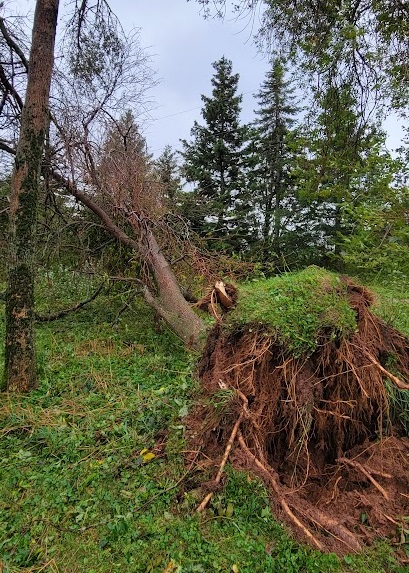
It’s Friday night. The platonic dark and stormy night. I’m watching a horror movie on my couch alone after my family has gone to bed. I figure it might be my last chance for a while (and I’m right). The rain is pressing against the window on our north wall so hard that the glass is bowing. I’m a bit afraid to go to bed because of the old walnut tree next to the house. If it fell it would fall directly on my room. The power stays on long enough for me to finish my movie and the stress of the storm coupled with the anxiety of a tense film has left me tired enough to sleep. I lie in bed listening to the noise outside. Eventually the lights die but I don’t notice because I’ve already turned everything off. I will get my confirmation in the morning when my toilet stops flushing.

It’s Tuesday morning and I’m driving to work. We heard a rumour that the lights were back on at our office building downtown and maybe even internet? It’s worth the fuel to come in from the countryside. And anyway, there’s water to be had in town. When we arrive we discover the lights are on but the internet is out. Work has become another warming center – albeit one locked behind a key card. After a half hour of fiddling I manage to jury-rig the internet to work and get to doing my job but the attempt to restore normalcy breaks me open and tears begin to flow. I keep myself off camera for calls all day, claiming I’m conserving limited bandwidth but it’s because I don’t want my colleagues to see me cry. I don’t even really know why I’m crying now. The cat is back from the hospital. He’s alive but he’s rough and hiding a lot. We still don’t have water at home but our house survived the storm unscathed so at least we’re warm and dry.

So many people aren’t that lucky.

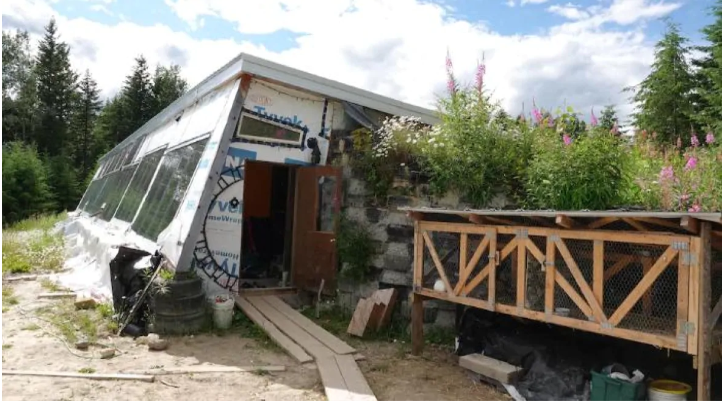
It’s Saturday afternoon. The storm that had been screaming outside all day has finally begun to subside – drifting off to expend its fury on Newfoundland where it will wash the town of Port aux Basques into the sea. We emerge from the house and examine the damage. Our greenhouse is miraculously undamaged but our solar panels are gone. We walk around some more and find them face down in the field next to the struts they stood on. We don’t know if they’re insured or not. In a few hours we will discover that our cat is sick but there are four trees down across our driveway and the wind and rain are still too high for me to safely cut us out with me being a green novice with the chainsaw. We decide to wait until the morning and reassess. By morning the cat is nearly dead but a neighbour, unaware that we were even home, brings his chainsaw and clears the path to the road. We cling desperately to the belief he just saved a life.

Time loses meaning in all this. We still have clocks but they’re not relevant. We do daylight things in daylight; we do night-time things in the dark. Most of our activity is geared just to keeping us going and alive.

But not all of us survive.

It’s Wednesday afternoon. A beautiful day. My cat dies in my arms. The vet kept him overnight, made sure he was able to pee on his own. The vet loves the cat; he’s so friendly and playful. Just a perfect little kitty. They were almost sorry to see him go but he seemed to have recovered and we wanted our friend, our family member, home. But things quickly start going wrong. He doesn’t want to touch his new food. He doesn’t drink. He fights against his medicine. He spends his last days hiding under my daughter’s bed or sleeping next to her at night. Wednesday he seems lethargic and drowsy. We hope it’s a side effect of the medicine and he’s still peeing – but he seems to be incontinent. We call the vet and they give us monitoring instructions. My wife takes a vacation day to look after him. There’s electricity at work again so we’re both supposed to be back. I go in. She calls me in the midst of a meeting telling me that we need to get the cat back to the vet quickly and I rush home – hindered by a vast traffic jam caused by the needs of road crews cutting trees out of power lines along the highway. The vet tells us he’s blocked again. His electrolytes are out of balance again. We’re back to square one. They can do everything they did before all over again but they aren’t observing the crystals they’d associate with stress cystis in his samples and the truth is they don’t know why his bladder and kidneys are shutting down. They cannot promise even the most heroic efforts would let him recover. They don’t say it but we are thinking it: the storm has killed my cat; it’s just taking a while to finish the job.

He dies in my arms knowing he was always loved. He’s only one year old. I don’t sleep well that night. I keep waking to the sound of feet scampering in the attic but they stop as soon as I’m awake and alert. I don’t know whether these liminal footsteps are an animal or if they’re just the remnants of dreams of a missing friend. I’m too tired to look.

Depictions of disaster in popular art are neat and tidy. They focus on the moment of crisis – the sharp fear of devastation and the bright excitement of survival. But the truth is that this is not the true nature of the disaster. Time breaks down around you. There’s a heavy grief that occupies you for lost friends, lost possessions and the shared pain of a community struggling to reconstruct itself amidst the ruins of the event. Bataille’s inner experience captures the fragmented nature of thought at the edge of what a person can tolerate. Sentences break down. Time sense becomes confused as the pain of the past, the doldrum of the present and the blank grey fear of the future all crowd together. I was in a meeting when I got the call from the vet to have that talk. All I could manage to get out for the longest time were fragments: “I just…” “I can’t.” Eventually I managed to force out, “I have to go,” but still I lingered to the end of the call – as much as I couldn’t stand to be in the present moment I also couldn’t stand the idea of moving toward that awful future I could anticipate ahead of me.

The truth was that in the anticipation of that moment I was already there, in that future time, living through it. There is still a future for us. Those of us who remain. And there are still routines that need to be served. Work needs to be done. Livestock needs feeding. We have another cat and a dog who we love and who can’t understand why their third companion is gone and won’t come back. There still isn’t electricity at home. There’s still no running water. So I’m sitting in my office: my actual office that I normally never go to since I work from home most every day, trying to work and lose myself in routines but it’s not enough and my sense of time remains unmoored. I’m still living in Friday night watching the storm push in my windows. I’m still living in Saturday afternoon, surveying the destruction of my farm. I’m still living in Wednesday afternoon, in a comfortable but impersonal room watching my cat die between my tears.

Disasters shatter time. So many things are broken: landscapes, properties, lives but, in the aftermath, it’s the breaking of chronology that cuts to the soul. You are pulled in a thousand temporal directions – unable to grieve properly because you’re still at the start, anticipating the terror to come an at the middle, struggling to understand and at the end, trying to pick up the pieces all at once.

Notes on Squeecore

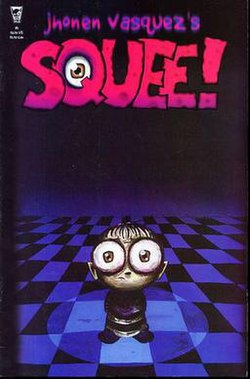
Squee! - Wikipedia

On January 13 R.S. Benedict’s Rite Gud podcast published an episode titled A Guide to Squeecore which served as an addendum and exploration of some topics raised during the previous November 11, 2021 episode Puppy Play. The discussion in this later podcast episode was wide-ranging and loose but it broadly posited that there is a dominant movement within SFF, that the participants in this movement often operate as gatekeepers, that this gatekeeping has a broadly class-based dynamic and that this movement has characteristic stylistic and ideological markers.

This has caused considerable consternation.

Now, as this “Squeecore” concept dovetails quite nicely into my recent essay on Hopepunk and into my ongoing examination of the impact of capitalism and idealism on the style and ideology of genre fiction I found the podcast to be very interesting. It certainly was not perfect and I think Camestros Felapton’s rebuttal is on the money on many points. With that being said, a podcast is most certainly not an essay and cannot be treated as one. Even the most essay-like podcasts (looking at the absolutely delightful Horror Vanguard) must ultimately be discursive, conversational. Podcasts are not essays. And as such, I think that CF’s argument – that Squeecore was insufficiently defined and too loose to constitute a movement, that there were contradictions among the examples provided and in fact some internal contradictions within the definition offered, isn’t a fatal criticism. It was two people exploring a phenomenon, grappling with it. It was insufficient to provide a definition or a proof but it provided many very interesting threads to pull at. So let’s tug a bit.

But first let’s examine the idea of “movements” within art and what dominance entails. There are largely two different modes by which a movement is reified. The first is for a group of artists with shared ideologies and worldviews to release a manifesto (or more than one manifesto) and announce that they are to constitute a movement. Examples of these include Futurism, Dogme 95 and Hopepunk. Movements like these are easy. If you want to know what they do, what they stand for, and who is within them they are generally happy to tell you. Sometimes, as in the case of Hopepunk, these definitions may become unclear but this isn’t generally a matter of under-definition so much as over-definition and contradictory definition. However that isn’t always the case.

Take, for example, Fauvism. This early modernist art-style emerged largely out of a school but it had no manifesto and didn’t require strict adherence to some sort of ideology or even aesthetic beyond a fondness for a vibrancy of colour, a treatment of the use of colour as a predominant aesthetic concern of painting. And Fauvism did not name itself. Rather, scandalized critics who saw the output of the Fauvists at the Salon D’Automne of 1905 derided the paintings of these “wild beasts” who had thrown the careful accuracy of prior styles out the window in favour of their laser-sharp aesthetic concern with colour. Furthermore these Fauvist aesthetic concerns are not able to be narrowly confined to just one school; Tom Thomson‘s Algonquin paintings share many of the aesthetics of a painter like Maurice de Vlaminck and Thomson was contemporaneous with the Fauves but he was not an exhibitor at the Salon. A movement may be defined by clear memberships and clear goals but neither of these are necessary preconditions for one to manifest.

Turning to genre literature and something like the New Wave is more nebulous still. Although it is best situated as part of the broader new wave artistic movement of the late 1950s and early 1960s it is hardly like John Wyndam was writing essays on Nouvelle Vague and its applications in literature. And while Michael Moorcock eventually had quite a lot to say about the New Wave, I don’t think anything he produced could be treated as an exhaustive definition of the movement. Rather it was broad, nebulous and open-ended.

And the truth is that this is the case for the vast majority of literary movements. They are coextensive and permeable. When we look at authors like John Brunner or Philip K. Dick we might be looking at a New Wave author or as an early representative of Cyberpunk. The fact that the boundaries between Cyberpunk and New Wave blur and mesh doesn’t reduce the possibility that either movement could be considered dominant.

In fact precisely because movements are coextensive and permeable dominance must always be treated as contingent. What it means for a movement to be a dominant one will change as the historical terrain upon which it operates moves. Frankly, the Cyberpunk movement could never have expressed dominance in the same manner that a contemporary movement, whatever we choose to call it, could because the Cyberpunk movement didn’t have Twitter, Goodreads and AO3 at its disposal. Dominance is best recognized in retrospect – when a movement has unified with the socius of the literary scene, left its marks for future movements to follow, and we can observe how it has impacted those who are without it. Cyberpunk and New Wave can be called dominant movements not because they exercised any sort of gatekeeping power at journals, conventions, workshops or within artists social spaces but rather because, in retrospect, they shaped how those who followed engaged with the production of new literature and new movements.

So that brings us to two questions: is there a cohesive literary movement that could be seen as dominant within genre fiction right now and is it something recognizable within the Rite Gud parlance as Squeecore?

Let’s set aside the question of dominance for the moment and ask whether there is a literary movement that meets some or all of Rite Gud’s criteria. I’m not going to slavishly constrain myself here within the contradictions identified by Camestros Felapton since, as I said before, I don’t think A Guide to Squeecore provides a definition so much as a map. However there are a few aesthetic and ideological markers I think we need to look at:

  1. A screen-aesthetic
  2. An undue influence from the YA genre even outside of those works identified as YA
  3. A specifically self-aware form of deconstructive discourse
  4. An ideology derived from progressive bourgeois liberalism
  5. A triumphalism within that ideological frame

For the first point I think it would be good to examine one of the few named examples of a Squeecore author in Chuck Wendig. Now, I should note, that I previously defended Wendig when various Star Wars chuds attempted to review bomb Star Wars: Aftermath – a book which I liked far more than most tie-in fiction.

A few caveats: 2015 is not 2022 and I am decidedly not the same person I was seven years ago. With that being said, I was already starting to feel a dissatisfaction with fandom even then and my response toward a coordinated reactionary fan movement against a broadly progressive author was always going to favor the author over the fans. The main change in my thinking regarding fandom since then is a shift from identifying reactionary fandom as a problem to identifying fandom as being intrinsically reactionary. The main change in my thinking regarding Wendig was rather a souring with regard to his style. Certain elements that I enjoyed from him in 2015, notably a certain kineticism with regard to action, a flair for the visual and how these two qualities imbeds the narrative in a sort of flow from any given moment to the next, have become tedious and overplayed to me. I’ve seen far too much of this and begun to become frustrated not that there are screen-like books but that it seems like most of what is produced are screen-like.

Even the most internal of Wendig’s books, the Mookie Pearl duology, which I would happily characterize as the high-water mark of Wendig’s career, aren’t particularly internal. Although we are invited to understand something of how Mookie feels and why things matter to him, the book remains mostly a kinetic and screen-like action thing. If this duology, his best work, has such little in the way of internality beyond a gesture toward Mookie’s patriarchal regret then it’s reasonable to describe Wendig’s work as being composed mostly of surfaces across which action plays. Like a movie, or a TV show.

Wendig is, perhaps, the clearest example of a novelist who writes in a filmic style. Now I think it’s important to draw out how I talked previously a bit about how this was a characteristic of Hopepunk – the mediation of a literary canon via its filmic representation being something I called out within the Hopepunk manifestos – but this isn’t so much a matter of Wendig mediating literature via its depiction on screens as it is Wendig drawing the screen structure back into the book. The crafting of an image becomes the chief concern of the novel in Wendig’s hands. Action is in the moment and the dialog is kinetic precisely because Wendig is trying to show his audience a moving picture rather than tell them a story. In a way the lionization of show, don’t tell, almost inevitably leads to the logic of a filmic literature. After all, internality often involves telling the audience how somebody feels. As “Show, Don’t Tell” becomes a hard rule, it’s not hard to see how an audience of would-be authors with an insufficient grounding in literature but a lot of exposure to television will inevitably interpret that to turn the page into a kind of screen.

Let’s turn next to Scalzi, another person who was mentioned as part of the foundation of the Squeecore canon, to examine the second and third points. Now Camestros Felapton quite rightly points out that Scalzi’s protagonists are generally quite old. I mean it’s right there in the title: Old Man’s War. However this doesn’t mean that Scalzi’s work is without YA influence. It would be easy just to point to Zoe’s Tale as an example of a Young Adult novel, within his Old Man’s War series, that simultaneously attempts to be a work of adult fiction. However even in Old Man’s War and The Ghost Brigades the influence of Heinlein is too obvious to elide. Old Man’s War, especially, shares in a bildungsroman style wherein John undergoes a second adolescence and a subsequent initiation into adulthood via a process of moral development. It would obviously be reductive to call all contemporary bildungsromans young adult but it is likewise reductive to discard the influence of young adult fiction on an author simply because the protagonist was 75 before getting shunted into an unfamiliar, newly young, body. I think it’s clear that Scalzi’s Old Man’s series has influences from young adult while simultaneously being clearly a work of adult fiction. It is, to a very large extent, also heavily in discourse with Heinlein in a way that points toward the third point – a specifically self-aware form of deconstructive discourse.

Now here I want to pause on one of the points the Rite Gud podcast were clear on here that, within their Squeecore definition it was not sufficient that a work be discursive so much as that a work must insist that its discursive element be seen and I think this is where Redshirts becomes a valuable point of discussion. Absolutely nobody is suggesting that the idea of disposable, red-shirted, extras on Star Trek was somehow unexplored prior to 2012. However Redshirts did a lot to foreground this through its fourth-wall-breaking conclusion. Now me? I like a fourth-wall break when it’s well executed and I think it was well executed in Redshirts. This essay should not be seen as an attempt to bury John Scalzi. But regardless of where we stand on matters of taste regarding the literary device or where we stand on the quality of execution of the device in this case, it still holds that this execution, in this story, served to underline the discursive elements of Redshirts such that it insisted the audience engage with them. It wasn’t sufficient to construct a funhouse mirror reflection of the Gothic as Peake did in his Gormenghast books, nor to interrogate the cultural assumptions of a genre as Pratchett did with classic British fantasy in his early Discworld novels – both of these were deconstructive works but neither, especially not Peake, felt much need to insist that the audience acknowledge that a deconstruction was in progress. But Scalzi had his characters literally escape from their work of fiction to plead for consideration from their own fictive creators. This is not a subtle work of deconstruction.

So then we should grapple with whether these works, and others we might fold into this canon operate within a progressive liberal bourgeois ideological framework. And I mean let’s consider the end of The Last Colony to start, “In time every member of the Special Forces will be the same. It matters. It matters to who we are and for what we can become to the Colonial Union and to humanity.” This book was largely framing the revelation of a military secret to bring about a universal reification of the human. I mean. That’s pretty liberal. However we can’t discount how Scalzi’s progressivism puts him into dialog with Heinlein’s more fascist leanings, and how he suggests a progressive liberal solution to fascism through the revelation of truth. Marxists may have largely abandoned the idea of false consciousness after the work of Reich and Althusser, both of whom highlighted the Spinozist elements of Marx but this idea, that all that is needed to make conservatives see the light of progress is simply to lift the scales from their eyes is alive and well in liberalism.

Finally there’s the triumphalist pose. Certainly we can see this extratextually in the Hopepunk manifestos and I persist in insisting that we cannot explore the Rite Gud proposed Squeecore movement without considering it in relation to Hopepunk. However that same triumphalism arises in Wendig and Scalzi regularly, especially in Scalzi who cannot end a book but as a triumphalist clarion-call. Hints of this triumphalism also occur in the work of Hannu Rajaniemi whose Leflambeur trilogy concludes, “Inside one of the Prison’s many, many cells of glass a man sits reading a book or trying to,” this prisoner experiences a sudden moment of illumination, “There is a door, open, white and bright.
“He puts down the book, gets up and walks through it, whistling as he goes. He is surprised, but only a little. For in the end, there is always a way out.”

This same triumphalism occupies the conclusion of The Goblin Emperor which grants its righteous and just king the very liberal epithet of “bridge-builder.” And so what we can see is the beginning of a movement. This is built principally of 21st century literature although, notably, these examples are quite deliberately selected from among decade-old books. This is in part a recognition that much of the literature that Rite Gud was grappling with was from this period at the end of the first decade of the 21st century and the beginning of the second. But it’s also because movements don’t happen overnight and their dominance is, as I said before, best recognized after the fact. With that being said, it would be foolish to under-count the significant influence of Wendig, Scalzi, Rajaniemi and Addison on the last decade of speculative fiction. Between Wendig’s filmic treatment of text, Scalzi’s triumphal progressivism, Addison’s liberalism and even Rajaniemi’s more metaphysical liberalism (grounded in a kind of positivist and pluralist concern with an order / chaos dialectic) there is a common thread which is at least as unifying as that one which ties together Brunner and Gibson or Wyndham and Herbert. Or Dick and all four of the former. There is, ultimately, a movement and we can see its dominance in the worm-trace it leaves in its wake.

The dominance posited by Rite Gud was one that occupied two principal axes: a social control on the bounds of acceptable discourse that was grounded in a specifically bourgeois frame and a financial control of access to careers via class-gated activities such as writers’ workshops. These are rather nebulous but we can certainly look at the success that figures like Scalzi and Wendig enjoyed in their activities against the Sad Puppies as indicative of the former. Much of the complaint, especially against the Sad Puppies (less so for the more openly far-right Rabid Puppies) was that they’d violated an unspoken set of social norms with regard to comportment around awards conversations. They were thus frozen out of discourse, rendered invisible. As Benedict pointed out this sort of indirectness and this focus on unspoken and assumed norms are both characteristics of a Bourgeois reflection of culture. But, of course, per Deleuze and Guattari there is only one class: the Bourgeois in that the neoliberal period has driven all other class constructions out of consideration. Everyone is Bourgeois, just some of us are financially embarrassed members of the monolithic class. A direct, “hey fuck you buddy,” form of engagement is often interpreted as threatening or dangerous within this monolithic class formation as it is inappropriate comportment for a member of the Bourgeoisie – which to the Bourgeoisie is taken to mean everyone.

And that brings us to how workshops and conventions play into the networking necessary for SFF careerism. Frankly this is patently obvious. Notwithstanding limited scholarships (which create the myth of meritocracy) workshops, especially, are the domain of the idle rich. Six weeks and five thousand dollars can scarcely be obtained by anyone who has to work for a living although it’s a trivial barrier for a member of the propertied class. A five hundred dollar scholarship to entice a monied person who has experienced some intersectional form of marginalization in a non-class domain does very little to democratize access to these rarified events. What these workshops are very effective at doing is further financializing the arts as each author with the success of a few novels or a brace of short stories behind their name then becomes a workshop facilitator in some greater or lesser capacity as a side hustle, to make a career of their art. The workshops are, as such, a principal tool of recuperating art into a neoliberal ideological paradigm. Conventions are a bit less expensive and give networking opportunities to the labour aristocracy and petit bourgeois who have sufficient wealth and free time for a $1000 hotel stay for a week if not for the full workshop experience. But even within conventions it’s widely known that financial barriers distort attendance and create barriers to access for economically marginalized people including workers in the imperial core and people from the global south. It is worth remarking how these authors engaged in both workshop facilitation, the selling of writing manuals and curricula and in convention culture across their careers. A Clarion attendance can make a career as can being at the right place at the right time at a convention. If we discount how these become tools of dominance it is at our peril. And so we see here what dominance looks like: it is a group of largely monied, largely liberal major authors all of whom are sufficiently advanced in their career to have had a sizeable influence on the genre, and all of whom have a series of interlocking aesthetic and ideological concerns.

As I said previously, movements are coextensive and permeable. It’s not surprising that the movement that Rite Gud are gesturing toward in their podcast is nebulous. Most are. Futurists and Dogme 95 are the exception, not the rule when it comes to artistic movements and an attempt to deny a movement exists because it doesn’t have a manifesto that everyone within it has signed onto is just an act of self-delusion. And honestly a lot of this constructed movement fits very well with the Hopepunk manifestos anyway. Frankly it requires an act of willful blindness to ignore how screen-representation has impacted narrative style across the last two decades or how significant authors like Wendig have been influential as trend-setters in this regard. Likewise it is an act of willful blindness to ignore the triumphalism of Addison and Scalzi in the lionization of liberal progressivism – as I mentioned Rajaniemi goes so far as to imbed this in his metaphysics. The dominance this movement encompasses is diffuse but aligns with the class position of these authors such that a very bourgeois moral order is allowed to reproduce within literary culture. The alternative proposed by the sad and rabid puppies: varying from a conservative retreat into the past to outright fascism was roundly banished to the margins by this dominant group and that’s well and good. They should be told to fuck off. But a half-decade on we’ve seen very little to unseat these asethetic indicators or, especially, these ideological ones and this includes the adoption of liberal blind-spots like a failure of science fiction authors to recognize a Raytheon logo or understand why that is bad. This isn’t to propose an all-encompassing dominance. What is being sketched as a dominant movement isn’t like Sherwin Williams covering the world in paint but the contingent dominance it enjoys is visible and will remain present until some opposing force unseats it.

“Cat Person” in the uncanny valley

I swear I read “Cat Person” when it first came out although I found it so tedious an affair that everything about it is a void in my mind. However I’ve been open about how the period of 2016-18 was not the best for my mental health and it’s possible my inability to remember a single detail of the story was less about the craft of it and more about my own depression. With that in mind, when this story became the focal point of the Twitter discourse cycle, I decided to re-read it.

And in less than a minute I encountered this absolute clunker of a paragraph:

After the movie, he came back to her. “Concession-stand girl, give me your phone number,” he said, and, surprising herself, she did.

It doesn’t get better. Margot is an incredibly tedious subject. Her internal monolog is a mixture of vaguely bourgeois relationship anxiety and badly timed Whedonesque quippery. Of course it’s hard to generate much sympathy for a protagonist when her thoughts are narrated like this, “Looking at him like that, so awkwardly bent, his belly thick and soft and covered with hair, Margot recoiled. ” It’s not even the casual disgust at fat bodies that bothers me as much as how pedestrian this psychodrama is. Oh no. The protagonist is feeling regret at the sex she’s about to have because the man is a bit fat. Having re-read “Cat Person” in the cold light of 2021 reiterates my initial view of it. That it’s a dull story about two very dull people whose dull tryst leads to a dull revelation about pain and misogyny that undercuts itself at every turn by how little agency it assigns its protagonist.

But then someone came forward and said she was the subject and it set off a discourse cycle about authors using the people they know in their writing. Two principal camps emerged: 1) that this is just how writers go about building out their worlds and 2) that this was an intrusion into the privacy of a person even if it was lamp-shaded with a fiction.

One commentator from the second camp even went so far as to describe it as a theft, that the author of “Cat Person” had stolen a bit of this woman’s life to use as the basis for her story. In this I must be a yes-sayer. This is a theft. And that’s fine. Because artists should be criminals and outlaws. The problem here is not that Kristen Roupenian is a thief of another’s life. The problem is that she’s not a particularly talented thief and what she has created is not Alexis Nowicki but is rather a weak simulacrum imbued with just enough of the latter’s personality to make it recognizable while still being little more than a paper doll to dress up in the clothes of her attempt to explore the frustrations of dating.

Let’s be honest, authors talk about people as part of their art. I’m talking about Roupenian and Nowicki directly in this article because, as a critic, I don’t have the luxury of putting a fictive screen in front of my subject but, consciously or not, an author will draw from their experience of the mannerisms, cadences and motivations of the people around them in the construction of a fictional character. We might like to imagine the author alone in an off-grid shed, entirely disconnected from the world, and giving birth to their creations like they are Zeus birthing Athena but this is hardly the case.

The Creative Process

Art is created in a social field and an artist is first and foremost someone communicating within that social field. Characters do not arise ex-nihilo but rather through a process of creative destruction wherein an author’s sense of a subject is disassembled and used as the ground from which their creative objects arise. An artist, like it or not, has something to say about the world and if they’re talking about people that implies they have something to say about real, material, people.

But bad art doesn’t necessarily accomplish this well. And this, I think, is where the discomfort so many people feel with “Cat Person” arises. Margot is hardly a person. She’s a hollow shell of a person – mannerisms, jobs, ages and easily identified quirks but there’s nothing there beyond this. Her terribly banal inner monolog is almost precisely the same “professor has a mid-life crisis and dates his student” sort of story that detractors of “lit-fic” like to point to about What Is Wrong With The Genre and it’s not made better by having the point of view inverted to the student rather than the older man. The character is dragged through her own story by Robert and Tamara. Her monolog is an endless litany of banal and common-place complaints. Regrets over mistakes, things not said, a kind of Freudian reaction to dating and life that is buried behind the metaphoric screen memory of neo-passéist realism. When that inane internality is stripped away from the character, what we’re left with is just what you could find out about anybody through a facebook crawl: brands liked, photos of pets, nights at specific bars. This story wants you to know these are New York daters but the setting is flat. What is created isn’t a living breathing city, it isn’t even a flat sound-stage reproduction. It’s empty boxes with names attached.

When you close your eyes and imagine the theatre Margot works at, all that’s summoned to mind is a pack of twizzlers and a pudgy man. The Seven-Eleven is just what could be said about it anywhere: a harsh white-yellow light inside, a garish orange and green sign without. Brand markers stand in for any viceral sense of place.

With this flat and empty prose it’s not surprising that Nowicki and her friends are unnerved. I think I’d be equally unnerved to find out that somebody was using a photograph of my head to construct amateurish paper dolls. But the problem isn’t, in fact, that the Roupenian used Nowicki’s life in her work but rather that she did so with such ham-fisted disregard for the person she was observing. She created a world made entirely of flat surfaces and the flattest surface of all is Margot’s affect. Who wants to look at that and see themselves?

Art is theft. And art isn’t nice. Authors hardly have a choice but to use the people around them as grist for the creative mill; even if the author wants to lie to themself and say that they create like Zeus created Athena, they are forgetting that Zeus only gave birth in this startling way because he swallowed Metis whole. Metis, the Titaness who stands for creative ingenuity was a person taken in by Zeus in the process of his creation, and through the deconstruction of Metis, Athena was born. Fictive creation depends on the materiality of the world for it to be produced. There will always be a violence to art, a destructive one. The challenge is to make it loving.

And the absence of love is, I think, where the failure of “Cat Person” arises most clearly. There’s no sense in the story that Margot is an object of love. “Whore,” Robert calls her at the end. And while it is made painfully evident that Robert has no idea who Margot is, there’s no self-love in Margot to balance against the ways Robert objectifies her. Inside and out, Margot remains not much more than an object, navigated by a seemingly disinterested author through empty rooms full of brand markers and empty thoughts full of anxiety and ennui. Effort is made to fully realize the revulsion Robert conjures but no effort is made to elevate Margot beyond the flat affect with which Robert views her.

I think the discourse that surrounds this story and its camps is in part a failure of criticism. “Cat Person” is not a good short story. It’s tedious and passé. It attempts to dig at misogyny but does so with all the grace of a decade-old “manspreading” article. It is a story so revulsed by materiality that the meat of the story lies entirely within the heart of the protagonist, unfortunately it is a story whose protagonist has a heart as real as a child’s paper cut-out of the same. To point to this and say, “see! Thief!” is almost embarrassing because it is such a poor grade of theft. Artists who think creation of character is possible without reference to real people lack self-examination on the matter. Readers who think this are naïve at best. Even Athena was born from an artist’s deconstruction of another. Zeus destroyed Metis to create Athena. Artists must be thieves. There is no real choice in that. But this is neither an indication of good or bad art. And ultimately, when the discourse and the camps are stripped away, what we are left with in the case of “Cat Person” is a bad portrait and a subject whose friends said, “this portrait sucks.”

Complex Systems, bees, lobster and Kitchen Cabinets

As I’ve worked through a lot of materialist thought for the aesthetics project I keep coming back to complex systems. Complex systems theory is an interdisciplinary area of study centered around ecology but with significant impacts for philosophy, economics, sociology, mathematics, physics and other realms of study. It’s a method of looking at non-closed systems. This is largely a response of the failure of ecological and economic systems to behave according to theoretical models predicated around good careful scientifically contained defined systems. We can see systems at work but they’re messy. They have an unlimited number of externalities. Complex systems theory is one of my principal objections to the application of game theory to economics. A game is not a complex system. It is, in fact, a carefully bounded and parsimonious system. Effectively the problem is the board. All games have a board, whether that’s the boundaries of permutations within a deck of cards, an actual physical gameboard or a field of play. The board delineates the boundary of play where, barring unexpected and chaotic factors (say for instance if a swarm of bees invades a football pitch) all that is the game exists within the boundaries of the board. Externalities such as bee swarms are excluded from play. The game will be paused, and resumed when the chaotic element is removed. But of course economies and ecologies don’t work as a game. An economy can’t be paused while a pandemic is cleared away. And that moves it out of the bounds of a game. If economies are games then they are games with infinitely expansive boards in which externalities don’t exist.

Here’s an extended example of the complexity intrinsic to complex systems:

One of the frustrating and long-term unexpected side effects of the pandemic is a disruption of the kitchen fixtures manufacturing sector. It’s very hard to get cabinets installed right now. This is a result of multiple interfacing systems: Let’s start with Alberta paying skilled tradespeople far more than PEI means many carpenters move out west to work. This reduces the overall available pool of carpenters within the province. Add to that the fact that PEI is the fastest growing province in Canada and that the new-construction housing market has a resource bottle neck and the challenge of resourcing people for resale market renovations becomes even more challenging. So you might ask, why doesn’t PEI offer incentives to bring home all those expatriated carpenters from the oil patch? The answer points to even more interlocking systems.

1) Developers in PEI operate on lower margins than oil companies out west. They don’t want to increase pay. Because they’re quite profitable now and the backlog of work just means they have a consistent funnel. They COULD surge hiring by raising pay but that would reduce their overall profitability.

2) PEI effectively doesn’t build public housing. There are two political parties that have traditionally formed power: The Liberals and the Conservatives. Despite the names, the provincial liberals are probably very slightly to the right of the provincial Conservatives though the divide is more a historic town/country split. 

Neither the property-developer beholden Liberals nor the fiscally anxious Conservatives want to spend PEI’s limited budget on affordable housing if they can instead just offer tax cuts to developers in exchange for commitments to lease purpose-built rental units back to the province. This means the province doesn’t need to hire any project managers, carpenters, concrete layers, electricians, etc. It also allows the province to privatize the capital acquisition costs of construction equipment. With the arrival of COVID-19 the attention of the government turned sharply to disease management. And to their credit they have done a commendable job. PEI has had some of the lowest spread of COVID-19 per capita around at 132 cases per 100k people. This puts us on roughly the same footing as Australia. For reference, Canada, overall, is at 3,792 cases per 100k people. To situate this overall, Vietnam, which was widely seen as being the gold standard, sits at 22/100k. South Korea, another stand-out for COVID response is at 312/100k. The best European response is probably Finland at 1753/100k. The world mean is 2396/100k. But the PEI government somewhat notoriously managed this feat by deprioritizing everything else.

This is something that the governing Conservatives, the official opposition Green party and the recently deposed Liberals all aligned on. So despite the pre-existing rental availability crisis there has been very little action on housing in the last two years. 

Now another important system at play here is short-term rental. PEI has four principal industries: Agriculture, Fisheries, IT and tourism. And in Charlottetown, where over half of the population of the whole island lives, Tourism reigns supreme. In particular, Charlottetown has a huge short-term rentals market with something like 1/3 of all downtown homes on the rental market being for short-term rentals specifically. Prior to COVID-19 there was discussion in Charlottetown of addressing this issue. Rental availability rates were lower than those of Toronto and, if you could get a mortgage, it was rapidly becoming substantially cheaper to buy a house than to rent. But this was driving rapid increases in home prices, particularly in the capital region. 

Charlottetown was planning consultations on bylaws that would impose restrictions on short-term rental operators who were not either A) renting rooms or grandparent suites of their own principal residences or B) properly registered tourism operators ie: those who run their businesses through the traditional B&B model rather than unofficial AirBnB premises. However between lockdowns, COVID measures taking bandwidth and the lobbying of the tourism industry to protect it in a general sense against the ravages COVID visited upon the industry, this particular file laid in abeyance until very recently. There was a public consultation that became heated enough that the Charlottetown city council actually shut it down early. I have not heard about subsequent consultations or action on the file since. 

As an aside, the rise in home purchase prices in PEI accelerated significantly during COVID as Ontario and Quebec residents relocated to the Maritimes in record numbers to escape the plague. Anyone who bought a home before 2019 stood to make an exceptional windfall. This is, in fact, how we came to be in a position to need new cabinets as we were able to realize a long-time dream of buying a hobby farm but the farmhouse doesn’t currently have a very functional kitchen. Exacerbating this further, much of the kitchen fixture manufacturing for North America occurs in Texas and the industrial capacity of the state has been impacted not just by Coronavirus but also by the impact of climate disasters, further disrupting delicate supply chains.

So here is an example of how complex systems interlock. Canada subsidizes oil production and makes it part of “the national interest” and so oil companies pay attractive wages pulling carpenters out of the province. The province is politically uninterested in increasing wages for skilled trades. AirBnB pulls rental homes out of the market and drives the start of a home price bubble accelerated further by internal immigration from other provinces. A global pandemic disrupts manufacturing and shipping abroad while climate crisis and the just-in-time delivery model further weaken supply chains. Pandemic response prioritizes public health and the protection of a key provincial industry over resolving pre-existing crises. Home owners are sitting on money to invest back into their homes and further driving demand. But rather than raising prices were seeing, instead, raising wait times. It’s not a matter of some open market bidding because carpenters are employed by specific employers in specific sectors who don’t want their costs to rise. And of course home owners with money in their pockets and lot of time at home are willing to invest in quality. So what ends up buckling is time, making the wait for cabinetry long. This isn’t a game but rather the overlap of several complicated economic systems and it doesn’t map cleanly onto a demand curve. Demand is a factor, but the externalities far outweigh the simple requirement of “people want cabinets.”

All these things: oil barons and floods in Texas, disease and government ideology, rising demand and supply chain fragility, it’s all part of the field of play. In his later work on acid communism and post-capitalist desire, Mark Fisher pointed toward a concept of consciousness raising and I do think that this is a necessary activity. However I think it needs to be directed specifically toward those ontological tools that allow for an understanding of complex systems. What’s more, it isn’t sufficient to leave this in the ivory tower as the domain of ecologists and mathematicians. We can see some understanding of the scope of the problem there, of course. In The Integrative Analysis of Economic Ecosystems: Reviewing labour market policies with new insights from permaculture and systems theory Michael Schlauch addresses the challenges facing economics in adopting a complex systems approch, saying, “Systems are then referred to as “purposeful activity systems”, i.e. systems that consist of human actors that take purposeful actions. These are not taken as real, but as continually changing perceptions from different points of view. Models are “working models” not claiming any “permanent ontological status” (Checkland, 2000, p. 20). Resulting solutions are valid for the observed situation and may not be purported as universal laws.” Referring back, himself, to Peter Checkland’s Soft Systems Methodology: A Thirty Year Retrospective. This is academically interesting but not particularly helpful. It’s good for economists to admit that models should not claim a permanent ontological status but it doesn’t really propose clearly what ontology would be preferred nor how to achieve such an ontological position. On the other hand, there’s a risk in over-mystifying complex systems. The Biggest Little Farm takes great care to show how complex systems interact but tends to reduce them either to a “circle of life” implementation of the eternal return or to become even more mystical, assigning some sort of special ontological position to the blue eyes of an aging dog. While this is entertaining (and it is a masterfully shot documentary which will likely entertain people interested in sustainable agriculture) it is also not particularly useful as part of a consciousness raising program.

We can however find some tools for handling complex systems. The ecological tools of permaculture provide a good framework. A permaculture expert at the University of Western Ontario, Rebecca Ellis (in collaboration with Weis, Suryanarayanan and Bailin) says, regarding bees, “Despite growing attention, there is cause for concern that much of the coverage of bee declines pivot around narrowly defined technical evidence (especially in relation to the harm caused by a specific class of pesticides) in a way that can obscure the more fundamental roots of the problems, along with the need for much bigger changes… while conditions affecting bee health and threats to survival are well studied, and evidence is proliferating, too often the problems facing bees are assessed and presented in isolation, with insufficient attention given to the range of ways that industrial agriculture bears on them and how these interrelate.” Complex systems study within agriculture and ecology has its strength both in maturity and in the materiality of its subject matter. Unlike philosophers or economists, who are largely working with abstractions, ecologists and agriculturalists are fully grounded in the material conditions of the world and treat the complexity of these systems as matters of material reality: crop health, biodiversity and systems equilibria in lived environments. Ellis et. al get at the necessity of looking at interrelating systems as relationships rather than as isolated subjects.

This is, of course, not a new idea. From the Denma Translation Group Sunzi:

A state's impoverishment from its soldiers --
When they are distant, there is distant transport. 
When they are distant and there is distant transport the hundred clans are impoverished. 
When soldiers are near, things sell dearly.
When things sell dearly, wealth is exhausted. 
When wealth is exhausted, people are hard-pressed by local taxes.

The Denma Group tie this to Sunzi’s statement that “Taking a state whole is superior. Destroying it is inferior to this,” to transport the idea of taking whole out of the specific context of capturing a state without unneeded military destruction and instead to an ontological position. In the Taking Whole commentary, the Denma group reconcile Sunzi with the Confucian critic Xunzi claiming that the statement, “There is a plant in the Western Regions called a blackberry lily. Its stem is four inches long, but because it grows atop tall mountains, it looks down into a thousand-foot abyss,” rather than operating as a critique of Sunzi, demonstrates the sort of flexibility in perspective that defines Sunzi’s prescription for a sage commander. Ultimately, their interpretation of the ontology of Sunzi depends on a concept called Shih. “The rush of water to the point of tossing rock about. This is shih.” Shih represents the flow across a gradient that manifests as power. But it, and its companion concept node which is the moment of the event in which power is exercised, denote that the principal way Sunzi views circumstances is in their relationships. Much like in Xunzi’s example, power is intrinsically a matter of relationship. Xunzi expresses this relationship in the position of a distant perspective while Sunzi prefers to be enmeshed in the action but both come together to propose that an understanding of the moment of the event is not enough. One must understand rather how that event interrelates to every other event. You can’t just say rocks smashed but rather that they were pushed by the river. And the river, in its turn is water acted upon by gravity, channeled by the differential density of the same rock that it erodes and throws about. The system doesn’t have limits, it expands in every direction over the horizon. The Denma Translation group proposes that a sage must be both Sunzi, occupying the position of the drawn crossbow, the raging river, the boulder rolling down a hill and also that of Xunzi: a little plant at the precipice of a towering abyss. A general must know both the specificity of their supply chain and how it interacts with the local economy but also the terrain in which the army moves. They must live both in the mathematical specificity of the logbook and must stand upon high hills and survey the terrain.

This ontological superposition has been expanded upon greatly in recent years by Mi’kmaw Elder Abert Marshall as Two-Eyed Seeing. This concept has principally been applied to the conflict-laden topic of fisheries management in an attempt to bridge the gap between the Canadian colonial administration of fisheries and Mi’kmaw traditional fisheries stewardship. Marshall proposed that the value of European sciences should not be discarded as poison fruit of a poison tree but rather should be integrated with traditional understandings of fisheries management. The Mi’kmaw people have been fishing the Martime Atlantic for millennia and hold specific local knowledge of the ecological systems in their environment but a scientific understanding of epidemiology and population control is also useful for stewarding seafood populations. This must all be positioned within the context of the Marshall Decision, in which Donald Marshall Jr. (the son of then-Mi’kmaw Grand Chief Donald Marshall Sr.) successfully petitioned the Canadian Supreme Court over treaty obligations not to interfere with Mi’kmaw fisheries. Disputes, especially over lobster, have boiled over into violence directed against First Nations people in Nova Scotia as recently as last year over the decision of Mi’kmaw fishermen to fish lobster outside of the season prescribed by the department of fisheries.

The argument put forward by the Mi’kmaw nation is twofold: first that they know quite well what they are doing and second that Canada is not legally authorized to prohibit their activity. The latter position is best elaborated through the two Marshall decisions which remain the binding legal interpretation of the treaties upon Canada in the current time. The former is elaborated in part through this ontological framework.

Complex systems are open-ended networks of relationships. The analytic/scientific approach of excluding externalities and concentrating on increasingly atomized elements of the system have, as Ellis et. al. suggested, produced problems. People get hung up on glyphosphate and fail to consider how bee populations are impacted by monoculture, by climate change, by the breaking up of habitat, by the transportation of hives as a form of migrant worker or at least imported livestock and how that can create supply chain fragility when transportation or industry becomes disrupted. Attempts to put bees in the little box marked, “honey producing livestock” are as much a part of the problem facing bees as a general category as the use of pesticides which kill them. Not that this defends glyphosphate use; it is one of the inputs into the system. It is just that it is necessary to treat the complex system whole but it is also necessary, when a part of the system is breaking down to be able to manipulate that specific relationship before stepping back again to observe the holistic impact of that change upon the system.

We must learn to treat problems neither in isolation nor as mere movements within an holistic system but rather both at once. We should be enmeshed in systems sufficient to see their node but also be the little plant above the abyss.

Truth Windows

I’ve been thinking a lot about sustainable homes lately.

Sustainable homes are a very interesting trend – this trend has largely been tied to an interconnected network of associated home and lifestyle micro-cultures including the permaculture farming movement, the rewilding movement (in both the conservation biology and anarchist senses of the word) and to tiny homes.

Sustainable home builders are unified by a shared set of general precepts:

  • That modern housing construction is ecologically harmful and unsustainable.
  • That traditional house construction techniques have advantages over modern house construction.
  • That there is an aesthetic or moral advantage to a “simplified” lifestyle.
  • An interest in specific technologies including: passive climate control, sustainable water use practice and efficient home construction.
  • An aesthetic interest in curved living spaces over right-angle construction, the integration of built structures into the landscape, the incorporation of recycled material as explicit aesthetic flourishes and a desire for a DIY aesthetic that carries certain proletarianized (or peasantized) signifiers.

These homes have a few principal overall construction and aesthetic methodologies:

It should be noted that any of the first four categories may or may not also be a part of the fifth, as there are many off-grid sustainable homes but being off-grid is not an intrinsically fundamental aspect of any of the above. I want to focus on a feature specific to two types of buildings in the earthship and the bale and cob style homes in the form of the “truth window” because I think this aesthetic feature of these homes is particularly interesting.

Now part of the reason that truth windows occur in the former types of structure but not in yurts or cave homes is because yurts and cave houses show their truth-in-construction intrinsically. The frame of a yurt is the interior finish of the building and likewise a cave house is, well, a cave.

Nothing is hidden in the construction of a yurt.

However bale and cob homes and earthships share a commonality in that their construction consists of three layers: an outer shell, generally made out of some form of clay masonry, an inner lining of plaster and a central layer made out of a novel material: straw bales in the case of bale and cob, tires full of rammed earth in the case of earthships.

There are certainly commendable advantages to these design decisions. Straw bales are a highly renewable building material, cheap and readily available in any rural setting. They provide excellent insulation and they are an easy substrate to work with. When fully sealed, straw bales will also last a long time. Tires full of rammed earth provide some of the insulative benefit of straw bales and make use of recycled material, diverting tires that are past use as vehicle parts from garbage dumps to be re-used as an incredibly durable building material.

Now I do want to lay out a few points before we dig too deeply into the question of the truth window: first I think sustainable buildings are a good idea. Certainly the violent uniformity of the modern suburb is neither ecologically sustainable, aesthetically pleasing nor culturally positive. Quite a bit has been written about how the suburb breeds alienation. The suburban aesthetic of the grass lawn has lead to turf grass becoming the largest irrigated crop in the United States. And this is despite grass being an invasive species that isn’t particularly efficient at carbon capture (a consequence of monoculture and the externalities of mowing, fertilizer and pesticide), provides no nutrition to people or domestic animals in the suburban milieu and is boring and ugly to boot. The ecological problems of the suburb continue with the manner in which they are built for cars, the space-use structures of the cul-de-sac, and the significance of paved spaces. These are, of course, related issues. Part of what makes sustainable buildings sustainable isn’t in the construction of the building envelope itself so much as the relationship between the building and the surrounding terrain.

Nowhere is this clearer than in the construction of the earthship. These structures have a very specific relationship to their landscape wherein even microclimactic factors are carefully considered in the engineering of the building envelope. An earthship requires both unobstructed access to sunlight, with carefully angled windows for the front wall, and also a large bank of earth into which the back wall is built. The land bank at the rear of the earthship is often where rainwater cisterns are positioned, depending on gravity to pull water through the filtration system, to in-house use before exiting via gray water disposal systems into the front-of-house greenhouse. This imposes specific and particular landscape limitations on the positioning of earthships that limits their usefulness to a rural milieu. You literally cannot build them as suburbs. However this relationship between a built structure and a specific landscape extends beyond the practical limitations of dependence on sunlight and earth for passive climate control and on gravity and cisterns for off-grid water collection. There are, in fact, a preponderance of aesthetic and ideological complexes that interface sustainable homes with their environments. An example is visible in the image of the yurt above.

In traditional construction the wood burning stove is the principal heating source. There is a practical dimension to this decision because this allows for even radiation of heat around the entirety of the structure and because putting the stove (and the chimney) in the middle of the yurt allows for a heavy object from which to tie the central anchor line of the yurt – a structural feature that keeps yurts stable in high wind. However the centrality of the hearth and chimney also creates a hub between the platform and the central dome: an axle to the round home and its radically open concept. Living in a yurt, as it was traditionally designed, imposes certain ways of living that are more collective than the privatization of separate rooms. Tents don’t have internal walls. Cooking happens in the center with furniture and storage in a circle around it. The plan of the home imposes a lifestyle upon those who live within it. The same can be said of the greenhouses of the earthship – which are intrinsic and necessary parts of the water filtration system and which also provide food year-round to the occupants. This, too, imposes certain task-requirements on the occupants in the form of garden maintenance. You will not enjoy living in an earthship if you don’t want to also be a gardener.

In the case of both earthships and bale and cob houses, local earth is used in the creation of the facade. This is first a matter of cost: one of the attractions of sustainable house construction is its low price compared to traditional building. There is a whole ecosystem (if you can pardon the pun) built around seminars and workshops training people how to design and build sustainable homes that doubles to provide a volunteer workforce to undertake the labour of doing so. Recycled tires are frequently donated or can be sourced cheaply. Likewise straw bales are cheap and locally available in nearly any rural setting. It would defeat the purpose of this cost-cutting to drop a bunch of money bringing in earth for making the cladding, especially when these buildings so often require excavation of the terrain upon which they are built anyway. So you’ve got all this clay right there already. You might as well mix it with sand and straw to make some adobe. But this means that the building is literally constructed out of the local environment. In the case of earthships and cave homes, green roofs are not uncommon with local grass species providing protection against water damage and additional insulation in much the same way as a reed or thatch roof – just one that is still alive. At the very least, an earthship will have grasses planted on the rear earth mound.

But with these buildings taking the form of earthworks specifically it is also common to have those earthworks extend out into carefully structured gardens that often provide additional food for the residents and that extend the visual motifs of the built structure into the local environment. These homes are somewhat strongly bound to homesteading. As such the psychology of the sort of people who devote time and energy to learning how to build these structures and who would be happy to accept the trade-offs in creature comforts they sometimes entail (wood chip composting toilets and the like) is also conducive to a deliberate use of small-scale agriculture to supplement or even replace grocery purchases. For various reasons, the users of sustainable homes are often people who are dissatisfied with consumerism as a phenomenon and who wish to minimize their engagement in the formal economy.

But this brings us, finally to truth windows.

Now as I mentioned before, a truth window is a feature common to earthships and to cob and bale homes. It’s a cut-out in the inner plaster, generaly but not always framed and glazed like a window, behind which the central material of the house composition is displayed. In the case of an earthship you will see the tires full of rammed earth. In the case of a cob and bale house you will see the straw bale. The window isn’t a window out to the landscape the house is situated in but rather is a window into the truth of its construction. But why would anybody want such a thing?

And the answer is that, for all that these home life arrangements are organized around a wish for greater simplicity and as much as these homes are often constructed by people who feel both that consumerism is a problem to be avoided and one they are up to the challenge of avoiding most of the people who build and own these homes cannot entirely decouple from capitalism. They may have mortgages to pay unless they’re the recipients of inheritances. Their homestead farms may not produce all of their daily caloric intake and may principally operate as a supplement to groceries. They may need to buy clothes, books, games and tools. Many of the principal advocates for this lifestyle have made use of volunteer labour to build their homes but to access that labour pool they have, themselves, had to be volunteers at builds. Only attending these builds often requires you to fly half-way across the world at your own expense and take a week or even a month working hard labour on somebody else’s property for no pay. All this costs. And once a person has this expertise there’s likely a desire to monetize it further either by consulting, offering seminars in traditional building design or in permaculture, charging enthusiasts who can pay to gain access to hard-won expertise in unorthodox skills or even by renting out properties as cottages which serves the dual purpose of evangelizing for the home style by demonstrating its comforts and of subsidizing the monetary needs of the homesteaders.

The reality is that, despite the global networks of volunteers involved in the production of these homes, there aren’t many established sustainable communities. There are sustainable homes and they are disparate. Spread out. They’re show pieces, secret retreats or outposts in the wilds. Most of these homes contain one family and most of the homesteads feed one family. There is this oedipal triangle built in the social formation of the homestead – the pioneer myth of lone families against the world in terra nullius. This is, of course, all ahistorical nonsense but it’s easy nonsense to sell.

The motivation to live in a bale and cob house is likely, at its root, “I want to live in a house of straw.” But that’s very easy for capitalism to co-opt to “wouldn’t you like to live in a house of straw too?” And this, then, becomes a principal selling point. You might have the honesty to show that the toilet is a bucket full of wood chips, but that’s not how you sell the house either a day at a time as a rental or more abstractly as a lifestyle. Instead you narrow it down to, “wouldn’t you like to live in a house of straw?”

In Soledad Brother, George Jackson says, “I may run, but all the time that I am, I’ll be looking for a stick! A defensible position!” This moved Gilles Deleuze so much that he used it, or paraphrases of it, repeatedly throughout his career including in his work with Felix Guattari as part of his key definition of the term “line of flight.” Sustainable housing is a line of flight from capital. The people who desire these things want outside. So they take their little family and they go out into the wilds, become nomadic. In some cases these buildings are an end-position after literal nomadism as it isn’t uncommon for people building a home like this to have lived in a van while they get their new home in order. The sustainable home is an escape but it also contains within it the possible search for weapons through the resistance they provide to consumerism, the focus on local sustainability and the way in which they show how the structure can become one with the field in which it arises.

But as with any Deleuzo-Guattarian line of flight, the one involving sustainable homes is a walk along the razor’s edge. and, “the sharp edge of a razor is difficult to pass over; thus the wise say the path to Salvation is hard.” On one side of this chasm is a return fully into the territorialities of capitalism.

You can build a yurt that looks like it would be pitched in the lobby of an Ikea doing a special promotion. You can sell sustainable living as a lifestyle and you can make bank doing it; wouldn’t you like to own this life?

I’ve written before about how easy it is to build a self-identity around commodities and there isn’t anything intrinsically decommodifying about a sustainable home, certainly nothing that can’t be immediately reterritorialized by capitalism. And there’s another danger present. In building upon the pioneer myth as part of its basis, a lot of the homesteading movement can be fertile ground for the sort of reactionaries who would happily trade capitalism in for feudalism or something worse. It’s worth noting that homesteading is a predominantly white activity. And I don’t say this to smear homesteaders or say they’re a pack of fascists – I’m aware of many good and kind green-anarchists who are permaculturalists and who are deeply fond of homesteading: people who either are homesteaders themselves or who would be if they could follow the line of flight even that far. However cautionary tales abound. In Do you Make Yourself a Body Without Organs, Deleuze and Guatari warn that it’s very easy to fall into fascism while looking for your escape. And it’s not like this is without precedent. Look what happened to Nick Land. The truth window can be a window into an imagined past in which people “lived simply” and were more “in tune with nature,” and these naturalistic myths elide much of the messy material reality of the past. Yurts are the traditional homes of Central Asian steppe peoples, nomads whose way of life evolved together with their lived condition. Bale and Cobb houses are constructed still in Northern China, and while they are fading from popularity cave homes still exist too.

These white homesteaders building “traditional” dwellings from adobe and straw may act as if they’re reviving some lost past when all they’re really doing is building using the normal and lived expertise from other people in other places. The world has never been “simple” and the truth is that de-cluttering, choosing to raise your own food, and trying to minimize your interaction with capitalism will not make it simpler.

We can’t go back to the past and even if we could we wouldn’t enjoy what we found. There’s a reason we moved on and we don’t want to go back there. We can escape into the wilds but an escape from prison isn’t sufficient. As I’m fond of saying, echoing Tiqqun, what is needed is a total desertion.

Being an evangelist of that desertion may mean setting one foot outside the prison door and revealing that there was never any guard. The tower at the center of Bentham’s panopticon is empty and while Capitalism may always try to move its own boundaries such that it seems as if there is no outside, there is one and the sun shines there on a world just as complicated but in different, better, ways. But we cannot succeed until everyone escapes all together. That is why we must do as Jackson advises and look for a defensible position as we escape – a spot from which to help our fellows find the exit.

But this, eventually, is the rub. One homestead alone in the wild is never enough. We must start to imagine not sustainable homes but sustainable communities. It will involve a reordering of our space and our production not on a familial level but on the broad level of the group. There’s nothing wrong with borrowing the expertise of people who know how to build in these (better) ways, and the motivation of forming communities who volunteer to raise each other’s homes is precisely the right instinct. But we can’t have it be a game for rich kids to play – it’s something we have to do in our communities. My fear coming out of these plague years is that people will cry, “the city is dead, long live the suburbs!” But sustainability cannot happen there. If we must flee the city it must be to rural climes but it must not be as a homestead alone. It must be communities together. We don’t need truth windows to tell us the house is built of straw. We need instead groups of people who understand why using straw is a good choice in this place and at this time.

Of course Disney tried to copyright Loki

Recently a Redbubble designer shared a letter they got about the takedown of their “Low Key Loki” design. And I have to say that I really wish I was even slightly surprised. The image below is a clip from the form letter Redbubble gave to the artist regarding their tee shirt design.

Look at these shitty thieves at Disney trying to steal a whole-ass god.

The thing is that this isn’t the first time that Disney has attempted total nonsense like this. In fact it’s not even the second time. After all, there was that time that Disney tried to trademark a Mexican holiday. There was also that time that Disney tried to trademark a traditional Swahili expression. In fact, aggressive use of trademark law is one of Disney’s preferred methods of expressing ownership over a concept.

Now I know the pedants in the room will be quick to jump on how trademark is more limited than copyright, that the use of “Hakuna Matata” within the Lion King and the use of  Día de Muertos in the (insufferable) Coco does not prevent people from using the expression or enjoying the holiday but that’s the thing: as Disney has shown with their most recent trademark shenanigans, they’re perfectly willing to attempt to take ownership of the idea of Loki notwithstanding the usual barriers of specific design or context that limit trademark. Frankly it doesn’t matter whether something Disney claims ownership is claimed via copyright or trademark. The truth is that in both cases it’s Disney expressing a territory.

If you look at how Disney has camped on the works of Hans Christian Andersen, the Brothers Grimm, Chinese folk traditions dating back 1700 years,  Madame Gabrielle-Suzanne de Villeneuve, and so many other artists whose work has entered the public domain then what you see is the same predation that played out across England between 1600 and 1900 being executed again not in real estate but within the terrain of the imagination.

Let’s not have a misunderstanding. Disney has no right to ownership of the Little Mermaid, Rapunzel, Hua Mulan, Beauty and the Beast, Día de Muertos, Hakuna Matata or Loki. All they did in all these cases was to adapt extant public-domain material. That they then try to claw these stories, characters and concepts out of the public domain, and that anybody complies says nothing about the nature of copyright or trademark law but rather just demonstrates that all laws kneel below sufficient power and sufficient hubris.

I have not been watching Loki. This is, in fact, because I was quite fond of Thor: Ragnarok which I consider to be the best of the MCU films by a considerable margin. Loki’s arc ended there and it was a satisfactory ending. That the MCU decided to retcon him back to a prior, more usable, state at the expense of character growth is a perfect example of the corrosive violence to art that Disney represents. However I know some people are watching it and enjoying it.

If this is you I have just one request: find some way to watch this show that doesn’t give Disney a single penny of your money. I don’t care about the details but the only way to make Disney relax its avarice about this or that cultural artifact is to make it worthless to them. So do that thing.

Degenerate

The Tower of Blue Horses by Franz Marc
The Tower of Blue Horses – Franz Marc – 1913
Degenerate: late 15th century: from Latin degeneratus ‘no longer of its kind’, from the verb degenerare, from degener ‘debased’, from de- ‘away from’ + genus, gener- ‘race, kind’.

The Tower of Blue Horses disappeared after World War 2. Franz Marc was a German expressionist painter who died during World War 1 but his death, nor that it was in service of Germany during wartime didn’t prevent the nazis from labeling him a degenerate, confiscating his paintings from galleries, and displaying this one at the degenerate art exhibition. Marc had two strokes against him: first he came from a family of Jewish ethnic origin (they had converted to Catholicism, you know, because of all the antisemitism in Europe). Second, his work, which was steeped in mysticism and a visceral response against the violence of war was seen as being actively debasing to the aesthetic purity the Nazis strove toward.

Degenerate, in the context of aesthetics, carries a lot of connotation. It implies art that is no longer art (no longer of its kind) it is debased art – art that moves art away from what it should be. It implies a movement out of its genre: painting that is like sculpture or like a wood print. It implies a mixing of races, and it is no surprise that much of the art at the Degenerate Art exhibit was art that was affected by the exposure to foreign aesthetics brought about by colonialism. Matisse’s fauvism was heavily influenced by Japanese printmaking, as were many post-impressionists prior. The flattening of perspective these styles preferred moved art away from the renaissance preference of depth of field. Cubism, like that of Picasso, owed a deep debt to the art pillaged from Africa and its colonies and abstractionists also drew heavily on middle-eastern motifs. Fellow degenerate and expressionist painter Marc Chagall was Jewish and Jewish mysticism pervades his work.

The Fiddler – Marc Chagall – 1912

I bring this up mostly because I want it to be clear that, first off, degeneracy has always principally been an aesthetic accusation rather than an ethical one. Those who hate the degenerate do so because they find it ugly. Second, it’s important to situate that art called “degenerate” is art that is inseparable from the impact of colonialism. Between the advent of the impressionists in the mid-1800s and the end of WWII, visual art in Europe underwent a transformation the scope of which had not been seen since the Renaissance, and just as the Renaissance was brought about by the reintroduction of classical ideas via expanded contact with the Middle East, so too was modern art explicitly informed by the impact of colonialism. Matisse took from Japanese art freely and Picasso from African art but it wasn’t a moral reaction against those appropriations but rather a revulsion to what these appropriations entailed that upset the fascists. This situates the Nazi revulsion for the degenerate aesthetic as being a clear and obvious expression of their fear that the colonial project would change the imperial core and make those seats of empire no longer like their genus.

The deterritorializing and nomadic quality of modern art is not intrinsically moral either. Les Demoiselles d’Avignon is, in my eyes a work of transcendent beauty but it is also a product of theft. Degenerate art goes out beyond the boundaries of its genre and brings in the new. But what is new within the imperial core was the legacy of a thousand years elsewhere.

Les Demoiselles d’Avignon – Pablo Picasso – 1907

The conservativism of the Nazi remains, unsurprisingly, a perfect example of bad faith. The art they called degenerate was a product of the imperialism they championed. The empires of Germany, France, Spain and England sewed the seeds of modern art that revulsed the Nazi. They were unprepared to reap the whirlwind. They believed somehow they could go out and take from the world and somehow make everything German. This is the same phenomenon that the Wachowskis so masterfully commented upon in the Matrix Sequels via the solipsism of Smith.

I say all this because I want to point out that when supposed leftists speak of the degeneracy of, “transgenderism,” or when they try to lionize Socialist Realism over degenerate, ugly, decadent (rotting or decaying) art, they are speaking with the tongue of Nazis. I have always been proud to call myself a degenerate. These paintings I shared are, in my eyes, some of the greatest ever produced by Europeans explicitly because they went beyond the boundaries of European art and expanded the realm of the aesthetic in doing so. I have no desire to show fidelity to my genre. But this is not an ethical position. All these men, even Chagal, were thieves as for all that his Jewish mysticism shone through his canvases, they did so in the smiling simulation of an African mask.

But why say all this? Why simultaneously claim the term degenerate, announce that its enemies are Nazis and undermine it by laying bare its colonialist framework? Because the moral and the moralizing should be banished from art. It is critical to recognize that the attacks levied against “degenerates” in the present age has no grounding in ethics. It does not live there. For all that self-deceiving liars might harp on the safety of children, on the idea of harm, on the dubious proposition that this or that aesthetic position represents a violation of consent we must recognize that what is being said by these fork-tongued descendants of the Nazis isn’t, “this is evil,” but rather, “this is ugly.” And beauty is not intrinsically good nor ugliness evil.

There is cruelty and danger and wrath in our beauty. The Nightbreed of Midian crave flesh. There is beauty in the skull and the ruin as much as in the flower and the sunrise. The Nazis were immoral butchers. They slaughtered their way across Europe, committed genocides against anybody perceived different from them: Jews, Roma, Gays, Communists. But they were also narrow-minded ugly people who inured themselves against any beauty they didn’t recognize as being of their genre. It’s too easy to flatten these two perspectives, but this leaves us vulnerable.

When we hear people speaking sweet moralizing words, when they talk about liberating workers and organizing the working classes, when they claim revolutionary intent and then turn around and say Nazi things about sex and art it can be disorienting because they’re not Nazis. They said so, right?

But it’s important to remember that the reactionary current is as much an aesthetic position as a moral one. The reactionary is unwilling to accept that our concept of beauty grows as our concept of “us” does. They call for a mass movement then lock the door and say, “not you, you’re too ugly.” So, especially this month, when you encounter some petty person, even a putative leftist, calling kink at pride or trans people degenerate, decadent, or ugly, black their eyes and call them a fucking Nazi. They’ve earned it.