This Shit is Bananas

In 1954 the United Fruit Company (which later rebranded as Chiquita Bananas) conspired with the CIA to overthrow the democratically elected government of Guatamala. This became an exemplar of a category of 20th century political apparatuses called “banana republics” – autocratic dictatorships, generally in the global south, which were supported by the United States with the express purpose of supporting the unimpeded flow of cheap commodities into the imperial core. Other such banana republics included the turn-of-the-century government of Honduras, the state of Hawaii, and at various times Panama, the Philippines, Mexico, Nicaragua, the Dominican Republic, Haiti and, of course, Cuba.

This phenomenon was so called because of the centrality of both fruit companies to the series of coups and dictatorships and because of the instability they fostered – republics with the shelf life of a banana. However it must be clear that the objective of the United States in supporting often brutal regimes like that of Batista in Cuba was explicitly capitalist in nature. In many cases, throughout the first two decades of the 20th century, the US military, supporting American bankers and fruit sellers, took direct control over the political levers of many of these countries including, notably, Honduras, Nicaragua and Cuba.

Bananas have never failed to be political.

Now aside from the blood fertilizing so many export fruit crops, the desolation of indigenous kingdoms like Hawaii and of independent, democratic, republics like that of Guatamala prior to the 1954 coup there is another big problem with the tropical fruit trade: its carbon footprint. The production and shipping of each single banana contributes 80g of carbon to the atmosphere. For comparison, a locally grown apple, if raised organically (the caveats of “local” and “organic” here are important for later) extracts carbon from the atmosphere at a rate of 15,000 kg/year/acre. This works out, very roughly, to a net carbon reduction of 19g per apple.

And this gets to the two hearts of our recent “bananas under communism” discourse. See certain social democrats and left-liberals don’t like to believe that the imperial core would have to make any lifestyle changes at all if we were to overthrow capitalism and bring about a true economic revolution. For them the idea that communists are proposing they should not eat bananas is tantamount to betraying the very principles of socialism, this idea that we must unleash productive potential in some vulgar Stakhnovist sense of the word.

However what many eco-socialists, green-anarchists and other materialist communists are telling them is that one significant and necessary economic transformation that has to happen around the world is a pivot to a focus on local food production with the objective of feeding people where they live. Global supply chains that give the imperial core tropical fruit year-round and at cheap prices are still, to this day, lubricated with blood. Much of the world’s supply of inexpensive chocolate depends on child-slavery.

Beyond this, the carbon cost of growing and shipping cash crops like chocolate, bananas and other tropical fruit is exorbitant compared to the better option of growing abundant fruit trees local to any given population and that population eating that fruit.

Because this is the thing that a lot of the liberal banana-defenders miss: we aren’t saying some sort of scolding moral imperative like “you don’t deserve bananas filthy American” but, rather, we are saying, “grow your own damn fruit and share it with your own damn community.”

This will, of course, mean that availability of fruit will become more seasonal and consumer choice in the imperial core will shrink. That’s actually good though. Because, as other left-permaculturalists have pointed out, there’s another problem with mass production of out-of-season tropical fruit: it mostly sucks.

Tropical fruit bred to ship from Honduras or Guatamala to Prince Edward Island in the dead of winter is bred for shelf-life and hardiness. It must travel, by boat and truck, thousands of kilometers and across days to reach grocery shelves unblemished enough for the discerning imperial core consumer. In order to achieve this with a fragile banana the hardiest breeds are selected. If they taste good this is incidental. The logic of capital persists across all fruit strains. Most important is that as much of the fruit as possible is saleable at market. Second most is that it costs next to nothing to produce. Next is that it look pretty. If it tastes and smells good this is a nice bonus.

It’s not sufficient that we switch from bananas to apples. Apples put a lot of carbon back into the atmosphere via pesticides, artificial fertilizer and shipping. The same logic that gives us hard, aroma-free, green bananas on our store shelves also created and distributed the abomination that is the “red delicious” apple. Instead we should be putting fruit right where people live. Municipalities should plant local fruit trees for shade. Orchards should grow crops for sale within a local range of 100km or less as their principal targets. We should avoid pesticides and carbon-intensive nitrogen fertilizers in our fruit production and select fruit not for shelf hardiness but for aroma and flavour. This way of looking at fruit, especially the part about growing it freely in cities for anyone to eat, is the most critical aspect of what the environmentalist left is calling for. We’re not trying to take away your banana. We’re trying to give you pawpaws for free.

However, as a concession to our Banana-loving Stahknovists we must also remind them that it’s not just a bunch of revisionist ecological hippies saying this. It’s Karl Marx. “The determination of the market-value of products, including therefore agricultural products, is a social act, albeit a socially unconscious and unintentional one. It is based necessarily upon the exchange-value of the product, not upon the soil and the differences in its fertility.” Marx says in Capital Vol. 3 – part of an extended exegesis regarding differential rents on agricultural land – but this statement makes something very clear: capital is incapable of caring about soil health.

Now Marx goes on to make a very cogent point, that as the price of rents on land will be derived from the market price on crops grown on the least-fertile land a movement away from capitalism would ultimately lead to a reduction in the price of agricultural commodities that “would have the same effect as a reduction in price of the product to the same amount resulting from foreign imports.” In other words we can get more abundance by using land in a rational, non-capitalist sense, locally and, as such, side-step the need for imports.

And this is important because the liberals of the imperial core so worried that communists will take their tasty treats away are forgetting a key question of global revolution: if we overthrew capitalism what would you do to compel the global South to keep producing your bananas? Are you going to do what the United States did in 1954 and re-inscribe empire in order to keep the treat flowing in? Will we keep watering the cocoa trees with the blood of child slaves at gunpoint even under communism?

The truth is the decision will not ultimately belong to what is now the imperial core. If a revolution were to come the flow of cheap out of season tropical fruit would die back considerably as local farmers began to focus first on feeding themselves and their families rather than growing cocoa, coffee and bananas for export. The perverse economic incentives to produce cash crops don’t exist outside of capitalist compulsion and exploitation. To abolish capitalism will abolish green $0.80 per lb bananas on your grocery shelves. But this doesn’t mean the global North will starve. The socialist relationship to food, which no longer gears price to the rent that can be gained from the worst productive land, will allow for local crops to be available and affordable for us too.

There’s an old phrase, “farmers feed cities,” and it’s true. But right now many of these farmers live in the global South and starve to feed the cities of the imperial core. This is the injustice that must end. Right now these farmers watch as climate crisis hits them with wet bulb temperatures, heightened hurricane seasons and drought. The global South is the frontline of the devastation of climate change. And so, ultimately, the shit that is really bananas is that comfortable progressives in the imperial core think they’ll have any choice at all when the revolution finally does arrive.

Your bananas will go. Better learn to like apples.

Kid’s Stuff – The Double Binds of Barbie

Barbie (2023) is perhaps the most thoroughly postmodern children’s movie produced to date. The marketing material for this film promised that it was the movie for you whether you loved Barbie or hated Barbie and the film delivers almost precisely this – a story that attempts to shatter any grand narrative surrounding this toy. This is done from a variety of directions: first by establishing, as the premise of the film, that Barbieland is perfect – for Barbies – and that the Barbies who live there are comfortable in the knowledge that through the nebulous and infinitely transforming nature of Barbie they have created an avatar that allows girls, and by extension women, to be anything. The film then sends Barbie out of Barbieland and to the real world – in which the lie to that statement is revealed in full.

And yet, the Barbie movie also refuses to fully let go of the idea of Barbie as a mystical avatar for modern femininity. This creates one of the central double-binds of the film. The Barbie movie wants to demonstrate both that Barbie is representative of the aspirational desires of women but also that it is insufficient to the task.

These sorts of double-binds proliferate the text quite openly such as a late scene in which Gail, the Mattel executive assistant and frustrated mother whose spiritual bond with Margot Robbie’s “stereotypical Barbie” leads, in part, to the action of the film delivers a monologue saying, “You have to be a career woman, but also look out for other people.

“You have to answer for men’s bad behavior which is insane but if you point that out you’re accused of complaining.

“Because you’re supposed to stay pretty for men but not so pretty you tempt them too much or you threaten other women. Because you’re supposed to be part of the sisterhood but always stand out.

“You have to never get old, never be rude, never show off, never be selfish, never fall down, never fail, never show fear, never get out of line. It’s too hard, its too contradictory, and nobody gives you a medal and says thank you.”

Many critics have been fast to point out that much of the feminist content of this film is reminiscent of “girlboss feminism” – a kind of reintegration of third-wave Feminism that has been fully subsumed by capitalism. But this, too, is a bit of a simplification of a central double-bind for the film in which the CEO of Mattel mumbles that the company is built of women and that two prior CEOs were women while standing amongst a cadre of nameless male executives but in which the ghost of Ruth Handler maintains an office and seems, in some way, to still be running the company. This is a film in which Mattel is proven incapable of taking action of any moral significance because it is restricted by the profit motive but also one in which Mattel will also take moral action because it is restricted by the profit motive. The theme of the Barbie movie is so fragmentary as to be almost fractal.

And, of course, the Barbie movie shares a common concern with other postmodern films such as The Matrix with regard to authenticity and the order of simulacra. However, where the latter settles toward a Kierkegaardian celebration of the leap toward the authentic against all rational odds this movie instead spends two of its three acts reveling in probing the boundary between simulacra and the real. Barbieland is like a town in Sweden. However, when the pedal hits the metal the Barbie movie collapses any vestige of a division between simulacra and the real in favour of a Beauvoirian recognition of the necessity of self-announcement of being.

However let’s not suggest that Gerwig and Baumbach were able to get ahead of the greatest existentialist ethicist with their script. The script introduces our Barbie in a role that maps to Beauvoir’s description of narcissism. “Her memories become fixed, her behavior stereotyped, she dwells on the same words, repeats gestures that have lost all meaning: this is what gives the impression of poverty found in “secret diaries” or “feminine autobiographies”; so occupied in flattering herself, the woman who does nothing becomes nothing and flatters a nothing.”

And from there the film charts her evolution toward a kind of liberation, while attempting to recognize the fundamental incompleteness of the struggle. It’s, honestly, one of the better interpretations of existentialism in any recent scripts. I’ve commented elsewhere that Gerwig and Baumbach appear to grasp Beauvoir far better than the Daniels did Camus and, while I still think Nope did a better job of interrogating questions of recognition and the look, this was in part because Nope was a movie for adults and, as such, could get darker than a children’s comedy. And the script here is very good. It’s funny – very funny – and designed in a way that stays alert both to the child audience who are the primary targets of the film and the inevitable parents who will be escorting their kids there.

But, for all that the film uses Beauvoir’s feminism to strong effect they miss something very critical that Beauvoir said of liberation. “These civic liberties remain abstract if there is no corresponding economic autonomy; the kept woman—wife or mistress—is not freed from the male just because she has a ballot paper in her hands; while today’s customs impose fewer constraints on her than in the past, such negative licenses have not fundamentally changed her situation; she remains a vassal, imprisoned in her condition.”

The action of the Barbie movie comes to a head as the Barbies manage to protect legal rights via legal democratic action. Their economic dependence upon Mattel is, not only not abolished, it’s reaffirmed when Mattel realize that certain progressive doll ideas put forward by Gail would be very profitable. And this is the realm in which the incomplete double-binds of Barbie really strike at it. “Woman’s fate is intimately bound to the fate of socialism,” Beauvoir says, and the film is unable to follow her down such socialist lines of inquiry.

It does appear that the film is aware of this. There is a self-conscious and recursive auto-critique of Mattel present throughout the movie that treats capitalism as being bleak, dangerous, byzantine and ritualistic in ways that recognize both the libidinal irrationality of capitalism and its tendency to co-opt its own critique. The situationist double-bind of the intrinsic spectacle of capitalist critique is fully present in this film and there’s no effort made to conceal that it is the simulacrum of a criticism rather than anything actually cutting. Mattel makes out like the subject of a televised roast.

But this is a children’s movie. Am I saying I want children’s movies to be socialist propaganda? I mean yes. But that’s neither here nor there for navigating the central tension I’m picking at with this film between its postmodern obsession with the real and the fake and its attempt to create a Beauvoirian thesis regarding objectification. Because this gets to something I’ve danced around until now: how much of the film is predicated upon the conflict intrinsic in “Barbie has a great day everyday. Ken only has a great day if Barbie looks at him.”

It’s kind of funny that one defense I’ve seen of the film is that it might encourage little girls to ask about what the Patriarchy is. And that’s all for the good although mine actually just asked what a gynecologist was. But we do have a moment in the movie where Ken says he grew bored with patriarchy once he realized it didn’t have anything to do with horses.

Ultimately the film correctly places patriarchy as being, in part, a failure of the Kens to be for-itself. (I know, it would be lovely to get through an issue of Kid’s Stuff without bringing in Heideggerian phenomenological terminology but, like, it was Gerwig and Baumbach who decided to put this much Beauvoir into their discourse so here we are, again.) Effectively Ken depends upon the gaze of Barbie in order to validate his being. He doesn’t have much of a stable identity. His job is “beach” – not lifeguard. Just beach. But Barbie, being something of a body without organs, escapes the for-itself / for-others dichotomy a bit more than Ken who is oriented so thoroughly to validation via Barbie that he ends up existing only for Barbie. Barbie is effectively nothing because she contains the potential to be anything. Ken is just Ken: hyper-determined in his transfiction in the gaze of the other.

This is, honestly, where it becomes clear that the scriptwriters understand Beauvoir at least outside of her socialism. There is more depth of feminist theory to the psychological landscape of Ken than there is in the boilerplate “girlboss” feminist speeches of Gail and her daughter. Instead Ken’s catharsis comes about from the realization that he needs to understand who he is when he’s not with Barbie. His antagonistic turn and dalliances with patriarchy arise out of the frustration he feels at his own superfluity. Ken tries to bring down Barbieland because he can only have a good day when Barbie looks at him. And Barbie has her own shit going on right now and kind of just doesn’t need constantly validating Ken’s existence to be her focus. The central mystery of where Kens go when Barbies aren’t with them is never resolved because Ken ends the film beginning the search for the answer to that question. And meanwhile Barbie is taken up by God (I mean the ghost of Ruth Handler) and is told that she cannot ask for humanity. No power can give her authentic being for itself. She has to announce it for herself.

I liked the Barbie movie quite a lot. It’s very funny. It’s well-written, well-shot and well-designed. A central scene in the real world in which Barbie is overcome by the beauty of the natural world and is brought to tears demonstrated that Gerwig’s pretensions to indy artistry were strong enough to survive into what should be an over-glorified toy commercial. It helps that it’s very well peformed with Robbie delivering some of her best work of her career in this film. Initially comparisons to The Lego Movie might seem appropriate but that would be doing this film a disservice. Greta Gerwig has created a very good children’s film on the back of Margot Robbie and Ryan Gosling’s considerable talent and chemistry. They’re both excellent comedic actors and displaying their talents very well here. There is a remarkable strangeness to this film with its ghosts and ritualistic CEOs, with its plastic other-world and its metaphysical bond between toys and people that is honestly refreshing and that resists boiling down to “parent-child trauma” the way so many of these other toy movies do. In fact the closest this movie gets to that is making it clear that a parent is ultimately not responsible for choosing who her child will grow into.

I like that this movie is one that infuriates all the very worst people. It amuses to imagine Ben Shapiro furiously marking down a tick on a notepad every time somebody says the word Patriarchy in this movie. However the Barbie movie demonstrates a key problem with taking the work of materialist leftist theorists and divorcing them from their economic contexts. The Beauvoir of the Barbie movie is a remarkable work of fictional reproduction. But it’s incomplete through the absence of a coherent economic critique. The Barbies save the day with a vote to protect the constitution and via protecting the liberal character of the supreme court. This failure of the Barbie movie to be as cogent about formal politics and capitalism as it is of cultural criticism of patriarchy is an obvious artifact of the “toy commercial” aspect of what Mattel wanted from this movie. This is to its detriment.

And yet still it is a movie that is satisfied with presenting the messy facticity of life and telling the girls who are its primary audience that it’s alright to be mixed up, frustrated and confused just as long as they keep working toward being for themselves and that nobody will give them this. They must announce it.

Hauntology and social reproduction: Stranger Things, Starship Velociraptor and Starlight Patrol

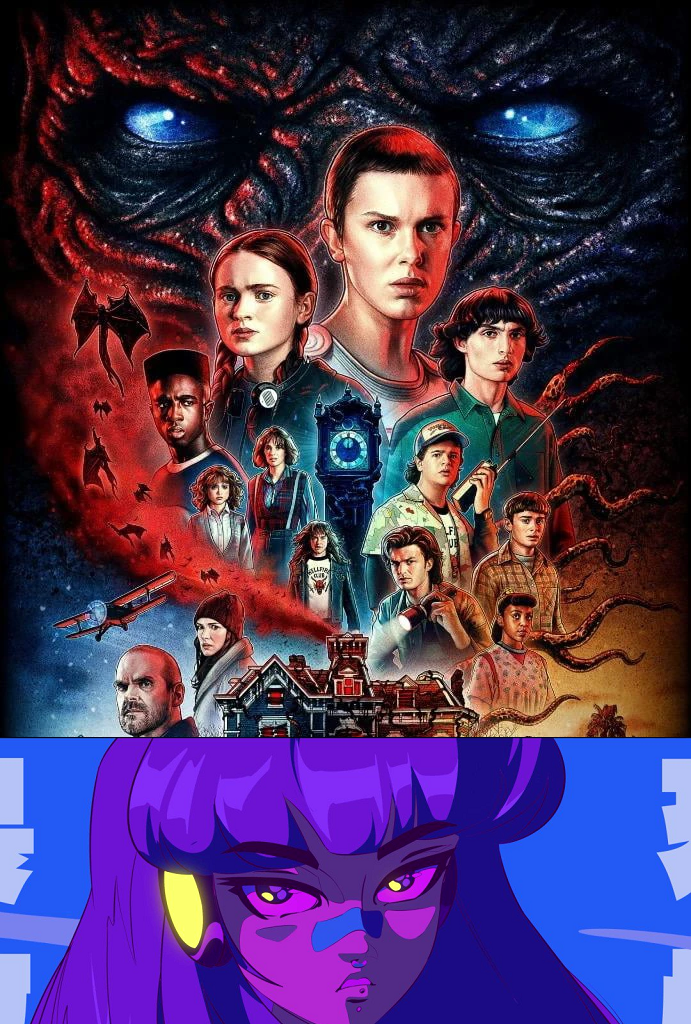
A collage of key images for Stranger Things Season 4 and the Jonathan Young song Starship Velociraptor

The general sense in the public discourse is that Stranger Things is a product of nostalgia but that’s not quite right. I’ve struggled to write about this television show – I’ve been promising a review since June 2022 and yet nothing ever came together.

Part of the problem has been that I’ve struggled with the question of who Stranger Things is for. Certainly it’s most popular among kids. My daughter is a big fan. Many of her classmates and team-mates likewise enjoy the show.

But why make a television show so explicitly loyal to the 1980s as an aesthetic if your target audience consists of people who were born a decade into the 21st century?

Stranger Things presents as a form of nostalgia programming, harkening back to Red Dawn and A Nightmare on Elm Street (right down to a Robert Englund cameo). But its primary audience can’t possibly be nostalgic for the 80s. It’s a past they never experienced.

Recently a few pieces fell into place for me that made writing about this television show a bit more viable. The key was that the Youtube algorithm, trained by my fondness for Gorillaz started serving me more animated music videos. Two of these that I ended up watching were Starlight Brigade by TWRP and Starship Velociraptor by Jonathan Young. Now both of these are actually very similar to Stranger Things in a few critical ways: first they’re pretty obviously targeting kids. This is especially apparent with Starship Velociraptor that includes the following quite-childish lyrics:

It's got a dozen restrooms inside
In case we all just have to
Sit on the comfy leather seats
Comes with a fridge that's full of meat, oh

But as I was listening to these two songs it struck me that they weren’t precisely 1980s pastiche. For all that Starlight Brigade, as a work of visual art, attempts to replicated the haze of VHS and for all that both songs as audio works are marked by the synth-pop-rock fusion sound that characterizes public perceptions of the 1980s as a musical period they’re both far too polished there is a clarity and velocity to the songs that belies their announced ties to the past. These are very much simulacra of the 1980s. They present a false 80s – a past that never exactly was. This, oddly enough, situates these kid-friendly cartoon songs in the domain of Panos Cosmatos‘s superb Mandy in that they treat the 1980s hauntologically, allowing us to engage in a deconstruction of the aesthetics of the era via the powers of the false. Except there’s the question of target audience again. Mandy is made by people who lived through the 1980s and its target audience is likewise people old enough to remember the decade. Panos Cosmatos was 10 in 1984. Nicholas Cage was 20. Producer Elijah Wood was born in 1981 as was Andrea Risenborough (who played the title character.)

Mandy, made by children of the 1980s to interrogate the 1980s, was, most importantly, intended for an audience of people who experienced the 1980s. And as a result it makes a kind of internal sense. But these shows that use the same aesthetic indicators but are marketing them to kids age 6-14 don’t have this sort of logic. Why interrogate a decade your audience has never seen?

But of course their parents have experienced that decade. At least our parents had the decency to just force us to listen to the Beatles instead of fabricating an update to their childhood ready-made to make their own childhoods legible to their children. There’s a concession to the inevitable progress of time about these songs. “This ship is fire,” they say in Starship Velociraptor. But, of course, “x is fire” to mean “x is good and also contemporary” is a phrase out of the mid-2010s. It’s slang old enough to be legible to the Generation X and Millennial children of the 1980s who might have cause to reproduce their aesthetics in their children but also to their children.

And so far this isn’t any worse than that old Onion article about the “cool dad” who raises his daughter on his media. These songs may be a bit goofy and childish but there’s nothing ominous about their hauntological musings – which are, at worst, a little cringe. The video for Starship Velociraptor may contain some puerile puns and the video for Starlight Brigade might be an empty bit of fluff but neither has ambitions that outstrip the ability of their artists and, in fact, both have some redeeming qualities via some good synth-riffs and visual aesthetics that draw from 80s and 90s anime but with no more fidelity than the music. This simulacrum of an era then, via the falseness of its particularity, actually does something moderately novel. The risk of something more insidious lies in a common comment that appears on both these videos, “you should make this into a show.”

And this is where this relatively harmless exercise in aesthetic update and reproduction takes a turn for the sinister. Because somebody has made this into a show. It’s called Stranger Things.

What’s interesting about Stranger Things is that it creates a no more accurate rendition of the 1980s than Mandy or Starlight Brigade. The 1980s of Stranger Things is remarkably devoid of the racism that would have been endemic in suburban Indiana while the misogyny and homophobia of the era, while addressed, have been toned down sufficiently to avoid offending contemporary sensibilities too thoroughly. This is a United States where the local shopping mall is a cover for a KGB mad science lab and paranoia about reds under the bed are apropos.

And it’s a 1980s America where the absolute and most critical relationships that exist are between a mother and son or between a father and daughter. Stranger Things is not a show about the 1980s. Instead it’s a show about the importance of the family as a site of social reproduction. Stranger Things looks at technological change, social transformation, and economic opposition to capitalism and then centers the family as the method of holding the disruptive aspects of these transformations at bay.

This is a far older trick than any sort of Derridean hauntological deconstruction. In fact, even as far back as Engels we were aware of how the family is a site of social reproduction. “In the great majority of cases today, at least in the possessing classes, the husband is obliged to earn a living and support his family, and that in itself gives him a position of supremacy, without any need for special legal titles and privileges. Within the family he is the bourgeois and the wife represents the proletariat. In the industrial world, the specific character of the economic oppression burdening the proletariat is visible in all its sharpness only when all special legal privileges of the capitalist class have been abolished and complete legal equality of both classes established,” Engels says in Origins of the Family, Private Property, and the State, suggesting that the family becomes a primary site for the construction of the legal and structural basis of the capitalist class antagonism, creating, via the vehicles of social and economic coercion a situation wherein two legally equal parties can recreate the lord and bondsman dialectic.

Now many will rightly point out that Engels’ anthropological work is deeply flawed and we’d be ill-advised to rest on his description of the family and social reproduction as authoritative. Happily Anti-Oedipus exists.

“Oedipus restrained is the figure of the daddy-mommy-me triangle, the familial constellation in person,” Deleuze and Guattari say, establishing that to discuss Oedipus is to discuss a specific form of familial construction that centers psychological inquiry upon the triangulation between a child and their parents. However, they contend that the way in which Oedipus is deployed leads to something far vaster than simply a triangulation between three parties in a relationship, creating, “an Oedipal structure as a system of positions and functions that do not conform to the variable figure of those who come to occupy them in a given social or pathological formation: a structural Oedipus (3 + 1) that does not conform to a triangle, but performs all the possible triangulations by distributing in a given domain desire, its object, and the law.”

By structuring the relationship between how we produce want, what we want and what we are permitted along familial lines we also, again, trace the family as the site of social reproduction. In fact Deleuze and Guattari take this further, arguing that it is necessary to colonize the formation of the family in order to colonize a people. Alert to the colonial character of Oedipus, they call for a shattering of “the iron collar of Oedipus” so as to “rediscover everywhere the force of desiring-production.”

Oedipus overcodes desire – it shapes the ways in which we want to follow certain socially prescribed boundaries – and to establish at an unconscious level the ways in which we should feel about that social reproduction. Oedipus, in the context of this work, represents the forces of unconscious repression that operate to shape the desiring subject into an appropriate subject for capitalism.

Family is the predominant binding thread that ties the otherwise disparate seasons of Stranger Things together. This is book-ended by the mother-son relationship of Will and Joyce which dominates the first season and the father-daughter relationship of Eleven and Hopper that slowly becomes the predominant focus.

And these familial ties are explored in considerable depth. Instability is introduced via the tired will-they / won’t-they antics that trap Joyce and Hopper. Joyce serves as a surrogate mother to Hopper’s daughter when he disappears to a secret Soviet Monster Gulag (perhaps the Siberian monster death camps were a policy Gorbachev reversed after Glasnost) and Hopper is positioned as the ultimate patriarchal authority: cop as action hero as dad. This story charts the ways in which parents reproduce their social milieu in their children via a narrative structure in which the parents have an adventure that parallels the children’s adventure, culminating in a uniting cathartic moment. These include both the finale of season two, in which Eleven and Hopper seal the gate to the upside down and that of season four, in which the nonsense Hopper and Joyce get up to in Siberia manages to synch itself perfectly to the children’s confrontation with Vecna and his minions. This process of reproduction is made quite explicitly textual in the fourth season in which a preponderance of fathers as the interplay of “Papa” Brenner with Eleven and with Henry Creel is demonstrated to be something of an original sin – a kind of a primordial filial rebellion against the father that leads to the fracture of law and the intrusion of the upside-down-outside.

This rebellion was presaged by Henry’s first attempt to overthrow his patriarch via his failed murder of Victor Creel, his father. However, in an entirely un-subtle nod to Oedipus and King Lear, Victor gouges out his own eyes as a form of self-punishment for his failure to uphold the law. To fail as a patriarch is to make one’s self blind.

But we aren’t done with fathers yet as Eleven manages a third via Sam Owens. Through him we now have three possible models of patriarchy through which to orient Eleven: Brenner’s clinical authoritarianism, Owens’ kinder clinical model and then Hopper: the Good Father.

And this is where can see most clearly how, in contrast to Mandy‘s hauntological deconstruction of the 1980s, Stranger Things uses this nostalgia for a past that never existed for the purposes of reproduction. Because the challenge for Eleven is not to go beyond the patriarch but rather to develop the psychic strength to recognize the just patriarch. Each of these patriarchal figures is a man of law. Brenner is a psychological professional and a high-ranking government agent. The same is true of Owens who represents the factionalism of government: two psychologists, one government, two aims. And, of course, Hopper is a cop, a monster-slayer and a commie-killer (which, to the show, is basically saying the same thing in three different ways). Stranger Things instructs us that Eleven must cleave to this pig of a man in order to come to a greater understanding of herself.

Ultimately Stranger Thing presents a world in which nothing is more important than the law of the father as bounded by capitalism. If Government science interferes, if communism interferes, if any other authority beyond the bounds of the family intrudes or if the father’s law is insufficient to discipline the child then a gate (a mother gate even, unsubtle in its subtext with its gash-like structure) will open and the dangerous monstrous Outside will come flooding in to turn parochial suburbia upside down.

But why did it have to be this way? Was this inevitable just like “cool dads” will inevitably make their kids sit down and have a serious listen to The Dark Side of the Moon?

I would say no. This is because of our prior counter-examples of the hauntological 80s. Certainly capitalism intrudes onto Starship Velociraptor. But it’s far more parodic:

You're looking for a starship lately
Something with comfort, speed and style
I'll get you to agree that maybe
There's just one ship that's worth your while
The secret is a core reactor
To make the light-years feel like miles
With just a little antimatter
And hardwood floors instead of tile

You've got to get it
You can buy on credit
Our payment plan, you won't regret it, yeah

In this case the same puerile humour that made me refer to this song as cringe-inducing introduces sufficient parody into the hyper-capitalism it depicts to make it not such a blatant reproduction of capitalist desire. There’s no outside-monstrosity-communism complex in this song. Starlight Brigade departs even farther from this reproduction of capitalism. It also has an entirely inverse relationship to the concept of the outside from Stranger Things as the visual storytelling of the video shows us an escape story. This is reinforced by the lyrics stating:

I hear a voice in the back of my head
Screaming "this is suicide! Did you hear what I said?"
But then it fades into nothing with the rest of the light and sound
I'm on my way out!

While Starlight Brigade is very beholden to the idea of justice, which sits approximate enough to law to warrant interrogation it does so not from the perspective of the directive passed down from the father but rather of the volunteer who puts themselves in the way of the unjust. This could be seen as a relatively straightforward imperialistic read if not for the clear text of the early verses which describes the recruit to the Starlight Brigade as one who escapes imprisonment. It’s hardly a revolutionary text but, put beside the patriarchal ordering of the world that is Stranger Things, it might as well be written by Engels himself.

This all demonstrates a valuable lesson on the importance of asking what a text does. Both Starlight Brigade and Stranger Things blend the aesthetics of the 1980s and the 2010s creating a false-past that never was. Starlight Brigade does this as a single artifact: a condensation of a Saturday morning cartoon that never aired. Stranger Things does this via a network of nested references blending explicit citation and allusion to create a tapestry of an imagined suburban 1980s that has more to do with contemporaneous media depictions of suburban life in the 1980s than it does the material reality of the time. Neither one of these things has an intrinsic political character. You can, with the same basic structural material, make Mandy, Starlight Brigade or Stranger Things. However how this container is used matters and, in the case of Stranger Things, that container carries Oedipus, a closed family unit, ruled by a cop and paranoid of outside infection.

And, of course, all cops are bastards. Especially that communist-murdering brute Jim Hopper.

Adaptation and the Powers of the False: A Review of The Water Outlaws by S. L. Huang

Cover for the book The Water Outlaws by S. L. Huang.

(I try to avoid “spoiler warnings” but, as a courtesy, since this book is not yet published I will note that my approach to review will include discussion of plot elements including from the end of the book. Please consider yourself forewarned.)

This book kind of drove me crazy.

The Water Outlaws is an upcoming 2023 novel written by S.L. Huang and published by Tordotcom. It is a loose adaptation of a little more than the first half of the classic 水浒传 (variously translated as Water Margin, Outlaws of the Marsh and All Men are Brothers – I will prefer the first of these translations throughout this review) – one of the four classics of Chinese literature and one of the first structurally modern novels in the world.

I have to admit that when I first heard of this novel I knew immediately I had to read it. After all Water Margin is a favourite of mine and the proposed premise: a gender-swapped version of the text in which the Liangshan bandits are principally women was a very compelling pitch. After all, the question of gendered violence looms very large within the original material. In particular the early stories of Song Jiang and Lu Zhishen provide contrasting lens on the violence men do to women and the ethical questions that this violence raises as Lu murders an abusive butcher for mistreating a concubine and must conceal himself in a monastery and as Song shows no interest in his wife who takes a lover and whose entanglements leads to his murder of them both. It would not be a stretch, in the slightest, to describe Song Jiang as textually a gay character. Later within the story he falls in with the savage Li Kuei and the homoerotic frisson between the two is palpable – which adds pathos to their tragic end.

However it’s somewhat surprising how much of that angle Huang’s book ignores. Certainly the question of gendered violence against women looms large within The Water Outlaws while nods are made toward queer sexualities via the presence of trans and gender-fluid secondary characters but what is kind of strange is the extent to which the queer content of the text being adapted is backgrounded in favour of the introduction of novel elements to stand in for it. A less charitable reader might be inclined to suggest that Huang wanted to make the aspect of the queer less problematic by smoothing the jagged edges off Song Jiang and by distancing her from Li Kuei within the adapted text but I’m not sure that was Huang’s aim. After all, it’s not like Huang shies away from some of the protagonistic violence intrinsic to this story, including a scene of ritual retributive cannibalism that honestly took me by surprise with its dissonance from prior chapters. This becomes then one of the tensions in this adaptation that demonstrates some of what has been driving me crazy.

In Cinema 2 Deleuze discusses a concept called “the powers of the false” which is a novel method for addressing the question of simulacra and the real. In it he discusses how Leibniz attempts to defend the idea of truth within time via the concept of the incompossible and suggests that Leibniz only postpones the problem of truth within time, putting forward what he calls “Borges’s reply to Leibniz: the straight line as force of time, as labyrinth of time, is also the line which forks and keeps on forking, passing through incompossible presents, returning to not-necessarily true pasts.”

An adaptation creates an incompossible present within a work. Clearly The Water Outlaws is an adaptation of Water Margin – and not a half-bad one at that. There is a very strong truncated translation of the first 65 chapters of Water Margin here. This translation actually demonstrates, to a certain extent, the superfluity of the headline grabbing gender-swap. Lin Chong and Lu Da are still very much themselves regardless of whether the pronoun “he” or “she” is applied to them. Specific incidents are also rendered with care, attention and substantial craft. The wine dipping robbery is adapted far better in this work than by Guy Gavriel Kay when he mined the same text for River of Stars. It’s impossible to come away from The Water Outlaws without being absolutely certain that Huang is deeply familiar with and has a great deal of reverence for the work being adapted.

However this is also, undoubtedly and with certainty not a translation of Water Margin. As already mentioned Song Jiang’s rough edges are smoothed down and she ends up somewhat less queer than her namesake. In addition other characters retain little more than a name, their stories contorted to such an extent that it’s difficult to map them onto the characters they are derived from. Fan Rui is dissimilar to her counterpart in almost every single capacity and Lu Junyi is likewise transformed, brought into the story far earlier and with a different set of relationships than anything from the original.

Some of this is tied to the method in which the book interrogates gendered violence, making of Gao Qiu and Cai Jing even broader and more caricatured representations of their historical counterparts than in Water Margin – a task which is no mean feat considering the negative light the original casts these two officials in. But the other reason has to do with the second book that The Water Outlaws is. Because, on top of being a decent truncated translation of Water Margin, The Water Outlaws is a passable secondary world fantasy story. These novel fantasy elements aren’t built entirely on air. Several characters within Water Margin are sorcerers and magicians with magic powers. Dai Zong has magical talismans that allow him to travel 800 li in a day (approximately 400 kilometers) and Gongsun Sheng is a powerful mystic and instructor in magic to several other magically inclined characters. However, again, there is an odd doubling at play here as Gongsun Sheng is mentioned in passing only as being unavailable for recruitment and Dai Zong is not mentioned at all.

Instead a magical talisman is given to Lu Da (Lu Zhishen) and Lu Junyi and Fan Rui are sequestered into an entirely original storyline regarding Cai Jing’s plot to fabricate and mass-produce magical talismans for the military. These talismans tie into a metaphysical other-space that also serves to flesh out the relationship between Lu Da and Lin Chong – whose sisterhood is the central relationship of Huang’s book – but both the metaphysical character of that other-space and how these talismans relate to the “scholar’s powers” which are The Water Outlaws‘ version of the neigong and qinggong powers of wuxia stories is left decidedly vague. I’m somewhat glad of this. I’ve mentioned previously that I am not fond of systematics in magic and the lack of causal definition around the various manifestations of magic in Huang’s book is satisfactorily non-systematic. However it does then return us to our incompossible texts. The Water Outlaws is simultaneously both an iteration of Water Margin and not at all.

“Narration ceases to be truthful, that is, to claim to be true, and becomes fundamentally falsifying. This is not at all a case of ‘each has its own truth’, a variability of content. It is a power of the false which replaces and supersedes the form of the true, because it poses the simultaneity of incompossible presents, or the coexistence of not-necessarily true pasts.” Deleuze says and certainly this idea of the adaptation as the false is entirely apropos here. However I do want to step back and mention that Deleuze says, and I agree, that the regime of the false is described by the Nietzschean will to power. Deleuze argues that it is Nietzsche rather than Leibniz who settles the problem of truth in time, “in opposition to Leibniz, in favour of the false and its artistic, creative power.” In this sense it’s in its incompossibilty that the adaptation becomes a creative work. When I’ve spoken before about translation and the idea of the false-aleph I’ve argued effectively that all translation is likewise incompossible with the original text. As such much of what gives Huang’s work value is its deviation from its source.

First, of course, is the truth that there is a vast distance between the prose style of an early-modern novel penned in 14th century China and a contemporary English language work of genre fiction published by Tordotcom. Huang does hold many of the hallmarks of the Tordotcom curatorial style. Characters are rendered in very close third person. We have multiple perspective characters but from a limited roster of about five total characters out of a far-larger cast. There is considerable attention paid to the emotional lives of the protagonists and antagonists alike when they hold the perspective and the audience is immediately privy to their reflections upon their immediate situation however that internal voice is almost entirely in the moment. The narrator can tell us how Lin Chong feels now but gives much less narrative attention to how Lin Chong’s affect may have changed over time. Instead this is inferred by the audience via the stream of consciousness throughout the various episodes. The visual character of environments is rendered in loving and careful detail but I’d be hard pressed to tell you what anything in the world of the novel smelled or tasted like. In fact, beyond the realm of sight and sound the material sensations of our perspective characters are limited to only one item: pain.

It’s remarkable the way Huang is able to use the immediacy of her protagonists’ internality in order to describe how they hurt, how they are injured, and how they react to hurt. Lin Chong’s tendency to deny her pain, to minimize it and push it to the back of her mind becomes a useful vehicle for understanding her. What is odd though is that it’s not merely Lin Chong’s sublimated masochism that use the percept of pain to communicate but rather a whole host of other affects. Meanwhile nothing tastes, nothing smells, and nothing feels good. This is an evolution of the Novelization Style to a certain extent. Interiority is reintroduced but we are still mostly left with a book that would be easily adapted to a screen.

There is also the question of tone. This book cuts off almost immediately before the tragic turn in Water Margin. In the original text the first two imperial invasions happen in much the same way that the end battle transpires in The Water Outlaws. The 108 Stars of Destiny hold their grand assembly and begin engaging in heroics against corrupt ministers throughout the country. This is where Huang’s book ends: our heroes happy in their sisterhood (if made bittersweet by the death of a small number of secondary characters) and transforming empire via truth and justice.

But of course this isn’t how things pan out for Water Margin.

The empire grants the bandits of Liangshan an amnesty, yes, but then throws them into a meatgrinder of bandit raids and border skirmishes which slowly whittles their numbers down. In all two thirds of the 108 stars die in combat. Lin Chong is paralyzed, Lu Zhishen achieves enlightenment and dies in meditation. Song Jiang is compelled by Cai Jing to drink poison and, fearing that Li Kuei would create havoc to avenge him, he poisons Li Kuei with the same poison. They die together. Water Margin serves as a tragedy. The tragic flaw of our heroes is the very loyalty to the Emperor which is also their great virtue. Song Jiang is incapable of escaping Cai Jing’s web because of his proximity to the emperor. The corrupt ministers win. By ending around chapter 60 Huang is able to sustain the illusion that Liangshan really can transform empire – that patriarchy can be overcome without overcoming the other power structures in which it’s inextricably entangled. Cai Jing dies with a tent spar through his mangled guts, dispatched by Lu Junyi in secret and so he will never poison Song Jiang.

Pivoting the conclusion of this story from tragic acceptance that to be governed is to be governed by corrupt ministers to one where our heroes all bask in the warm glow of the possibility of change is the most incompossible element of The Water Outlaws and it leaves me deeply ambivalent. There is a part of me that wants Huang to revisit this well and tell the rest of the story but it isn’t the same story. The Water Outlaws derives its creative vitality from its deviation from the story. Certainly this story contains a few elements of fiction that often irritate me: It is triumphal in its liberalism, its certainty that empire can be reformed. It passes by problematic queer content in favour of a universalist view of sisterhood that is simpler to parse in moral terms (although it is never precisely moralizing). But, on the other hand, it is honest about the horrific character of violence, even when it is being executed by a perspective protagonist. Huang’s talent for visual description extends to the grotesque and to the strange and things are described with clarity and artistry. We have a clear sense of the emotional life of our protagonists and if the narrative voice is something of a house style at this point it is, at least, a very well executed example of the house style. And while I was somewhat disappointed with the changes to Song Jiang I persist in thinking that it wasn’t a matter of Huang cringing away from a difficult topic so much as a desire to focus on Lin Chong and Lu Da rather than Song Jiang. I think ultimately my frustration is this: This is a good book. It’s well worth reading if you are a fantasy reader. But there is, on the page, a better book that is caught in a tangle of insertions that bring it down from the heights it could otherwise have achieved. It’s this third, mutually incompossible, text that I most want to read.

Terrifier 2 and the Master-Slave Dialectic

Terrifier 2 is a horror movie for the horror fan who thinks they’ve seen it all. A long film, clocking in at 2 hours and 18 minutes, it is nonetheless so impeccably paced that you wouldn’t notice if you didn’t check. This small-budget horror movie (budget estimates at $250,000) is yet another entry (along with Skinamarink and Psycho Goreman) that demonstrates how much inventive and truly alarming horror can be conjured without blockbuster budgets.

Anchoring the film are two standout performances: Lauren LaVera as Sienna and David Howard Thornton as the capering Art the Clown. LaVera is a very new actor with few credits to her name but I expect her to join the ranks of Mia Goth, Jenna Ortega and Samara Weaving among the new generation of high-talent scream queens on the back of her performance here as a grieving and anxious artist struggling with her family’s recent and tragic losses and the unwanted attention of an immortal murder-clown. Thornton, meanwhile, has some significant prior experience in television although much of this is off the back of his turn as Art the Clown in Terrifier (2016). He brings such impeccable manic energy to his performance as Art that this demon clown should be treated among the rank of the slasher killer greats like Freddy and the Ghostface Killer. Art is a mute and un-killable force of pure malevolence who, despite never speaking a word, manages to give one of the most expressive performances in horror cinema. Please believe me that favorable comparisons to Robert Englund and Roger L. Jackson are entirely apropos.

The film picks up where the prior Terrifier movie left off, with the cannibalistic clown awakening from his suicide at the conclusion of the prior film and murdering a coroner before escaping the morgue. He makes his way to a laundromat where he meets his unnerving psychopomp – “The Little Pale Girl” – a sometimes invisible child clown who acts as his guide and accomplice.

From there Sienna and Art’s existences will collide in a conflict that leaves a bloody trail of torture and extreme gore across the social circle of the young woman.

The special effects here are a treat, if you have the stomach for them. Terrifier 2 has been referred to as one of the goriest films of all time and, with a scene in which one of Sienna’s friends (Allie) has her eye cut off, is scalped, has an arm cut off, is given caustic chemical burns and then subjected to a form of slow-slicing torture, all while horribly alive, marks this film as one not for the faint of heart or the soft of stomach. But this is a movie, more than any other I’ve seen, that puts lie to the idea of “torture porn.” Certainly torture is depicted. It is depicted graphically and at length. Damien Leone, the director, was also responsible for the special effects (all practical, of course) and makeup in this film. He is a remarkable artist of the macabre and the disgusting. But part of what makes him effective is that the terrible violence depicted on the screen never seems to encourage any sort of prurient pornographic titillation. In fact, Leone has made statements in the past which indicate that part of the project of Terrifier 2 is to critique the tendency of audiences to root for the killer in slasher movies. Art the Clown is charismatic in a horrible and vile way. He’s also fully inhuman, cruel beyond measure and petty to boot.

In a middle scene of the film Sienna is at a Halloween store to replace a costume element that was destroyed in a fire (more on that later) and Art follows her to the store where he hangs around leering and making an ass of himself. He grabs a bike horn, one of those ones with the black rubber bulb that go “oogah” and he approaches Sienna and squeezes it in her ear over and over. The clerk at the store tells him to stop and Sienna makes her escape. Art immediately locks the store and murders the clerk for daring to speak back to him. It’s entirely evident through the narrative framing that, even as you are captivated by the cannibal clown, you should be rooting firmly for Sienna to overcome the un-killable foe.

Of course this raises a few questions: 1) why would an artist depict such torture? The torture of Allie by Art is a far more drawn out affair than many high-water marks of cinematic torture (such as the hammer scene in The Texas Chainsaw Massacre). In fact it’s so extreme that it belabors believability that anyone could survive such abuse at all. As a result no claim to verisimilitude can be made here. This isn’t representing torture as it is in the world. In the world if you did to a person what Art the Clown did to Allie the victim would die of shock and blood loss far before he was done with her. So if it isn’t there for prurient purposes why display it at all? 2) What sort of audience would enjoy watching such a movie?

It would be all too easy for me to gesture, as I often do, in the direction of Georges Bataille and Story of The Eye, to discuss the Freudian proximity of Thanatos and Eros and to argue that art has no moral imperative to be comforting. I could go from there to a discussion of limit experiences and the idea of horror as a cinema of discomfort. For my kind readership this is all rather old-hat by now though, isn’t it? To do this would be to disregard the label of “pornography” as irrelevant and to play the Nietzschean “Yes Sayer” who denies nothing. Except this would be doing a disservice to this film because the truth is that the gore isn’t prurient; there’s nothing sexy about it at all. It’s almost pure and distilled abjection. And it occludes a key theme of the movie: recognition.

Before we talk too much about recognition, let us briefly refresh ourselves on the figure of the final girl. In Men, Women and Chainsaws, Carol Clover describes the Final Girl thus: “the one who did not die: the survivor, or Final Girl. She is the one who encounters the mutilated bodies of her friends and perceives the full extent of the preceding horror and of her own peril; who is chased, cornered, wounded; whom we see scream, stagger, fall, rise, and scream again. She is abject terror personified. If her friends knew they were about to die only seconds before the event, the Final Girl lives with the knowledge for long minutes or
hours. She alone looks death in the face, but she alone also finds the strength either to stay the killer long enough to be rescued (ending A) or to kill him herself (ending B).”

Much as Clover is confident that Craven read Freud I am pretty confident that Leone has read Clover because much of Clover’s later interrogation of the gendered nature of a final girl’s heroism, focusing on the feminine coding of abjection, the gender-play of the final girl vis her role as an investigator and the use of gendered gazes (with a male gaze applied to the killings inverted when the final girl enters an investigative mode and gazes upon the killer) is problematized by the film. So I guess we haven’t entirely escaped Freud. But in this film it falls to the final girl to run to the rescue of a male character – her brother Jonathan, kidnapped by Art the Clown to lure her to him. Sienna doesn’t look death in the face alone. She does it with her little brother. But, yet, a gendered problematic remains a valuable lens to look at this film from. While Art the Clown happily murders men and women alike and while both Sienna and her brother take the position of “final girls” within the story this is unquestionably a film about the violence men visit upon women and the consequences of that trauma.

Throughout the film we discover that Sienna’s father, who died shortly before the start of the film, suffered from a brain tumor. This gave him prophetic visions related to Art the Clown and his metaphysically bonded relationship to Sienna. But it also made him violently abusive and self-destructively violent. He died, burning to death, in a crashed car. This legacy of sickness, dark transformation and abuse has left traumatic scars on Sienna’s family. Her mother, Barbara, is fragile, drinking and throwing back pills to keep things together while snapping variously at Sienna or Jonathan and refusing to believe them when they repeatedly tell her that they believe the various misfortunes that have befallen them to be the doing of the clown. Jonathan has become obsessed with serial killers and other dark figures of fiction and history. At the start of the film Sienna suspects her brother might be a bit of a sociopath. As the high weirdness that surrounds Art the Clown invades their situation Sienna’s suspicions of her brother subside; but her mother’s suspicions are heightened.

Sienna is fragile. She is also taking valium to keep level and, despite this, is prone to anxiety attacks and depressive ideation. Sienna actually does very little of the “investigative gazing” that Clover describes. She, much like Sidney Prescott, would prefer to avoid the killer. Unfortunately she is no more able to do so than Prescott.

You may have noticed I’ve mentioned Craven’s oeuvre a fair bit so far. I would propose that Wes Craven’s New Nightmare should be treated as a key influence on this film but it also contains much of the original Nightmare on Elm Street and of Scream in its DNA. This manifests in a variety of ways: early scenes in the film treat the idea of a slasher-killer fandom in much the same way that Wes Craven’s New Nightmare does. Sienna is, as I mentioned before, a final girl in the mold of Sidney in how she subverts the final girl trope – although there is no Gail Weathers equivalent to create a whole final girl in the way the first four Scream movies did. There is also something of a spiritual tie between her and Art the Clown that is evocative of the relationship between Nancy and Freddy Krueger. Art the Clown also demonstrates the ability to invade Sienna’s dreams, and some of the actions taken in dreams manifest in the waking world (in her dream Art the Clown attacks Sienna with a flame thrower which she parries with a gladius gifted to her by her father. The flames burn her bedroom in the waking world while leaving the sword remarkably unscathed. The Freudian idea of the sword as a phallus passed from father to daughter would likely catch Clover’s notice, especially with how it blends the waking and sleeping world).

But while Art is tied to Sienna in a metaphysical way, the specifics of why remain unclear. And this is where we can finally bid farewell to the Final Girl and talk properly about recognition of the other and the Master-Slave dialectic. (Yes I know Hegel calls it the lord-bondsman dialectic for the pedants in my audience but, let’s be honest, any non-Hegel scholars who know about it would be likely to use Master-Slave as the language.)

So in brief the Master-Slave dialectic is a parable from The Phenomenology of Spirit regarding the construction of self-awareness via the process of mutual recognition by unequal entities. Hegel describes two people coming into conflict. This conflict will proceed to a struggle to the death but, crucially, self-awareness fails if one party kills the other. Instead the lord must subordinate the bondsman by force. However this subordination is unstable and ultimately the master discovers that he is entirely dependent upon the recognition (and labour) of the bondsman while the bondsman, via the immediacy of his labour, is able to come to a place of more authentic self-recognition. This ultimately makes the lord the slave of the bondsman via his oppression of them. While Hegel saw this as suggesting that liberation occurred through the process of servitude Marx turned this on its head and used this dialectic as a basis for describing class struggle, whereby the stakes become not self-recognition so much as class self-liberation from servitude.

Art the Clown has a fraught relationship with recognition. The mute clown stands out, regularly making an ass of himself when he appears in public. He strips naked in a laundromat and silently laughs at newspaper articles about car crashes. He hangs out in the Halloween store mugging and playing with crap. He has bad manners. But, for all Art tries to attract attention to himself, he responds with lethal force to anyone who actually recognizes him. When he’s in the laundromat a sleeping man wakes up and sees him playing paddy-cake with an invisible partner (The Little Pale Girl) and he kills the man for seeing his display. At the Halloween store he kills the clerk who threatens to call the cops on him. When Jonathan sees him and the Little Pale Girl playing with a dead opossum he chases Jonathan.

“Just as life is the natural setting of consciousness, independence without absolute negativity, so death is the natural negation of consciousness, negation without independence, which thus remains without the required significance of recognition. Death certainly shows that each staked his life and held it of no account, both in himself and in the other; but that isn’t for those who survived this struggle. They put an end to their consciousness in its alien setting of natural existence, that is to say, they put an end to themselves, and are done away with as extremes wanting to be for themselves, or to have an existence of their own,” Hegel says. And so, within the context of this dialectic Art’s tendency to murder anyone who observes him prevents him from any sort of independent experience.

To be blunt: this film tells us that, without a final girl, the slasher killer cannot live. Art the Clown is immortal. He cannot be killed. But likewise the text of the movie is that he cannot kill Sienna. She arrives to rescue her brother, adorned in her warrior-angel costume to find that Art has stolen the sword her father gave her – the sword she refused to take up earlier in the movie – and when Art stabs her with the sword and drowns her something magical happens and she is resurrected seemingly by a sympathetic tie to the blood on her blade. Just as there is no death for the killer so too is there no death for the heroine.

Sienna, occupying the position of the bondsman within this dialectic, overcomes Art, beheading him with her father’s magic sword, but, much as the Hegelian idea of history depends on a continuous process of these dialectical arrangements, so too does this film end ambiguously as the Pale Little Girl retrieves Art’s severed head and as his only surviving victim from the first film, a deformed mad woman marred by his cannibal hunger, gives birth to his living head.

Clearly this is a deeply odd movie. What it isn’t is a prurient one. Terrifier 2 traffics in extremes of abjection in part to demonstrate the necessity of the final girl to the slasher killer. Much of the focus of the deconstructive horror wave starting in the 1990s has been to interrogate the interiority of the victim but this often leaves the villain not much more than a foil. Even the best slashers of this subgenre (by which I mean our old friend the Ghostface Killer) ultimately amount to not much more than this. But, for all these attempt to deconstruct the early slashers they riff off of, this leaves them still confined pretty clearly within the Freudian bounds Clover set in her seminal work. Craven may have been responding to Clover in Scream but he never succeeded in getting past her.

Clover said here’s what the final girl is and Craven said “and here’s what that can mean.” Leone explodes this via a strange, bloody and surreal experiment poking not only at the same gender puzzles Clover speaks of but also of something simultaneously phenomenological but also deeply mystical.

So what kind of people would like a movie as disgusting as this one? Me for one. But more broadly this is a movie for people who love horror and also its critical interrogation. Much like Craven’s later works Terrifier 2 is as much a work of criticism as it is a work of art. It interrogates the limits of what has become a staid trope of a genre now in its fifth decade and asks not “what is this thing” but rather “why do we keep coming back to this thing?”

Sienna is the immortal final girl. She is the form of this trope raised up not just for deconstructive interrogation but for reintegration into our own collective spirit as horror fans. This collapses the comfortable distance Clover describes between a (male) audience and the (female) victim and gives immediacy to her struggle as part of a historically bound dialectical process. There may not be any more of a teleological end to the final girl than there is to history but, by showing us how Art the Clown is incapable of recognizing himself without her, by showing us that nobody needs the Final Girl more completely than the slasher killer, Terrifier 2 gives horror fans that one thing they often crave most: something completely new.