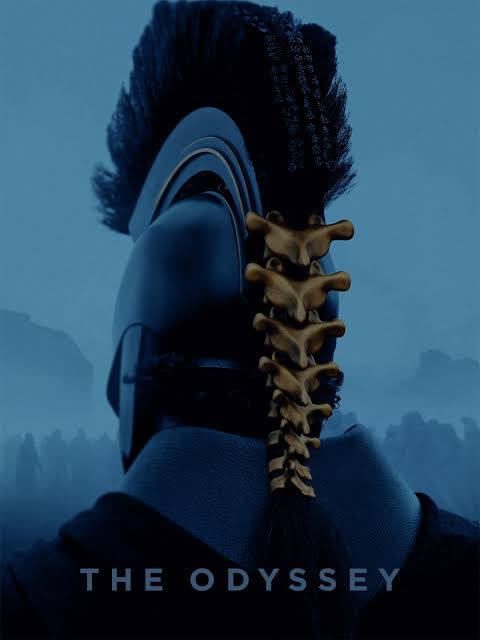
Christopher Nolan’s 2026 adaptation of The Odyssey is likely to be one of the most talked-about movies of the year. Starring Matt Damon, Anne Hathaway, Tom Holland and Robert Pattinson, it certainly is a film that cleaves to Nolan’s idiosyncrasies. It is filmed in Imax with a restrained color palette that suggests he would have been happier to be shooting in black and white (as he did in his first feature film). It leans into the structure of epic poetry by beginning in media res and constructing its narrative around frames within frames as characters in the film tell the story of the film to each other. Nothing of this is something we didn’t see before in Memento, Tenet, or Inception.
And this movie also leans into Nolan’s thematic preoccupations. This is a war movie that hates war. This is some of the places where the shift of Odysseus from the original source material to this filmic adaptation is clearest. Homer scholar Emily Wilson wrote a somewhat scathing (and very worthwhile) review in the London Review of books that treats the changes to the character of Odysseus as a key flaw of the film. I think this was necessary for Nolan to create a character who both participates in and regrets his participation in a civilizationally destructive war. And for Nolan all war is fundamentally destructive to civilization. I will be somewhat in dialog with the Wilson review in this review and I would strongly suggest reading it; it is one of the better works of criticism I’ve read this year and, even if I don’t agree with all of Wilson’s conclusions, I don’t think her perspective on the movie is easily dismissed.
As a case in point, one of Wilson’s key criticisms is the poor quality of the script. And after hearing Tom Holland bleet out “mum” or “dad” regarding the mythic figures of Odysseus and Penelope I have to agree with her on this. An adaptation of a poem need not be written in iambic pentameter but it should have at least some lyricality, which this script entirely lacks. There is also a hint of the second-screen effect to some of the dialog as there are scenes toward the end of the film where Odysseus all but turns to the camera to directly expound on the themes of the movie.
Nolan’s film was always going to upset all the worst people, of course, regardless of the quality of the script and much online discourse has centered on the colour-blind casting of the film. This is all very silly – the bronze-age Mediterranean included Egypt and it is entirely unsurprising to see people participating in Mediterranean society who come in pretty much every colour. But, beyond that, Nolan draws a direct line between the question of war and that of hospitality. To make war is to either fail to be hospitable or to fail to be an appropriate guest. The actions of Antinous (played with glorious sliminess by Robert Pattinson) and the suitors is made directly parallel to the actions of Agamemnon and his alliance on the beaches of Troy. Both are gangs of men who have turned up as unwelcome houseguests so that they can take a politically significant woman as a prize contrary to her wishes. The moral failing that plagues Odysseus is the fear he may be more alike to Antinous than different for his role in violating the laws of hospitality. This structural paralleling makes a compelling argument that Nolan wants to treat civilization and hospitality as synonymous. When we fail to be hospitable to outsiders (who may, after all, be a god in disguise) we are actively cutting away at the basis of all civilization. Far from lionizing “the west”, as many approaches to Greek myth have, this serves as a scathing indictment of both colonial adventure and of anti-immigrant rhetoric. For Odysseus, by being warlike and inhospitable, the West has authored its own dark age. In the best-written line of the movie Odysseus says that people in the future will only be able to sing of their deeds because, in the desecration of the temple of the goddess of wisdom, the bronze age Myceneans have doomed even the ability to write what has been done.
This makes for a very solid basis of the film. But it is not one that would survive the cunning, loquacious, and often unrepentant Odysseus. Wilson complains that the film does Calypso dirty and that it gives short shrift to the year that Odysseus spends with Circe. She positions this criticism as being an example of Nolan’s weakness with women characters. I don’t entirely disagree although I think this does a disservice to the centrality of Anne Hathaway’s Penelope to the story and its core themes and I also think many of Wilson’s criticisms, if acted upon, would have bloated the three-hour film to the point it would become a limited series instead.
In fact, aside from the core four characters and Eumaeus (played with career-defining panache by John Leguizamo) almost every character in this film gets somewhat cheated of their breadth and depth. Simply put there is too much to The Odyssey to fit into a feature film without cutting. It seems Nolan preferred a survey-approach where most of the significant encounters of the poem are present, but all in a truncated form. Frankly I was shocked and delighted that Circe (performed by Samantha Morton swinging for the bleachers and hitting) made it into the film at all and her section is a wonderfully perverse bit of body horror in an otherwise staid affair that dials back supernatural aspects to brief monster appearances and obvious metaphor.
An attentive reader may note that I have no effusive praise for the performance of Tom Holland as I do of Hathaway, Pattinson, Leguizamo and Morton. This is because he remains the weakest link in the performances of this film. While key actors manage to bring just the right balance between restraint and melodrama to their epic characters, Holland is entirely unsuited for such a deliberately serious film and is unhelped by Nolan’s relatively weak grasp of dialog. My only consolation is that, if there is one major character in the Odyssey who is appropriately portrayed by a cardboard standee brought to life like the mannequin from Today’s Special it is Telemachus, who spends much of the poem ambling around the countryside getting pretty clothes and a nice ride.
While their roles are very small, Elliot Page, Lupita Nyong’o, Zendaya and Charlize Theron all deliver excellent performances, making the best of the script they were given. I don’t really share Wilson’s ambivalence concerning the treatment of Sinon whose narrative role was to provide a wedge through which Odysseus could find a distinction between himself and Antinous. As such, Sinon shares space with Athena playing Jiminy Cricket for Odysseus and the story of the film and the performances of its principals support this approach well.
And this brings us to the performance, and character, who will be most fraught to parse in the movie. That of Odysseus. Matt Damon is fine as an actor. He is, perhaps, a little too restrained in his delivery and I’d have liked to see him bring some of the energy that Pattinson and Morton povide to his role. But that’s fine. Wilson argues that this Odysseus is too dissimilar from the one of the poem, becoming just a generic action movie protagonist. She likens the story then to blockbuster fantasies such as (especially as) Lord of the Rings. This is probably her point I take the most umbrage with. It’s certainly true that there are clear parallels between Odysseus’s self-imposed exile into the mysterious West and the voyages undertaken by the protagonists of the Lord of the Rings at Mithlond but I think the causal arrow here is pointing the wrong direction. A classics scholar himself it would be bizarre to propose that Tolkien had not read Homer. I suggest his idea of the Grey Havens owe such a deep debt to Homer and to Tennyson that it is somewhat nonsensical to suggest that Nolan was aping Peter Jackson’s adaptations of Tolkien in this moment. And here’s where we get to what I see as the crux of this revised Odysseus. Nolan’s Odysseus is a man beset by doubt and by guilt. He fears his choice to remain with Calypso, his lack of faith to Penelope, was a wrong decision. He also fears that the brutality of his choices at Troy have disqualified him from being able to return to civilization, he brings, in his wake, the end of civilization as a consequence of his deeds. But this fixes him in a mental state that approximates two poems by Tenysson. The Lotos-eaters depicts a group of sailors getting high on shore and forgetting the worries of the world.
Suffer endless anguish, others in Elysian valleys dwell,
Resting weary limbs at last on beds of asphodel.
Surely, surely, slumber is more sweet than toil, the shore
Than labour in the deep mid-ocean, wind and wave and oar;
O, rest ye, brother mariners, we will not wander more.
This captures Odysseus’ state as he keeps the memories of his wartime deeds at bay in the care of Dr. Freud Calypso. And this gives a small justification for the significant reimagining of Calypso. Her narrative purpose is to bridge the divide between that retreat into forgetfulness and the most apropos depiction of Odysseus to come out of Tennyson.
Push off, and sitting well in order smite
The sounding furrows; for my purpose holds
To sail beyond the sunset, and the baths
Of all the western stars, until I die.
It may be that the gulfs will wash us down:
It may be we shall touch the Happy Isles,
And see the great Achilles, whom we knew.
Odysseus must remember the things he did wrong in order to set himself off into a self-imposed exile as the sin-eater for a culture that has done away with the laws of hospitality. It’s a challenge, for Damon, to show us an Odysseus who is both one of the Lotos-eaters and also the old king who says
Old age hath yet his honour and his toil;
Death closes all: but something ere the end,
Some work of noble note, may yet be done,
And this is very important. The film makes no bones that the war in Troy was wrong. As Wilson correctly points out, Agamemnon is reduced to a faceless figure of cruelty and menace, a man dressed like the Kurgan who exists only to be the physical locus of the cruelty and ultimate futility of war-making. Instead the central question of the film becomes how one can find his way back to grace after perpetrating a war. Odysseus must choose between a blissful forgetfulness and a willingness to face the consequences of his deeds and to make a gambit that there may be a future beyond the fall of this age of bronze. And so, ultimately, I think there’s far more of Tennyson in the conclusion of the film than Tolkien. This is a movie about how a man Made weak by time and fate can find the strength of will to, after having come to his lowest point, strive, seek, find, and never yield.

